Scholarship@Western
Scholarship@Western
Electronic Thesis and Dissertation Repository
4-23-2013 12:00 AM
Novel Control of PV Solar and Wind Farm Inverters as STATCOM
Novel Control of PV Solar and Wind Farm Inverters as STATCOM
for Increasing Connectivity of Distributed Generators
for Increasing Connectivity of Distributed Generators
Mahendra AC
The University of Western Ontario
Supervisor
Dr. Rajiv K. Varma
The University of Western Ontario
Graduate Program in Electrical and Computer Engineering
A thesis submitted in partial fulfillment of the requirements for the degree in Master of Engineering Science
© Mahendra AC 2013
Follow this and additional works at: https://ir.lib.uwo.ca/etd
Part of the Power and Energy Commons
Recommended Citation Recommended Citation
AC, Mahendra, "Novel Control of PV Solar and Wind Farm Inverters as STATCOM for Increasing Connectivity of Distributed Generators" (2013). Electronic Thesis and Dissertation Repository. 1241.
https://ir.lib.uwo.ca/etd/1241
This Dissertation/Thesis is brought to you for free and open access by Scholarship@Western. It has been accepted for inclusion in Electronic Thesis and Dissertation Repository by an authorized administrator of
NOVEL CONTROL OF PV SOLAR AND WIND FARM INVERTERS AS STATCOM FOR INCREASING CONNECTIVITY OF DISTRIBUTED GENERATORS
(Thesis format: Monograph Article)
by
Mahendra AC
Graduate Program in Engineering Science
Department of Electrical and Computer Engineering
A thesis submitted in partial fulfillment of the requirements for the degree of
Master of Engineering Science
The School of Graduate and Postdoctoral Studies The University of Western Ontario
London, Ontario, Canada
ii
ABSTRACT
The integration of distributed generators (DGs) such as wind farms and PV solar farms in
distribution networks is getting severely constrained due to problems of steady state voltage
rise and temporary overvoltages (TOV). This thesis presents a first time application of a
patent-pending PV solar farm control as a dynamic reactive power compensator
(STATCOM), termed PV-STATCOM, for mitigating the voltage rise and TOV issues, and
significantly enhancing the connectivity of a neighbouring wind farm both during night and
day in a realistic distribution feeder in Ontario. The effectiveness of PV-STATCOM is
demonstrated even if the solar farm is located 30 km away from wind farm on a common
distribution line. The PV-STATCOM utilizes the entire inverter capacity in the nighttime and
the inverter capacity remaining after solar power generation during daytime. A novel control
of full converter based wind farm as Wind-STATCOM for substantially increasing the
connectivity of a neighbouring PV solar farm is also described. The Wind-STATCOM
employs the inverter capacity left after that needed for wind power production, both during
night and day. Subsequently, a new combined application of PV-STATCOM and
Wind-STATCOM to improve the connectivities of both solar farm and wind farm to significantly
high levels in a common distribution feeder is presented. These studies have been conducted
for the first time in known literature. Commercial grade software PSS/E and
PSCAD/EMTDC are used to evaluate the steady state voltage profile and TOVs,
respectively, in distribution feeder having different Reactance (X) /Resistance (R) ratios.
Keywords:
Distributed Generator (DG), Static Synchronous Compensator (STATCOM), Photovoltaic
iii
Dedicated to
iv
ACKNOWLEDGMENTS
I would like to express my sincere gratitude to my thesis supervisor Prof. Rajiv K. Varma for
his persistent support and utmost guidance in my research work. His broad knowledge and
thoughtfulness has been a constant source of motivation for hard work and sincerity.
I would like to acknowledge the financial support provided by the University of Western
Ontario and Natural Sciences and Engineering Research Council of Canada (NSERC). I am
also grateful to the faculty and administrative staff of the department for their contribution
and support throughout my study at Western.
I express my gratitude towards my friends Akshaya, Arif, Ehsan, Byomakesh and Gagan for
their constructive suggestions, excellent company and constant support.
v
TABLE OF CONTENTS
ABSTRACT ... ii
ACKNOWLEDGMENTS ... iv
TABLE OF CONTENTS ... v
LIST OF TABLES ... x
LIST OF FIGURES ... xiii
LIST OF ABBREVIATIONS ... xix
LIST OF SYMBOLS ... xxi
1 INTRODUCTION ... 1
1.1 Growth of Wind Power and PV Solar Power Based Distributed Generators ... 1
1.2 Issues with Grid Integration of DGs ... 4
1.2.1 Steady state voltages ... 4
1.2.2 Temporary overvoltage ... 6
1.3 Conventional Mitigation Measures for Voltage Issues ... 7
1.3.1 Voltage Regulation ... 7
1.3.2 Reactive Power Compensation ... 8
1.4 FACTS Controller based Mitigation Measures for Voltage Issues ... 9
1.4.1 Static Synchronous Compensators (STATCOM) ... 9
1.5 Mitigation Measures using DG based STATCOM ... 14
1.5.1 PV Solar Farm based STATCOM (PV-STATCOM) ... 14
1.5.2 Wind Farm based STATCOM (Wind-STATCOM) ... 16
1.6 Motivation of Thesis ... 16
vi
1.8 Objective of the Thesis ... 18
1.9 Outline of Thesis ... 19
2 SYSTEM MODELING ... 20
2.1 Introduction ... 20
2.2 Study System ... 20
2.3 Network and Load Model ... 22
2.3.1 Grid Model ... 22
2.3.2 Transformer Modeling ... 22
2.3.3 Line Modeling ... 23
2.3.4 Load Model ... 24
2.4 PV System Model ... 26
2.4.1 Photovoltaic Array ... 26
2.4.2 Line Filter... 30
2.4.3 Coupling Transformer ... 32
2.4.4 PV Solar Inverter ... 32
2.4.5 Model of PV Solar Inverter as STATCOM (PV-STATCOM) ... 33
2.5 Design of PV-STATCOM Controller ... 40
2.5.1 Voltage Controller Parameters ... 40
2.5.2 Steady-state and Transient Performance ... 43
2.5.3 Temporary Overvoltage (TOV) Control ... 46
2.6 Wind Turbine Generator Model... 46
2.7.1 Induction Generator Based WTG ... 48
2.7.2 Full Converter Based WTG ... 51
2.8 System Model for Steady-state Studies using PSS/E ... 55
vii
3 PV-STATCOM CONTROL FOR INCREASING WIND FARM CONNECTIVITY 58
3.1 Introduction ... 58
3.2 Base Case Studies ... 59
3.2.1 Steady State Analysis ... 60
3.2.2 Temporary Overvoltage (TOV) Analysis ... 61
3.3 Effect of Wind Farm Integration on Steady State Voltage ... 62
3.3.1 Daytime Analysis ... 63
3.3.2 Nighttime Analysis ... 65
3.4 Effect of Wind Farm Integration on Temporary Overvoltage ... 66
3.4.1 Daytime Analysis ... 66
3.4.2 Nighttime Analysis ... 69
3.5 Steady-state Voltage Control by PV-STATCOM ... 70
3.5.1 Daytime Analysis ... 70
3.5.2 Nighttime Analysis ... 72
3.6 Temporary Overvoltage Control by PV-STATCOM ... 73
3.6.1 Daytime Analysis ... 73
3.6.2 Nighttime Analysis ... 73
3.7 Reactive Power Compensation Requirement... 74
3.8 Effect of Solar Farm Location ... 77
3.9 Effect of X/R Ratio in Base Case Scenario ... 78
3.9.1 Daytime Analysis ... 79
3.9.2 Nighttime Analysis ... 80
3.10 Effect of X/R ratio on Wind Farm Connectivity with PV-STATCOM Control ... 82
3.10.1 Daytime Analysis ... 82
viii
3.11 Increase in Wind Farm Connectivity with PV-STATCOM ... 85
3.12 Conclusion ... 88
4 WIND-STATCOM CONTROL FOR INCREASING SOLAR FARM CONNECTIVITY ... 90
4.1 Introduction ... 90
4.2 Daytime Base Case Studies ... 91
4.2.1 Steady State Analysis ... 92
4.2.2 Temporary Overvoltage (TOV) Analysis ... 93
4.3 Effect of Solar Farm Integration on Steady-state Voltages ... 94
4.4 Effect of Solar Farm Integration on Temporary Overvoltage ... 96
4.5 Control of Steady-state Voltages by Wind-STATCOM ... 98
4.6 Effect of Feeder X/R Ratio in Solar Farm Connectivity ... 100
4.7 Discussions ... 103
4.8 Conclusion ... 104
5 COMBINATION OF PV-STATCOM AND WIND-STATCOM ... 106
5.1 Introduction ... 106
5.2 Base Case System Analysis with PV Solar and Wind Farms ... 107
5.2.1 Steady State Analysis ... 107
5.2.2 Temporary Overvoltage (TOV) Analysis ... 108
5.3 Impact of Increasing PV Solar and Wind Farms Output ... 109
5.3.1 Steady State Analysis ... 109
5.3.2 Temporary Overvoltage (TOV) Analysis ... 111
5.4 Steady State Voltage Control using PV-STATCOM ... 112
5.5 Steady State Voltage Control using Wind-STATCOM ... 113
ix
6 CONCLUSIONS AND FUTURE WORK ... 116
6.1 General ... 116
6.2 System Modeling ... 117
6.3 PV-STATCOM Control for Increasing Wind Power Connectivity ... 117
6.3.1 Impact of X/R ratio Variation ... 118
6.4 Wind-STATCOM Control for Increasing PV Solar Power Connectivity ... 119
6.5 Combined Application of PV-STATCOM and Wind-STATCOM ... 120
6.6 Thesis Contributions ... 120
6.7 Future Work ... 121
References ... 122
Appendix– A: Study System Parameters ... 128
Appendix– B1: Base Case Load Flow Results for Daytime Loading ... 129
Appendix– B2: Base Case Load Flow Results for Nighttime Loading ... 130
x
LIST OF TABLES
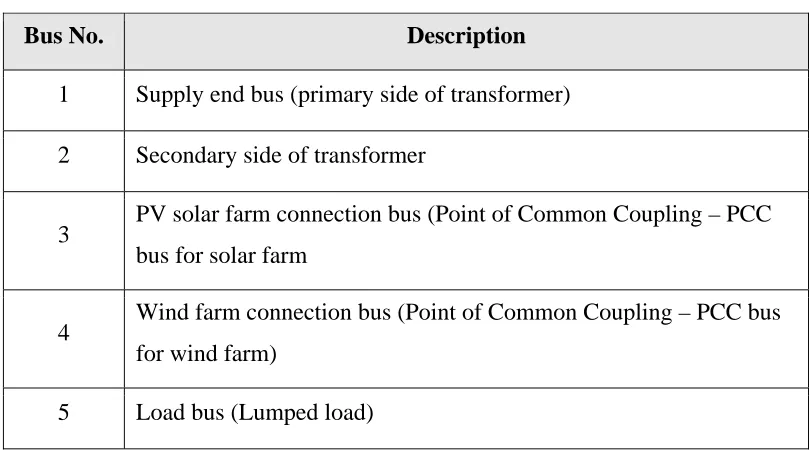
Table 2.1 Study system bus identification ... 21
Table 3.1 Base case steady state analysis - Voltages at various nodes of the system for
daytime and nighttime ... 60
Table 3.2 Steady state results for daytime loading, Case 1: 0% Solar farm output,
PSF = 0.0 MW, QSF = 0.0 Mvar ... 63
Table 3.3 Steady state results for daytime loading, Case 2: 50% Solar farm output,
PSF = 4.25 MW, QSF = 0.0 Mvar ... 64
Table 3.4 Steady state results for daytime loading, Case 3: 100% Solar farm output,
PSF = 8.5 MW, QSF = 0.0 Mvar ... 64
Table 3.5 Steady state results for nighttime loading, PSF = 0.0 MW, QSF = 0.0 Mvar ... 65
Table 3.6 Steady state voltages with reactive power compensation during daytime
Case 1: 0% solar farm output, PSF = 0.0 MW ... 71
Table 3.7 Steady state voltages with reactive power compensation during daytime
Case 2: 50% solar farm output, PSF = 4.25 MW ... 71
Table 3.8 Steady state voltages with reactive power compensation during daytime
Case 3: 98% solar farm output, PSF = 8.33 MW ... 72
Table 3.9 Steady state voltages with reactive power compensation
Nighttime loading: PSF = 0.0 MW ... 72
Table 3.10 Base case steady state voltages with X/R ratio variation ... 78
Table 3.11 Base case results for X/R ratio variation, PSF = 0.0 MW, PWF = 0.0 MW ... 82
Table 3.12 Steady state voltages with X/R ratio variation for daytime
xi
Table 3.13 Steady state voltages with X/R ratio variation for daytime
Case 2: 50% solar farm output, PSF = 4.25 MW ... 84
Table 3.14 Steady state voltages with X/R ratio variation for daytime
Case 3: 95% solar farm output, PSF = 8.07 MW ... 84
Table 3.15 Steady state voltages with X/R ratio variation for nighttime,
PSF = 0.0 MW ... 85
Table 3.16 Summarized results for wind farm connectivity ... 86
Table 4.1 Steady state voltage for daytime loading Case 1: 0% wind farm output,
PWF = 0.0 MW, QWF = 0.0 Mvar ... 95
Table 4.2 Steady state voltage for daytime loading Case 2: 50% wind farm output,
PWF = 4.95 MW, QWF = 0.0 Mvar ... 95
Table 4.3 Steady state voltage for daytime loading Case 3: 100% wind farm output,
PWF = 9.9 MW, QWF = 0.0 Mvar ... 95
Table 4.4 Steady state voltages with reactive power compensation from Wind-STATCOM,
Case 1: 0% wind farm output PWF = 0.0 MW ... 99
Table 4.5 Steady state voltages with reactive power compensation from Wind-STATCOM,
Case 2: 50% wind farm output PWF = 4.95 MW ... 99
Table 4.6 Steady state voltages with reactive power compensation from Wind-STATCOM,
Case 3: 99% wind farm output PWF = 9.8 MW ... 99
Table 4.7 Steady state voltages with X/R ratio variation – without and with
Wind-STATCOM, Case 1: 0% wind farm output PWF = 0.0 MW ... 101
Table 4.8 Steady state voltages with X/R ratio variation – with and without
Wind-STATCOM, Case 2: 50% wind farm output PWF = 4.95 MW ... 102
Table 4.9 Steady state voltages with X/R ratio variation – with and without
xii
Table 4.10 Summarized results for solar farm connectivity ... 104
Table 5.1 Steady state voltages for daytime loading ... 107
Table 5.2 Steady state voltages for nighttime loading ... 108
Table 5.3 Steady-state voltages with reactive power compensation using PV-STATCOM
(Daytime loading, Solar farm output, PSF = 20.0 MW ) ... 113
Table 5.4 Steady-state voltages with reactive power compensation using Wind-STATCOM
xiii
LIST OF FIGURES
Figure 1.1 Total installed capacity (end of 2011) and new capacity added in 2011 for top 10
wind power producing countries ... 2
Figure 1.2 Growth of wind generation installed capacity in Canada ... 2
Figure 1.3 Total installed capacity (end of 2011) and new capacity added in 2011 for top 10 solar power producing countries ... 3
Figure 1.4 Growth of PV solar installed capacity in Canada ... 3
Figure 1.5 Radial distribution system with DG ... 5
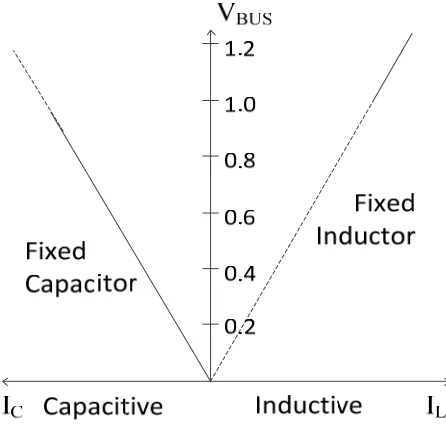
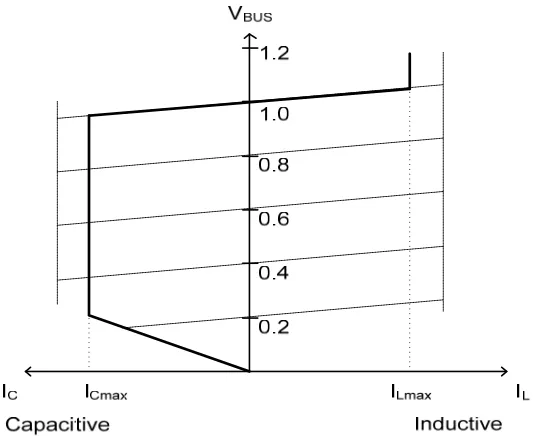
Figure 1.6 Terminal characteristic of fixed Capacitor/Inductor ... 8
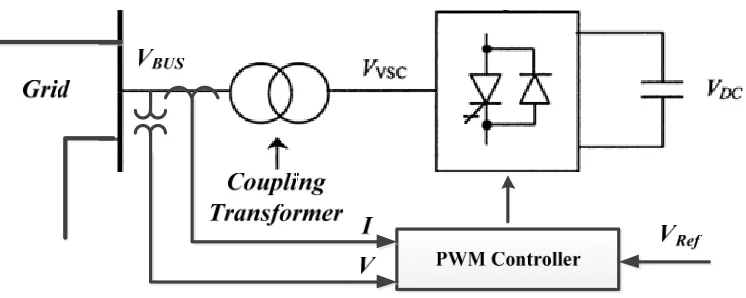
Figure 1.7 STATCOM connected to AC system through coupling transformer ... 10
Figure 1.8 Terminal characteristic for a STATCOM ... 11
Figure 1.9 Single line representation of STATCOM terminal connected to the grid ... 11
Figure 1.10 Phasor diagram showing reactive power control by STATCOM, (a) Reactive power consumed by STATCOM – Inductive mode, and (b) Reactive power supplied by STATCOM – Capacitive mode ... 12
Figure 1.11 Phasor diagram showing active power control by STATCOM - (a) Active power consumed by STATCOM – Power flow from AC to DC side (b) Active power supplied by STATCOM – Power flow from DC to AC side .. 12
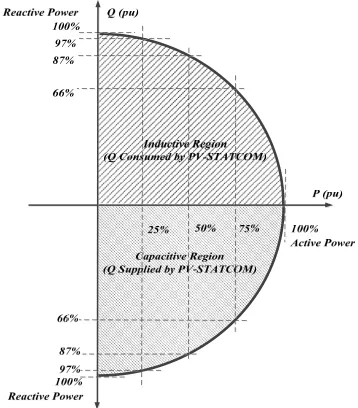
Figure 1.12 Active/reactive power capability curve for PV-STATCOM ... 15
Figure 2.1 Study system ... 21
Figure 2.2 Grid modeled as voltage source with equivalent impedance ... 22
xiv
Figure 2.4 Equivalent -model of overhead line (lumped parameters) ... 24
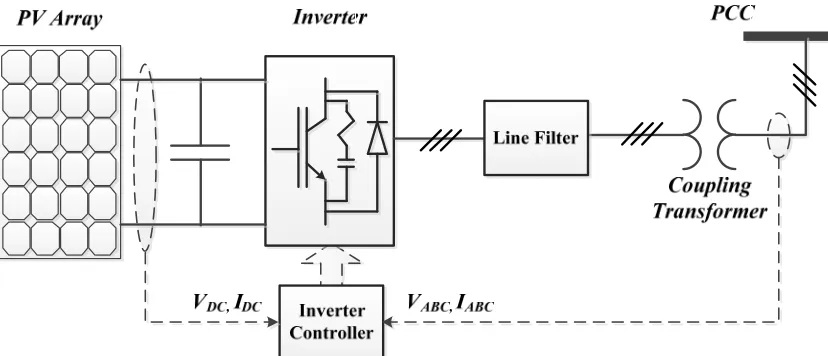
Figure 2.5 PV Solar System ... 26
Figure 2.6 Equivalent circuit of PV solar cell ... 27
Figure 2.7 A typical current-voltage characteristic of PV module ... 29
Figure 2.8 Schematic diagram of LC filter and coupling transformer ... 31
Figure 2.9 Generation of sinusoidal reference signal (for firing pulse generation for SPWM control) ... 34
Figure 2.10 Generation of triangular reference signal (for PWM control) ... 35
Figure 2.11 STATCOM voltage control with 3% droop characteristics ... 36
Figure 2.12 Phase shift angle control to maintain real power transfer ... 36
Figure 2.13 DC side voltage control with real power transfer ... 37
Figure 2.14 Voltage control strategy for unbalanced fault conditions ... 38
Figure 2.15 Study system model with PV-STATCOM (PSCAD/EMTDC model) ... 39
Figure 2.16 Step response with variation of proportional gain, Kp Case 1: PSF = 0.0 MW ... 40
Figure 2.17 Step response with variation of integral time constant, Ti Case 1, PSF = 0.0 MW ... 41
Figure 2.18 Step response with variation of proportional gain, Kp Case 2, PSF = 5.0 MW ... 42
Figure 2.19 Step response with variation of integral time constant , Ti Case 2, PSF = 5.0 MW ... 42
xv
Figure 2.21 PCC voltage control with PV-STATCOM: Case 2, Daytime loading with
PSF = 5.0 MW and PWF = 10.0 MW ... 45
Figure 2.22 Phase voltages without and with PV-STATCOM for single line to ground fault (SLGF) for 0.1 sec. ... 47
Figure 2.23 Schematic representation of typical wind turbine system ... 47
Figure 2.24 Induction Generator based wind turbine generator (fixed speed operation) ... 48
Figure 2.25 Stator and rotor representation of induction machine ... 49
Figure 2.26 Per-phase equivalent circuit model of induction machine ... 50
Figure 2.27 Permanent Magnet Synchronous Generator (PMSG) based wind turbine (variable speed operation) ... 51
Figure 2.28 Wind turbine and rectifier control schemes ... 53
Figure 2.29 Schematic diagram of Wind-STATCOM control ... 54
Figure 2.30 PSCAD/EMTDC model of the study system with Wind-STATCOM ... 56
Figure 2.31 PSS/E model of the complete system ... 57
Figure 3.1 Study system with PV-STATCOM ... 59
Figure 3.2 Base case voltages at various buses for daytime and nighttime ... 61
Figure 3.3 Phase voltages for daytime loading with single line to ground fault ... 61
Figure 3.4 Phase voltages for nighttime loading with single line to ground fault ... 62
Figure 3.5 PCC bus voltages for various solar farm output cases with increasing wind farm output (daytime and nighttime) ... 66
xvi
Figure 3.7 Phase voltages for daytime loading with SLGF
Case 1: PSF = 0.0 MW, PWF = 11.5 MW ... 67
Figure 3.8 Phase voltages for daytime loading with SLGF Case 2: PSF = 4.25 MW, PWF = 5.4 MW ... 68
Figure 3.9 Phase voltages for daytime loading with SLGF Case 3: PSF = 8.33 MW, PWF = 2.1 MW ... 68
Figure 3.10 Phase voltages for nighttime loading with SLGF, PSF = 0.0 MW, PWF = 20.0 MW ... 69
Figure 3.11 Phase voltages for nighttime loading with SLGF, PSF = 0.0MW, PWF = 3.9 MW ... 69
Figure 3.12 Phase voltages for daytime loading with SLGF, PSF = 0.0 MW, PWF = 19.5 MW ... 73
Figure 3.13 Phase voltages for nighttime loading with SLGF, PSF = 0.0 MW, PWF = 16.6 MW ... 74
Figure 3.14 Annual sunshine graph for London, Ontario (Source: www.gaisma.com) ... 75
Figure 3.15 Available active and reactive power capacity for solar farm converter based on typical insolation (approximate sunshine data) and PV module output ... 76
Figure 3.16 Reactive power compensation provided by solar farm (PV-STATCOM) to maintain PCC voltages within permissible limits (±6%) ... 76
Figure 3.17 Maximum reactive power compensation provided by PV-STATCOM to maintain steady-state voltage within permissible limits ... 77
Figure 3.18 PCC voltages for base case with X/R ratio variation ... 79
Figure 3.19 Phase voltages for SLGF Daytime base case loading: Half X/R (1.236) ... 80
xvii
Figure 3.21 Phase voltages for SLGF Nighttime base case loading: Half X/R (1.236) ... 81
Figure 3.22 Phase voltages for SLGF Nighttime base case - Double X/R (4.994) ... 81
Figure 3.23 Increase in wind farm connectivity with solar farm inverter as PV-STATCOM87 Figure 3.24 Increase in wind farm connectivity with PV-STATCOM (No reactive power compensation available during peak irradiance) ... 88
Figure 4.1 Study system with Wind-STATCOM ... 91
Figure 4.2 Base case steady state voltage profile for PLD = 4.82 MW, QLD = 2.19 Mvar ... 92
Figure 4.3 Phase voltages for daytime loading with SLGF ... 93
Figure 4.4 PCC bus voltages for various wind farm output cases with increasing solar farm output (Daytime loading without compensation) ... 96
Figure 4.5 Phase voltages for daytime loading with SLGF, Case 1: PWF = 0.0 MW,PSF = 20.0 MW... 97
Figure 4.6 Phase voltages for daytime loading with SLGF, Case 2: PWF = 4.95 MW, PSF = 20.0 MW... 97
Figure 4.7 Phase voltages for daytime loading with SLGF, Case 3: PWF = 9.9 MW,PSF = 20.0 MW... 98
Figure 4.8 Reactive power compensation provided by Wind-STATCOM to maintain PCC voltages within permissible limits (0.94 pu – 1.06 pu) ... 100
Figure 5.1 Phase voltages for daytime loading with SLGF, PSF = 8.5 MW, PWF = 9.9 MW ... 109
Figure 5.2 Phase voltages for nighttime loading with SLGF, PSF = 0.0 MW, PWF = 9.9 MW ... 109
xviii
Figure 5.4 Steady-state voltage profile at wind farm PCC (Nighttime loading) ... 111
Figure 5.5 Phase voltages for daytime loading with SLGF,
PSF = 20.0 MW, PWF = 20.0 MW ... 112
Figure 5.6 Phase voltages for nighttime loading with SLGF,
xix
LIST OF ABBREVIATIONS
ALFC : Automatic Load Frequency Controller
AVR : Automatic Voltage Regulator
CBEMA : Computer and Business Equipment Manufacturer’s Association
CSC : Current Sourced Converter
DER : Distributed Energy Resources
DFIG : Doubly Fed Induction Generator
DG : Distributed Generation/Distributed Generator
DR : Distributed Resources
EMTDC : Electromagnetic Transients including DC
EPS : Electric Power System
FACTS : Flexible AC Transmission Systems
FIT : Feed-In Tariff
GTO : Gate Turn-off Thyristor
HONI : Hydro One Networks Inc.
HV : High Voltage
IGBT : Insulated Gate Bipolar Transistor
ITIC : Information Technology Industry Council
LV : Low Voltage
MPPT : Maximum Power Point Tracking
MV : Medium Voltage
OLTC : On Load Tap Changer
PCC : Point of Common Coupling
xx PLL : Phase Locked Loop
PMSG : Permanent Magnet Synchronous Generator
PSCAD : Power Systems Computer Aided Design
PSS/E : Power System Simulator for Engineers
PWM : Pulse Width Modulation
PV : Photovoltaic
PV-STATCOM : Photovoltaic (Inverter) Static Synchronous Compensator
SCIG : Squirrel Cage Induction Generator
SEIG : Self-Excited Induction Generator
SLGF : Single Line to Ground Fault
SPWM : Sinusoidal Pulse Width Modulation
STATCOM : Static Synchronous Compensator
SVC : Static Var Compensator
TOV : Temporary Overvoltage
VSC : Voltage Sourced Converter
Wind-STATCOM : Wind turbine (Inverter) Static Synchronous Compensator
WRSG : Wound Rotor Synchronous Generator
xxi
LIST OF SYMBOLS
PLD : Active power consumed by load
QLD : Reactive power consumed by load
PSF : Active power supplied by solar farm
QSF : Reactive power compensation by solar farm
Positive - Inductive mode (consumed by solar farm), Negative - Capacitive mode (Supplied by solar farm)
PWF : Active power supplied by wind farm
QWF : Reactive power compensation by wind farm
Positive - Inductive mode (consumed by wind farm), Negative - Capacitive mode (Supplied by wind farm)
Vbus1 : Voltage magnitude at Bus 1 (in pu)
Vbus2 : Voltage magnitude at Bus 2 (in pu)
Vbus3 : Voltage magnitude at Bus 3 (in pu)
Vbus4 : Voltage magnitude at Bus 4 (in pu)
Vbus5 : Voltage magnitude at Bus 5 (in pu)
Chapter 1
1
INTRODUCTION
1.1 Growth of Wind Power and PV Solar Power Based
Distributed Generators
Solar farms and wind farms are the most common distributed generators (DGs) that are
primarily being connected in power distribution networks worldwide [1], [2]. By the end
of 2012 global wind energy installed capacity increased to 276,055 MW, which was a
significant growth from 4,800 MW in 1995 with average cumulative annual growth rate
of about 28.5% [3]. The total installed capacity of the world’s major wind power
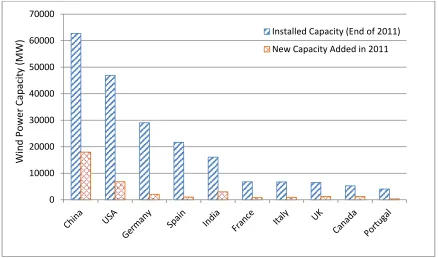
producing countries is shown in Figure 1.1 whereas, the growth of wind power in Canada
is given in Figure 1.2.
Due to incentives provided by several governments, small and medium scale PV solar
installations are being increasingly installed worldwide [4]. Feed-in Tariff (FIT) program
implemented by Ontario Government has helped to boost the growth of PV solar farm
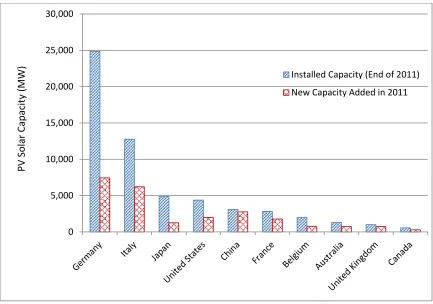
and wind farm in Ontario. The worldwide installations of PV solar capacity is shown in
2
Figure 1.1 Total installed capacity (end of 2011) and new capacity added in 2011 for top 10 wind power producing countries
Figure 1.2 Growth of wind generation installed capacity in Canada
0 10000 20000 30000 40000 50000 60000 70000
Installed Capacity (End of 2011)
New Capacity Added in 2011
Wind Power Capacity (MW)
137 198 236 322
444 684 1,460 1,846 2,369 3,319 4,008 5,511 0 500 1000 1500 2000 2500 3000 3500 4000 4500 5000 5500 6000
2000 2001 2002 2003 2004 2005 2006 2007 2008 2009 2010 June 2012
Figure 1.3 Total installed capacity (end of 2011) and new capacity added in 2011 for top 10 solar power producing countries
Figure 1.4 Growth of PV solar installed capacity in Canada
0 5,000 10,000 15,000 20,000 25,000 30,000
Installed Capacity (End of 2011)
New Capacity Added in 2011
PV Solar Capacity (MW) 0 50 100 150 200 250 300 350
2000 2001 2002 2003 2004 2005 2006 2007 2008 2009 2010
Off-grid
Grid Connected Total
Cumulative PV Solar Installation in Canada
(as of December 31 of each year)
Installed
C
apacity
4
1.2 Issues with Grid Integration of DGs
Traditionally, power grids are fed from large centralized generating stations mainly based
on hydro, thermal or nuclear generation technologies. The integrated power grids are
characterized by large generation, bulk transmission and end use through distribution
network. However, the distributed nature of renewable energy resources like solar and
wind have transformed this traditional integrated power network with presence of a large
number of small scale distributed generators (DGs) [5] . These distributed generators are
normally connected to the medium voltage (MV) and low voltage (LV) distribution
networks.
The interconnection of DGs in distribution network provides additional benefits in the
network. With the development of solar farm and wind farm in medium voltage
distribution network, the increase in the demand can be locally fulfilled reducing the cost
of transmission network expansion. It also helps to reduce the transmission congestion in
existing network. The transmission and distribution losses are reduced increasing the
system efficiency. However, these benefits come along with new challenges to the system
operator. The major issues encountered by the medium voltage distribution with the
integration of distributed generation include, but not limited to, steady state voltage rise,
increased temporary overvoltage (TOV), increase in voltage flicker and harmonic
components, and restrictions on operation of existing grid protection [5] – [7] .
1.2.1
Steady state voltages
Connecting the DGs towards the receiving end of radial distribution system may create
reverse power flow during the light load condition (off-peak load during nighttime). In
this situation, the distribution line, traditionally operated to carry designed amount of
power from the source end towards the load end, is likely to face increased voltage at the
receiving end due to reverse power flow [6]. A typical scenario of reverse power flow can
occur when DG output is greater than the load for the distribution network, shown in
Figure 1.5 Radial distribution system with DG
For this network, the receiving end voltage is given by:
∙ ∙ ……… 1.1
where, ∙ /
,
∙ / ∙ ∙
, ∙ ∙ / ∙ ∙ ∙ / … 1.2
The approximate expression for receiving end voltage is:
∙ ∙ / ……… 1.3
For the DG in the receiving end with active power injection of at unity power factor,
the receiving end voltage is given by:
∙ ∙ / ……… 1.4
From this expression we can identify that the receiving end voltage will increase
6
generation at receiving end and the line resistance . For a distribution
system with low X/R ratio (i.e. high line resistance R), the rise in voltage can be
substantial.
The guidelines provided by IEEE Standards (IEEE Std 1547-2003: IEEE Standard for
Interconnecting Distributed Resources with Electric Power Systems) [8] – [10] and CSA
Standards (CSA C22.3 No. 9-08: Interconnection of distributed resources and electricity
supply systems) [11] are widely implemented to specify the permissible steady-state
voltage variation in distribution network. The steady state voltage limit of ±6% of
nominal value at the end user terminal is permitted in Hydro One’s Technical
Interconnection Requirements [7]. Appropriate reactive power compensation is required
to maintain steady state voltage within permissible limits. The conventional mitigation
measures for voltage issues are discussed in Section 1.3 whereas measures based on
Flexible AC Transmission Systems (FACTS) are discussed in Section 1.4.
1.2.2 Temporary
overvoltage
In medium voltage networks, unbalanced faults, such as single line to ground fault
(SLGF) in the network causes temporary overvoltages (TOV) on the healthy phases of
the network feeder [12], [13]. Overvoltages between one phase and ground or between
two phases are classified based on the shape of the voltage, percentage increase from
nominal value and duration of application. Temporary overvoltages (TOV) originating
from switching or system faults (e.g. load rejection, unbalanced faults) or from
nonlinearities (ferroresonance effects, harmonics) are normally undamped or weakly
damped [10].
Integration of distributed generators causes changes in fault level, fault current
distribution and voltage profile in the distribution line. TOV in the distribution line
mainly depends on pre-fault voltage, type of fault, fault resistance, etc. Single line to
ground bolted fault is considered to observe the impact of temporary overvoltage in this
thesis. The types of distributed generator and configuration of its interconnection
The range of higher and lower level of system voltages, that end user equipment can
safely handle, are specified by CBEMA voltage curves [14]. These characteristic shows
that the voltage level as well as the time interval for which such voltages appear are both
important in identifying the level of acceptable temporary overvoltage. The temporary
rises in voltage are specified by IEEE standards [8] and CSA standards [11]. Based on
these requirements, Hydro One Networks Inc. has specified that the TOV anywhere in
the distribution network under no circumstances shall exceed 130% [7].
1.3 Conventional Mitigation Measures for Voltage Issues
In any power network, voltages at various system buses change continuously according
to the variation in demand, switching of lines and transformers, and system
contingencies. Power system operators are responsible for maintaining system voltages
within permissible limits in all operating conditions. Typically, on load tap changing
(OLTC) transformers are used to maintain voltages in medium voltage distribution
network.
1.3.1 Voltage
Regulation
Voltage control is achieved by implementing voltage regulators [15] at various locations
in power network. Most of the existing voltage regulators in the distribution network are
implemented for unidirectional power flow from the source to the load ends. Increased
DG output during off-peak load hours, may result in reverse power flows. The upstream
voltage regulators are affected by such reverse power flow [15]. Modifications of the
controller have been proposed for the upstream line voltage regulators if DGs are
connected to the system. Multiple line drop compensation based voltage regulators are
effective to regulate the system voltage even with high penetration of distributed
generators [16]. In the traditional distribution system, the system voltage is maintained by
implementing upstream voltage regulators and the load end reactive power compensators.
8
1.3.2 Reactive
Power
Compensation
It is a well-known fact that shunt compensation can be used to provide reactive power
compensation locally at load buses. Conventional shunt capacitors or shunt inductors are
used for this purpose. Capacitive reactive power compensation is used to increase the
system voltage to desired level where as inductive compensation is used to reduce the
voltage during light load (off-peak) conditions. The terminal characteristic (I-V
characteristic) for fixed capacitor and inductor is shown in Figure 1.6.
Shunt capacitors and inductors provide fixed compensation. Variable compensation is
implemented by switching appropriate combination of capacitors or inductors. The
variability of distributed generation resources and requirement of dynamic reactive power
support make these conventional devices less effective in resolving voltage issues created
by DGs. Synchronous condensers can provide continuously controlled reactive power
output from inductive to capacitive region [17]. However, such devices have slow
response and are less commonly employed in distribution systems due to their high cost.
1.4 FACTS Controller based Mitigation Measures for
Voltage Issues
Flexible AC Transmission System (FACTS) is defined as the AC transmission systems
incorporating power electronics based and other static controllers to enhance
controllability and increase power transfer capability [18]. The FACTS Controllers
impart the following benefits to the electric power network:
Provides reactive power compensation
Provides voltage regulation
Improves steady-state stability and transient stability
Damps power system oscillations
Improves voltage stability
Increases power transfer capability
In medium voltage distribution networks, shunt FACTS devices are used to provide very
fast and continuous reactive power support. It helps to improve system power factor and
regulate the system voltage. Due to their fast response and dynamic reactive power
support capability, FACTS Controllers are most suitable to mitigate voltage fluctuation
created by the solar and wind power integration to the grid [19]. Mostly, Static Var
Compensator (SVC) – a thyristor based FACTS Controller [17], [20] and Static
Synchronous Compensator (STATCOM) – a voltage source converter based FACTS
Controller are used in medium voltage distribution network.
1.4.1
Static Synchronous Compensators (STATCOM)
The Static Synchronous Compensator (STATCOM) is a FACTS Controller utilized at the
transmission and distribution level [18], and as a custom power device at end users’
electrical installations [21]. The major applications of STATCOM in these contexts
include voltage regulation, power factor correction, damping power oscillations, and load
10
1.4.1.1 Principle
of
Operation
Static synchronous compensator (STATCOM) is a voltage sourced converter (VSC)
based on controllable switches. A STATCOM is a shunt connected device that provides
rapid reactive power compensation in the network.
STATCOM, which injects sinusoidal current at the point of common coupling, can
emulate itself as inductive or capacitive reactive power source by aligning the injected
current almost in quadrature with line voltage [22], [23]. A STATCOM with proper
control strategy can be effectively used to suppress voltage fluctuation in the network
[24], [25], [26].
A functional representation of the STATCOM showing various components is shown in
Figure 1.7. The STATCOM is connected to the AC system terminal bus through a
coupling transformer. The terminal characteristic for such STATCOM is shown in Figure
1.8. It is seen that the STATCOM can provide rated capacitive current at very low
voltages. This feature is very helpful in voltage regulation. Pulse Width Modulation
(PWM) controller is used to provide the firing pulses to the converter switches to achieve
the control on active and reactive power flow from the STATCOM. A 2-level, 6-pulse,
three phase converter is modeled as Static Synchronous Compensator (STATCOM) in
this thesis.
Figure 1.8 Terminal characteristic for a STATCOM
Figure 1.9 Single line representation of STATCOM terminal connected to the grid
The single line diagram representing the grid and the STATCOM is shown in Figure 1.9.
A STATCOM basically produces a set of balanced 3-phase sinusoidal voltages at
fundamental frequency with fast voltage magnitude and phase angle control capability.
The active and reactive power exchange between the STATCOM and the grid (flow from
STATCOM terminal to grid side terminal) can be represented by the following
expressions [17]:
∙
∙ ……… 1.5
∙ ∙
12
From (1.5), it is noted that the real power transfer is dependent on the power angle
between STATCOM terminal and grid side terminal for nominal values of voltage
magnitudes. Similarly from (1.6) it is seen that for small power angle , the reactive
power exchange is dependent on STATCOM terminal voltage magnitude compared to
grid terminal voltage magnitude. Accordingly, various combinations of active and
reactive power transfer to and from STATCOM may arise. The four combinations of
active and reactive power transfer are illustrated with the help of phasor diagrams. The
exchange of reactive power to and from the STATCOM is shown in Figure 1.10. The
STATCOM will consume reactive power in inductive mode of operation if
and will supply reactive power in capacitive mode of operation if . Similarly,
the exchange of active power is given in Figure 1.11. Active power will flow from AC
side (Grid) to DC side (STATCOM) when power angle is negative. This will increase
the DC link voltage. When power angle is positive, active power will flow from DC
side to the AC side and the DC link voltage will decrease.
Figure 1.10 Phasor diagram showing reactive power control by STATCOM, (a) Reactive power consumed by STATCOM – Inductive mode, and
(b) Reactive power supplied by STATCOM – Capacitive mode
Figure 1.11 Phasor diagram showing active power control by STATCOM - (a) Active power consumed by STATCOM – Power flow from AC side to DC side
1.4.1.2 STATCOM
Controller
Based on the analysis presented above, a phase angle regulator and a voltage magnitude
regulator are used to control the transfer of active power and reactive power respectively
between the grid and the STATCOM. Accordingly, STATCOM can provide control on
voltage magnitude and phase angle at its terminal.
Voltage Sourced Converters employ either fundamental frequency switching or pulse
width modulation switching strategies. Due to low switching frequency in fundamental
frequency switching technique, there is less loss in converter switching mechanism.
However, this switching technique injects more harmonic components in the system.
Normally, Gate Turnoff Thyristors (GTO’s) are used as controllable switches at
fundamental frequency and multi-level voltage switching is used to reduce harmonic
component. Alternatively, pulse width modulation (PWM) technique can be used to
eliminate lower order harmonics and reduce the total harmonic distortion due to
converters. Insulated Gate Bipolar Transistors (IGBT’s) are used as controlled switches
to reduce switching losses in PWM converters. In sinusoidal pulse width modulation
(SPWM), which is the most common PWM technique, the magnitude and frequency of
the sinusoidal fundamental component are controlled by pulse width modulation. In such
converters, the higher the switching frequency, the better will be the quality of the
resulting waveform and smaller the filter capacitor and inductors requirements [27].
In PWM technique, the information about the fundamental component of the output
voltage is embedded (modulated) in the widths of the output voltage pulses. The
demodulation takes place in the output low-pass filter (LC filters), where the switching
harmonics are separated from the fundamental component, or in the inductive load, where
the pulsed voltage waveform is transformed to a sinusoidal current at the fundamental
frequency. The Sinusoidal Pulse Width Modulation (SPWM) is based on generation of
sinusoidal modulating signal and the triangular carrier signal [28], [29]. The sinusoidal
modulating signal is compared with a triangular carrier signal of constant amplitude and
frequency to generate the gate pulses for the switches. For three phase PWM converter,
14
√3 ∙ ∙
2√2 0.6124 ∙ ∙ ……… 1.7
,
3
, ; . .
; . .
1.5 Mitigation Measures using DG based STATCOM
1.5.1
PV Solar Farm based STATCOM (PV-STATCOM)
Solar farms are equipped with grid tied inverters to facilitate the transfer of DC power
generated from photovoltaic modules to the power grid. These inverters consist of
voltage sourced converters with pulse width modulated (PWM) switching and necessary
filter and/or interconnection transformer between the converter and the grid. PV solar
farms are absolutely idle in the nighttime and only partially utilized during early morning
and late evening hours. A novel control of PV solar farm inverter as STATCOM (termed
PV-STATCOM) was proposed by Varma [30]. The PV-STATCOM can provide dynamic
reactive power compensation utilizing the entire inverter capacity during nighttime and
Figure 1.12 Active/reactive power capability curve for PV-STATCOM
Assuming the inverter capacity S to be the same as the peak output power capacity of the
photovoltaic modules, the active power P and reactive power capability √
of the PV-STATCOM is shown is Figure 1.12. It is noted that the PV-STATCOM can
deliver up to 66% of reactive power when it is producing 75% of rated real power.
Significant availability of reactive power even with large production of active power
makes such PV-STATCOM control very effective in reactive power compensation. The
detailed modeling and control of solar farm converter as STATCOM is presented in
16
1.5.2
Wind Farm based STATCOM (Wind-STATCOM)
The flexibility of voltage sourced converters (VSC) and their fast response make it
possible to control wind farm converters to provide FACTS-like performance
characteristics for low voltage ride through applications [32]. For wind farms with
variable speed permanent magnet synchronous generator and back to back full converter
based interface connection, the VSC based grid side converter can be controlled as
STATCOM [30]. Such STATCOM, referred as Wind-STATCOM, is incorporated in this
thesis to achieve the required reactive power injection along with available active power.
This reactive power injection is achieved by controlling the converter AC terminal
voltage. The available active injection is controlled by controlling shift angle between
PCC and converter AC terminal voltage. The active power and reactive power capability
curve for Wind-STATCOM is similar to that of PV-STATCOM as shown in Figure 1.12.
The detailed modeling and control of Wind-STATCOM is presented in Chapter 2.
1.6 Motivation
of
Thesis
The widespread growth of wind farms and PV solar farms is increasing their likelihood of
being connected on same distribution networks. It is known that the reverse power flow
due to increased DG output during light load condition causes steady-state voltage rise.
Also, increased output from the DGs causes high temporary overvoltage for unbalanced
faults. All these issues limit the amount of power that can be injected into the grid from
wind farms and PV solar farms.
In this thesis, a novel control of existing inverters of solar farm as well as wind farm as
STATCOM are presented to address the challenges created by grid integration of
distributed generation. These challenges relate to steady state voltage rise due to reverse
power flow with the increased generation in distribution network and the temporary
overvoltage created by unbalanced faults with higher distributed generation integration.
these problems is the major focus of this thesis. It is expected that the implementation of
such controller will be useful in significantly enhancing the DG connectivity in
distribution networks.
1.7 Scope of Research
The dynamic reactive power compensation provided by the novel control applied to the
existing solar farm inverters can be used in the transmission and distribution network for
various applications [33] – [36]. Varma et al in [33] used a novel control concept by
which the existing PV solar farm inverter is operated as STATCOM to improve the
transient stability of the transmission network and consequently increase the power
transfer capability of an existing transmission line.
In [34], authors have demonstrated voltage regulation and power factor correction using
PV-STATCOM both during nighttime and daytime. The optimal utilization of solar farm
for 24-hours is demonstrated on a 10kW photovoltaic system in Bluewater Power
Corporation’s network. The voltage regulation and power factor correction features of
PV-STATCOM are demonstrated with Real Time Digital Simulator (RTDS) in [35]. The
application of PV-STATCOM to prevent instability of a neighbouring induction motor
load is presented in [36].
In this thesis, the novel control of existing PV solar farm and wind farm inverter resulting
in PV-STATCOM and Wind-STATCOM is used to regulate steady state voltage and
suppress temporary overvoltage so that the amount of power that can be injected from the
neighbouring solar farm and wind farm can be increased. The partial converter based
wind farms that employ Doubly Fed Induction Generator (DFIG) are not covered in this
research.
A realistic medium voltage distribution network with radial feeder is considered as the
18
varying distances from the IG based wind farm. Also, the effectiveness of
PV-STATCOM and Wind-PV-STATCOM for the same radial distribution feeder with different
conductors having different X/R ratios is studied.
The modeling and analyses in this thesis are performed using commercial grade
softwares, PSS/E and PSCAD/EMTDC. Power System Simulator for Engineers (PSS/E)
and Power Systems Computer Aided Design using Electromagnetic Transients including
DC (PSCAD/EMTDC) are two industry standard software tools used in simulation
studies of power system networks. PSS/E is used for steady-state load flow analysis as
well as transient stability analysis [37]. PSCAD/EMTDC is used to perform
electromagnetic transient simulations during system faults [38], [39]. The switching
operation in power electronics based converters is considered in PSCAD/EMTDC.
1.8 Objective of the Thesis
The objectives of this thesis are as follows:
1. To develop a system model of a realistic distribution feeder line with PV solar
farm modeled as PV-STATCOM and a full converter based wind farm modeled
as Wind-STATCOM.
2. To study the enhancement of wind farm connectivity in medium voltage (MV)
distribution network by addressing steady-state voltage rise and temporary
overvoltage issues with the help of PV-STATCOM.
3. To examine the improvement of PV solar farm connectivity in distribution
network by utilizing the wind farm converter as STATCOM to address
steady-state voltage rise and temporary overvoltage issues.
4. To evaluate the additional PV solar farm and wind farm connectivity achievable
1.9 Outline
of
Thesis
An introduction of the various issues faced by medium voltage distribution network due
to DG connectivity and the mitigating measures to address the issues of high bus voltage
and TOVs are presented in Chapter 1. The principle of STATCOM, and the novel
concepts of utilizing PV solar farm as PV-STATCOM and full converter based wind
farm as Wind-STATCOM are also presented. The rest of this thesis is organized as
below.
Chapter 2 deals with the modeling of the medium voltage distribution network as well as
development of PV-STATCOM and Wind-STATCOM models. Models are developed
for both load flow studies and electromagnetic transient simulation studies.
Chapter 3 deals with the application of PV solar converter as STATCOM
(PV-STATCOM) to enhance the connectivity of wind farm. A base case scenario of the study
system is presented and the issues of steady-state voltage and temporary overvoltage are
evaluated. The steady-state analysis is based on PSS/E model of the study system and
transient analysis is based on PSCAD/EMTDC model of the complete system. This
chapter focuses on the evaluation of increased wind farm connectivity with the help of
PV-STATCOM both during nighttime and daytime.
Chapter 4 deals with the application of full converter based wind farm as STATCOM
(Wind-STATCOM) to enhance the connectivity of PV solar farm during daytime. Here,
PSS/E model is used for steady-state analysis and PSCAD/EMTDC model is used for
fault study.
Chapter 5 presents the combined operation of PV-STATCOM and Wind-STATCOM to
maximize the system’s capability in integrating DGs in the distribution network.
The conclusions from this thesis work and recommendations for further research are
Chapter 2
2
SYSTEM MODELING
2.1 Introduction
This chapter deals with the modeling of a realistic medium voltage radial distribution line
connected with a PV solar farm, a wind farm along with loads. The system model
implemented in PSS/E software is used for steady state analyses. The system model
implemented in PSCAD/EMTDC is used for electromagnetic transient analyses. This
chapter further presents the system modeling from the perspectives of both load flow
studies with PSS/E and fault studies with PSCAD/EMTDC software.
2.2 Study
System
A realistic medium-voltage distribution system shown in Figure 2.1 is considered as the
study system in this thesis. The system data corresponds to an actual Hydro One feeder in
Ontario (name withheld due to confidentiality). The study system consists of 45 km of
27.6 kV radial distribution network connected to a supply substation through
118kV/27.6kV transformer. The load is approximated as lumped a load at bus no. 5 at
the end of the radial network. Here, peak load (daytime load) is considered as 4.82 MW
active and 2.197 Mvar reactive (5.3 MVA at 0.91 lagging power factor). The off-peak
at 0.91 lagging power factor). A wind farm of 9.9 MW capacity is located at bus no. 4 at
a distance of 5.0 km from the load bus. Also, a PV solar farm of 8.5 MW capacity is
located at bus no. 3 at a distance of 5.0 km from the wind farm terminal. A brief
description of the five buses considered in the network is given in Table 2.1. The
parameters for the study system and various components are provided in Appendix – A.
Figure 2.1 Study system
Table 2.1 Study system bus identification
Bus No. Description
1 Supply end bus (primary side of transformer)
2 Secondary side of transformer
3 PV solar farm connection bus (Point of Common Coupling – PCC bus for solar farm
4 Wind farm connection bus (Point of Common Coupling – PCC bus for wind farm)
22
2.3 Network and Load Model
2.3.1 Grid Model
For steady-state analysis in PSS/E, the grid is represented by a slack bus/infinite bus
capable of supplying the required power at specified bus voltage. The generator
considered at slack bus can supply the active power (including total system loss and load)
required by the distribution network or it can absorb the excess active power in case of
reverse power flow due to distributed generators. Also, such generators can supply or
consume reactive power at specified voltage as required by the feeder.
For electromagnetic transient simulation in PSCAD/EMTDC, the grid feeding the
distribution line is represented by a voltage source behind equivalent source impedance
as shown in Figure 2.2. The equivalent series impedance of the grid consists of series
resistance, RSRC and the series reactance, XSRC. The voltage behind the reactance, E, is
fixed whereas the terminal voltage VBus-i depends on the loading condition of the
distribution feeder.
Figure 2.2 Grid modeled as voltage source with equivalent impedance
2.3.2 Transformer Modeling
Electric power grid basically consists of generation, transmission and distribution
systems which normally exist at different voltage levels. In such power grids,
transformers are widely used to connect the systems at different voltage levels. The
parameters, which consist of series resistance and reactance, are used to represent the
copper loss and the leakage flux of the windings, respectively. The copper loss and the
leakage flux for both the primary and secondary windings depend on transformer loading.
The net flux that links the transformer windings and the iron loss (hysteresis loss and
eddy current loss) are fixed for a transformer with rated voltage and independent of the
transformer loading condition. Shunt parameters, namely shunt resistance and reactance
are used to represent such fixed loss and flux in the transformer. The shunt resistance and
reactance are very high and their effect in the system is neglected for complete system
analysis. Also, copper loss in the transformer windings is significantly low compared to
the network losses and hence a loss less transformer is used for the study system. In this
scenario, the transformer can be modeled as a reactance XTR in series with an ideal
transformer between two system buses i and j as shown in Figure 2.3. VBus-i and VBus-j
denote the voltage at buses i and j, respectively.
Figure 2.3 Transformer model - ideal transformer with series reactance
2.3.3 Line Modeling
Electrical parameters of a transmission line are based on size of conductors and their
geometrical configuration. An overhead transmission line is represented by series
parameters (series resistance, , and reactance, ) and shunt parameters (shunt
conductance, , and susceptance, ) as below.
Ω/ ……… 2.1
/ ……… 2.2
24
For the medium voltage overhead feeder, these distributed line parameters are
represented by lumped model both for steady-state and transient analyses. The series
parameters are represented by equivalent resistance, R and equivalent reactance, X. The
shunt conductance, G is negligible for the overhead lines and half of capacitive
susceptance (Y/2) is used to represent shunt parameters on each terminal of the line. The
resulting equivalent -model, as shown in Figure 2.4, is used to represent the line
sections of the study system between Bus-i and Bus-j.
∙ ……… 2.3
∙ ……… 2.4
∙ ……… 2.5
,
Figure 2.4 Equivalent -model of overhead line (lumped parameters)
2.3.4 Load Model
The load in a distribution network consists of various types of heating, lighting and motor
loads. Individual loads vary widely in their performance characteristic. The equivalent
characteristic of the load viewed from the medium voltage side (secondary of the feeder
transformer) will be obtained by the net effect of the individual loads. The net active
power and reactive power of a given load are affected by the terminal voltage and the
Based on the study requirements, load models are broadly classified into two types: static
load models and dynamic load models. Static load models used in load flow studies are
expressed as steady state active and reactive powers as function of bus voltage and
system frequency. Dynamic load models, on the other hand, are used for stability studies
that involve load dynamics (as in voltage stability studies). Static load models are
traditionally classified into following three types [41].
Constant power load model (Constant P): A static load model in which the
power does not vary with voltage magnitude. It is also referred to as
constant MVA load model.
Constant current load model (Constant I): A static load model in which the
power varies directly with voltage magnitude.
Constant impedance load model (Constant Z): A static load model in which
the power varies with the square of the voltage magnitude.
Though the individual characteristics vary widely, the aggregated load characteristic of
typical commercial and domestic loads are given as:
1 . ……… 2.6
1 . ……… 2.7
,
26
In this thesis constant power static load models are used for load flow studies as well as
transient (fault) studies. The load is considered to be lumped at the receiving end (Bus 5)
of the network. The constant power load with power factor of 0.91 lagging is considered
both for steady state and transient studies.
2.4 PV System Model
PV solar system basically consists of photovoltaic cells that produce DC electricity, an
inverter that converts DC to AC, an LC line filter that removes the harmonic components
produced by inverter, and coupling transformer that connects AC side of the PV system
to the point of common coupling (PCC) at grid. The DC side voltage, VDC, DC current,
IDC, AC side three phase voltages VABC and three phase line currents IABC are used as input
to the inverter controller which generates gate drive pulse signal to operate inverter
switches. A schematic diagram of PV system is shown in Figure 2.5.
Figure 2.5 PV Solar System
2.4.1 Photovoltaic Array
Photovoltaic cell, which consists of semiconductor material, is the basic unit of a PV
semiconductor PV cells are classified in three categories: Monocrystalline,
Polycrystalline, and Amorphous. Monocrystalline PV cells require pure silicon and
complicated crystal growth technology making them most expensive among various PV
cell technologies. However, these monocrystalline cells have highest efficiency and are
used in critical applications where generating more power utilizing less space is of
importance. Polycrystalline cells, on the other hand, contain many crystals and have a
less perfect surface than monocrystalline cells. Polycrystalline PV cells are widely used
due to their low cost and moderate efficiency. Amorphous cells, with the thinner silicon
wafers compared to crystallized PV cells, are more flexible than the other types. Though
the efficiency is least of the three, amorphous silicon cells have gained wider application
in recent days with the development of thin film photovoltaic (TFPV) technology. With
the this technology, low cost PV modules can be made in variety of sizes and shapes.
The basic units of photovoltaic technology referred as PV cells are connected in a
combination of series and parallel connection to increase the voltage and current
available from the photovoltaic cells. Such combination of cells is referred as PV solar
module. Typical solar module consists of 36 to 72 cells and ranges from 75 W to 350 W
in peak output power (Wp). A PV array is the combination of PV modules connected in
series and parallel to match the requirement of inverter for grid integration. A PV solar
farm may consist of a number of solar arrays based on its capacity.
28
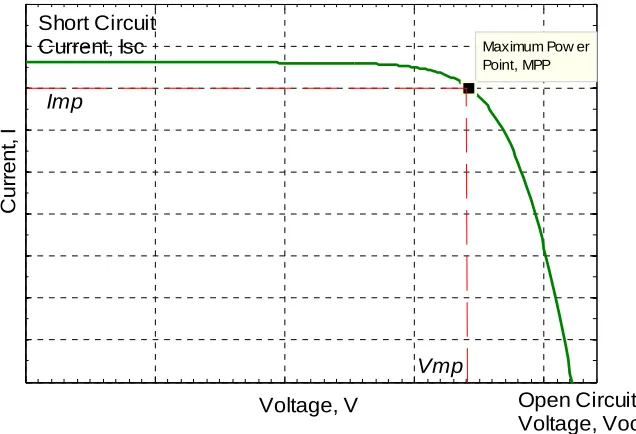
A solar module can be represented by simplified equivalent circuit as shown in Figure
2.6. Based on this equivalent circuit, the relationship between the terminal voltage of
solar module and the current delivered to the load is:
∙
1 ∙ ……… 2.8
,
/
1.381 10 /
°
Based on the equivalent circuit shown in Figure 2.6 and relationship given in (2.8), a
typical I-V characteristic curve for given insolation and cell temperatures at standard test
condition is depicted in Figure 2.7. The voltage at open terminals of the module is
referred as open circuit voltage (VOC). For this open circuit case, the voltage across the
terminals is maximum for given operating conditions and the current through the PV
terminals is zero. The terminal voltage decreases slightly as the current drawn from the
PV terminals increases. This drop in voltage is affected by the series resistance value RSE
current increases beyond certain value. This sharp fall in current depends on the value of
shunt resistance RSH of the module (∆ / . The maximum current from the PV
module, when its terminals are shorted, is referred as short circuit current, ISH.
This unique I-V characteristic of PV modules provides self-regulation for battery
charging applications. However, an additional control is provided to operate PV modules
for maximum power output when connected to the power grid. The nominal voltage and
current magnitude are identified by the voltage and current at maximum power point at
the nominal insolation and nominal ambient temperature (standard test conditions). The
short-circuit current and open-circuit voltage are slightly higher than respective nominal
voltage and current. The ratio of the maximum power . to the product of
open-circuit voltage and short-open-circuit current . ) as given in (2.9) is defined as the fill
factor of PV module
Figure 2.7 A typical current-voltage characteristic of PV module
∙
∙ ……… 2.9
,
Maximum Pow er Point, MPP
Voltage, V
C
u
rr
e
n
t, I
Short Circuit Current, Isc
Open Circuit Voltage, Voc
30
Fill factor generally varies between 0.8 and 0.9. It depends on series and shunt resistance
values shown in the equivalent circuit of Figure 2.6. Fill factor represents the measure of
efficiency of the PV module. For nominal operating condition, the variation in terminal
voltage with the variation of power output is minimal. Accordingly, the DC side voltage
of the solar inverter can be approximated by the nominal DC voltage to study the impact
of PV solar farm integration to the grid. Such equivalent DC voltage source along with
series resistance to represent the DC side loss, are used to model the PV solar array. The
MPPT is not modeled in the PV solar farm model in this thesis, as only the inverter
capacity remaining after real power generation is being utilized for voltage control.
2.4.2 Line Filter
Voltage Source Converter (VSC) based PV inverters produce various harmonic
components based on the control strategy and switching frequency [48]. The pulse width
modulation (PWM) technique can be used to eliminate lower order harmonics and reduce
the total harmonic distortion due to converters.. In sinusoidal pulse width modulation
(SPWM), which is the most common PWM technique, the magnitude and frequency of
the sinusoidal fundamental component are controlled by pulse width modulation. In such
converters, the higher the switching frequency, the better is the quality of the resulting
waveform and smaller the filter capacitor and inductors requirements.
A low-pass LC filter, as shown in Figure 2.8, is used to remove the harmonic components
and provide smooth sinusoidal waveform at the point of common coupling (PCC). In
PWM technique, the information about the fundamental component of the output voltage
is embedded (modulated) in the widths of the output voltage pulses. The demodulation
takes place in the output low-pass filter (LC filters), where the switching harmonics are
separated from the fundamental component, or in the inductive load, where the pulsed
; . .
The odd value of frequency modulation index is chosen as it provides a half-wave
symmetry in resulting output waveform. Half-wave symmetry is useful in converter
output as it eliminates even harmonic components. The harmonic components in output
waveform will appear as sidebands around the switching frequency and its multiples. The
frequencies of harmonic components are given by the following expression.
∙ ∙ ……… 2.10
Here value of k is even when j is odd, and k is odd when j is even. The frequency
modulation is selected in such a way that significantly higher order harmonics will appear
in the output (which are relatively easier to filter out) and switching loss is maintained
within acceptable value.
The series inductor (Lf ) used in the LC filter provides sufficient impedance between the
AC side of the inverter and the point of common coupling of the grid. The shunt
capacitor (Cf ) provides attenuation to the harmonic components of the inverter AC side
voltage.