Copyright 0 1989 by the Genetics Society of America
Transposition Pattern of the Maize Element Ac from the bx-m2(Ac) Allele
Hugo K. Dooner and Alemu Belachew
Advanced Genetic Sciences,' 6701 San Pablo Avenue, Oakland, Calijiornia 94608
Manuscript received October 14, 1988 Accepted for publication March 8, 1989
ABSTRACT
The pattern of transposition of Ac from the mutable.allele bz-mZ(Ac) has been investigated. Stable (bz-s) and finely spotted (bz-m(F)) exceptions were selected from coarsely spotted bz-mZ(Ac) ears. The presence or absence of a transposed Ac (trAc) in the genome was determined and, when present, the location of the trAc was mapped relative to the flanking markers sh and wx. The salient general features of Ac transposition to sites linked to bz are that the receptor sites tend to be clustered on
either side of the bz donor site and that transposition is bidirectional and nonpolar. Thus, the symmetrical clustering in the distribution of receptor sites adjacent to bz differs from the asymmetrical clustering reported in 1984 for the P locus by I. M. GREENBLATT. Though Ac tends to transpose preferentially to closely linked sites, an appreciable fraction of Ac transpositions from bz-mZ(Ac) is to unlinked sites: 41 % among bz-s derivatives and 59% among bz-m(F) derivatives. Many transposition events among the bz-m(F) selections result in kernels carrying a genetically noncorresponding embryo. These can be interpreted as twin sectors arising at one of the megagametophytic mitoses. The bz
locus data fit the earlier (1962) model of I. M. GREENBLATT and R. A. BRINK in which transposition takes place from a replicated donor site to either an unreplicated or replicated receptor site.
0
VER the last few years, plant transposable ele- ments have become powerful gene isolation tools (FEDOROFF, FURTEK and NELSON 1984; DOONER et al. 1985; O'REILLY et al. 1985; MARTIN et al. 1985; PAZ ARES et al. 1986; CONE, BURR and BURR 1986; WIENAND et al. 1986; LECHELT, LAIRD and STARLIN-GER 1986; PETERSON and SCHWARTZ 1986; SCHMIDT, BURR and BURR 1987; THERES and STARLINGER 1987; MCLAUGHLIN and WALBOT 1987; MCCARTY et al.
1987). T h e increased use of transposons as tags to physically mark and isolate genes makes it imperative that, in order to optimize the efficiency of experi- ments that aim to recover a transposon at a desired target locus, we fully understand the pattern of trans- position of the different elements at different donor loci.
T h e best characterized transposition behavior of any plant transposon is that of the Ac element present at the P-vu allele, conditioning variegated pericarp color in maize. Early on, VAN SCHAIK and BRINK (1 959) showed that Ac at P (then called M p , for Mod- ulator of pericarp) transposed preferentially to closely linked sites. T h e subsequent extensive studies of
GREENBLATT and BRINK (1962) and GREENBLATT (1 984) have provided the basis for most of our current knowledge on the distribution of receptor sites for transposed Ac elements (trAcs) in the genome.
GREENBLATT mapped over 100 cases of transposi- tion of Ac from the P locus. He found that in about 61 % of cases, Ac was still linked to P and in the
I Current name: DNA Plant Technology Corporation.
Genetics 122: 447-457 (June, 1989)
remaining 39%, Ac segregated independently of the P locus. He also found that Ac transposed preferen- tially to sites closely linked to P , that Ac could trans- pose both proximally and distally, but that, peculiarly, there was a 4-cM region immediately proximal to P where Ac did not appear to transpose. Based on these and other observations, GREENBLATT proposed a model of Ac transposition in which Ac transposes at the time of chromosome replication and inserts only into a region that is being replicated. T h e 4-cM gap can be explained if a replicon initiation site is located proximal to P so that the region has already completed replication at the time the P locus is replicated.
448 H. K. Dooner and A. Belachew
MATERIALS A N D METHODS
Description of bz alleles: All the alleles used in the present investigation were incorporated into the genetic background of the inbred W22. The aleurone phenotypes conditioned in the presence of all the complementary factors necessary for anthocyanin pigmentation are given in paren- theses.
Rz-McC (purple): the normal progenitor allele of the Ac and Ds insertion mutations utilized in this study.
bz-m2(Ac) (bronze-purple variegation): an allele arising from insertion of a 4.6-kb Ac element in the second exon of Bz-McC (MCCLINTOCK 1955; RALSTON, ENGLISH and
DOONER 1988).
bz-m2(DI) (bronze in the absence of Ac; spotted, in its presence): the first derivative from bz-m2(Ac), harboring a 3.3-kb Ds element as a consequence of an internal deletion from Ac (MCCLINTOCK 1962; DOONER et al. 1986).
bz-R (bronze): the stable, reference allele at the locus; it
is associated with a 340-bp deletion in the transcribed region (RHOADES 1952; RALSTON, ENGLISH and DOONER 1987).
Markers: The mutations sh (shrunken endosperm) and wx (waxy endosperm) were used as markers flanking the bz locus. They map, respectively, about 3 units distal and 25 units proximal to bz in 9s. Chiasma interference in the region is very high. In one experiment involving 1072 individuals, its value was measured as one (DOONER 1986).
Selection and analysis of stable bronze and fine spotted derivatives from bz-m2(Ac): These derivatives were selected as single kernel events from test-crosses of sh bz-mP(Ac) Wx homozygotes or Sh bz-mZ(Ac) Wx/sh bz wx heterozygotes to sh bz-R wx pollen parents. An important consideration in the latter cross is that due to the high chiasma interference in the sh wx region ( I = l), practically all stable bronze types carrying the Sh Wx flanking markers of the bz-m2(Ac) allele
will originate from an Ac transposition event rather than from a double crossing-over event. The derivatives were then crossed to a marked Ds tester stock, sh bz-m2(DI) wx, and the corresponding heterozygotes were test-crossed with sh bz-R wx to map the location of the trAc elements.
Molecular analysis: Restriction enzyme digestions, DNA isolation, and genomic blotting were carried out as described previously (DOONER et al. 1985).
RESULTS
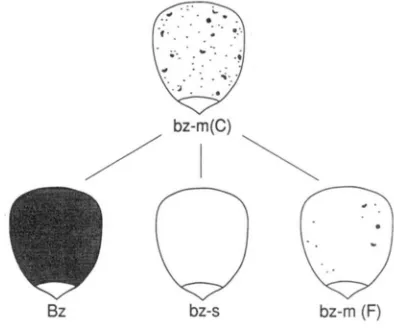
Mutations from bz-m2(Ac): As shown in Figure 1, bz-m2(Ac) can mutate from a normally coarse spotting
type to either full purple, stable bronze or a fine
spotting type (MCCLINTOCK 1956). These exceptions
arise from excisive transposition of the transposable
element Ac from the bz locus, and, therefore, are
highly likely to carry a trAc. When plant transposable
elements excise, they usually do so imprecisely, so that
the excision product retains part of the short direct
repeat generated upon insertion (see review by DOR-
ING and STARLINGER 1986). Since the Ac element in
bz-m2(Ac) is inserted in the second exon of bz (RAL-
STON, ENGLISH and DOONER 1988), it will often leave
behind an impaired bronze gene upon excision. There-
fore, the most common type of derivative is stable bronze (bz-s), followed by a fine mutable type (bz- m:F), indicative of an increase in Ac dosage, and a purple type (Bz), corresponding to restorations of bz
Bz bz-rn (F)
FIGURE 1 .-Phenotypes of bz-mZ(Ac) and its derivatives. bz-m(C).
coarsely spotted: Bz, purple; bz-s, stable bronze; bz-m(F), finely spotted.
locus function. In one experiment involving 5650 bz-
m2 gametes, the aforementioned exceptions occurred
in the following percentages: bz-s, 1.7%, bz-m(F),
1.5%, and Bz, 0.4%. T h e two types of derivatives
analyzed in this study are bz-s and bz-m(F).
Analysis of stable bronze derivatives: New stable
bz alleles originate from excision of Ac from bz-m2(Ac).
They are collectively designated bz-s and each new allele is identified by the four digits of the pedigree
number under which it was first grown (e.g., bz-
s:2097). T h e presence or absence of Ac in each bz-s
stock can be ascertained by crossing to a Ds reporter stock, such as bz-m2(DZ), and scoring for the presence or absence of variegation.
T h e location of trAc is then determined from test-
crosses of Sh bz-s Wx (trAc)/sh bz-m2(DZ) wx heterozy-
gotes to sh bz-R wx, by selecting spotted seed and
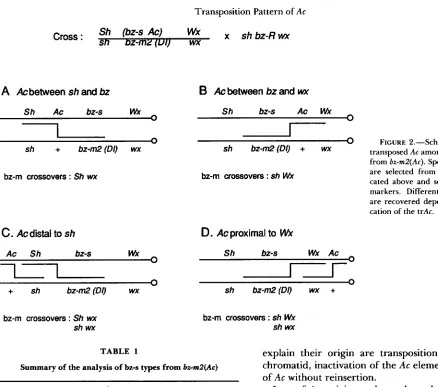
classifying flanking markers. There are various dis- tinct outcomes depending on whether Ac has trans-
posed between sh and bz, between bz and wx, distal to
sh, proximal to wx, or to an unlinked site (Figure 2).
If Ac is located in the sh-bz interval (Figure 2A), crossing over between Ac and bz-m2(DI) will produce plump waxy (Sh wx) spotted seeds. This class should
represent less than 1-2% of the total kernel popula-
tion, or less than half the size of the sh-bz interval (only half of the crossovers can be detected). If Ac is
located in the bz-wx interval (Figure 2B), crossing over
between bz-m2(DZ) and Ac will produce shrunken non-
waxy (sh Wx) spotted seed. Again, this class should
represent less than half the recombination percentage
between bz and wx. If Ac is located distal to sh, recom-
bination events between Ac and sh will give rise to
shrunken waxy (sh wx) spotted seeds and those be-
tween sh and bz will give rise to plump waxy (Sh wx)
spotted seeds (Figure 2C). T h e size of the former class
will vary depending on the location of Ac, but the
Transposition Pattern of Ac 449
A
Acbetween sh and bzB
Ac between bz and wxSh AC bz-S
wx
Sh bz-S AC WXI
0I
0sh
+
b z - d (Dl) wx sh bz-m2 (Dl)+
wx transposed FIGURE 2,”Scheme for mapping Ac among bz-s derivatives from bz-m2(Ac). Spotted (bz-m) seedsbz-m crossovers : Sh wx bz-m crossovers : sh Wx
. .
are selected from the crosses indi- cated above and scored for outside markers. Different crossover types are recovered depending on the lo- cation of the trAc.
c.
Ac distal to shD.
Ac proximal to WxAc Sh bz-S
wx
Sh bz-S WX AcI
I
I
o
0
+
sh b z - d (Dl) wx Sh bZ-d(Dl) wx +bz-rn crossovers : Sh wx bz-rn crossovers : sh Wx sh wx
TABLE 1
Summary of the analysis of bz-s types from bz-m2(Ac)
Ac present
No. ana- Ac ab-
lyzed Total Linked Unlinked sent
116 49 29 20 67
(0.42) (0.58)
(half the size of the sh-bz interval). If Ac is located
proximal to w x , there will also be two types of spotted
kernel recombinants depending on the position of the
exchange: recombination between bz and w x will gen-
erate sh Wx seeds, whereas recombination between
w x and Ac will generate sh wx seeds. T h e former class
should constitute about 10% of the total or half the
recombination percentage between bz and w x ,
whereas the latter class will be of variable size. Finally,
if Ac segregates independently of bz, one quarter of
the kernels will be spotted and among them, the
majority will be sh wx.
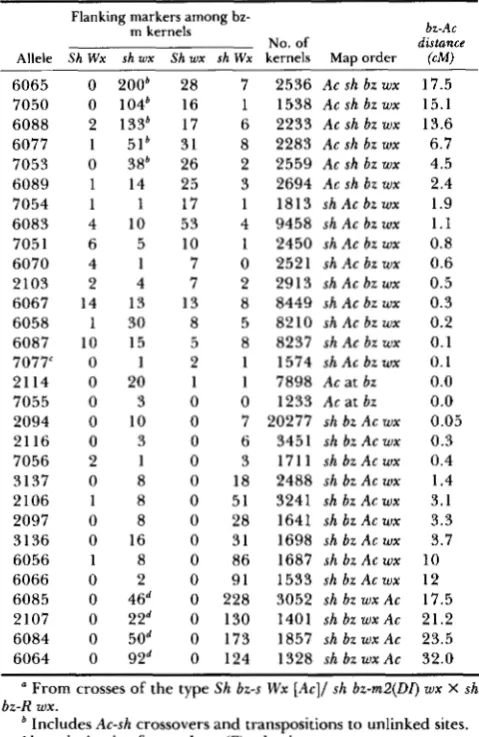
Table 1 shows the summary of the analysis of bz-s
types from bz-mZ(Ac). Of 1 16 cases examined, Ac was
present in 49 (42%) and absent in 67 (58%). Among
those bz-s derivatives having a trAc, 29 (59%) carried
a linked Ac and 20 (41 %) carried an unlinked Ac. It is
evident from the number of bz-s derivatives carrying
an unlinked Ac that loss of a trAc by meiotic segrega-
tion can account for only a fraction of the bz-s deriv-
atives that lack Ac. Other possible mechanisms to
sh wx
explain their origin are transposition to the sister
chromatid, inactivation of the Ac element or excision
of Ac without reinsertion.
Loss of Ac activity at the w x locus has been corre- lated with methylation (modification) of internal sites in Ac (SCHWARTZ and DENNIS 1986; CHOMET, WES-
SLER and DELLAPORTA 1987). In order to investigate
the possibility that inactivation of the Ac element at
the bz locus might contribute to the class of bz-s
derivatives lacking a genetically active Ac element, 24
such derivatives were subjected to Southern blot
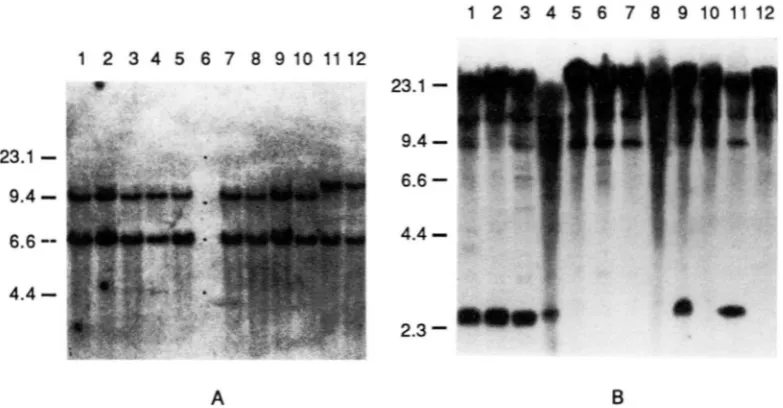
analysis. Figure 3A shows a representative blot in
which BglII digests of DNA from bz-m2(Ac) and sev-
eral bz-s derivatives were hybridized with a bz-specific
probe. T h e individuals in lanes 1 1 and 12 are bz-
mZ(Ac)/bz-R heterozygotes and exhibit the expected
11.2-kb bz-mZ(Ac) band and 6.5-kb bz-R band
(DOONER et al. 1985; RALSTON, ENGLISH and DOONER
1987). T h e individuals in lanes 1-5 and 7-10 are bz-
s/bz-m2(DZ) heterozygotes. All exhibit an identical
pattern, the expected 9.7-kb bz-mZ(DZ) band and a
6.5-kb band that corresponds to the bz empty site,
indicating that these derivatives arise by excision of
Ac. A similar empty site was detected in all other Ac
minus, bz-s derivatives examined.
Further evidence against Ac inactivation at bz comes
from PvuII digests. PvuII is a methylation sensitive
enzyme which produces a characteristic 2.5-kb Ac-
450 H. K. Dooner and A. Belachew
1 2 3 4 5 6 7 8 9 1 0 1 1 1 2
1 2 3 4 5 6 7 8 9 1 0 1 1 1 2
c 23.1
-
ir
9.4-
6.6
-
23.1
-
:.\:4.4
-
2.3
-
"
A B
FIGURE 3.-Southern blot analysis of 62-s derivatives. (A) Bglll digests hybridized to the br-specific probe pAGS528 (DOONER et al. 1985). Lmes 1-5 and 7-10: bz-s/br-m2(DI) heterozygotes; lanes 1 1 and 12: bz-m2(Ac)/bz-R heterozygotes; lane 6: molecular weight markers. (B)
fuull digests hybridized to pAGS501, the internal 1.6-kb Hindlll fragment from Ac (DOONER el al. 1985). Lane 1: bz-m2(Ac)/bz-R; lanes 2- 4 . 9 and 1 1 : br-s/br-R heterozygotes, Ac present; lanes 5-8, 10 and 12: br-s/bz-R heterozygotes, Ac absent.
element or larger fragments in stocks carrying an
inactive Ac element at the wx locus (SCHWARTZ and
DENNIS 1986; CHOMET, WESSLER and DELLAPORTA
1987). Figure 3B shows a Southern blot analysis of
several bz-s derivatives that either have or lack Ac.
Hybridization of PvuII digests with an Ac-homologous probe reveals the presence of a 2.5-kb band in stocks carrying an active Ac (lanes 1-4, 9 and 11) and its absence in stocks lacking an active Ac (lanes 5-8, 10 and 12). None of the 24 Ac minus, bz-s derivatives tested produced a 2.5-kb band or any other distinct
band that hybridized to Ac. We conclude that the
majority of this class of derivatives originates by Ac excision without reinsertion, by sister chromatid trans- position or by transposition to locations in the genome where Ac becomes inactivated by methylation. Evi- dence that such Ac elements may exist was obtained
by DOONER et al. (1 985), who isolated from a bz-m2(Ac)
stock with a single active Ac at bz an element similar to Ac in size and restriction map that had inserted in highly repetitive DNA and that was probably geneti- cally inert.
For those transposed Ac elements linked to the bz
donor site, the estimates of genetic distance between Ac and bz are based on testcross progenies of at least
1000 kernels each. Table 2 presents the pertinent
mapping data. An examination of the data reveals the following salient points.
1. In most cases there is a majority recombinant
class, so that the proximal-distal orientation of trAc
relative to bz can be readily established. In the few
instances where there is no obvious majority recom-
binant class (e.g., bz-s:6087), the few individuals car-
rying recombinant arrangements of outside markers
were progeny tested further to elucidate the bz-Ac
linkage relationship. T h e Sh wx and sh Wx spotted
exceptions (bz-m2(DI)/bz-R Ac/+) were backcrossed
to the sh bz-R wx tester. True crossovers, in which
trAc is linked to the
Ds
reporter allele, will segregateapproximately 1 bz-m: 1 bz; secondary transpositions
of trAc to unlinked sites will segregate 1 bz-m: 3 bz.
In all the cases examined, the Sh wx exceptions seg-
regated 1 : 1, whereas the sh Wx exceptions segregated
1:3, indicating that trAc was closely distal to bz. The basis for the absence of a distinct majority recombi- nant class among bz-s derivatives in which trAc is closer than 0.2 cM on the distal side of bz is the inequality in genetic lengths of the two flanking intervals, sh-bz and bz-wx, which leads to a fortuitous balance between
the number of true crossovers (Sh W X ) and the number
of secondary transpositions to unlinked sites that are accompanied by an exchange in the larger bz-wx inter- val (sh Wx).
2. In two derivatives, bz-s:2114 and bz-s:7055, Ac appears to reside at bz. Southern analysis of these derivatives indicates that they carry deletions imme-
diately adjacent to the Ac insertion site (DOONER 1985
and our unpublished results). This inference has been confirmed by cloning and sequencing the bz-s:2114
allele, which arose by deletion of 789 bp proximal to
Ac (DOONER, ENGLISH and RALSTON 1988). Since in
these derivatives Ac still resides at the bz locus, the alleles have been designated bz-s:2114(Ac) and bz- s:7055(Ac).
3. Among bz-s derivatives carrying a transposed Ac
element within the sh-wx interval, the parentally
marked sh wx spotted class represents principally sec-
Transposition Pattern of Ac 45 1
TABLE 2
Placement of linked trAcs among bz-s selections from bz-m2(Ac)"
Flanking markers among bz-
m kernels bz-Ac
Allele Sh Wx sh wx Sh w x sh Wx kernels MaDorder (cM)
No. of distance
- 6065 7050 6088 6077 7053 6089 7054 6083 7051 6070 2103 6067 6058 6087 7077' 21 14 7055 2094 2116 7056 3137 2106 2097 3136 6056 6066 6085 2107 6084 6064
0 20Ob 0 104' 2 133' 1 51b
0 38' 1 14
1 1
4 10
6 5
4 1
2 4
14 13 1 30 10 15
0 1
0 20
0 3
0 10
0 3
2 1
0 8
1 8
0 8
0 16
1 8
0 2
0 46d 0 22d 0 50d 0 92d
28 16 17 3 1 26 25 17 53 10 7 7 13 8 5 2 1 0 0 0 0 0 0 0 0 0 0 0 0 0 0 7 1 6 8 2 3 1 4 1 0 2 8 5 8 1 1 0 7 6 3 18 51 28 31 86 9 1 228 130 173 124
2536 Ac sh bz wx
1538 Ac sh bz wx
2233 Ac sh bz wx
2283 Ac sh bz wx
2559 Ac sh bz wx
2694 Ac sh bz wx
1813 sh Ac bz wx
9458 sh Ac bz wx
2450 sh Ac bz wx
2521 sh Ac bz wx 2913 sh Ac bz w x 8449 sh Ac bz wx
8210 sh Ac br w x
8237 sh Ac bz wx
1574 sh Ac bz wx
7898 Ac at bz
1233 Ac at bz
20277 sh bz Ac wx
3451 sh bz Ac wx
1711 s h b r A c w x
2488 sh bz Ac w x 3241 sh bz Ac wx
1641 sh bz Ac wx
1698 sh bz Ac wx
1687 sh bz Ac wx
1533 sh bz Ac wx
3052 sh bz wx Ac
1401 sh bz w x Ac
1857 sh bz wx Ac
1328 sh bz wx Ac
17.5 15.1 13.6 6.7 4.5 2.4 1.9 1.1 0.8 0.6 0.5 0.3 0.2 0.1 0.1 0.0 0.0 0.05 0.3 0.4 1.4 3.1 3.3 3.7 10 12 17.5 21.2 23.5 32.0 From crosses of the type Sh bz-s Wx [Ac]/ sh bz-mZ(DI) wx X sh
Includes Ac-sh crossovers and transpositions to unlinked sites. bz-s derivative from a bz-m(F) selection.
Includes wx-Ac crossovers and transpositions to unlinked sites. bz-R W X .
been demonstrated by testcrossing a group of these
exceptions to bz-R and verifying that they segregate 1
bz-m: 3bz (DOONER, RALSTON and ENGLISH 1988).
Therefore, the frequency of this class provides an
estimate of the frequency of secondary transposition
of Ac from its new location in the genome to unlinked
sites. For most trAcs, this frequency is less than 1 in
100, but can range from less than 1 X 1 0-3 for the
trAc element in the bz-s:2094 derivative, which carries
in addition a 2-kb single-ended, fractured Ac element at bz (E. J. RALSTON, J. ENGLISH AND H. K. DOONER, in preparation), to a high of 1.8% for the trAc in the b z - s : 3 2 3 6 derivative, the mean being 5 X (Fre-
quencies have been adjusted by a factor of 2, since
transposition to unlinked sites can be detected in only half the gametes.) T h e variability in secondary trans-
position frequencies among trAc elements derived
from the P - w allele has also been reported by VAN
SCHAIK and BRINK (1 959).
4. Among bz-s derivatives carrying a trAc outside
the sh-wx interval, the sh wx spotted class (marked
with superscripts in Table 2) includes both secondary
transpositions and crossovers between Ac and either
flanking marker, the ratio of their respective contri-
butions being inversely related to the distance sepa-
rating Ac from the flanking marker. Based on the
preceding paragraph, one can expect that the contri- bution of secondary transpositions to the sh wx class
will be generally low, 0.5% on average. Since no
attempt was made to separate transpositions from
crossovers in most cases, the distance between bz and
Ac among these derivatives was estimated by adding
the percentage of the sh wx class, corrected by 0.5%
to account for secondary transpositions, to that of
either the Sh wx or the sh Wx recombinant class. 5. Sh Wx spotted exceptions constitute, by far, the
smallest flanking marker class in Table 2. This is to
be expected since, formally, they represent double
crossovers in the sh wx region, where interference is
high. However, in the group of seven bz-s derivatives
with an Ac element within 1 cM distally from bz, Sh
Wx is not the smallest class. In fact, the frequency of
the Sh bz-m Wx class is higher in these bz-s derivatives
(37/34354 or 0.1 1 %) than in the eight bz-s derivatives
carrying Ac farther than 1 cM distally from bz (9/
25564 or 0.04%). This result is the opposite of what
one would expect if Sh Wx spotted types arose by
double crossing over. However, it is in agreement
with our earlier observations on intragenic recombi- nation between transposable element insertion muta-
tions (DOONER and KERMICLE 1986; DOONER 1986).
We found that recombination between chromosomes bearing closely linked insertions produces predomi-
nantly parentally marked exceptions. Thus, the oc-
currence of Sh bz-m Wx types among bz-s derivatives
carrying a distal Ac element closely linked to bz can
be explained by recombination events between trAc
and
Ds
that are resolved without flanking markerexchange, i.e., by conversion of the bz-m2(DZ) reporter
allele. T h e reciprocal conversion event of the trAc site may also occur. It would give rise to a sh bz-m wx kernel type, which would only be distinguished from a phenotypically identical secondary transposition by
progeny testing. No attempt was made in this study
to sort out the relative contributions of these two
sources of sh bz-m wx kernels.
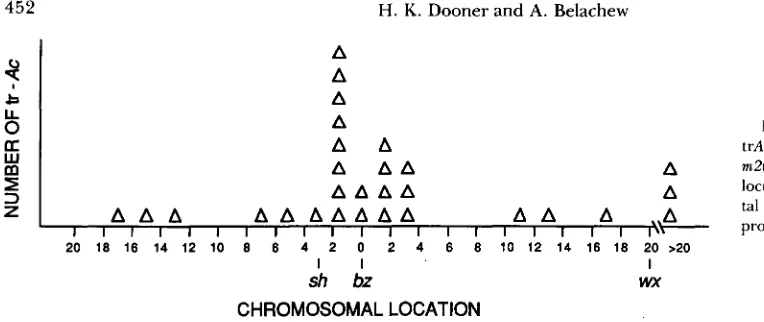
T h e distribution of linked trAcs in 9s is shown
graphically in Figure 4. An examination of this figure
leads to the following conclusions. First, as in the P
locus data, there is an obvious clustering of receptor
sites closely linked to the bz donor site. There are two
0 values: these are real and correspond to deletions
adjacent to the Ac insertion site in bz. Second, Ac
appears to transpose proximally and distally with
452 H. K. Dooner and A. Belachew
9
B
A A A A A A A A A A A A A
+
2A A A A
A
f
A
A Ac
A[r A A
m A A A
A
w
1 1 1 1 1 1 1 1 1 1 1 1 1 1 1 1 1 1 1 1 ~ 2 0 1 8 1 6 1 4 1 2 1 0 8 6 4 2 0 2 4 6 8 ’
I I
sh
bzCHROMOSOMAL LOCATION
locus data, there is no region devoid of trAcs either
immediately to the left or right of bz.
Analysis of finely spotted derivatives: A well known property of Ac is its “negative dosage effect,” i . e . , as Ac dosage is increased, there is a delay in timing
and a reduction in frequency of transposition of Ac
(MCCLINTOCK 1951; BRINK and NILAN 1952). T h e
spots in a spotted kernel become fewer and finer, so
that kernels with a fine spotting phenotype in ears
carrying bz-m2(Ac) represent instances where Ac dos- age has increased as a consequence of an Ac transpo- sition event. Such derivatives are collectively referred
to as bz-m(F), a convenient phenotypic designation.
In bz-m2(Ac) ears they constitute a clearly discrete
phenotypic class, easily distinguishable from the ma- jority of coarsely spotted kernels.
T h e location of trAcs among bz-m(F) derivatives
was mapped in a similar fashion to the location of
trAcs among bz-s derivatives. In the following discus-
sion, (trAc) stands for a linked trAc of undetermined
location in 9s. Testcrosses of heterozygotes Sh bz-
m2(Ac) Wx (trAc)/sh bz-m2(DZ) wx produce a majority
of either finely spotted or bronze seeds plus a few exceptional coarsely spotted seeds that carry a single
Ac element. The-exceptions, designated bz-m(C), were
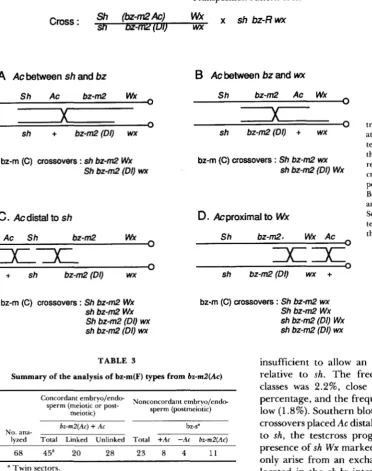
selected and classified for outside markers. As shown in Figure 5, various outcomes are possible, depending
on where Ac is located. However, because the products
of reciprocal recombination, bz-m2(Ac) and bz-m2(DZ) (trAc), are phenotypically equivalent, the flanking marker classification of bz-m(C) exceptions is not a
sufficient criterion to determine the position of the
exchange (compare Figure 5 , A and B). Southern blot
analysis must be used to determine the bz locus con-
stitution of bz-m(C) crossover exceptions in those cases
where the trAc lies within approximately 3 cM of bz.
For example, if trAc is located in the sh-bz interval
(Figure 5A), recombination between trAc and bz-
m2(DZ) will produce Sh wx and sh Wx coarsely spotted seeds in about equal numbers. Southern blot analysis would establish that the former carry bz-m2(DZ) and
the latter carry bz-m2(Ac) at the bz locus. These excep-
tions should represent less than about 3% of the total,
IO 12 14 16 18 20 >20
I
wx
FIGURE 4.-Distribution of linked trAcs among br-s selections from bz-
rn2(Ac). T h e position of the donor br
locus is indicated as 0. Locations dis- tal to bz are to the left and those proximal to bz are to the right of bz.
the percent recombination between sh and bz. Ac
locations farther than about 3 cM from bz can be
distinguished on the basis of genetic data alone, fol- lowing a similar logic to that applied to the mapping
of trAcs among bz-s derivatives.
T h e summary of the analysis of 68 bz-m(F) types
from bz-m2(Ac) is presented in Table 3. Unlike the
situation with the br-s types, there are two classes of
bz-m(F) derivatives with respect to transmission of the
selected phenotype to the next generation: those with
a concordant embryo and endosperm, in which the
embryo carries a trAc besides the one present at bz, as
expected from the selected finely spotted phenotype, and those with a nonconcordant embryo and endo- sperm, in which the genotype of the embryo is differ-
ent from the expected bz-m2(Ac)
+
trAc.Concordant bz-m(F) derivatives can arise from Ac
transposition either at meiosis or at a postmeiotic
division occurring early enough to lead to the recov- ery of a trAc in both the embryo and the endosperm.
Of 48 trAcs in such derivatives, 20 (41%) are linked
to bz, whereas 28 (59%) are unlinked. Nonconcordant
bz-m(F) derivatives arise post-meiotically, during de-
velopment of the female gametophyte. Of 23 such
cases examined, 11 simply carried bz-m2(Ac) and 12
carried a bz-s allele. Among the bz-s types, Ac was
present in 8 and absent in 4. Nonconcordant bz-m(F)
derivatives carrying a bz-s allele in the embryo can be
considered to represent twin sectors originating at the megagametophytic mitosis that gives rise to the egg
and to its sister polar nucleus (COOPER 1937; SIMCOX,
SHADLEY and WEBER 1987). Their possible origins
will be discussed later.
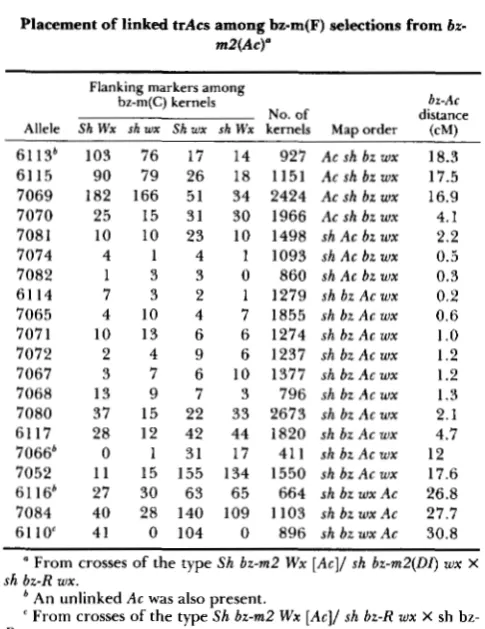
T h e data for the placement of linked trAcs among the bz-m(F) selections are presented in Table 4. For
all derivatives where Ac mapped within 3 cM from br,
Southern blot analysis of at least three bz-m(C) cross- overs allowed the unambiguous placement of Ac rela-
tive to bz. For example, among the bz-m(C) offspring
from derivative 7074, the 3 Sh wx crossovers exam-
ined carried bz-m2(DZ) and the single sh W X crossover
carried bz-mB(Ac), whereas among the bz-m(C) off-
Transposition Pattern of Ac 4 5 3
A
Acbetween sh and bzB
Ac between bz and wxSh AC bZ-m2 Wx Sh bz-m2 Ac Wx
x.
x.
Sh
+
bZ-m2 (Dl) wx sh bzm2 (Dl)+
wxbz-rn (C) crossovers : sh bz-m2 Wx bz-m (C) crossovers : Sh bz-mZ wx
Sh bz-m2 (Dl) wx Sh bZ-m2 (Dl) WX
c.
Ac distal to shAc Sh bz-m2 wx
xx
0+ sh bz-m2 (Dl) wx
bz-m (C) crossovers : Sh bz-m2 Wx sh bz-m2 Wx Sh bz-m2 (Dl) wx
Sh b z - d (Dl) wx
D.
Acproximal towx
Sh bZ-m2. WX AC
X
I
o
Sh bZ-m2 (Dl) wx
+
bt-rn (C) crossovers : Sh bz-m2 wx
Sh bz-m2 Wx
sh bzm2 (Dl) wx
Sh bZ-m2 (Dl) WX
TABLE 3
Summary of the analysis of bz-m(F) types from Lz-mZ(Ae)
c ~ ~ ~ Nonconcordant embryo/endo- ~ ~ ~ , e ~ ~ ~ ~ ~ ~ ~
-meiotic) sperm (postmeiotic)
bz-m2(Ac)
+
AcNo. ana- bz-sa
lyzed Total Linked Unlinked Total +Ac -Ac bz-mP(Ac)
68 45‘ 20 28 23 8 4 1 1
Twin sectors. Three had 2 tr-Acs.
the Sh wx crossovers analyzed carried bz-m2(Ac) and the sh Wx crossovers carried bz-m2(DZ). As with the bz-s derivatives, a high frequency of parentally marked sh wx and Sh Wx exceptions is indicative of Ac trans-
position to sites outside the sh-wx marked interval. In
those cases, the frequency of Sh wx and sh Wx recom-
binant classes was invariably close to either the sh-bz
or 62-wx recombination values. For example, in deriv- ative 61 13, the frequency of parentally marked bz- m(C) kernels is high (1 9.3%) and the frequency of nonparentally marked bz-m(C) kernels is 3.3%, close
to the actual recombination percentage between sh
and bz. Thus, the genetic data suggests that Ac is distal
to sh. Southern blot analysis of recombinant bz-m(C)
individuals confirmed this placement.
In one case, 708 1, the criteria described above were
FIGURE 5,”Scheme for mapping transposed Acs among bz-m(F) deriv- atives from bz-mP(Ac). Coarsely spot- ted (bz-m(C)) seeds are selected from the crosses indicated above and sco- red for outside markers. Different crossover types are recovered de- pending on the location of the trAc. Because the phenotypes of br-mP(Ac) and bz-mZ(DI)
+
Ac are equivalent, Southern blot analysis is used to de- termine the bz locus constitution of the bz-m(C) crossover products.insufficient to allow an accurate placement of trAc
relative to sh. T h e frequency of the nonparental
classes was
2.2%,
close to the sh-bz recombinationpercentage, and the frequency of parental classes was low (1.8%). Southern blot analysis of selected bz-m(C)
crossovers placed Ac distal to bz. T o locate trAc relative
to sh, the testcross progeny were screened for the
presence of sh Wx marked bz-m(F) kernels, which can
only arise from an exchange between sh and a trAc
located in the sh-bz interval. This class was, in fact,
found (5/1498), thus allowing the placement of Ac
proximal to sh.
As with the bz-s derivatives, secondary transposi-
tions of either the Ac element at bz or the trAc will
affect the estimates of genetic distance between bz and
trAcs lying outside the sh-wx marked region. Cosegre-
gation of either newly transposed Ac with the sh bz-
m2(DZ) wx chromosome will result in sh wx parentally
marked bz-m(C) offspring. Conversely, excision and
loss of the primary trAc will result in Sh Wx parentally
marked bz-m(C) offspring. However, since the per-
centage of parentally marked classes among bz-m(F)
derivatives carrying a trAc within the interval delim-
ited by the flanking markers sh and wx is low (some-
what variable, but around l%), the frequency of sec-
454 H. K. Dooner and A. Belachew
TABLE 4
Placement of linked trAcs among bz-m(F) selections from bx- mZ(Ac)”
Flanking markers among
bz-m(C) kernels br-Ac
No. of
Allele Sh Wx sh wx Sh wx sh Wx kernels Map order (cM) 6113’ 103 76 17 14 927 A c s h b z w x 18.3 distance
6115 90 79 26 18 1151 A c s h b z w x 17.5 7069 182 166 51 34 2424 Ac sh bz wx 16.9 7070 25 15 31 30 1966 A c s h b z w x 4.1 7081 10 10 23 10 1498 s h A c b z w x 2.2
7074 4 1 4 1 1093 sh Ac bzwx 0.5
7082 1 3 3 0 860 sh Ac bz wx 0.3
61 14 7 3 2 1 1279 sh be Acwx 0.2
7065 4 10 4 7 1855 sh bz Acwx 0.6
7071 10 13 6 6 1274 sh b z A c w x 1.0
7072 2 4 9 6 1237 sh bz Ac wx 1.2
7067 3 7 6 10 1377 s h b z A c w x 1.2
7068 13 9 7 3 796 s h b z A c w x 1.3
7080 37 15 22 33 2673 sh bz Ac wx 2.1 6117 28 12 42 44 1820 s h b z A c w x 4.7
7066’ 0 1 31 17 411 s h b z A c w x 12 7052 1 1 15 155 134 1550 s h b z A c w x 17.6
61 16’ 27 30 63 65 664 sh bz wx Ac 26.8 7084 40 28 140 109 1103 sh b z w x A c 27.7 6110“ 41 0 104 0 896 sh bz w x A c 30.8
a From crosses of the type Sh bz-m2 Wx [ A c ] / sh bz-m2(DI) wx X
*
An unlinked Ac was also present. sh bz-R W X .From crosses of the type Sh bz-m2 Wx [Ac]/ sh bz-R wx X sh bz- R wx.
distance between bz and trAcs lying outside the sh wx
region were obtained by adding the percentages of all
classes of bz-m(C) exceptions and subtracting 1% to
correct for secondary transpositions. This numerical manipulation may affect slightly the estimate of trans- position distance but not the placement of Ac relative to the other 9 s markers.
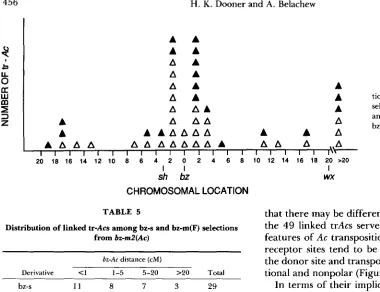
A plot of the distribution of trAcs among bz-m(F)
derivatives is presented in Figure 6. Though only 20
trAcs have been mapped, the following observations
can be made. As with the bz-s derivatives, the trAcs
are recovered in about equal numbers proximally and
distally to bz and there is no obvious region devoid of
trAcs either immediately to the left or right of bz.
However, the clustering of trAcs around the donor
site seen with bz-s derivatives is less pronounced.
Among the nonconcordant bz-m(F) derivatives
which carried a bz-s allele and Ac, two appear by
genomic Southern analysis to have arisen by deletion
of at least part of the bz locus. One of them, bz-s:7079,
may be an adjacent deletion, similar to bz-s:2II4(Ac)
and bz-s:7055(Ac). T h e other one, bz-s:7089, is a sh bz
double mutant. Both of them are being subjected to further molecular analysis to elucidate their origin.
DISCUSSION
T h e pattern of transposition of the Ac element
present in the bz-mZ(Ac) allele in the short arm of
chromosome 9 (9s) has been examined in this report.
There are similarities and differences with the pattern
of transposition of the Ac element present in the P-vu
allele in I S . As in P - w (VAN SCHAIK and BRINK 1959;
GREENBLATT 1984), there is a pronounced clustering
of Ac receptor sites closely linked to the donor site.
T h e preference shown by Ac for very closely linked
sites may be even stronger for bz than for P . In
contrast to P-vu (GREENBLATT 1984), however, the
distribution of receptor sites adjacent to the donor site is symmetric. There is a roughly equal distribution
of trAcs on either side of the bz donor site and, more
importantly, there is no region devoid of receptor
sites either immediately proximal or distal to bz.
If the pattern of transposition of Ac adjacent to bz
were a reflection of a chromosome replication pattern,
as GREENBLATT ( 1 984) has suggested for P , the repli-
con initiation site would have to be either within Ac
or very close to the Ac insertion site. According to
GREENBLATT’S most recent replicon model ( 1 984), Ac
transposes during replication and reinserts only at sites that are as yet unreplicated. Though the symmetrical distribution of receptor sites immediately adjacent to
bz neither supports nor disproves this model, the data
presented here can best be explained by the simpler
model of Ac transposition initially proposed by GREEN-
BLATT and BRINK ( 1 962) according to which Ac trans-
poses during chromosome replication from a repli-
cated site to either a replicated or an unreplicated
site. That is, no restrictions were placed on the nature
of the receptor site, which in GREENBLATT’S later
model (1984) had to be a region that was actively
replicating. T h e transposition of Ac to unreplicated
sites, a feature of both models, has been demonstrated
physically by CHEN, GREENBLATT and DELLAPORTA
(1 987). In the following discussion, various aspects of
the bz locus data will be examined in light of the
GREENBLATT and BRINK ( 1 962) model.
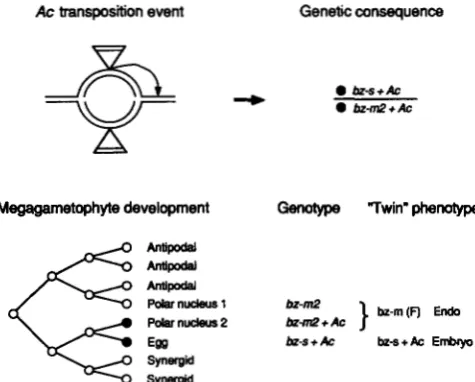
T h e origin of the nonconcordant bz-m(F) deriva-
tives carrying bz-s plus a trAc (Table 3) can be envi-
sioned as shown in Figure 7. As in the GREENBLATT
and BRINK ( 1 962) model, Ac transposes after replica- tion and into an unreplicated site. T h e consequence of such a transposition event will be that one sister
chromatid carries bz-s plus a trAc and the other one
carries bz-m2(Ac) plus a trAc. As drawn in the figure,
the unreplicated receptor site lies in the same chro- mosome, but it could lie in a different chromosome,
as well. If the egg receives the bz-s [trAc] chromatid
and its sib polar nucleus receives the bz-mZ(Ac) [trAc] sister chromatid, the kernel resulting from double
fertilization will have a bz-m(F) endosperm and a bz-s
[trAc] embryo.
T h e origin of the nonconcordant bz-m(F) deriva- tives where the embryo lacks Ac, a class of twin sector
Transposition Pattern of Ac 455
A
A
A
A
A
A
A
A
I , , , , , , , , , , , , , , , , , , ,
A A
A A A A A A
A
A IA+"
2 0 1 8 1 6 1 4 1 2 1 0 8 6 4 2 0 2 4 6 8
" "
I I
sh
bzCHROMOSOMAL LOCATION
according to their 1962 model as originating from
transposition of Ac after replication and into an al- ready replicated site (Figure 8). The consequence of
this event will be sister chromatids carrying bz-s with-
out Ac and bz-m2(Ac) with a trAc, respectively. In the
figure, the replicated receptor site lies in the same
replicon, but could also lie in a different replicon of
the same chromosome or in a different chromosome.
Again, if at the corresponding mitosis the egg receives
bz-s and its sib polar nucleus receives bz-mP(Ac) plus a
trAc, the kernel resulting from double fertilization
will have a bz-m(F) endosperm and a bz-s embryo lacking Ac.
Other postmeiotic transposition events not dia- grammed here will produce nonconcordant kernels with a bz-m(F) endosperm and a bz-m2(Ac) embryo and, as mentioned earlier, others will also contribute
to the concordant class. Notice in Table 3 the high
proportion of concordant derivatives carrying un-
linked trAcs. The greater the contribution to the
concordant class of postmeiotic events relative to
meiotic events, the greater the proportion of unlinked
trAcs to linked trAcs will be since there is no interven- ing meiosis to segregate out Acs that have transposed to unlinked sites.
Ac transposition event Genetic consequence
10 12 14 16 18 20 >20
I wx
FIGURE 6.-Distribution of linked trAcs among bz-m(F) selections from br-mZ(Ac). The position of the donor br locus is indicated as 0. Locations distal to br are to the left and those proximal to br are to the right of bz.
An interesting point to consider in the analysis of
the distribution of linked to unlinked receptor sites
for trAcs is whether their ratio changes in different cell divisions. In an attempt to obtain an answer to this question one can make the following comparison.
Since bz-s derivatives occur as single kernels in bz-rn2
ears, they can be considered to arise at or shortly
before meiosis. (A transposition event occurring post- meiotically cannot result in a kernel with a bronze
phenotype because the two polar nuclei have different
cell lineages.) Conversely, noncorresponding kernels must originate from gametophytic transposition
events. Therefore, a comparison of the ratio of linked
to unlinked trAcs in these two classes might reveal if large differences occur in the distribution of Ac recep- tor sites between meiosis and gametophytic mitoses.
Among the 49 6%-s derivatives carrying a trAc, Ac
was found to be unlinked in 20 (Table 1). One can
expect an equal number of unlinked trAcs to have
been lost by meiotic segregation. Therefore, at
meiosis, the proportion of receptor sites unlinked to
the donor site would be 40/69 or 58%. Though the
number of nonconcordant bz-m(F) derivatives carry- ing bz-s and a trAc was small (Table 3), examination
Ac transposition event Genetic consequence
Megagametophyte development Genotype Twin' phenotype Megagametophyte development Genotype Twin"phenotype
FIGURE 7.-Model to explain the origin of nonconcordant bz- m(F) derivatives where the embryo carries a bz-s allele and a trAc.
Am=-
" Antipodal
POlarMldewl bz-nl2
Poknudeus2 bz-Il?z+Ac
}
k-m(F)E a bZ-S k-s Embryo
Synetgid
Synergid
H . K. Dooner and A. Belachew
A
A
A A
A
A
A
A
A A
A
A
A
FIGURE g.-Cumulative distribu-A
A
A tion of trAcs among bz-s and bz-m(F)A
A A
A
selections from bz-mZ(Ac). Open tri-A
A A
A angles: bz-s selections; solid triangles:A A A A A A A
A
A
bz-m(F) selections.A A A A A A A A A A A
A
A A A
&
l l i l I l l l l l l l l l l l l l l l ~
20 18 16 14 12 10 8 6 4 2 0 2 4 6 6 10 12 14 16 18 20 >20
sh I bz I
CHROMOSOMAL LOCATION
TABLE 5
Distribution of linked trdcs among bz-s and bz-m(F) selections from bx-m2(Ac)
6%-Ac distance (cM)
Derivative < I 1-5 5-20 >20 Total
bz-s 1 1 8 7 3 29
Fraction 0.38 0.28 0.24 0.10 1.0
Fraction 0.20 0.40 0.25 0.15 1.0
bz-m(F) 4 8 5 3 20
of the distribution of linked and unlinked receptor
sites for the trAcs is instructive, nevertheless. In this
group there is no loss of trAcs by meiotic segregation.
Of 8 individuals in the class, 5 or 63% had an unlinked
Ac. Thus, there is no indication in these data that the ratio of linked to unlinked receptor sites changes between meiosis and the ensuing postmeiotic mitoses.
As pointed out in RESULTS, the clustering of trAcs
around the bz donor site appears to be different in bz-
s and bz-m(F) selections from bz-m2(Ac). This differ-
ence is made more obvious if one disregards direction of transposition and pools the transposed Acs into
classes covering progressively larger map distances
away from bz, as has been done in Table 5 . Very close
transpositions, those occurring to sites within 1 cM of
bz, are about twice more frequent in the bz-s class
than in the bz-m(F) class. This difference can be
accounted for in the GREENBLATT and BRINK (1 962)
model if very short-range transpositions at or shortly
after meiosis, tend to be intrachromatid transposi-
tions, i e . , from a donor site to a replicated site in the
same chromatid. Such transpositions would produce bz-s derivatives with very closely linked trAcs, but
would not produce bz-m(F) derivatives. GREENBLATT
(1984) has raised the important question of whether the means of uncovering the transpositions could in- fluence the recovery of receptor site locations. At least for 6 2 , this is clearly the case.
Finally, though the above analysis of the distribu- tions of trAcs among the two types of selections reveals
I wx
that there may be differences, pooling of the data for
the 49 linked trAcs serves to emphasize the general
features of Ac transposition to sites linked to 6%: the
receptor sites tend to be clustered on either side of
the donor site and transposition appears to be bidirec- tional and nonpolar (Figure 9).
In terms of their implication on strategies for tag-
ging genes with Ac, the bz locus data support the
existing P locus data (VAN SCHAIK and BRINK 1959;
GREENBLATT and BRINK 1962; GREENBLATT 1984) in showing a pronounced preference for short range transpositions of Ac. Therefore, it is important to
initiate an Ac mutagenesis experiment with an Ac
element closely linked to the desired target locus. This
can be presently achieved in corn through the use of
translocation chromosomes carrying Ac (e.g., GREEN-
BLATT'S derivation of mR-nj, cited in BRINK and WIL-
LIAMS 1973) and it may soon be possible in dicots through the use of transformed lines carrying easily scorable Ac-mutable genes, such as the green-white variegating SPT::Ac (streptomycin phosphotransfer-
ase), at appropriate locations in the genome (JONES et
al. 1989).
We would like to thank ED RALSTON and DIANE BURGFSS for comments on the manuscript and JOYCE HASHASHI for the artwork. This is paper No. 5-1 1 from Advanced Genetic Sciences.
LITERATURE CITED
BRINK, R. A., and R. A. NILAN, 1952 The relation between light variegated and medium variegated pericarp in maize. Genetics
BRINK, R. A., and E. WILIAMS, 1973 Mutable R-navajo alleles of cyclic origin in maize. Genetics 73: 273-296.
CHEN, J., I . M. GREENBLATT and S. L. DELLAPORTA, 1987 Transposition of Ac from the P locus of maize into unreplicated chromosomal sites. Genetics 117: 109-1 16. CHOMET, P. S., S. WFSSLER and S. L. DELLAPORTA,
1987 Inactivation of the maize transposable element Activator (Ac) is associated with its DNA modification. EMBO J. 6 295- 302.
CONE, K . C., F. A. BURR and B. BURR, 1986 Molecular analysis of the maize anthocyanin regulatory locus C I . Proc. Natl. Acad. Sci. USA 83: 9631-9635.
Transposition Pattern of Ac 457
COOPER, D. C., 1937 Macrosporogenesis and embryo sac devel- opment in Euchtaena mexicana and Zea mays. J. Agric. Res. 55:
DOONER, H. K., 1985 A deletion adjacent to the Ac insertion site in a stable derivative from bz-mP(Ac), pp 561-573 in Plant Genetics, edited by M. FREELING. Alan R. Liss, New York. DOONER, H. K. 1986 Genetic fine structure of the bronze locus
in maize. Genetics 113: 1021-1036.
DOONER, H. K., and J. L. KERMICLE, 1986 The transposable element Ds affects the pattern of intragenic recombination at the bz and R loci in maize. Genetics 113: 135-143.
DOONER, H . K., J. ENGLISH and E. J. RALSTON, 1988 The fre- quency of transposition of the maize element Activator is not affected by an adjacent deletion. Mol. Gen. Genet. 211: 485- 491.
DOONER, H. K., E. J. RALSTON and J. ENGLISH, 1988 Deletions and breaks involving the borders of the Ac element in the bz-
mZ(Ac) allele of maize, pp. 2 13-226 in International Symposium on Plant Transposable Elements, edited by 0. E. NELSON and C. WILSON. Plenum Press, New York.
DOONER, H. K., E. WECK, S. ADAMS, E. RALSTON, M. FAVREAU and J. ENGLISH, 1985 A molecular genetic analysis of insertions
in the bronze locus in maize. Mol. Gen. Genet. 200: 240-246. DOONER, H. K., J. ENGLISH, E. J. RALSTON and E. WECK, 1986 A
single genetic unit specifies two transposition functions in the maize element Activator. Science 234: 2 10-2 1 1 .
DORING, H. P., and P. STARLINGER, 1986 Molecular genetics of transposable elements in plants. Annu. Rev. Genet. 2 0 175- 200.
FEDOROFF, N., D. FURTEK and 0. E. NELSON, 1984 Cloning of the bronze locus in maize by a simple and generalizable proce- dure using the transposable element Activator (Ac). Proc. Natl. Acad. Sci. USA 81: 3825-3829.
GREENBLATT, I. M., 1984 A chromosome replication pattern de- duced from pericarp phenotypes resulting from movements of the transposable element Modulator in maize. Genetics 108: 471-485.
GREENBLATT, I. M., and R. A. BRINK, 1962 Twin mutations in medium variegated pericarp maize. Genetics 47: 489-501. JONES, J. J., F. CARLAND, P. MALIGA and H. K. DOONER,
1989 Visual detection of transposition of the maize element Activator in tobacco seedlings. Science (in press).
LECHELT, C., A. LAIRD and P. STARLINGER, 1986 Cloning DNA from the P locus. Maize Genet. Coop. Newslet. 60: 40. MARTIN, C . , R. CARPENTER, H. SOMMER, H. SAEDLER and E. S.
COEN, 1985 Molecular analysis of instability in flower pig- mentation of Antirrhinum majus, following isolation of the pallida locus by transoposon tagging. EMBO J. 4: 1625-1630. MCCARTY, D. R., and C. CARSON, 1987 Transposon tagging of viviparous-1 using Robertson’s Mutator (abstract), p. 64 in Ab- stracts of the International Symposium on Plant Transposable Elements. Madison, Wisc.
539-55 1 .
MCCLINTOCK, B., 1951 Chromosome organization and gene expression. Cold Spring Harbor Symp. Quant. Biol. 1 6 13- 47.
MCCLINTOCK, B., 1955 Controlled mutation in maize. Carnegie Inst. Wash. Year Book 5 4 245-255.
MCCLINTOCK, B., 1956 Mutation in maize. Carnegie Inst. Wash. Year Book 55: 323-332.
MCCLINTOCK, B., 1962 Topographical relations between ele- ments of control systems in maize. Carnegie Inst. Wash. Year Book 61: 448-461.
MCLAUGHLIN, M., and V. WALBOT, 1987 Cloning of a mutable b z 2 allele of maize by transposon tagging and differential hybridization. Genetics 117: 771-776.
O’REILLY, C., N. S. SHEPHERD, A. PEREIRA, 2. SCHWARZ-SOMMER, I. BERTRAM, D. S. ROBERTSON, P. A. PETERSON and H. SAE- DLER, 1985 Molecular cloning of the a1 locus of Zea mays using the transposable elements En and M u l . EMBO J. 4: 877- 882.
PAZ-ARES, J., U. WIENAND, P. A. PETERSON and H. SAEDLER, 1986 Molecular cloning of the c locus of Zea mays: a locus regulating the anthocyanin pathway. EMBO J. 5: 829-833. PETERSON, T., and D. SCHWARTZ, 1986 Isolation of a candidate
clone of the maize P locus. Maize Genet. Coop. Newslet. 60:
RALSTON, E. J., J. ENGLISH and H. K . DOONER, 1987 Stability of deletion, insertion and point mutations at the bronze locus in maize. Theor. Appl. Genet. 74: 471-475.
RALSTON, E. J., J. ENGLISH and H. K. DOONER, 1988 Sequence of three bronze alleles of maize and correlation with the genetic fine structure. Genetics 119: 185-197.
RHOADES, M. M., 1952 The effect of the bronze locus on antho- cyanin formation in maize. Am. Nat. 8 6 105-108.
SCHMIDT, R. J., F. A. BURR and B. BURR, 1987 Transposon tagging and molecular analysis of the maize regulatory locus opaque-2. Science 238: 960-963.
SCHWARTZ, D., and E. DENNIS, 1986 Transposase activity of the Ac controlling element in maize is regulated by its degree of methylation. Mol. Gen. Genet. 205: 476-482.
SIMCOX, K. D., J. D. SHADLEY and D. F. WEBER, 1987 Detection of the time of occurrence of nondisjunction induced by the r- X I deficiency in Zea mays L. Genome 2 9 782-785.
THERES, K., and P. STARLINGER, 1987 Cloning of the bz2 locus of Zea mays using the transposable element Ds as a gene tag. Mol. Gen. Genet. 2 0 9 193-197.
VAN SCHAIK, N., and R. A. BRINK, 1959 Transposition of Modu- lator, a component of the variegated pericarp in maize. Genetics
WIENAND, U., U. WEYDEMANN, U. NIESBACH-KLOSGEN, P. A. PE-
TERSON and H. SAEDLER, 1986 Molecular cloning of the c 2 locus of Zea mays, the gene coding for chalcone synthase. Mol. Gen. Genet. 203: 202-207.
36-37.
44: 725-738.