Phage
X
Cro Protein and
cZ
Repressor Use Two Different Patterns of
Specific Protein-DNA Interactions
to
Achieve Sequence Specificity in
Vivo
Nicholas
Bensonand Philip Youderian
Department of Biological Sciences, University of Southern Calvornia, Los Angeles, Calvornia 90089-1481
Manuscript received April 25, 1988 Accepted for publication September 14, 1988
ABSTRACT
By assaying the binding of wild-type Cro to a set of 40 mutant X operators in vivo, we have determined that the 14 outermost base pairs of the 17 base pair, consensus X operator are critical for
Cro binding. Cro protein recognizes 4 base pairs in a X operator half-site in different ways than cZ
repressor. The sequence determinants of Cro binding at these critical positions in vivo are nearly perfectly consistent with the model proposed by W. F. ANDERSON, D. H. OHLENDORF, Y . TAKEDA
and B. W. MATTHEWS and modified by Y . TAKEDA, A. SARAI and V. M. RIVERA for the specific interactions between Cro and its operator, and explain the relative order of affinities of the six natural X operators for Cro. Our data call into question the idea that X repressor and Cro protein recognize the consensus X operator by nearly identical patterns of specific interactions.
C
RO protein, the product of the cro gene of coli- phage X, is a small polypeptide 66 amino acid residues long (ROBERTS et al. 1977; HSIANC et al. 1977; TAKEDA, FOLKMANIS and ECHOLS 1977). Cro monomers assemble into active dimers in vivo, that bind six specific DNA sites (operators) on the X ge- nome with differential affinities. These operators con- trol the expression of the two phage X early pro- moters, PL and PR [see PTASHNE et al. (1980) and GUSSIN et al. (1983) for reviews]. T h e structure of Cro protein has been solved by X-ray crystallographic analysis to 2.8A resolution (ANDERSON et al. 1981), and has been refined subsequently to 2.2A (OHLEN-DORF et al. 1982). These studies show that Cro mon- omer is composed of three strands of antiparallel
p-
sheet and three a-helices joined by short surface turns, plus a short, disordered carboxyl-terminal arm (Fig- ure 1).
In the Cro dimer, the third a-helices (as; Figure 1) in symmetrically related monomers are separated by a center-to-center distance of 34A, the distance be- tween successive major grooves of B-form DNA (AN-
DERSON et al. 1981). T h e phenotypes of mutations that change amino acid residues in a3 implicate this secondary substructure of Cro in specific DNA-bind- ing (PAKULA, YOUNG and SAUER 1986). Together, these results suggest that the two subunits of the Cro dimer contact nucleotide base pairs (bp) located in successive, adjacent major grooves on the same face of the DNA duplex. T h e results of chemical and enzymatic protection and interference experiments also indicate that the functional groups on DNA im- plicated in binding are nearly symmetrically disposed in two successive major grooves (JOHNSON, MEYER
and PTASHNE 1978;JOHNSON, PABO and SAUER 1980).
Genetics 121: 5-12 (January, 1989)
T o model how Cro binds the X operator, OHLEN- DORF et al. (1982) have proposed that side chains of residues in a3 make a specific pattern of contacts with
operator DNA. This model was constructed initially by using computer graphic approaches to fit the bind- ing surface of Cro defined by the crystal structure with B-form operator DNA, and has been refined successively to account for the results of detailed kinetic and thermodynamic measurements of the binding of wild-type Cro to various operator se- quences (TAKEDA et al. 1983; KIM et al. 1987; SARAI and TAKEDA 1987; TAKEDA, SARAI and RIVERA
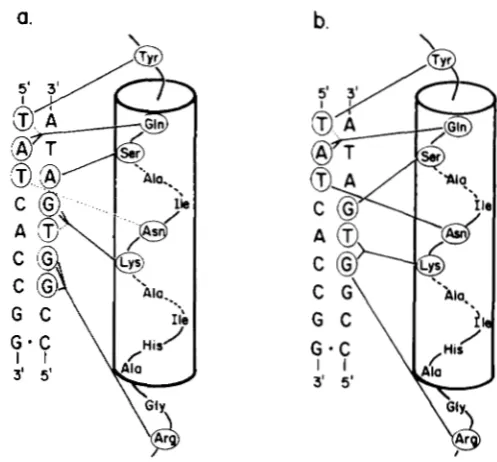
1988). A second model, proposed more recently by HOCHSCHILD and PTASHNE (1 986) and elaborated by HOCHSCHILD, DOUHAN and PTASHNE (1 986), is based on a different set of genetic and chemical modification data, involving the binding of mutant Cro proteins to various operator sequences. This alternative model argues that a subset of the specific contacts Cro makes with the X operator is identical to a subset of the contacts made by X c l repressor. T h e two models are summarized in Figure 2.
To assess the predictions of each model in vivo, we examine the binding of wild-type Cro in vivo to each member of a set of variant X operators derived from a consensus, 17-bp operator that is symmetric about its central bp, and to which Cro binds with high affinity in v i t r o (KIM et al. 1987). Each member of this set of operators differs from the consensus by a pair of symmetric substitutions. Our previous analysis of X
operator
C
roFIGURE 1 .-Cro protein recognizes features of successive major grooves of B-form DNA. The schematic drawing, from TAKEDA et al. (1983), shows two successive major grooves on B-form DNA and a Cro dimer viewed orthogonally with respect to their dyad axes. Note that the angle of tilt between the as helices and dyad axes of
Cro is similar to that of the angle of incidence between the major axis and the screw axes of the major grooves in the X operator. The side chains of more amino-terminal residues of a3 should contact positions more distal to the center of dyad symmetry of the operator (see Figure 2).
or van der Waals interactions) between a repressor dimer and the operator is sufficient to result in a loss
of binding by our assay, our results in vivo corroborate the detailed predictions made by LEWIS et al. (1 983) of how repressor might interact with the operator
(BENSON, SUGIONO and YOUDERIAN 1988).
Given the same assumption, the results of our analy- sis of Cro binding in vivo are nearly perfectly consist- ent with the predictions of the model proposed for Cro binding by OHLENDORF et al. (1 982) as revised by
TAKEDA, SARAI and RIVERA (1988). We argue that the data obtained by HOCHSCHILD and PTASHNE
(1 986) can be reinterpreted, and suggest that Cro may use its surface amino acid side chains to make different sets of specific contacts with operator half-sites that differ in sequence.
MATERIALS AND METHODS
Bacteria, phage and plasmids: Bacterial strains, deriva- tives of Salmonella typhimurium LT2 or Escherichia coli K12, and challenge phages have been described previously (BEN-
SON, SUGIONO and YOUDERIAN 1988), with the exception of Salmonella strain MS 1868/F'lacP' carrying the plasmid source of Cro protein, PAP 10 1 (PAKULA, YOUNG and SAUER 1986). Plasmid pAPlOl carries an operon fusion of the lacUV5 promoter to the CTO gene. Media, enzymes, chemi- cals, general phage techniques, and challenge phage con- structions were as described previously (BENSON, SUGIONO and YOUDERIAN 1988).
Challenge phage infections: Challenge phage infections were performed as described (BENSON, SUGIONO and YOUD- ERIAN 1988), with several modifications. MS 1868/F'lacZ@
a.
b
FIGURE 2.-Models proposed for Cro binding to the X operator. For each model, the a3 helix of Cro is depicted to the right of the consensus operator half-site sequence; the dyad axis passes through position 9 of the operator, indicated by the dot. Solid lines con- necting amino acids of Cro with nucleotide bases indicate hydrogen bonds involved in sequence-specific recognition; dashed lines indi- cate critical van der Waals contacts. The model of OHLEND~RF et al. (1983) as modified by TAKEDA, SARAI and RIVERA (1988) is shown in (a); that proposed by HOCHSCHILD and PTASHNE (1986) is shown in (b). The main difference between the two models is that Ser28 is predicted to contact bp 3 of the operator in the model of TAKEDA, SARAI and RIVERA (a), whereas Ser28 contacts bp 4 in the model of HOCHSCHILD and PTASHNE (b). Lys32 and Arg38 are
predicted to interact with different bp in the two models.
(pAP101) was grown in LB medium supplemented with 50 rg/ml ampicillin at 37" to a density of 2 X 1O8/ml,
8-
isopropylthiogalactoside (IPTG) was added to a final con- centration of M, and the cells were grown to a density of 4 X 10⁸/ml. Challenge phage were added to give an input multiplicity of infection of 20 phage/cell, and allowed to adsorb for 20 min at 25". Appropriate dilutions of infected cells were spread on green indicator plates with ampicillin (50 rg/ml), kanamycin sulfate (20 Pg/ml), and with or without M IPTG. Plates were scored after incubation for 20 hr at 37 "
.
The frequency of lysogeny of cells infected with challenge phage is the concentration of surviving cells divided by the concentration of infected cells. All frequen- cies of lysogeny are average values determined from at least three different experiments, and were found to vary by less than a factor of five from experiment to experiment.Unlike the case for X cZ repressor-producing cells, the frequency of lysogeny of Cro-producing cells infected with challenge phages shows an extremely steep dependence on IPTG concentration [see BENSON, SUGIONO and YOUDERIAN (1988) for comparison]. In the presence of IPTG at concen- trations below M, few pAPl 01-carrying host cells survive challenge phage infection; at IPTG concentra- tions higher than 1 0-5 M, the overproduction of Cro protein or mRNA inhibits cell growth (data not shown).
RESULTS
Cro/Operator Interactions 7
TABLE 1
Frequencies of lysogeny of Cro-producing cells infected with challenge phages carrying the natural X operators
IPTG
Operator Sequence 10pM O p M
ref TATCACCGGCGGTGATA 0.1 4 X
oLI
TA~CACTGGCGGTGATA 4 xoL2
TATC~C~GGCGGTGTTG <10-~oL3
AACCATCTGCCGTGATA 4 0 - 7oRI
TACCTCTCGCGGTGATA <1o - ~
e1 0-7oR2
TA~CACCGTGCGTGTTG " <1o - ~
e1 0-7 "O R 3 TATCACCGCAAGGGATA 0.3 3 X "
Cells producing Cro protein were infected with challenge phages carrying the listed operator sequences. Numbers in the columns are frequencies of lysogeny of Cro-producing cells (the number of surviving cells divided by the number of infected cells) from chal- lenge phage infections in the absence or presence ( 1 0-5 M) of IPTG, performed as described in MATERIALS AND METHODS.
Kn9 arc-amHl605 phage carrying a substitution of an alternative DNA-binding site for the P22 mnt opera- tor. Upon infection with a challenge phage at high multiplicity, a Salmonella host will survive if and only if it produces a protein that can bind the substituted site. T h e fraction of cells that survive challenge phage infection is a measure of how well the substituted site is occupied by a specific DNA-binding protein (BEN-
SON et al. 1986; BASS et a l . 1987; BENSON, SUGIONO and YOUDERIAN 1988; LEBRETON et al. 1988).
We have shown that challenge phages with the consensus X operator efficiently lysogenize a host that produces
X
cZ repressor from a plasmid (BENSON et al. 1986; BENSON, SUGIONO and YOUDERIAN 1988). We tested whether challenge phages carrying the consen- sus X operator or each of the six natural operators could lysogenize a similar host that produces Cro protein. Table 1 shows that, among these seven op- erators, the consensus and OR3 operators have the highest affinity for Cro protein. T h e 0 ~ operator, 1bound best by X repressor among this set of operators, is bound poorly but detectably by Cro. We cannot detect the binding of Cro to any of the four remaining natural operators, 0 ~ 2 , 0 ~ 3 , 0 ~ 1and , 0 R 2 , and cannot
order their relative affinities by this binding assay in vivo. The order of affinities of these operators for Cro (consensus, 0 ~
>
3O L 1>
O R l , O L 2 , 0 ~ 3 , 0 R 2 ) is inagreement with that determined in vitro by KIM et al.
(1987), with the exception that O R 1 was reported to
be better than O L 1 . Reexamination of the primary
data obtained in vitro has shown that the relative affinity of OL1 is slightly better than that of OR1, and the orders of affinity determined in vivo are perfectly consistent with those determined in vitro ( Y . TAKEDA, personal communication).
Cro protein, like cZ repressor, prefers to bind an asymmetric operator: T h e 17-bp consensus operator
TABLE 2
Frequencies of lysogeny of Cm-producing cells infected with challenge phages carrying symmetric X operators
IPTG
Operator Sequence l O p M O p M
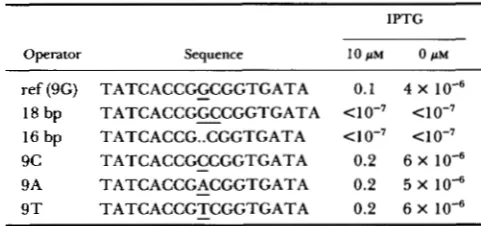
ref (9G) TATCACCGGCGGTGATA 0.1 4 X
18 bp TATCACCGGCCGGTGATA
16 bp TATCACCG..CGGTGATA <I 0-7 < l 0-7
9 c TATCACCGCCGGTGATA 0.2 6 X
9A TATCACCGACGGTGATA 0.2 5 X
9 T TATCACCGTCGGTGATA 0.2 6 X
-
-
- -
~ ~~~~~ ~~~
Cro-producing cells were infected with challenge phages carrying one of the synthetic X operators with the sequences shown. Numbers are frequencies of lysogeny, as in Table 1 . ref = reference-type operator.
bound by X repressor and Cro protein has an asym- metric, central G:C bp (Table 1). An axis of symmetry through this bp relates the 16 bp in the two operator half-sites perfectly. Symmetrically related subunits of a Cro dimer are thought to recognize the two operator half-sites nearly identically (JOHNSON, MEYER and
PTASHNE 1978; JOHNSON, PABO and SAUER 1980;
ANDERSON et al. 198 1). To determine whether Cro protein, like Lac repressor, prefers to bind a symmet- ric site (SADLER, SASMOR and BETZ 1983), we made two perfectly symmetric variants of the consensus operator 16 and 18 bp in length. As shown in Table
2, neither the shorter nor the longer operators bind Cro so well as the 17 bp reference-type operator. From this result we conclude that Cro prefers to bind an asymmetric, 17-bp operator, like
X
cZ repressor (BENSON, SUGIONO and YOUDERIAN 1988). Cro cannot "adjust itself" to recognize pairs of operator half-sites when these half-sites are incorrectly spaced along the DNA helix, a possibility that has been suggested byOHLENDORF et al. (1 982). Thus, the relative spacing and rotational disposition of the X operator half-sites with respect to one another on the surface of B-form DNA are critical for Cro binding.
How critical is the central, asymmetric base pair for Cro binding? Table
2
shows that changing the central, asymmetric bp has no discernible effect on Cro bind- ing, consistent with other results that indicate Cro does not interact with functional groups of the central three bp (positions 8 and 9) of the operator (JOHNSON,MEYER and PTASHNE 1978; JOHNSON, PABO and
SAUER 1980).
Operator determinants of Cro binding: Presum-
TABLE 3
Frequencies of lysogeny of Cro-producing cells infected with challenge phages carrying symmetric, variant X operators
IPTG
Operator Sequence 1 O p M O p M
ref lG* 1A 1 c 2G 2T 2 c 3G 3A 3 c 4G 4A 4T 5G 5 T 5 c 6G 6A 6 T 7G 7A 7 T 8A 8 T 8C TATCACCGGCGGTGATA
-
GATCACCGGCGGTGATC- AATCACCGCCGGTGATT
- CATCACCGGCGGTGATG TGTCACCGGCGGTGACA - -
TTTCACCGGCGGTGAAA TCTCACCGGCGGTGAGA TAGCACCGGCGCTGCTA TAACACCGGCGGTGTTA -
TACCACCGGCGGTGGTA -
TATGACCGGCGGTSATA TATAACCGGCGGTTATA TATTACCGGCCGT&ATA TATCGCCGGCGGCGATA TATCTCCGGCGGAGATA TATCCCCGGCGGGGATA TATCAGCGCCGCTCATA TATCAACGGCGTTGATA - -
TATCATCGGCGATGATA TATCACGGGCCGTGATA TATCACAGGCTJ3TGATA TATCACTGGCAGTCATA TATCACCAGTGGTGATA TATCACCTGAGGTGATA TATCACCCGGGGTGATA - - - - - - - -
0.1 4 x lo+
0.2 2 x
4 X 10-7 4 0 - 7
4 0 - 7 4 0 - 7
4 0 - 7
4 0 - 7 4 0 - 7
4 0 - 7 4 0 - 7
< I O - 7 4 0 - 7
<io-’
4 0 - 7 <lo-’
4 0 - 7
4 0 - 7 5 X 10⁻⁷
4 0 - 7 4 0 - 7
4 0 - 7 4 0 - 7
4 0 - 7 4 0 - 7
4 0 - 7 4 0 - 7
4 0 - 7 4 0 - 7
0.2 2 x lo+
0.04 4 X
0.3 9 X
0.3 8 X 0.2 6 X
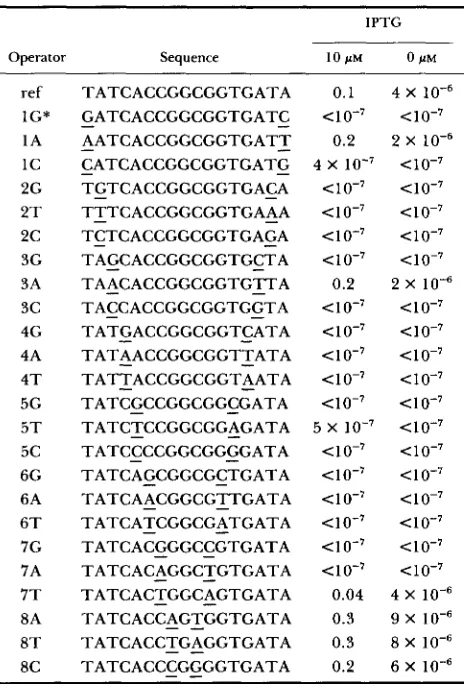
Cro-producing cells were infected with challenge phages carrying one of the synthetic X operators with the sequences shown. Numbers are frequencies of lysogeny, as in Table 1. This analysis was com- plicated by the fact that one of the substitutions (1, T:A&:C; operator lG, indicated by the asterisk) results in the modification
of three adjacent base pairs, since it creates a site recognized by Salmonella Dam methylase ( 5 ’ GATC 3’), in which adenine C6- amino groups are methylated (GOMEZ-EICHELMANN 1979). In a dam+ host, this change not only replaces the T:A base pair at position 1 with G:C, but also results in the methylation of the C6 amino groups of adenine in base pairs 2 and 3. When methylated, this operator sequence does not bind either Cro protein or X repressor. As yet, we have been unable to assay binding in a dam- Salmonella host. ref = reference-type (consensus) operator.
operators that differ from the consensus operator by pairs of single bp changes (Table 3). As summarized in Figure 3 ,
7
bp in the X operator (1 through 7) are critical for Cro binding, since challenge phages car- rying operators with changes in these bp cannot lyso- genize a Cro-producing host. Four of these bp (2, 4, 5 , and 6) are particularly critical for binding, because all three substitutions at each of these operator posi- tions abolish binding.What the challenge phage assay tells us in the case of Cro is simply whether operator changes have severe effects on binding or not ( i . e . , reduce the affinity of the interaction substantially in vivo). We make no
T A T C A C C G G
A : A : : : T A A
: : : : : : : T T : : : : : :
: c c
. . . . . . . . . . . . . .c
Increasedbinding wild-type binding . . . . . . . . . . . . . . . . . . . . . _ _ .
C G G G G G G
G G G G G C]
C C A C A A A A A binding loss of
T T T T T T T T
Cro protein
cl
repressor
FIGURE 3,”Symmetric base pair changes at six positions in the
X operator impair Cro binding. Cells producing Cro were infected with challenge phages differing from the reference-type operator by symmetric pairs of base pair substitutions. The results of these infections are represented in two dimensions. The sequence of the top strand of the left, reference-type half-site is represented by bold letters; the dyad axis passes through position 9 of the operator, indicated by the dot. Immediately below the reference sequence are listed changes that do not change operator strength (negligible). Below the reference sequence are listed the changes that reduce the ability of Cro to bind to more than 10‘-fold (severe). The data for c l repressor (BENSON, SUGIONO and YOUDERIAN 1988) are shown for comparison; some operator changes fall into a third, interme- diate category in terms of their ability to be bound by c l repressor, changes that reduce survival less than 104-fold (mild). The 3C change is shown above the consensus half-site for c l repressor, since it results in an operator with higher affinity for repressor.
claims that the numbers we obtain as an indication of relative affinities measured by a genetic assay in vivo have anything to do with relative affinities measured in vitro. In fact, this is something we do not wish to do, particularly in view of the results of NELSON and
SAUER ( 1 985) showing that affinities measured for X
repressor mutants in vitro may have a limited relation to the physiologically important situation in vivo. How- ever, we note that the simplest interpretation of our results is consistent with the detailed model evolved for Cro binding from the systematic analysis of Cro binding to operators differing from the natural 0 ~ 1 operator by single base pair substitution mutations in vitro (TAKEDA, SARAI and RIVERA 1988).
Cro binding to asymmetric operators: Each of the two natural operators bound by Cro protein,
OR^
andO L , , are composed of two half-sites, one of which has
Cro/Operator Interactions
TABLE 4
Frequencies of lysogeny of Cro-producing cells infected with challenge phages carrying asymmetric X operators
IPTG
Operator Sequence 1 O p M O p M
ref TATCACCGGCGGTGATA 0.1 4 X
3C (asym) TACCACCGGCGGTGATA 0.02 5 X
5C (asym) TATCCCCGGCGGTGATA - 0.06*
5 T (asym) TATCTCCGGCGGTGATA 0.06 2 X
7 T (asym) TATCACTGGCGGTGATA 0.08 4 X
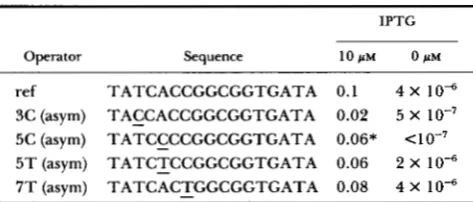
Cro-producing cells were infected with challenge phages carrying either the consensus, reference-type operator (ref), or one of the asymmetric (asym) operator sequences shown. Numbers are fre- quencies of lysogeny, as in Table 1 . An asterisk indicates that colonies appear after 40 hr of incubation. Since these survivors are unstable lysogens carrying the challenge phage as prophage (and form dark green colonies on green indicator plates), we interpret their slow growth to mean that the amount of repressor produced under these conditions is near the threshold required to saturate a particular operator (see BENSON, SUGIONO and YOUDERIAN 1988).
operator is bound more poorly than consensus. When each of these mutations is present as a pair of sym- metric substitutions, it abolishes detectable binding (Table 3). T h e asymmetric
7T
change does not appear to affect Cro binding significantly, consistent with the finding that the symmetric mutant 7 T operator binds Cro well (Table 3).T h e mutant 5C (asymmetric) operator binds Cro, whereas the 5C (symmetric) operator does not. Sur-
vivors resulting from the challenge of our Cro-pro- ducing host with a phage carrying the 5C (asymmetric) operator form unstable lysogens, as is the case for other repressor-producing hosts that produce just enough protein to barely saturate a site (BENSON, SUGIONO and YOUDERIAN 1988; HUGHES, YOUDERIAN
and SIMON 1988). T h e 5C (asymmetric) operator has just sufficient affinity to be bound by Cro under our
conditions in vivo.
- -
DISCUSSION
T o define the operator determinants of Cro binding in vivo, we have tested the ability of Cro to bind each operator among a set of X operators differing from consensus by symmetric pairs of bp substitutions. At least one symmetric pair of substitutions at each of seven operator positions prevents Cro binding, indi- cating that these seven bp in an operator half-site are critical for the formation or stability of the Cro/ operator complex (Table 3). Unlike the case for X cZ
repressor (BENSON, SUGIONO and YOUDERIAN 1988), none of the symmetric, variant operators derived from consensus binds Cro measurably better than consen-
When the operator determinants for Cro binding are compared with those for X c l repressor binding (Figure 3), one can see that at each operator position,
sus.
particular substitutions may affect repressor binding, Cro binding, or both. At positions 1, 3, 4, and
7
of the operator, we find that particular substitutions affect c l repressor binding differently than Cro bind- ing. Therefore, the two repressors most likely recog- nize these bp in different ways.Order of affinity of the natural X operators for Cro: T h e orders of affinity for the binding of cI repressor and Cro to the six natural operators differ
UOHNSON, MEYER and PTASHNE 1978;JOHNSON, PABO and SAUER 1980). CZ repressor binds 0 ~more tightly 1 than ORlr and OR1 more tightly than the other four natural sites (BENSON, SUGIONO and YOUDERIAN
1988). In contrast, Cro prefers
OR^
to 0 ~ 1 , and O L ~to other operators (Table 1). Both OLI and
OR^
are closely related to the consensus site, each differing from consensus by one asymmetric change that, when present as a symmetric pair of mutations, prevents Cro binding (3C and 5C, respectively). Each of the four other natural operators is not bound detectably by Cro, and differs from consensus by two changes that impair Cro binding severely.Immediate context and Cro binding: T h e natural
X operators bound best by Cro
OR^
and O L ~ ) differ from consensus by multiple, asymmetric mutations clustered in one of their two half-sites. OR3 differs from consensus by four mutations, 5C, 7T, 8T, and 9G. Three of these mutations, 7T, 8T, and 9G, have little or no effect on Cro binding when present as symmetric mutations, whereas the fourth, 5C, is det- rimental to binding when present as either a symmet- ric (Table 3) or asymmetric (Table 4) change in the immediate context of a consensus operator half-site. In contrast, in the immediate context of the variant half-site of ORs, the 5C mutation appears to have littleor no effect on binding. T h e OLI operator, bound poorly by Cro (Table l), differs from consensus by two changes in one of its half-sites, 3C and 7T. Whereas a single, asymmetric 3C change has little effect on Cro binding, when paired with a second change in the same half-site,
7T,
that also has little effect on Cro binding, the double mutant operator binds Cro only poorly. In the immediate context of the nonconsensus OL1 half-site, the asymmetric 3C change has a more severe effect on binding than when present in a consensus context. It is clear that operator mutations may have different effects on the binding of Cro when found in different immediate contexts, as is the case for the binding of c l repressor (BENSON, SUGIONO and YOUDERIAN 1988).DORF et al. (1 982), as modified by TAKEDA, SARAI and RIVERA (1988). This model predicts that the side chains of five amino acid residues of Cro, Tyr26, Gln27, Asn31, Lys32, and Arg38, are responsible for the observed specificity of Cro binding.
As originally proposed by OHLENDORF et al. (1982), the hydroxyl group of Tyr26 is predicted to donate a proton to form a hydrogen bond with the thymine 0 4 group at position 1 of the operator, and the side chain of Gln27 may participate in an additional hy- drophobic interaction with the methyl group of thy- mine (TAKEDA, SARAI and RIVERA 1988). We find that Cro can bind the mutant 1A operator, suggesting that Tyr26 may make an alternate set of contacts with a variant A:T bp at position 3. Perhaps when Cro binds the 1A operator, the’hydroxyl group of Tyr26 can participate in a pair of hydrogen bonds with the N6-amino and N7-purine groups of adenine, or the N6-amino group of adenine and the
0 4
group of thymine. T h e former possibility seems more attrac- tive, since Cro does not bind the 1C operator so well.Gln27 should both donate a proton to the N7 group and accept a proton from the N6 group of adenine +2, to make two hydrogen bonds with the operator. T h e model of TAKEDA, SARAI and RIVERA (1988) predicts that all three single bp changes from consen- sus at position 2 would impair binding, the result we observe.
At position 3 of the operator, Ser28 is thought to make two hydrogen bonds with the N7 and N6 groups of adenine -3. Although this predicts that all three changes from the consensus (3T) at this position might interfere with binding, we find that the symmetric, mutant 3A operator is bound well by Cro. TAKEDA, SARAI and RIVERA (1988) have proposed that Ser28 may make an alternative set of contacts with the 3A operator, hydrogen bonding with the 0 4 group of thymine -3 and the N6 group of adenine +3. T h e specificity of recognition at this position may be de- termined in part by additional hydrophobic contacts between the methyl group of thymine and the side chains of Am31 and perhaps Lys32. Like operator 3A, operator 3C should present a somewhat con- gruent pair of donor and acceptor groups to Cro at this position, but is not bound well by Cro. Y. TAKEDA, A. SARAI and V. M. RIVERA (unpublished results) have shown that a mutant Cro with the change Ser28 + Gly binds operators with changes at bp3 with nearly equal affinities in vitro, indicating that these repressor and operator mutations are mutually epistatic, and that Ser28 specifically contacts bp 3 of the operator.
In the model of TAKEDA, SARA1 and RIVERA (1 988), Lys32 may make at least three specific interactions with the operator, its t-amino group participating in two hydrogen bonds with the N7 and 0 6 groups of guanine at -4, and its hydrophobic side chain making
a specific van der Waals contact with the methyl group of thymine -5. These predictions are consistent with our observation that any of the symmetric substitu- tions at each of these two positions prevents binding. In the alternative model proposed by HOCHSCHILD and PTASHNE (1986), Lys32 is predicted to interact with positions 5 and 6 of the operator different from the observed recognition specificity. (For example, if Lys32 is making a single hydrogen bond with bp 5 (A:T) of the operator, then we might expect that at least one of the changes 5G or 5C should have little effect on Cro binding.)
Arg38 is postulated to form two hydrogen bonds with the N7 and 0 6 groups of guanine -6, accounting for the specificity observed at this position. In addi- tion, Arg38 may donate a proton to the N7 group of guanine
-7
to form a third, specific hydrogen bond with the operator. This hypothesis is consistent with our observation that both the consensus (7C) and variant 7T operators are bound well by Cro, but the 7G and 7A operators are not, implicating bp7
as a critical determinant of Cro binding.X cZ and Cro proteins do not recognize the consensus
X operator in nearly identical ways. How, then, are we to explain the results of HOCHSCHILD and PTASHNE (1 986), that argue
CZ
repressor and Cro proteins make nearly identical patterns of interactions with the con- sensus X operator? T h e major differences between the models proposed by HOCHSCHILD and PTASHNE (1986) and that of OHLENDORF et al. (1982) is that HOCHSCHILD and PTASHNE argue that Ser28 of Cro contacts position -4 of the operator and, conse- quently, Lys32 contacts positions 5 and 6. Their ar- gument that Ser28 of Cro makes specific contacts with guanine -4 rests on the results of experiments that examined the binding of Cro to operators differing by three or more substitutions from consensus.First, HOCHSCHILD and PTASHNE (1 986) have found that methylation of the N7 group of guanine -4 in the variant half-site of O R 1 interferes with the binding
of wild-type Cro, but not with the binding of a mutant Ser28 + Ala Cro. This variant half-site differs by three substitutions from consensus (3C, 5T, and 7T),
two of which (3C and 5T) are detrimental to Cro binding, immediately flank position 4 of the operator, and alter the immediate context of bp 4 in a most drastic way. OHLENDORF et al. (1982) have suggested that particular amino acid side chains of Cro might interact with several alternative bp in different im- mediate contexts; a logical consequence of this idea is that Cro may recognize consensus and variant half- sites with different networks of specific contacts. Thus, when a Cro dimer binds 0 ~ (albeit poorly), 1 one Cro monomer may make one (“Cro-like”) pattern
Cro/Operator Interactions
constrained to make a different (“cZ-like”) pattern of contacts with the less affine, variant left half-site.
T h e ability of a repressor to make different sets of specific interactions with different operator half-sites is not without precedent. T h e binding of Lac repres- sor tetramers to the asymmetric, natural lac operator is fundamentally asymmetric; at the central operator positions
7,
8, and 10, which specify critical determi- nants of Lac repressor binding, different specific con- tacts are made with the left and right operator half- sites. Thus, symmetric mutations or chemical modifi- cations of the lac operator may have opposite effects on Lac repressor binding [see SADLER, SASMOR and BETZ (1 983) for review].For both the cases of the Lac repressor/operator and Cro/OR1 interactions, we contend that the bind- ing of a repressor to mutant half-sites that differ from a preferred half-site by three or more single bp changes can force the repressor to adopt a pattern of specific weak bonds with the mutant half-site different than the pattern with its preferred half-site. From our perturbation analysis of Cro binding to operators dif- fering from the consensus X operator by symmetric changes, our data are consistent with the idea that single bp changes in an operator half-site need only result in a simple loss of contacts. T h e argument that multiply mutant half sites may be recognized by alter- native patterns of weak bonds is not inconsistent with this interpretation. It is not surprising that when the potential for forming specific, weak chemical bonds is impaired at three or more positions in an operator half-site, the binding surface of a repressor monomer might accede to a more energetically favorable fit to the operator half-site than that dictated merely by the
loss of multiple, specific contacts. Moreover, operator substitutions not only may result in the loss of specific contacts, but also may introduce unfavorable potential interactions or alter the local secondary structure of the operator in ways that have more global effects upon binding. Therefore, it is not surprising that Cro protein can make different sets of weak bonds with different operator half-sites, particularly with the poorer half-site of an operator (OR]) to which Cro binding is normally physiologically unimportant.
Second, HOCHSCHILD and PTASHNE (1 986) exam- ined the binding of wild-type and mutant Ser28
+
Ala Cro proteins to operator OR2 and mutant deriva- tives of 0 1 1 2 in vivo. In these experiments, they meas-
ured the relative levels of expression of a set of Pr/ lac2 operon fusions regulated by OR2 carried on sin- gle-copy X prophages in the presence and absence of
wild-type and mutant Cro. They showed that substi- tutions at position 4 of OR2 are detrimental to the binding of wild-type but not mutant Cro, and con- cluded from the failure of the mutant Ala28 Cro to discriminate between operators mutant at position 4
that the Ser28 side chain of Cro contacts this position of OR2. However, their experiments are complicated
by the fact that the adjacent natural operator, OR], is also present in each of their operon fusions. To cir- cumvent this problem, they “inactivated” 0 ~with a 1 single asymmetric 3C change, a change that may not lower the affinity of O R 1 for Cro significantly below that of OR2, since OR] binds wild-type Cro with at least sevenfold higher affinity than 0 1 2 in vitro (KIM et al.
1987).
Even if we assume that their mutant OR1
+
3C operator has an affinity for wild-type Cro somewhat less than that of O R 2 , we might also expect the resultsthey observe if the model proposed by OHLENDORF et al. (1982) is correct, and Ser28 interacts specifically with bp 3. Changes at position 4 of O R 2 should inter-
fere with repression by wild-type Cro, since these changes disrupt critical contacts between Lys32 and the operator. Furthermore, the model of OHLENDORF et al. (1982) would predict that the change in Cro from Ser28 .--, Ala may be epistatic to the 3C change in OR^. That is, if Ser28 interacts specifically with position 3, both the 3C change and the Ser28 + Ala change should result in the loss of the same specific contacts from the wild-type Cro/operator interaction, and the effects of the Ser28 .--, Ala change in Cro may mask the effects of the 3C operator mutation. Thus, mutant Cro may bind the 0 ~
+
13C operator with higher affinity than OR2, and consequently fail to discriminate between changes at position4
of O R 2 9 because these changes have little effect on repression of the PR/lacZ operon fusions, which may be regulatedby Cro binding to OR]. This alternative interpretation points out that the results of HOCHSCHILD and PTASHNE (1986) are complicated by the presence of more than one operator on their templates. We have avoided this problem explicitly by examining the bind- ing of Cro to otherwise isogenic templates carrying single X operators. More important, given that the effects on Cro binding of changes from consensus are dependent upon their immediate contexts, it is not clear that the weaker interactions occurring between Cro and the less affine half-sites of O R ] , OR*, or mutant 0 3 2 operators are representative of the
stronger interactions between Cro and the consensus operator.
T h e prima facie interpretation of our results is that Cro does not recognize its most affine (consensus) operator in a way nearly identical to that of X cZ repressor. Although the amino acid residues of both c I and Cro implicated in DNA binding are organized into similar (“helix-turn-helix”) secondary structures, side chains on the surfaces of the “recognition” ( a 3 )
protein and c l repressor use a conserved secondary structure (two a-helices joined by a surface turn) to interact with the X operator in quite similar manners.
We thank CURTIS ADAMS for expert technical assistance, M. M. SUSSKIND and Y. TAKEDA for their helpful criticisms of the manu- script, and B. W. MATTHEWS for his encouragement. This work was supported by National Institutes of Health grant GM34150 to P.Y.
LITERATURE CITED
ANDERSON, W. F., D. H. OHLENDORF, Y. TAKEDA and B. W. MATTHEWS, 198 1 A phage repressor-operator complex at 2.8 A resolution. Nature 3 1 6 596-601.
BASS, S., P. SUGIONO, D. N. ARVIDSON, R. P. GUNSALUS and P. YOUDERIAN, 1987 DNA specificity determinants of Esche- richia coli tryptophan repressor binding. Genes Dev. 1: 565- 572.
BENSON, N., P. SUCIONO and P. YOUDERIAN, 1988 DNA sequence determinants of X repressor binding in vivo. Genetics 118: 21- 29.
BENSON, N., P. SUGIONO, S. BASS, L. V. MENDELMAN and P. YOUD-
ERIAN, 1986 General selection for specific DNA-binding ac-
tivities. Genetics 1 1 4 1-14.
GOMEZ-EICHELMANN, M. C., 1979 Deoxyribonucleic acid adenine and cytosine methylation in Salmonella typhimurium and Sal- monella typhi. J. Bacteriol. 1 4 0 574-579.
GUSSIN, G. N., A. D. JOHNSON, C. 0. PABO and R. T. SAUER, 1983 Repressor and Cro proteins: structure, function, and role in lysogenization. pp. 93-123. In Lambda I I , Edited by R. W. HENDRIX, J. W. ROBERTS, F. W. STAHL and R. WEISBERG. Cold Spring Harbor Laboratory, Cold Spring Harbor, N.Y. HOCHSCHILD, A., and M. PTASHNE, 1986 Homologous interac-
tions of X repressor and X Cro with the X operator. Cell 4 4
HOCHSCHILD, A., J. DOUHAN I11 and M. PTASHNE, 1986 How X repressor and X Cro distinguish between OR, and OR%. Cell 47:
807-816.
HSIANG, M. W., R. D. COLE, Y. TAKEDA and H. ECHOLS, 1977 Amino acid sequence of Cro regulatory protein of bac- teriophage lambda. Nature 2 7 0 275-277.
HUGHES, K. T., P. YOUDERIAN, and M. I. SIMON, 1988 Phase variation in Salmonella: analysis of Hin recombinase and hix recombination site interactions in vivo. Genes Dev. 2: 937-948. JOHNSON, A. D., B. J. MEYER and M. PTASHNE, 1978 Mechanism
of activation of the cro protein of bacteriophage X. Proc. Natl. Acad. Sci. USA 75: 1783-1787.
JOHNSON, A. D., C. 0. PABO and R. T. SAUER, 1980 Bacteriophage 925-933.
X repressor and Cro proteins: interactions with operator DNA. Methods Enzymol. 65: 839-856.
KIM, J. G., Y. TAKEDA, B. W. MATTHEWS and W. F. ANDERSON, 1987 Kinetic studies on Cro repressor-operator DNA inter- action. J. Mol. Biol. 196: 149-158.
LEBRETON, B., P. V. PRASAD, M. JAYARAM and P. YOUDERIAN, 1988 Mutations that improve the binding of yeast FLP re- combinase to its substrate. Genetics 118: 393-400.
LEWIS, M., A. JEFFREY, J. WANG, R. LADNER, M. PTASHNE and C.
0. PABO, 1983 Structure of the operator-binding domain of X repressor: implications for DNA recognition and gene regu- lation. Cold Spring Harbor Symp. Quant. Biol. 47: 435-440. NELSON, H. C. M., and R. T. SAUER, 1985 Lambda repressor
mitations that increase the affinity and specificity of operator binding. Cell 42: 549-558.
OHLENDORF, D. H., W. F. ANDERSON, R. G. FISHER, Y. TAKEDA B. W. MATTHEWS, 1982 The molecular basis of DNA-protein recognition inferred from the structure of Cro repressor. Na- ture 298: 718-723.
OHLENDORF, D. H., W. F. ANDERSON, M. LEWIS, C. 0. PABO and B. W. MATTHEWS, 1983 Comparison of the structure of Cro and repressor proteins from bacteriophage X. J. Mol. Biol. 1 6 9
757-769.
PAKULA, A. P., V. Y. YOUNG and R. T. SAUER, 1986 Bacteriophage lambda Cro mutations: effects on activity and intracellular degradation. Proc. Natl. Acad. Sci. USA 83:
PTASHNE, M., A. JEFFREY, A. D. JOHNSON, R. MAURER, B. J. MEYER, C. 0. PABO, T. M. ROBERTS and R. T. SAUER, 1980 How the X repressor and Cro work. Cell 19: 1-1 1.
ROBERTS, T. M., H. SHIMATAKE, C. BRADY and M. ROSENBERG, 1977 Sequence of cro gene of bacteriophage lambda. Nature
2 7 0 274-275.
SADLER, J. R., H. SASMOR and J. L. BETZ, 1983 A perfectly symmetric lac operator binds the lac repressor very tightly. Proc. Natl. Acad. Sci. USA 8 0 6785-6789.
SARAI, A,, and Y. TAKEDA, 1987 How Cro and X repressor rec- ognize operator DNA sequences. In Protein Structure and De- sign, Edited by D. OXENDER. Alan R. Liss, New York (in press).
TAKEDA, Y., A. FOLKMANIS and H. ECHOLS, 1977 Cro regulatory protein specified by bacteriophage X. J. Biol. Chem. 252: 6 177- 6183.
TAKEDA, Y., D. H. OHLENDORF, W. F. ANDERSON, and B. W. MATTHEWS, 1983 DNA-binding proteins. Science 221:
TAKEDA, Y., S. SARAI and V. M. RIVERA, 1988 Analysis of the sequence-specific interactions between Cro repressor and op- erator DNA by systematic base substitution mutations. Proc. Natl. Acad. Sci. USA (in press).
8829-8833.
1020-1026.