Length Polymorphisms of Simple Sequence Repeat
DNA in Soybean
Mahinur S. Akkaya, Arvind A. Bhagwat' and Perry B. Cregan*
Soybean and Alfalfa Research Laboratory, United States Defartment of Agriculture, Agricultural Research Service, Beltsville Agricultural Research Center, Beltsville, Maryland 20705-2350
Manuscript received May 14, 1992
Accepted for publication August 8, 1992
ABSTRACT
The objective of this work was to ascertain the presence and degree of simple sequence repeat (SSR) DNA length polymorphism in the soybean [Glycine max (L.) Merr.]. A search of GenBank revealed no (CA), or (GT), SSRs with n greater than 8 in soybean. In contrast, 5 (AT). and 1 (ATT), SSRs with n ranging from 14 to 27 were detected. Polymerase chain reaction (PCR) primers to regions flanking the six SSR loci were used in PCR amplification of DNA from 43 homozygous soybean genotypes. At three loci, amplification produced one PCR product per genotype and revealed
6, 7 and 8 product length variants (alleles) at the three loci, respectively. F1 hybrids between parents carrying different alleles produced two PCR products identical to the two parents. Codominant segregation of alleles among FP progeny was demonstrated at each locus. A soybean DNA library was screened for the presence of (CA/GT), SSRs. Sequencing of positive clones revealed that the longest such SSR was (CA)9. Thus, (CA), SSRs with n of 15 or more are apparently much less common in soybean than in the human genome. In contrast to humans, (CA), SSRs will probably not provide an abundant source of genetic markers in soybean. However, the apparent abundance of long (AT), sequences should allow this SSR to serve as a source of highly polymorphic genetic markers in soybean.
R
EPETITIVE DNA sequences such as variable number tandem repeat (VNTR) loci (NAKA- MURA et al. 1987) serve as highly informative genetic markers. These multiallelic loci consist of repeated core sequences which have been referred to as mini- satellitesUEFFERYS,
WILSON and THEIN 1985). T h e tandemly repeated minisatellites are flanked by con- served endonuclease restriction sites. Thus, the length of the restriction fragment produced by this type of genetic locus is proportional to the number of core units it contains. It was subsequently suggestedUEF-
FREYS et al. 1988) that the highly informative nature of VNTR loci be combined with the specificity and rapidity of polymerase chain reaction (PCR) technol- ogy (MULLIS et al. 1986). Primers to the conserved flanking regions of VNTR loci were developed allow- ing amplification of the entire VNTR locus. Resulting PCR products possess electrophoretic mobilities which differ according to the number of core units in the VNTR allele(s) present.This approach was recently extended to a different type of repetitive DNA in humans (LITT and LUTY
1989; WEBER and MAY 1989; TAUTZ 1989). Rather than repeat units in the range of 11-60 bp in length
as occur in the minisatellites, these workers suggested that high levels of polymorphism exist in dinucleotide tandem repeat sequences. For example, (CA/GT), were reported to occur in the human genome as many
lege ' Park, Maryland 20742.
Current address: Agronomy Department, University of Maryland, Col- To whom reprint requests should be sent.
as 50,000 times with n varying from 10 to 60. This type of reiterated sequence has been termed a simple sequence repeat (SSR) by JACOB et al. (1 991), short tandem repeat by EDWARDS et al. (1 99 l), or microsa- tellite (LITT and LUTY 1989). The DNA sequences flanking SSRs are conserved, allowing the selection of PCR primers that will amplify the intervening SSR. As initially reported (LITT and LUTY 1989; WEBER and MAY 1989; TAUTZ 1989), the PCR reaction in- cludes one '*P-labeled nucleotide or one or two '*P end-labeled primers to allow visualization of amplifi- cation products via autoradiography after electropho- resis on a standard sequencing gel. Variation in PCR product length is a function of the number of SSR units. SSR length polymorphism is detected when the PCR products from a particular locus differ in length. This type of genetic marker can be placed on genetic maps in relation to other SSR, restriction fragment length polymorphism (RFLP) (BOTSTEIN et al. 1980), random amplified polymorphic DNA (RAPD) (WIL- LIAMS et al. 1990), and phenotypic markers in a man- ner identical to that used with RFLP, RAPD, and phenotypic markers.
Human geneticists first demonstrated the highly polymorphic nature of SSRs in 1989 (LITT and LUTY
1989; WEBER and MAY 1989), with up to 12 alleles at some SSR loci. SSRs include tri- and tetrameric re- peats such as (AAT), and (AGAT),. According to EDWARDS et al. (1 99 l), the combined frequency in the human genome of tri- and tetrameric SSRs with n =
T h e presence and abundance of SSR loci in higher plants is not well defined. A search of only 35 kbp of algal and plant DNA sequence data (TAUTZ, TRICK and DOVER 1986) indicated similar numbers of di- and trinucleotide repeats per 100 kbp as occurs in vertebrates. T h e only report documenting SSRs in higher plants is that of CONDIT and HUBBELL (1991). They screened DNA libraries of five tropical tree species as well as Zea mays for the presence of clones containing (AC), and (AG), sequences and estimated a total of between 5 X 10' and 3 X 1 O5 such sequences in the species examined. We are not aware of any published reports in plants regarding length polymor- phism of SSRs.
Based upon the abundance and informativeness of SSR markers in humans and the lack of information concerning the frequency and polymorphic nature of SSRs in plants and particularly in soybean [Glycine max (L.) Merr.], we undertook the study presented here. T h e experiments reported here were designed to investigate: (1) the frequency and nature of SSRs in soybean as determined by a search of GenBank;
(2)
the presence of SSR length polymorphism in soybean and wild soybean (Glycine soja Sieb. & Zucc.); (3) the mode of inheritance of SSR markers in soybean; and(4) if the frequency and length of (CA/GT), SSRs in soybean is comparable to that found in the human genome.
MATERIALS AND METHODS
Search of GenBank soybean sequences for SSRs: At the time of our search, GenBank had a total of 141 soybean sequences. Of these, 10 appeared to be chloroplast-derived and at least one was a duplicate. T h e remaining 130 se- quences were searched for all possible di-, tri- and tetrameric SSRs. In the case of dinucleotide repeats, only those with greater than four repeat units were selected. For tri- and tetrameric SSRs, we selected those with greater than three repeat units.
Soybean DNA library, colony hybridization and prob- ing: Soybean DNA (cv. Williams) fragments of 250-300 bp in length obtained by digestion with restriction enzymes XbaI and Hind111 ( U S . Biochemical Gorp., Cleveland, Ohio) were cloned into pBluescript I1 KS+ (STRATAGENE, LaJolla, California) which were used to transform Escherichia coli host strain XLl-Blue followed by blue/white color selection. Selected colonies were picked into microtiter plates contain- ing LB medium with ampicillin (50 pg/ml) and tetracycline (1 0 pg/ml). T h e library was screened by colony hybridiza- tion. Procedures outlined by SAMBROOK, FRITSCH and MAN-
IATIS (1989) were followed throughout. Filters were hybrid- ized to a "P-labeled G(AC)I I oligonucleotide probe which was labeled using a reaction mix containing a (GT)IIC oligonucleotide template, a G(AC)s primer, Klenow frag- ment, and [a-"PIdATP and [a-"P]dCTP and filtered through a BioSpin 6 chromatography column (Rio-Rad, Richmond, California) for removal of unincorporated nu- cleotides. Hybridization conditions were as described by ROSTAS et al. (1 986). Membranes were washed for 1 - 1.5 hr a t 42" in 2 X SSC and exposed to x-ray film.
The selection and synthesis of PCR primers: WEBER
(1 990) indicated that in humans dinucleotide sequences with
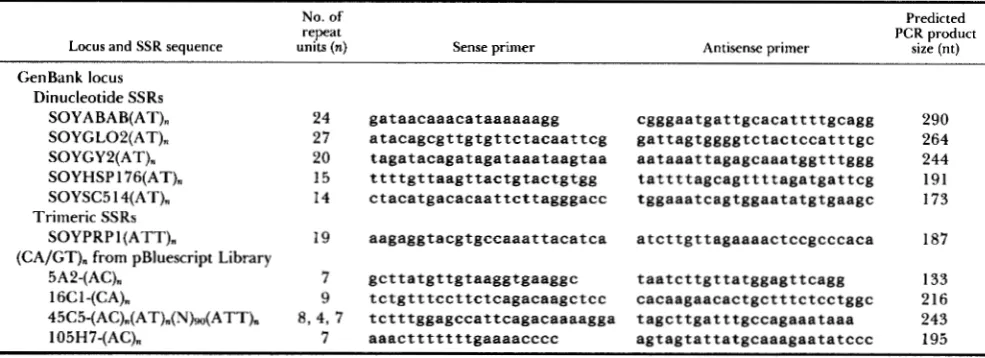
10 or fewer repeats were unlikely to be polymorphic. There- fore, we synthesized primers to regions flanking only those GenBank dinucleotide SSRs with greater than 10 repeats. Likewise, EDWARDS et al. (1 99 1) indicated that in the human populations they investigated approximately seven tri- or tetrameric repeats were necessary to produce a 50% prob- ability of polymorphism. Therefore, primers were only syn- thesized when the number of tri- or tetranucleotide repeat units met these minimum length requirements. In the case of SSRs obtained from the Bluescript library no such mini- mum length requirement was imposed.
T o select PCR primers to regions flanking SSRs, sequence data were analyzed using Primer Detective, Primer Design Software Program (CLONTECH Laboratories, Inc., Palo Alto, California). Primers were selected with expected PCR product length between 130 and 300 bp and were synthe- sized on an Applied Biosystems International 391 DNA Synthesizer followed by high performance liquid chroma- tography purification. In addition to the PCR primers the oligonucleotides (GT)IIC and G(AC)s were synthesized for use in the development of the radiolabeled G(AC), I probe.
Soybean genotypes, soybean hybridization and DNA
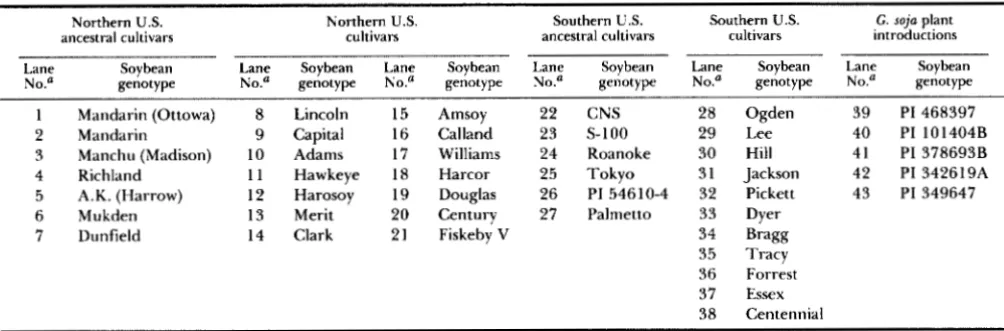
isolation: A group of 43 soybean genotypes (Table 1) were selected to use for investigating the presence of length polymorphism of SSRs using the primer sets that were synthesized (see Table 2). These soybeans can be classified into five groups: (1) northern United States ancestral culti- vars that include genotypes that formed the germplasm base of cultivars grown in the northern United States and Can- ada, (2) northern U.S. cultivars that include soybeans devel- oped via hybridization from the northern U.S. ancestral cultivars through a number of breeding cycles, (3) southern U.S. ancestral cultivars that include genotypes that form the germplasm base of cultivars grown in the southern United States, (4) southern U.S. cultivars that include soybeans developed via hybridization from the southern U.S. ances- tral cultivars through a number of breeding cycles, and (5) G . soja (wild soybean) from a range of origins in the Far East. Seeds were originally obtained from Dr. Randall Nel- son, USDA-ARS, University of Illinois, Department of Agronomy, 1 102 South Goodwin Avenue, Urbana, Illinois 61801.
T h e 10 possible crosses between the soybean cultivars Amsoy, Williams, Fiskeby V, Tokyo and Jackson were made in the field or in the photoperiod houses at Beltsville, Maryland (BORTHWICH and PARKER 1952). F1 plants of each cross were grown in the greenhouse for DNA isolation and to obtain F2 seeds. Approximately 70 F2 plants of the cross Williams X Amsoy and 100 plants of Jackson X Williams, along with the 43 soybean genotypes described earlier were grown in the greenhouse. Plants were inoculated with Bra- dyrhizobiumjaponicum strain USDA 110. DNA was isolated from leaf tissue of these plants using the procedure de- scribed by SAGHAPMAROOF et al. (1 984).
Southern hybridization: Human placental and E . coli strain B DNA were obtained from the Sigma Chemical Co. (St. Louis, Missouri). Soybean (cv. Williams) DNA was iso- lated as described above. Pal1 (Stratagene)-digested DNAs
(3 Pgllane) were separated on a 0.7% agarose gel and transferred to a Nytran membrane (Schleicher & Schuell, Inc., Keene, New Hampshire) as described by (SAMBROOK, FRITSCH and MANIATIS 1989). After baking at 80" for 2 hr the membrane was prehybridized and hybridized to a J2P- labeled G(AC)I I probe as described above. The membrane
was washed for 1 hr at 42" with 2 X SSC and exposed to X-
Simple Sequence Repeat 1133
TABLE 1
Soybean cultivars and wild soybean accessions examined for the presence of simple sequence repeat length polymorphism
Northern U.S. ancestral cultivars
Northern U.S. Southern U.S. Southern U S .
cultivars ancestral cultivars
G. soja plant cultivars introductions
Lane No."
Soybean Lane Soybean Lane Soybean Lane Soybean Lane Soybean Lane Soybean
genotype No." genotype No." genotype No." genotype No." genotype No." genotype
1 Mandarin (Ottowa) 8 Lincoln 15 Amsoy 22 CNS 28 Ogden 39 PI 468397
2 Mandarin 9 Capital 16 Calland 23 S-100 29 Lee 40 PI 101404B
3 Manchu (Madison) 10 Adams 17 Williams 24 Roanoke 30 Hill 41 PI 378693B
4 Richland 1 1 Hawkeye 18 Harcor 25 Tokyo 31 Jackson 42 PI 342619A
5 A.K. (Harrow) 12 Harosoy 19 Douglas 26 PI 54610-4 32 Pickett 43 PI 349647
6 Mukden 13 Merit 20 Century 27 Palmetto 33 Dyer
7 Dunfield 14 Clark 21 Fiskeby V 34 Bragg
35 Tracy
36 Forrest
37 Essex
38 Centennial " Lane No. refers to the lane number occupied by each genotype in Figure 1 .
0.1 X SSC. The blot was exposed to x-ray film after each wash.
PCR: PCR (10 PI) contained 1 X PCR buffer (10 mM Tris-HCI, pH 8.3, 50 mM KCI), 1 mM Mg2+, 0.1 mM of each dNTP, 1.5 pmol each of the oligonucleotide primers, 0.1 PI
of 3000 Ci/mmol [a-92P]dATP (Amersham Corp., Arling-
ton Heights, Illinois), 1 unit of Tuq DNA polymerase (U.S.
Biochemical Corp.) and 20 ng of soybean DNA template. A two-step PCR protocol was employed with 30 cycles; dena- turation (1 min, 94") and annealing/extension (1.5 min, 62") using a Perkin-Elmer Cetus thermocycler.
DNA sequencing and polyacrylamide gel electropho- resis: DNA sequencing reactions of selected positive clones from the colony hybridization were performed on alkaline denatured dsDNA, prepared as in KRAFT et ul. (1988) using
U.S. Biochemical Corp. DNA sequencing kit Version 2.0. Reaction products were separated on a denaturing gel con- taining 6% polyacrylamide, 8 M urea and 1 X TBE at 60- watt constant power using a DNA sequencing gel electro- phoresis apparatus (GIBCO/BRL, Gaithersburg, Maryland). The PCR products (1
-
1.8 pl/lane) were separated the same way after addition of stop solution supplied with the se- quencing kit and denaturation for 5-10 min at 95". Gels were dried and exposed to a Kodak XAR-5 (Eastman Kodak, Rochester, New York) film for 1-2 hr. A and G sequencing reactions of M 13 mp18 ssDNA were used as molecular weight standards (U.S. Biochemical Corp.).RESULTS
T h e search of GenBank for SSR sequences in soy- bean identified a total of 33 sequences with at least five repeat units. Only four of these contained (CA/ GT), repeats and five contained (TC/AG), SSRs with n ranging from 5 to 8. In contrast, 17 sequences had SSRs composed of (AT/TA), repeat units with n
ranging from 5 to 27. Six trimeric and one tetrameric repeat were also identified. Of the 33 SSRs only two were located within coding sequences and both of these were trimeric repeats. Primers flanking each of the six DNA repeat regions with greater than 10 dimeric or greater than 6 trimeric SSRs were synthe- sized (Table 2) and used in PCR amplification of DNA
from the four soybean cultivars Amsoy, Williams, Tokyo and Fiskeby V.
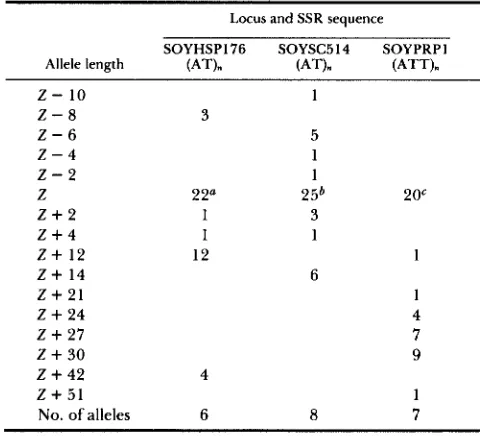
Length polymorphism of SSRs: In the case of the SOYHSP176(AT), (NAGAO et al. 1985), SOYSC5 14(AT), (SHIBATA, KATO and TANAKA 199 l), and SOYPRPl(ATT), (HONG, NAGAO and KEY 1987) loci, PCR amplification with the four initial cultivars produced variable length products. Subse- quent investigation of 38 cultivars and 5 G . soja gen- otypes revealed 6, 8 and
7
alleles at the three loci, respectively (Figure 1). The most common allele at each locus was arbitrarily assigned a length of 2 nucle- otides (nt). Other alleles were assigned values of 2 k nt with nt equaling the apparent number of nt greater or less than 2 in the denatured PCR product (Table 3). T h e number of nucleotides in each allele was established using the size of the most intense band of each amplification product. T h e precise size of partic- ular alleles could not always initially be determined with certainty. When uncertainty existed, gels were exposed to film for shorter or longer periods or PCR products were reanalyzed with the sequencing ladder in an adjacent lane. In the case of the dinucleotide repeat loci SOYHSPl76(AT), and SOYSC5 14(AT),, the difference between alleles varied by multiples of2
while at the SOYPRPl(ATT), locus, which con- tained a trimeric repeat, alleles varied by multiples of three (Table 3). A total of 21 alleles were detected at the three loci. Nine of these occurred only once among the 43 genotypes. Of these nine, eight were found in one of the five G. soja genotypes.TABLE 2
Soybean sequences from CenBank found to possess SSRs with greater than 10 repeat units in dinucleotide SSRs and greater than six in trinucleotide SSRs and sequences from the pBluescript library with (CA/GT)%, bases contained in each repeat unit, number of
repeat units (n) in GenBank or Bluescript clone sequence, primers used in attempted PCR amplification, and predicted PCR product size based on sequence information
No. of repeat
Locus and SSR sequence units (n) Sense primer PCR product
Predicted Antisense primer size (nt)
GenBdnk locus Dinucleotide SSRs SOYABAB(AT). SOYGLOP(AT)* SOYGY2(AT)" SOYHSP176(AT). SOYSC5 14(AT). SOYPRPl(ATT). Trimeric SSRs
(CA/GT). from pBluescript Library 5A2-(AC). 16Cl-(CA), 45Cs-(AC),(AT)"(N),,,(ATT), 105H7-(AC). 24 27 20 15 14 19 7 9 8 , 4 , 7
7
gataacaaacataaaaaagg a t a c a g c g t t g t g t t c t a c a a t t c g
tagatacagatagataaataagtaa
ttttgttaagttactgtactgtgg ctacatgacacaattcttagggacc
aagaggtacgtgccaaattacatca
gcttatgttgtaaggtgaaggc t c t g t t t c c t t c t c a g a c a a g c t c c tctttggagccattcagacaaaagga aaactttttttgaaaacccc cgggaatgattgcacattttgcagg gattagtggggtctactccatttgc aataaattagagcaaatggtttggg tattttagcagttttagatgattcg tggaaatcagtggaatatgtgaagc atcttgttagaaaactccgcccaca taatcttgttatggagttcagg c a c a a g a a c a c t g c t t t c t c c t g g c tagcttgatttgccagaaataaa a g t a g t a t t a t g c a a a g a a t a t c c c
290 264 244 191 173 187 133 216 243 195
ents of Corsoy are the cultivars Harosoy and Capital which both carry the 2
+
12 allele (Figure 1 A, lanes 12 and 9, respectively). At the SOYSC5 14(AT), locus, the most common allele had a length of 174 nt which was one nucleotide longer than that predicted based upon the GenBank sequence. In the case of SOYPRPl(ATT), the most common allele was 160 nt in length whereas the predicted length from the GenBank sequence was 187 nt. T h e size of this allele was identical to the 2+
27 SOYPRPl(ATT), allele which occurred in7
of the 43 genotypes examined.In the case of the SOYABAB(AT), and SOYGYS(AT), loci, PCR amplifications were unsuc- cessful with the DNA of any of the initial four soy- beans as template. Using primers to the
SOYGLOP(AT), locus, two PCR products were pro- duced with each soybean genotype, one of which appeared to be polymorphic. Further study of these loci is being undertaken.
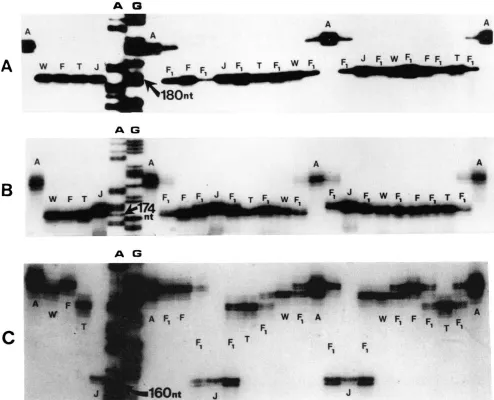
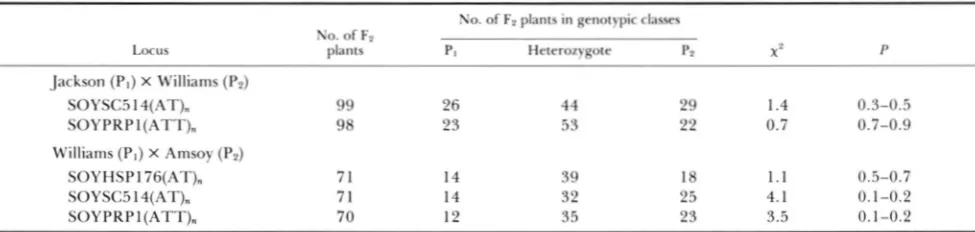
Mendelian inheritance of SSR alleles: In no case did any of the 43 soybean genotypes appear to be heterozygous, i.e., produce more than one PCR prod- uct. Not surprisingly, a contrasting result was obtained with PCR amplification of DNA from FI plants of crosses between genotypes carrying different SSR al- leles (Figure 2). In the 10 possible F1 hybrids between cultivars Amsoy, Williams, Fiskeby V , Tokyo and Jackson, the Fls always produced two PCR products
in those cases in which the parents were polymorphic. Codominant segregation of SSR markers among FS soybean progeny was demonstrated at the three SSR loci. For example, at the SOYPRPl(ATT), locus, Jackson carries the 2 allele and Williams the 2
+
27 allele. Of 98 F2 progeny, 22 were homozygotes car-rying the 2
+
27 allele, 53 were heterozygotes, and 23 were homozygotes carrying the 2 allele. This veryclosely fits the 1
:2:
1 ratio of codominant segregation with a Chi-squared value of 0.7 ( P = 0.9-0.7). T h e allelic constitution of 38 of these F2 progeny is illus- trated in Figure 3. Similar codominant segregation ratios were obtained among the F2 progeny of Jackson X Williams at the SOYSC514(AT), locus and at all three loci in the cross of Williams x Amsoy (Table 4). The presence of (CA/GT), sequences in soybean: T h e first reports of SSR length polymorphism in humans were of (CA/GT), sequences and therefore, concurrent with the search of Genbank for SSRs, we probed soybean DNA with a radiolabeled poly(CA) probe to determine if such sequences were also com- mon in soybean. T h e poly(CA) probe hybridized to Pal1 digested human DNA and to a lesser extent to Williams soybean DNA (Figure 4), while no hybridi- zation to E . coli was observed. T h e probe remained annealed to human and soybean DNA even after very high stringency washing (Figure 4, lanes 1 and 3). Based upon this positive assessment of the presence of (CA/GT), sequences, a library of Williams soybean DNA was screened for the presence of (CA/GT), sequences.Of approximately 10,000 clones examined, 36 pro- duced a positive signal. Four of the 36 gave an ob- viously stronger signal than the remaining 32 and these clones were sequenced along with two of the remaining 32 which had given a weaker signal. These weakly hybridizing clones both contained a (CA/GT)4 repeat. In the four clones producing stronger signals, (CA/GT), repeats were also present and varied in length from n =
7
to n = 9 (Table 2). In addition, one sequence (45C5) also contained an (AT)4 adjacent to the (CA) repeat and an (ATT);, 90 bp from the (CA) SSR.4s A Q
1 4 7 10 13 16 19 2 1 22
"
1
"3
u40
2 s 2 0 54 a7
A
B
C
1 4 7 2s 28 31 34 37 40 43
A O 19 21 22
1 4 7 10 13 16 2s 2 8 31 34 37 40 43
FIGURE I.-Radiolabeled PCR products amplified from 43 soybean genotypes using primers flanking simple sequence repeats at three
soybean loci, SOYHSPI 76(AT). (A), SOYSC514(AT), (B) and SOYPRPI(ATT). (C), from CenBank. The genotypes in each lane are listed in Table 1. Fragments were separated on a standard DNA sequencing gel. The sequencing ladder between lanes 2 I and 22 is the A and G lanes obtained from sequencing reactions using M 1 Snip18 ssDNA.
rived from Bluescript clones containing (CA/GT),6: DNA of the cultivars Amsoy, Williams and Tokyo was used in an initial amplification using primers to se- lected Bluescript clones (Table 2). Multiple amplifi- cation products which were not polymorphic resulted in the case of clones 16C1 and 105H7. One product whose size was identical for the three soybean geno- types resulted from PCR using primers to 5A2. In the case of 45C5, a larger spectrum of soybean genotypes was examined. One genotype among a group of 19 produced a PCR product with a slightly higher molec- ular weight than the others. Because of the minimal level of SSR length polymorphism we did not investi- gate this locus further.
DISCUSSION
SSR
length polymorphism in soybean: T h e degree of SSR length polymorphism at the SOYHSP176-(AT),, SOYSC5 14(AT), and SOY PRP 1 (ATT), loci was comparable to that found by WEBER and MAY (1 989) at SSR loci in humans. They analyzed 10 loci and observed that the number of alleles ranged from
TABLE 3
Number of soybean genotypes carrying each allele at three simple sequence repeat loci
Locus and SSR sequence SOYHSPl'76 SOYSC514 SOYPRPl Allele length (AT)" (AT). (ATT).
z -
10 12 - 8 3
Z - 6 5
2 - 4 1
2 - 2 1
Z 2 2a 25b 2 o c
z + 2 1 3
z + 4 1 1
z +
1212 1
Z + 14 6
z +
21 1Z
+
24 4Z
+
27 7Z
+
30 9Z
+
42 4Z + 51 1
No. of alleles 6 8 7
The length (number of nucleotides) of the most common allele
was arbitrarily assigned a value of Z. The number of nucleotides in alleles shorter or longer than Z are given by - and
+
values.Z = 180 nucleotides. Z = 174 nucleotides.
Z = 160 nucleotides.
here appeared to be quite similar to polymorphic SSR loci in humans.
The 43 soybean genotypes included in the current study were selected to represent wide genetic diver- sity. If genotypes were put into classes based upon their allelic profiles, that is, those carrying identical alleles at each of the three loci would be placed in the same class, a total of 22 classes was required to accom- modate the 43 genotypes. T h e G. soja genotypes each fell into unique classes. It was anticipated that these genotypes would be distinct from the G. max geno- types. Because the G . soja accessions were selected to represent diverse origins, it was also not surprising that they differed from each other. The cultivated soybeans fell into 17 allelic classes with up to 5 geno- types in one class. This group included the cultivars Mandarin, Lincoln, Clark, Williams and Douglas. Based upon their pedigrees, these genotypes are closely related. Similarly, the closely related cultivars S-100, Pickett and Lee were in a group by themselves. Thus, even the small amount of data collected at the three polymorphic SSR loci exhibiting length poly- morphism allowed the grouping of genotypes into classes that would be anticipated based upon their species, origins, and pedigrees. With similar data from additional loci it should be possible to develop unique allelic profiles for establishing individual cultivar iden- tity.
Simple sequence repeat DNA in soybean: T h e total length of the soybean sequences searched in
GenBank was approximately 200 kbp. The presence of only four (CA/GT), sequences with n ranging from only 5 to 8 was much less than anticipated based on human DNA sequence data. In the human genome various estimates indicate between 50,000 and 100,000 (CA/GT), repeats with n ranging from 15 to 30 (BRAATEN et al. 1988; HAMADA and KAKUNAGA 1982; HAMADA, PETRINO and KAKUNAGA 1982; HA- MADA et al. 1984; STALLINGS et al. 1991). Assuming equal spacing throughout the human genome, one such SSR would occur every 30-60 kbp. This was not the case in the soybean sequences contained in GenBank, as no (CA/GT), with n greater than 8 was found.
T h e lack of such (CA/GT), sequences in soybean was further supported by the results obtained in screening and sequencing clones in the library of Williams soybean DNA. About 3 100 kbp of DNA was screened and 36 clones putatively containing (CA/ GT), sequences were identified. Our sequencing data suggest that in the 32 clones that gave weaker signals when probed with a "P-labeled poly(CA) probe, the length of (CA/GT), was probably only 4 or 5 repeat units. By chance alone, one (CA/GT)4 should occur every 65.5 kbp. Therefore, our finding of 32 such sequences in 3 100 kbp was somewhat less than what would be anticipated. Of four clones that gave an obviously stronger signal with the poly(CA) probe, the maximum number of (CA/GT), repeats was nine. If the frequency and length of (CA/GT), SSRs in soy- bean were similar to that in human, we would have expected between 50 and 100 (CA/GT), SSRs rang- ing in length from 15 to 30 repeat units. We found no evidence to suggest that such sequences exist in soybean.
T h e only data concerning frequency and length of dinucleotide repeats in a sizable sample of higher plant DNA is that of CONDIT and HUBBELL (1 99 1). In two tropical tree species and Zea mays they estimated an average of one (CA/GT), repeat every 103 kbp. This estimate was based on a library consisting of DNA fragments whose average size was assumed to be 256 bp. Their detection procedure used a radiolabeled probe and a low stringency similar to that employed in our screening of the Bluescript library of Williams DNA. If the 36 clones we detected all contained (CAI GT), sequences, then one such sequence occurred every 86 kbp. This is similar to the result of CONDIT and HUBBELL (1 99 1) and is not greatly different from estimates of (CA/GT), sequences in humans. The more important question concerns the length of these SSRs. T h e longest (CA/GT), sequence reported by CONDIT and HUBBELL (1991) had an n of 1 1. T h e longest such sequence we found had only 9 dinucleo- tide repeats. Together these experimental data fail to support the conclusion that long (CA/GT), SSRs ( n
>
Sequence
FIGURE 2."RadiolabelecI PCK products amplified from five selected soybean genotypes and the 10 F1 hybrids from all possible crosses between them produced using primers flanking simple sequence repeats at three soybean loci SOYHSP176(AT). (A), SOYSC514(AT). (B) and SOYPKPI(ATT). ( C ) from GenBank. Fragments were separated on a standard DNA sequencing gel. The sequencing ladder is the A
and G lanes obtained from sequencing reactions using M 13nlp18 ssDNA. I n the 21 lanes to the right of the sequencing ladder each FI is flanked by both of its parents ( A = Amsoy, W = Williams. F = Fiskeby. T = Tokyo and J =Jackson soybean).
I:IC:URE J.--K;ldiol;~l)eled PCK products amplified from the D N A of the parents (J =Jackson, W = Williams), F,. and 38 F? plants from a cross of Jackson X Willianls soybean using primers to the simple sequence repeat locus SOYPRPI(ATT).. The sequencing ladder is the A
1138 M . S. Akkaya, A. A . Bhagwat and P. €3. Cregan
TABLE 4
Segregation of simple sequence repeat alleles in the Fn progeny of two soybean crosses
L.0cus
No. of F2
No. of F2 plants in genotypic classes
plants PI Heterozygote p2 X ? P
Jackson (PI) X Williams (P2)
SOYSC514(AT), 99 26 44 29 1.4 0.3-0.5
SOYPRPI(ATT). 98 23 53 22 0.7 0.7-0.9
Williams ( P I ) X Amsoy (P2)
SOYHSPl76(AT). 7 1 14 39 18 1 . 1 0.5-0.7
SOYSC514(AT). 71 14 32 25 4.1 0.1-0.2
.SOYPRPI(ATT). 70 12 35 23 3.5 0.1-0.2
I’rogenv were classified as: homozygous for the allele from the maternal parent ( P I ) . heterozygous. or homozygous for the allele frotn the
male p;lrellt (1’2). with at1 expected codominant segregation ratio of 1:2:1.
1 2 3
2 3.1 9.4
6.7
4.4
2.3
2.0
0.5
While the soybean sequences in GenBank had no (CA/GT), sequences with n of 15 or greater, the five (AT/TA), sequences with n ranging from 14 to 27
provided an excellent source of dinucleotide SSRs. T h e frequency of these sequences (1 per approxi-
mately 40 kbp) is similar to the frequency of (CA/ GT), SSRs of comparable length in humans.
CONCLUSIONS
Two findings emerge from the experiments re-
ported here. First, the presence of polymorphic length SSRs in soybean demonstrates that this type of genetic maker is useful in a higher plant species. T h e average of 7 alleles present at each locus indicates that these should function as highly informative markers com- parable to those in humans. T h e presence of SSR length polymorphism offers a complement to the RFLP and RAPD markers now commonly in use in many plant species. T h e rapidity of PCR combined with the informativeness of SSR length polymor- phisms should make SSR markers valuable tools for molecular map development, genotype identification, and other uses. T h e highly polymorphic nature of SSR markers make them particularly advantageous in a species such as soybean in which RFLP has been somewhat difficult to detect.
T h e second result of interest relates to the lack of (CA/GT). sequences in soybean comparable to that found in humans. While the frequency of such se- quences may be similar to that found in human DNA, their length is apparently significantly less. Obviously, this fact has important implications on the use of (CA/
GT), SSRs as genetic markers in plants. WEBER (1 990) demonstrated that the polymorphism information
coefficient was near zero when n was 10 or fewer repeats, but reached approximately 0.8 with 24 or more repeats. Thus, it would appear that in soybean, and perhaps in other plants, the length of the (CA/
ternative to the use of (CA/GT), SSRs as genetic markers. Trimeric repeats such as (ATT), should also serve as a source of polymorphic SSRs although such sequences may not be as common in soybean as has been reported in the human genome (EDWARDS et al.
1 99 1).
We thank PAMELA PRICC ABUTALEB and EDWARD FICKUS for their technical assistance. T h e authors wish to thank DAVID NEAL, URI LAVI, LINCOLN MCBRIDE and JANET ZIECLE for their careful reading of this manuscript. We gratefully acknowledge the U.S.
Department of Agriculture, Agriculture Research Service Postdoc- toral Research Associate Program for support of M.S.A.
LITERATURE CITED
~ORTHWICH, H. A,, and M. W. PARKER, 1952 Light in relation to flowering and vegetative development. pp. 80 1-810 in
Report of the 13th International Horticultural Congress of the Royal Horticultural Society, London.
UO’I‘STEIN, D., R. L. WHITE, M. SKOLNICK and R. W. DAVIS, 1980 Construction of a genetic linkage map in man using restriction fragment length polymorphisms. Am. J. Hum. Ge- net. 32: 314-331.
BRAATEN, D. C . , J. R. THOMAS, R. D. LITTLE, K. R. DICKSON, 1. GOLDBERG, D. SCHLESSINGER, A. CICCODICOLA and M. D’URSO, 1988 Locations and contents of sequences that hybridize to poly(dgG-dT).(dC-dA) in mammalian ribosomal DNAs and two X-linked genes. Nucleic Acids Res. 1 6 865-881. GONDIT, R., and S . P. HUBBELL, 1991 Abundance and DNA
sequence of two-base repeat regions in tropical tree genomes. Genome 3 4 66-7 1 .
l<l)WARDS, A., A. CIVITELLO, H. A. HAMMOND and C . T. CASKEY, 1991 DNA typing and genetic mapping with trimeric and tetrameric tandem repeats. Am. J. Hum. Genet. 49: 746-756. HAMADA, H., and T . KAKUNAGA, 1982 Potential Z-DNA forming
sequences are highly dispersed in the human genome. Nature
HAMADA, H., M. G. PETRINO and T. KAKUNAGA, 1982 A novel repeated element with Z-DNA-forming potential is widely found in evolutionarily diverse eukaryotic genomes. Proc. Natl. Acad. Sci. USA 7 9 6465-6469.
I ~ A M A D A , H . , M. G. PETRINO, T. KAKUNAGA, M. SEIDMAN and B. D. STOLLAR, 1984 Characterization ofgenomic poly(dT-dG). poly(dC-dA) sequences: structure, organization, and confor- mation. Mol. Cell. Biol. 4: 2610-2621.
HONG, J. C., R. T. NACAO and J. L. KEY, 1987 Characterization and sequence analysis of a developmentally regulated putative cell wall protein gene isolated from soybean. J. Biol. Chem. 262: 8367-8376.
.JACOB, H. J., K. LINDPAINTNER, S. E. LINCOLN, K. KUSUMI, R. K. BUNKER, YI-PEI MAO, D. GANTEN, V. J. DZAU and E. S . LAN- DER, 1 9 9 1 Genetic mapping of a gene causing hypertension in the stroke-prone spontaneously hypertensive rat. Cell 67:
JEFFREYS, A.J., V. WILSON and S. L. THEIN, 1985 Hypervariable 298: 396-398.
2 13-224.
“minisatellite” regions in human DNA. Nature 314: 67-73.
JEFFREYS, A. J., V. WILSON, R. NEUMANN and J. KEYTE, 1988 Amplification of human minisatellites by the polymer- ase chain reaction: towards DNA fingerprinting of single cells. Nucleic Acids Res. 16: 10953-10971.
KRAFT, R., J. TARDIFF, K. S . KRAUTER and L. A. LEINWAND, 1988 Using mini-prep plasmid DNA for sequencing double stranded templates with sequenase. Biotechniques 6 544-546. LITT, M., and J. A . LUTY, 1989 A hypervariable microsatellite
revealed by in vitro amplification of a dinucleotide repeat within the cardiac muscle actin gene. Am. J. Hum. Genet. 4 4 397- 401.
MULLIS, K., F. FALOONA, S . SCHARF, R. SAIKI, G. HORN and H. ERLICH, 1986 Specific ewymatic amplification of DNA in vitro: the polymerase chain reaction. Cold Spring Harbor Symp. Quant. Biol. 51: 263-273.
NAGAO, R. T., E. CZARNECKA, W. B. GURLEY, F. SCHOEFFL and J. L. KEY, 1985 Genes for low-molecular weight heat shock proteins of soybeans: Sequence analysis of a multigene Family. Mol. Cell. Biol. 5: 3417-3428.
NAKAMURA, Y., M . LEPPERT, P. O’CONNELL, R. WOLFF, T . HOLM,
and R. WHITE, 1987 Variable number tandem repeat (VNTR) markers for human gene mapping. Science 235:
1616-1622.
KONDOROSI, 1986 Conservation of extended promoter re- gions of nodulation genes in Rhizobium Proc. Natl. Acad. Sci.
SAGHAI-MAROOF, M. A,, K. M. SOLIMAN, R. A. JORGENSEN and R. W. ALLARD, 1984 Ribosomal DNA spacer length polymor- phisms in barley: Mendelian inheritance, chromosomal loca- tion, and population dynamics. Proc. Natl. Acad. Sci. USA 81: 8014-8019.
SAMRROOK, J., E. F. FRITSCH and T . MANIATIS, 1989 Molecular Cloning: A Laboratory Manual, Ed. 2. Cold Spring Harbor Laboratory, Cold Spring Harbor, N.Y.
SHIBATA, D., T . KAToand K. TANAKA, 1991 Nucleotide sequence of a soybean lipoxygenase gene and the short intergenic region between an upstream lipoxygenase gene. Plant Mol. Biol. 16: 353-359.
STALLINGS, R. L., A. F. FORD, D. NELSON, D. C . TORNEY, C. E. HILDERRAND and R. K. M o Y ~ I ~ , 1991 Evolution and distri- bution of (GT), repetitive sequences in mammalian genomes. Genornics 10: 807-8 15.
TAUT%, D., 1989 Hypervariability of simple sequences as a general source of polymorphic DNA markers. Nucleic Acids Res. 17: 6463-647 1 .
TAUTL, D., M. TRICK and G. A. DOVER, 1986 Cryptic simplicity in DNA is ;I major source of genetic variation. Nature 322: 652-656.
WEBER, J. L,., 1990 Informativeness of human (dC-dA)..(dG-dT), polymorphisms. Genotnics 7: 524-530.
WEBER, J. L., and P. E. MAY, 1989 Abundant class of human DNA polymorphisms which can be typed using the polymerase chain reaction. Am. J. Hum. Genet. 44: 388-396.
WILLIAMS, J. G . K., A. R. KURELIK, K. J. LIVAK, J. A. RAFALSKI and S. V. TINGEY, 1990 DNA polymorphisms amplified by arbitrary primers itre useful as genetic markers. Nucleic Acids Res. 18: 6531-6555.
M. CULVER, C . M A R T I N , E. FUJIMOTO, M . HOFF, E. KUMLIN
ROSTAS, K., E. KONDOROSI, B. HORVATH, A. SIMONCSITS and A.
USA 83: 1757-1761.