Influence of Temperature Dependent
Properties and Gravity on Porous
Thermo-elastic Solid Due to Laser Pulse Heating
With G-N Theory
Mohamed I. A. Othman1,2 and Mohamed I. M. Hilal1
Department of Mathematics, Faculty of Science, P.O. Box 44519, Zagazig University, Zagazig, Egypt1 Department of Mathematics, Faculty of Science, Taif University 888, Saudi Arabia2
ABSTRACT: The present article deals with the gravity field and the laser pulse on porous thermoelastic solid under
the effect of the temperature dependent properties in the context of the Green-Naghdi theory. The normal mode method used to obtain the exact solution of the considered physical quantities which have been shown graphically in the presence and the absence of the physical operators used in the problem.
KEYWORDS: Gravity, Green-Naghdi, Laser pulse, Normal mode, Porous, Temperature dependence,
Thermoelasticity.
I. INTRODUCTION
thermoelastic materials with voids. The temperature dependence is an important physical property of materials reflecting the elastic deformation capacity of the material when subjected to an applied external load. Most of the investigations were done under the assumption of the temperature-independent material properties, which limit the applicability of the obtained solutions to certain ranges of temperature. At high temperature, the material characteristics such as the modulus of elasticity, Poisson's ratio, the coefficient of thermal expansion and the thermal conductivity are no longer constants [15]. In recent years due to the progress in various fields in science and technology the necessity of taking into consideration the real behaviour of the material characteristics prosperities as the temperature dependent measurements. In the classical theory of elasticity, the effect of the gravity neglected in a general manner. Bromwich [16] in particular on an elastic globe, was the first study the effect of the gravity of the problem of propagation of waves in solids. Laser at a high intensity when interacts with the solid surface, the absorption takes place. This in turn causes an internal energy gain of the substrate material and heat release from the irradiated region. Since the process, in general, is fast, the temperature gradients remain high in the irradiated region. This results in high thermal strain and thermally induced stresses in this region. The ultra-short lasers are those with the pulse duration ranging from nanoseconds to femto-seconds. In the case of short-pulsed laser heating, the high intensity, energy flux and ultra-short duration laser beam have introduced situations where very large thermal gradients or an ultra-high heating rate may exist on the boundaries by Sun et al. [17]. The microscopic two-step models, that is, parabolic and hyperbolic are useful for modifying the material as thin films. When a laser pulse heats a metal film, a thermoelastic wave generated due to thermal expansion near the surface. Othman et al. [18] investigated a model of thermoelasticity under thermal loading due to laser pulse.
This investigation studies the effect of the temperature dependent properties and the gravity field of porous thermoelastic solid heated by laser pulse with both types II and III of the (G-N) theory. The physical quantities obtained analytically. The physical quantities represented graphically in the presence and the absence of the gravity, the temperature dependent, the laser pulse and the porous effect.
II. BASIC EQUATIONS, FORMULATION AND SOLUTION OF THE PROBLEM
Following Green and Naghdi [5] of type III, Cowin and Nunziato [12], the field equations and the constitutive relations for a porous linear homogenous, isotropic thermoelastic solid without body forces, heat sources and extrinsic equilibrated body force and heated by a laser pulse, can be written as
, ,
ij j ui
(1)
,ii b uk k, 1 0 ,t+mT = ,tt,
(2)
*
,ii ,iit 0 e ,tt 0 ,tt ,t,
kT k T m T C T T e Q (3)
, ( , , ) , , , 1, 2, 3,
ij uk k ij ui j uj i b ij T ij i j k
(4)
, , 1
( ).
2
ij i j j i
e u u (5)
Where, , are the Lame constants, , , ,b 1 0,mand are the constants due to porous material, T is the absolute
temperature, (32 ) tsince tis the coefficient of thermal expansion, is the density, Ceis the specific heat, kis
the thermal conductivity, *
k is the material constant characteristic of the theory, T0 is the reference temperature chosen
so that (T T0)T0 1, is the change in the volume fraction field, e is the dilation, eij is the strain components, ij
are the stress components, ijis the Kronecker delta, and Qis the heat input of the laser pulse. When
* 0
k then (3) reduces to the heat conduction equation in (G-N) theory of type II. Consider a homogeneous, linear, porous and isotropic thermoelastic solid with half space (y0), the rectangular Cartesian coordinate system ( , , )x y z having originated on the surface z0. In equations for this problem a dot denotes differentiation with respect to time, while a comma denotes the material derivative. For two dimensional problem assume the dynamic displacement vector as
( 0),
= u,v,
2 0
2 2 2
0 0
exp ( ) exp ( ). 2
I t x t
Q y
t r t r
(6)
Where, I0 is the energy absorbed, t0is the pulse rise time, r is the beam radius, x is the heat deposition due to the
laser pulse is assumed to decay exponentially within the solid. To study the effect of the temperature dependence of modulus of elasticity, keeping the other elastic and thermal parameters, assuming that
1f T( ),
1f T( ), 1f T( ), 1f T( ), 011f T( ), 111f T( ), 1f T( ), mm f T1 ( ), bb f T1 ( ).
Where, 1, 1, 1, 1, 11, 11, 1,m b1, 1 are constants, f T( )(1*T0)is a non-dimensional function of temperature and *
is
the empirical material constant.
Equations (1)-(3) in the 2-D space under the effect of the gravity field under the temperature dependent investigation will be on the form
2 2
1 1 1 1 1 1 1 1 1 2
( ) ( ) ( ) T ( ( )) v ( ( )) u ,
u b g f T f T
x x x x t
e
(7)
2 2
1 1 1 1 1 1 1 1 1 2
( ) ( ) ( ) T ( ( )) u ( ( )) v ,
v b g f T f T
y y y x t
e
(8)
2 2
1 1 11 1 11 1 1 1 1 1 2
(b )e ( ) ( ) (m )T ( ) ,
t t
(9)
2 2
2 * 2
1 ( ) 0 e 2 1 ( ) 0 2 .
T e
k T k T m f T T C f T T Q
t t t t t
(10)
The equation can put in a more convenient form by using the following non-dimensional variables
* 1 1
(x ,y ,u ,v) = ( , , , ),x y u v c
1 1
1 1 (ij,p ) = (ij,p),
0 =T ,
T
* 1 1 = g , g c *2 1 2 1 = , c * 1 = ,
t t
* 1 0 , e Q Q T C
2 1 1
1 2
( )
c
and
2
* 1
1 C ce
k
(11)
To relate the displacement components to the two potential functions 1 and ψ2 use the expression
1 2 u x y
and
1 2.
v
y x
(12)
To get the exact solution without any approximation for the physical quantities, consider the solution in the form of the normal modes as
* * * *
1 2 1 2
[ , , , ]( , , ) x y t [ , , , ] ( ) exp{i (y a xt)}, (13)
Where, * * * *
1 2
[ , , , ]( )y are the amplitude of the physical quantities, is the angular frequency, i 1 and a is the wave number in the x- direction.
Eqs. (7)-(10), with the help of the Eqs. (11)-(13) after dropping primes for convenience
2 * * * *
2 1 3 2 4 5
[D m ] m m m 0, (14)
* 2 *
6 1 [D 7] 2 0,
m m (15)
2 2 * 2 * *
6[D ] 1 [D 8] 9 0,
a a m a
(16)
2 2 * * 2 *
10[D ] 1 11 [D 12] ( , ) .
y
m a m m S f x t e (17)
Where, 2 2
2 (5 1),
m a a m m3(ia a4 m1), m4a2 m1, m5a3 m1, m6ia a4, m7a2a52, m8a2a7ia8a102,
9 3 i 2,
m m10 1 2 m9, m11ia11 m9, m12a2(2 m9), SQ0 m9,
2 2
0 0
( , ) (1 ) exp{( ) ( ) (i ) (i )},
f x t t t x r t t a x t Q0I0 2r t2 20, Dd dy, 1 1 1 1
,
a
2 1 1 2 *2
1 1 1
,
b c a
3 1 0
2 1 5 1 , ( ) c a f T
6 1 1
1 , b a 2 11 1 7 *2 1 1 , c a 2 10 1 8 * 1 1 , c a
9 1 0 1
1 , m T a 2 1 1 10 1 , c
a
2 1 1 11 * 1 1 ( ) , 3 e
m f T c a
C
1 1
( ) , e f T C * * 1 2 2 1 , e k C c 3 2 1 , e k C c
m1a11.
Eliminate the functions * 1, *2,*
and *
between equations (14)-(17), to obtain the differential equations
*
1 2 3 4 1 1
8 6 4 2
[D D D D ] S A f x t( , ) exp(y), (18)
*
1 2 3 4 2 2
8 6 4 2
[D D D D ] S A f x t( , )exp(y), (19)
*
1 2 3 4 3
8 6 4 2
[D D D D ] S A f x t( , ) exp(y), (20)
*
1 2 3 4 4
8 6 4 2
[D D D D ] S A f x t( , ) exp(y). (21)
n(n = 1, 2, 3, 4)
and An(n = 1, 2, 3, 4) can be obtained from elimination the functions from Eqs. (14)-(17).
Equation (21) factored as
2 2 *
1 2 3 4 4
2 2 2 2 2 2 ( , ) exp( ),
(D k )(D k )(D k )(D k ) S A f x t y (22)
2 (n = 1,2,3,4) n
k are the roots of the characteristic equation of the homogeneous equation of Eqs. (18)-(21). The general solution of the considered physical quantities which is bounded as y , is given by
4
2
1n n n 2
n 1
i ( )} 2 1 1 1 )
( , , ) exp{ (( ) ) exp( ,
u x y t L R k y t a x A x r A B Q y
(23)
4
2
1n n n 2
n 1
i ( )} 1 2 1 1 )
( , , ) exp{ ( ( ) ) exp ( ,
v x y t M R k y t a x A xA r B Q y
(24)
4
2n n n 3
n 1
i ( )} 1 1 )
( , , )x y t C R exp{ k y t a x A B Q exp ( y ,
(25)
4
3n n n 4
n 1
i ( )} 1 1 )
( , , )x y t C R exp{ k y t a x A B Q exp ( y ,
(26)
4
5n n n 3
n 1
i ( )} 1 1 )
( , , ) exp{ exp( ,
yy x y t C R k y t a x B B Q y
(27)
where 2
1n 6 ( n 7),
C m k m C2n{a m k6 5(n2a2)a m C9 3 1na k9( n2m2)} {m k5(n2m8)a m9 4}, C3n{a m k6 5( n2m2)m C3 1nm C4 2n}m5,
5n 12(i 1n n 1n) 213 n 1n 14 2n 15 3n,
C a a L k M a k M a C a C 8 6 4 2
1 1 { 1 2 3 4},
B Q Sf x t1 1( , ), f x t1( , ) (1 t t0)exp{(x2 r2) (t t0)},
2
2 2
3 12 2 1 2 2 1 2 13 1 2 14 3 15 4
2 2
2 2
[ { (1 ( x )) } ( x A))] 2 ( x A) ,
B a A x A A a A a A a A
r r r r
12 1
1 ( ) , f T a
a13f T( ),
2 1 1
14 *2
1 1 1 ( )
,
b c f T a
1 0
15 1
( ) ,
T f T a
1n (i n 1n),
L a k C M1n (knia C1n), n 1,2,3,4.
Since, Rn(n 1, 2, 3, 4) are constants (the coefficients of the series).
III. APPLICATIONS
Consider the following non-dimensional boundary conditions to determine the coefficients Rn(n 1, 2, 3, 4) and
suppress the positive exponentials to avoid the unbounded solutions at infinity. Then the surface of the solid at y 0
assumes these conditions
(1) The mechanical boundary conditions are
(i) The normal stress condition (mechanically stressed by constant force p1), so that
i (a x t),
yy p e1
(28)
(2) The condition of the voids (the volume fraction field is constant in y-direction). This implies that 0,
y
(30)
(3) The thermal condition (the half-space is a thermally insulated boundary).
0.
y
(31)
Substituting the expressions of the considered quantities in these boundary conditions, to obtain the equations satisfied by the parameters. Then one can obtain a system of four equations. After applying the inverse of matrix method, we get the values of the constants Rn(n 1, 2,3, 4).
51 52 53 54
1 1
61 62 63 64
2
3 1 21 2 22 3 23 4 24
4 1 31 2 32 3 33 4 34
0 . 0
0
C C C C
R p
C C C C
R
R k C k C k C k C R k C k C k C k C
(32)
Hence, obtain the expressions for the physical quantities of the plate surface.
IV. PARTICULAR CASES
(i) In the case of absence of the gravity: taking g0in equation (1).
(ii) In the case of absence of the temperature dependent properties: taking * 0
in the relations (iii) In the case of the absence of the porous: taking , , ,b 1 0,m and 0in Eqs. (1)-(4).
V. NUMERICAL RESULTS AND DISCUSSION
Following Dhaliwal and Singh [19], the porous magnesium crystal-like thermoelastic solid chosen to evaluate the numerical results. All the units of parameters used in the calculation given in SI units. The constants of the problem taken as
10 2 2.17 10 N m/ ,
3.278 10 10N m/ 2, k 1.7 10 2W m K/ , 1.04 103 / ,
e
C J k g K 1.74 10 3kg m/ 3, 2.68 10 6N m/ 2K,
* 11
1 3.58 10 / ,s
t 1.78 10 5N/m2, T0298K, 1.753 10 15m2, 3.688 10 5N, 11.475 10 10N/m2,
2 9.8 m / s , g =
10 2 1.13849 10 / ,
b N m m 2 106N m/ 2K, 3 2
0 0.0787 10 N/m s,
3 2
0 10 / ,
I J m
r10m, 50 /m, t04n s,
2
1 1.5 / ,
p N m
* 85 / ,
k W m K a1.6m, i1, x 10m, 0.1rad/ s, 15.5rad/ s, t0.01 ,s 0y2m.
These numerical values were used for the variation of the real parts of the displacement, the temperature, the stress and change in the volume fraction field. Figs. 1-13 are graphically represented changes in the behavior of the physical quantities against distance y in 2D for the (G-N) theory of both types II and III in the presence and absence of the gravity effect (g9.8, 0)during *0.00051,the temperature dependent (*0.00051, 0)during
9.8
Fig. 1 Variation of uwith and without the gravity Fig. 2 Variation of with and without the gravity
Fig. 3 depicts the variation of yyis increasing for both types II and III of (G-N) theory with the increase of g for y 0.
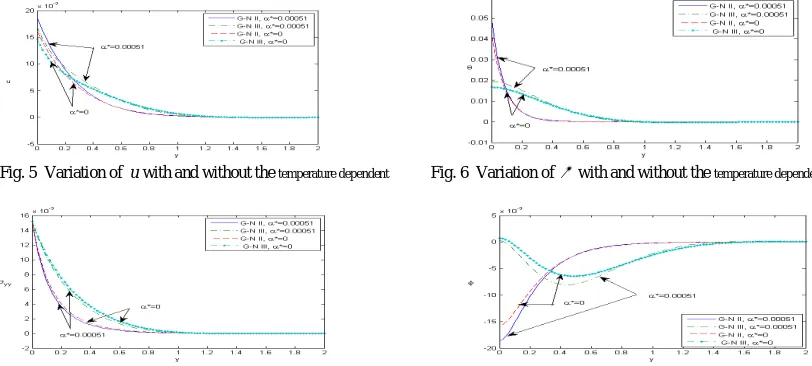
Fig. 4 expresses the variation of is decreasing with the increase of the value of g for y 0 in both types II and III of (G-N) theory with the increase of the value of g for y 0. It is clear that the gravity has an important role in the variation of the physical quantities. Fig. 5 shows the variation of the displacement u in the case of *0.00051, 0; it
noticed that the variation of u is increasing in the case of (G-N) theory of both types II and III for y0 with the increase of the value of *
.
Fig. 6 clarifies the variation of is increasing for types II and III of (G-N) theory with the increase of the temperature dependent properties for y 0. Fig. 7 depicts the variation of yy for *0.00051, 0; it is
noticed that the variation of yy is decreasing for both types II and III of (G-N) theory with the increase of
*
for y 0
with the increase of *
value.
Fig. 3 Variation of yy with and without the gravity Fig. 4 Variation of with and without the gravity
Fig. 8 expresses the variation of is decreasing with the increase of the value of * for y 0 in both types II and III
of (G-N) theory. It deduced that the temperature dependent properties have a significant role in the variation of the physical quantities.
Fig. 5 Variation of uwith and without the temperature dependent Fig. 6 Variation of with and without the temperature dependent
Fig. 9 shows the variation of the displacement u in the case of the absence and the presence of the laser pulse effect; it noticed that the variation of u is increasing in both types II and III of (G-N) theory for y 0 with the increase of the laser pulse value of the porous thermoelastic solid. Fig. 10 expresses the variation of yy in the case of the absence and
the presence of the laser pulse effect; it observed that the variation of yy is increasing in both types II and III of (G-N)
theory for y 0 with the increase of the laser pulse value of the porous thermoelastic solid.
Fig. 9 Variation of uwith and without the laser pulse effect Fig. 10 Variation of yy with and without the laser pulse effect
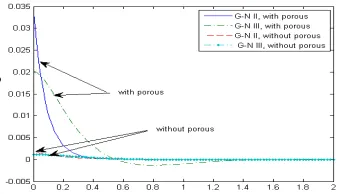
Fig. 11 clarifies the variation of in the case of the absence and the presence of the laser pulse effect; it observed that the variation of is decreasing in both types II and III of (G-N) theory for y 0 with the increase of the laser pulse value on the porous thermoelastic solid. It deduced that the presence of the laser pulse effect is a significant in the variation of the physical quantities. Fig. 12 shows the variation of the displacement u in the case of the absence and the presence of the porous effect; it noticed that the variation of u is decreasing in both types II and III of (G-N) theory for
0
y with the increase of the porous existence on the thermoelastic solid.
Fig. 11 Variation of with and without the laser pulse effect
Fig. 13 clarifies the variation of in the case of the absence and the presence of the porous effect; it observed that the variation of is increasing in both types II and III of (G-N) theory for y 0 with the increase of the porous existence on the thermoelastic solid. It deduced that the presence of the porous effect is a significant in the variation of the physical quantities. All the previous functions are continuous and all curves converge to zero.
3D curves are representing the complete relation between physical quantities u and xy with both components of the
distance as shown in Figs. 14-15, in the presence of the gravity, the temperature dependent properties and the effect of the porous in the studied thermoelastic solid in the context of (G-N) theory of type III. 3D figures stated that all the physical quantities are moving in the wave propagation.
Figs. 14, 15 respectively 3D Curve of variation of u and xyversus the components of distance
IV. CONCLUSIONS
The gravity and the temperature dependent properties have a significant effect on the variation of the considered physical quantities, since they make great changes in the behaviour of the functions, also the same observation of the absence and the presence of the porous and the laser pulse effect in the thermoelastic solid. The laser pulse heating effect is an important thermal loading in many scientific uses as the biological and the geological treatments of the materials. These physical quantities are continuous functions and all the curves converge to zero, as the solution using the normal mode method gives the exact solutions of the functions.
REFERENCES
[1] Biot, M.A. (1956), “Thermoelasticity and Irreversible Thermodynamics”, Journal of Applied Physics, Vol. 27, 240-253.
[2] Lord, H.W. and Shulman, Y. (1967), “A Generalized Dynamical Theory of Thermoelasticity” Journal of Mechanics and Physics of Solids, Vol. 15, 299-309.
[3] Green, A.E. and Lindsay, F.A. (1972), “Thermoelasticity”, Journal of Elasticity, Vol. 2, 1-7.
[4] Green, A.E. and Naghdi, P.M. (1991), “A re-examination of the basic postulates of thermo-mechanics”, Proceedings of the Royal Society A London, Vol. 432, 171-194.
[5] Green, A.E. and Naghdi, P.M. (1992), “On Undamped Heat Wave in Elastic Solids”, Journal of Thermal Stresses, Vol. 15, 253-264. [6] Green, A.E. and Naghdi, P.M. (1993), “Thermoelasticity without Energy Dissipation”, Journal of Elasticity, Vol. 31, 189-208.
[7] Ailawalia, P., Budhiraja, S. and Singh, B. (2011), “Effect of Hydrostatic Initial Stress and Rotation in Green-Naghdi (Type III) Thermoelastic Half-space”, Multidisciplinary Modelling in Materials and Structures, Vol. 7, 131-145.
[8] Othman, M.I.A., Zidan, M.E.M. and Hilal, M.I.M. (2013a) “Effect of Rotation on Thermoelastic Material with Voids and Temperature Dependent Properties of Type III”, Journal of Thermoelasticity, Vol. 1, 1-11.
[9] Othman, M.I.A., Zidan, M.E.M. and Hilal, M.I.M. (2013b), “The Influence of Gravitational Field and Rotation on Thermoelastic Solid with Voids under Green-Naghdi Theory”, Journal of Physics, Vol. 2, 22-34.
[10]Goodmann, M.A. and Cowin, S.C. (1972), “A Continuum Theory for Granular Materials”, Archive of Rational of Mechanics and Analysis, Vol. 44, 249-266.
[11]Nunziato, J.W. and Cowin, S.C. (1979), “A Nonlinear Theory of Elastic Materials with Voids”, Archive of Rational of Mechanics and Analysis, Vol. 72, 175-201.
[12]Cowin, S.C. and Nunziato, J.W. (1983), “Linear Elastic Materials with Voids”, Journal of Elasticity, Vol. 13, 125-147. [13]Iesan, D. (1986), “A Theory of Thermoelastic Materials with Voids”, Acta Mechanica, Vol. 60, 67-89.
[14]Iesan, D. (2004), “Thermoelastic Models of Continua”, Springer, Berlin.
[15]Lomarkin, V.A. (1976), “The Theory of Elasticity of Non-homogeneous Bodies, Moscow.
[16]Bromwich, T.J. (1898), “On the Influence of Gravity on Elastic Waves and in Particular on the Vibrations of an Elastic Globe”, Proceedings of the London Mathematical Society, Vol. 30, 98-120.
[17]Sun, Y., Fang, D., Saka, M. and Soh, A. K. (2008), Laser-induced Vibrations of Micro Beams under Different Boundary Conditions, International Journal of Solids Structures, Vol. 45, 1993-2013.