Optimization of Materiel Removal Rate for
AL6063-T6 on WEDM Using Response
Surface Methodology
Abhishek kumar
1, Prof. B.M.Behl
2P. G. Student, Department of Mechanical Engineering, Shri Krishan Institute of Engg. & Technology, Kurukshetra,
Haryana, India1
Professor, Department of Mechanical Engineering, Shri Krishan Institute of Engg. & Technology, Kurukshtra,
Haryana, India2
ABSTRACT: AL6063-T6 are gradually becoming very important materials for their scope of uses in manufacturing industries e.g. aerospace, nuclear, automotive, defense, and automobile industries Wire Electric Discharge Machine (WEDM) seems a good option for machining the complicated shapes on metal matrix composite. this paper, identify
the effects of various process parameters of WEDM such as pulse on (Ton) ,pulse off (Toff), Servo voltage (Sv), and
wire feed (Wf) for analysis the material removal rate (MRR) while machining AL6063-T6 . Central Composite Design
is used to plan and design of experts. The output response variable being material removal rate will be measured for all the number of experiments conducted. As the lowest value of MRR indicates the poor cutting rate, the optimum parameter level combination would be analyzed which gives desired material removal rate. These optimized values of various parameters would then be used in performing machining operation in order to obtain desirable outputs.
KEYWORDS: Metal Matrix Composite, Wire Edm, Process Parameters, Rsm Technique, Material Removal Rate.
I . INTRODUCTION
The main objective of this paper is to study different parameters likes ( Ton,Toff,Sv,Wf) of WEDM operations using
response surface methodology, in particular central composite design (CCD), to develop empirical relationships between different process parameters and output responses namely MRR. The mathematical models so developedare analysed and optimised to yield values of process parameters producing optimal values of output responses. In 2003 Tosun N, Cogun C; and Pihtili H [1] investigated the effect of cutting parameters on the size of crater erosion on wire electrode. The level of importance of the machining parameters on the wire crater size was determined by utilizing ANOVA. In 2004 Shajan Kuriakose, and M.S. Shunmugam [2] the Wire EDM process is essentially a thermal process and the nature of surface produced is studied. It is observed that more uniform surface characteristics are obtained with coated wire electrode. Among the parameters such as time between two pulses, pulse duration, injection pressure, wire speed and wire tension that has more influence on the surface characteristics, the time between two pulses is the most sensitive parameter. In 2006 Manna A and Bhattacharya B [3] experimentally investigated machining of Al/SiC-MMC by utilizing CNC-Wire cut EDM. Authors studied the various parameters machining of WEDM during machining and established the optimal combination of WEDM parameters for different performance criteria. It was concluded that low input pressure of dielectric is not sufficient to remove the reinforcement particles during machining. Open gap voltage and pulse on time are the most significant and influencing machining parameters for controlling the material removal rate. In 2007 Mahapatra and Patnaik [4] optimized the wire electrical discharge machining parameters . In 2008 J.A.
Sanchez et al [5] presented a new approach to the prediction of angular error in wire-EDM taper-cutting. A systematic
phenomena such as contact mechanics, plastic behavior, stress-stiffening and large displacements. Both the results of DoE techniques and FEM simulation have been validated through experimental tests in industrial conditions.
Deviations of accuracy of WEDM tapered parts can be reduced to values below 40 using these models. In 2012 Jangra
kamal [6] presented a study on unmachined surface area named as surface projection in the die cutting after rough cut in WEDM. Using scanning electron microscope images, length of unmachined surface projections have been
determined. Tungsten carbide was used as a work-piece and brass wire as electrode. In 2013 Sharma et al. [7]
optimized the process parameters for the cutting speed and dimensional deviation for high strength low alloy steel (HSLA) on WEDM. Response surface methodology was used for the modeling and multi-response optimization. In 2013 R.Chaudhary et al.[8] EN5 is medium strength mild steel so it is widely used in various machineries parts like shafts, racks, pinions, studs, bolts, nuts, rollers etc. Wire Electric Discharge Machine (WEDM) seems a good option for machining the complicated shapes on medium strength steel. this paper, identify the effects of various process parameters of WEDM such as pulse on (Ton) ,pulse off (Toff), peak current (Ip), servo voltage (Sv) for analysis the material removal rate (MRR) while machining EN5 mild steel material. Central Composite Design is used to plan and design of experts. The output response variable being material removal rate will be measured for all the number of experiments conducted. As the lowest value of MRR indicates the poor cutting rate, the optimum parameter level combination would be analyzed which gives desired material removal rate. These optimized values of various parameters would then be used in performing machining operation in order to obtain desirable outputs.In the present
study Al/Al2O3/SiC MMC is chosen for parametric investigation and optimization of material removal rate by using
response surface methodology and Wedm. The rest of the paper is orgainsed as follows. Proposed experimental methodology is explain in section II.Experimental results are presented in section III .Concluding remarks are given in section IV.
Workpiece: Aluminium 6063-T6 is a medium tensile low harden ability carbon steel generally supplied in the cold drawn or turned and polished, or centre less ground condition, with a typical tensile strength range 500 - 850 Mpa, and Brinell hardness range 150 - 245.characterised by good machinability, reasonable Weldability with medium strength plus good ductility. Aluminium 6063-T6 is perhaps the most widely used because of its Extrudability. A structural member of experimental magnetic levitation is also made of Aluminium 6063-T6 mild steel Europe and Japan. Another application of Aluminium 6063-T6 is in welded. Aluminium 6063-T6 extrusions combined with 1580 tube and 289 casting make up the axle body assembly parts of automobiles. Electrical cable towers are also made of Aluminium 6063-T6 extruded shapes. Aluminium 6063-T6 also provides better mechanical properties and is heat treatable and weldable. These are used in pipe and tubing industries and also used in ship and aerospace industries. Aluminium 6063-T6 are usually 15 to 25% lighter steel alloys. Another application of Aluminium 6063-6063-T6 axles, connecting rods, guide rods, hydraulic shafts, motor shafts, rams, spindles, studs, pressure vessels, pipe lines, bridges and other highway structures, door beams, rails etc.
II. EXPERIMENTAL METHODOLOGY
A. Machine Tool: -
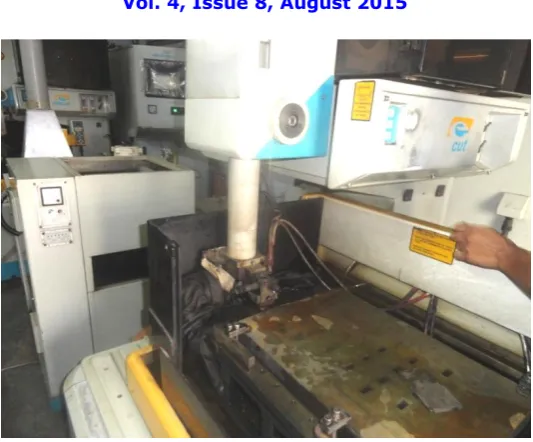
In this research work, MRR is response characteristics. These response characteristics are investigated under the varying conditions of input process parameters, which are Ton, Toff, servo gap voltage (SV), wire feed (Wf). The
Fig : 1 WEDM Setup for experimentation.
B. Examining The Output Response-
The MRR (mm³/min) is calculated from the cutting speed (directly displayed by the machine tool)*length of work piece removed *breadth of work piece removed. i.e MRR = cutting speed* length * Gap Width. Values of the MRR are noted at a distance of 5 mm, 5 mm, and 5 mm from the initiation of cut along a particular axis. This is done to ensure that readings are to be noted only when the cutting process is properly stabilised. The offset of the wire is set at zero.
C. Response surface methodology and design of experiment - RSM is a compilation of mathematical and statistical
techniques useful for the modeling and analysis of problems in which output factors are influenced by several input parameters and the main aim is to optimize this output parameters[9].
Table 1: Design of experiment and MRR
Std Run
A:Ton µs
B:Toff µs
C:IP A
D: SV V
1 1 125 60 180 30
2 14 125 60 50 30
3 18 125 20 180 80
4 4 105 60 50 80
5 5 125 20 50 80
6 15 105 20 180 30
7 6 105 60 180 80
8 7 105 20 50 30
9 11 98 40 115 55
10 12 131 40 115 55
11 13 115 6 115 55
13 2 115 40 5 55
14 21 115 40 224 55
15 8 115 40 115 12
16 20 115 40 115 97
17 17 115 40 115 55
18 3 115 40 115 55
19 16 115 40 115 55
20 9 115 40 115 55
21 19 115 40 115 55
III. RESULT AND DISCUSSION
There are 21 experiments in total carried out according to the design of experiments. The average values of Mrr (mm³/min) are shown in Table 1. For analysis of data, checking the goodness of fit of model is required. The model adequacy checking includes test for significance of regression model, test for significance on model coefficients, and lack of fit test .For this purpose, ANOVA is performed.
Analysis Of Material Removal Rate-
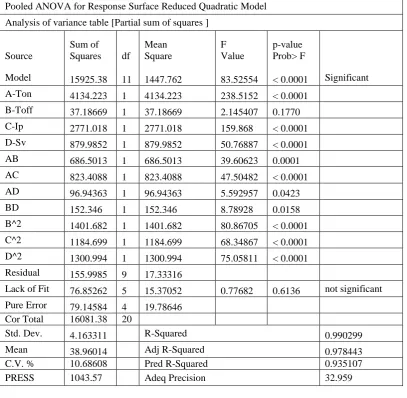
According to the fit summary obtained from analysis, it is found that quadratic model is statistically significant for MRR. The results of the quadratic model for MRR in the form of ANOVA are presented in Table 2. If the F value is more corresponding, p value must be less corresponding resulting in a more significant corresponding coefficient. Non significant terms are removed by backward elimination for the fitting of MRR in the model. Alpha out value is taken at 0.05 (i.e., 95 % confidence level). When quadratic model with backward elimination is selected, the model is not hierarchical so the Toff (B in coded form) is hierarchically added. A model is said to be hierarchical if the presence of higher-order terms (such as interaction and second-order terms) requires the inclusion of all lower-order terms contained within those of higher order. It is found from Table 2 that F value of the model is 149.3925 and related p value is <0.0001, results of a significant model. The lack of fit is a measure of the failure of the model to represent data in the experimental domain at which points are not included in the regression variations in the model that cannot be accounted for by random error. If there is a significant lack of fit, as indicated by a low probability value, the response predictor is discarded . The lack of fit is non significant and its value is 0.1953. From Table 2 it is found that R² of the model is 0.9955, which is very close to 1. The meaning behind this is that 99.55 % variation can be explained by this model and only .45% of total variation cannot be explained, which is an indication of good accuracy. The predicted R² is in logical concurrence with the adjusted R2 of 0.97 Figure (3) shows the normal probability plot of residuals for MRR. Most of the residuals are found around the straight line, which means that errors are normally distributed. Adequate precision compares the significant factors to the non significant factors, i.e., signal to noise ratio. According to the results obtained from the software, ratio greater than 4 is desirable. In this, the adequate precision is 44.37. So the signal to noise ratio is significant. By applying multiple regression analysis on the experimental data, the empirical relation in terms of coded factors is obtained as follows:
MRR =-57.08+2.7* Ton-2.56*Toff+14.24* Ip-12.47* Sv-14.39* Ton * Toff+10.15* Ton * Ip+5.41* Ton * Sv+6.78 * Toff * Sv-9.66* Toff2-8.88* Ip2-0.931 x Sv2
Table 2 : ANOVA for response surface of reduced quadratic model of Material Removal Rate
Pooled ANOVA for Response Surface Reduced Quadratic Model
Analysis of variance table [Partial sum of squares ]
Source
Sum of
Squares df
Mean Square
F Value
p-value Prob> F
Model 15925.38 11 1447.762 83.52554 < 0.0001 Significant
A-Ton 4134.223 1 4134.223 238.5152 < 0.0001
B-Toff 37.18669 1 37.18669 2.145407 0.1770
C-Ip 2771.018 1 2771.018 159.868 < 0.0001
D-Sv 879.9852 1 879.9852 50.76887 < 0.0001
AB 686.5013 1 686.5013 39.60623 0.0001
AC 823.4088 1 823.4088 47.50482 < 0.0001
AD 96.94363 1 96.94363 5.592957 0.0423
BD 152.346 1 152.346 8.78928 0.0158
B^2 1401.682 1 1401.682 80.86705 < 0.0001
C^2 1184.699 1 1184.699 68.34867 < 0.0001
D^2 1300.994 1 1300.994 75.05811 < 0.0001
Residual 155.9985 9 17.33316
Lack of Fit 76.85262 5 15.37052 0.77682 0.6136 not significant
Pure Error 79.14584 4 19.78646
Cor Total 16081.38 20
Std. Dev. 4.163311 R-Squared 0.990299
Mean 38.96014 Adj R-Squared 0.978443
C.V. % 10.68608 Pred R-Squared 0.935107
PRESS 1043.57 Adeq Precision 32.959
Effect Of Process Parameter On MRR:
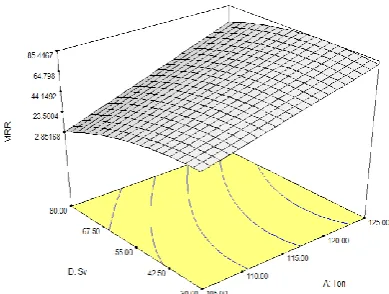
The combined effect of two control factors or process parameters on the response variables is called the interaction effect. For the interaction plot, the two parameters vary keeping other two process parameters at the central value and observe the effect on the response characteristics. This plot is called the three-dimensional surface plot (i.e., 3D surface
plot). So the significant interactions are shown in Figs. 3.1(a). The interaction effect (combined effect) of Ton and Toff
on MRR (as shown in Figure 3.1 (b) shows that MRR goes to a maximum value 110 mm³/min at a high value of Ton (125) and a low value of Toff (105), while it reaches at a minimum level, where Ton is minimum (105) and Toff is maximum (60). This is due to the fact that higher Ton and lower Toff means that discharge will take place for a long time, long time of discharge means a higher value of discharge energy. A higher value of discharge energy creates violent sparks between the work piece and moving electrode, these sparks causes a faster erosion of material and a faster cutting speed is observed. fig. shows that MRR increases with decrease in the Spark Gap Voltage (SV).The main reason behind this is, higher the Spark Gap Voltage longer the discharge waiting time. To obtain the longer discharge wait time machining speed needs to be slowed down. So lower value of SV favours the productivity.
Fig 3.1(a) shows the interaction effect of Ton and Toff Fig 3.1 (b) shows the 3D interaction plot of Ton and Ip on . MRR.
Figure 3.1(c) shows the interaction effect of Ton and Sv
IV. CONCLUSION
In this paper, effect of process parameters on MRR is investigated. it is concluded that: 1. For material removal rate Ton,Toff and Sv are the most significant process parameter.
2. For both the response parameters, the predicted values of the responses are in close agreement with experimental results.
variable. Quadratic function of Ton and SV, interaction effects of Toff and SV, and SV and Toff are significant for material removal rate.
REFERENCES
[1] Tosun N, Cogun C.; and Pihtili H, “The effect of cutting parameters on wire crater sizes in wire EDM”, International Journal of Advance Manufacturing Technology, Vol. 21, 2003, pp. 857-865.
[2] Shajan Kuriakose, and M.S. Shunmugam, “Characteristics of wire-electro discharge machined Ti6Al4V surface”, Materials Letters 58 (2004) 2231– 2237.
[3] Manna A., and Bhattacharyya B.; “Taguchi and Gauss elimination method: A dual response approach for parametric optimization of CNC Wire Cut EDM of PRAI-SiC-MMC”, International Journal of Advance Manufacturing Technology, Vol. 28, 2006, pp. 67-75.
[4] S.S. Mahapatra and Amar Patnaik. Optimization of wire electrical discharge machining (WEDM) process parameters using Taguchi method, Int J Adv Manuf Technol 34, pp. 911-925, 2007.
[5 J.A. Sanchez, S. Plaza, N. Ortega, M. Marcos, and J. Albizuri, “Experimental and numerical study of angular error in wire-EDM taper-cutting”, International Journal of Machine Tools & Manufacture, 48, (2008), 1420– 1428
[6] Jangra Kamal, Jain.Ajay and Grover Sandeep., (2010). Optimization of multiple-machining characteristics in wire electrical discharge machining of punching die using grey relational analysis. Journal of Scientific & Industrial Research, 69, 606-612.
[7] N. Sharma, R. Khanna, R.D. Gupta, R. Sharma, Modeling and Multi-response optimization on WEDM for HSLA by RSM, Int Journal Adv. Manuf. Technol, august 2013.volume 67,issue 9-12,pp 2269-2281.
[8]Ravinder Chaudhary,Rohit Rampal,Neeraj Sharma (2013) Investigates the and Optimization of Materiel Removal Rate For Wire Cut Electro Discharge Machining In EN5 Steel Using Response Surface Methodology,International Journal of Latest Trends in Engineering and Technology (IJLTET),Vol. 3 Issue 1 September 2013,ISSN: 2278-621X.