An Efficient Conflict Free Multi-Path
Dynamic Routing For Improving QoS in
Wireless Sensor Networks
Bindushree M R
1, Vijayalaxmi R Patil
2P.G. Student, Department of Information science& Engineering, Dr. AIT, Nagarbhavi, Bangalore, India1
Assistant Professor, Department of Information science& Engineering, Dr. AIT, Nagarbhavi, Bangalore, India2
ABSTRACT: Wireless Sensor Network (WSN) is often outlined as a network of devices. Devices are denoted as
nodes, which may sense the surrounding and communicate the data gathered from the surrounding in wireless way. In WSN, the QoS requirements can be determined as performance measurements, such as, delay, reliability, throughput or jitter. The different applications which run on WSN can have different QoS requirements. The dynamic routing algorithm called Integrity and Delay Differentiated Routing (IDDR) is used to differentiate the packets with different QoS requirements. Low Energy Adaptive Clustering Hierarchy (LEACH) protocol has been used to make the clustering and cluster heads are chosen based on the highest energy. The cluster heads with minimum distance are used to transmit packets to sink node. The routing algorithm differentiate the packet according to weight present at header and send the delay sensitive packet along shortest path and data integrity packets along sub optimal path. Data integrity packets are encrypted using homomorphic encryption technique in order to provide security. The performance metrics like energy consumption, average packet drop, packet delivery ratio, queue length are considered. The simulation results show that proposed method is much efficient when compared with MinRoute protocol.
KEYWORDS: Wireless sensor networks, Quality of service, Routing, Performance.
I. INTRODUCTION
Wireless Sensor Network (WSN) as the name suggests it’s a network structure where each other nodes are connected to several other nodes without using any physical medium. Wireless Sensor Network has several abundant applications such as monitoring system, environment monitoring system, healthcare centre etc. Because of their simplicity and availability the WSNs has altered our general surroundings. They are getting to be basic part of our lives, more so than the present-day PCs as a result of their various focal points as said beneath. QoS in WSN can be interpreted as a measurement metrics that the network provides to the end user or application in terms of delay, integrity, bandwidth, accuracy, packet drop etc. User is concentrated only on the service that the network gives to improve the QoS of the application and not really concentrated on how the network is going to provide.
The QoS requirements can be application specific or network specific. For example, for the event tracking application QoS requirements can be coverage, optimum number of sensor that are need to be active, exposure etc. From network perspective, the QoS requirement can be maximum utilization of the sensors resources. While developing QoS provisioning protocol for WSN the challenges like resource constraint, mixed data, dynamic topology, scalability, multiple sinks or base station, redundant data etc must be addressed.
The rest of the paper is organized as follows. Section II describes motivation for choosing the topic. In section III, we discuss some of the related work. Section IV presents the design of the method we proposed in this paper. Section V shows the simulation results of the proposed method compared with the MinRoute protocol. Finally, Section VI presents conclusion and future work.
II. MOTIVATION
There are lot of techniques that are proposed to handle the QoS necessities in WSN. Existing systems cannot satisfy low delay and high integrity services in the mean time. Since delay sensitive packets occupy restricted bandwidth and buffer. High integrity packets block the shortest path thus delay sensitive packets to travel additional hops and these packets occupy buffers that will increase the queuing delay for the delay sensitivity packets
III.RELATEDWORK
So many algorithms have been proposed to improve the quality of service in wireless sensor networking. Algorithm may consider single QoS parameter or more than that. There are routing protocols like RAP, SPEED and EDF which are proposed to provide real-time service and Protocols like AFS, ReInforM and LIEMRO are proposed to improve the reliability.
The SPEED is QoS conscious protocol in WSN that ensures end to end QoS. Every individual hub holds the details of the surrounding hubs and “Stateless Geographic Nondeterministic Forwarding (SNGF)” is used as a routing procedure to find the path. It manages selected shipping speed to all the packets. By dividing length to sink by speed an end to end delay is calculated. Last Mile course of action is used to provide communication service. Congestion can be minimized using this. However packet miss ratio is high when network is congested [3].
MMSPEED an extension of SPEED and this protocol provides multi route and multi speed for data. The QoS prerequisites like reliability and timeliness are considered. Because of probabilistic multi-route packet forwarding, packet can select shipping speed. Here routing is localized which allows different types of packet to go through network. By doing decision at each intermediate node it achieves both QoS prerequisites considered. But it consumes lot of power in doing so. The protocol suffers from wastage of the energy and data redundancy problem [4].
ReInForM, a routing algorithm which supplies wanted dependability at proportional cost. Protocol makes copies of the packet and transmits them through multiple paths. Reliability is achieved by doing this. ReInForM makes use of randomized forwarding mechanism which results in load balancing. But scares resources like energy and bandwidth usage is more and the global topology of the network should be known [6].
EQSR protocol for wireless sensor networks to recover from node failure. The protocol splits the traffic and routed through node disjoint paths across the network to achieve efficient load balancing. The real time and non real time queuing model is used to differentiate between real time and non-real time data traffic. “XOR-centered Forward Error Correction (FEC)” has been utilized to increase the reliability. But this protocol suffers from control overhead [7].
Hassanein, et al.,[10] proposed Reliable energy aware routing in wireless sensor networks. It mainly tries to reduce energy wastage. The reliability is achieved by sending packets along multiple paths and acknowledgement. Source node initiates the routing procedure in this protocol. In the path discovery process packets are flooded by sink node. The energy is reserved according to different energy requirement. It is used to reduce buffering and data loss in case of broken connection. This is not used under normal operation but used only when no path exist. End to end capability is minimized to capability of single path.
For the link quality estimation, the proposed method uses distributed, mind moreover computation effective devices. Multisink single route is used in order to increase reliability. The protocol is the initial that forces wear of the different data types whereas considering latency, reliability, remainder battery power in sensor nodes. Packet drop occurs frequently.
IV.DESIGNOFPROPOSEDMETHOD
There are various algorithms which have been proposed to address the QoS requirements in WSN. The routing protocol can consider single QoS constraints or more. Due to the limited bandwidth and buffer size the existing system cannot consider two basic QoS parameters delay and data integrity. In the highly congested network these requirements cannot be satisfied simultaneously. So there is a need of new protocol which addresses both these parameters and should be scalable. [2] Jiao Zhang, et al., proposed on novel potential based routing protocol, integrity and delay differentiated routing (IDDR) to improve fidelity for data integrity applications and to decrease end to end delay for delay-sensitive applications. The data integrity packets are cached on underloaded path which suffers from large end to end delay where as delay sensitive packets will route through shortest path. It has following disadvantages. Energy consumption to transfer a packet is high. There can be routing loops. Data integrity can be destroyed by internal or external attacks.
To overcome the problems of existing system here IDDR routing protocol is combined with LEACH protocol and homomorphic encryption. The basic step is to create potential field by calculating the potential depth for each node. Clusters are formed by using LEACH which considers the energy and position. Based energy and potential depth value cluster head is selected for each cluster formed. Cluster head will be used to route the packets from one cluster to another until it reaches the sink node. The packets are given weight which indicates the degree of delay sensitivity. Packets with zero weights are considered as data integrity packets and they are encrypted by using homomorphic encryption technique to maintain the integrity. Packets whose weights are not zero are delay sensitive packets which should travel shortest path to avoid end to end delay. The integrity and delay differentiated routing (IDDR), potential based routing algorithm is used to differentiate different packets according to their weight and route them accordingly. Energy consumption is minimized by using leach protocol. Security is provided by encrypting packets and has acceptable overhead.
1) LEACH Clustering algorithm
Here LEACH protocol based on current energy of the node is considered. The node with highest energy is considered as the cluster head. Cluster head uses energy more than any other non cluster node. Each cluster contains one cluster head to transmit data from neighbors to another cluster.
T (n) = 𝑝 1−𝑝∗(𝑟𝑚𝑜𝑑1
𝑝)
∗𝐸𝑐𝑢𝑟
𝐸0 ...1
Where T (n) is the threshold, 𝐸𝑐𝑢𝑟 represents current energy and 𝐸0 represents initial energy.p represents percentage of cluster head. The clustering helps to save the energy and prolongs the network lifetime.
2) Potential depth
Potential depth is calculated by Euclidean distance formula for two dimensions. Since nodes are deployed in 2D the x and y co ordinates are considered. If p is considered as any node in the network and q is considered as another node, the distance between them is calculated as follows.
d (p,q) = (𝑥1− 𝑥2)2+ (𝑦1− 𝑦2)2 ....2
where p(𝑥1, 𝑦1) is the position of the node and q(𝑥2𝑦2,) is position of the sink node and d (p,q) is the distance between node p and node q.
3) IDDR algorithm
Let c be the weight of the packet. The weight of the packet is represented in the packet header. Let p be the packet. Before applying IDDR algorithm clustering is done and the cluster head is selected.
Step 1: if(c!=0) // delay sensitive packet Step 2: if( CH= mindistance&& q!= full)
Send packet p to next CH having minimum distance and having empty queue else
Step 3: if(c==0) // data integrity packet. Do the step 4 and step5.
Step 4: Encrypt the packet p using homomorphic encryption and Store it in the buffer Step 5: Send the encrypted packet p to next CH having optimal distance.
Step 6: end
V. SIMULATIONRESULTANDANALYSIS
This section gives the detail analysis of the simulation results. Proposed protocol is evaluated against the existing protocol MinRoute. Different parameters like queue length, packet drop, packet delivery ratio, energy consumption in the node are considered to evaluate the results and we will explain them with the help of graphs. The simulation is conducted for 49 nodes and based on MinRoute papers the values are taken and compared.
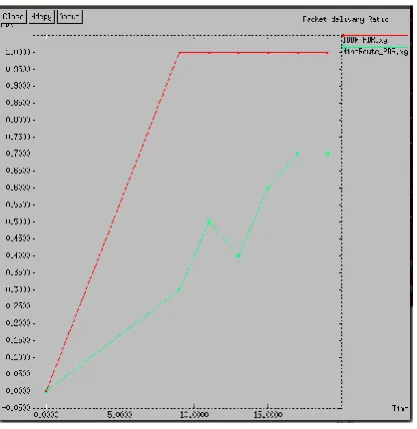
Packet delivery ratio: The packet delivery ratio is number of packets successfully received by the sink node.
Fig 1.Packet delivered versus time
The graph in the Figure 1 represents packet delivered versus time. From the graph it’s confirmed that proposed method have better packet delivery ratio compared to MinRoute. Almost all packets are delivered in the proposed system as we can see in the graph.
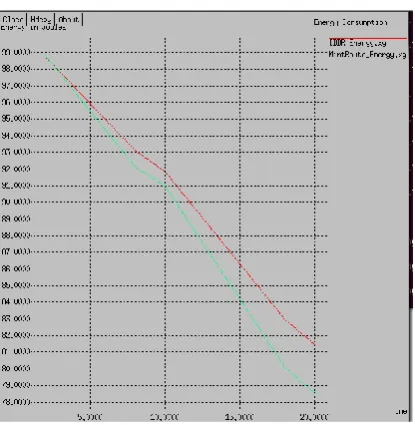
Energy consumption:Due to energy is scares resource in the wireless sensor nodes it’s very important that energy
Fig 2.Energy consumption versus time.
The energy consumption of proposed protocol IDDR is compared with the MinRoute protocol as depicted in Figure 2. The energy at the node is initially 99J. As the time goes on the energy consumption is less in proposed method compared to MinRoute.
Packet drop:The number of packets dropped over the time is referred as packet drop.
Fig 3.Packet drop versus time
The graph in the Figure 3 shows packet drop of the proposed system and the existing system. Over the time packet drop occurs in MinRoute protocol whereas the IDDR works well. Since IDDR scatters different packets according to situation, the packet drop is zero.
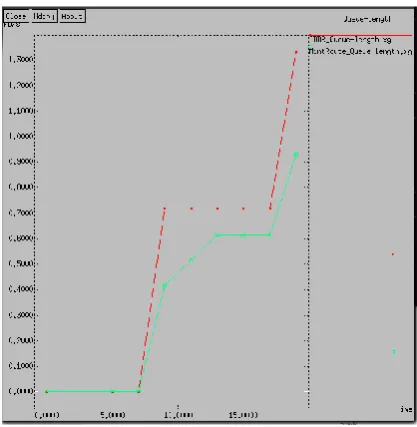
Fig 4. Queue length versus time
As the simulation time goes and number of packets increases the IDDR maintains more packets in queue than the MinRoute. So IDDR makes efficient usage of the queue. The graph in the Figure 4 shows the maximum utilization of queue by the proposed method.
VI. CONCLUSION
In Wireless Sensor Network (WSN) QoS aware routing is a vast area of exploration with growing set of research results. The proposed system implements a combination routing algorithm called integrity and delay differentiated routing (IDDR) and clustering protocol LEACH to improve fidelity for data integrity packets and reduce delay for delay sensitive packets. Encryption is done for the data integrity packet using homomorphic encryption technique to maintain integrity of the packet. The simulation was carried on NS-2 and the simulation results were compared with MinRoute protocol. The obtained results show that energy consumption, packet delivery ratio, packet drop and queue length are improved in proposed system. The future work can focus on improvement of the proposed system by considering different parameters like priority of packets, multiple sink etc. and still more efficient encryption algorithm can be combined.
REFERENCES
[1] A. Ganz, Z. Ganz, and K. Wongthavarawat, “Multimedia Wireless networks: technologies Standards, and QoS” , Prentice Hall, Upper Saddle River, NJ, 2004.
[2] Jiao Zhang, FengyuanRen, Shan Gao, Hongkun Yang and Chuang Lin, “Dynamic Routing for Data Integrity and Delay Differentiated Services in Wireless Sensor Networks”, IEEE Transactions on Mobile Computing, DOI 10.1109/TMC.2014.2313576
[3] T. He, et al., “SPEED: A Stateless Protocol for Real-Time Communication in Sensor Networks,” Proceedings of International Conference on Distributed Computing Systems, Providence, RI, 19-22 May 2003, pp. 46-55.
[4] K. Akkaya and M. Younis, “An Energy-Aware Qos Routing Protocol for Wireless Sensor Networks,” Proceedings of the IEEE Workshop on Mobile and Wireless Net works (MWN 2003), Providence, RI, May 2003.
[5] EmadFelemban, Chang-Gun Lee, and EylemEkici, “MMSPEED: Multipath Multi-SPEED Protocol for QoS Guarantee of Reliability and Timeliness in Wireless Sensor Networks”, IEEE Transaction on mobile computing, Vol. 5, no. 6, June 2006, pp. 710-715.
[6] B. Deb, S. Bhatnagar and B. Nath, “ReInForm: Reliable Information Forwarding using Multiple Paths in Sensor Networks,” Proceedings of IEEE International Conference on Local Computer Networks, Germany, 2003, pp. 406-415.
[7] H. W. Tsai, et al., “Mobile Object Tracking in Wireless Sensor Networks,” Journal of Computer Communications,Vol. 30, No. 8, March 2007. [8] P. Ji, et al., “DAST: A QoS-Aware Routing Protocol for Wireless Sensor Networks,” Proceeding of International Conferences on Embedded
[9] Ben-Othman, Jalel, and Bashir Yahya. "Energy efficient and QoS based routing protocol for wireless sensor networks." Journal of Parallel and Distributed Computing 70, no. 8 (2010): 849-857
[10] Hassanein, Hossam, and Jing Luo. "Reliable energy aware routing in wireless sensor networks." In Dependability and Security in Sensor Networks and Systems, 2006. DSSNS 2006. Second IEEE Workshop on, pp. 54-64. IEEE, 2006. [11] P. T. A. Quang and D.-S. Kim, “Enhancing Real-Time Delivery of Gradient Routing for Industrial Wireless Sensor networks,” Industrial Informatics, IEEE Transactions on, vol. 8, no. 1, pp. 61–68, 2012.
[11] M. Radi, B. Dezfouli, K. A. Bakar, S. A. Razak, and M. A. Nematbakhsh, “Interference-Aware Multipath Routing Protocol for QoS Improvement in Event-driven Wireless Sensor Networks,” Tsinghua Science & Technology, vol. 16, no. 5, pp. 475–490, 2011.
[12] M. Razzaque, M. M. Alam, M. MAMUN-OR-RASHID, and C. S. Hong, “Multi-constrained QoS Geographic Routing for Heterogeneous Traffic in Sensor Networks, IEICE Transactions on Communications,” IEICE Transactions on Communications, vol. 91B, no. 8, pp. 2589– 2601, 2008.
[13] L.Georgiadis, M. J. Neely, and L. Tassiulas, “Resource Allocation and Cross-Layer Control in Wireless Networks,” Foundations and Trends in Networking, vol. 1, no. 1, pp. 1–144, 2006.