GENETIC STUDIES OF SEVERAL CHARACTERS I N COLIAS EURYTHEME (LEPIDOPTERA, PIERIDAE)
SHIGERU ALBERT AE
Department of Zoology, Yale Uniuersity, New Haven, Connecticut* Received August 26, 1957
EMINGTON (1954) recently reviewed the previous studies on genetics of
R
Colias. The sex-limited “alba” gene, which controls female dimorphism, has been studied in C. eurytheme Boisduval, C. philodice Latreille, C. ChristinaEdwards. C . myrmidone Esper, and in C. erate poliographus Motschlsky. Besides this well studied gene, inheritance of the following genes has been investigated: “blue-green” and “olive-green’’ larval color in C. philodice ( GEROULD 1926) ;
blue-green larval, pupal and adult eye color, recessive white male and female wing color, and egg sterility and food plant sterility. (HOVANITZ 1944); discal spot color on the hind wings in C . philodice, C. eurytheme, and C . erate poliogra-
phus (KOMAI and AE 1953; REMINGTON 1955; DEAN 1956; AE 1957); and in-
heritance of orange and yellow ground coloration in the hybrids between C. eury-
theme and C. philodice ( GEROULD 1943; HOVANITZ 1944; REMINGTON 1954).
AE (1956) also studied the genetics of hybrids between C. eurytheme and C .
interior Scudder.
As FORD (1945) has pointed out, wild butterflies carry many recessive genes in heterozygous condition, and sib matings in the laboratory produce some rec- ognizable recessive homozygotes.
Certain new hereditary characters in C. eurytheme were found by means of sib matings, and their genetics has been investigated. Two of these characters were transmitted into the hybrids between C . eurytheme and C. philodice. The collection of Colias at the American Museum of Natural History, New York, and most of the specimens of GEROULD’S genetic studies (1923, et al.) at the Peabody Museum of Natural History at Yale University also have been ex- amined. The results are presented and discussed here.
MATERIALS A N D METHODS
C . eurytheme orange female, P-62, which was collected at Yale University by the writer, carried the several hereditary characters described below. The prog- eny from one other C. eurytheme and one C . philodice in New Haven, and from two C. eurytheme in Jackson, Mississippi, were also used in this study.
The rearings were carried on in a rearing room of the Josiah Willard Gibbs Laboratory, at Yale University. The room was kept at 80”F, and fluorescent light illumination was used 14 hours per day. Humidity was kept low and ap- proximately constant in the room.
GENETICS O F COLIAS 565
Eggs were obtained from females in glass lamp chimneys on potted food plants, placed under the sun or near a n incandescent lamp. The larvae were reared in insect cages about 10 inches cubed, of which all four sides were netting and the top was glass. Vetch (Vicia uillosa) was used as the sole larval food. Matings were obtained in cages near the laboratory window, under either direct sunlight or under strong fluorescent light in the rearing room.
A
mixture of one part of clover honey and two parts of water was used as food for the adults. The butterflies were stored at 60°F in a dark room when they were not being used for mating or egg laying.During the rearing, a large number of larvae or pupae often died of diseases. Their symptoms coincide precisely with the description by STEINHAUS (1949)
of
polyhedroses by virus infection in Colias. Therefore, these losses are referred to simply as virus diseases in this paper, although microscopic tests were not perf ormed.An individual designation was given to each wild female which became the mother of a brood, and to all laboratory reared males and females. The individual designation of a female was also used as the designation of its brood. For in- stance, the wild C . eurytheme female, P-62, produced Brood P-62, and one of the females of this brood, P-52-9, mated with one of its sibs, P-62-2, and produced Brood P-62-9.
RESULTS
“Black-veined” character
On 20 December 1956, one C. eurytheme mutant male emerged from a stock from female P-62 which had been continuously inbred by sib matings. Its wing veins on the upper side were almost completely black as in the Monarch butter- fly (Danaus plexippus L.). The ancestors of this butterfly were carefully ex- amined and further matings and rearings were carried on in order to clarify the genetics of this new mutant (Figure 1 )
.
Figure 2 shows the analysis of ancestors and sibs of the above “black-veined” mutant, P-62-9-7-2, which is one of the four “black-veined” mutants of Brood P-62-9-7. The expression of blackness of veins vaned extensively. All veins were black on the upper sides of both wings in the most prominent ones. In some individuals veins of the upper side of the hind wings only were clearly black. Only traces of blackness were found in veins of the central portions of the hind wings in other individuals. In many females in this strain and others, there is a tendency for black lines to extend along veins from the border to the base of the wing. However, no correlation of this female condition with male
“black-veined” was recognized.
366 S. A. A E
FIGURE 1 .-Three “hlark-wined“ mutants of Colins curyrhcnw. Normal male is shown in lower right hand corner.
TABLE I
F , from fcrnalcs of Rrood P - 6 2 - 9 2 ( R)
B- 3 0-4 NO 7 0 0 3 10
B-5 B-12 SO 3 1 0 3 7
B-9 B- 1 Tr I1 3 I 4 19
B l 0 P-76-8 NO 10 0 0 12 22
B-13 B-4
s o
0 3 0 1 4D-18 B-15 NO 4 0 1 8 13
B-2 1 B-9-5 I S V 1 0 3 1 5
the above matings. Sterile matings and other matings which failed to produce adult progeny were excluded from the table. Brood P-62-9-7 was designated as
Brood
R
in this table and hereafter.GENETICS O F COLIAS 567
8
P-62-35
X
I
I5
$3
6bb
Tr
(VV)
(vv,v V)
(vv)
$P-62-9-7
X
*-62-9-8
Tr
(VV)
I
(vv)
1288
4 b B v
ldTr
56bNo
(vv)
(vv)
(VV
1
FIGURE &.--Genealogy of a ““black-veined’ strain (AE I ) . No-normal, Tr-trace black-veined,
an unrelated C. eurytheme female, P-78-4-102, which was from Mississippi stock.
The writer found two wild C. eurytheme males which show “black-veined” in trace expression in the collection of the American Museum of Natural His-
tory. One was collected by LICK
BROOK
at Ithaca, N.Y., on 19 August 1928. Another was collected by H. J. SANFORD at Manahawkin, Ocean County, N.J., on 15 October 1948.The writer also examined most of the specimens reared by J. H. GEROULD in his genetic studies of C. eurytheme and C. phiLodice (1923), now deposited in the Peabody Museum of Natural History at Yale University. Two strains of
C. phi2odice proved to include “black-veined’’ males. Figures 5 and 6 show their genealogies. No difference was found in expression of “black-veined’’ in C.
eurytheme, C . philodice and hybrids between them.
These studies clearly indicate that “black-veined” is a hereditary character, which is recognized only in males. Phenotypes vary in intensity of expression of
the “black-veined” character. The most probable interpretation for the trait is that it is a single recessive. Table 2 shows results obtained from matings in which the genotypes of parents were fairly certain, as derived from their ancestors or progeny. The mating between a strongly “black-veined” male,
568 S . A. AE
?B-9
X
86-1
(VV)
(vv)
(v v) ( V V )
288
Bv
988
Tr
I?
2 8
Bv
( v v ) (vv) (vv)
9PP
FIGURE 3.-Genealogy of a “black-veined” strain (AE 11).
TABLE 2
F , of Colias crosses of “black-ueined” strain
Brood
Male offspring
Male parent Normal “black-veined”
P-62 1909 2w 1910 a 1910 e
P-62-35 P-6%9-7 (B) B-9
B-21 B-10-174
P-78-4-102
B-9-10
a. Vu x Vu
wild 1 a6
wild
a7
P-62-15 P-62-9-8 8-1 B-9-5 B-3-4-19
b. Vu x uu
c.
vv
x vud. uu x uu
B-34-26-8
B-9-5
17 13 12 51
12 5 4 1 1
23
0
0
GENETICS OF COLIAS 569
(VV) (VV)
88-3-4-26-8 X ?P-78-4-102 (Mississippi stock)
(vv)
/
(VV)(VV)
FIGURE 4.-Genealogy of a “black-veined’ strain (AE 111). B = P-62-9-7.
5 70 S. A. AE
wild C. philodice
+
19090
20
A
88
- 0Brood 1909 la
I
9 N
lk$t
No
h b
Tr
.--
Brood 1909
2 w
FIGURE 5.-Genealogy of a “black-veined’ strain (Gerould I).wild
G.
phitodice
8
12
$$FIGURE 6 . 4 e n e a l o g y of a “black-veined’ strain (Gerould 11).
recessive homozygote, which had its normal expression decreased by a low penetrance. Therefore, 1 : 3 and 1 : 6 ratios for 1 : 1 do not necessarily indicate a n excess of recessive homozygotes, but rather a modification from 0 : 1 ratio.
Glueless female
GENETICS O F COLIAS 571 Wild
8
P - 6 2
G
$P-62-9
?*\
X
8
CP-62-35 X
%
G
I
G
I
I
+
-
l
3830
IP G
b
3.
SP-62-9-7 X
$G
I
G
I
I8g IgG
G
I
I3G
FIGURE 7.-Genealogy of a “glueless” strain. G-glue, g-glueless.
this genealogy. Some wild females which were kept at 60°F in a dark room for about one month or more also failed to glue eggs during the experiments. How- ever, glueless females of this genealogy had been kept in the 60°F room for only a few days or less before they failed to glue eggs. Therefore, its hereditary basis is fairly clear. Although the data are not sufficient to justify a discussion
of genes conditioning this character, the most probable interpretation is a six- limited, single dominant gene, because this character seems to carry through males and crossing between glueless female B-10 and unrelated C . philodice
5 72 S. A. AE
Mule sterility
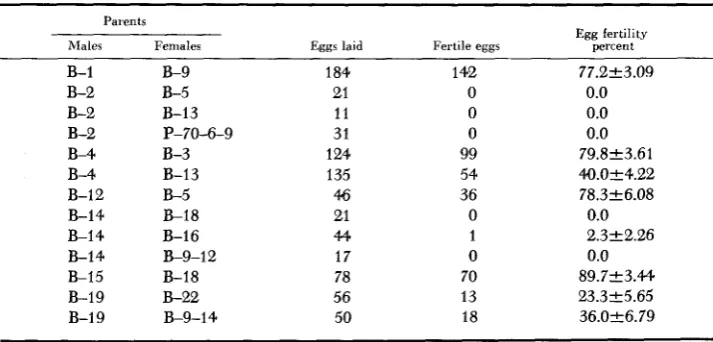
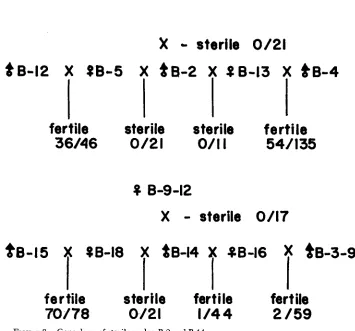
Thirteen matings were obtained from seven males of Brood B. Table 3 shows the results of egg fertility from these matings. Two males mated three times and the other two males mated twice. Five matings produced only infertile eggs (did not turn red), and one mating produced only one fertile egg out of 44 laid. The above six matings were from males B-2 and B-14. Two females, B-5 and B-13, mated with B-2, later mated again with males respectively B-12 and B-4 and produced fertile eggs. One female, B-18, mated with B-14, later mated again with B-15 and produced fertile eggs. Figure 8 illustrates the situation. It is clear that the sterilities of these six matings are the result of sterility of males B-2 and B-14. Since the above seven males were all sibs and the progeny of the two continuous sib matings, these sterilities could have been the results of one or two pairs of recessive genes.
TABLE 3
Egg fertility of mates of Brood P-62-9-7 ( B ) males Parents
Egg fertility Males Females Eggs laid Fertile eggs percent
B-1 B-9 184 142 77.223.09
B-2 B-5 21 0 0.0
B-2 B-13 1 1 0 0.0
B-2 P-70-6-9 31 0 0.0
B-4 B-3 1 24 99 79.823.61
B-4 B-13 135 54 40.024.22
B-12 B-5 46 36 78.326.08
B-14 B-18 21 0 0.0
B-14 B-16 44 1 2.322.26
B-14 B-9-12 17 0 0.0
B-15 B-18 78 70 89.723.44
B-19 B-22 56 13 23.325.65
B-19 B-9-14 50 18 36.0&6.79
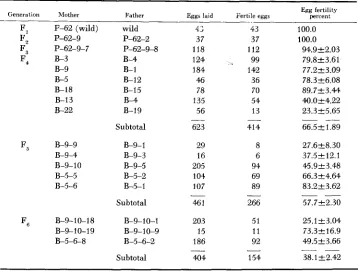
From the rearings and matings of the progeny of the above matings, large numbers of completely sterile matings were obtained, mainly by continuous sib matings (Table 4 ) . Although it was not determined whether females or males were responsible for these sterilities, many of the above sterile matings could be the results of the same gene(s) which caused the sterilities of B-2 and B-14.
Reductions of fertility and hatchability
GENETICS O F COLIAS
5
73?
P-70-6-9
X
-
sterile
0/21
tB-12 X $Bo5 X
$8-2
X
$8-13 X bB-4
I
ferf
ile
sterile
sterile
fertile
36/46
0/21
O/I
I
541135
8
8-9-12
X
-
sterile
0/17
$ 8 4 5
X 86-18
X 8B-I4
X 88-16
x
be-3-9
I
I
I
I
fertile
sterile
fertile
fertile
70/78
0/21
1/44
2 /59
FIGURE 8.-Genealogy of sterile males, B-2 and B-14.
TABLE 4
Ratio of number of crosses of egg fertility less than fiue percent to total number of crosses in continuous sib matings from female P-62
Ratio 01 1 0/2 2/4 4/10 2/7 7/10 1/1
5
74 S. A. AETABLE 5
Reduction in egg fertility in continuous sib matings from female P A 2
Generation Mother Father
F, F-62 (wild)
F, P-62-9
F, P-62-9-7
F, B-3 B-9 B-5 B-18 B-22 B-13 wild P-62-2 P-62-9-8 3-4 B- 1 B-12 B-15 B-4 B-19
Subtotal
Eggs laid
~~ 4; 37 118 124 184 46 78 135 56 623 -
F, B-9-9 B-9-1 29 B-9-4 B-9-3 16 B-9-10 B-9-5 205 B-5-5 B-5-2 104 B-5-6 B-5-1 107
Fertile eggs 43 37 112 99 142 36 70 54 13 414 - 8 6 94 69 89
Subtotal 46 1
F, B-9-10-18 B-9-10-1 203 B-9-10-19 B-9-10-9 15 B-5-68 B-5-6-2 186
Subtotal 404
- 266 51 11 92 154
-
Egg fertility percent 100.0 100.0 94.922.03 79.823.61 77.223.09 78.326.08 89.723.44 40.024.22 23.3&5.65 66.521.89 27.628.30 37.5212.1 45.9k3.48 66.324.64 83.223.62 57.722.30 25.1 k3.04 73.3216.9 49.5k3.66 38.1k2.42 - - - _ _ _ _ _ DISCUSSIONThree recessive characters, namely, “black-veined”, male sterility, and a re- duction in egg fertility and hatchability, were found from one wild C. eury- theme female, P-62. This may be an indication of extensive heterozygosity in wild Colias. The “black-veined” gene seems to be common in nature. However, a homozygote of this gene seems to have a low viability or penetrance in nature, and a higher viability or penetrance in the laboratory. Only two “black-veined” males were found among a very large collection of C. eurytheme and C . philo- dice in the American Museum of Natural History, and three “black-veined’’ strains and a large number of “black-veined’’ males were obtained from the rearings by GEROULD and the writer. This gene seems interchangeable between
GENETICS OF COLIAS 5 75
B-10, of the “black-veined” strain, was mated to a male of a n unrelated
C. philodice stuck, and three females were obtained from a sib mating of their progeny. One of them mated with a strongly “black-veined” male and produced strongly “black-veined” males in the F,. There remains a possibility that two pairs of genes are controlling this character. But the frequent appearance of strongly “black-veined” males in different broods may reduce this possibility. One must always consider the possibility that an environmental condition has effected the “black-veined” expression. However, the conditions which the writer used seem never or very seldom to produce a phenocopy of “black-veined” from the wild type allele, because no “black-veined” appeared in a very large number of unrelated individuals (to “black-veined” strain) which were reared in the same room.
The data are not sufficient to discuss their heredity basis for other characters in detail. The most probable interpretations were stated in the previous section. Rearing conditions may reduce egg fertility or hatchability. However, it seems probable that rearing conditions which were used in these experiments were favorable enough that extensive reductions in fertility and hatchability did not take place. Long, continous sib matings were successful in the rearing room and the butterflies mated very well without help of sunlight. Many of the butterflies laid 100 to 200 eggs in a few days; facilities prevented us from obtaining more eggs. No noticeable reductions of adult sizes or pigmentations took place. When an individual obtained from a continuous sib mating was mated to a nonsib, re- coveries of egg fertility and hatchability were sometimes very noticeable.
SUMMARY
1. Four hereditary characters, “black-veined’, “glueless”, male sterility, and a reduction of egg fertility and hatchability, were obtained from a wild Colias eurytheme female, P-62.
2. The “black-veined’’ character on the wing is a male sex-limited single recessive and has various phenotypes.
3. The above character was transmitted into the hybrids between C. eury- theme and C . philodice.
4 . Two wild-caught “black-veined” C. eurytheme males were found from the collection at the American Museum of Natural History.
5. Two “black-veined” strains were found from specimens of C. philodice
reared during GEROULD’S genetic work.
6. The “glueless’ character seems to be controlled by one pair of female sex- limited dominant genes.
5 76 S . A. AE
ACKNOWLEDGMENTS
The writer wishes to express his sincere gratitude to DR. CHARLES L. REM- INGTON, Department of Zoology, Yale University, for direction of the research and for help in writing this paper. The writer is grateful to MR. MATHER BRYANT of Jackson, Mississippi, providing living Colias.
The cooperation of the authorities of the American Museum of Natural His- tory for allowing him to study the Colias collections is appreciated.
LITERATURE CITED
AE, S. A., 1956 Hybrids between Colias eurytheme and C. interior. Lepid. News 10: 9-14. 1957 Corrections and additions concerning the genetics of Colias erate poliographus (Pieridae)
Analysis of physiological and genetical differences of polymorphic Lepid. News 10: 143-149.
forms of Colias eurytheme. Wasmann J. Biol. 14: 1-57.
DEAN, SISTER M. B., 1956
FORD, E. B., 1945 GEROULD, J. H., 1923
Butterflies. Collins. London.
Inheritance of white wing color, a sex-limited (sex-controlled) variation
Inheritance of olive-green and blue-green variations appearing in the life-cycle of a
Genetic and seasonal variations of orange wing-color in Colias butterflies. Proc. Am.
Genetic data on the two races of Colias chrysotheme in North America and
Genetic studies of the Pierid butterfly, Colias hyale poliographus.
The Genetics of Colias (Lepidoptera). Advances in Genet. 6: 403-450. The inheritance of hindwing discal spot color in Colias philodice. Lepid. News 8 : 163-
Principles of Insect Pathology. 477-485. McGraw-Hill Book Co. New in yellow pierid butterflies. Genetics 8 : 495-551.
butterfly, Colias philodice. J. Exptl. Zool. 43 : 413-427.
Phil. Soc. 86 : 4.05-438. 1926
1943
HOVANITZ, W., 1 9 M
KOMAI T., and A. S. AE, 1953 Genetics 38 : 65-72. REMINGTON, C. L., 1954
on a white form occurring in each. Genetics 2 9 : 1-30.
1955
166.
York.