(Under the direction of Ann C. Schulte, PhD.).
COLLEGE STUDENTS’ PRODUCTION OF CONNECTED TEXT
by
Jacquelyn Gore Mercer
A dissertation submitted to the Graduate Faculty of North Carolina State University
in partial fulfillment of the requirements for the Degree of Doctor of Philosophy
SCHOOL PSYCHOLOGY Raleigh, NC
2005 APPROVED BY:
_________________________________ Lynne Baker-Ward
_________________________________ Patricia Collins
_________________________________ William Erchul
_________________________________ Susan Osborne
_________________________________ Ann C. Schulte
mistaken. I am greatly indebted to many individuals for support, guidance, fellowship, and forbearance.
First, I must thank Dr. Pat Horan for having the courage to commit precious program resources to a decidedly non-traditional student with three children and a strong need to understand how children learn, why they sometimes fail to learn, and what it is about schools that either facilitates or constrains learning processes. My life over the past several years would have been very different had she not taken a chance and accepted me as her student. Later, she unselfishly encouraged me to change advisors because she recognized that the change would result in a better fit with my research interests.
Fortunately, Dr. Ann Schulte agreed to chair my dissertation committee. I am very grateful to her for her excellent contributions to my study. She has always shared thoughtful and thought-provoking feedback that has improved my work. Other members of my dissertation committee, Drs. Lynne Baker-Ward, Patsy Collins, Bill Erchul, and Susan Osborne have generously contributed time and effort to my research as well. Dr. Collins has also guided the development of my clinical skills. She is a gifted clinician, and I have been privileged to learn from her.
I have been fortunate to learn from my student colleagues as well. It has been a source of great joy in my life to know Priscilla Grissom, Malissa Bailey Carr, Michelle Whichard, and Sarah Little as the members of my cohort. Priscilla contributed
have enjoyed much laughter with Lisa Ahern, Karen Attwood, Caryn Ward, Joylynn Miller, and my other fellow students.
CHAPTER ONE: INTRODUCTION 1
CHAPTER TWO: REVIEW OF LITERATURE 4
Written Expression 4
Writing Problems 6
Development of Writing Skills 7
Less Skilled Writers 10
Skilled Writers 11
Comprehensive Writing Process Models 14
That Feature Observable Writing Behaviors 15 That Include Inferred Cognitive and Metacognitive
Processes
15
Considered for the Present study 19
Other Studies of Writing Skills and Processes 23 Constructs Associated with Writing Problems 24
Descriptive and Observational Studies 24
Intervention Studies 28
Weaknesses in the Writing Skills Literature 38
Cognitive and Metacognitive Processes 40
Working Memory 40
Executive Functions 42
Two Perspectives on Executive Functions 42
Defining Executive Functions 44
Executive Functions in Elementary School Children With and Without Problems in Written Expression
52 Executive Functions Defined for the Present Study 53 Relationship between Working Memory and Executive
Functions
54
CHAPTER THREE: STATEMENT OF THE PROBLEM 55
Hypotheses 59
CHAPTER FOUR: METHODS 62
Participants 62
Measures 62
Mather-Woodcock Group Writing Tests 63
Woodcock-Johnson III Tests of Achievement Handwriting Subtest 64
Executive Function Questionnaire 64
CHAPTER FIVE: RESULTS & DISCUSSION 74
Descriptive Statistics 74
Hypothesis 1 76
Initial Analysis and Results 76
Brief Discussion of Results Related to Hypothesis 1 76
Hypothesis 2 78
Initial Analysis and Results 78
Brief Discussion and Additional Analyses Related to Hypothesis 2 79
Hypothesis 3 82
Initial Analysis and Results 82
Brief Discussion and Additional Analyses Related to Hypothesis 3 83
CHAPTER SIX: GENERAL DISCUSSION 88
Relations Between Predictor Variables and Production of Connected Text
89
Limitations of the Present Study 93
Participant Characteristics 94
Measurement Characteristics 94
Construct Characteristics 97
Model Characteristics 98
Manipulation 100
Future Directions for Additional Research 101
Implications for Research 103
Implications for School Psychologists 104
REFERENCES 107 APPENDICES
A: Executive Function Questionnaire 119
B: Outlines and Procedures for WIAT Written Expression Letters 122 C: Descriptive Statistics for Isolated Writing Skills Subtests 125 D: Descriptive Statistics for Executive Function Subtests 126 E: Descriptive Statistics for Working Memory Subtests 127 F: Descriptive Statistics for Unsupported Production of Connected Text
Subscales
128 G: Descriptive Statistics for Supported Production of Connected Text
Subscales
129
H: Bivariate Correlations 130
I: Hunter and Schmidt (2004) Corrections for Attenuation and Range Restriction
2 Findings from Descriptive and Observational Studies of Weaknesses in Skills Related to Written Expression
26
3 Findings from Intervention Studies of Weaknesses in Skills Related to Written Expression
29
4 Order of Measures Completed by Participants 73 5 Descriptive Statistics for Composite Predictor Variables & Outcome
Variables
74
6 Intercorrelations between Predictor & Outcome Variables 75 7 Prediction of Unsupported Connected Text Production Scores 77 8 Effect of Interaction of Executive Function and Working Memory
on Unsupported Production of Connected Text
78
9 Correlations between Individual Task Variables and Production of Connected Text
80
10 Role of Executive Function in the Production of Connected Text 82 11 Gains in Writing Scores Associated with the Provision of a
Supportive Outline
83
12 Relations between Executive Functioning and Organization, Unity, & Coherence
84
13 Gains in Organization, Unity, & Coherence Scores Associated with the Provision of a Supportive Outline
85
14 Role of Working Memory in the Production of Connected Text 86 15 Gains in Writing Scores Associated with the Provision of a
Supportive Outline
cognitive, and metacognitive skills must be deployed and managed simultaneously. Although difficulties in written expression have been observed and described for more than 100 years (Hooper et al., 1994), empirical examinations of the skills, processes, and products of written expression have typically been limited in quantity and methodology (Hooper et al., 1994; Lyon, 1996).
Theoretical and empirical models of written expression (Hayes & Flower, 1980) have identified component processes that operate in recursive interaction to produce written text. These processes include long term memory constructs (i.e., oral language skills or knowledge of writing conventions and topical content), metacognition, executive function, short term memory, and working memory, which operate via their influence on isolated basic writing skills, such as word and sentence generation, spelling and
to assess and examine relationships between isolated writing skills, executive functions, working memory processes, and production of connected text has not been previously evaluated in the literature. One basic research goal was therefore to assemble a collection of measures to describe and assess isolated writing skills, such as spelling, handwriting, and basic writing mechanics (such as punctuation and capitalization), and their relation to other skills associated with the production of connected text, such as executive functions (planning, organizing, maintaining text that is topic-relevant), and working memory. The assessment battery therefore included measures of isolated writing skills, executive functions, and working memory so that possible relations of these constructs to the production of connected text could be examined.
This study also represented an initial attempt to evaluate the effects of providing executive function support during the writing process by comparing students’
performance on writing tasks completed without and with the use of an outline that instructed students to think, plan, write, review, and revise. The students were therefore also asked to complete two samples of connected text (one without and one with the outline). This combination of basic and applied approaches sought to develop information regarding the component processes associated with the production of connected text from educational and psychological perspectives that is currently lacking in the writing
(isolated writing skills, executive functions, and working memory) and connected text production. Predictions of significant relationships were based on integration of diverse lines of research in education, special education, psychology, school psychology, and neuropsychology presented in the next chapter.
(Berninger, 1999) and as a motoric production that uses a system of symbols to communicate or record an individual’s thoughts, ideas, or feelings on paper (Poteet, 1980). Composing and producing written text requires the student to coordinate multiple motoric, cognitive, and metacognitive processes simultaneously (Berninger, 1999; Berninger, Abbott, Whitaker, Sylvester, & Nolen, 1995; Bradley-Johnson & Lesiak, 1989; Poteet, 1980). Several models of the components of this process and their interactions have been proposed (e.g., Berninger et al., 1995; Hayes & Flower, 1980).
may be responsive to intervention, and inspires further research. However, though empirical efforts have identified some key component reading skills and validated some successful strategies for intervention for specific reading deficits, progress in the writing research literature has been weak, particularly compared to research in other learning areas such as reading (Feifer & De Fina, 2002; Lyon, 1996).
This observation is not intended to imply that writing skills and the cognitive processes that underlie them have been ignored. Interest in writing has grown over the past 50 years, with particular emphasis during the past two decades (Hooper, 2002). Theoretical models have been discussed since the 1960s, and diagnosis and intervention for severe writing problems have been regulated by special education laws since the mid-1970s.
Since the 1980s, writing has been conceptualized as “a problem-solving process whereby authors attempt to produce visible, understandable, and legible language
inhibition, that have been found to be associated with inattention, hyperactivity, and impulsivity but not explicitly linked to writing skills and problems until Hooper’s (2002) recent study of elementary children. Similar studies with college students have not been published.
Writing Problems
One approach to writing research involves the specific study of writing problems. Single participant case design and small sample studies have been prominently featured in these studies of written expression. Large sample or epidemiological research designs have not often been attempted. One exception to this trend was a study completed by Hooper and his colleagues (1994) when they used the Test of Written Language-2 to measure the writing skills of all 531 students in a middle school in Troy, Alabama. Preliminary analysis of a random sample of 30% of the data revealed that 4 - 18% of the middle school students obtained scores that were at least two standard deviations below the mean on the Handwriting (4.0%), Contextual Style (10.7%), Thematic Maturity (14.8%), Contextual Vocabulary (14.8%), Contextual Spelling (14.8%), and Syntactic Maturity (17.4%) subscales, as well as the composite Writing Quotient (18.1%), indicating marked impairment in these domains. These rates of impairment are
Although it is broadly assumed that deficits in written expression need not be pervasive across all skills to cause significant writing problems, empirical attempts to identify and operationalize specific component skills where deficits may be found have occurred only relatively recently. Difficulties with identifying fundamental component skills, lack of agreement regarding relevant construct definitions, and use of a variety of informal evaluation scales (Gregg & Mather, 2002) may be associated with slow progress in understanding skills and processes related to the production of connected text.
Moreover, although published studies of writing skill appear to include assumptions about implied executive dysfunction, validated laboratory measures of executive functions have not been included in most published studies of writing problems. The present study sought to integrate presently divergent lines of educational and
psychological research to address these issues.
After reviewing the progress and sequence of normal development of writing skills, two writing process models will be described along with studies conducted for the purpose of examining writing problems. Following that summary, this chapter includes a critical evaluation of weaknesses in the current writing literature.
Development of Writing Skills
1997).
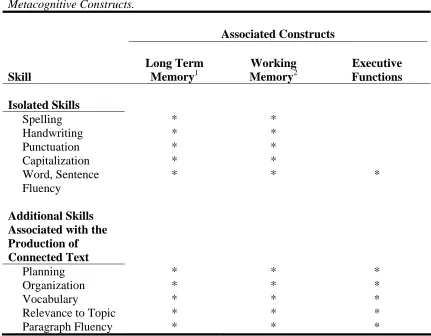
Skill levels of each component can be thought of as falling on a continuum with infinitely fine gradations. Each component may be portrayed as a contributor to the characteristics of text product through quantifiable isolated writing skills and inferred executive functions and working memory performance (Table 1).
Table 1 lists the writing skills that are of interest in the production of connected text (defined as one or more paragraphs rendered in the form of a letter, essay, story, or report) and designates cognitive or metacognitive processes to which each skill may be related. Isolated skills, such as spelling, handwriting, punctuation, and capitalization, are related to, and dependent upon, the knowledge introduced into long term memory as well as the capacity and efficiency of working memory. Skills associated with the production of connected text, such as planning, organizing, maintaining topic relevance, and
paragraph fluency, are also related to basic knowledge that may be activated in working memory (though they also require additional knowledge) as well as the efficiency of working memory. However, because of their relative difficulty and complexity, these higher level skills are additionally dependent upon the executive functions that are generated in the context of metacognitive knowledge.
clarify developmental differences, two broad general categories, labeled less skilled writers and skilled writers, may be imposed on the intricate continua of writing
proficiency. It should be noted in the following sections that the writing literature does not present strong empirical evidence for developmental progression in writing skills. Table 1
Theoretical Relationships Between Writing Skills and Underlying Cognitive and Metacognitive Constructs.
Associated Constructs
Skill
Long Term
Memory1
Working
Memory2
Executive Functions
Isolated Skills
Spelling * *
Handwriting * *
Punctuation * *
Capitalization * *
Word, Sentence Fluency
* * *
Additional Skills Associated with the Production of Connected Text
Planning * * *
Organization * * *
Vocabulary * * *
Relevance to Topic * * *
Paragraph Fluency * * *
Notes:
1
Long term memory for basic skills includes knowledge of letter strokes, spelling, and basic writing conventions. For higher level skills, it includes knowledge about the goals, purposes, processes, and structures of written compositions.
2
Less skilled writers. Before writing, children draw and read their drawings as messages (Sulzby, 1985). They scribble, and over time, their scribbles grow to resemble writing (Gundlach, McLane, Stott, & McNamee, 1985). They shift from using a mitten grip to the typical tripod grip of writers (Grose & Hupert, 1997). Scribbles begin to resemble letter-like forms (Gundlach et al., 1985; Sulzby, 1985). The first written word is typically a child’s own name. Knowledge of the letters in the name serves as the basis for further writing (Dyson, 1985; Lu, 2000), and children tend to write the same letters over and over in many ways or produce long strings of the letters in random order (Grose & Hupert, 1997; Gundlach et al., 1985). Early writing is often accompanied by talking and drawing. As children begin to face writing demands in school, they are often encouraged to invent spellings for words they have not mastered. One letter may represent an entire syllable or word at first, but with time and practice, more words are spelled correctly (Gundlach et al., 1985; Sulzby, 1985). Early words are typically labels for objects and pictures (Dyson, 1985; Sandbank, 2001). Eventually, spelling, neatness, and readability begin to resemble that of skilled writers (Sowams School, 2000).
and each sentence may seem only to be elicited by the previous one (McCutchen, 2000). Less skilled writers’ knowledge is comprised of emergent awareness of letter forms and spacing as well as growing familiarity with writing conventions (i.e., spelling, capitalization, and punctuation rules). Their cognitive processing, which involves
retrieval from long term memory and working memory functioning, is predominantly applied to the basic writing skills that Berninger (1994) refers to as low-level
transcription, primarily spelling and handwriting. Motor skills include appropriate grip and control of one’s pencil on paper. The goal of writing tasks at this stage is the
construction of correctly formed letters and words that may be arranged to express simple ideas in a mechanically correct product.
ideas in a clear, organized, complete product. Written text grows in length and
complexity over time (Lu, 2000; Sulzby, 1985). Students begin to use varied sentence structures and combine sentences into paragraphs (School District of Philadelphia, 1999). They use correct spelling and punctuation more frequently and elaborate on their ideas. They learn to use a process of drafting, editing, and revising (Grose & Hupert, 1997). As was the case with their earlier knowledge acquisition, these skills emerge at an irregular pace and are applied to the writing task occasionally at first, but with increasing
frequency and regularity over time and with experience. By the time they reach college age, most individuals are thought to have developed at least average writing skills. In his commentary on instruction in first-year writing classes, Bernard-Donals (2004) noted changes in complexity in writing tasks as students’ progress from producing general texts to domain-specific reports and essays.
levels off or even regresses past fourth grade. In their study, Graham and Harris (2000) found that spelling skills were moderately correlated with writing quality and had a low to moderate correlation with the quantity of writing output. Handwriting fluency was moderately correlated with writing performance measures, but handwriting neatness was not correlated with writing performance. Ignoring or eliminating spelling, handwriting, and mechanics demands had weak to moderate effects on text quality, and teaching these skills improved writing in the primary grades. However, in a later study conducted with college students, Gregg, Coleman, Stennett, and Davis (2002) found that variations in handwriting and spelling skills could not account for differences in the complexity of expository writing samples.
Regarding skills associated with the production of connected text, to which they referred as regulation, Graham and Harris (2000) found that skilled writers used self-regulation strategies more frequently than unskilled writers. The quality and quantity of writers’ plans were associated with writing performance. Skilled writers spent more time planning their text, made more revisions, and demonstrated more knowledge about the processes involved with composing. Graham and Harris noted that although longitudinal investigation has not been published, cross-sectional studies have suggested that
developing writers become increasingly self-regulated with age and schooling.
to use single strategies (Graham, 1997) or combinations of strategies (Danoff, Harris, & Graham, 1993).
The emergence and development of writing skills is highly idiosyncratic. By middle school, a sample of writers may include the entire range from very deficient to highly skilled. Indeed, a wide variety of skill was found by De La Paz (1999) in her study of students in regular education settings. In her sample of 22 seventh and eighth grade students, baseline writing standard scores (obtained on the Written Expression subtest of the Wechsler Individual Achievement Test) ranged from 77 (6th percentile rank) to 123 (94th percentile rank).
Researchers have sought to understand why some students struggle to master the isolated and higher level skills required for writing effectively. The following sections will include a review of models of writing processes, as well as research examining specific skills related to writing and writing problems.
Comprehensive Writing Process Models
of handwriting. Spelling, of course, refers to the correct spelling of individual words. Grammar refers to compliance with accepted rules and conventions of written language, and ideation concerns the thoughts and ideas that the writer generates. Although this model provides useful descriptive information that may prompt additional inquiry, it fails to link observable skills to potentially influential cognitive and metacognitive processes.
requires adequate memory for retrieval of rules and exceptions. Cognitive processing ability is required to organize writing into a logical gestalt that is sequenced properly and conveys an understandable content. Bradley-Johnson and Lesiak (1989) have not
specified the requirements for adequate cognitive processing ability. However, reliance on organization and evaluation would suggest that metacognitive knowledge and executive functions (planning, monitoring, self-regulation, organization, and inhibition) are likely to be involved.
Though Berninger and her colleagues (Berninger, 1999; Berninger et al., 1995; Swanson & Berninger, 1996) have conceptualized writing somewhat differently from Bradley-Johnson and Lesiak (1989), Berninger’s conception of the writing process also includes an inferred cognitive construct. She has described writing as the recursive interaction of three general abilities, two of which are observable writing skills: (a) text generation (a subcomponent of translation, which is related to the classic Hayes & Flower model from 1980 described in greater detail below), (b) transcription, and (c) working memory. Text generation refers to the translation of ideas into language representations in memory. This skill depends on oral language development. It could be observed and measured by assessing text for fluency, vocabulary, and clarity of meaning. Transcription refers to the transformation of oral language representations into written words. This skill also depends on observable behaviors, such as handwriting and spelling. Working
monitor what has been written and what is about to be written, and revise as needed. As previously noted from the working memory resource allocation model, the pool of cognitive resources available for employment in the service of working memory tasks is finite (Graham et al., 1993). As some tasks are initiated or processed, working memory resources available for new tasks will be reduced.
Swanson and Berninger (1996) have defined working memory as the cognitive space within which executive functions are deployed and operated, further providing for metacognitive involvement. They have also argued that working memory is time
constrained. Writing goals must be addressed immediately before information retrieved from long term memory begins to decay.
Berninger and her colleagues have applied this model in research. In their study of 300 fourth, fifth, and sixth grade students (who had a mean Full Scale IQ of 108.40 (SD=12.93) on the Wechsler Intelligence Scale for Children, Revised), Swanson and Berninger (1996) found evidence of differential contributions of long term memory, short term memory, and working memory to the quality of students’ writing. They
handwriting) than working memory measures did, and working memory measures correlated more highly with reading comprehension measures than short term memory did. Stepwise regression techniques revealed that working memory related to executive functioning was the only significant predictor of compositional fluency and organization. This construct also contributed unique variance to quality ratings beyond the contribution of reading comprehension. The authors concluded that because the contribution of
working memory was not general, but rather was restricted to executive function-related skills, their results did not support the resource allocation model that has been generally described in the literature. Instead they viewed their results as support for recognition of differential effects of specific processes on writing output. Their finding of underlying factors, however, was important in the context of the present study because it may suggest the presence of subtypes of writing problems, an issue the present study was designed to explore.
Examining even a limited sample of theoretical perspectives on written language component skills reveals the lack of consensus in specifying the subcomponents of this complex task. Models that rely on isolated writing skills seem rudimentary and
combining skills specificity with additional information on metacognitive skills and their contributions to written language skills, a goal of the present study.
The following section introduces a writing process model that is grounded in the historical Hayes and Flower (1980) work and the Berninger (1995) modification of that early model. This process model was considered in this research to address gaps
regarding the relations of isolated writing skills, executive function, and working memory processes and their potential contributions to connected text production in these classic models.
research with students in first through ninth grades. Studies with children in first through third grades led to the addition of subcomponents to Hayes and Flower’s translating skill. These subcomponents, text generation and transcription, permit researchers and educators to explain how some children have much stronger abilities to express ideas verbally (text generation) than to transform those ideas into written letters, words, and sentences (transcription). Work with children in grades four through six led Berninger to differentiate text generation from revising, and work with these and older (seventh through ninth grade) students led her to differentiate between planning at the advanced stage (prior to writing) and online stage (while producing text), between online revising and post-writing review and revision, and between declarative and procedural knowledge and metacognition. With these older students, she recognized the need for a working memory construct in the writing process model to explain the interaction between long term memory and writing processes. This working memory construct should also be relevant in understanding college students’ production of connected text.
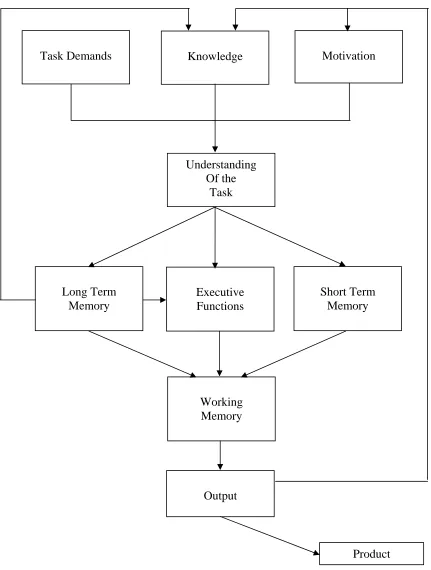
The model developed for the present study included some of the elements that Berninger incorporated into her adaptation, but it sought to extend that formulation by including specific constructs that are closely aligned with the neuropsychological literature. The bottom half of the current model in Figure 1 (below the box for
For example, the objective demands of the writing task (i.e., required length, level of difficulty, type of writing, narrative, expository, etc., and time limit) combine with the student’s knowledge and motivation to influence the individual’s understanding of the task. In turn, understanding leads to retrieval of knowledge from long term memory, activation of short term memory (a temporary holding space), and selection and
deployment of executive functions (knowledge of which is also retrieved from long term memory). These factors operate within working memory to create output that includes behavior (i.e., the observable isolated and higher level writing skills that have been described previously), the written product, and potential changes in the student’s
Task Demands Knowledge Motivation
Understanding Of the
Task
Executive Functions Long Term
Memory
Short Term Memory
Working Memory
Output
Figure 2. Elements of the model tested in the present study.
Other Studies of Writing Skills and Processes
The following sections provide a review of studies published by investigators who were working to understand isolated writing skills, cognitive processes, and their
potential relationships to production of connected text. Researchers summarized in this section have focused on exploring writing processes by examining writing problems. As with the comprehensive writing process models, these studies can be differentiated by their focus on isolated writing skills or their inclusion of inferred cognitive and metacognitive processes. Isolated writing skills that have been associated with global written expression scores include handwriting skills (Brooks, Vaughan, & Berninger, 1999; Graham, Berninger, Abbott, Abbott, & Whitaker, 1997), spelling (Brooks et al., 1999; Graham, 1997; Graham et al., 1997; MacArthur, Graham, Schwartz, & Schafer, 1995; Wong, Wong, & Blenkinsop, 1989), orthographic processes (Brooks et al., 1999), story or essay length (Danoff, Harris, & Graham, 1993; De La Paz & Graham, 1997; De La Paz, Swanson, & Graham, 1998; Graham, 1997; MacArthur et al., 1995), fluency (De
Isolated Writing Skills
Executive Functions
specific behaviors in student writers. These processes include metacognitive knowledge (Graham et al., 1993; MacArthur, Graham, & Schwartz, 1991; Welch, 1992; Wong et al., 1989), executive control (Graham, 1997), planning time (De La Paz & Graham, 1997), organization (Wong et al., 1989), and revising behavior (De La Paz & Graham, 1997; MacArthur et al., 1991). The processes have been related to quantitative and holistic ratings of quality (Brooks et al., 1999; Danoff et al., 1993; De La Paz & Graham, 1997; De La Paz et al., 1998; Graham, 1997; MacArthur et al., 1995; Wong et al., 1989), as well as the writers’ affect (Graham et al., 1993; Welch, 1992), and sense of self-efficacy (Danoff et al., 1993; Graham et al., 1993).
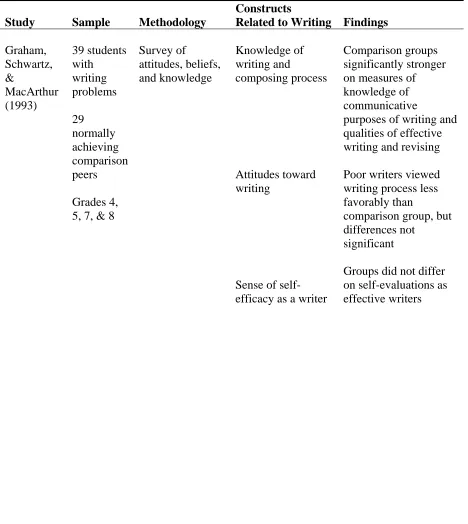
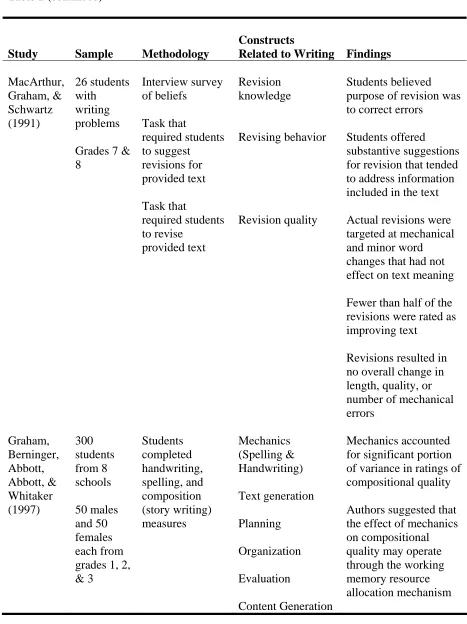
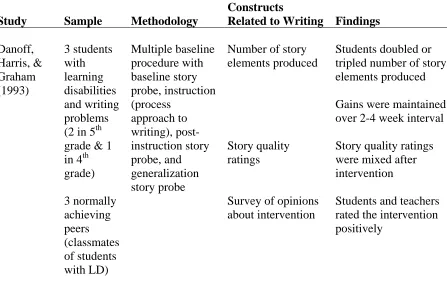
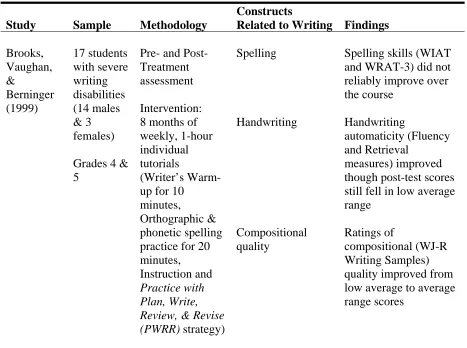
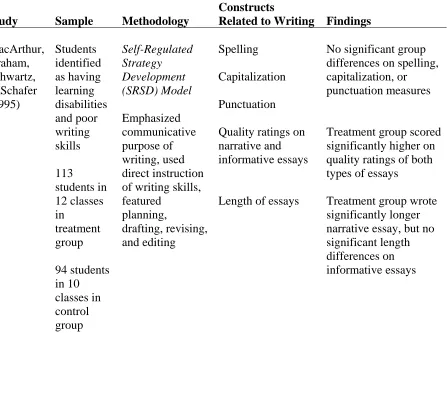
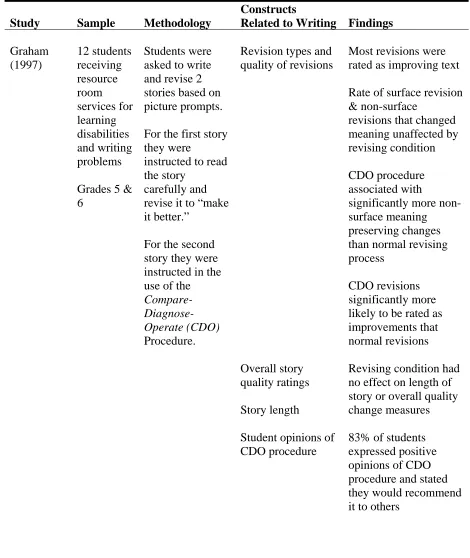
Constructs associated with writing problems. Students with learning disabilities and writing problems have been the focus of descriptive, observational, and intervention studies. Descriptive and observational studies have served to increase knowledge without attempting to change students’ behavior or outcomes. On the other hand, intervention studies create knowledge about skills and processes and serve as direct tests of causal models regarding the relation of component skills to skilled writing. Studies from both of these approaches are described in the following section and summarized in Tables 2 (Descriptive and Observational Studies) and 3 (Intervention Studies).
Written Expression.
Study Sample Methodology
Constructs
Related to Writing Findings
Graham, Schwartz, &
MacArthur (1993)
39 students with writing problems 29 normally achieving comparison peers Grades 4, 5, 7, & 8
Survey of
attitudes, beliefs, and knowledge
Knowledge of writing and
composing process
Attitudes toward writing
Sense of self-efficacy as a writer
Comparison groups significantly stronger on measures of knowledge of communicative
purposes of writing and qualities of effective writing and revising Poor writers viewed writing process less favorably than
comparison group, but differences not
significant
Study Sample Methodology Related to Writing Findings MacArthur, Graham, & Schwartz (1991) 26 students with writing problems Grades 7 & 8 Interview survey of beliefs Task that required students to suggest revisions for provided text Task that required students to revise provided text Revision knowledge Revising behavior Revision quality Students believed purpose of revision was to correct errors
Students offered
substantive suggestions for revision that tended to address information included in the text Actual revisions were targeted at mechanical and minor word changes that had not effect on text meaning Fewer than half of the revisions were rated as improving text
individual tutorial (Brooks et al., 1999), spelling has proven difficult to improve consistently (Brooks et al., 1999; De La Paz et al., 1998; MacArthur et al., 1995).
Capitalization and punctuation skills have also resisted intervention efforts (De La Paz et al., 1998; MacArthur et al., 1995).
Metacognitive skills have also been the focus of intervention research. In addition to the teaching of a process approach to writing (Danoff et al., 1993), planning (Brooks et al., 1999; De La Paz, 1999; De La Paz, 2001; De La Paz & Graham, 1997) and reviewing and revising (Brooks et al., 1999; De La Paz et al., 1998; Graham, 1997; MacArthur et al., 1995) have been studied. Students have received direct instruction in the
communicative purpose of writing (MacArthur et al., 1995) and have been supplied with checklists of the steps to complete in essay or story writing (De La Paz, 1999, & 2001; De La Paz et al., 1998; Welch, 1992).
Findings from Intervention Studies of Weaknesses in Skills Related to Written Expression.
Study Sample Methodology
Constructs
Related to Writing Findings
Danoff, Harris, & Graham (1993)
3 students with learning disabilities and writing problems (2 in 5th grade & 1 in 4th grade) 3 normally achieving peers (classmates of students with LD)
Multiple baseline procedure with baseline story probe, instruction (process
approach to writing), post-instruction story probe, and generalization story probe
Number of story elements produced
Story quality ratings
Survey of opinions about intervention
Students doubled or tripled number of story elements produced Gains were maintained over 2-4 week interval Story quality ratings were mixed after intervention
Brooks, Vaughan, &
Berninger (1999)
17 students with severe writing disabilities (14 males & 3 females) Grades 4 & 5
Pre- and Post-Treatment assessment Intervention: 8 months of weekly, 1-hour individual tutorials
(Writer’s Warm-up for 10
minutes,
Orthographic & phonetic spelling practice for 20 minutes, Instruction and Practice with Plan, Write, Review, & Revise (PWRR) strategy)
Spelling
Handwriting
Compositional quality
Spelling skills (WIAT and WRAT-3) did not reliably improve over the course
Handwriting
automaticity (Fluency and Retrieval
measures) improved though post-test scores still fell in low average range
Ratings of
Welch (1992)
18 students with poor writing skills (7 in treatment group, 11 in
comparison group) Grade 6
Pre- and Post-Treatment assessment Intervention: PLEASE strategy (Pick topic, List information, Evaluate list, Activate paragraph, Supply supportive statements, End with concluding sentence and proofread with COPS procedure)
Attitude toward writing
Metacognitive knowledge about writing
Writing sample scores
MacArthur, Graham, Schwartz, & Schafer (1995)
Students identified as having learning disabilities and poor writing skills 113 students in 12 classes in
treatment group 94 students in 10 classes in control group
Self-Regulated Strategy Development (SRSD) Model Emphasized communicative purpose of writing, used direct instruction of writing skills, featured
planning,
drafting, revising, and editing
Spelling Capitalization Punctuation Quality ratings on narrative and informative essays
Length of essays
No significant group differences on spelling, capitalization, or punctuation measures
Treatment group scored significantly higher on quality ratings of both types of essays
Graham (1997) 12 students receiving resource room services for learning disabilities and writing problems Grades 5 & 6
Students were asked to write and revise 2 stories based on picture prompts. For the first story they were
instructed to read the story
carefully and revise it to “make it better.”
For the second story they were instructed in the use of the Compare- Diagnose-Operate (CDO) Procedure.
Revision types and quality of revisions
Overall story quality ratings Story length
Student opinions of CDO procedure
Most revisions were rated as improving text Rate of surface revision & non-surface
revisions that changed meaning unaffected by revising condition CDO procedure associated with
significantly more non-surface meaning preserving changes than normal revising process
De La Paz, Swanson, & Graham (1998) 12 students identified as having a learning disability and problems in writing Grade 8
Pre- and Post-Treatment assessment Intervention: Students wrote narrative and informative essays. They were instructed to ignore errors of spelling, capitalization, and punctuation and focus on higher level content revision. Also had groups for the CDO procedure and normal revising Completed 2 revision cycles: global (structure, organization, and ideas) and local (potential trouble spots within sentences) Composition quality ratings Composition quality ratings significantly higher for essays using CDO procedure than for normal revising procedures CDO revisions associated with significant quality improvements and increased length No significant
De La Paz & Graham (1997)
42 students identified as having a learning disability and problems in writing Grade 5, 6, & 7
Pre- and Post-Treatment assessment Intervention: 2 * 2 design that included dictation (vs. writing) and advanced planning instruction (vs. no advanced planning instruction) Comparison group students learned about the characteristics of good essays, read & revised sample essays for
meaning and structure, and compared & shared their own essays with peers
Planning time Essay length Number of ideas in essay
Essay coherence
Survey of writer’s beliefs about
benefits of dictation and planning
instruction
Advanced planning instruction associated with significantly increased time spent on planning for both dictation and writing conditions
Planning + Dictation condition was
associated with essays that were rated
significantly higher than comparison group essays on measures of length, number of ideas, & coherence Participants believed dictation increased speed of planning essays and reduced worries about correct spelling, capitalization, and punctuation, but were frustrated by slow scribes and need to attend to own ideas as well as the words being placed on paper by scribe
Two-thirds of
De La Paz (1999)
Regular education students
Pre- and Post-Treatment assessment Maintenance probes 4 weeks after intervention was completed Intervention: PLAN strategy targets planning (Pay attention to the prompt, List main ideas, Add supporting ideas, Number ideas) WRITE strategy reminded writers to keep planning while composing. (Work from plan to develop thesis statement,
Remember goals, Include transition words, Try to use different kinds of sentences, & Exciting words) Cue cards provided with strategies to produce 5-paragraph essays Planning Essay quality ratings
Essay quality gain ratings
Essay length
Prior to intervention, 7% produced plans. After intervention, 100% produced plans rated high in quality Most students
continued to use plans on maintenance essay Essay quality scores rose for every student at post-test
All students maintained quality gains over baseline at post-test All students except low-achieving (but not LD) maintained quality gains that were
exhibited at initial post-test
Quality gains were correlated with baseline ratings of ability. Higher achieving students made greater gains than others Average essay length at post-test was more than double length at
Writing
De La Paz (2001)
3 Students (2 with specific language impairment & 1 with ADHD)
Pre- and Post-Treatment assessment Intervention: Also used PLAN and WRITE strategies Planning Essay quality ratings Essay length
All 3 students generated plans in post-test essay Post-test essay quality ratings exhibited substantial gains compared to baseline
Average length of essays increased after intervention Zimmerman & Kitsantas (2002) 72 Undergraduates Mean age 19-9
Social cognitive model Modeling Observational learning Sentence combining task Post-exposure writing skills score
Students’ degree of observational learning was related to writing skills scores Johnstone, Ashbaugh, & Warfield (2002) 664 University sophomores, juniors, & seniors Accounting & other Business School majors Mean age 21
Students completed 8 writing
assignments that were relevant to a series of 4 courses 60 minute writing task Multiple choice test of grammar, punctuation, and organization Grammatical conventions, organization, professionalism of presentation (as well as technical accuracy & quality of analysis)
outcomes, areas of weaknesses in the literature remain. For example, comprehensive formulations describing writing processes tend to be predominantly theoretical. Although there appear to be broadly held assumptions regarding developmental trends and
sequences (e.g., the school and school district publications that disseminate information about typical development of writing skills in children), many publications do not cite an empirical base and appear to be anecdotal in origin. The literature lacks rigorous
empirical validation. The present study was conducted in an attempt to increase the empirical research base regarding writing skills.
In addition to this weakness, some comprehensive models that have been tested have featured only observable isolated writing skills constructs. Exceptions to this trend include the classic Hayes and Flower (1980) model and Berninger and her colleagues’ (1995) developmental adaptation of that early work. These models include inferred cognitive and metacognitive constructs, but there is a lack of consensus regarding the definitions of the inferred concepts.
demonstrate adequate reliability and validity for their purpose.
Integration of these literatures is a goal of the present study in order to address the current failure to incorporate constructs and methods from neuropsychology into the study of writing skills. In part, it will be useful to create links between studies published in the educational literature to the neuropsychological literature. For example, prominent research on students who have weak writing skills has attributed outcomes to poor planning (DeLaPaz, 1999; DeLaPaz & Graham, 1997; Graham, 1997; MacArthur, Graham, & Schwartz, 1991). However, in this work, planning was defined as the time that elapsed between the delivery of the instruction to begin and the point at which writing actually did begin, with the inference that the interval was occupied by the student creating a plan for completion of the assigned task. This definition of planning may be related to the definition of planning that is operationalized in a typical
extensive testing of specific processes and their relations to writing outcomes has yet to occur. After a review of a cognitive construct (working memory) and a collection of metacognitive constructs (executive functions), the following section includes a summary of recently published work that examined the executive functioning of students with and without writing problems. Based on this review, working memory and executive function measures were included in the current study.
Working Memory
Working memory, and its relation to writing skills, may be best understood using the model first published by Baddeley and Hitch in 1974. Recently, Alan Baddeley received the American Psychological Association Award for Distinguished Scientific Contributions, largely in appreciation for the work he has done on this model. Baddeley (2001) used the occasion to review the model, its revisions, and its current formulation. As defined by Baddeley, working memory is defined as computational space, “the system or systems involved in the temporary maintenance and manipulation of information” (p. 852). He argued that the importance of working memory is in its functioning as well as its storage capacity.
The Baddeley and Hitch model was originally comprised of three components: (a) the phonological loop (formerly known as the articulatory loop), (b) the visuospatial sketchpad, and (c) the central executive. The phonological loop is concerned with
systems are used for active temporary storage and may process information from stimulus input or long term memory. They are managed and directed by the central executive, an admittedly vaguely defined construct that comprises a limited capacity pool of general processing resources. Originally, Baddeley believed that the central executive possessed a separate storage capacity of its own, but he has recently argued that it is best understood solely as an attention allocation resource. He now asserts that the central executive serves three functions: (a) focusing available attention, (b) dividing attention in the face of multiple competing goals, and (c) switching attention when appropriate. A fourth
component, the episodic buffer, has recently been added to Baddeley’s working memory model. The function of this new component is to serve as an interface between the other subsystems and long term memory because it can make use of information in more than one format (i.e., it is not limited to a single modality in the same manner as the
phonological loop or visuospatial sketchpad).
When limited resources are consumed by non-automatic processes, performance on a task declines because accumulated task demands exceed resource capacity (Lea & Levy, 1999). These processes would occur within working memory’s space, and their effectiveness would depend in part on working memory skills.
Executive Functions
The following section provides a summary of metacognition and executive functions from two empirical perspectives, neuropsychological and cognitive developmental. These two approaches to the study of metacognitive knowledge and behavior are reviewed, and a basis for understanding the relationship of the two perspectives is offered. The variety of definitions of executive functions from the neuropsychological literature are then reviewed, along with one recent study that examined the executive functioning of elementary school children with and without problems in written expression. Finally, the specific definition of the construct for the purpose of the proposed research is detailed.
Two perspectives on executive functions. Investigators have explored executive function processes and behavioral outcomes from two broad perspectives,
Notably, fundamental information processing models form the foundation of writing skills (according to Hayes & Flower, 1980; Berninger, 1994; and the model developed for the present study), cognitive and metacognitive skills, and executive functions (the investigation of which may improve the writing literature).
Considering the remarkable variability in terminology across the two theoretical and empirical traditions, it becomes important to clarify the constructs included in the proposed research. Therefore, for the purposes of the proposed research, usage of the terms metamemory, metacognition or metacognitive skills or knowledge refers to Flavell’s (1976) definition: “metamemory refers to one’s knowledge concerning one’s own cognitive processes and products or anything related to them, e.g., the learning-relevant properties of information or data” (p. 232), and his specification that the term “refers, among other things, to the active monitoring and consequent regulation and orchestration of these processes in relation to the cognitive objects or data on which they bear, usually in the service of some concrete goal or directive” (p. 232). This definition is the standard and is consistently cited as an empirical assumption in the metacognitive literature. The term executive function refers conceptually to the processes and behaviors that an individual generates and deploys in the deliberate pursuit of a goal.
functions. It is believed that executive functions are deployed, facilitated, and constrained by metacognitive knowledge. For example, metacognitive knowledge concerning the difficulty of a writing task, appropriate writing strategies, and one’s own writing skills may lead an individual to generate and deploy executive function behaviors such as planning and outlining an essay prior to writing it out completely. The relationship of the two constructs, metacognitive knowledge and executive functions, is therefore believed to be one of source and product, of knowledge and behavior.
Defining executive functions. Although contributors to the cognitive and
developmental psychological literatures appear to enjoy consensus in the conceptual and operational definitions (if not in terminology) of metamemory and metacognition, contributors to the neuropsychological literature continue to grapple with defining the construct and processes of executive functions. In 1996, Lyon and Krasnegor published a compilation of contributions to the National Institute of Child Health and Human
Development (NICHD) Conference on Attention, Memory, and Executive Function. In an introduction to that text, Lyon acknowledged that understanding of executive
outcomes).
Contributors to the NICHD conference formulated conceptual and operational definitions from three perspectives: (a) information processing, (b) neuropsychological, and (c) behavioral. Problems with definition specificity and the psychometric properties of attention, memory, and executive function measures have been broadly acknowledged. Definitions of executive functions vary across theorists. For example, Morris (1996) cited lack of consensus in the definitions of the constructs and considerable overlap in the constructs that are assessed by measures in the literature in a meta-analysis of all of the articles published during a five-year period in the following journals: (a) Brain & Language, (b) Child Development, (c) Educational Psychology, (d) Journal of Clinical and Consulting Neuropsychology, (e) Journal of Learning Disabilities, (f) Learning Disability Quarterly. In studies that reported assessments of school-aged children, Morris found more than 25 measures of attention, 15 measures of memory and learning, and more than 20 measures of executive function. Despite all of this variety, it is possible to find broad conceptual consistencies across theorists and research. For example, though Lyon (1996) asserted that the construct of executive function seemed resistant to being defined specifically, he did recognize its links to the constructs of metacognition and mental control processes. Executive functions have frequently been studied in the context of attention research. Impairment in executive function has come to be strongly
students is reviewed, and a specific definition of executive function for the purposes of this study is proposed.
Borkowski and Burke (1996) defined executive function as referring to “task analytic, strategy selection, and monitoring skills necessary for higher-level problem solving” (p. 256). They argued that the construct was synonymous with planning and self-regulation and specified task analysis, strategy selection, strategy monitoring, and strategy revision as essential components of executive functioning.
behavior, reflecting on progress, and revision of behavior if necessary. They noted that hundreds of tests have been used in executive function research, including measures of inhibition (the Stroop Color Word Test, the Wisconsin Card Sorting Test, the Tower of Hanoi, the Tapping Test, the Trail Making Test, and hand movement tasks), ability to switch solutions (the Wisconsin Card Sorting Test, the Tapping Test, Rapid Alternating Stimulus Naming Test, Visual Search Test, and the Trail Making Test), planning (Tower of Hanoi, hand movement tasks, and Rey-Osterreith Complex Figure Test), attentional control (Tapping Test, Rapid Alternating Stimulus Naming Test, and Visual Search tasks), and verbal fluency (Controlled Oral Word Association Test).
Barkley (1996) cited four characteristics as essential for determining whether an action is “executive.” First, the action in question must be a behavior that is about and that acts upon behavior. It must also alter the probability that a subsequent behavior may be performed. It must involve time delay between an environmental event and subsequent response, and the initial executive act must involve inhibition and delay of other
competing behaviors. In short, Barkley defined executive functions as inherently self-regulating. In addition to inhibition, executive functions include self-monitoring, working memory, planning, organizing, interference prevention, and intention to act.
inhibition, planning, and mental representations of tasks and goals. In contrast to Barkley’s (1996) formulation, they stated that working memory, though critical to understanding executive functioning, is not an executive function itself. Rather, in their conceptualization, working memory is a limited capacity computational arena that functions to select behaviors and monitor and evaluate their outcomes. It interacts with both short term memory and long term memory and is critical because it functions across time, thereby accounting for the ability to inhibit current behaviors in favor of postponed gratification.
abilities that allow one to carry out social and instrumental activities successfully, such as engaging with others effectively, planning activities, solving problems, and interacting with the environment to get needs met” (p. 243). They specified response set, inhibition (including impulse control), planning, organization, judgment, reasoning, concept formation, abstraction, initiation, and fluency as executive functions and linked them to specific measures. For example, response set (i.e., the ability to establish, maintain, and shift a set of specific responses) was measurable by the Trail Making Test and the Wisconsin Card Sorting Test. Inhibition and impulse control were measurable by Go/No Go tasks and the Stroop Color Word Test. Planning and organization were measurable by Porteus Mazes, the Tower of London, and the Hooper Visual Organization Test.
Judgment, reasoning, concept formation, and abstraction were measurable by the Proverb Test, the Category Test, Raven’s Progressive Matrices, and the Wechsler Adult
Intelligence Scale (Revised Edition) Comprehension and Similarities subtests. Initiation and fluency were measurable by the Controlled Oral Word Fluency Test and the Ruff Figural Fluency Test.
Diagnostic System and the Matching Familiar Figures Test. Problem solving was
measured by the Wisconsin Card Sorting Test, and working memory was evaluated using the Wechsler Intelligence Scale for Children, Revised or Third Edition, Digit Span subtest, the Illinois Test of Psycholinguistic Abilities Visual Sequencing of Memory subtest, and the Kaufman Assessment Battery for Children Hand Movement subtest.
Kempton, Vance, Maruff, Luk, Costin, and Pantelis (1999) examined the effects of stimulant medication on the executive function performance of children with ADHD. They defined executive functions as “cognitive processes through which performance is optimized in situations requiring the operation of a number of cognitive processes” (p. 527-528). These functions, linked theoretically to frontal brain structures, included organization, attentional processes, inhibition of inappropriate responses, and self-monitoring.
Morgan and Liliefield (2000) also defined executive functions in their meta-analysis of studies of antisocial behaviors and neuropsychological measures of executive functioning. They noted that executive functions were difficult to operationalize because they could only be inferred from observed changes in lower level cognitive functions. Components of executive function included volition, planning, purposive action, and effective performance. Their analysis indicated that, though no measures were entirely specific to frontal brain damage, the Category Test of the Halstead-Reitan
Houghton and his colleagues (1999) did not offer a conceptual definition in their study of differential patterns of executive function in children with ADHD according to gender and subtype. However, they did include response inhibition, forethought,
planning, organization, set shifting, categorization, inhibition, visual search, attention, mental flexibility, motor function and working memory as components of executive function in the 122 student participants in their study and found significant differences on the Wisconsin Card Sorting Test and Stroop Color Word Test. Klorman and her
colleagues (1999) also did not specify a conceptual definition of executive function, but included components of volition, planning, purposive action, and effective performance in their study of children with attentional, oppositional defiant, and reading disorders. They linked the Wisconsin Card Sorting Test to flexibility and set shifting and the Tower of Hanoi to planning and management of goal conflict. They found that executive deficits characterized only the combined subtype of Attention-Deficit/Hyperactivity Disorder but not the inattentive subtype. They further found that results were not affected by the presence of reading disability or oppositional defiant disorder.
continuing difficulty in defining the characteristics of executive functions but argued that they “involve higher order, integrative control-type skills” (p. 117). Linking executive function processes to writing skills may be more difficult than finding conceptual consistency in executive function definitions. One recent study examined the executive functioning of elementary students with and without writing problems.
Executive functions in elementary school children with and without problems in written expression. To date, studies that examine possible relationships between executive functions and written expression in college students have not been published. Hooper and his colleagues (2002) published the first study that examined the executive functioning of children in relation to their writing skills. In that work, they conceptually defined executive functions as “the higher order control processes that regulate cognition during tasks such as writing” (p. 61), and they attributed the four executive function domains of their study to Denckla (1996): (a) initiation, (b) set shifting, (c) sustaining, and (d) inhibition/stopping. After controlling for reading decoding skills, their analysis revealed that children with weaknesses in written expression performed significantly more poorly than their normal peers on measures of initiation (Sentence Formulation subtest total score from the Comprehensive Evaluation of Language Fundamentals, Revised; Controlled Oral Word Association Test total score; and a working memory test designed for this study) and set shifting (Wisconsin Card Sorting Test number of
emerged on measures of inhibition and stopping (Visual Search and Attention Test commissions score; and the Matching Familiar Figures Test latency score). Notably, effect sizes were small (.09 - .16), indicating that the variance in children’s writing skills was greater than could be explained with knowledge of executive functions as defined and measured in this study. Clearly, in executive function research, care must be taken to operationalize the components of executive function and to select measures that minimize the shared variance of executive functions across measures.
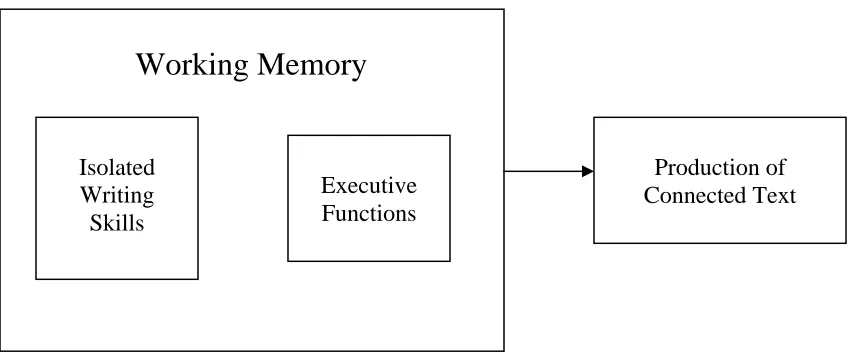
function components, few other theorists have constructed lists that are consistent with his perspective. The present study was based on a model that specifies that working memory is a separate construct, and although it is related to executive functioning, working memory is not itself an executive function. This perspective is consistent with this aspect of Baddeley’s (2001) working memory formulation and with the Swanson and Berninger (1996) statement that working memory tasks tap executive functioning, an assertion that describes related but separate constructs. Thus, the relationship of working memory and executive functions can be said to be one of cognitive structure (working memory) and behavior (executive function). Previously, it was noted that metacognitive knowledge constrains and facilitates the use of executive function strategies. Working memory can be viewed as the space within which metacognition operates and executive functions are deployed. Baddeley’s central executive component can be viewed as the operator that functions under the influence of metacognitive knowledge to deploy
generate ideas, retrieve information from long term memory, create an organizing plan, fit thoughts and ideas into the plan, place the strokes of letters, words, and punctuation symbols on paper, read the partially completed product, evaluate it in the context of task requirements, and revise and extend it as appropriate. Operation of all these simultaneous activities occurs in the computational arena known as working memory and may be facilitated and constrained by a variety of factors, including the student’s proficiency in isolated writing skills, the extent to which the student’s ability to generate and deploy executive functions is developed, and the student’s working memory capacity.
across departments and disciplines (Bernard-Donals, 2004).
Despite recognizing the importance of writing skills to long term academic success, the skills and processes that contribute to the production of written text have received little empirical examination, particularly in comparison to reading performance. Although reading skills and the development of fluent, accurate reading have been extensively studied, understanding the development of written expression ability remains largely an exercise in theoretical or anecdotal description. Researchers who study written expression have failed to identify component writing skills and cognitive and
metacognitive processes that may be related to success. Rather than focus on this analysis, contributors to the school psychology literature, in particular, have sought to create and test intervention strategies (e.g., De La Paz, 1999; De La Paz & Graham, 1997). Clearly, helping children become better writers is an important goal. However, intervention strategies that have been created without understanding of the component skills and processes of written expression may demonstrate diminished efficacy because they have not been empirically linked to specific skills deficits.
Eventually, the science and practice of school psychology can be better informed by empirical study of written expression from a developmental perspective. That
examined to gain a better understanding of how isolated writing skills, executive functions, and working memory are related to the production of connected text and to each other. This approach was intended to provide an opportunity to develop a model of written expression that could later be tested for downward extension to younger students. It was predicted that results might provide guidance such that it may eventually become possible to design and implement interventions targeted at specific skills or process weaknesses. An additional goal was to identify directions for further research in this area. The purpose of the present study was to examine isolated writing skills, executive
functions, working memory, and production of connected text in a college-aged sample as an exploratory step toward these goals.
For the purposes of the present study, the following key terms were defined:
• Production of connected text was defined as one or more paragraphs rendered
in the form of a letter, essay, story, or report. In the present study, production of connected text was assessed by performance on the Wechsler Individual Achievement Test (WIAT) Written Expression test (The Psychological Corporation, 1992), which required participants to produce a letter that described either an ideal place or a desired day trip. Unsupported production of connected text (UNS WIAT score) refers to a letter written without the assistance of an outline designed to support executive functions. It was
production of connected text (SUP WIAT score) refers to a letter written with this supportive outline. It was measured by the sum of scores on the
component skills assessed by the WIAT Written Expression Test (with outline).
• Isolated writing skills (IWS) were defined as measurable, observable writing
skills that are deployed in relative isolation to produce words or sentences. These skills were assessed using the Mather-Woodcock Group Writing Tests (GWT; Mather & Woodcock, 1997). The GWT Basic Writing Skills
composite score incorporated scores on tests of Spelling (spelling individual words) and Editing (the ability to identify and correct errors in individual sentences).
• Executive functions (EF) were defined as processes and behaviors that are
• Working memory (WM) was defined as the cognitive space within which
isolated writing skills and executive functions are activated and coordinated in order to produce a response such as connected text. Participants’ working memory abilities were assessed with subtests from the Woodcock-Johnson III Tests of Cognitive Skills (McGrew & Woodcock, 2001). The working
memory score was the composite of scores on tasks that required participants to repeat strings of numbers in reverse order and to sort lists of objects and numbers and repeat them according to instructions.
Present study goals, their related hypotheses, and the data analysis strategies that were used to test them are listed in the following section:
1. Investigate the extent to which the constructs of isolated writing skills, executive functions, and working memory predicted scores on a measure of connected text production.
• Hypothesis 1: Isolated writing skills, executive functions, and working
memory variables in combination will account for a significant portion of the variance in scores on a measure of production of connected text.
• Hypothesis 2: The relationship of executive functions to the production of
connected text will be conditional on working memory, such that the impact of executive processes will be greater as working memory scores increase.
o Regression equation: UNS WIAT score = EF + WM + EF*WM o This hypothesis would be supported if the EF*WM interaction in
the regression were significant and follow-up analyses were consistent with the pattern described.
• Exploratory analyses: The semipartial correlations from the multiple
regression analysis and the bivariate correlation matrix for all variables were examined to determine to what extent each of the dependent variables accounts for unique or shared variance in the prediction of connected text production.
3. Test the role of executive functioning in the production of connected text by assessing the extent to which reducing the organizational demands on a connected text production task reduced the relationship between executive functions and quality of connected text production.
• Hypothesis 3: Students who have weak executive function skills will benefit
used to test the hypothesis.