1
The complex approach to the determination of NPP Steam Generators
Heat-Exchange Tubes Plugging Criterion (NPP SG HET PC) on the basis of
analy-ses of the procesanaly-ses of the tubes damaging during NPP operation
G.P.Karzov, S.A.Suvorov, V.A.FedorovaCRISM "Prometey", St-Petersburg, Russia INTRODUCTION
As a result of eddy-current control (ECC) methods development appears the opportunity of early revealing of defects, which incipient in a walls of heat-exchange tubes (HET) of steam generators (SG) during operation. Preventive plugging of a defective HET, as a result of ECC, has essentially increased the reliability and the safety of reactor facility operation, but thus vol-umes of HET plugging have simultaneously sharply increased. In some cases HET are unrea-sonably plugged as a result of imperfect ECC equipment application, or a mistakes of the control measurements, or imperfection of criterion of HET plugging. Unreasonable HET plugging essen-tially reduces SG service life In this connection the scientifically proved determining of SG HET Plugging Criterion gets a problem a great value. This Criterion should be to provide a necessary level of NPP safety, but thus simultaneously to minimize the number of HET plugging. The ap-proach suggested in the given work is based on the developed Phasic Model of Damage (PMD) of NPP WWER-1000 type SG HET. In this model it has been shown, HET by key parameters determining a dynamics of HET damages, are the thickness of deposits on a surface of SG HET and kinetics of an oxidizer reduction in a local electrochemical cell around of growing defect. In this paper represented the results of a HET plugging criterion substantiation by the example of one of NPP Unit with steam generators PGV-1000. The corrosion defects of HET have been found out during the preoperational period of HET Unit after ECC of SG HET. By nature HET defects constitutes as pitting and the corrosion cracks developing from pitting. Pitting and cracks have arisen in HET metal under the influence of chlorides and the oxygen, which have got in SG volume during installation of NPP equipment. The substantiation of criterion of SG HET plug-ging was based on: - Defect depth in a HET wall limiting values estimated determination from the conditions of the crosspiece breakdown in front a crack tip due to instability of plastic de-formation of metal. Limiting values depends on the relation of depth of crack (a) to its length on a forming line of tube (l); - Experimental confirmation of estimated value of limiting depth of de-fect; - An estimation of permissible dimension of defect in view of an opportunity of its maximal growth during the period between periodical E ; - An estimation of the maximal error at de-termination of depth of a crack on data ECC; - Dede-termination of plugging criterion, as the limit-ing value of a defect depth determined by ECC, at which is created a danger of a tube destruction excess during reactor facility operation at the period between periodical E .
1. Main principles of NPP SG Heat-Exchange Tubes Plugging Criterion
The criterion of HET plugging can be determined as limiting value of depth of the defect which has been found out during operational ECC of the control at which the further operation heat-exchange tubes yet will not lead to loss of its tightness during the period between ECC. Thus it is necessary to consider only such situations of NPP operation at which loss of tightness of a tube results to flow-over of the radioactive coolant from the primary-coolant system into the secondary coolant circuit. In view of this condition a mode of hydraulic tests HET should be ex-cluded from consideration as destruction heat-exchange a tube during hydrotest (HT) does not create danger for operating of reactor facility, and HET which was destroyed at HT is to be sub-jected to plugging.
sur-2 face of tubes. The algorithmic diagram of HET plugging criterion determination is submitted in table 1.
Table 1. The algorithmic diagram of HET plugging criterion determination. No Stages of analysis Determination of design parameter 1. Determination of limiting values
of depth of defect in a wall HET
It is determined from conditions of break of the cross-piece in front of a crack tip. Limiting values depends on a ratio of depth of a crack (a) to its length (l}.
2. Estimation of the most possible undergrowth of cracks during the period between ECC.
It is determined on the basis of generalization of ECC re-sults of SG in view of the data on water chemistry condi-tions of the secondary circuit during operating of SG. 3. Estimation of the allowable size
of a crack in view of its possible undergrowth.
It is determined by reduction of the limiting size of a crack by size of it possible undergrowth
4. An estimation of the maximal er-ror of determination of a crack depth on the data of ECC.
It is determined on the basis of generalization of ECC experience over characteristics of the used equipment and a level of a registered signal.
5. Determination of HET plugging criterion
It is determined as limiting value of the defect depth (which has been found out during ECC) at which growth of defect during operating period between periodical E cause a danger of tube destruction.
As shows operating experience of steam generators of horizontal type, damage of HET represent ulcers and pitting from which the corrosion cracks focused, as a rule, along an axis forming HET develop, it is perpendicular to the maximal tensile stress, acting in a wall of HET at SG operation. In this connection in further analysis will be considered only axial cracks, as the most dangerous for HET break.
2. Determination of limiting values of defect depth in a wall of HET. 2.1. Design estimation of limiting values of defect depth.
Mechanical properties of metal HET have been accepted on the basis of the minimal actual values certificate data for SG tubes. Yield stress at =20° and =350° are ingly accepted equal 245 MPa and 207 MPa. Strength at = 20° and =350° are accord-ingly equal to 595 MPa and 412 MPa (tab. 2).
At the analysis of serviceability of HET the defects which have been found out at ECC, were schematized as superficial semi-elliptical cracks with accordingly taken into account depth a1 = 0.75 mm (50 %); 2 = 0.975 mm (65 %) and 3 - 1.2 mm (80 % from thickness of a wall
HET). For each taken into account depth of a crack three variants of taken into account length of a crack were considered l1 = 10 mm; l2=30 mm and l3=50 mm.
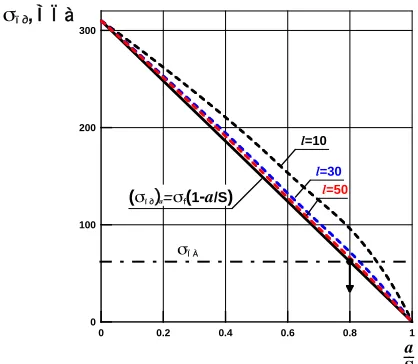
The analysis of serviceability HET was carried out with use of two methodical approaches (1) and (2) on the basis of comparison of limiting stress to corresponding taken into account stresses (fig. 1).
The analysis of occurrence of plastic instability was carried out at modes of normal op-eration (NO) and design accident (DA). Modes of hydrotests (HT) as it has been earlier speci-fied were not considered. For each group of modes of operation the maximal stress in a wall : in mode NO - 41.2 MPa, in mode DA - 65.0 MPa. Results of calculation for cracks in length 10, 30, 50 in mode DA are submitted on fig. 1 (dashed lines).
For simplification of the taken into account analysis and increase of presentation of re-ceived results more simple limiting dependence establishing connection between conditional limiting stress in a wall HET and size by relative depth of longitudinal defects as a crack, look-ing like also has been used:
( )
!ï! a= !"# $% & ' (
s a
f 1
)
3 Where: (σ )a - ring stress in a wall of tube causing development of a through crack from initial
defect by depth (a), S - thickness of a wall of a tube, σf- a stress of instability at plastic
deforma-tion of the metal, determined under the formula (2.2):
2 / )
( m p0,2
f = R +R
!
(2.2) Where:Rm andRp02-strength and a yield stress of a material HET accordingly.
The formula 2.1 is received from a condition of achievement by average stress in the crosspiece before top of a crack of size σf, for a crack which length on an axis of a tube the much
greater of its depths and, thus, lateral borders of a crack do not render influence on intense - de-formed a condition in its average part.
The given dependence submitted on Fig. 1 by a continuous line, is bottom bending around all taken into account values received according to techniques (1) and (2). Apparently from the resulted comparison, calculation by techniques (1) and (2) gives some difference from depend-ence (2.1) only for the defects having rather small extent on an axis of a tube whereas for defects in the extent of 50 mm and are higher results of calculation by all techniques are practically iden-tical.
0 0.2 0.4 0.6 0.8 1
a S
0 100 200 300
!ï!, Ì Ï à
l=10
!Ï À
l=30
l=50
(!ï!)a=!f(1-a/S)
Fig. 1 Comparison of results of calculation of limiting stress in a wall HET, resulting in forma-tion of a through crack from defect depth - a, by techniques (1) and (2), and under the formula (2.1), and also results of hydraulic tests of tubular samples with a cut (are designated by an aster-isk) depending on relative depth of a crack.
It allows to use the formula (2.1), as the most conservative, for carrying out of the further analysis. As follows from the formula (2.1), the size
( )
a ï!
! does not depend on geometry of a tube, in particular, from attitude{*relation*} S/R. In view of HET
( ) ( )
S R Dï! à
à
ï! = !
" ,
depend-ence (2.1) can be written down as:
( )
!" # $ % &
' (
=
S a R S
Pï! à f 1
(2.3) Where:
( )
à ï!
P - size of the internal pressure corresponding to a condition of formation of a through crack from defect by depth - a.
4
0 0.2 0.4 0.6 0.8 1
a
S 0
20 40 60 80 100
(Pï!)a, Ì Ï à
S/R=0,10 S/R=0,15 S/R=0,20
S/R=0,25 S/R=0,30
(PÏ À)óñë
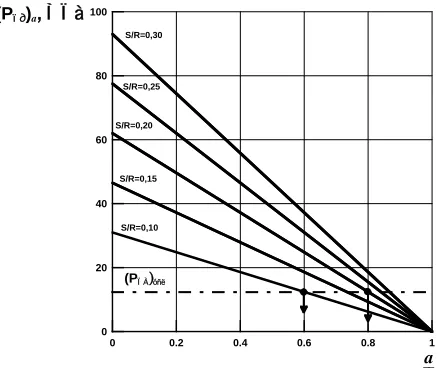
Fig. 2. Connection between a limiting condition of a tube and depth of longitudinal defect in view of its geometry.
The comparative estimation of mechanical properties of materials heat-exchange tubes SG PWR and PGV-1000 is resulted in table 2.3. In table 2 the taken into account estimation of the limiting sizes of defects HET SG PWR and PGV-1000, executed is resulted also in view of mechanical properties heat-exchange tubes SG PWR and PGV-1000. The taken into account esti-mation was carried out in view of HET the level of loadings on HET in SG PWR approximately cor-responds to loadings on HET PGV-1000. Value ( ) is determined for HET PGV-1000 from the assumption, HET district stress at a mode of design accident (DA) are caused only by super-fluous internal pressure in a tube. For HET SG PWR this pressure has been updated in view of distinction of pressure in the first contour of installations.
As follows from the taken into account estimations resulted in table 2, the size of the lim-iting sizes of defects essentially depends on the geometrical sizes of a tube.
Table 2. The basic characteristics of materials, standard sizes and operating conditions heat-exchange tubes and a comparative estimation of the limiting sizes of defects in a wall HET for steam gen-erators installations such as PWR and WWER.
Firm Westinghouse, (Seguoyah-1) NPP with
PGV-1000
Type SG Vertical Horizontal
Material HET Alloy 600 Alloy 690 Alloy 600 Alloy 690 08 18 10 The geometrical
sizes HET, mm
19 1,05 19 1,05 22 1,2 22 1,2 16 1,5 mm
Rp0,2 (at 20° ) !180 !300 !180 !300 !245
Rm(at 20° ) !550 !600 !550 !600 !595
Rp0,2 (at 300° ) !145 !220 !145 !220 !207 (at 350° )
Rm (at 300° ) !445 !520 !445 !520 !412 (at 350° )
f, MPa 295 370 295 370 310
Rav, mm 9,0 9,0 10,4 10,4 7,25
S/Rav 0,111 0,111 0,115 0,115 0,206
( ) 13,2 13,2 13,2 13,2 13,4
( /S) 0,60 0,68 0,61 0,69 0,79
( ) , mm 0,60 0,68 0,73 0,83 1,19
5 2.2. Hydraulic tests of a samples of HET of SG such as PGV-1000.
For verification of taken into account value of limiting depth of a crack in the wall HET determined from conditions of break of the crosspiece before top of a crack (1,19 mm, or 0,79S) have been carried out hydraulic tests of samples of the tubes delivered for steam generators PGV-1000. Tests of samples (fig. 3) were carried out at the test bench equipped with systems of adjustment of rate of a gain of pressure and registration of pressure in time.
!16
1,5
200 50
1,2
600
Fig. 3. The sketch of preparation of a sample HET with a cut for hydraulic tests.
The results of tests submitted in table 3, show, HET values of breaking points in recalcula-tion on the area of residual secrecalcula-tion come nearer to strength, and more than twice surpass a yield stress. Counting upon nominal section of a wall of a tube (without taking into account a cut) the stress causing break of a tube, average 116 MPa.
Table 3. Results of hydraulic tests of samples HET with cuts at 20 . Spec.
No
Rm20,
MPa
Rp0220,
MPa
Pressure of destruction,
F, MPa
Stress of destruc-tion in secdestruc-tion of
the crosspiece
σF, MPa
Stress of plastic instability of metal, !f , MPa
Stress of destruc-tion counting upon nominal section of a tube, σNF, MPa
1 657 245 24,7 585 483 117
2 657 245 24,4 597 483 115,4
At drawing experimental data on taken into account dependences (fig. 1) it is possible to see, HET experimental stress of break (average value 116 MPa - is designated by an asterisk)) almost twice exceed the most conservative taken into account values of limiting stress (63 MPa), received under the formula (2.1). They also in 1,6-1,7 times exceed the taken into account limit-ing values received by techniques (1) and (2).
On the basis of the received data it is possible to conclude, HET at taken into account value of limiting depth of a crack (0,8S or 1,2 ) the coverage factork320 at calculation on stress of
design accident (σ = 65 MPa) makes:
k320 =σ /σ = 116/65 = 1,78.
Even taking into account decrease in guaranteed strengthRm for tubes from steel of mark
08 18 10 with 510 MPa at 200 up to 412 MPa at 3000 and accepting decrease in stress of break of the crosspiece proportional to decrease in guaranteed durability, the coverage factor at 3000 k3300 will make:
k3300 = k320 Rm20 /Rm300 = 1,78·412/510 = 1,43
So high coverage factor for taken into account value of limiting depth of a crack in a wall HET (1,19 mm, or 0,79S) convincingly confirms conservatism of the accepted taken into ac-count value of limiting depth of a crack in a wall HET.
3. Estimation of permissible dimension of defect in view of its undergrowth for the period between periodical ECC.
6 connection, an individual estimation of rate of development of damages HET now cannot be made. Precisely as it is impossible to judge authentically rate of development of corrosion dam-ages in separate HET on the basis of results ECC in connection with available an error of meas-urements on the given method. In this situation the most reliable method of determination of the greatest possible rate of development of operational damages HET is statistical data processing stage-by-stage ECC on really working units of NPP. In case data processing ECC is carried out for several units of NPP with various conditions of operation on structure of the heat-carrier of the secondary circuit, there is an opportunity to estimate value of growth rate of damages in view of influence of conditions of operation HET.
Estimation of growth rate of defects in heat-exchange tubes PGV-1000 at operation it was carried out on the basis of statistical data processing ECC of steam generators on BNPP and KNPP. Feature of statistical processing of data file is HET at the analysis it is necessary to take into account two independent factors, the received results determining a dispersion, namely
- An error of measurement of depth of defect method ECC;
- Casual deviations of growth rate of damages in HET depending on local conditions on a chemical compound of environment in a zone of development of defect.
3.1. A conclusion of the basic taken into account formulas
Results ECC can be presented as some set undergrowth defects !Lèçìån !. "!Lèçìån !.(!tn)
for known (generally, various) intervals of time !tn:
N ,..., 1 n , t v
Lèçìå!. n n
n = #" +! =
" , (3.1)
) t ( L L n . èçìå! n . èçìå!
n "! !
! !tn: L v tn n, n 1,...,N
. èçìå!
n = #" +! =
" , (3.1)
Where: v - true growth rate of defects (mm/year), !tn - an interval of time between ECC,
!
n - a casual error of measurements, , N- number of measurements.Assuming, that errors of various measurements undergrowth defects are statistically in-dependent, and dispersions of mistakes are identical we shall receive:
2 L 2
m 2
n = # ="!
#
. (3.2)
For calculation of growth rate of defects
v
!àñ÷. we shall take advantage of a method of the least squares for minimization of a divergence between measured value and taken into ac-count undergrowth of defect:!
= " $ #"N 1 n 2 n . !àñ÷ èçìå!. n
v ( L v t )
min
.
!àñ÷
(3.3)
Having equated zero a derivative of criterion of optimization on parameter v , we shall receive the following equation for determination of taken into account growth rate of de-fects:
!
!
= = " " # " = N 1 n 2 n N 1 n n . èçìå! n . !àñ÷ t t L v. (3.4)
As follows from last formula, growth rate of defects is calculated through the values
. èçìå!
n L
! containing random errors of measurements. Thus, growth rate calculated by the specified
way itself is a random variable. We shall estimate its dispersion for what we shall substitute ex-pression (3.1) in the formula (3.4):
!
!
= = " " # $ + = N 1 n 2 n N 1 n n n . !àñ÷ t t v v, (3.5)
7
!
= " " # = $ % # N 1 n 2 n 2 L 2 . !àñ÷ 2 v t ) v v (. (3.6)
Value
2 L
!
"
can be estimated under the known formula:1 N ) t v L ( N 1 n 2 n . !àñ÷ . èçìå! n 2 L ! " # ! " $ %"
&
=. (3.7)
Thus: 1 N ) t v L ( t 1 N 1 n 2 n . !àñ÷ . èçìå! n N 1 n 2 n 2 v ! " # ! " # " $ %
&
&
== . (3.8)
Where value
v
!àñ÷. is calculated under the formula (3.5).For final specification of results of the statistical analysis we shall notice, that the random variable v!àñ÷. is superposition of the big number of casual errors !n and consequently according
to the central limiting theorem of probability theory with a high degree of accuracy has normal distribution [2]: 2 v 2 2 v !àñ÷ v v !àñ÷ e 2 1 v ! " " # $ ! % & ) . ( . ) ( (3.9) In view of the stated, 95 % the confidential interval for growth rate of defects is deter-mined by expression:
-1,96⋅σv ≤ v -v ≤ 1,96⋅σv (3.10)
That allows to state a final statistical estimation of an error of calculation of growth rate of de-fects by the described technique.
3.2. Results of data processing ECC
The statistical data processing ECC which has been carried out by a technique described above, has yielded the following results.
On BNPP : - the standard deviation of measured undergrowth of defects has made 6.11 % of thickness of a wall, i.e. 0.092 mm; - growth rate of defects with probability of 95 % lays in an interval (2.35 0.41) % from thickness of a wall in one year, i.e. (0.035±0.006) mm/year. On KNPP: - the standard deviation measured undergrowth defects has made 5.96 % of thick-ness of a wall, i.e. 0.09 mm; - growth rate of defects with probability of 95 % lays in an inter-val (1.45±0.69) % from thickness of a wall in one year, i.e. (0.022±0.01) mm/year.
Thus, results of statistical data processing ECC on BNPP and KNPP show, that the maximal growth rate of corrosion defects makes for conditions of BNPP WCC 0,041 mm/year, and for WCC conditions on KNPP 0,032 mm/year.
On the basis of the analysis of representative data file it is possible to note positive operat-ing experience of steam generators BNPP and KNPP with defects which depth exceeds 65 % from thickness of a wall HET.
In particular, on the power unit 3 BNPP from 374 defects registered and observed by re-sults of ECC, carried out in 1997-2004, 221 defect had depth from 65 % up to 90 % from thick-ness of a wall, including 13 defects depth more than 80 %. Thus some defects depth more than 65 % from thickness of a wall existed during 4 - 5 years (2000 - 2004), not resulting to destruc-tion heat-exchange tubes or to development of inadmissible leaks of coolant from the first circuit to the second circuit.
8
3.3. An estimation of defects undergrowth rate on NPP perspective units (PU) after achievement of permissible thickness of deposits.
In connection with essentially differences of SG HET operation conditions on BNPP and KNPP, the received results of calculation evidently shows dependence of defect growth rate in HET from parameters of the NPP units secondary circuit WCC and thickness of deposits on a surface of HET.
Not stopping in details on the analysis of HET corrosion damage mechanism, it is neces-sary to note the following basic moments.
1. Nucleation and development of pitting, and also corrosion cracks which going from pitting occurs on the mechanism of anodic dissolution of metal, originally, after breakdown of oxide film - in a zone of pitting, and then, at localization of process due to action of mechanical factors, - in the tip of corrosion crack.
2. Origin and the subsequent development of corrosion damage on walls of HET occurs, as a rule, under the deposits formed at SG operation as a result of slightly soluble impurities sedimentation during boiling of water.
3. Stability of protective oxide film on a surface of metal depends on value. For sta-bilization of oxide film value should be in a range 5,0< <10,0. Taking into account, that at hydrazine-ammoniac WCC value of in a zone of water boiling under deposits can be de-crease (due to evaporation of ammonia at repeated evaporation of water), the level of in wa-ter of a steam generator is established usually closer to the top border of this range.
4. For nucleation of pitting and corrosion cracks accumulation under deposits of salts - activators of corrosion (chlorides, sulfates, etc.) up to critical concentration, and also presence of oxidizers which role at absence of oxygen ions of copper Cu2+ can play is necessary.
5. Concentrating of nonvolatile impurity (salts, acids or alkalis) in a solution under depos-its on a HET surface at simultaneous removal of flying impurity (gases, including oxygen, am-monia, etc.) occurs as a result of evaporation of water inside porous deposits. Concentration of impurity under depositsCwi at their concentration in volume of steam generatorCoi can be
de-termined under the formula [4]:
Cwi = Coi exp( q/ψ w Lw Di) (3.3.1),
Where: ψ - porosity of deposits, w - density of water,Lw - heat of evaporation of water,Di -
factor of diffusion of i – salt ions.
Then concentrating of impurities, or the relation of concentration of impurity under depos-its to their concentration in volume of a steam generator (and accordingly in bleed water), Cwi/Coi it is possible to express a degree ratio:
lg(Cwi/Coi) = 0,434 (q )/(Lw wψ Di) (3.3.2).
For maintenance in water SG of impurity contents according to norms of WCC receipt of impurity in SG with a feed water should be balanced by their removal with a bleed water and a steam. At small thickness of deposits this balance is achieved by schedule of a constant and peri-odic blowing of a bleed water. At the big thickness of deposits there is an accumulation of impuri-ties (including chlorides, sulfates, ions of copper, etc.), that results in increase of corrosion rate un-der deposits.
Let's result as an example an estimation under the formula (3.3.2) concentration of chlo-rides under deposits of average and maximal undergrowth rates of cracks in HET of SG of PU NPP. For this purpose we shall accept thickness of deposits equal = 55 microns (such thick-ness approximately corresponding to specific impurity of 200 /m2, it was marked as minimal on damaged HET BNPP [3]). Porosity of deposits increases with growth of thickness of deposits from 5-10 % (at thickness of deposits up to 30 microns) up to 30-50 % at thickness more than 100 microns. For estimated calculation we shall accept porosity of deposits of equal 15 % (ψ=0,15 that approximately corresponds to porosity of deposits by thickness about 50 microns). According to lines of works [1, 3] and the help data we shall accept for 2800 :Lw =1600 kJ/kg;
PGV-9 1000 size of a specific thermal stream q = 123 kW/m2, we shall receive a degree of concentrating of salts under deposits: lg (Cwi/Coi) = 0,6274. Then, at allowable concentration Cl- in blowing-off
water BNPP CoCl-= 100 mkg/kg, concentration of chlorides under deposits will achieve value of
424 mkg/kg.
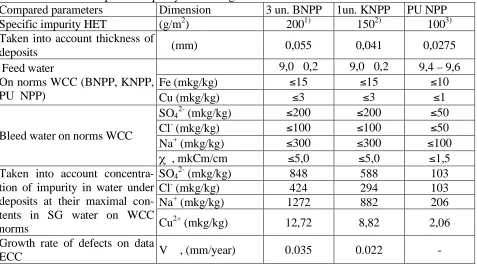
Taken into account estimations of concentration of impurity under deposits on HET SG unit 3 BAES, unit 1 KAES and PU NPPs received under the formula (3.3.2), are resulted in table 4. Table 4 The basic parameters of quality of feed and bleed water on the various NPP, taken into ac-count estimations of specific impurity HET and growth rates of defects.
Compared parameters Dimension 3 un. BNPP 1un. KNPP PU NPP
Specific impurity HET (g/m2) 2001) 1502) 1003)
Taken into account thickness of
deposits (mm) 0,055 0,041 0,0275
9,0 ±0,2 9,0 ±0,2 9,4 – 9,6
Fe (mkg/kg) ≤15 ≤15 ≤10
Feed water
On norms WCC (BNPP, KNPP,
PU NPP) Cu (mkg/kg) ≤3 ≤3 ≤1
SO42- (mkg/kg) ≤200 ≤200 ≤50
Cl- (mkg/kg) ≤100 ≤100 ≤50
Na+ (mkg/kg) ≤300 ≤300 ≤100
Bleed water on norms WCC
χ , mkCm/cm ≤5,0 ≤5,0 ≤1,5
SO42- (mkg/kg) 848 588 103
Cl- (mkg/kg) 424 294 103
Na+ (mkg/kg) 1272 882 206
Taken into account concentra-tion of impurity in water under deposits at their maximal con-tents in SG water on WCC
norms Cu
2+
(mkg/kg) 12,72 8,82 2,06
Growth rate of defects on data
ECC V , (mm/year) 0.035 0.022 -
Notes:
1) Average specific impurity HET SG on the unit 3 BNPP taken into account; 2) The specification on limiting impurity HET SG the Russian NPP;
3) The specification on limiting impurity HET SG of perspective power units.
As follows from table 3.3, the maximal growth rate of corrosion damages on the unit 3 BNPP during the period till 2003 corresponded to the maximal impurity of a surface HET (thickness of deposits), and, accordingly, to concentration of chlorides, sulfates, copper under deposits.
The estimation of the maximal rate of defects development in HET SG of PU NPP, can be executed on the basis of ratio of the maximal concentration of an oxidizer (ions Cu2 +) with incom-ing feed water for that units, and for KNPP (1 and 3 mkg/kg accordincom-ingly) and the maximal rate of development of defects on SG KNPP:
V PU NPP = V KNPP CuPU NPP/ CuKNPP = 0,032 2,06/8,82 ≤ 0,01 mm/year.
Thus it is supposed, that concentration of chlorides under deposits achieves a level, providing started also development corrosion cracking at presence of oxidizers.
Results of an estimation of probable maximal rate of defects development in HET of SG PU NPP in comparison to the received data on growth rates of defects on BNPP and KNPP are graphi-cally illustrated in figure 4. In a basis of this comparison the lay known regulations that at absence of oxidizers corrosion damages of HET does not occur and growth rate of existing defects is equal to zero.
10 Apparently from fig. 4, it will well be coordinated to the resulted data on average values of growth rate of defects on BNPP and KNPP.
For an estimation of the greatest possible growth rate of defects in HET SG perspective units of NPP it is possible to use the data on the maximal rates of development of defects for BNPP and KNPP. Straight lines going from the beginning of coordinates, expected value of the maximal rate of development of corrosion defects in HET for NPP with different WCC. Taking into account the approached character of the made estimations, it is possible to accept for the further calculations for PU NPP VmaxPU NPP≤0,01 mm/year (on fig. by 4 horizontal dashed line).
0 2 4 6 8 10 12
Ê î í öåí ò!àöèÿ èî í î â ì åäè, ì êã/êã
0 0.01 0.02 0.03 0.04 0.05
Ñ
êî
!
îñ
òü
!
îñ
òà
ä
åô
åê
òî
â,
ì
ì
/ã
îä
!àñ÷åòí î å çí à÷åí èå Vmax!0,01 ì ì /ãî ä
Áàë ÀYÑ
Ê ÀYÑ
ÒÀYÑ
Vmax
Vc!
Vmax
Vñ!
äèàï àçî í âî çì î æí û õ ñêî!î ñòåé !î ñòà äåôåêòî â
Fig. 4. Estimation of probable rate of corrosion damages growth in HET SG NPP.
The carried out analysis allows to receive an integrated estimation of annual growth rate of defects in HET SG perspective units of NPP. This estimation bases on the data on development of corrosion damages HET, received during an interval of time from three till five years on two Rus-sian NPP units with a various degree of impurity HET. It allows to take into account totally all va-riety of the factors determining processes of corrosion damage HET at various operating modes SG HET provides a high level of reliability of the received results.
It is necessary to note, HET at specific impurity HET less than 50 g/m2 as occurrence new, and development of existing defects has very low probability. Indeed this regularity is possible to see on long-term operating experience of steam generators of the Russian NPP.
3.4. Estimation of the relative admitted size of cracks in view of its probable undergrowth.
As shown earlier, limiting relative depth of defect for HET PGV-1000, determined of conditions of HET loading at design accident, makes 0,79 S or on absolute size of 1,19 mm.
At the accepted taken into account maximal growth rate of corrosion cracksV . = 0,01
mm/year, greatest possible undergrowth defect for the period between periodical ECC making 4 years, will make !a≈0,04 mm that corresponds to relative reduction of cross-section of a tube by size !a/S= 0,027 !0,03.
This implies, that the relative admitted size of cracks in a wall of steam generators PGV-1000 HET will make:
!" # $% &
S
a =
! " # $ % & ' ( ! ! " # $ $ % &
S a S
a
ï!
= 0,76.
4. Estimation of the maximal error at determination of depth of a crack on the ECC data.
PU
PU NPP
KNPP
BNPP
Concentration of Cu2+ , mkg/kg
D
ef
ec
ts
gr
ow
th
ra
te
,
m
m
/ye
11 Method ECC, which usually used for detection and an estimation of defects size in HET is an indirect method. It is carried out by creation eddy currents in a wall of a tube of and regis-tration of the response of the induced electromagnetic field corresponding to distortion in a zone of available defect.
On the basis of the analysis of the executed measurements at control SG of the various NPP it has been established, that reliable accuracy of measurement can be received only at am-plitudes of signals ≥1,0 V. Such amplitude it is steadily registered only for deep defects (depth more than 40-50 % of a wall HET thickness). As a result of statistical processing the results re-ceived at ECC of steam generators of these NPP it has been established, that at use of modern probes the maximal error at amplitude of signal ≥1,0 V makes no more than 11 %. It allows to accept the maximal size of an error of measurement of depth of the defect subject to plugging at a level of 11 % for perspective units of NPP.
5. Determination of criterion of HET plugging SG
5.1. The review of existing approaches to a choice of criteria of HET plugging
In Russia for lines of power units VVER-440 in view of SG matrix condition is accepted value of criterion of plugging of 75 % of HET wall. This size will well enough be coordinated to taken into account estimations of experts of Czechia where on NPP steam generators of the Rus-sian design are used. The criterion of plugging of 60-70 % is applied to lines of power units with WWER-1000 from thickness of a wall HET [6,7].
In global practice size of criterion of HET plugging varies from 40 up to 80 %, including: 40-65 % in the USA; 40-78 % in Spain.
It is obvious, HET the criteria of plugging used on some NPP of USA and European countries, cannot be directly applied for steam generators of the Russian manufacture owing to design features and various constructional materials of heat-exchange tubes. Long-term operat-ing experience of steam generators and results of ECC, carried out at various times on steam generators of various units of NPP, has shown, that the criteria of plugging used on working units of the Russian NPP are conservative enough.
5.2. Determination of criterion of HET plugging SG on perspective units of NPP
In view of stated in sections 2, 3, 4 it is possible to determine simply enough criterion of HET plugging SG on perspective units of NPP according to the principles stated in section 1 which can to be submitted by expression:
âòê
S à
!" # $%
&
(
)
ÂÒÊ ï!
U S
a S
a
+
! ! " #
$ $ % &
' ( ) * + , -. ' ( ) * + ,
= 1
(5.1) Where: :
âòê
S à
!" # $%
& - the admitted relative size of defect determined on basis ECC in view of an error of measurements
(cri-terion of plugging);
ï!
S a ! " # $ %
& - limiting value of the relative size of the defect corresponding to a
condi-tion of formacondi-tion of a through crack;
S a
! - the relative size greatest possible undergrowth cracks for the period between periodical ECC;UECC - an error of measurement of used method
ECC.
In view of the results of calculation submitted in sections 2, 3 and 4, values:
ï! S a
! " # $ %
& = 0,79;
S a !
=0,03 andUECC = 11 %, and accordingly:
âòê
S à
!" # $%
& = 0,68.
12 In view of the above mentioned analysis, criterion of HET plugging SG on perspective units of NPP with steam generators such as PGV-1000 can be established conservatively enough at a level not less than 65 % from thickness of a wall heat-exchange tubes.
THE CONCLUSION
On the basis of the analysis of conditions of the control and development of defects such as cracks, and also a limiting condition before destruction heat-exchange tubes of steam generators, the diagram of determination of criterion of HET plugging is developed.
According to the diagram the taken into account way for a crack of unlimited length (along an axis HET) receives value of limiting depth from conditions of break of the crosspiece in front of the tip of a crack due to instability of plastic deformation of metal. This value making for a case of design accident in HET PGV-1000 not less of 79 % from thickness of a wall (0,79 S), proves to be true results carried out of hydraulic tests of samples HET with a sharp longitudinal cut.
The estimation of undergrowth of the cracks, received on the basis of statistical processing results ECC during operation shows, that the maximal growth rate of corrosion defects under characteristic conditions of WCC and thickness of deposits made no more than 0,041 mm/year on HET SG BNPP and no more than 0,032 mm/year on HET SG KNPP. The average rates are lower than these values on 20-30 %. The data on average rates of defects development well cor-relate with concentration under deposits of the basic oxidizer - the ions of copper acting in a steam generator with a feed water. That allows to express dependence of a crack growth rate on concentration of an oxidizer of the straight line leaving the beginning of coordinates. On the ba-sis of this dependence it is established, that the maximal growth rate of defects taken into ac-count for perspective units of NPP will not exceed 0,01 mm/year.
In view of an error of a crack depth determination by results of ECC (no more than 11 % at amplitude of a signal more than 1 V), criterion of HET plugging of steam generators such as PGV-1000 on perspective units of NPP can be established reliably enough at a level not less than 65 % from thickness of a wall heat-exchange tubes.
The list of the literature
1. Karzov G.P., Suvorov S.A., Fedorova V.A., Trunov N.B. " Conditions of origin and development of cor-rosion defects heat-exchange tubes at installation, starting-up and adjustment works and lay modes of operation ", - Works of 9-th International conference " Problems of materiology at designing, manufac-turing and operation of the equipment of NPP ", PU , Russia, 2006 .
2. Korn G., Korn T., Spravochnik on mathematics (for science officers and engineers), Moscow, the Sci-ence, 1973-832 .
3. Trunov N.B., Logvinov S.A., Dragoons . ., Hydrodynamical and is warm - chemical processes in steam generators of NPP with WWER, ., Energoatomizdat, 2001, 316 p.
4. R Garsney/Corrosion and requirement for feed and boiler water chemical control in nuclear steam generators. Water chemistry of nuclear reactor systems // PNES. London. 1978.
5. G.G. Uhlig, Revi, Corrosion and struggle against it . Trans. With English, L., Chemistry, 1989, 456 p.
6. Grigorjev V.A.. Bessarabov . , Trunov N.B., Sharyj N.N., Davidenko S.E., Portnov B.B. the Ap-proach to the analysis of serviceability heat-exchange tubes of steam generators such as SG . 6-th inter-national seminar on horizontal steam generators, Podolsk, 2004.