ISSN: 2319-8753
I
nternational
J
ournal of
I
nnovative
R
esearch in
S
cience,
E
ngineering and
T
echnology
(An ISO 3297: 2007 Certified Organization)
Vol. 3, Issue 5, May 2014
Copyright to IJIRSET www.ijirset.com 12751
Test Data Compression Using Soft Computing
Technique
V.Mohanadas1, Ms.T.Thangam 2.
P.G. Student, Department of ECE, P.S.N.A. C.E.T, Dindigal, India,1 .
Associate. Prof., Department of ECE, P.S.N.A. C.E.T, Dindigal, India,2
ABSTRACT - One of the methods to reduce the area and power dissipation is by doing the test data compression scheme using soft computing technique. By doing the soft computing the area minimization can be achieved. The soft computing is the term applied for solving the NP complete problems. The main objective is to reduce the amount of test data that is applied to DUT. Generally, a circuit or system consumes more power in test mode than in normal mode. This extra power consumption can give rise to severe hazards in circuit reliability or, in some cases, can provoke instant circuit damage. To overcome this drawback the compression is applied to the input i.e. when the amount of data is compressed area minimization is achieved. The type used in this compression is lossless compression which means when the data are compressed there will be no loss of information. When processed in the logic block the compressed data is decompressed and each and every data are processed and are provided in the output. The algorithm used in this project is an image compression algorithm used to achieve data compression. In this algorithm we are going to use two matrices BM Binary Matrix and GSM Grey scale matrix.
KEYWORDS- genetic algorithm, loss les compression scheme ,DUT Device Under Test.
I.INTRODUCTION
ISSN: 2319-8753
I
nternational
J
ournal of
I
nnovative
R
esearch in
S
cience,
E
ngineering and
T
echnology
(An ISO 3297: 2007 Certified Organization)
Vol. 3, Issue 5, May 2014
Copyright to IJIRSET www.ijirset.com 12752 data compression algorithm is proposed in [8]. This algorithm combines features from both PDLZW and an approximated adaptive Huffman algorithm with dynamic-block exchange (AHDB). In [8], the authors proposed a simple implementation based on content-addressable memory (CAM) to perform the required parallel search. One disadvantage of this implementation is that the resulting CAM module must be synthesized with circuits based on -type flip-flops and, hence, consumes a large amounts of hardware due to the fact that most cell-based libraries or FPGA-based devices do not support CAM modules with full functionalities, including write, interrogate, and read out operations. Modern chip design has greatly advanced with recent silicon manufacturing technology increasing a chip’s complexity while maintaining its size. This phenomenon will continue, resulting in at least 10 of today’s microprocessors fitting onto a single chip by 2020.Consequently, sign and test of complex digital circuits imposes extreme challenges to current tools and methodologies. VLSI circuit designers are excited by the prospect of addressing these challenges efficiently, but these challenges are becoming increasingly hard to overcome. Test currently ranks among the most expensive and problematic aspects in a circuit design cycle, and test-related solutions. As a result, researchers have developed several techniques that enhance a design’s testability through DFT modifications and improve the test generation and applicationprocesses.
II. RELATED WORKS
Code-based schemes use data compression codes to encode the test cubes. The basic idea is to partitioning the original data into symbols, and then replacing it with a code word to form the compressed data. In order to do decompression, a decoder simply converts each code word in the compressed data back into the corresponding symbol. The first data compression codes that researchers investigated for compressing scan vectors encoded runs of repeated values. Jas and Touba has developed a scheme based on effective run-length codes that encoded runs of 0s using fixed-length code words. To increase the occurrence of runs of 0s, this scheme uses a cyclical scan architecture to allow the application of difference vectors where the difference vector between test cubes t1 and t2 is equal to t1 ≈ t2. Careful ordering of the test cubes maximizes the number of 0s in the difference vectors, thereby improving the throughput and effectiveness of run-length coding. Chandra and Chakrabarty have developed a technique based on Golomb codes that encode runs of 0s with variable-length code words. The purpose of variable-length code words is to allows efficient encoding of longer runs, which requires a synchronization mechanism between the tester and the chip. Effective and high optimization can be achievable by using frequency-directed run-length (FDR) codes and variable-input Huffman codes (VIHC), which customize the code based on the distribution of different run lengths in the data.
ISSN: 2319-8753
I
nternational
J
ournal of
I
nnovative
R
esearch in
S
cience,
E
ngineering and
T
echnology
(An ISO 3297: 2007 Certified Organization)
Vol. 3, Issue 5, May 2014
Copyright to IJIRSET www.ijirset.com 12753
III. PROPOSED SYSTEM
Our algorithm is based on only two matrices, binary matrix and grayscale matrix. The main steps of the proposed algorithm are as follows:
Step 1: Read the original image matrix [OR]
Step 2: Construct the Binary Matrix [BM] and Grayscale Matrix [GSM] based on the following steps
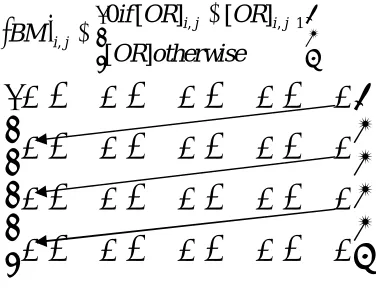
Step 3: Compare each pixel in the matrix [OR] with the previous pixel in the same matrix as shown in Fig. 1
Step 4: The binary matrix [BM] elements are calculated as follows:
otherwise
OR
OR
if
BM
ij i j i j1
]
[
]
[
0
, , 1,
Step 5: First element in [GSM] is set to be equal to the value of the first pixel of [OR]
Step 6: The rest of the elements of [GSM] are calculated as follows:
otherwise
OR
OR
OR
if
BM
ij i j i j]
[
]
[
]
[
0
, , 1,
Fig : 1
Step 7: The original image[OR] can be reconstructed by using :
[
]
1
ISSN: 2319-8753
I
nternational
J
ournal of
I
nnovative
R
esearch in
S
cience,
E
ngineering and
T
echnology
(An ISO 3297: 2007 Certified Organization)
Vol. 3, Issue 5, May 2014
Copyright to IJIRSET www.ijirset.com 12754 The performance of the proposed algorithm is compared with other research results and predefined software such as JPEG Lossless Encoder. The criteria used for the comparison is the compression ratio achieved which is defined as follows[4]:
In a genetic algorithm, a population of solution called as resultant effective solution to an optimization problem is evolved to achieve a better solutions. Each candidate solution or its chromosomes or genotype which can be mutated and altered; traditionally, resulting sets or solution are represented in binary forms as strings of 0s and 1s, but other encodings can also be predicted.
We propose a Genetic Algorithm based text data lossless compression standard for bayer pattern.It is used to select the best patterns or pixels among the set of available patterns or pixels in the bayer pattern Image. It also achieves better compression ratio and Less Elapsed time.
3.1Chromosomes:
The next step is to generate a second generation population of solutions from those selected through genetic operators: crossover (also called recombination), and/or mutation. For each new Chromosomes to be produced, a pair of "parent" solutions is selected for breeding from the pool selected previously. By producing a "child" solution using the above methods of crossover and mutation, a new result or effective solution is created which typically shares many of the characteristics of its "parents". New parents are selected for each new child, and the phenomena continues until a new population of solutions of appropriate size is generated. The further improvement methods that are based on the use of two parents are more, some research suggests that more than two "Solutions" generate higher quality chromosomes.
Chromosomes or solutions represent solutions consisting of centers of k clusters – each cluster center is a ddimensional vector of values in the range between 0 and 255 representing intensity of gray or color component.
3.2 Population initialization and fitness computation:
The clusters centers are initialized randomly to k ddimensional points with values in the range 0 – a 255. Fitness value is calculated for each chromosome in the population according to the rules ..
3.3 Selection:
Selection operation tries to choose best suited chromosomes from parent population that come into mating pool and after cross-over and mutation operation create child chromosomes of child population. Most frequently genetic algorithms make use of tournament selection that selects into mating pool the best individual from predefined number of randomly chosen population chromosomes. This phenomena is repeated for each parental chromosome.
3.4 Crossover:
The crossover operation presents probabilistic process exchanging information between two parent chromosomes during formation of two child chromosomes. Basically, one-point or two-point crossover operation can be used.
3.5 Mutation:
Mutation operation is applied to each created child chromosome with a given probability pm. After crossover operation children chromosomes that undergo mutation operation flip the value of the chosen bit or change the value of the chosen byte to other in the range from 0 to 255. Basically mutation probability rate has a limit between 0.05 - 0.1 [4].
3.6 Termination criterion:
ISSN: 2319-8753
I
nternational
J
ournal of
I
nnovative
R
esearch in
S
cience,
E
ngineering and
T
echnology
(An ISO 3297: 2007 Certified Organization)
Vol. 3, Issue 5, May 2014
Copyright to IJIRSET www.ijirset.com 12755 terminates after predefined number of iterations. Other possible criterion for termination of the k-means algorithms depend on degree of population diversity or situation when no further cluster reassignment takes place.
IV.SIMULATION RESULTS:
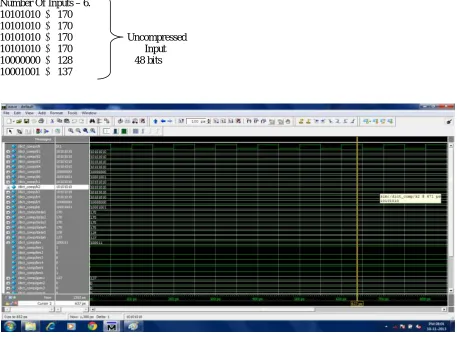
Number Of Inputs – 6. 10101010 170 10101010 170
10101010 170 Uncompressed 10101010 170 Input 10000000 128 48 bits 10001001 137
Fig 2:An example Test data.
BM
100011
6 bits.
GSM
10001001
137
ISSN: 2319-8753
I
nternational
J
ournal of
I
nnovative
R
esearch in
S
cience,
E
ngineering and
T
echnology
(An ISO 3297: 2007 Certified Organization)
Vol. 3, Issue 5, May 2014
Copyright to IJIRSET www.ijirset.com 12756
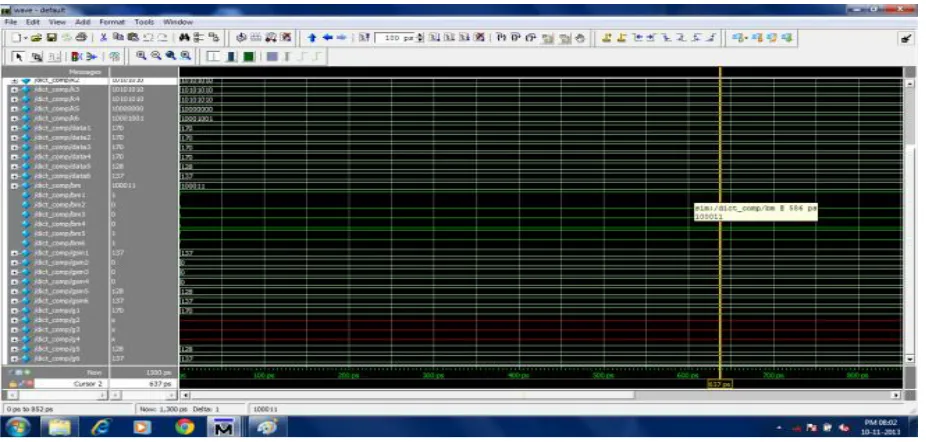
Fig 3:An example Test data.
ISSN: 2319-8753
I
nternational
J
ournal of
I
nnovative
R
esearch in
S
cience,
E
ngineering and
T
echnology
(An ISO 3297: 2007 Certified Organization)
Vol. 3, Issue 5, May 2014
Copyright to IJIRSET www.ijirset.com 12757
Fig6: Device Utilization
V. CONCLUSION
In this project, as it has been discussed so far,the Compression of test vector using two different matrix has been achieved. The programming was done using BM and GSM and a compression was achieved at the ratio of 16%.. This algorithm helps us to arrive with desired output by the selection of best pattern.On the analysis of the results produced by proposed system it can be said that applying BM and GSM algorithm may give better results for obtaining better Compression.The simulation was done using Modelsim and device utilisation was calculated using Xilinx.
REFERENCES
[1] T. C. Bell, J. G. Cleary, and I. H. Witten, Text Compression. Englewood Cliffs, NJ: Prentice-Hall, 1990. [2] R. M. Fano, Transmission of Information. Cambridge, MA: MIT Press, 1961.
[3] R. C. Gonzalez and R. E.Woods, Digital Image Processing. Reading, MA: Addison-Welsley, 1992.
[4] J. Jiang and S. Jones, “Word-based dynamic algorithms for data compression,” IEE Proc.-I, vol. 139, no. 6, pp. 582–586, Dec. 1992. [5] S. Khalid, Introduction to Data Compression, 2nd ed. San Mateo, CA: Morgan Kaufmann, 2000.
[6] M.-B. Lin, “A parallel VLSI architecture for the LZW data compression algorithm,” in Proc. Int. Symp. VLSI Technologym Systems, and Applications, Taiwan, R.O.C., 1997, pp. 98–101.
[7] M.-B. Lin, “A parallel VLSI architecture for the LZW data compression algorithm,” J. VLSI Signal Process., vol. 26, no. 3, pp. 369–381, Nov. 2000. [8] M.-B. Lin, J.-F. Lee, and G. E. Jan, “A lossless data compression and decompression algorithm and its hardware architecture,” IEEE Trans. Very Large Scale Interation (VLSI) Syst., vol. 14, no. 9, pp. 925–936, Sep. 2006.
[9] K. Pagiamtzis and A. Sheikholeslami, “Content-addressable memory (CAM) circuits and architectures:A tutorial and survey,” IEEE J. Solid- State Circuits, vol. 41, no. 3, pp. 712–727, Mar. 2006.
[10] H. Park and V. K. Prasanna, “Area efficient VLSI architectures for Huffman coding,” IEEE Trans. Circuits Syst. II, Analog Digit. Signal Process, vol. 40, no. 9, pp. 568–575, Sep. 1993.
ISSN: 2319-8753
I
nternational
J
ournal of
I
nnovative
R
esearch in
S
cience,
E
ngineering and
T
echnology
(An ISO 3297: 2007 Certified Organization)
Vol. 3, Issue 5, May 2014
Copyright to IJIRSET www.ijirset.com 12758
[12] T. A. Welch, “A technique for high-performance data compression,” IEEE Computer, vol. COM-17, no. 6, pp. 8–19, Jun. 1984.