Available online: http://edupediapublications.org/journals/index.php/IJR/ P a g e | 2799
A Secure Reversible Data Hiding With Optimal Value
Transfer
Chinta B D China Veer Reddy & A.Veerabhadra Rao 1M.Tech., 2 Head of Department, M.Tech, (Ph.d). 1,2 Department Of Computer Science & Engineering
1,2 Jogaiah Institute Of Technology And Sciences Kalagampudi, West Godavari District,
Andhra Pradesh
Email:- [email protected],[email protected]
Abstract
In reversible data hiding techniques, the estimations of host data are changed by some specific guidelines and the first host
substance can be consummately
reestablished after extraction of the hidden data on receiver side. In this paper, the optimal control of significant worth alteration under a payload-contortion model is found by utilizing an iterative methodology, and a down to earth reversible data hiding plan is proposed. The mystery data, and in addition the auxiliary data utilized for content recuperation, are conveyed by the contrasts between the first pixel-values and the relating esteems assessed from the neighbors. Here, the estimation errors are altered by the optimal esteem exchange run the show. Additionally, the host picture is partitioned into various pixel subsets and the auxiliary data of a subset is constantly embedded into the estimation errors in the following subset. A receiver can effectively separate the embedded mystery data and recoup the first substance in the subsets with a backwards arrange. Thusly, a great reversible data hiding execution is accomplished.
Keywords :- Reversible Data Hidhing, Auxiliary Data, Prediction-error expansion, difference expansion strategies, and histogram alteration
Introduction
DATA hiding method expects to implant some secret data into a bearer motion by
adjusting the irrelevant parts for copyright assurance or secretive correspondence. As a rule cases, the data-hiding task will bring about contortion in the host flag. Be that as it may, such bending, regardless of how little it is, is inadmissible to a few applications, e.g., military or on the other hand medicinal pictures. For this situation it is basic to insert the extra secret message with a reversible way so that the unique substance can be splendidly reestablished after extraction of the shrouded data. Various reversible data hiding techniques have been proposed, and they can be generally arranged into three kinds: lossless pressure basedmethods, difference Expansion (DE) strategies, and histogram modification (HM) techniques. The lossless pressure based strategies make utilization of factual excess of the host media by performing lossless pressure in request to make an extra space to suit extra secret data. In the RS technique [1], for instance, a normal solitary status is characterized for each gathering of pixels as indicated by a flipping activity what's more, a separation work. The total of RS status is at that point losslessly packed to give a space to data hiding.
On the other hand, the slightest huge digits of pixel esteems in anary framework [2] or the slightest huge bits (LSB) of quantized
Available online: http://edupediapublications.org/journals/index.php/IJR/ P a g e | 2800 as the picked thing is compressible, be that
as it may, the limits are not high. In the difference expansion strategy [4],differences between two neighboring pixels are multiplied so that another LSB plane without conveying any data of the first is produced.
The concealed message together with a compacted area delineate from the property of every pixel combine, yet not the have data itself, is implanted into the produced LSB plane. Since pressure rate of the area delineate high, and each pixel match can convey one piece, the DE calculation can insert a genuinely expansive measure of secret data into a host picture. Moreover, different techniques have been brought into DE calculation to enhance its execution, including summed up whole number change [5], [6], pixel esteem expectation system [7], histogram moving activity [8], expectation of area delineate [9], rearrangements of area outline, [11], and change of compressibility of area outline.
Literature Review
Literature survey is the most essential advance in software improvement process. Before building up the instrument it is important to decide the time factor, economy n organization quality. Once these things r fulfilled, ten following stage is to figure out which working system and dialect can be utilized for building up the instrument. Once the software engineers begin fabricating the instrument the developers require parcel of outside help. This help can be gotten from senior software engineers, from book or from sites. Before building the system the above thought r considered for building up the proposed system.
According to Sona Ignacious(2014) DATA hiding method intends to implant somesecret data into a transporter motion by modifying the inconsequential segments for copyright security or undercover
correspondence. When all is said in done cases, the data-hiding task will bring about bending in the host flag. Be that as it may, such bending, regardless of how little it is, is unsatisfactory to a few applications, e.g., military or medicinal images. For this reason numerous data hiding calculations have been proposed. This literature survey talks about all the current data hiding calculations and their execution.
According to Hu, Xiaocheng,(2015) Prediction-error expansion (PEE)- based reversible data hiding plans comprise of two stages. Initial, a sharp prediction-error (PE) histogram is produced by using pixel forecast procedures. Second, mystery messages are reversibly embedded into the expectation errors through growing and moving the PE histogram. Past PEE strategies treat the two stages freely while they either center around pixel expectation to get a sharp PE histogram, or go for histogram change to upgrade the installing execution for a given PE histogram. This paper propose a pixel forecast strategy in light of the base rate rule for reversible data hiding, which builds up the consistency between the two stages basically. What's more, correspondingly, a novel upgraded histograms change conspire is exhibited to surmised the optimal inserting execution on the produced PE arrangement. Trials exhibit that the proposed strategy beats the past condition of-craftsmanship partners fundamentally as far as both the expectation exactness and the last inserting execution.
Available online: http://edupediapublications.org/journals/index.php/IJR/ P a g e | 2801 recognize usable bits reasonable for data
hiding so that the scrambled bitstream conveying mystery data can be accurately decoded. The mystery message bits are encoded with error amendment codes to accomplish an impeccable data extraction and image recuperation. The encryption and implanting are controlled by encryption and installing keys individually. In the event that a receiver has both keys, the mystery bits can be extricated by examining the blocking relics of the neighboring squares, and the first bitstream consummately recuperated. On the off chance that the receiver just has the encryption key, he/she can at present decode the bitstream to get the image with great quality without extricating the hidden data.
Existing System:
Various reversible data hiding techniques have been proposed, and they can be generally characterized into three kinds: lossless pressure basedmethods, difference expansion (DE) strategies, and histogram alteration (HM) strategies. The lossless pressure based techniques make utilization of measurable repetition of the host media by performing lossless pressure so as to make an extra space to oblige extra mystery data. In the RS strategy [1], for instance, a general solitary status is characterized for each gathering of pixels as per a flipping activity and a separation work. The aggregate of RS status is then losslessly compacted to give a space to data hiding. Then again, the slightest huge digits of pixel esteems in a - ary system [2] or the least significant bits (LSB) of quantized DCT coefficients in a JPEG image [3] can likewise be utilized to give the required data space. In these reversible data hiding techniques, an extra place can simply be made accessible to oblige mystery data as long as the picked thing is compressible, however the limits are not high.
Disadvantages Of Existing System:
In these reversible data hiding techniques, an extra place can simply
be made accessible to suit mystery data as long as the picked thing is compressible, yet the limits are not high.
Payload of this technique is low since each piece can just convey one piece.
Proposed System:
In this paper, we will locate the optimal control of significant worth change under a payload-twisting foundation. By boosting an objective capacity utilizing iterative calculation, an optimal esteem exchange lattice can be acquired. Besides, we plan a reasonable reversible data hiding plan, in which the estimation errors of host pixels are utilized to oblige the mystery data and their esteems are adjusted by the optimal esteem exchange grid. Along these lines, a great payload-twisting execution can be accomplished
Advantages Of Proposed System:
A more intelligent expectation technique is misused to make the estimation errors more like zero, a superior execution can be accomplished, however the calculation intricacy because of the forecast will be higher.
The payload-bending execution of the proposed plot is amazing.
The host image is partitioned into various subsets and the auxiliary data of a subset is constantly embedded into the estimation errors in the following subset. Along these lines, one can effectively separate the embedded mystery data and recuperate the first substance in the subsets with a Backwards Arrange.
Extension of the Project Email Sending
Available online: http://edupediapublications.org/journals/index.php/IJR/ P a g e | 2802 particular user email. After receiving the
email user can download the image and extract data from images.
Input Design
The input design is the connection between the data system and the client. It involves the creating determination and techniques for data arrangement and those means are important to put exchange data in to a usable shape for processing can be accomplished by investigating the PC to peruse data from a composed or printed record or it can happen by having individuals entering the data straightforwardly into the system. The outline of information centers around controlling the measure of info required, controlling the errors, evading delay, maintaining a strategic distance from additional means and keeping the procedure basic. The info is composed in such a path along these lines, to the point that it furnishes security and usability with holding the protection. Info Design thought about the accompanying things:
What data ought to be given as info? How the data ought to be masterminded
or coded?
The exchange to control the working faculty in giving info.
Methods for getting ready info approvals and ventures to take after when error happen.
Objectives
Input Design is the way toward changing over a client situated portrayal of the input into a PC based system. This design is essential to maintain a strategic distance from errors in the data input process and demonstrate the right course to the administration for getting right data from the modernized system. It is accomplished by making easy to
understand screens for the data passage to deal with huge volume of data. The objective of designing input is to make data passage simpler and to be free from errors. The data section screen is
designed such that every one of the data controls can be performed. It additionally gives record seeing offices.
.At the point when the data is entered it will check for its legitimacy. Data can be entered with the assistance of screens. Proper messages are given as when required with the goal that the client won't be in maize of moment. Along these lines the goal of input design is to make an input format that is anything but difficult to take after
Output Design
A quality yield is one, which meets the prerequisites of the end client and presents the data obviously. In any system consequences of processing are imparted to the clients and to other system through yields. In yield design it is resolved how the data is to be uprooted for quick need and furthermore the printed copy yield. It is the most imperative and direct source data to the client. Effective and astute yield design enhances the system's relationship to help client basic leadership.
1. Designing PC yield ought to continue in a composed, well thoroughly considered way; the correct yield must be created while guaranteeing that each yield component is designed with the goal that individuals will discover the system can utilize effortlessly and viably.At the point when examination design PC yield, they should Identify the particular yield that is expected to meet the necessities.
2. Select strategies for exhibiting data.
3. Create record, report, or different organizations that contain data delivered by the system.
Available online: http://edupediapublications.org/journals/index.php/IJR/ P a g e | 2803 1. Convey data about past exercises,
current status or projections of the Future.
3. Signal critical occasions, opportunities, issues, or notices.
4. Trigger an activity.
5. Confirm an activity.
Reversible Data Hiding Scheme
Fig. 1. Sketch of data embedding procedure.
In The Proposed Scheme, The Secret Data, As Well As The Auxiliary Information Used For Content Recovery, Are Carried By The Differences Between The Original Pixel-Values And The comparing esteems evaluated from the neighbors, and the estimation blunders are altered by the ideal esteem exchange grid. The ideal esteem exchange framework is created for boosting the measure of mystery information, i.e., the unadulterated payload, by the iterative system portrayed in the past segment. That infers the measure of helper data does not influence the optimality of the exchange grid. By isolating the pixels in have picture into two sets and various subsets, the information inserting is organized performed in the subsets, and afterward the assistant data of a subset is constantly produced and implanted into the estimation blunders in the following subset. Along these lines, a beneficiary can effectively extricate the implanted mystery information
and recuperate the first substance in the subsets with an opposite request.
Data Embedding
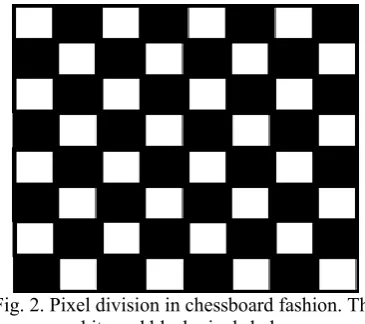
The data embedding procedure is sketched in Fig. 1. Denote the host pixels as where and are indices of row and column, and divide all pixels into two sets: Set A containing pixels with even and Set B containing other pixels with odd . Fig. 2 shows the chessboard-like division. Clearly, the four neighbors of a pixel must belong to the different set. For each pixel, we may use four neighbors to estimate its value,
That means the pixels in Set A/B are estimated by using the pixels in B/A. The data embedding procedure is made up of
Fig. 2. Pixel division in chessboard fashion. The white and black pixels belong
to Sets A and B respectively.
Data Extraction and Content Recovery
While having a picture containing inserted information, the recipient initially isolates the picture into Sets An and B, and partitions Sets An and B into various subsets utilizing a similar way. At that point, concentrate and AI from the LSB of the last subset in Set B, and deteriorate as the weight esteems, the histogram distinction of the primary
Available online: http://edupediapublications.org/journals/index.php/IJR/ P a g e | 2804 principal subsets, and with the histogram
contrast and the emphasis number, he can utilize the histogram contrast to recover the first scaled histogram and execute the iterative method to recover the ideal exchange grid utilized for information installing in the main subsets.
At that point, the recipient recuperates the first substance and concentrates the shrouded information in Subset of Set B. Since the initial segment of AI contains the names of immersed pixels and the first estimations of the principal kind of soaked pixels, the primary sort of immersed pixels in Subset can be confined and their unique esteems can be recuperated. For the second kinds of immersed pixels and the unsaturated pixels, subsequent to ascertaining the likelihood in, the collector can change over the second piece of AI into a succession of unique estimation blunder by math unraveling. Along these lines, the first pixel esteems are recouped as where and are the pixel esteem and estimation mistake in got picture, and is the first estimation blunder. Besides, with the first estimation blunders and the new estimation mistakes , in the wake of ascertaining the likelihood in, the recipient can likewise recover the installed information by math unraveling.
Thusly, the assistant data separated from a subset is utilized to recoup the first substance of the past subset, and after that the installed information in the past subset are extricated by utilizing the recuperated unique estimation blunder. That implies the first substance and the shrouded information in the subsets of Set B, aside from the last one, can be recouped and extricated with an opposite request. At that point, the recipient can disintegrate the payload covered up in the subsets into AI of Set A, , LSB of Subset of Set B, and the inserted mystery information. While the LSB of Subset of Set B is utilized to recoup the first substance of
the subset, is utilized to recover the ideal exchange network and the estimation mistake of every pixel in Set A.
Additionally, the first substance and the shrouded information in the subsets of Set A can be likewise recuperated and extricated with a converse request. Finally, by connecting the mystery information covered up in Sets An and B, the beneficiary remakes the whole mystery information.
Trial Results
Available online: http://edupediapublications.org/journals/index.php/IJR/ P a g e | 2805 The more the emphasis number or the littler
the estimation of in the last cycle, both the unadulterated payload and the twisting level are higher. Since we utilize the first pixel-values in Set B to gauge the pixels in Set An and utilize the new pixel-values in Set A to appraise the pixels in Set B, the estimation blunders in Set An are nearer to zero than those in Set B all in all. With a specific end goal to upgrade the aggregate payload-mutilation execution, we let the iterative methods in Sets An and B end at a same estimation of . As a result, the cycle number and the unadulterated payload of Set An are somewhat higher than those of Set B. For Fig. 9(a), the emphasis number for creating the ideal esteem move framework in Set A was 4.0 , while the number in Set B was 3.7 .
For this situation, the information measure of unadulterated payload was 1.9 bits, at the end of the day, the inserting rate, a proportion between the measure of installed mystery information and the quantity of all host pixels, was 0.71 bits for every pixel (bpp). What's more, the estimation of PSNR caused by information inserting was 39.3 dB. For Fig. 9(b), the cycle numbers in Sets An and B were 8.0 and 7.2 , individually. Thus, 2.7 mystery bits were installed (1.04 bpp), and PSNR was 33.5 dB. The bigger the emphasis numbers, a higher unadulterated payload and a lower PSNR esteem are come about. In the event that the mystery information to be inserted are given, we may dole out a cycle number of Set A to guarantee 55% of unadulterated payload can be suited by the set. Since the unadulterated payload of Set B is marginally lower than that of Set A when a same ended is utilized, the rest unadulterated payload can be effectively conveyed by Set B. As appeared in Section II, the past DE and HM strategies can be seen as the extraordinary cases in the model of exchange network.
In light of the utilization of ideal exchange framework, the proposed plan could beat the DE and HM techniques in principle. Be that as it may, the data used to recover the ideal exchange network at collector side, which incorporates the histogram contrast, the weights and the emphasis number, ought to be likewise implanted into the host picture. This abatements the unadulterated payload and debilitates the upside of the proposed plot. The execution of a few reversible information concealing plans on the four host pictures. The abscissa and ordinate speak to individually the installing rate and the estimation of PSNR caused by information implanting. The figures demonstrate a smoother have picture can convey more mystery information at a given bending level or has a lower twisting with a given unadulterated payload. It can be additionally observed the execution of proposed conspire is superior to anything that of different techniques when Lena, Plane and Lake were utilized as the host.With the host picture Baboon, the proposed plot still outflanks three different strategies, and the execution bends of proposed plan and strategy in are close and converge each other. Since there is more surface substance in this picture, the precision of pixel estimation is more awful in examination with different pictures, prompting a compliment histogram of estimation mistake.
Available online: http://edupediapublications.org/journals/index.php/IJR/ P a g e | 2806
Screen Shots
Conclusion
To accomplish a decent payload-contortion execution of reversible data hiding, this work first finds the optimal esteem exchange network by augmenting an objective capacity of unadulterated payload with an iterative technique, and afterward proposes a functional reversible data hiding plan. The contrasts between the first pixel-values and the comparing esteems assessed from the neighbors are utilized to convey
the payload that is comprised of the real mystery data to be embedded and the auxiliary data for unique substance recuperation. As indicated by the optimal esteem exchange grid, the auxiliary data is produced and the estimation errors are changed. Additionally, the host picture is separated into various subsets and the auxiliary data of a subset is constantly embedded into the estimation errors in the following subset. Along these lines, one can effectively remove the embedded mystery data and recuperate the first substance in the subsets with an opposite request. The payload-mutilation execution of the proposed plot is great. For the smooth host pictures, the proposed plot altogether beats the past reversible data hiding techniques. The optimal move system proposed in this work is autonomous from the age of accessible cover esteems. As it were, the optimal exchange component gives another lead of significant worth alteration and can be utilized on different cover esteems. On the off chance that a more quick witted forecast technique is misused to make the estimation errors more like zero, a superior execution can be accomplished, yet the calculation unpredictability because of the expectation will be higher. The mix of the optimal exchange component and different sorts of accessible cover data merits promote examination later on.
Bibliography
[1] M. Goljan, J. Fridrich, and R. Du, “Distortion-free data embedding,”in Proc. 4th Int. Workshop on Information Hiding, Lecture Notes in Computer Science, 2001, vol. 2137, pp. 27–41. [2] M. U. Celik, G. Sharma, A. M.
Tekalp, and E. Saber, “Lossless generalized-LSB data embedding,” IEEE Trans. Image Process., vol. 14,no. 2, pp. 253–266, Feb. 2005.
Available online: http://edupediapublications.org/journals/index.php/IJR/ P a g e | 2807 Watermarking of Multimedia Contents IV,
Proc. SPIE, 2002, vol. 4675, pp. 572–583.
[4] J. Tian, “Reversible data embedding using a difference expansion,”IEEE Trans. Circuits Syst. Video Technol., vol. 13, no. 8, pp. 890–896,Aug. 2003.
[5] A. M. Alattar, “Reversible watermark using the difference expansion of a generalized integer transform,” IEEE Trans. Image Process., vol.13, no. 8, pp. 1147–1156, Aug. 2004.
[6] X. Wang, X. Li, B. Yang, and Z. Guo, “Efficient generalized integer transform for reversible watermarking,” IEEE Signal Process. Lett., vol. 17, no. 6, pp. 567–570, 2010.
[7] H.-C. Wu, C.-C. Lee, C.-S. Tsai, Y.-P. Chu, and H.-R. Chen, “A high capacity
reversible data hiding scheme with edge prediction and difference expansion,” J. Syst. Softw., vol. 82, pp. 1966– 1973, 2009.
[8] D.M. Thodi and J. J. Rodríguez, “Expansion embedding techniques for reversible watermarking,” IEEE Trans. Image Process., vol. 16, no. 3, pp. 721– 730, Mar. 2007.
[9] L. Kamstra and H. J. A. M. Heijmans, “Reversible data embedding into images using wavelet techniques and sorting,” IEEE Trans. Image Process., vol. 14, no. 12, pp. 2082–2090, Dec. 2005.
[10] H. J. Kim, V. Sachnev, Y. Q. Shi, J. Nam, and H.-G. Choo, “A novel difference expansion transform for reversible data embedding,” IEEE Trans. Inf. Forensics Security, vol. 3, no. 3, pp. 456–465, 2008.
[11] S. Weng, Y. Zhao, J.-S. Pan, and R. Ni, “Reversible watermarking based on invariability and adjustment on pixel pairs,” IEEE Signal Process. Lett., vol. 15, pp. 721–724, 2008.
[12] Y. Hu, H.-K. Lee, and J. Li, “DE-based reversible data hiding with improved overflow location map,” IEEE Trans.
Circuits Syst. Video Technol., vol. 19, no. 2, pp. 250–260, Feb. 2009.
[13] C. Vleeschouwer, J.-F. Delaigle, and B. Macq, “Circular interpretation of bijective transformations in lossless watermarking for media asset management,” IEEE Trans.Multimedia, vol. 5, no. 1, pp. 97–105, 2003.
[14] Z. Ni, Y. Q. Shi, N. Ansari,W. Su, Q. Sun, and X. Lin, “Robust lossless image data hiding designed for semi-fragile image authentication,” IEEE Trans. Circuits Syst. Video Technol., vol. 18, no. 4, pp. 497–509, Apr. 2008.
[15] Z. Ni, Y.-Q. Shi, N. Ansari, and W. Su, “Reversible data hiding,” IEEE Trans. Circuits Syst. Video Technol., vol. 16, no. 3, pp. 354–362, Mar. 2006.
[16] W.-L. Tai, M.Yeh, and C.-C.Chang, “Reversible data hiding based on histogram modification of pixel differences,” IEEE Trans. Circuits Syst. Video Technol., vol. 19, no. 6, pp. 906–910, Jun. 2009.
[17] K.-S. Kim, M.-J. Lee, H.-Y. Lee, and H.-K. Lee, “Reversible data hiding exploiting spatial correlation between sub-sampled images,”Pattern Recognit., vol. 42, pp. 3083– 3096, 2009.
[18] C.-C. Chang, C.-C. Lin, and Y.-H. Chen, “Reversible data-embedding scheme using differences between original and predicted pixel values,” IET Inf. Security, vol. 2, no. 2, pp. 35–46, 2008.
[19] P. Tsai, Y.-C. Hu, and H.-L. Yeh, “Reversible image hiding scheme using predictive coding and histogram shifting,” Signal Process., vol. 89, pp. 1129–1143, 2009.
[20] W. Hong, T.-S. Chen, Y.-P. Chang, and C.-W. Shiu, “A high capacity reversible data hiding scheme using orthogonal projection and prediction errormodification,” Signal Process., vol. 90, pp. 2911–2922, 2010.
Available online: http://edupediapublications.org/journals/index.php/IJR/ P a g e | 2808 Security, vol. 5, no. 1, pp. 187–193,
2010.
[22] Ignacious, Sona. "Literature Survey on Performance of Reversible Data Hiding Algorithm." International Journal of Scientific Research Engineering & Technology (IJSRET) 2.10 (2014).
[23] Hu, Xiaocheng, et al. "Minimum rate prediction and optimized histograms modification for reversible data hiding." IEEE Transactions on Information Forensics and Security 10.3 (2015): 653-664.
[24] Qian, Zhenxing, Xinpeng Zhang, and Shuozhong Wang. "Reversible data hiding in encrypted JPEG bitstream." IEEE transactions on multimedia 16.5 (2014): 1486-1491.
Sites Referred:
http://www.sourcefordgde.com http://www.networkcomputing.com/ http://www.ieee.org
http://www.almaden.ibm.com/software/ques t/Resources/
http://www.computer.org/publications/dlib http://www.ceur-ws.org/Vol-90/