Narender Kumar Naryal et al,International Journal of Computer Science and Mobile Computing, Vol.3 Issue.8, August- 2014, pg. 18-23
© 2014, IJCSMC All Rights Reserved 18
Available Online atwww.ijcsmc.com
International Journal of Computer Science and Mobile Computing
A Monthly Journal of Computer Science and Information Technology
ISSN 2320–088X
IJCSMC, Vol. 3, Issue. 8, August 2014, pg.18 – 23
RESEARCH ARTICLE
Security Issues in the Firewall
Authentication caused by the
Wireshark- A Protocol Analyzer Tool
Er. Narender Kumar Naryal
1, Er. Satinderjit Kaur Gill
2¹Student (M.Tech) CSE, Eternal University, Akal School of Post Graduate Studies, Baru Sahib, Himachal Pradesh 173101, India
²Assistant Professor, Eternal University, Akal School of Post Graduate Studies, Baru Sahib, Himachal Pradesh 173101, India
1
[email protected]; 2 [email protected]
Abstract— In this paper we have showed or researched the blemishes of the proxy validation. Te proxy has been utilized to give the secured access to the web. In this examination paper we have extricated the data streaming on the system utilizing a packet sniffer or the system convention analyzer apparatus wire shark (Network Protocol Analyzer) as the parcels. We have analyzed the parcels deliberately and the data that has been binded with in the packet which is key data in regards to the client name and the watchword or the login a qualification (which is the inconvenience or the security break of the framework).
Keywords— Proxy, Authentication, Sniffer, Network Protocol Analyzer, Packets,
Credentials, Eavesdropping
I. INTRODUCTION
© 2014, IJCSMC All Rights Reserved 19
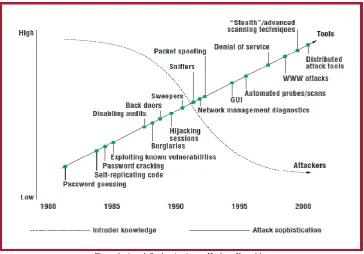
Figure 1:-Attack Sophastication vs Hackers Knowldge
The latest assessment in the security development is Intrusion Prevention Systems (IPS). The invention provides a method and system for monitoring a computer network and determining whether the network faces a threat from users. In the event that the existence of a threat is determined, the system in accordance with the invention provides a real-time assessment of the threat to the network and responds to prevent damage to the network[2]. Intrusion detection technology is immature and should not be considered as a complete defence, we believe it can play a significant role in overall security architecture. If an organization chooses to deploy an IDS, a range of commercial and public domain products are available that offer varying deployment costs and potential to be effective. Because any deployment will incur ongoing operation and maintenance costs, the organization should consider the full IDS life[3].
Narender Kumar Naryal et al,International Journal of Computer Science and Mobile Computing, Vol.3 Issue.8, August- 2014, pg. 18-23
© 2014, IJCSMC All Rights Reserved 20 OSSEC or IPS or the Firewall system approach for the intrusion prevention system.. The research by Weijian Huang et. al(2010)[14] inferred that the current state of workstation security, the security insurance focused around firewalls and encryption innovation is exceptionally imperative and we must create Distributed interruption identification engineering keeping in mind the end goal to enhance the framework's security status. A Multi-Agent-Based Distributed Intrusion detection System can enhance the location precision and discovery speed, and improve the framework's own particular security. The multi-step examination approach they are useful for the and fit to uncover the multistep assaults the movement and the IPS (intrusion Prevention System) alarms.
As work done by Marko Mata et. al.(2012) [15] MGtool naturally makes XML and MSC models for interruption discovery. Furthermore the NIDS (Network Intrusion Detection framework) which screens and break down the activity and make the methods of location with connection to the movement investigation.
As founded by the study of Anne James et. al.(2013) [16] they come to presume that the multi assaults are hard to identify in the high data transmission of system or the activity with the high stream rate on the system. The system movement could be successfully taken care of by an option method called parallel strategy. By and large, to create a security framework you need to use four primary capacities: checking, examining, catching and associating.
TYPES OF NETWORK ATTACKS
Eavesdropping, Password-Based Attacks, Sniffer Attack Compromised-Key Attack, Man-in-the-Middle Attack, Identity Spoofing (IP Address Spoofing) [6-7].
II. METHODOLOGY AND IMPLEMENTATION
The issue was framed or go to our knowledge because of the expanding number of the machine assaults interruptions and expulsions in the system and In system we need to secure our framework from the assaults and also to confirm and ensure the framework from the unapproved access. e.g. Internet within our Local Area Network.
Keriowinroute Firewall 6.7.1 software for observing the system movement arrangement, data transfer capacity limiter, substance sifting, steering table data, administration of the client and gatherings, status of the dynamic hosts, associations, and the logs of the system utilization. We have utilized the kerio firewall as the substitute validation by the points out username and secret key to get to the system or internet. There is issue with the login accreditations
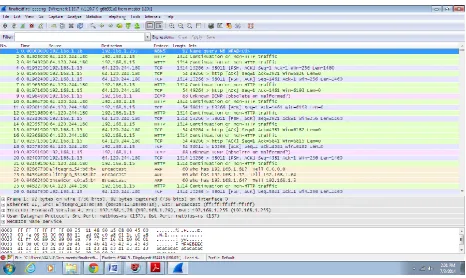
But we have analysed the Sniffer or the eaves dropping attack can be made to the network we have used the World's Most Popular Network Protocol Analyser Version 1.10.7 (v1.10.7-0-g6b931a1 from master-1.10).
© 2014, IJCSMC All Rights Reserved 21
Figure 2:- Wireshark sniffed packets from network
III. RESULTS AND DISCUSSION
We have landed on the results by utilizing these proxy authentication systems that are fundamentally utilized for the security as a part of the workstation systems to stay away from the intrusion and extrusions might be made we know it extremely well But the password confirmation method is not sheltered on the grounds that the password of the login Authentication could be sniffed effortlessly through the wireshark(Network Protocol Analyser and sniffer) convention analysers and it comes in the type of the plain content as shown below.
Narender Kumar Naryal et al,International Journal of Computer Science and Mobile Computing, Vol.3 Issue.8, August- 2014, pg. 18-23
© 2014, IJCSMC All Rights Reserved 22 So from the given realized output we are concluding that the proxy authentication for the user name and the password is not secured way to protect our internal network from intrusions or extrusions within the internal network. It can be sniffed easily and it is the biggest flaw of the network protection using the firewall proxy authentication.
IV. CONCLUSIONS
So from the given acknowledged yield we are inferring that the substitute verification for the client name and the secret password is not secured approach to ensure our inner system from intrusion or extrusion inside the inward network. It could be sniffed effortlessly and it is the greatest imperfection of the system protection. As there is an imperfection in the arrangement of validation like the HTTP (hyper Text Transfer Protocol) that When Post technique was known as the secret word was sniffed inside the packet in the plain content configuration. So there secret word could be effort lessly usable for the others all through everywhere throughout the system. So Https (hyper Text Transfer Protocol Secures) convention organization is ropelled which gives sniffed secret word in the coded structure. There is a future degree for the substitute secret key validation issue or the defect is to make a convention to scramble the Password of the substitute verification certifications. So the secret key sniffed can come in the coded or the scrambled manifestation of content.
ACKNOWLEDGMENT
This research paper is made possible through the help and support from everyone, including: parents, teachers, family, friends, and in essence, all sentient beings. Especially, please allow me to dedicate my acknowledgment of gratitude toward the following significant advisors and contributors: First and foremost, I would like to thank Mrs. Satinderjit Kaur Gill for his most support and encouragement as well as all the other professors who have taught me about my field over the past two years of my pursuit of the master degree.
Finally, I sincerely thank to my parents, family, and friends, who provide the advice and financial support. The product of this research paper would not be possible without all of them.
References
1) J. Allen, A. Christie, W. Fithen, J. McHugh, and J. Pickel, "State of the practice of intrusion detection technologies," DTIC Document, 2000.
2) G. Jackson, "Intrusion prevention system," ed: (Jackson 2001)Google Patents, 2001.
3) J. McHugh, A. Christie, and J. Allen, "The role of intrusion detection systems," Washington Post,pp. 42-51, 2000.
4) W. R. Cheswick, S. M. Bellovin, and A. D. Rubin, Firewalls and Internet security: repelling the wily hacker, Addison-Wesley Longman Publishing Co., Inc. , 2003.
5) J. YANG, H.-j. PU, and Y.-c. ZHANG, "Brief Introduction of Network——Firewall Technology [J],"
Hebei Journal of Industrial Science & Technology, vol. 4, pp. 008, 2003. 6) N. Haller, "The S/KEY one-time password system," 1995.
7) A. Orebaugh, G. Ramirez, and J. Beale, Wire shark & Ethereal network protocol analyzer toolkit, Syngress, 2006.
8) A. Lazarevic, V. Kumar, and J. Srivastava, "Intrusion detection: A survey," in Managing Cyber Threats, ed: Springer, pp. 19-78, 2005.
9) D. J. Ragsdale, C. A. Carver Jr, J. W. Humphries, and U. W. Pooch, "Adaptation techniques for intrusion detection and intrusion response systems," in Systems, Man, and Cybernetics, 2000 IEEE International Conference on, pp. 2344-2349,2000.
© 2014, IJCSMC All Rights Reserved 23 11) A. Siraj, R. B. Vaughn, and S. M. Bridges, "Intrusion sensor data fusion in an intelligent intrusion
detection system architecture," in System Sciences, 2004. Proceedings of the 37th Annual Hawaii International Conference on, pp. 10,2004,.
12) L.-C. Wuu, C.-H. Hung, and S.-F. Chen, "Building intrusion pattern miner for Snort network intrusion detection system," Journal of Systems and Software, vol. 80, pp. 1699-1715, 2007.
13) L. Ying, Z. Yan, and O. Yang-jia, "The design and implementation of host-based intrusion detection system,” Intelligent Information Technology and Security Informatics (IITSI), 2010 Third International Symposium on, pp. 595-598,2010.
14) W. Huang, Y. An, and W. Du, "A Multi-Agent-Based Distributed Intrusion Detection System," In Advanced Computer Theory and Engineering (ICACTE), 2010 3rd International Conference on, pp. V3-141-V3-143,2010.
15) M. Maatta and T. Raty, "Automatic creation of models for network intrusion detection," in Computing,
Communications and Applications Conference (ComComAp), pp. 231-237, 2012.