Western University Western University
Scholarship@Western
Scholarship@Western
Electronic Thesis and Dissertation Repository
9-12-2017 12:00 AM
Women’s Experience of Incivility in Professional Occupations: The
Women’s Experience of Incivility in Professional Occupations: The
Roles of Gender Representation and Occupational Commitment
Roles of Gender Representation and Occupational Commitment
Christina Politis
The University of Western Ontario
Supervisor Dr. John P. Meyer
The University of Western Ontario
Graduate Program in Psychology
A thesis submitted in partial fulfillment of the requirements for the degree in Master of Science © Christina Politis 2017
Follow this and additional works at: https://ir.lib.uwo.ca/etd
Part of the Industrial and Organizational Psychology Commons
Recommended Citation Recommended Citation
Politis, Christina, "Women’s Experience of Incivility in Professional Occupations: The Roles of Gender Representation and Occupational Commitment" (2017). Electronic Thesis and Dissertation Repository. 4952.
https://ir.lib.uwo.ca/etd/4952
Abstract
The aim of the current study was to examine the role of gender representation and occupational
commitment in shaping women’s experiences of workplace incivility, which was compared to
men. Participants included 550 professional employees (45% female) who provided
demographic information about their work units and completed a series of questionnaires
including ones measuring workplace incivility, affective occupational commitment (AOC) and
burnout. The analyses revealed that gender representation in the work unit predicted perceived
overt incivility but not covert incivility or overall incivility for the females in the sample, but not
for males. The predicted indirect effect of gender representation on burnout through incivility
exposure for females was not supported. Opposite from predictions, an exacerbating effect of
occupational commitment on the incivility-burnout relation was found and was stronger for
women than for men. Still, there was a positive main effect of AOC. Theoretical and practical
implications are discussed.
Keywords: Incivility, Selective Incivility, Gender, Women, Occupational Commitment, Burnout,
Dedicated to my Mom and my Yiayia. You are incredible women. You are my pillars of
strength.
Acknowledgments
I would like to thank my supervisor, Dr. John Meyer. This thesis would not have been
possible without you and your uncanny ability to be simultaneously motivating and patient. Your
support and encouragement over these past two years has allowed me to grow personally and
academically and for that I am truly grateful.
Thank you to my defense committee – Dr. Joan Finnegan, Dr. Ann Peng, and Dr. Jennifer
Robertson. Your thoughtful questions and comments made this process exceptionally rewarding.
I’d also like to thank Dr. Natalie Allen and Dr. Richard Goffin who have both been incredible
teachers and mentors, and have played a large role in shaping me as a student of psychology.
Thank you to my I-O family who have kept me on my intellectual toes and gave me
refuge in your offices when I needed it most. A special mention to Jose Espinoza – your
guidance and graciousness have not gone unrecognized and I cannot thank you enough.
To Dr. Sam Paunonen, for being my mentor and friend. You opened my eyes to the world
of research, and made me feel that there is a place for me in it. This accomplishment is a little
sweeter knowing you would have been proud.
And finally, thank you to my family and friends who never let me lose sight of the light
at the end of the tunnel. And to my parents – Roula Politis and Demetre Politis – for always
being supportive in my endeavours and for giving me every opportunity that allowed me to be
Table of Contents
Abstract ... i
Acknowledgments... ii
Table of Contents ... ii
List of Tables ... v
List of Figures ... vi
Table of Appendices ... vii
1. Introduction ... 1
1.1 Selective Incivility as Modern Discrimination ... 1
1.2 The Role of Gender Representation ... 3
1.3 The Role of Occupational Commitment ... 5
2. Method ... 8
2.1 Participants and Procedure ... 8
2.2 Measures ... 8
2.2.1 Pre-Screening Questions. As an additional check that participants read and complied to the necessary qualifications for participation in the study, ... 8
2.2.1 Percentage of Females in the Work Unit. ... 9
2.2.2 Incivility. ... 9
2.2.3 Occupational Commitment ... 10
2.2.4 Burnout ... 10
2.2.5 Demographic Information. ... 11
2.3 Data Cleaning Steps and Descriptive Statistics ... 11
3. Results ... 12
3.1 Test of Hypothesis 1 ... 12
3.2 Test of Hypothesis 2 ... 14
3.3 Test of Hypothesis 3 ... 17
4. Discussion ... 20
4.1 Gender, Gender Representation, and Incivility ... 21
4.2 An Alternative Explanation – Gender Differences in Incivility Perceptions ... 23
4.3 The Exacerbating Effect of Occupational Commitment Across Genders ... 26
5. Conclusion ... 33
References ... 34
Appendix A: MTurk Recruitment Poster ... 43
List of Tables
Table 1: Means, Standard Deviations, Scale Reliabilities and Correlations of Study Variables in Total Sample. ... 15
Table 2: Means, Standard Deviations, Scale Reliabilities and Correlations of Study Variables in Female Sample ... 15
Table 3: Means, Standard Deviations, Scale Reliabilities and Correlations of Study Variables in Male Sample... 15
List of Figures
Figure 1: Unstandardized path coefficients for the mediation model. ... 17
Table of Appendices
Appendix A: MTurk Recruitment Poster ... 44
Appendix B: Letter of Information and Consent Form ... 45
Appendix C: Purposeful Responding Measure ... 47
Appendix D: Pre-Screening Demographic Questionnaire ... 48
Appendix E: Work Unit Demographic Questionnaire ... 49
Appendix F: Workplace Incivility Scale ... 50
Appendix G: Occupational Commitment Scales ... 51
Appendix H: Outcome and Control Measures ... 52
1. Introduction
As the landscape of the Canadian workplace evolves to become more inclusive of women
in traditionally male-dominated occupations, there is a growing need to understand the
experiences of women in these work contexts. Despite society’s notable progress, stereotypes
about the role of women in these job positions prevail in the modern workforce (Hyde, 2007;
Dipboye & Halverson, 2004). Employees who are members of stigmatized groups may be
subject to workplace discrimination – the behavioural manifestation of prejudicial attitudes
(Whitley & Kite, 2006). Scholars have noted how acts of discrimination in the workplace have
evolved from the traditional more overt forms such as the blatant endorsement of pejorative
stereotypes to the modern subtler forms of interpersonal mistreatment such as alienation,
rudeness, and condescension (Deitch et al., 2003; Brief & Barsky, 2000; Jones, Peddie, Gilrane,
King, & Gray, 2016). This shift is largely due to anti-discrimination legislation, organizational
policies and changing social and societal norms that have made blatant discrimination
unacceptable in workplace contexts. Sexist attitudes are more likely to either intentionally or
unintentionally manifest into covert hostile behaviours (Hebl, Foster, Mannix, & Dovidio, 2002).
In addition, these behaviours are often ambiguous in intent – both to the target and to observers –
making it more likely for this form of discrimination to be disguised as generally rude behaviour
(Cortina, 2008). Subtle discriminatory behaviours overlap with behaviours that correspond to the
workplace phenomenon of incivility (Andersson & Pearson, 1999), and thus, under certain
conditions, incivility is beginning to be used as an indicator of subtle discrimination.
1.1Selective Incivility as Modern Discrimination
that “incivility, in some cases, is not ‘general’ at all but instead represents contemporary
manifestations of gender and racial bias in the workplace” (p. 55). Cortina advances a theory of
selective incivility by suggesting that targets of incivility are sometimes chosen systematically
according to their social group membership rather than at random. As mentioned, the behaviours
that are characteristic of incivility overlap with the behaviours that underlie conceptualizations of
subtle workplace discrimination (e.g., disrespectful remarks, interrupting, questioning
competence). These behaviours are described by Andersson and Pearson (1999) as “low intensity
deviant behaviour with ambiguous intent to harm the target, in violation of workplace norms for
mutual respect. Uncivil behaviours are characteristically rude and discourteous, displaying a lack
of regard for others.” (p. 457).
Since Cortina’s (2008) theoretical paper presenting selective incivility as modern
discrimination, scholars have begun to look at workplace incivility through a gender lens (e.g.,
Cortina, Kabat-Farr, Leskinen, Huerta, & Magley, 2013; Settles & O’Connor, 2014; Zurbrügg &
Miner, 2016). Indeed, empirical evidence suggests that women are more likely to be targets of
interpersonal mistreatment than men (Bjorkqvist, Osterman, & Hjelt-Back, 1994; Cortina,
Magley, Williams, & Langhout, 2001; Cortina et al., 2002; Cortina et al., 2013; Settles &
O’Connor, 2014; Zurbrügg & Miner, 2016). Cortina et al. (2013) tested the relation between
gender and incivility as well as the indirect effect of gender on turnover intentions through the
experience of incivility in three different samples: 369 city government employees, 653 law
enforcement agents, and 15,497 members of the U.S. military. Across all samples, women
reported significantly more incivility than men and gender was a significant predictor of turnover
through the experience of incivility. In the military sample, there was a significant interaction
turnover intentions through incivility exposure. The main effect of gender, but not race, was
significant above the moderated mediation effect.
1.2 The Role of Gender Representation
Interestingly, Cortina et al. (2013) also found an unexpected effect of gender composition
on incivility exposure when gender was controlled for in the military sample. This finding
suggested that the more skewed the gender composition of the work group was in favour of men,
the more incivility the employees in that group reported. Because this finding was not
hypothesized, not much theoretical rationale was provided but Cortina et al. proposed that
“demographics of situations, in addition to the demographics of persons, should be considered in
models of incivility risk.” (p.1597). As an answer to this call, the current study will investigate
how gender composition of a work unit relates to incivility exposure and the subsequent
consequences of this experience.
According to relational demography theory, gender dissimilarity – the
individual-within-the-group-level translation of a group’s gender composition – is indirectly related to negative
work outcomes via decreased social integration within the group (Riordan, 2000). In line with
this theory, recent meta-analytic findings provide evidence that gender dissimilarity directly
negatively related to social integration and indirectly negatively related to individual
performance via levels of social integration (Guillaume, Brodbeck, & Riketta, 2012). These
relationships are informed by social identity theory (SIT; Hogg & Terry, 2000) and
social-categorization theory (SCT; Tajfel & Turner, 1979). Individuals make sense of their
environments through categorization of similar others into their in-group and dissimilar others
into their out-group. This phenomenon is further explained by the similarity-attraction paradigm,
that deep-level similarities (e.g., values, personality, attitudes) are often inferred through
demographic similarity (Byrne, 1971). For high-status majority individuals, a strong
establishment of an in-group leads to feelings of superiority over a less established out-group.
This intergroup bias allows individuals to preserve a positive self-image by identifying as
belonging to the “better” group, but it leads to increased stereotypes of the out-group and a
decreased desire to integrate these perceived dissimilar others into the in-group. Intergroup
biases, whether implicit or explicit, may behaviourally manifest as workplace incivility towards
the out-group (Cortina, 2008). These effects may be compounded by the fact that the positions
where women are most underrepresented (e.g., STEM, upper-management) are the ones where
gender stereotypes continue to persist (Hyde, 2007; Moss-Racusin, Dovidio, Brescoll, Graham &
Handelsman, 2012; Whitley & Kite, 2006).
Empirical research on relational demography theory has investigated several
psychological mediators of the dissimilarity-outcome relationships in line with SIT and SCT
(e.g., uncertainty reduction, social integration, status enhancement; Guillaume, Dawson,
Otaye-Ebede, Woods, & West, 2015). Studies examining potential behavioural mediators are less
common.In the current study, I will investigate how the percentage of women in a work unit
relates to women’s experience of uncivil behaviours and subsequent burnout within the work
units. Burnout is chosen as the outcome measure of choice because it is a common measure that
reflects the experience of work-related strain in response to work stressors (e.g., Schaufeli &
Bakker, 2004; Demerouti, Bakker, Nachreiner, & Schaufeli, 2001) and has robust associations
with turnover, job performance and health outcomes (Alarcon, 2011; Bakker, Demetrouti, &
Based on the logic that a smaller representation of females in a job position is
synonymous with more males in that position and thus a more established male in-group and
likelihood for intergroup biases that may manifest into selective incivility, I propose the
following hypothesis.
Hypothesis 1: There will be a negative relation between gender representation and
incivility for women such that the less they are represented in their work units, the more
incivility they will report.
Based on the argument that a greater exposure to uncivil treatment will be a source of stress and
the empirical and meta-analytic findings that workplace bullying is related to the experience of
burnout (e.g., Nielsen & Einarsen, 2012), I also propose the following mediation hypothesis.
Hypothesis 2: There will be a negative indirect relation between gender representation
and burnout for women, via a greater frequency of experienced incivility.
1.3 The Role of Occupational Commitment
As previously noted, the negative psychological experience of being a target of selective
incivility at work is a type of work stressor and, as such, it is associated with elevated levels of
strain (e.g., burnout; Jones et al., 2016). This relationship is contingent on levels of other
work-related variables, which may either buffer or exacerbate the negative effects of work stressors.
For example, organizational commitment has been proposed as a moderating variable that may
function in either of two ways (Meyer & Maltin, 2010). One perspective is that highly committed
employees are more sensitive to negative events because of their heightened level of investment
and identification with the organization (Mathieu & Zajac, 1990). Individuals who are more
affectively committed to their organization are more likely to want to perform well in that
event will be more threatening for a highly committed employee than for an uncommitted
employee and this is most likely to be the case when the individual attributes the source of stress
to the organization. In this perspective, organizational commitment is an intensifier that makes
individuals more receptive to the ramifications of work stressors.
The alternative perspective is that highly committed employees will use affective
organizational commitment as a psychological resource (Kobasa, 1982). Meyer and Herscovitch
(2001) describe affective organizational commitment as a stabilizing and binding force of an
employee to an organization. In this view, organizational commitment serves a buffering
function by allowing highly committed employees to rely on this stabilizing force as a
psychological safeguard. These competing perspectives can be extended to another form of
commitment – commitment to the occupation. Affective occupational commitment is an
individual’s desire to remain in their occupation, and their identification with that occupation
(Meyer, Allen, & Smith, 1993). In the context of this study, what is particularly relevant is how
the experiences of women in male-dominated work contexts who are targets of incivility are
shaped by their affinity for and identification with their occupation. The identification of these
moderating variables is imperative in order to understand the conditions under which selective
uncivil treatment is more or less detrimental. More specifically, this study seeks to answer the
question: does a strong commitment to the occupation (a) act as a resource to help to buffer the
negative effects of selective incivility or (b) make the target more sensitive to acts of
interpersonal mistreatment from colleagues therefore amplifying negative effects? In their review
of the literature, Meyer and Maltin (2010) note that empirical investigations of the moderating
role of organizational commitment have yielded inconsistent results. They conclude that, despite
affective organizational commitment on the work stressor-strain relation (e.g., Begley & Czajka,
1993; Mowday, Steers, & Porter, 1979; Donald & Siu, 2001; Schmidt, 2007).
The limited studies that have investigated the moderating role of occupational
commitment have also found mixed results. Some research has found that occupational
commitment buffers the effect of job demands on emotional exhaustion (Nesje, 2017) as well as
the effect of job stress on outcomes such as job performance, turnover intentions, and
absenteeism (Jamal, 2014). Yet other studies have found that occupational commitment
intensifies the relation between job stressors and emotional exhaustion (Reilly, 1994) as well as
the relation between burnout and job satisfaction (Teng, Shyu, & Chang, 2007). The two latter
studies found that, in addition to a moderating effect on the relation between stressors and strain,
occupational commitment had a positive main effect on strain.
Because of the inconsistent nature of empirical investigations that test these competing
predictions (exacerbating effect of commitment vs. buffering effect of commitment), both are
mentioned here. However, based on the larger body of empirical support for the buffering role of
organizational commitment, and expanding these predictions to commitment to the occupation,
based on Meyer and Herscovitch’s (2001) argument that there is a core essence of commitment
that can be applied to multiple foci, I propose the following moderation hypothesis.
Hypothesis 3: Occupational commitment will buffer adverse experience of uncivil
treatment, such that women in male-dominated positions who report experiencing incivility will
report lower levels of burnout the more highly committed they are to their occupation
2. Method
2.1 Participants and Procedure
A total of 593 employed individuals were recruited using Amazon’s Mechanical Turk
(MTurk) to complete an online survey regarding work opinions and attitudes. Participants were
required to work at a single organization full-time (outside of MTurk) in order to participate in
the study. The recruitment poster used to advertise the study on the MTurk platform is included
in Appendix A. Interested participants were provided a letter of information and consent form
(See Appendix B). Participants qualified for the study if they worked full-time in a professional
occupation (i.e., belonged to a professional association and/or was regulated by a professional
body). They were told that their responses in the survey are both anonymous and confidential.
Consenting participants received some general instructions and were asked to complete a variety
of questionnaires that assessed their work-related experiences and attitudes and demographic
information of themselves and their work units. Once the questionnaires were completed,
participants rated the level of effort they exerted while answering the aforementioned
questionnaires and were asked whether or not their data should be used in analysis (See
Appendix C) in an attempt to identify careless responders. Participants were compensated
$1USD for their time.
2.2 Measures
2.2.1 Pre-Screening Questions. As an additional check that participants read and
complied with the necessary qualifications for participation in the study, two pre-screening
questions (see Appendix D) were included prior to the commencement of the focal study: (1)
what is your employment status? (Full-time, part-time, temporary/seasonal, self-employed,
regulated by a professional body (accounting, law, medicine, etc.) and/or has a professional
association? (graphic design, human resource, surveyor, etc)? (Yes, No). Individuals who did not
answer "full-time" to question 1 and "yes" to question 2 did not qualify to complete the study and
were directed to the end of the survey. Three hundred and forty-two individuals did not meet
these criteria and were filtered out of the study. The screening questions were embedded within
two other employment-related questions that were irrelevant to the screening criteria in order to
make the desired answers to the questions more ambiguous, thus minimizing deception.
2.2.1 Gender Representation in the Work Unit. Participants were asked to provide
information regarding the demographic composition of their work unit (see Appendix E). To
ensure that conceptualizations of the work unit were consistent across participants, an
operational definition of work unit was provided prior to their responses. The definition provided
read: “Your work unit consists of the group of individuals whom you interact with at work and
who have a similar job role as you.” Gender composition of the work unit was measured using
the item, “In your work unit, approximately what percentage are females?” and used a
fill-in-the-blank response format. Items assessing work unit composition in terms of race and age as well as
the size of the work unit were also included.
2.2.2 Incivility. Incivility was measured using the adapted Workplace Incivility Scale
(WIS; Cortina et al., 2013; See Appendix F). Items on this measure are designed to assess the
frequency that an individual experienced uncivil behaviours from coworkers or supervisors over
the last year at work. Uncivil behaviours in this measure included “Addressed you in
unprofessional terms, either publicly or privately” and “Accused you of incompetence” and
responses to each item were measured on a 5-point scale: never, once or twice, sometimes, often,
2.2.3 Occupational Commitment. Occupational commitment was assessed using Meyer
et al.’s (1993; see Appendix G) Occupational Commitment Scales. Items on this scale measure
three facets of occupational commitment: affective occupational commitment, normative
occupational commitment, and continuance occupational commitment. Affective commitment
reflects an individual’s desire to remain in an occupation and their identification with that
occupation. Normative commitment reflects an individual’s sense of obligation to remain in their
occupation. Continuance commitment reflects and individual who feel like the costs of leaving
their occupation outweigh the costs of staying. The three components of commitment are
theoretically distinct from one another and differentially predict outcomes. For this reason, only
the affective occupational commitment (henceforth, AOC) scale is of interest in the current
study. Items on this occupational commitment scale were kept general (i.e., they do not reference
any specific occupation) in order for participants to make ratings based off their own occupation.
For example, an item written as “Nursing is important to my self-image” was changed to “My
occupation is important to my self-image” and was responded to on a 7-point Likert scale (1 =
Strongly Disagree to 7 = Strongly Agree). Immediately prior to completing this scale,
participants were primed to think about their occupation by typing it into a provided textbox.
2.2.4 Burnout. Burnout was assessed using the Olderburg Burnout Measure (Demerouti,
Mostert, & Bakker, 2010). This scale measures two facets of burnout, namely, emotional
exhaustion and disengagement. Psychometric assessments of this scale provide empirical support
for this assertion (Bakker & Demerouti, 2008). Responses were measured on a 4-point Likert
scale (1 = Strongly Disagree to 4 = Strongly Agree) with no neutral midpoint.
The burnout measure was included with a battery of six other measures included for
Model of Organizational Commitment Scales (Meyer, Allen, & Smith, 1993), The
Organizational and Occupational Turnover Intentions Scales (Becker & Billings, 1993), Job
Satisfaction (Judge & Klinger, 2008), and Organizational and Occupational Mobility.
Organizational and Occupational Mobility scales were created for the purposes of this study
were measured using the respective items “If necessary, it would be easy for me to find a
comparable job in another organization” and “If necessary, it would be easy for me to change
occupations”.
2.2.5 Demographic Information. Demographic information (e.g., age, gender, language
proficiency, see Appendix I) was collected from the participants.
2.3 Data Cleaning Steps and Descriptive Statistics
Out of the 593 participants that completed the survey, 43 were excluded from analyses for
not meeting pre-established data cleaning criteria. Of those excluded, 14 were removed for
indicating on the purposeful responding measure that either their data should not be used or that
they put forth less than ‘quite a lot’ of effort. Twenty participants were removed because they
took less than 3.5 minutes to complete the survey, which was a natural cutoff point in the sample
distribution. Data for three participants were removed because they did not identify as either
male or female. Finally, data from six participants were removed because their responses for
their work unit size were either below two or outliers in the distribution (i.e., greater than 500).
After data cleaning, the final count of participants remaining was 550 (Males = 299, Females =
251). Participant ages ranged from 20 to 80 with an average of 37 for the females, and 20 to 64
with an average of 35 for the males. Thirty-six was the average age for the overall sample.
Means, standard deviations, scale reliabilities and correlations among study variables for
and 3 respectively. All predictor variables were centered around their grand means prior to
performing any further analyses. Gender was coded as males = 0 and females = 1.
3. Results
3.1 Test of Hypothesis 1
Hypothesis 1 stated that women who are less represented in their work context are more
likely to report experiences of incivility. This hypothesis was tested using a regression analysis
where incivility was regressed on percentage of women in the work unit for the female-only
sample. The regression analysis revealed that percentage of women in the work unit was not a
significant predictor of overall incivility, Adjusted R2 = .011, F(1, 236) = 3.549, β = -.003, p =
.061.
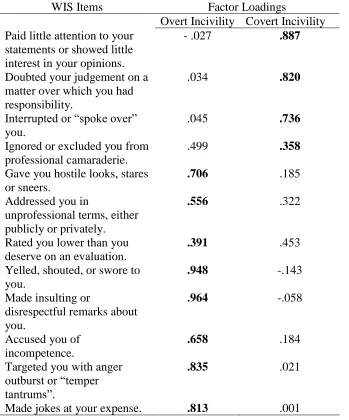
For exploratory purposes, I split overall incivility into subtle and overt incivility as per the
findings of Cortina, Lonsway, and Magley (as cited in Cortina, 2008) and Tarraf (2012). An
exploratory factor analysis provided revealed a two-factor structure (see Table 4). Items
generally loaded more highly on their respective dimensions, with the exception of two items
(one on the overt incivility subscale and one on the covert incivility subscale) that loaded
relatively equally on both scales. Percentage of women in the work unit was not a predictor of
covert incivility, adjusted R2 = .000, F(1, 244) = 1.043, β = -.002, p = .308, however, it was a
significant predictor of overt incivility, adjusted R2 = .014, F(1, 237) = 4.371, β = -.003, p = .038.
Including age as a covariate did not affect the statistical significance of these results. In partial
support of Hypothesis 1, greater representation of females in the work unit was related to lower
levels of experienced overt incivility in the female sample.
To test the conjecture that gender representation predicts incivility for females but not for
in the work unit was not a significant predictor of overall incivility, Adjusted R2 = -.003, F(1,
287) = .213, β = .001, p = .625, covert incivility, Adjusted R2 = -.003, F(1, 287) = .172, β = .001,
p = .678, or overt incivility, Adjusted R2 = -.003, F(1, 293) = .133, β = .001, p = .716 in the male
sample. To test a possibility of reverse causality (i.e., gender representation is significantly
related to overt incivility for women but not for men because women are more likely than men to
leave their work unit due to uncivil treatment), a moderation analysis was conducted on the
effect of overt incivility and turnover intentions as a function of gender. A significant interaction
such that the relation between overt incivility and turnover intentions is stronger for females than
for males would have been evidence of an alternative causal explanation for Hypothesis 1, but no
such moderating was found, R2 change due to interaction = .0023, F(1, 524) = 1.625, p = .203.
Hypothesis 1 concerned experiences of incivility as a function of gender representation in
a work unit, specifically for women. For this reason, the prediction that gender representation
would negatively predict experienced incivility was tested using only the females in the sample. I
preformed the same analyses on the male sample to compare groups and it was found that
percentage of females was a significant predictor of incivility for the female sample but not the
male sample. However, to test whether the relation between percentage of females and reported
overt incivility was stronger for females than males, a moderation analysis was conducted.
The moderation analysis was not significant, R2 change due to interaction = .002, F(1, 536)
=.984, p = .322. Thus, although percentage of females was a statistically significant predictor of
overt incivility for the female sample but not the male sample, it cannot be concluded that there
is a statistical difference in the strength of the percentage of females-incivility relation between
the groups.
conducted to determine whether there were gender differences in the frequency of uncivil
treatment. Prior to the main analyses, a Levene’s test for equality of variances was conducted
and revealed that homogeneity of variance could not be assumed between genders for overall
incivility, F(1, 532) = 7.787, p = .005, nor for covert incivility, F(1, 532) = 7.322, p = .007.
Thus, results for these outcomes should be interpreted with caution. The analysis revealed
significant gender differences in the frequency of experienced overall incivility such that males
(M = 1.576, SD = .753) reported more overall uncivil treatment than females (M = 1.439, SD =
.650), t(531) = 2.25, p = .025. Gender differences were also found in the frequency of
experienced covert incivility such that males (M = 1.460, SD = .752) reported more covert
uncivil treatment than females (M = 1.329, SD = .647), t(531) = 2.165, p = .031. There were no
gender differences between males and females in the amount of overt uncivil treatment reported,
t(546) = 1.770, p = .077.
3.2 Test of Hypothesis 2
Hypothesis 2 proposed a mediation model, such that a greater percentage of women in
the work unit predicts reduced burnout through the reduced level of incivility experienced. This
hypothesis was tested in SPSS’s PROCESS (Hayes, 2013) using a 5000-iteration bootstrap
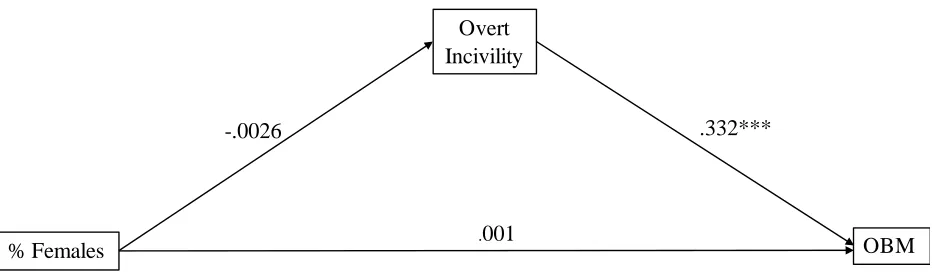
approach. An illustration of the mediation model for the female sample with unstandardized path
coefficients is presented in Figure 1. The indirect effect of percentage of females in the work unit
on burnout through overt incivility was -.000 and was not statistically significant, 95% CIs
[-.002, .000], and thus Hypothesis 2 was not supported. The direct link between percentage of
women in the work unit and overt incivility was not statistically significant in the mediation
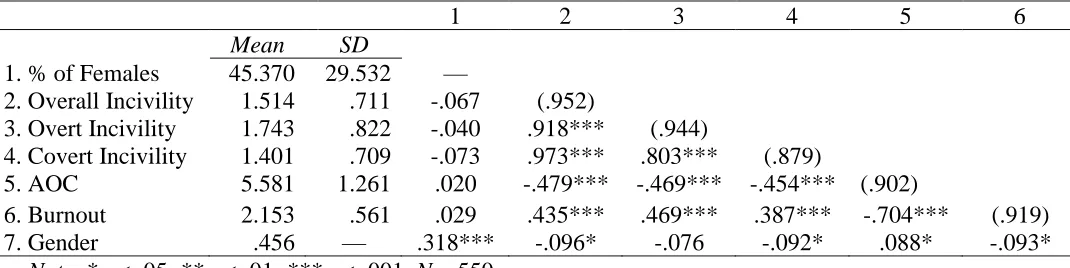
Table 1
Means, Standard Deviations, Scale Reliabilities and Correlations of Study Variables in Total
Sample.
Note. *p < .05, **p < .01, ***p < .001. N = 550.
Table 2
Means, Standard Deviations, Scale Reliabilities and Correlations of Study Variables in Female
Sample.
Note. *p < .05, **p < .01, ***p < .001. N = 251.
Table 3
Means, Standard Deviations, Scale Reliabilities and Correlations of Study Variables in Male
Sample.
Note. *p < .05, **p < .01, ***p < .001. N = 249
1 2 3 4 5 6
Mean SD
1. % of Females 45.370 29.532 —
2. Overall Incivility 1.514 .711 -.067 (.952)
3. Overt Incivility 1.743 .822 -.040 .918*** (.944)
4. Covert Incivility 1.401 .709 -.073 .973*** .803*** (.879)
5. AOC 5.581 1.261 .020 -.479*** -.469*** -.454*** (.902)
6. Burnout 2.153 .561 .029 .435*** .469*** .387*** -.704*** (.919)
7. Gender .456 — .318*** -.096* -.076 -.092* .088* -.093*
1 2 3 4 5 6
Mean SD
1. % of Females 55.61 29.497 —
2. Overall Incivility 1.439 .650 -.122 (.950)
3. Overt Incivility 1.675 .640 -.135* .984*** (.943)
4. Covert Incivility 1.329 .768 -.065 .916*** .849*** (.874)
5. AOC 5.700 1.238 .053 -.433*** -.407*** -.467*** (.894)
6. Burnout 2.095 .586 .035 .407*** .360*** .481*** -.705** (.928)
1 2 3 4 5 6
Mean SD
1. % of Females 36.76 26.722 —
2. Overall Incivility 1.576 .753 .027 (.952)
3. Overt Incivility 1.800 .862 .021 .918*** (.944)
4. Covert Incivility 1.460 .751 .024 .974*** .804*** (.881)
5. AOC 5.480 1.254 -.066 -.504*** -.466*** -.490*** (.907)
Table 4
Exploratory Factor Analysis Results of the Workplace Incivility Scale.
WIS Items Factor Loadings
Overt Incivility Covert Incivility Paid little attention to your
statements or showed little interest in your opinions.
- .027 .887
Doubted your judgement on a matter over which you had responsibility.
.034 .820
Interrupted or “spoke over” you.
.045 .736
Ignored or excluded you from professional camaraderie.
.499 .358
Gave you hostile looks, stares or sneers.
.706 .185
Addressed you in
unprofessional terms, either publicly or privately.
.556 .322
Rated you lower than you deserve on an evaluation.
.391 .453
Yelled, shouted, or swore to you.
.948 -.143
Made insulting or
disrespectful remarks about you.
.964 -.058
Accused you of incompetence.
.658 .184
Targeted you with anger outburst or “temper tantrums”.
.835 .021
Figure 1. Unstandardized path coefficients for the mediation model of the female sample.
3.3 Test of Hypothesis 3
Hypothesis 3 proposed a moderated mediation such that affective occupational
commitment buffers the adverse effect of uncivil treatment and consequently reduces the indirect
effect proposed in Hypothesis 2. Because Hypothesis 2 was not supported, the mediation was not
included in the moderation analysis. Instead, the moderating role of affective organizational
commitment on the relation between incivility and burnout was tested using PROCESS.
Although I found differences between the incivility subscales in the previous analyses,
Hypothesis 3 was tested using an overall incivility score to align with the original hypothesis.
First, because gender representation was not included in the model, the moderation was
tested using the total sample (i.e., both males and females). Taken together, the predictors
accounted for a significant proportion of the variance, R2 = .526, F(3, 498) = 184.182, p = .000.
AOC was a significant predictor of burnout, b = -.284, t(498) = -18.360, p = .000. Overall
incivility was a significantpredictor of burnout, b = .186, t(498) = 5.400, p = .000. Finally, the
interaction term was created automatically by the PROCESS macro using centered predictor
variables and significantly predicted burnout, b = .078, t(498) = 4.124, p = .000. The interaction
term accounted for an additional 1.62% of the variance above and beyond the individual
% Females OBM
Overt Incivility
.001
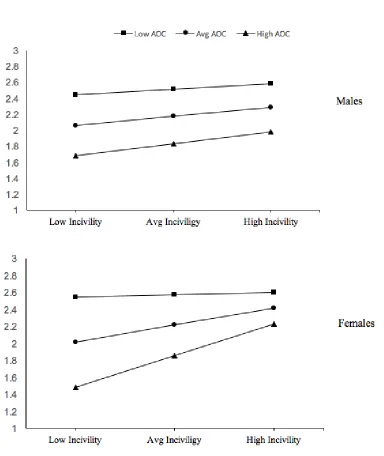
A simple slopes analysis was conducted to determine the nature of the interaction effect.
The slopes for incivility predicting burnout at three levels of AOC were tested. The three levels
for AOC are 1 SD below the mean, the mean, and 1 SD above the mean. For low, average, and
high AOC, incivility b = .088, t(498) = 3.172, p = .002; b = .185, t(498) = 5.402, p = .000, and b
= .285, t(498) = 5.436, p = .000, respectively. Thus, the relation between incivility and burnout
becomes stronger as the level of AOC increases but was significant at all levels of AOC.
To investigate whether the moderating effect upholds when incivility is broken down into
covert and overt incivility, the same analysis was conducted with both of these types of incivility
as predictors. These findings paralleled the moderating effect observed for overall incivility; that
is, AOC exacerbated both the relation between overt incivility and burnout, b= .041, t(509) =
2.844, p = .005, and the relation between covert incivility and burnout, b = .084, t(498) = 4.099,
p = .000.
Next, a three-way interaction with gender as an additional moderator was conducted to
test whether combining the genders for the aforementioned moderation model was justified. This
overall model was statistically significant, R2 = .536, F(7,494) = 81.538, p = .000. Interestingly,
a three-way interaction between incivility, AOC and gender significantly predicted burnout, b =
.149, t(494) = 3.161, p = .002. The three-way interaction accounted for an additional .9% (p =
.002) of the variance above the individual predictors and the two-way interactions. A simple
slopes analysis revealed that the moderating effect of AOC was stronger for females, b= .194,
t(498) = 4.619, p = .000, than for males, b= .048, t(498) = 2.071, p = .039. These findings
remained when age and occupational mobility were included as covariates, indicating that
were statistically significant. An illustration of the three-way interaction can be found inFigure
2.
4. Discussion
The aim of the current study was two-fold. First, I sought to understand the influence of
gender representation on women’s experience of incivility at work. Second, I examined whether
affective commitment to one’s occupation buffers the negative consequences of uncivil
treatment. In line with selective incivility theory and relational demography perspectives, I
proposed that there would be a negative relation between gender representation and women’s
experience of incivility (Hypothesis 1) and that incivility would mediate the relation between
gender representation and burnout (Hypothesis 2). I also predicted a buffering effect of AOC on
the negative consequences of incivility (Hypothesis 3). Although females were the target sample
for testing the predictions, data were collected from both males and females in order to make
comparisons across genders.
There is some literature to suggest that the WIS may have two dimensions – overt incivility
and covert incivility (Cortina, 2013; Tarraf, 2012). Overt uncivil behaviours are easily
recognizable as rude or offensive (e.g., making insulting or disrespectful remarks) and covert
uncivil behaviours are subtler forms of disrespect (e.g., interrupting; Tarraf, 2012). Although
overt incivility is more aggressive in its nature, incivility in general is ambiguous in its intent and
therefore both overt and covert incivility are considered to be modern forms of discrimination
when systematically targeted at females and minorities (Cortina, 2008).
Still, there is some research to suggest that certain types of uncivil behaviours may be more
likely to be manifestations of contemporary sexism than others. Cortina et al., (2004) found that,
contrary to the findings in the current study, women reported more frequent experience of
incivility than men when the incivility was covert rather than overt. The authors suggested that
attitudes. They state that covert uncivil behaviours that are targeted selectively towards women
stem from implicitgender stereotypes and they are harder to confidently attribute to the
perpetrator’s prejudice, thereby allowing the perpetrator to maintain a non-prejudiced self-image
and social standing. For exploratory purposes, the relevant hypotheses were tested separately
with these two dimensions. My post hoc prediction was that covert incivility would have a
stronger relation with gender representation than overt incivility.
4.1 Gender, Gender Representation, and Incivility
The analyses revealed women who were less represented in their work context reported
experiencing more incivility but only when the uncivil behaviours were overt rather than covert
or overall. These findings provided partial support for Hypothesis 1 but were conflicting with the
post hoc prediction that gender representation would have a stronger relation with covert
incivility than with overt incivility. Because the empirical research on the dimensionality of the
WIS is relatively scarce, it cannot be said with confidence that these findings contradict
established theory. Men did not differ in their experience of overt, covert, or overall incivility as
a function of the representation of men in their work unit.
It is also interesting to note that in this sample, males reported a greater frequency of uncivil
treatment than females which is inconsistent with the findings of previous research (e.g.,
Bjorkqvist et al., 1994; Cortina et al., 2001; Cortina et al., 2002; Cortina et al., 2013; Settles &
O’Connor, 2014; Zurbrügg & Miner, 2016). However, this finding is not necessarily in conflict
with selective incivility theory. The intention of the current study was to investigate whether
gender representation predicts the uncivil treatment of professional women; it was not designed
to be a test of gender differences in uncivil treatment. A key difference between this study and
variety of professional occupations with a range of demographic makeups. In other words, it was
not solely a sample of females who worked in male-dominated occupations or other occupations
where gender roles and stereotyping are most likely to be salient – a condition that would foster
modern discrimination (Fiske & Lee, 2008; Whitley & Kite, 2006).
The partial support for Hypothesis 1 has some implications for relational demography
theory. Indeed, the current study provides some evidence for the notion that demographic
dissimilarity (i.e., gender dissimilarity) from a work group has consequences for the individual’s
experiences within those work groups. The current findings contribute to the small subset of
studies that examine the effects of demographic dissimilarity on the treatment of the individual
within the group rather than the individual’s own behaviours or cognitive processes. This study
also provided evidence to suggest that status matters – being a female in a male-dominated group
may subject you to more interpersonal mistreatment (i.e., overt incivility). However, this effect
was not found for males in female-dominated work groups. This finding is consistent with the
social categorization perspective that being a part of a more highly established in-group may
facilitate more negative attitudes towards the outgroup and this is especially true when the
context makes the categorization more salient (i.e., women in traditionally male occupations;
Tajfel & Turner, 1979; Rydell, McConnell, & Beilock, 2009).
Hypothesis 2 was not supported – there was no indirect effect of gender representation on
burnout through the experience of incivility in the female sample. Furthermore, the direct effect
of gender representation on overt incivility was no longer statistically significant when it was
included in a mediation model. This is likely due to additional parameters needed to estimate the
mediation model but does cause some uncertainty as to the strength of the effect of gender
lack of existing studies that have examined this relation, it cannot be concluded that gender
representation predicts burnout in the female sample either directly or indirectly through
incivility.
4.2 An Alternative Explanation – Gender Differences in Incivility Perceptions
The theoretical implications stated in the previous section are based on the presumption that a
significant relation between gender representation and reported overt incivility for women (but
not men) implies that in male-dominated work units, women, but not men, are more likely to be
targets of incivility the more their work units skew towards “all men”. However, there is an
alternative explanation to be considered – male-dominated contexts may facilitate more incivility
in general, and women are more attuned to this incivility. Therefore, the differential
predictability of gender representation for reported incivility across men and women may not
reflect true differences in uncivil treatment between the genders, but rather, gender differences in
the propensity to report uncivil treatment.
There is some evidence to suggest that men and women perceive incivility and related forms
of interpersonal mistreatment in different ways. Young, Vance, and Ensher (2003) explored
gender differences in sensitivity to disempowering acts in a sample of graduate students.
Disempowering acts are ones that demean or belittle a person, are hostile and intimidating in
nature, and are not necessarily enacted out of malicious intent. In these ways, disempowerment is
akin to incivility. Young and colleagues presented participants with a series of video segments
that illustrated actual footage of a target (either male or female) being subject to
disempowerment while giving testimonies for the U.S. Senate. After each segment, participants
were asked to rate the level of offensiveness they perceived in the video on a 7-point Likert
more offensive than did men, irrespective of the target gender. Similarly, Montgomery, Kane,
and Vance (2004) used the same video segments and found that females were more likely than
males to report the Senators’ behaviour as inappropriate.
These findings become more complicated when other factors such as social context and type
of outcomes are taken into consideration. For example, Young, Vance, and Harris (2007) used a
similar experimental paradigm to the studies discussed above and found that social context with
regards to race played an important role in determining who would be most likely to report
behaviours as offensive. The authors found that in contexts where African-Americans were the
numerical majority and the target was an African-American female, men were more likely than
women to rate disempowering behaviours as offensive, a finding that contradicted prediction.
Miner and Cortina (2016) asked a sample of males and females to rate the frequency with
which they observed incivility towards female employees in their workplace over the past year,
and tested the prediction that women would rate this incivility as more unjust and suffer greater
psychological consequences as an observer than men. Contrary to these predictions, men
reported greater injustice as a function of observed incivility towards female coworkers than
women. There was also a stronger indirect effect of observed incivility towards females on job
satisfaction, organizational trust, and turnover intentions through injustice perceptions for male
observers than for female observers. Miner and Eischeid (2012) examined the roles of both target
and observer gender on the relation between observed incivility and negative emotions. The
researchers found that negative emotions were stronger when the target was the same gender as
the observer. Conflicting with their hypothesis, men who observed same-gender incivility
towards coworkers reported greater negative emotions (i.e., anger, fear, and anxiety) than women
that men may perceive a threat to the status and power of their group when observing
same-gender incivility and members of high-status groups are more motivated to maintain their status
(Berdahl, 2007). In contrast, women reported more feelings of demoralization with greater
frequency of observed incivility toward same-gender coworkers, but this relation was not found
for men.
The aforementioned studies provide evidence to suggest that men and women differ in their
appraisals of observed uncivil treatment, however, the nature of this relationship is complicated
and depends on a variety of factors such as the social context, the gender of the target, and the
outcomes of interest. In addition, all of these studies explore the cognitive and affective
responses that proceed the observation of uncivil treatment towards others. There is no empirical
evidence to my knowledge that has explored gender differences in victims’ propensity to report
uncivil treatment. It is unclear whether gender differences would emerge in appraisals of
experienced incivility, but because the WIS is a frequency measure with rather specific
behaviours, the appraisal of the event (i.e., if it was hostile or not) should ideally be unrelated to
scores. However, there is evidence to suggest that emotion and recall are often intertwined, such
that when an event triggers a strong emotional response in the moment, it is more likely to be
recalled at a later date (e.g., Bisby, Horner, Hørlyck, & Burgess, 2016); thus, if there are in fact
generalizable gender differences in appraisals of experienced incivility this could affect the
frequency responses. It is also worthy to reiterate here the finding that males reported more
incivility than females in the current sample overall. Thus, although the alternative explanation
that women have a greater sensitivity than men to uncivil treatment cannot be ruled out entirely,
there is little existing evidence to support this notion. Still, it should be noted when considering
4.3 The Exacerbating Effect of Occupational Commitment across Genders
Due to the lack of a significant mediation found in the previous analysis, I tested a simple
moderation model rather than the moderated mediation model originally proposed in Hypothesis
3. Hypothesis 3 was not supported – a moderating effect of AOC was found, but in the opposite
direction than what was predicted. I originally tested the moderating role of AOC on the
incivility-burnout relation for the total sample (both males and females) and found that there was
a significant interaction such that the greater the level of commitment the individual had to their
occupation, the greater the burnout they experienced as a result of uncivil treatment from
colleagues and supervisors. This result was in contrast with expectations and previous empirical
findings that have generally found support for the buffering effect of commitment on the
stressor-strain relation (e.g., Schmidt, 2007; Schmidt & Diestal, 2012; Setti, Lourel, &
Argentero, 2016) but aligned with research that found exacerbating effects of commitment. It is
important to note that this effect was not a true exacerbating effect because the burnout resulting
as a consequence of experienced incivility for employees with high AOC did not exceed the
burnout experienced from the same level of incivility for employees with low AOC. Rather, the
effect was what Meyer and Maltin (2010) describe as a pseudo-exacerbating effect; that is, there
was a positive effect of AOC at low levels of the stressor and at high levels of the stressor, those
with high and low levels of AOC experience the same amount of stress. Meyer and Maltin note
that two of the four studies in their review that reported an exacerbating effect of commitment
actually found a pseudo-exacerbating effect.
The most notable distinction between the current study and previous studies is that
occupational commitment, as opposed to organizational commitment, was the moderator of
binding force that ties an individual to some target (Meyer & Herscovitch, 2001), but perhaps the
target could be a particularly important distinction in this case. An individual may feel some
agency and choice with regards to the organization at which they work and there are often
alternative organizations with similar job roles that the individual can consider. However,
choosing to leave one’s occupation requires more thoughtful consideration. Indeed, research on
occupational turnover has found that leaving the occupation is seen as costlier and more difficult
than leaving the organization, for reasons such as the need for additional education or training, as
well as loss of professional connections, status within the occupation, and the education and/or
training that was invested up until that point (Blau, 2000; Blau et al., 2009). Furthermore, the
“occupation” is perceived as being highly interconnected with the “self” and informs how
individuals see themselves and present themselves to the world (van Maanen & Barley, 1984).
The few existing studies that have investigated the moderating role of occupational
commitment on the relation between workplace stressors and work-related outcomes such as job
satisfaction, emotional exhaustion, and turnover intentions have found mixed results (Nesje,
2017, Jamal, 2014, Reilly, 1994, Teng, Shyu, & Chang, 2007), so it is important to consider the
idiosyncratic features of the current study that could have fostered the pseudo-exacerbating
influence of occupational commitment. First, the type of stressor should be carefully considered.
Out of the four studies that examined the moderating role of occupational commitment, none
used an interpersonal mistreatment measure as the predictor (i.e., stressor) variable. The view
that commitment is a “protective resource” that safeguards an individual from adverse work
experiences may not hold when the adverse experiencing is relational in its nature and is thereby
threatening the very sense of security and belongingness that commitment provides (Schmidt &
to be employed in an occupation that is regulated by a professional body and/or has a
professional association. These types of professions often provide opportunities to be a part of
professional development networks, social clubs, and may contribute to a greater feeling of
personal connection with the occupation.
If one accepts the premise that the exacerbating effect of occupational commitment stems
from the victim perceiving the uncivil treatment to be threatening to their occupational
belongingness, then it follows that this effect should be even stronger if they believe that the
incivility is a product of their occupation’s culture, is likely to persist, and selectively targets
them for some systematic reason. This logic could help to explain the fact that gender emerged
as a moderator of the exacerbating effect of AOC on the relation between incivility and burnout
such that the exacerbating effect was stronger for women than for men. According to the
selective incivility perspective, men can more easily attribute the cause of their victimization to
factors unrelated to themselves (i.e., general perpetrator rudeness). Men may not see the
incivility as threatening to their occupational identity if they do not feel like they are being
selectively targeted. However, women may view incivility as a product of a general attitude
towards women in the occupation, rather than the product of one or two individuals’ rude
demeanors. This selective targeting based on gender can be perceived as having implications that
extend beyond just negative day-to-day work experiences to impediments on professional
advancement and success. This could explain why a stronger commitment to one’s profession is
related to more negative psychological consequences of incivility, particularly for women.
4.4 Limitations and Future Directions
The present study is not without its limitations, and thus there are many avenues for future
rationalization provided was post-hoc and therefore only thoughtful speculation as to the
theoretical underpinnings of the findings could be made. Inductive methods are useful for
answering questions that are derived from curiosity rather than established theory, but
theory-building processes should follow from statistical findings (Locke, 2007).Rigorous theory-driven
research is needed to uncover the phenomena that underlie the exploratory effects found in this
study. In particular, it would be interesting for future studies to more closely examine the
three-way interaction between gender, incivility and AOC on burnout. Researchers should try to
directly measure attributions and reactions to uncivil treatment as it is related to the occupation
and see if they differ between the genders. Do women perceive incivility to be more threatening
to their sense of occupational belongingness than men? What are the conditions that would foster
these gender differences? What are the conditions – personal and situational – that would lead to
within-gender differences in incivility attributions? Qualitative research would serve as a
valuable starting point to answering these and similar questions. In addition, a more direct
measure of occupational identification may be considered in future studies to determine the
extent to which an individual perceives their occupation as being part of the self and whether
personal identification with the occupation is an important piece of the puzzle.
Second, all data were gathered from self-report measures and were therefore vulnerable to
subjectivity. For example, the item that measured gender representation asked individuals to
estimate the percentage of women that worked in their work unit. This item allowed for a
demographic makeup estimate without the need to gain access to organizational records but it
was likely subject to human error, especially with larger work units. As explained in Section 4.2,
there is a possibility that the WIS is vulnerable to perceptual biases despite its frequency
valuable contribution to the literature on gender differences in incivility exposure. In addition,
although not an issue specific to self-report, there was no direct way to assess whether an
individual was currently working in an occupation-relevant organization (e.g., an accountant
working in an accounting firm) or in a non-relevant organization (e.g., a single accountant
working in a manufacturing firm). However, prior to being asked to indicate the demographic
composition of their work units, a definition of the work unit was described to individuals as
consisting of the people whom they interact with at work and who have a similar job role as
them.
Third, as with any cross-sectional study, causality could not be established. Indeed, it could
be that women are more likely than men to self-select out of groups due to overt uncivil
treatment. Although some additional analyses were conducted in order to address this issue (see
Section 3.1), there is no way to confidently conclude causality without manipulation of the
independent variables. A promising avenue for future studies would be to manipulate the
demographic composition of task groups (i.e., female-dominated, gender-equal, male-dominated)
in the lab (or, if possible, in the field), and determine the effects of this manipulation on
female-targeted and male-female-targeted incivility as judged by experts. In this case, it would also be possible
to determine whether or not the instigators of the incivility towards women in male-dominated
contexts are male, female, or both. In situations where manipulation is not possible, longitudinal
methodologies and experience sampling methods can paint a picture of the temporal timeline of
work unit gender composition as well as occupational commitment as they relate to incivility and
subsequent work-related outcomes.
Fourth, because the data were collected across a variety of organizations and occupations, it
and whether these unit-specific gender differences vary across occupations. Ideally, this study
would have employed a multi-level sample where individuals were nested within work units,
work units were nested within organizations, and organizations were nested within occupations
but this was not realistic given the available resources. Future research could use a multi-level
approach to testing the current study’s predictions in order to have a better understanding of the
effects at various levels of analysis (e.g., unit-level gender composition vs. occupational-level
gender composition).
Last, the current study did not consider the effects of other demographic variables that are
targets of modern discrimination (e.g., race, ethnicity, age) and how they may intersect with
gender. The argument for intersectionality (Crenshaw, 1991) suggests that researchers should
consider the intersecting patterns of racism and sexism when exploring individuals’ experiences
of discrimination. Indeed, empirical evidence suggests that gender and race interact to put
racial-minority women at a disproportional risk of uncivil treatment (Cortina et al., 2013) and
harassment (Berdahl & Moore, 2006). Research examining work-group composition based on
different demographic characteristics would add valuable contributions to selective incivility
theory. It would also be interesting to examine whether AOC interacts with other demographic
variables to moderate the relation between incivility and burnout.
4.5 Practical Implications
The present study suggests that male-dominated contexts may foster uncivil treatment
towards women in those contexts. Even just the act of observing incivility towards female
coworkers has detrimental effects on both male and female observers’ job satisfaction,
organizational trust, turnover intentions (Miner-Rubino & Cortina, 2004, 2007; Miner &
from considering the gender composition of groups and how this may relate to the uncivil
treatment of the individuals within those groups, particularly for women. In groups where
composition based on gender is less realistic, strategies to encourage inclusivity across social
categories can be applied. The common in-group identity model (Gaertner & Dovidio, 2000)
posits that individuals can expand the range of individuals who they perceive as their in-group by
using techniques that facilitate a team-like mentality (e.g., increasing interdependency, setting
common goals and shared rewards systems, labelling a group of individuals as a team) and this
mentality has been shown to lead to more positive evaluations of the outgroup and decreased
intergroup threat (Riek, Mania, Gaertner, McDonald, & Lamoreaux, 2010). General civility
training techniques would also be useful in this regard and managers should model civil
behaviours (Pearson & Porath, 2009).
At the organizational level, policies and programs can be set in place to not only increase the
representation of women in their workplaces (Zubrugg & Miner, 2016), but also to mitigate the
differential treatment, standards, and status of male and female employees (Berdahl, 2007;
Schultz, 2003) and to make expectations of civil conduct between employees clearly explicit and
enforced (Pearson, Andersson, & Porath, 2000). Organizations should also provide support for
individuals who feel like they are targeted with uncivil behaviours from coworkers and/or
supervisors. In organizations with a high climate of incivility, efforts to increase the occupational
commitment of employees (especially women) may not be very effective. Assuming that women
do, to some extent, perceive incivility as threatening to their professional careers, diversity and
inclusion policies and programs as well as interpersonal skills training would be beneficial at
both the organizational-level and the occupational-level. Existing programs tend to focus on
behaviours that can be perceived as discriminatory (Shih, Young, & Bucher, 2013). It is pertinent
that organizations shift the way they think about selective incivility in the modern workplace if
they hope to recruit and retain a diverse workforce.
5. Conclusion
The current study provided some support for selective incivility theory and relational
demography perspectives. The finding that women’s experiences of overt incivility were greater
in more male-dominated work units suggests that considering the demographics of groups can
add valuable prediction in models of selective incivility. However, there was no evidence to
suggest that gender representation predicts burnout through the experience of incivility. The lack
of a significant mediation necessitated the test of occupational commitment as a moderator of the
bivariate incivility-burnout link rather than a moderator of the full mediation model.
Nonetheless, the analyses yielded interesting findings that were contrary to prediction –
occupational commitment has a pseudo-exacerbating effect on the relation between incivility and
burnout. Additional analyses revealed that the pseudo-exacerbating influence of occupational
commitment was stronger from women than it was for men. This finding fits within the selective
incivility framework because it may be an indication that incivility directed towards women is a
perceived as a product of occupational attitudes towards women and is thus threatening to their
occupational success. Additional research is needed to empirically test these post hoc