School Dropout Analysis with R programming charts
Mahesh Mardolkar & Dr. N. Kumaran
Ph.D Scholar Department of Computer Science & Engg Annamalai University Tamil Nadu Assistant Professor Department of Computer Science & Engg Annamalai University Tamil Nadu
Abstract: A student drops out of school is a process, this process does not happen overnight, the dropping process start much prior to a child is admitted to school, also there appears major reasons for a student dropping out of school. Parent engagement, Academic performance, Family economic status, Delinquency, Lack of interest, Working in family shops, Supporting family, Constant failure, Serve bullying, Too much of academic pressure, Grabbing hold of other opportunities, Unable to fit in, are the reasons for dropout.
Keywords: Dropout, Students, R programming
Introduction
The systematic process of gaining knowledge and skills through study and instructions is called education. The person who provides instruction is called a teacher. Student or pupil is a person who gains or receives the instructions. Primary or elementary education, Secondary education is a school educations unfortunately there are large number of dropouts at this level which need to be addressed and taken care.
Dropouts
A student drops out of school is a process, this process does not happen overnight, the dropping process start much prior to a child is admitted to school. The predication is poor academic achievement at elementary schooling, there are different factors which also put the student at risk of dropping out of school, the risk factor are different among
different category of students, which lead to student drop out of school. The following are few of f the list of risk factors.
Academic performance is poor Parent engagement is lacking Economic needs
Supportive adult is lacking No individual attention Student engagement is low
Also there appears three major reasons for a student dropping out of school
1. Parent engagement is very important for a child to be successful in school, both financial and emotional are key factors for a child to stay in school, parents aspiration for their child’s education is also required for a doing well in school. Parent engagement in early stages of child’s education helps in successful result. Parents should also feel child’s education is important.
school, sometimes the relationship with their teacher is not strong, also due to multiple subjects at a time makes it difficult to get required attention which student need.
3. Family economic status also contributes to school dropouts, it was found that students with lower socioeconomic status are at higher risk to drop out of school than students from higher socioeconomic status, also students working part time have certain risk of dropping out.
Factors effecting student’s behavior, due to which over a time they lack interest towards studies.
1. Delinquency - students get fascinated by fancy things and try to acquire them which steps towards delinquency, they also take up theft, buying and selling, helping in unethical crimes and many more such things where they get trapped in.
2. Lack of interest – students in classes refuses to show any interest in subject being taught to them, they give lack of attention in whatever is taught to them, students cannot be forced and pressurized for learning, which doesn’t last long, they also feel whatever is taught to them is not important and hence prefer to dropout.
3. Working in family shops – many students have option of working in family business, they feel family business is more important than spending six to seven hours in school and their decision is supported by their family members.
4. Supporting family – Due to economic reasons students give up their education, their inability to pay fees is one of the reasons, they also follow the notion that number of helping hands is always better. 5. Constant failure- failing repeatedly
in class test or semester examination causes lack of self confidence in students, repeated failure results in giving up school education.
6. Support for ailing family member – students take leave to take care of their ailing parent or grandparent who are alone at home without anybody, long leaves diverts them from going back to school.
7. Serve bullying – students face extreme humiliation at school which they don’t discuss with anybody, they are also feared of being judged and laughed and they start making excuses from going to school.
8. Too much of academic pressure – The recent generation is not quipped in handling stress situations. They resort to alcoholism or substance abuse to overcome this problem of excessive anxiety, this inability to deal with academic pressure make them drop out of school.
9. Grabbing hold of other opportunities – students find many opportunities in advertising and modeling, also participation in auditions and competition more often put them away from school.
they feel like an outsider and they give up.
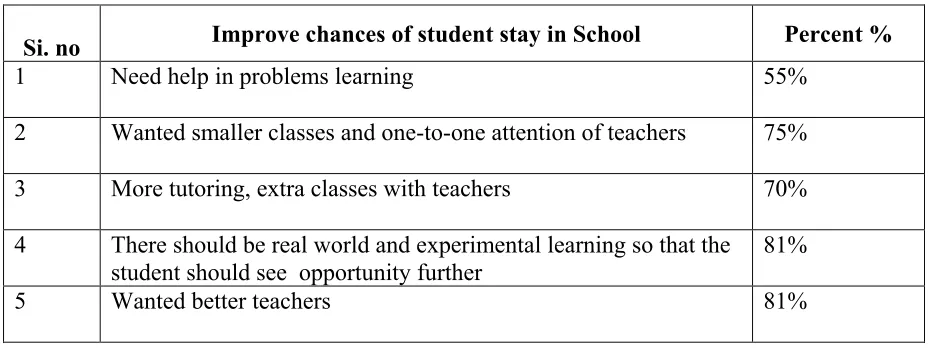
When discussed with dropouts and interviewed of what school can do to improve chances of students stay in school, it was found.
Si. no Improve chances of student stay in School Percent %
1 Need help in problems learning 55%
2 Wanted smaller classes and one-to-one attention of teachers 75%
3 More tutoring, extra classes with teachers 70%
4 There should be real world and experimental learning so that the student should see opportunity further
81%
5 Wanted better teachers 81%
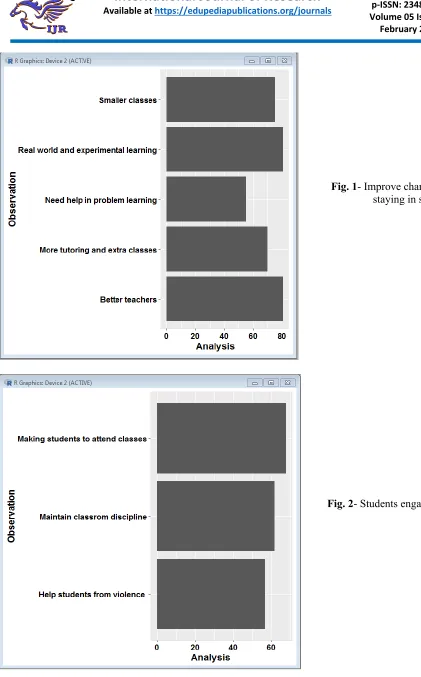
When dropouts were asked about what school can do to keep the students engaged in school
Si. no Students engagement in school Percent %
1 Making students to attend classes 68%
2 Maintain classroom discipline 62%
3 Help students from violence 57%
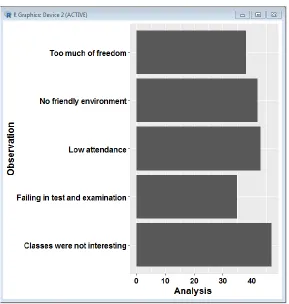
When asked about reason for dropout
Si. no Reason for dropout Percent %
1 Failing in test and examinations 35%
2 Too much of freedom 38%
3 No friendly environment 42%
4 Low attendance 43%
5 Classes were not interesting 47%
Table 1- Improve chances of students staying in school
Table 2 – Students engagement in school
R is a programming language used for developing statistical software and data analysis, widely used among statisticians and data miners. R programming is basically used for statistical computing. Ross Ihaka and Robert Gentleman created R at University of Auckland, New Zealand, which is currently developed by R development core team. R is an implementation of S programming which was created by John Chambers at Bell Labs.
R is freely available under GNU General Public License, R is a GNU project whose software environment is written in C, Fortran and R.
Statistical Features
A wide variety of statistical and graphical techniques is implemented using libraries in R which includes linear and nonlinear modeling, classical statistical tests, time series analysis, classification, clustering. R can also produce static graphs of high quality including mathematical symbols.
Programming Features
Through command line interpreter, since R is a interpreted language, if user types 2+2 on command prompt and presses enter, the computer replies with 4 as given below
R also supports matrix arithmetic, data structures which include vectors, matrices, arrays, data frames which makes it similar to APL and MATLAB.
Packages
Through user created packages the different capabilities of R are extended. These packages are developed in R and other languages like JAVA, C, C++ and Fortran. Packages allow specialized statistical techniques to be incorporated easily like graphical devices (ggplot2), Import/ Export capabilities, reporting tools (knitr, Sweave), etc. R installation includes core set of packages and additional packages of more than 7,801 available at Comprehensive R Archive Network(CRAN), Bioconductor, Omegahat, GitHub and other repositories.
R Graph Script
Dropout <- read.csv(“d:/dropout.csv”); ggplot2.barplot(data=Dropout,
Fig. 1- Improve chances of students staying in school
Conclusion
To succeed in life education is a very vital tool, education mitigates most of the challenges faced in life, education helps open doors to lots of opportunities for better prospects and growth. The students can also succeed in academics when they attend school consistently, if large number of students are frequently absent it is difficult to built their skills.
References
[1] Daniel T. Larose, Chantal D. Larose Discovering knowledge in Data Second Edition John Wiley
[2] Trever Hstie, Robert Tibshirani, Jerome Friedman,The Elements of Statistical Learning First Edition 2001 Springer
[3] Richard Cotton, Learning R O’ REILLY
[4] Peter Dalgaard, Introductory Statistics with R Second Edition Springer [5] https://www.importantindia.com/102 71/short-essay-on-importance-of-school-education/
[6] https://en.wikipedia.org/wiki/High_s chool_dropouts
[7] http://www.thehindu.com/news/natio nal/Why-children-drop-out-from-primary-school/article16792949.ece