UTILIZATION OF LONG-TERM AND PERMANENT FAMILY PLANNING METHODS AMONG FAMILY PLANNING CLIENTS AT WESTLANDS
HEALTH FACILITIES, NAIROBI COUNTY,KENYA
MUTHEE JUSTUS MAITETHIA (BSNPH) P57/CTY/PT/23708/2011
A RESEARCH THESIS SUBMITTED IN PARTIAL FULFILMENT OF THE REQUIREMENTS FOR THE AWARD OF THE DEGREE OF MASTER OF PUBLIC HEALTH(EPIDEMIOLOGY AND DISEASE CONTROL)IN THE
SCHOOL OF PUBLIC HEALTH OF KENYATTA UNIVERSITY
DECLARATION
This project is my original work and has not been presented for a degree in any other University or for any other award.
Signature ……….……. Date………..………. Muthee Justus Maitethia - P57/CTY/PT/23708/2011
Department of Community Health
SUPERVISORS
We confirm that the work reported in this thesis was carried out by the candidate under our supervision and submittedwith our approval as University supervisors.
Signature ……….……. Date………..………. Dr. Harun Kimani
Department of Community Health Kenyatta University
Signature ……….……. Date………..………. Dr. Tom Were
Department of Medical Laboratory Sciences
DEDICATION
ACKNOWLEDGEMENT
TABLE OF CONTENT
DECLARATION ... ii
DEDICATION ... iii
ACKNOWLEDGEMENT ... iv
TABLE OF CONTENT ... v
LIST OF TABLES ... ix
LIST OF FIGURES ... xi
OPERATIONAL DEFINITIONS ... xii
ABBREVIATION AND ACRONYMS ... xiv
ABSTRACT ... xv
CHAPTER ONE: INTRODUCTION... 1
1.1 Background of the Study ... 1
1.2 Problem statement ... 3
1.3 Justification ... 5
1.4 Research questions ... 6
1.5 Hypothesis... 7
1.6 Objectives ... 7
1.6.1 Broad objectives ... 7
1.6.2 Specific objectives ... 7
1.7 Significance and anticipated output of the study ... 8
1.8 Conceptual Framework ... 9
1.8.1 Narrative of conceptual framework ... 9
1.8.2 Diagram of conceptual framework ... 10
CHAPTER TWO: LITERATURE REVIEW ... 11
2.1 Global contraceptive use ... 11
2.2 Contraceptive Use in Kenya. ... 12
2.3.1 IUCD... 14
2.3.2 Tubal ligation ... 15
2.3.3 Vasectomy ... 15
2.3.4 Implants... 16
2.4 Factors influencing LAPMs use ... 16
2.4.1 Myths and misconception ... 16
2.4.2 Age... 17
2.4.2 Parity ... 17
2.4.3 Partner influence on family planning use ... 18
2.4.4 Service quality ... 18
2.4.5 Attitude of Health service providers ... 18
2.5 Summary of literature review ... 19
CHAPTER THREE: MATERIALS AND METHODS ... 21
3.1 Research design ... 21
3.2 Study variables ... 21
3.3 Study area... 21
3.4 Target Population ... 22
3.5 Sampling techniques and procedures ... 22
3.5.1 Sample size ... 22
3.5.2 Sampling technique and procedure ... 23
3.6 Eligibility criteria ... 25
3.6.1 Family planning clients ... 25
3.7 Construction and research instruments ... 25
3.8 Pilot study ... 26
3.9 Data collection techniques ... 26
3.10 Data quality control ... 26
3.11 Data management and analysis ... 27
3.12 Ethical and Logistical Issues ... 27
CHAPTER FOUR: RESULTS ... 29
4.1 Baseline characteristics of the study participants ... 29
4.1.1 Age, Marital status, and Religion ... 29
4.1.2 Education level, Occupation and Monthly Income ... 30
4.2 Demographic and socio-economic factors versus LAPM use ... 32
4.3 Role of health care workers in the use of LAPM ... 61
4.3.1 Method teaching/counseling ... 61
4.3.2 Client counseling sessions in the FP clinic and use of long term and permanent methods………62
4.3.4 Bivariate analysis... 64
4.3.5 Multivariate analysis of health care provider factors found significantly associated with use of LAPM ... 66
4.3.6 Health care providers FGD guide findings ... 68
CHAPTER 5: DISCUSSION, CONCLUSION AND RECOMMENDATIONS 71 5.1 Discussion ... 71
5.1.1 Baseline characteristics of study participants ... 71
5.1.2 Usage of long term and permanent methods of family planning ... 72
5.1.3 Factors influencing usage of long term and permanent methods ... 73
5.1.3.1 Socioeconomic and demographic factors ... 73
5.1.3.2 Contraceptives side effects ... 74
5.1.3.3 Help on choosing contraceptives ... 75
5.1.3.4 Partner influence ... 76
5.1.3.5 Myths and misconceptions ... 77
5.1.3.6 Parity, child spacing and future desire to use LAPM contraceptives ... 78
5.1.3.7 Service quality and provision of contraceptives... 80
5.1.4 Role of health care providers in offering the long term and permanent methods to potential women of reproductive age ... 80
5.2 Conclusion ... 82
5.3 Recommendations ... 83
5.4 Recommendations for further research studies ... 85
REFERENCES ... 86
APPENDICES ... 90
APPENDIX 1: CONSENT FORM ... 90
APPENDIX 2: QUESTIONNAIRE FOR CLIENT EXIT SURVEY... 93
APPENDIX 3: FGD GUIDE FOR FAMILY PLANNING SERVICE PROVIDERS101 APPENDIX 4: GRADUATE SCHOOL RESEARCH AUTHORIZATION...102
APPENDIX 6: KUERC ETHICS APPROVAL ...104
APPENDIX 7: COUNTY HEALTH OFFICER PERMIT ...105
APPENDIX 8: NACOSTI AUTHORITY ...106
LIST OF TABLES
Table 4. 1: Participants‟ Age, Marital status and Religion ... 29
Table 4. 2: Education level, Occupation and Monthly Income ... 30
Table 4. 3: Relationship between age and LAPMs use ... 32
Table 4. 4: Relationship between marital status and LAPM use ... 32
Table 4. 5: Religion and use of LAPM‟s contraceptives... 33
Table 4. 6: Education level and use of long term and permanent methods of FP .... 34
Table 4. 7: Respondents occupation and use of long term and permanent methods of FP ... 34
Table 4. 8: Average monthly income and use of LAPM ... 35
Table 4. 9: Health care worker enquired on side effect and use of long-term and permanent methods of FP ... 36
Table 4. 10: Presence of side effects among users and non-users of LAPM ... 37
Table 4. 11: Action taken by health workers on side effects of LAPM ... 38
Table 4. 12: Myths and beliefs about LAPM ... 43
Table 4. 13: Number of children and use of LAPM ... 44
Table 4. 14: Future child spacing and use of LAPM‟s... 45
Table 4. 15: Incidence of missing FP method in a facility ... 47
Table 4. 16: Action taken by respondents who missed FP method ... 49
Table 4. 17: Socio-demographics and use of LAPM ... 50
Table 4. 18: Relationship between contraceptive side effects, side effects management and use of LAPMs ... 52
Table 4. 20: Relationship between partner influence and use of LAPM ... 54 Table 4. 21: Relationship between myths/beliefs, culture and use of LAPMs ... 55 Table 4. 22: Association between number of living children, future child spacing,
future desire to use FP and use of LAPM ... 56 Table 4. 23: Association between service quality and use of long-term and
permanent contraceptives ... 57 Table 4. 24: Relationship between missing of contraceptive service, reason for
missing the service, the action taken and use of LAPM ... 58 Table 4. 25: Multiple regression analysis of factors found to influence usage of
LAPM ... 60 Table 4. 26: Client counseling sessions in the FP clinic and use of long term and
permanent methods ... 62 Table 4. 27: Relationship between Client counseling sessions in the FP clinic and
use of long term and permanent methods ... 65 Table 4. 28: Provision of client friendly FP method and use of long term/permanent
methods ... 66 Table 4. 29: Multivariate analysis of health care provider factors found significantly
LIST OF FIGURES
Figure 1. 1: Conceptual framework (Adopted from literature review)………10
Figure 4. 1: Usage of long term and permanent FP methods ... 32
Figure 4. 2: People who helped chose FP method to client ... 39
Figure 4. 3: Partner influence on use of LAPM ... 40
Figure 4. 4: Partner involvement in choice of LAPM ... 41
Figure 4. 5: Influence of Culture on Choice of LAPM ... 44
Figure 4. 6: Desire to use LAPM in future ... 46
Figure 4. 7: Waiting time before being attended by service provider ... 46
Figure 4. 8: Client opinion on waiting time ... 47
Figure 4. 9: Reason for missing FP ... 48
Figure 4. 10: Level of method counselling done to FP clients ... 61
OPERATIONAL DEFINITIONS
Contraceptive prevalence rate: This is the percentage of currently married women age 15-49 that are using any method of family planning.
Contraceptive implants: They are small rods that are inserted under the skin of a woman‟s upper arm to release the hormone progestin slowly and prevent pregnancy for 3-5 years.
Depo-Provera: This is a short acting progesterone only contraceptive injectable effective for 1-3 months depending on the type.
Family planning: According to WHO, “family planning is allowing individuals and couples to anticipate and attain the desired number of children and the spacing and timing of their children through contraception and treatment of involuntary infertility.”
Family planning utilization: Refers to using any form of family planning method.
Intrauterine contraceptive device: This is a flexible device (copper based or hormone-releasing device) that is inserted into the uterine cavity by a trained service provider. It is a safe and highly effective long-acting (3-12years depending with type) contraceptive method.
Long term/acting family planning method: These are irreversible family planning methods that prevent contraception for a longer period exceeding three years. This includes contraceptive implants, IUCD/coil
Tubal ligation: aminor surgical operation that involves cutting and tying of fallopian tubes to prevent the sperm from fertilizing the ovum that was released from the ovary, and reaching the uterine cavity.
Unmet need: Defined by West off (1988) as “the percentage of married women of reproductive age who are not using any FP, but who would like to postpone the next pregnancy(unmet need for spacing) or do not want any more children(unmet need for limiting)”
Unwanted pregnancy: Pregnancy that is unplanned for and thus not needed.
Vasectomy: thesurgical process of cutting and tying the vas deferens to prevent spermatozoa from mixing with semen.
ABBREVIATION AND ACRONYMS AQUIRE: Access, quality, and use in reproductive health CBS: Central Bureau of Statistics
CPR: Contraceptive Prevalence Rate FP: Family Planning
HCW: Health care worker HCP: Health care provider IMR: Infant Mortality Rate
IUCD: Intra Uterine Contraceptive Device KDHS: Kenya Demographic Health Survey KNBS: Kenya National Bureau of Statistics
LAPM: Long Term and Permanent Methods of Family Planning LARC: Long acting and reversible contraceptives
MEC: Medical Eligibility Criteria MMR: Maternal Mortality Rate MoH: Ministry of Health SDP: Service Delivery Point TFR: Total Fertility Rate TL: Tubal Ligation
UNPD: United Nation population division
UNDESA: United Nations Department of Economic and Social Affairs UNFPA: United Nation Family Planning Association
ABSTRACT
CHAPTER ONE: INTRODUCTION
1.1 Background of the Study
Access to family planning services and contraception is critical with the world population currently at seven billion inhabitants, and unfortunately, too many people (250 million) do not have the means to control their fertility (UNFPA, 2011). The health of women is closely related to their reproductive role and pregnancies which are either too early, too close, too many or too late, exposing mothers to high morbidity and mortality during pregnancy and childbirth (Gebremedhin, 2002). Child survival is also influenced by the mother's parity, birth interval, and birth order in addition to duration of breastfeeding (Sebastian, 2010; WHO, 2011).
Among adolescents and young adults, the major health problems include, complications related to abortions and childbirth. For instance, an estimated 358 000 maternal deaths occurred worldwide in 2008, a 34% decline from the levels of 1990.Despite this decline, developing countries continued to account for 99% (355,000) of the deaths. Sub-Saharan Africa and South Asia accounted for 87% (313,000) of global maternal deaths (WHO, 2010). Fortunately, the vast majority of maternal and newborn deaths can be prevented with proven interventions to ensure that every pregnancy is wanted using modern contraceptive and every birth is safe (Jacobs, 2008).
and permanent methods are given in few areas and sometimes are missing in many national reproductive health and family planning programs with more than 350 million couples worldwide having limited or no access to effective and affordable FP, especially to LAPMs (USAID, 2007). In developing countries, 20 to 30% of women who use oral contraceptives or injectable stop within two years of starting because of side effects or other health concerns (USAID, 2007). These women could benefit by switching to LAPMs.
Sub-Saharan Africa, has an average total fertility rate of 5.1, the highest average in the world; which is twice that of South Asia (2.8) (World Bank, 2009). The average contraceptive prevalence rate of 22% is half of South Asia (53%) due to low acceptance and high cultural resistance to family planning (UNPD, 2009). The total fertility rate of Kenya as reported in KDHS (2014) is 3.9 children per woman down from 8.1 in 1978, population growth rate is estimated at 2.6% per year, contraceptive prevalence rate (CPR) is only 58% ( a marked increase from 46% in 2008-09 demographic survey) and an unmet need for family planning is 25 %. Consequently, the maternal mortality ratio of 500/100,000 live births is high, and most SSA countries are not on track to achieve MDG5 (WHO, 2012).
withdrawal, lactational amenorrhea, and fertility awareness-based methods. Injectable (Depo-Provera) is by far the most commonly used contraceptive method; they are used by 22% of married women, while 7% of women uses pills. However, the prevalence of long-term/acting and permanent family planning method is very low and includes female sterilization 5%, IUCD and implants 2% among all married women (KDHS, 2008/09).
The contraceptive prevalence rate of Nairobi was estimated by Kenya demographic health survey of 08/09 to be 55% and notably, TFR had increased slightly from2.7 in 2003 to 2.8 in 2008. The majority of married women rely on short-term contraceptives in Nairobi which include; injectable (18.2%), pills (13.2%) and 4.4% condom. The long-term methods are least used with implants being the preferred method at 4.4%, IUCD 3.9 % and female sterilization 2.7%. To attain a balance between resources and population, the Kenyan population policy promotes family planning as an entitlement that is based on informed and voluntary choice (Musyoka & Ogola, 2009). Therefore this study aimed at assessing the utilization of long-term/acting and permanent methods of family planning.
1.2 Problem statement
1000 (KDHS, 2014) and the population growth keeps on increasing by one million people yearly. According to the Kenya 2009 population and household census result, there were 38.6 million people compared to 28.7 million and 21.4 million of 1999 and 1989 respectively (KNBS,2010). The Kenya population is projected to reach 83 million by the year 2050 (KNBS, 2010). It will further strain the reproductive health services and increase the unmet need for contraception.
Over time the use of LAPMs has not kept pace with that of short-acting methods such as oral contraceptives (pills) and injectable. Data from demographic and health surveys from four Sub-Saharan countries (Ghana, Kenya, Senegal, and Tanzania) show that the proportion of women currently using LAPM is significantly lower than the proportion usingshort-acting methods. In each of the country, it has stagnated or declined over the past two decades with fewer than 5% of the women on contraception using LAPM (Janowitz, Gmach & Otterness, 2006)
Itis known that despite women requiring long-termchild spacing needs of more than twoyears, most still opt for short term methods of contraception hence under use of LAPMs. The later are unreliable with high failure rates, health concerns, and high discontinuation rate of the methods.
sub-countyhealth records were; injectable (47%), oral pills (26%), IUCD (2.4%), implants (2%), tubal ligation (0.05%) and vasectomy not utilized at all. However, the reasons responsible for this low uptake of long-acting and permanent methods in Westlands remain undefined.
1.3 Justification
The uptake of LAPM is very lownot only in Westland'ssub-county of Nairobi but also in the entire country with short-acting reversible methods like Depo-Provera and oral pills being the most preferred modern contraceptives.Repeated health facility attendance of clients on short term FP methods poses a challenge to the already strained health care providers as well as increasing therisk of contraceptive failure.
Kenya still has a large unmet need for FP services estimated at around 18% in 2014, with nearly 42% of Kenya‟s population (16.5M) being under 15 years of age and an estimated 100,000 young people turning 16 every year. This pattern according to KDHS (2014), is expected to continue for more than a decade, and it is likely to put a heavy demand on reproductive health services including FP. This need could be met adequately by LAPMs which are cost effective option for users over time.
that increases the need for an effective and longer family planning method, which could be the choice of LAPMs.
Westlands Sub County in Nairobi typifies the rapid urbanization and population explosions with theproliferation of informal settlement which is posing a health service challenge to already strained facilities especially reproductive health. The World Bankprojects that by 2033 the country (Kenya) will likely have half of the population living in the city. Nairobi will be hardly affected (World Bank, 2011).
1.4 Research questions
1) What is the level of usage of long-term and permanent family planning methods among family planning clientsin Westlands sub-county health facilities?
2) What are the (socio-economic, socio-demographic, behavioral, logistical and service quality) factors influencing family planning choice regarding LAPMs among family planning clients in Westlands sub-county health facilities? 3) What are the roles of health care providers‟ on theuptake oflong-term and
1.5 Hypothesis Null hypothesis
There was no significant relationship between socio-economic, demographic, logistical, service quality characteristics and utilization of LAPMs among family planning clients in Westlands Sub County.
There was no relationship between family planning service provider‟s knowledge and skills and utilization of long-term and permanent family methods among family planning clients.
1.6 Objectives
1.6.1 Broad objectives
To assess the utilization of long-term and permanent methods of family planning among family planning clients in Westlands Sub-county health facilities.
1.6.2 Specific objectives
1) To establish the level of uptake of long-term and permanent family planning methods among family planning clients in Westlands sub-county health facilities.
3) To determine health care providers‟ role in theuptake of the long-term and permanent family planning methods to eligible women of reproductive age seeking FP services in Westlands sub-county health facilities.
1.7 Significance and anticipated output of the study
The study findings would be used to advise the MOH through thedivision of reproductive health on strategies/approaches to enhance positive factors and remove negative factors that influence LAPM (IUCDs, implants, and male/female sterilization) use so as to increase contraceptive prevalence and lower the unmet need of birth control.
The study findings would as well help the division of reproductive health and other key stakeholders in making decisions on how to initiate/proceed with LAPM skills training programs for health care workers in FP clinics and as well engage health care services to make full use of opportunities to provide family planning information and services.Family planning has been identified as a key priority component in the National Reproductive Health Policy (MOH, 2012) and has a high impact intervention to lower maternal and infant mortality by the maternal, infant and adolescent reproductive policy group (MOH,2016).
The study findings have identified the number of women inlong-term and permanent birth control methods which informs the need for support services such as follow-up and as well community advocacy for acceptance of this methods.
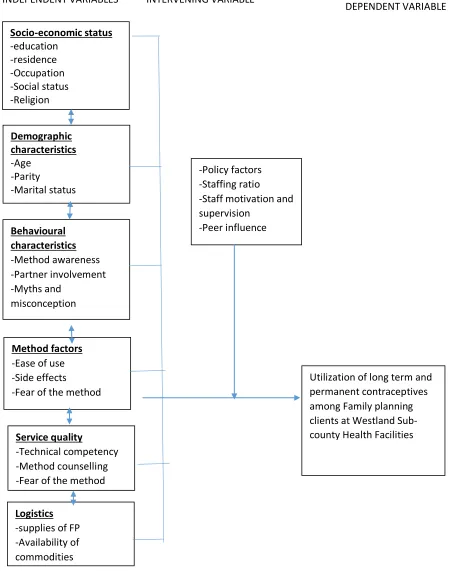
1.8Conceptual Framework
1.8.1 Narrative of conceptual framework
1.8.2 Diagram of conceptual framework
INDEPENDENT VARIABLES INTERVENING VARIABLE
Figure 1. 1: Conceptual framework (Adopted from literature review) Socio-economic status -education -residence -Occupation -Social status -Religion
Utilization of long term and permanent contraceptives among Family planning clients at Westland Sub-county Health Facilities -Policy factors
-Staffing ratio -Staff motivation and supervision -Peer influence Demographic characteristics -Age -Parity -Marital status Behavioural characteristics -Method awareness -Partner involvement -Myths and misconception Method factors -Ease of use -Side effects
-Fear of the method
Service quality
-Technical competency -Method counselling -Fear of the method Logistics
-supplies of FP -Availability of commodities
CHAPTER TWO: LITERATURE REVIEW
2.1 Global contraceptive use
The global contraceptive rate stands at 63%. It is higher in the developed countries at 70% than in the developing countries at 62%. The Sub-Saharan Africa region has lowest CPR at 21%. The United Nations, Division of Population Reports that the CPR in Asia is 67%, Latin America and the Caribbean 72%, North America 73%, Europe 71 and 72% in Oceania. Ninety percent of contraceptive users control birth with a modern method with short-acting and reversible methods being preferred in the developing countries. Female sterilization is the most commonly used long-termmethod globally at 20%, followed by IUCD at 14% with the pill third at 9%.The injectable and the implants are used by 3.7% of the world‟s population (UNPD, 2009).
Despite annual increase in the prevalence of contraceptive use worldwide (UNDESA,2009) and advances in available contraceptive options millions of women who do not want a child or want to delay childbearing are not using contraception (UNDESA, 2009). USAID (2007), observedthat there is a large unmet need for reproductive health and family planning services in Sub-Saharan Africa. Moreover, this need is even particularly high in rural areas where health care facilities are often scarce, difficult to access or unable to meet the needs of clients due to shortages of staff or resources.
contraceptive pills. For example, a study done on prevalence and factors affecting theuse of LAPM in 2008 at Jinka Ethiopia, showed the prevalence of contraceptive among participants was 39.5% of which LAPM contributed 7.3%. Implants were the most widely used method (50%) by LAPM users (CSA, 2009). It is now recognized that increasing access to quality services for long-acting and permanent methods such as IUCD, implants, and tubal ligation is pivotal to widening women‟s contraceptive choices (USAID, 2007).
Evidence suggests a substantial unmet need for LAPMs in Sub-Saharan Africa. A discrepancy exists between the proportion of women who wish to stop having children and the proportion using a LAPM. Data from DHS conducted in SSA between 2003 and 2005 show that more than 20 % of women in nine out of 11 countries (Cameroon, Chad, Congo-Brazzaville, Ethiopia, Guinea, Lesotho, Madagascar, Malawi, Rwanda, Senegal, and Tanzania) surveyed do not want any more children. However in each of the nine countries fewer than 7% of the women are using a LAPM (Janowitz, Gmach & Otterness, 2006). A LAPM may be a good option for some of them given their reproductive intentions, but they may not be using one because of lack of knowledge or access (ESD, 2007).
2.2 Contraceptive Use in Kenya.
program has been among the most successful in Sub-Saharan Africa (MOH, 2009). The method mix of contraceptives nationally is pills 8%, female sterilization 3.2%, Implants 9.9%, Injectable 26.4%, IUCD 3.4% and male condoms at 2.2% (KNBS, 2015). While that of Nairobi is 23.6% injectable, 12.1% Pills, 3.2% male condoms, 4.2% IUCD, 12.1% Implants and 7% being other methods (KDHS, 2014).
Fifty-five percent of married women in Kenya are not using contraception because of fear of side effects and health concerns. Other reasons for not using such as religious prohibitions, opposition to use, menopause, infecundity, desire for many children and infrequent sex were each cited by 6-9% of women as the main reason for not intending to use a family planning method in the future. In addition, the largest proportion (52%) of prospective users of family planning in KDHS 08/09 reported injectable as their preferred method, with 12% citing pills compared to 8% favoring female sterilization and implants.
2.3 Long term and permanent contraceptive method
2.3.1 IUCD
In countries of Sub-Saharan Africa, IUCD utilization levels are generally amongst the lowest in the whole world, as are overall contraceptive use rates. IUCDs have been used for nearly 40 years and have become one of the most commonly used, most available methods of FP worldwide. More than 100million women have used the IUCD so that it has become second only to voluntary sterilization as the most popular method in the world (Trieman et al., 1996; Liskin 1990). Sixteen percent of Africans rely on IUCD, but it‟s influenced by relative dominance of IUCDs in North Africa where 37% of all users rely on the IUCD. For instant in Egypt and Tunisia one in two contraceptive users have an IUCD, but in Sub-Saharan Africa, the use of the IUCD is less common with only 2%of users relying on IUCD (WHO, 2010).
In Kenya, the most widely used copper bearing IUCD is „copper T380A‟ which provides protection for as long as 12 years (WHO, 2008). In a study done in Guatemala showed that women with high school or higher education (5.2%) use coil than women with elementary education (1.4%) or without formal schooling (0.4%) (Montufar & Morales, 2005).
negative side effects and conditions. In addition myths and misconceptions at the client and community levels remain widespread (ACQUIRE, 2007).
2.3.2 Tubal ligation
A meta-analytical study carried out by United Nations in 2009, found out that among women aged 15-49 who were married or in union, female sterilization was used by 20.3% and IUCDs by 14.2%. Tubal ligation is a safe and effective permanent method for women who have completed their families or for individuals who do not wish to have children (WHO, 2012). In Kenya for example, nearly 4% of users of modern methods of contraception rely on female sterilization (CBS, 2014; KDHS, 2014) despite being a highly effective surgical non-reversal method of contraception with a pregnancy rate of less than 1% of women within one year after surgery and few women (0.4-2.0 %) experiencing side effects (WHO,2009).
2.3.3 Vasectomy
contraceptive particularly vasectomy. More than half of the married women had anegative attitude towards practicing of LAPMs particularly for female sterilization and vasectomy (Alemayehu, 2012).
2.3.4 Implants
Implants are small rods inserted under the skin of a woman‟s upper arm to release the hormone progestin slowly, thus preventing pregnancy. There are three types of implants that have been approved for use in Kenya, which include Jadelle (effective for 5years), Implanon (3years) and sino-implant/Zarin which are effective for four years (MOPHS, 2010). Implants use increased from 0% in 1993 to 7.7% in 2008 and are more common in women of the age groups 15-29 years (KNBS, 2010).
2.4 Factors influencing LAPMs use
2.4.1 Myths and misconception
2.4.2 Age
The Kenya demographic health survey (2008/09) identified the contraceptive peaks among married women to be 30-34 age groups and is lowest for women at 15-19.As expected female sterilization is used more commonly by women at age 40-49, while married women at the peak of childbearing age of 20-39 are most likely to use injectable and pills. Use of condoms is particularly high among sexually active unmarried women (KDHS, 2008/09).
2.4.2 Parity
2.4.3 Partner influence on family planning use
Use of family planning methods is facilitated when couples discuss and agree on the issue (KDHS, 2009). A retrospective study on vasectomy users in Uganda found that in only about one-half (44.4%) of the cases both partners had made the decision to opt for the vasectomy (Kakamade etal., 1993).
2.4.4 Service quality
The Kenya Demographichealth survey of 2008/09 revealed that government sources supply a larger proportion of users of long-term methods such as female sterilization, implants (and injectable) than users of pills, IUCDs and male condoms. In a study carried out in Tanzania to explore and document factors affecting IUCD use, it found out that 42% of the rural health providers had not received training in IUCD skills and most of them expressed theneed for the training. In addition, even those who had previously received training had largely suffered erosion of knowledge, skills and confidence and now needed refresher and update training (Ruminjo & Hiza, 2002).
2.4.5 Attitude of Health service providers
The results reveal only 9% discussed issues of FP with the health facility staff. This implies that many opportunities are lost when potential users can be educated on the benefits of family planning (KDHS, 2010).
Health care providers may help women at risk of unwanted pregnancies by informing them about the full range of reliable contraceptive options available, including LARC methods which greatly minimize the need for the user's dependence on the adherence to a routine (Blumenthal etal., 2010).
In a study carried out in Uganda by Kate et al. (2012), the main reasons that women gave for adopting LAPMs were child spacing (53%), not wanting children (23%) and completed families (13%). A higher percent of tubal ligation clients reported completed families 30% than IUCD and implants clients (7% and 3% respectively).
2.5 Summary of literature review
Globally female sterilization is the most used method of contraception followed by intrauterine contraceptive devise where as in Kenya Depo Provera injectable and pills are the most preferred birth control methods. The factors identified in Africa from literature review to influence the utilization of long term and permanent contraception were myths, beliefs, misconceptions, spouse opinion and parity of more than 3 children.
CHAPTER THREE:MATERIALS AND METHODS
3.1 Research design
It was a descriptive cross-sectional survey, which assessed the utilization of long-term methods of contraception among women of reproductive age, through an exit survey. This design allowed the researcher to solicit personal and self-reported information directly from respondents about family planning method they were utilizing.
3.2 Study variables
Dependent variable was utilization of long term/acting family planning method Independent variables were; a) Socio-economic (education, occupation, residence, social status), b) Demographic characteristics (marital status, age, religion, culture, and beliefs, parity), c) Behavioral characteristics (ease of use of FP methods, fear of side effects related to FP, partner involvement, FP awareness levels), d) Service quality and role of health care provider (technical competency, staffing ratio, staff motivation, method counseling, and follow-up).
3.3 Study area
According to thecensus of 2010 Westlands Districts had a population of 247,102 (124,748 males and 122,354 females). It has six administrative Divisions (High Ridge, Kangemi, Kilimani, Kitisuru, Lavington, and Parklands). The study was carried out in 8 public health facilities owned by Nairobi County government (Karura, Kangemi, Westlands, Kabete approved, Kari, Lower Kabete, Mjiwa Huruma, and State House Clinic) distributed in those administrative areas.
3.4 Target Population
The target population was all women of reproductive age(15-49) years, who were using family planning services in different service delivery points in Westlands Sub County and all providers of FP services in those SDPs.
3.5 Sampling techniques and procedures
3.5.1 Sample size
The required sample size for client exit interview was determined by using the following assumption to estimate thesample size of single population proportion for prevalence studies by Kish Leslie (1965).
Where = = 1.96 (For a normal distribution table for a CI 95%
P is the prevalence; inKenya the CPR is 46% (KDHS, 2009) (The absolute precision required is ±5%)
Therefore n = × (0.46(1-0.46) ÷ )
= 381
10 % (38) was added to cater for incompleteness of questionnaire. The total participants for the exit survey interview were 419. FGD had 6 to 8 service providers per site due to theconstraint of health personnel within the facilities of study.
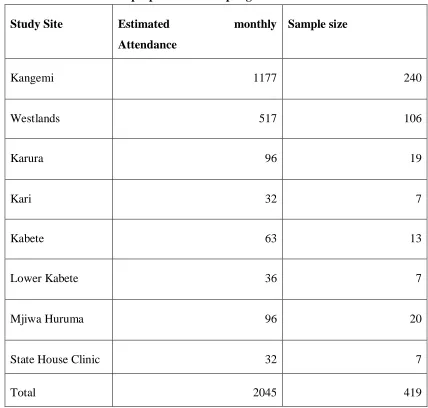
3.5.2 Sampling technique and procedure
Table 3.1 proportionate sampling for health facilities
Study Site Estimated monthly
Attendance
Sample size
Kangemi 1177 240
Westlands 517 106
Karura 96 19
Kari 32 7
Kabete 63 13
Lower Kabete 36 7
Mjiwa Huruma 96 20
State House Clinic 32 7
Total 2045 419
room.This was done until the required number was achieved as per the study site, throughout the study period.
For Qualitative data, fourFGDswere conducted. Theywere given to family planning service provider identified conveniently at each service delivery point in Kangemi, Westlands, Mjiwa Huruma and Karura health centres. Each group consisted of six to eight nurses (depending on the study site) and the researcher coordinated the discussion.
3.6 Eligibility criteria
3.6.1 Family planning clients Inclusion criteria
FP clients aged 15-49 years and who consented to participate in the study.
Exclusion criteria
FP clients < 15 years of age and those > 50 years. Those FP clients who did not consent to participate in the study
3.7 Construction and research instruments
3.8 Pilot study
A pilot study intended to pretest the data collection instruments was carried out at a rural-semi urban government health center of Wangige, which shared similar characteristics with the study area. 42 (10% of the study sample) structured interview questionnaires and one FGD were pretested. The results of the pilot study were cleaned, coded and analyzed by SPSS to check for data quality control; amendmentwere done to the data collecting instruments guided by study objectives. Control of bias was done through appropriate selection and training of research assistants and piloting of data collection tools and procedures.
The recruitment of research assistant followed theunderstanding of thesubjectunderstudy, dynamics of thestudy area and avoidance of bias. A second year nursing student with abetter understanding of English, Swahili and Sheng‟ were recruited and trained. Three of them assisted in data collection.
3.9 Data collection techniques
An exit structured interview questionnaireswere given to clients by the researcher and trained research assistants.4 FGDs were used to collect data from the health care workers identified in the busy service delivery points of Kangemi, Westlands, Mjiwa Huruma and Karura health centres.
3.10 Data quality control
the actual study. The research assistants were thoroughly trained and closely supervised by the investigator and data collection tools were checked in the field to ensure completeness and consistency.
3.11 Data management and analysis
Data collected was coded, entered and cleaned in the Microsoft Excel software 2010. All quantitative statistical analysis was performed using the statistical package for social sciences (SPSS) software version 2014 (SPSS Inc. USA). Descriptive statistics were computed to generate frequencies, mean, mode and standard deviation. Chi-square test was used to test the association between dependent and independent variables. A p-value of less than 0.05 was considered for all statistical analysis. Strength and direction of therelationshipwas established using multiple regression.
Qualitative data was transcribed, coded and analyzed using content, thematic analysis to support quantitative analysis and presented in thenarrative.
3.12 Ethical and Logistical Issues
CHAPTER FOUR: RESULTS
4.1 Baseline characteristics of the study participants
4.1.1 Age, Marital status, and Religion
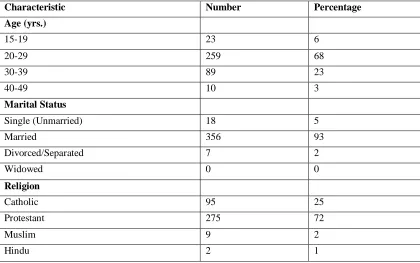
Table4.1 shows the baseline characteristics of women aged 15-49 years in the study. A total of 381 participants (FP clients) and 4 FGDs (FP service providers) were interviewed from the eight public health facilities within Westland‟s sub-county, Nairobi County. This represents 92% response rate.
The mean age of the respondents was 26.4 years (SD=5.6) with those at theage group of 20-29 years being the majority of FP consumers. The majority of the respondents are married (93%) and are Protestants (72%) as represented in Table 4.1 below.
Table 4. 1: Participants’ Age, Marital status, and Religion
Characteristic Number Percentage
Age (yrs.)
15-19 23 6
20-29 259 68
30-39 89 23
40-49 10 3
Marital Status
Single (Unmarried) 18 5
Married 356 93
Divorced/Separated 7 2
Widowed 0 0
Religion
Catholic 95 25
Protestant 275 72
Muslim 9 2
4.1.2 Education level, Occupation and Monthly Income
Thirty-four percent (34%) of the client had completed secondary school education and themajority (48%) of them are house wives. 50% of the respondent earned less 30 USD per month. This is shownin Table 4.2.
Table 4. 2: Education level, Occupation and Monthly Income
Characteristic Frequency Percentage (%)
Highest Level Of Education
No formal education 11 3
Primary incomplete 35 9
Primary complete 110 29
Secondary incomplete 45 12
Secondary complete 129 34
College 38 10
University 13 3
Occupation
Unemployed 3 1
Employed 67 18
Self Employed/Merchants 70 18
House wife 184 48
Casual Labourer 46 12
Student 11 3
Income (USD)
None 12 3
<30 191 50
31-55 84 22
56-111 51 13
112-167 21 6
168-223 6 2
224-279 13 3
4.1.3 Use of long term and permanent FP methods
Implant (22%) was the most used long term method amongst women of reproductive age seeking FP services at Westlands Health Facilitieswhile 8% used coil.For permanent method, tubal ligation was used by 2% of the respondent compared to 1% whose partners had undergone avasectomy. Short-term
contraceptives are by far the most preferred methods of family planning as presented in figure 4.1.
This is well supported by the findings of FGD, “Among the clients who use long terms, implants and coil is the most preferred method, a few chose tubal ligation where we link up with Tupange project and vasectomy is hardly mentioned or used as it is a man-method and few of them if any accompany their women to the
clinic”(Participant 3, nurse Westlands health centre).
22%
8%
2%,
1% 67%
Level of use(%)
Figure 4. 1: Usage of long term and permanent FP methods
4.2 Demographic and socio-economic factors versus LAPM use
4.2.1 Age
Among the LAPM‟s users, those at 20-29 years age group are the highest at 63%. This is shown in Table 4.3.
Table 4. 3: Relationship between age and LAPMs use LAPM
used
Age
15- 19 20-29 30-39 40-49 Totals
n(%) n(%) n(%) n(%)
Implants 4 (5) 53 (62) 26 (30) 3 (3) 86 IUCD 1 (3) 20 (66) 9 (31) 0 (0) 30
BTL 0 (0) 6 (67) 0 (0) 3 (33) 9
Totals 5 79 35 6 125 (100)
4.2.2 Marital status
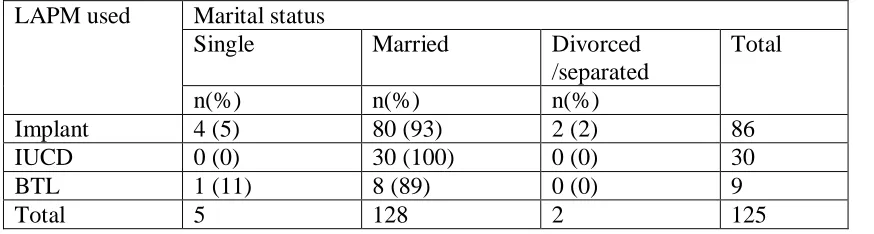
Long term and permanent contraceptives are mostly used by the married women (93%) with implants being the most preferred (22%) among the respondent .This is shown in Table 4.4
Table 4. 4: Relationship between marital status and LAPM use LAPM used Marital status
Single Married Divorced /separated
Total
n(%) n(%) n(%)
Implant 4 (5) 80 (93) 2 (2) 86
IUCD 0 (0) 30 (100) 0 (0) 30
BTL 1 (11) 8 (89) 0 (0) 9
4.2.3 Religion
71% of the Protestant used LAPM contraceptives compared to 26% of the Catholics with implants being the most preferred method of contraception as shown in Table 4.5.
Table 4. 5: Religion and use of LAPM’s contraceptives LAPM used Religion
Catholic Protestant Muslim Hindu Totals
n(%) n(%) n(%) n(%)
Implants 19 (22) 63 (73) 3 (4) 1 (1) 86
IUCD 18 (60) 12 (40) 0 (0) 0 (0) 30
BTL 6 (67) 3 (33) 0 (0) 0 (0) 9
Totals 43 88 3 0 125
4.2.4 Education
Table 4. 6: Education level and use of long term and permanent methods of FP Method
of LAPM used
Level of education No formal educatio n Primary incomplet e Primary complet e Secondary incomplet e Secon dary compl ete
College Univ ersit y
n(%) n(%) n(%) n(%) n(%) n(%) n(%)
Implant 3(27) 6(17) 18(16) 9(20) 36(28) 9(24) 5(38 .5) IUCD 1(9) 2(6) 8(7) 5(11) 6(5) 5(13) 3
BTL 1(9) 0(0) 3(3) 0(0) 4(3) 1(2) 0
Total 5 8 29 14 46 15 8
4.2.5 Occupation
Majority of the house wives use LAPM‟s at 44% with implants being the most preferred method by them as shown in Table 4.7.
Table 4. 7: Respondents occupation and use of long term and permanent methods of FP
Method of LAPM used Occupation Un employe d Employe d
merchant House wife
Casual laboure r
Student Total
n(%) n(%) n(%) n(%) n(%) n(%)
Implant 0(0) 22(26) 15(17) 40(47) 7(8) 2(2) 86 IUCD 0(0) 6(20) 7(23) 14(47) 0(0) 3(10) 30 BTL 0(0) 3(33) 3(33) 0(0) 3(33) 0(0) 9
4.2.6: Income
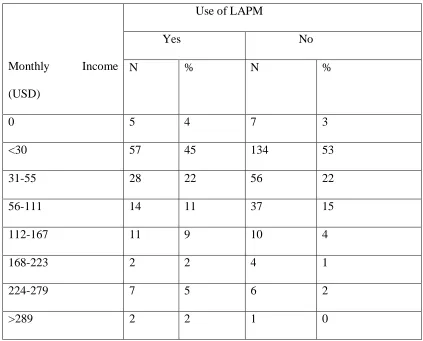
Majority of the respondent in the category of LAPM users (45%) and users of other contraceptive method (53%) earn less than 1 US$ per day (<30USD per month) as indicated in Table 4.8.
Table 4. 8: Average monthly income and use of LAPM
Monthly Income (USD)
Use of LAPM
Yes No
N % N %
0 5 4 7 3
<30 57 45 134 53
31-55 28 22 56 22
56-111 14 11 37 15
112-167 11 9 10 4
168-223 2 2 4 1
224-279 7 5 6 2
>289 2 2 1 0
4.2.7 Health care worker enquired on side effects and use of long-term and permanent methods of FP
This was also captured from the service provider FGD guide, where a participant had this to say, “It’s not possible to talk to all clients about contraceptive they are using as the clinic may be too busy, we also do postnatal follow up in the same clinic other times the clients are in a hurry so you offer the method” (Participant 4, nurse, Kangemi health centre)
Table 4. 9: Health care worker enquired on side effect and use of long-term and permanent methods of FP
Enquiry by HCW on side effects
Used LAPM Used Short term FP Methods
N % N %
Yes 118 38 192 62
NO 8 11 63 89
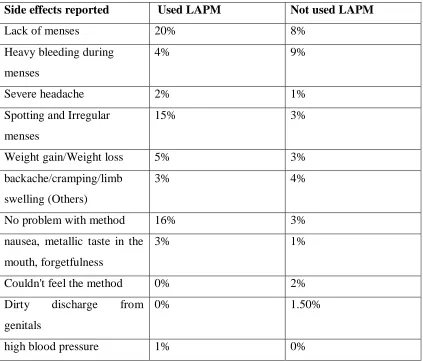
4.2.8 Presence of Side effects and use of LAPM
Table 4. 10: Presence of side effects among users and non-users of LAPM
Side effects reported Used LAPM Not used LAPM
Lack of menses 20% 8%
Heavy bleeding during menses
4% 9%
Severe headache 2% 1%
Spotting and Irregular menses
15% 3%
Weight gain/Weight loss 5% 3%
backache/cramping/limb swelling (Others)
3% 4%
No problem with method 16% 3%
nausea, metallic taste in the mouth, forgetfulness
3% 1%
Couldn't feel the method 0% 2%
Dirty discharge from genitals
0% 1.50%
high blood pressure 1% 0%
4.2.9 Handling of the side effects by health care and clients use of LAPM
Table 4. 11: Action taken by health workers on side effects of LAPM
Action taken by HCP Users of
LAPM (%)
Non-users of LAPM (%)
HCP explained problem to client Yes
No
Client had no problem
42 14 14 58 86 86 HCP suggested action to resolve problem
Yes No
Client had no problem
41 11 14 59 89 86 Client satisfied with treatment/action
offered Yes No
Client had no problem
45 11 14 55 89 86
4.2.9 Help on choosing the LAPM contraceptives
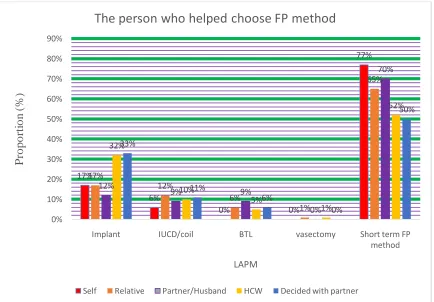
Contraceptives service providers play a role in helping clients to choose contraceptives with that of long-term and permanent contraceptives standing at 22%. Thisis as shown in Figure 4.2.Others choose their own methods with preference being short term methods.
the method of their choice from their friends or internet, you can’t change them”(participant 1,nurse, Karura health centre)
Figure 4. 2: People who helped chose FP method to client
(On bivariate analysis there was a significant association between help in choosing contraceptive method and use of LAPM‟s at X²(5) =46.7, P<0.001)
4.2.10 Partner influence on use of LAPM
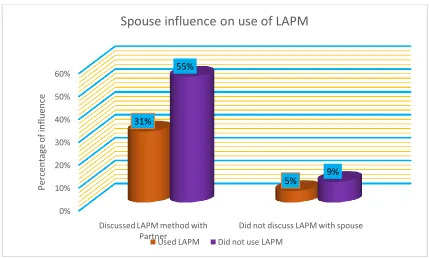
Most of the respondent who used long term and permanent method of contraception had discussed with their spouses as shown in Figure 4.3
17% 6% 0% 0% 77% 17% 12% 6% 1% 65% 12% 9% 9% 0% 70% 32% 10% 5% 1% 52% 33% 11% 6% 0% 50% 0% 10% 20% 30% 40% 50% 60% 70% 80% 90%
Implant IUCD/coil BTL vasectomy Short term FP
method P ro po rt io n ( % ) LAPM
The person who helped choose FP method
Figure 4. 3: Partner influence on use of LAPM
Among LAPM‟s users, those who had discussed with their spouse the method to use tended to use more of the LAPMs (10%) compared to 2% whose partners were not aware they were using the method of contraception as shown in Figure 4.4
0% 10% 20% 30% 40% 50% 60%
Discussed LAPM method with Partner
Did not discuss LAPM with spouse 31%
5% 55%
9%
P
er
centa
ge
o
f
inf
luenc
e
Spouse influence on use of LAPM
Figure 4. 4: Partner involvement in choice of LAPM
4.2.10 Myths, beliefs and misconception and use of LAPMs
The commonest myths and beliefs among long term and permanent contraceptives non users is that implants causes high blood pressure and sudden death (8%),coil hurts husband during intercourse and affects sex styles(7%), women become pregnant with coil(6%) as shown in Table 4.12.
0% 5% 10% 15% 20% 25%
Had used LAPM Had not used LAPM
24% 9%
4% 1%
11% 10%
7% 7%
13% 5%
4% 2%
6% 1%
Proportion of Fp use (%)
Partner Involvement in chosing LAPM
Not Aware am using fp No partner
Refused fp method Healthcare provider to chose for us
Decided the metghod together Forced me into his method
Table 4. 12: Myths and beliefs about LAPM
Myths and beliefs Using LAPM
N (126)
Not using LAPM N (255) Reported no myths and beliefs
13% 22%
Coil causes cervical uterine cancer
2% 4%
Women become pregnant with coil and child is born holding it
3% 6%
Coil causes HIV/AIDS
3% 2%
Implant causes high blood pressure and sudden death
3% 8%
Implants causes breast cancer
3% 5%
Implants makes a woman shapeless
2% 5%
With implant, woman cannot do manual work,
hand becomes weak 1.5% 6%
Coil hurts husband during intercourse, affects sex styles
4% 7%
BTL makes menses to clot in woman abdomen
causing diseases like fibroids 0% 2%
BTL requires major surgical operation and hospitalization
1% 1.5%
Vasectomy makes a man useless sexually 0.5% 1%
BTL is for older women 0% 1%
4.2.11 Culture and use of LAPM
Figure 4. 5: Influence of Culture on Choice of LAPM
4.2.12 Number of children and use of LAPM
Implants are mostly used by women with one child(42%) while coil was used by those with 2 children(40%) and BTL preferred by those with four children as shown in Table 4.13.
Table 4. 13: Number of children per house and use of LAPM LAPM
used
Number of children client Had
1 child 2 children 3 children 4 children >children none Total
n(%) n(%) n(%) n(%) n(%) n(%)
Implant 36 (42)
28 (32) 16 (19) 6 (7) 0 (0) 0 (0) 86
IUCD 6 (20) 12 (40) 3 (10) 7 (24) 1 (3) 1 (3) 30
BTL 3 (34) 1 (11) 0 4 (44) 1 (11) 0 (0) 9
Total LAPM
45 41 19 17 2 1 125
Short- term FP
89(34) 91(36) 38(15) 25(10) 10(4) 2(1) 255
0% 10% 20% 30% 40% 50% 60% 70% 80% 90%
Had used LAPM Had not used LAPM
15% 14% 85% 86% P ro po rti o n o f FP us e
Culture influence on choice of LAPM
4.2.13 Future child spacing and use of LAPM’s
Most of the respondents would wish to wait for more than five years (space) before getting another child. These respondents used mostly implants (49%) and coil (37%) compared to those who had enough children and mostly had undergone tubal ligation as shown in Table 4.14.
Table 4. 14: Future child spacing and use of LAPM’s
LAPM used Child space Totals
No plan 1-2 yrs 3-4 yrs >5yrs Have enough
n(%) n(%) n(%) n(%) n(%)
Implant 4 (5) 11 (13) 9 (10) 42 (49) 20 (23) 86
IUCD 1 (3) 4 (13) 5 (17) 11 (37) 9 (30 ) 30
BTL 0 (0) 1 (11) 0 (0) 2 (22) 6 (67) 9
Total 5 26 14 55 44 125
4.2.14 Future desire for contraceptives and use of LAPM’s
Figure 4. 6: Desire to use LAPM in future
4.2.15 Client waiting time at the health facility
Most of the clients,71 (56%) who used LAPM waited for 16-30 min before they were attended by the FP service provider compared to 16% who had waited for 31-45 minutes as shown in Figure 4.7
Figure 4. 7: Waiting time before being attended by service provider Yes, I would like to use …
No, I do not intend to use …
0% 10% 20% 30% 40% 50% 60% 70% 80% 90%
Using LAPM Not using LAPM
85% 37% 15% 63% P ro po rti o n ( % )
Desire to use LAPM in future
Yes, I would like to use LAPM No, I do not intend to use LAPM
Less than 15 min 28% 16-30 min 56% 31-45 min 16% 46-60 min 0% >1 hr 0%
Waiting time before being attended by service provider
When asked about their feeling on waiting time before being attended by FP service provider, 64% of the respondents who used long term and permanent methods, said it was reasonably short while 2% of them felt it was too long as shown in Figure 4.8.
Figure 4. 8: Client opinion on waiting time
4.2.16 Missed FP method in a facility
19 (15%) of the respondents who used LAPM had missed a contraceptive method in any one of the facility at any given time compared to 95 (37%) who relied on other FP methods as shown on Table 4.15.
Table 4. 15: Incidence of missing FP method in a facility
Using LAPM Not using
LAPM
N % N %
I have ever missed FP service in this facility
19 15 95 37
I have never missed FP service in this facility
103 82 153 60
It is my first time in this facility 4 3 7 3
There was no waiting time 34%
It is reasonably short 64%
It is too long 2%
Client opinion on waiting time
The reasons given for missing the contraceptives method among LAPM users were lateness (5%) and stock out (1%) while among users of other methods it was lateness (22%), stock out (5%), wrong appointment dates (1%) and lack of the service provider (2%) as illustrated in Figure 4.9.
Figure 4. 9: Reason for missing FP
The actions taken by respondents who missed the contraceptive methods among non-LAPMs users included buying from the chemist (19%), waiting for the next day clinic (18%), visiting the nearby facility (3%) and appointment booking for the method when next it will be offered (2%) as shown in Table 4.16.
5% 22% 2% 5% 0% 0% 37% 38%
0% 0% 2% 1%
0% 5% 10% 15% 20% 25% 30% 35% 40%
LAPM users LAPM non users
P rop or ti on of FP u se (% )
Reasons for missing FP method in the facility
Was late for clinic Stock out
don’t know never missed the method
Table 4. 16: Action taken by respondents who missed FP method Action taken after missing FP method Among those
using LAPM
Among those not using LAPM
N % N %
Bought from Chemist 13 10 49 19
Waited for the next clinic day 8 6 47 28 Visited the nearby health facility 2 2 8 3 Booked for the method another day 0 0 6 2 Never missed the FP service 103 82 145 57
4.2.17 Socio-demographics and use of LAPM
Table 4. 17: Correlation of Socio-demographics and use of LAPM
Variable LAPM
use(n/%)
Non LAPM use (n/ %)
Total (100%) Chi Age(yrs.) < 19 20-29 30-39 40-49 5(22) 80(31) 35(39) 6(60) 18(78) 179(69) 54(61) 4(40) 23 259 89 10
X² = 0.932 Df =3 P= 0.087 Marital status Single MarriedDivorced/separated 5(28) 119(33) 2(29) 13(72) 237(67) 5(71) 18 356 7
X² = 0.312 Df =2 P= 0.855 Religion Catholic protestant Muslim Hindu 33(35) 89 (32) 3 (33) 1 (50) 62(65) 186 (68) 6 (67) 1 (50) 95 275 9 2
X² = 0.441 Df =3 P= 0.952 Occupation Unemployed Employed Self-employed/merchants Housewife Student 0 31(46) 25(36) 55 (30) 5(45) 3 (100) 36 (54) 45 (64) 129 (70) 6 (550 3 67 70 184 11
X² =
11.247 Df =5 P= 0.047*
Average monthly Income 0 <30USD 31-55 56-111 112-167 168-223 224-279 >280 57(30) 28 (33) 14 (27) 11 (55) 2 (33) 7 (55) 2 (67) 5 (42) 134(70) 56 (67) 37 (73) 10 (45) 4 (67) 6 (45) 1 (33) 7 (58) 191 84 51 21 6 13 3 12
X² = 9.63 Df =7 P= 0.21
Level of education No formal education Primary incomplete Primary complete Secondary incomplete Secondary complete College education University 5 (45) 8 (23) 29 (26) 13 (29) 48 (37) 15 (39) 8 (62) 6 (55) 27 (77) 81 (74) 30 (71) 81 (63) 23 (61) 5 (38) 11 35 110 45 129 38 13
X² =
11.465 Df =6 P= 0.075
freedom. LAPM, long term and permanent methods of family planning. X², chi-square values. Values in bold are Significant P-values.
4.2.18 Relationship between contraceptive side effects, side effects management and use of LAPMs
Table 4. 18: Relationship between contraceptive side effects, side effects management and use of LAPMs
Variable Use of
LAPM n (%) No LAPM use n (%) N=381 (100%) Significance level(chi test) Enquiry by HCW about
side-effects Yes No 118 (38) 8 (11) 192 (62) 63 (89) 310 71
X ² =18.741 Df=1 P=0.01*
Ever had side-effects Yes No 114 (38) 12 (15) 188 (62) 67 (85) 302 79
X ² =14.397 Df=1 P=0.01*
HCW understood & explained the problem to client
Yes No
Had no problem
108(42) 6 (11) 12(15)
152 (58) 35 (89) 67 (85)
265 37 79
X ² =26.522 Df=2 P=0.01* HCW suggested the action to
resolve the problem Yes
No
Had no problem
110 (41) 4 (12) 12(15) 158 (59) 30 (88) 67 (85) 268 34 79
X ² =26.084 Df=2 P=0.01* Client Satisfied with
treatment/ action offered Yes
No
Had no problem
107 (45) 7 (11) 12(15) 131 (55) 57 (89) 67 (85) 238 64 79
X ² =40.774 Df=2 P=0.01*
4.2.6.3 Relationship between help in choosing contraceptive method and of LAPMs FP
There was a significant relationship between help in choosing the contraceptive method and subsequent use of long term/permanent methods of family planning at X² (5) =23.294, P< 0.001 (table 4.19)
Table 4. 19: Relationship between help in choosing contraceptive method and use of LAPMs FP
Choice of FP Use of LAPM n (%)
Non LAPM use n (%)
N=381(%) (100%)
Significance level (chi test)
Self 50 (24) 160 (76) 210
X² =23.294 Df=5 P=0.001 Relative 6 (35) 11 (65) 17
Partner/spouse 10 (30) 23 (70) 33
Friend 22 (51) 21 (49) 43
Service provider
29 (49) 31 (51) 60 Decided with
partner
9 (50) 9 (50) 18
Foot note:Data presented are subjects (n) & proportions (%) of LAPM use. Statistical analysis was conducted using Pearson’s chi-square test. df, degrees of freedom. LAPM, long term and permanent methods of family planning. X², chi-square values. Values in bold are Significant P- values.
4.2.19 Relationship between partner influence and use of LAPM
Table 4. 20: Relationship between partner influence and use of LAPM
Variable LAPM
Use n(%)
Short term FP use n(%)
Significance level(chi test)
Discussed FP method to use with partner Yes No 114 (35) 12 (22) 212 (65) 43 (78)
X ² =3.677 Df=1 P=0.055 Partner‟s opinion on FP your using
Own choice
Forced me to his own method Decided together
HCW to choose for us Refused FP
Not aware am using FP No partner 34 (27) 4 (21) 38 (48) 22 (49) 17 (27) 6 (27) 5 (19) 91 (73) 15 (79) 42 (52) 23 (51) 47 (73) 16 (73) 21 (81)
X ² =19.607 Df=6 P=0.003*
Foot note:Data presented are subjects (n) & proportions (%) of LAPM use. Statistical analysis was conducted using Pearson’s chi-square test. df, degrees of freedom. LAPM, long term and permanent methods of family planning. X², chi-square values. Values in bold are Significant P- values.
4.2.20 Relationship between myths/beliefs, culture and use of LAPMs
Table 4. 21: Relationship between myths/beliefs, culture and use of LAPMs
Variable Use LAPM
n(%)
Not using LAPM n(%)
Chi test
Heard myths/beliefs and misconception Yes No 79 (32) 47 (34) 165 (68) 90 (66)
X ² =0.148 Df =1 P =0.701 Culture influence FP method
on use Yes No
19 (35) 107 (33) 35 (65) 220 (67) X ²=0.127 Df =1 P =0.721
Foot note:Data presented are subjects (n) & proportions (%) of LAPM use. Statistical analysis was conducted using Pearson’s chi-square test. df, degrees of freedom. LAPM, long term and permanent methods of family planning. X², chi-square values. Values in bold are Significant P- values.
4.2.21 Association between number of living children, future child spacing, future desire to use FP and use of LAPM
Table 4. 22: Association between number of living children, future child spacing, future desire to use FP and use of LAPM
Variable LAPM
Use n(%) Non-LAPM Use n(%) N=381 (100%) chi test
Number of children None 1 2 3 4 >5 1(33) 46 (34) 41(31) 19 (33) 17(40) 2 (17) 2 (67) 89 (66) 91(69) 38(67) 25 (60) 10 (83) 3 135 132 57 42 12
X ² =2.804 Df=5 P=0.73
Future child spacing (yrs) No plan 1-2 yrs 3-4yrs >5yrs Have enough 5 (38) 15 (41) 15 (31) 56 (34) 35 (30) 8 (62) 22 (59) 34 (71) 110 (66) 81 (70) 13 37 49 166 116
X ² =1.711 Df=5 P=0.789
Future Desire to use LAPM Yes No 107 (53) 19 (11) 95 (47) 160 (89) 202 179
X ² =76.921 Df=1 P=0.01 Foot note:Data presented are subjects (n) & proportions (%) of LAPM use. Statistical analysis was conducted using Pearson’s chi-square test. df, degrees of freedom. LAPM, long term and permanent methods of family planning. X², chi-square values. Values in bold are Significant P- values.
4.2.22 Association between service quality and use of long-term and permanent contraceptives
Table 4. 23: Association between service quality and use of long-term and permanent contraceptives LAPM Use n (%) Non LAPM Use n (%)
N=381 (100%)
Significance level (chi test)
Respondent waiting time (min) Less than 15
16-30 31-45 46-60
More than 1hour
35 (26) 70 (37) 21 (45) 0 0 99 (74) 120 (63) 26 (55) 7 (100) 3 (100) 134 190 47 7 3
X ² =11.95 Df=4 P=0.018*
Respondent feeling on waiting time
No waiting time Reasonable/short Too long 43 (28) 80 (40) 3 (11) 112 (72) 119 (60) 24 (89) 155 199 27
X ² =12.442 Df=2 P=0.002*
Foot note:Data presented are subjects (n) & proportions (%) of LAPM use. Statistical analysis was conducted using Pearson’s chi-square test. df, degrees of freedom. LAPM, long term and permanent methods of family planning. X², chi-square values. Values in bold are Significant P- values.
4.2.23 Relationship between missing of contraceptive service, reason for missing the service, the action taken and use of LAPM
missing that particular FP service was also found to be significantly associated with usage of long term and permanent FP methods at P value of 0.01 as depicted in table 4.24.
Table 4. 24: Relationship between missing of contraceptive service, reason for missing the service, the action taken and use of LAPM
Variable LAPM
Use n(%)
Short term FP Use n(%)
Significance level (chi test)
Ever missed fp service Yes
No
Never been here before
19 (17) 103 (40) 4 (36) 95 (83) 153 (60) 7 (64)
X ² =19.843 Df=2 P=0.01* Reason for missing FP service
Lateness Stock out
No skilled FP provider Wrong TCA
Never missed the service
18 (17) 5 (22) 0 0 103 (42) 85 (83) 18 (78) 5 (100) 2 (100) 145 (58)
X ² =24.133 Df=4 P=0.01*
Action taken after missing the FP service
Bought from chemist Waited next clinic day Visited next facility Booked for another day Never missed the service
13 (21) 8 (15) 2 (20) 0 103 (42) 49 (79) 47 (85) 8 (80) 6 (100) 145 (58)
X ² =24.389 Df=4 P=0.01*
4.2.8. Multiple regression analysis of factors found to influence usage of LAPM in Bivariate analysis
The variables which were found significant at bivariate analysis were further analyzed using multiple regressions to determine independent factors that influence use of long term and permanent contraceptives. Those further found significant are; Help in choosing contraceptive (p=0.001, OR=1.28), client satisfaction in handling of contraceptive side effects (p= 0.000, OR=0.1), future desire to use LAPMs (p=0.000, OR=.1) and waiting time before contraceptive service (p= 0.034, OR=1.48) as illustrated in table 4.25.