© 2015, IJCSMC All Rights Reserved
242
Available Online atwww.ijcsmc.com
International Journal of Computer Science and Mobile Computing
A Monthly Journal of Computer Science and Information Technology
ISSN 2320–088X
IJCSMC, Vol. 4, Issue. 3, March 2015, pg.242 – 246
RESEARCH ARTICLE
A Study on Traffic Engineering Architecture
for Multiprotocol Label Switching
Ritika Dangi
1, Akshat Jain
2Student, Panipat Institute of Engineering and Technology, Samalkha, Panipat
Panipat Institute of Engineering and Technology, Samalkha, Panipat
Abstract: One of the major requirements of any network is high speed and reliable communication. When the communication is done between the servers, the requirement is more critical. In such dedicated network where large amount of data is communicated, there is the requirement of some high speed networking approach. MPLS itself provides such high speed communication over the dedicated channel to perform the dedicated and reliable connection between server nodes. But the MPLS network suffers from the problem of high congestion and the broken link. In this present work, an effective load balancing path deviation approach is suggested to identify the effective routing path for MPLS TE network. The work will be divided in three main stages. The presented work is about to setup some agent over the communication network with defined sensing limit in terms of hop count. Here the work will be defined to identify the effective positions of agent nodes over the network.
Keywords – Label Switching, MPLS, IP Addressing
I.
Introduction
An optical communication system consists of a transmitter, which encodes a message into an optical signal, a channel, which carries the signal to its destination, and a receiver, which reproduces the message from the received optical signal. An optical fiber is a flexible, transparent fiber made of very pure glass (silica) not much bigger than a human hair that acts as a waveguide, or "light pipe", to transmit light between the two ends of the fiber. The field of applied science and engineering concerned with the design and application of optical fibers is known as fiber optics. Optical fibers are widely used in fiber-optic communications, which permits transmission over longer distances and at higher bandwidths (data rates) than other forms of communication. Fibers are used instead of metal wires because signals travel along them with less loss and are also immune to electromagnetic interference. Fibers are also used for illumination, and are wrapped in bundles so they can be used to carry images, thus allowing viewing in tight spaces. Specially designed fibers are used for a variety of other applications, including sensors and fiber lasers [1].
© 2015, IJCSMC All Rights Reserved
243
single mode are called single-mode fibers (SMF). Multi-mode fibers generally have a larger core diameter, and are used for short-distance communication links and for applications where high power must be transmitted. Single-mode fibers are used for most communication links longer than 1,050 meters (3,440 ft). Joining lengths of optical fiber is more complex than joining electrical wire or cable. The ends of the fibers must be carefully cleaved, and then spliced together either mechanically or by fusing them together with heat. Special optical fiber connectors for removable connections are also available.
Figure1: Difference between conventional and an optical communication system
In the present time, there are ultra low loss fibers (0.001 dB/km) so that the optical signals can be transmitted through the fiber over very long distances with low loss. Thus the optical fibers are dielectric waveguides which transmit the optical signals or data throughthem with a very low attenuation and very low dispersion [3]. If soliton laser pulses are used then one can transmit the signals almost without any loss or dispersion. Thus one can achieve very high band width or high data rate using fiber optic cables. Now a day, it also has dispersion free and dispersion compensation fibers.
In this paper, a study of the existing prediction and classification approaches is defined along with a fuzzy based model representation. In this section, a study to the prediction system is defined along with relative prediction based approach. In section II, the work done by earlier author in this area is discussed. In section III, a fuzzy based model is represented to perform the prediction for the autistic patients. In section IV, the conclusion relative to the predictive analysis is defined.
II.
LITERATURE SURVEY
© 2015, IJCSMC All Rights Reserved
244
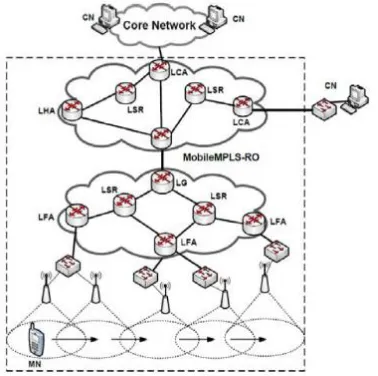
network. The author performed the work on a linear network under the topological specifications and the load constraints [2]. Another to optimize the MPLS network is performed by Ali Diab in year 2006. The author also performed the optimization of the network under the node mobility framework. In this mobility based MPLS Architecture, the major problem discussed is the handover mechanism. To provide the optimized communication the multi protocol label switching. The author has defined an integrated approach respective to the traffic engineering and the QOS system. The author has provided an efficient and reliable handover approach. The approach presented here is the secure and dedicated tunnel based approach that provided the transparency over the network and provide the effective communication over the network [3]. Another scheme to control the communication over the MPLS network is defined by Bin Li in year 2009. In this work author has defined an effective transportation technology to provide the effective bandwidth usage. The scheme provided for the communication is the cascaded packet transfer scheme. Author also performed the analysis transportation scheme in MPLS network and provides a modular design so that the effective functional model is presented along with bandwidth utilization and to improve the network the network communication [4]. In Year 2011, Rolf Winter defined the entire advance and the future aspects of MPLS network. Large operators have embraced multiprotocol label switching, deploying it in their backbone networks to enable a number of services and applications such as virtual private networks to just name one. This article is a short tutorial on what MPLS-TP is, how it came about, and what it promises to deliver in the future [5]. In Year 2011, Zhihui Zhang presented a work on the secure transportation in multiservice in MPLS tp networks. The author has defined the work with two main secure approaches to provide the reliable MPLS services. The work was focused basically on VOIP and IPTV services over the network. The author also studies the interconnected networks with growing packet scheme along with traditional services. The author has performed the analysis on dedicated ring network. Both the proposed schemes based on the interconnected rings structure extend the protection methods defined in the latest joint ITU-IETF draft standard to MPLS-TP ring structure, which is a widely deployed topology of legacy networks and has the natural ability to support resiliency. And they have an adapted OAM function which has the ability to monitor the multi-service status, such as configuration failures, software failures and performance degradation, to ensure the reliability of the whole branch and normal nodes in MPLS-TP rings. Finally, Author present an innovative multi-service test-bed for MPLS-TP networks to demonstrate the transport performance of interconnected rings [6]. Another work on route optimization was proposed by Savinya Polvichai in 2011. This paper proposes a route optimization protocol to overcome this problem in Mobile MPLS. By adding a correspondent agent function to Mobile MPLS's edge routers, the mobility binding of a mobile node can be cached by the edge routers and the packet routing to the mobile node can be route-optimized. Author evaluate Presented proposal by implementing it on the Network. The obtained results show the effective MPLS network [7].
© 2015, IJCSMC All Rights Reserved
245
Networks". Author presents the logical structure of the program as well as example measurements scenarios and results, for packet and connection level simulations. Author also describes shortly the Vims, a graphical extension to the msim simulator [14].
III.
MPLS COMMUNICATION MODEL
MPLS is evolved through ATM and frame relay VAN networks; MPLS uses labels to advertise between different routers by means of label mapping through label switching mechanism. Previously frame relay uses frames while ATM uses cells to map labels, to label switching techniques, frames cannot be of fix length while the cells consists of fix length with 5 bytes of header and 48 bytes of payload. ATM and frame relay are identical in a way when label traversing each hop in the network causes the label to change the header value. This differentiate from the traditional IP network when IP packets are forwarded through router it does not change the value at the header of the IP packet i.e. destination IP address. MPLS also adds the label at the ingress Label Edge Router (LER) of the MPLS network, changes the label value at each LER within MPLS network until it reaches the egress LER, where completely removes the MPLS label and the data packet is forwarded towards destination IP address [3].
Figure 1 : MPLS Model
MPLS is based on the concept of label switching: An independent and unique label is added to each data packet and this label is used to switch and route the packet through the network. The label is simple essentially a short hand version of the packet header information so network equipment can be optimized around processing the label and forwarding traffic. This concept has been around the data communications industry for years. X.25, Frame Relay, and ATM are examples of label switching technologies.
© 2015, IJCSMC All Rights Reserved
246
A) WorkingMPLS is a technology used for optimizing traffic forwarding through a network. Though MPLS can be applied in many different network environments, this discussion will focus primarily on MPLS in IP packet networks, by far the most common application of MPLS today. MPLS assigns labels to packets for transport across a network. The labels are contained in an MPLS header inserted into the data packet.
These short, fixed-length labels carry the information that tells each switching node (router) how to process and forward the packets, from source to destination. They have significance only on a local node-to-node connection. As each node forwards the packet, it swaps the current label for the appropriate label to route the packet to the next node. This mechanism enables very-high-speed switching of the packets through the core MPLS network.
MPLS combines the best of both Layer 3 IP routing and Layer 2 switching. In fact, it is sometimes called a Layer 2-3 protocol. While routers require network-level intelligence to determine where to send traffic, switches only send data to the next hop, and so are inherently simpler, faster, and less costly. MPLS relies on traditional IP routing protocols to advertise and establish the network topology. MPLS is then overlaid on top of this topology. MPLS predetermines the path data takes across a network and encodes that information into a label that the network routers understand. This is the connection-oriented approach. Since route planning occurs ahead of time and at the edge of the network (where the customer and service provider network meet), MPLS-labeled data requires less router horsepower to traverse the core of the service provider's network.
IV. CONCLUSION
In this paper, an model of MPLS communication is been presented. The presented model has explored the use of label switching instead of IP Adderssing. The paper has explored the basic function of MPLS model along with communication analysis.
References
[1] Gaeil Ahn," Design and Implementation of MPLS Network Simulator Supporting LDP and CR-LDP", 0-7695-0777-8/00 @ 2000 IEEE
[2] David Applegate," Load optimal MPLS routing with N + M labels", 0-7803-7753-2/03@2003 IEEE
[3] Ali Diab," Optimized I-MPLS: A Fast and Transparent Micro-Mobility-Enabled MPLS Framework", 1-4244-0398-7/06@2006 IEEE
[4] Bin Li," Cascaded Packet Transfer Schemes to Improve Wireless T-MPLS Network Bandwidth Efficiency", 978-1-4244-3693-4/09©2009 IEEE
[5] Rolf Winter," The Coming of Age of MPLS", IEEE Communications Magazine 0163-6804/11 © 2011 IEEE
[6] Zhihui Zhang," Demonstration of Transport and Protection Schemes in a Multi-service Testbed for MPLS-TP Networks", 978-1-4244-6554-5/11©2011 IEEE
[7] Savinya Polvichai," Mobile MPLS with Route Optimization: The Proposed Protocol and Simulation Study", 2011 Eighth International Joint Conference on Computer Science and Software Engineering (JCSSE) 978-1-4577-0687-5/11©2011 IEEE
[8] James Kempf," OpenFlow MPLS and the Open Source Label Switched Router", 978-0-9836283-0-9@ 2011 ITC
[9] Ali Boudani," Multicast Routing Simulator over MPLS Networks", Proceedings of the 36th Annual Simulation Symposium (ANSS’03) 1080-241X/03 © 2003 IEEE
[10] O. de Bruijn," RSVP Browser: Web Browsing on Small Screen Devices".
[11] Farrah Farooq," QoS-based MPLS Multicast Tree Selection Algorithms", FIT’09, December 16–18, 2009, CIIT, Abbottabad, Pakistan. ACM 978-1-60558-642-7/09/12
[12] Najmul Hassan," Priority-based Allocation of Network Resources in Multi-class MPLS Networks", FIT’09, December 16–18, 2009, CIIT, Abbottabad, Pakistan. ACM 978-1-60558-642-7/09/12
[13] Svetlin Petrov," Main Components of a MPLS Recovery Approach", International Conference on Computer Systems and Technologies - CompSysTech’ 08