Optimizing the performance of a real time queue using SimEvents
Anu Kadian
1M Tech, DCRUST, Murthal, Haryana
Abstract - Discrete event systems are hard to model and optimize due to their irregular occurrence of events. Existing Discrete systems like queuing systems were designed to model single server queue manually. There was hardly any system to simulate incoming and outgoing of customers in and out of banking queue. Apart from simulation there was a problem of calculating average queue length of customers at any instant of time. Our experiment not only simulates a random and variable queue of customers but it also calculates average queue length of customers.
Also our experiment gives methods that can be used to optimize the queue length and manage the average queue length of the costumers.
Fourthly it automates the behavior of queue according to varying servers for processing the customers. Load can be managed by increasing or decreasing the number of servers processing the customers.
.
1. Introduction
Queuing system with vacations has been attracted considerable attention to many authors. It has effectively been applied in computers and communication systems production/inventory system. It is presented an excellent survey of queuing system with server vacations. One of the important achievements for vacation queuing system is the famous stochastic decomposition results, which was first established by authors [1]. . They derived the system size distribution which confirmed the famous stochastic decomposition property, and the optimal stationary operating policy was also investigated. At the present day, batch arrival queuing system under N-policy with different vacation policies have been received considerable attention because of its practical implication in production/inventory system have considered batch arrival queuing system under N-policy with various vacation policies [2]
To be more realistic, the machine need a setup time for some preparatory work before starting processing. When all the semi-finished products in the system are processed, the machine is shut down and leaves for a vacation. The operator performs machine repair, preventive maintenance and some other jobs during the vacation [2]. After these extra operations, the operator returns and checks the number of semi-finished products in the queue determining whether or not start the machine. The N-policy was first introduced by which is a control policy turning the server on whenever N (a predetermined value) or more customers in the system, turning off the server when system is empty. it is successfully combined the batch arrival queue with N-policy and obtained the analytical solutions. Later, it is analyzed in detail a batch arrival Mx/G/1 queue under N-policy with a single vacation and repeated vacation respectively[2][3]. It is to be noted that few authors involved above considered the probability
systems [8]. Daigle illustrates how the M/G/1 paradigm can be used to obtain fundamental insight into the behavior of a slotted-time queuing system that represents a statistical multiplexing system. This time may be utilized by the server to carry out some additional work. On return from a vacation, if he finds “a” or more customers waiting, he takes them for service. Otherwise, he may remain idle (dormant) and continue to do so until the queue length reaches “a.” In queuing literature, such types
of queues are known as bulk service queues with single vacation. Bulk service queues are, generally speaking, hard to analyze [9]. The server works until all customers in the queue are served then takes a vacation; the server takes a second vacation if when he is back, there are no customers waiting, and so on, until he finds one or more waiting customers at which point he resumes service until all customers, including new arrivals, are served [10.]
2. Literature survey RESEARCHER OBJECTIVE METHODOLOGY FINDINGS Peschansky et. Al
[11]
to propose a methodology for designing a central maintenance
workshop, enabling the evaluation of performance in terms of cost and sojourn time, for a given budget.
modeling
framework based on queue networks
leads to a maintenance decision support tool enabling to give the structure of the MW, performing at a higher level, but at a reasonable configuration cost.
Tony Proctor [12] to focus on the ED's operational level and determine an optimal fast track strategy to improve performance measures
analysis of scenarios for optimizing fast track.
Length of stay and queue length were most significantly reduced when there was an increased physician presence in the fast track system, followed by an additional emergency nurse practitioner in the system. Finally, the implementation of See‐and‐treat had a negligible effect on both performance measures for fast‐tracked patients
vor Church [13] . Waiting time and the impact it has on customer perceptions of service quality is considered alongside a typology of customers, based on their waiting characteristics. A number of critical components that affect customer queuing and crowding emerge as an inherent
part of the
production‐line service system
Case study that modern computer‐based simulation packages offer a way of measuring most of the influencing factors, and is an opportunity for leading fast food retailers to optimize their (total) product positioning.
Wang et. Al [14] describes a restructuring effort of a Hong Kong‐based company, which provides technical support services in office equipment,
explore the different options and to evaluate the results for restructuring the existing call centers.
products
Yu [15] Suggests that hospitals are faced with variable demand patterns, and simulation provides managers with a powerful means to access the demands on resources created by different case scenarios
Case study Outlines the iterative development of a case study of patient flows at one clinic in an out‐patients department, describing the
software used ‐ a
Windows‐based simulation environment called SIMUL8.
Zadeh et al. [16] Royal Navy’s manpower planning system represents a highly complex queue which aims to provide sufficient manpower to meet both operational and structural
commitments
Experimental design illustrates how computer simulation and experimental design was applied to identify the key risk variables within the manpower planning system at the UK’s Royal Navy.
Zineb Simeu [17] focuses on a conceptual
methodology for an integrated
simulation model dubbed as dynamic simulation modeling system (DSMS) for proactive and optimal decision making within a project management
framework.
simulation model Possible extensions are outlined. The C++ programming language in association with the object‐oriented database management system is used to achieve the aforementioned objectives.
Work done by different researchers on queue simulation over the years.
3. Scope of the paper
1. Simulation of a real time queuing system 2. Simulating average queue length of
customer
3. Determining average queue length of the customer
4. Changing system from single server to multiple servers to manage server load 5. Optimizing the queuing system
4. Methodology used in the paper
1. Deriving a random number generator to generate n - random customrs arriving at any instant of times.
2. Generaing a odered queue
3. Using a single server to process n customesrs
4. Simulating the system response to increasing number of customers with single server using simulink.
6. Plotting the simulation output with single server
7. Varying single server to multiple server to reduce the average queue length and load on the server
8. Simulating the system response to increasing number of customers with multiple servers.
9. Plotting the optimized output using simulink
10. Using matlab code to automate the system
5. Results and conclusion
1. A discrete event system is presented in the model.
2. The model is implemented with a FIFO queue.
3. Here we are measuring the average queue length of customers in a queue per unit of time
4. The model is ready to run as presented in the figure 1
Figure 1-Model used in the paper
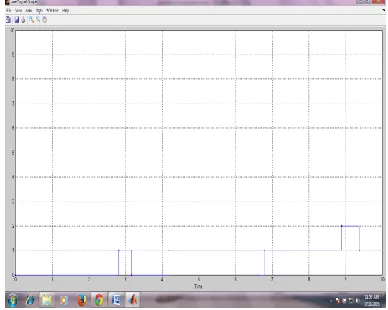
5. Model is run for time unit t=10 units 6. Here we see queue length is steady in the
beginning then it is rising high up to 2 customers in a queue (Fig 2)
Figure 2 – Output scenario
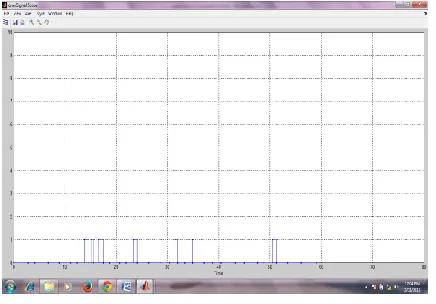
7. Now when we stress test the system and run the system for time t=60 units (Fig 3), we see queue length rapidly increases to 11 customers per queue with time
Figure 3
8. In above cases we were dealing with single server only. It is evident that using single server a queue processing system cant run efficiently and queue length increases rapidly with increasing stress of customers. 9. To overcome this problem and optimize our
system we are increasing the number of servers from 1 to 2.
Figure 4 – Optimized performance
11. Thus we are modeling and optimizing a discrete event system with Sim Events library in real time.
References
1. Baruah et. Al. (2013), A Two Stage Batch Arrival Queue with Reneging during Vacation and Breakdown Periods , American Journal of Operations Research, 3, 570-580
2. Brill et. Al.(2013), Server Workload in an M/M/1 Queue with Bulk Arrivals and Special Delays , Applied Mathematics, 2012, 3, 2174-2177
3. Brian Lehaney, Harry Kogetsidis, Steve Clarke, (1996) "A case study of patient flows using Windows‐based computer simulation", Work Study, Vol. 45 Iss: 6, pp.17 – 21
4. Gandole (2011), Computer Modeling and Simulation of Ultrasonic System for Material Characterization, Modeling and Numerical Simulation of Material Science, 1, 1-13
5. Hemanta Doloi, Ali Jaafari, (2002) "Conceptual simulation model for strategic decision evaluation in project management", Logistics Information Management, Vol. 15 Iss: 2, pp.88 - 104 6. Jennifer La, Elizabeth M. Jewkes, (2013)
"Defining an optimal ED fast track strategy using simulation", Journal of Enterprise Information Management, Vol. 26 Iss: 1/2, pp.109 - 118
7. Kokin Lam, R.S.M. Lau, (2004) "A simulation approach to restructuring call
centers", Business Process Management Journal, Vol. 10 Iss: 4, pp.481 – 494
8. Kukla (2008), Rationalization of foundry processes on the basis of simulation experiment, Archives of foundry engineering, Volume 8 Issue 3
9. Kumar (2014), A single server markovian queuing sytem with discouraged arrivals and retention of reneged coustumers, Yugoslav Journal of Operations Research 24 , Number 1, 119-126
10. Marcus Blosch, Jiju Antony, (1999) "Experimental design and computer based simulation: a case study with the Royal Navy", Managing Service Quality: An International Journal, Vol. 9 Iss: 5, pp.311 – 320
11. Peschansky et. Al. (2011), Stationary Characteristics of the Single-Server Queue System with Losses and Immediate Service Quality Control Applied Mathematics, 2011, 2, 403-409
12. Tony Proctor, (1996) "Simulation in hospitals", Health Manpower Management, Vol. 22 Iss: 5, pp.40 - 44
13. vor Church, Andrew J. Newman, (2000) "Using simulations in the optimisation of fast food service delivery",British Food Journal, Vol. 102 Iss: 5/6, pp.398 - 405 14. Wang et. Al. (2009), On the Scalable
Fairness and Efficient Active Queue Management of RED, I. J. Communications, Network and System Sciences, 1, 1-89 15. Yu (2010), Steady-State Queue Length
Analysis of a Batch Arrival Queue under N-Policy with Single Vacation and Setup Times, Intelligent Information Management, 2010, 2, 365-374
16. Zadeh et al. (2012), A Batch Arrival Queue System with Coxian-2 Server Vacations and Admissibility Restricted, American Journal of Industrial and Business Management, 2, 47-54