Western University Western University
Scholarship@Western
Scholarship@Western
Electronic Thesis and Dissertation Repository
4-27-2018 10:30 AM
Analysis Challenges for High Dimensional Data
Analysis Challenges for High Dimensional Data
Bangxin Zhao
The University of Western Ontario
Supervisor He, Wenqing
The University of Western Ontario
Graduate Program in Statistics and Actuarial Sciences
A thesis submitted in partial fulfillment of the requirements for the degree in Doctor of Philosophy
© Bangxin Zhao 2018
Follow this and additional works at: https://ir.lib.uwo.ca/etd
Part of the Applied Statistics Commons, Biostatistics Commons, Microarrays Commons, Multivariate Analysis Commons, Numerical Analysis and Scientific Computing Commons, Statistical Methodology Commons, and the Theory and Algorithms Commons
Recommended Citation Recommended Citation
Zhao, Bangxin, "Analysis Challenges for High Dimensional Data" (2018). Electronic Thesis and Dissertation Repository. 5370.
https://ir.lib.uwo.ca/etd/5370
This Dissertation/Thesis is brought to you for free and open access by Scholarship@Western. It has been accepted for inclusion in Electronic Thesis and Dissertation Repository by an authorized administrator of
Abstract
The practical and theoretical challenges posed by the ‘largep, smalln’ settings are
important issues in contemporary statistics. In this thesis, we propose new
methodolo-gies that target three different areas of high-dimensional statistics: variable screening,
influence measure and post-selection inference.
Variable screening is a general procedure in high dimensional data analysis to
en-sure the applicability of statistical methods. Typically marginal correlation between
the response and each predictor are employed for this role. It is a complicated and
computationally burdensome procedure since spurious correlations commonly exist
among predictor variables, and important predictor variables may not have large
marginal correlations with the response variable. We propose a new estimator for
the correlation between the response and high-dimensional predictor variables, and
based on the estimator we develop a new screening technique termed Dynamic
Tilt-ed Current Correlation Screening (DTCCS) for high dimensional variables screening.
DTCCS is capable of picking up the relevant predictor variables within a finite number
of steps. The DTCCS method includes the widely used sure independence screening
(SIS) method and the high-dimensional ordinary least squares projection (HOLP)
approach as special cases. The DTCCS technique has sure screening and
consisten-cy properties which are demonstrated theoretically and numerically and illustrated
through a real-life example.
Two methods of high-dimensional influence measure have also been explored.
They are from the perspective of the extreme value distribution (EVD) and the
robust-ness of design respectively. For the first method, EVD-type statistics have been shown
to be powerful in measuring high-dimensional influence theoretically and numerically.
From the second method, we propose Hellinger distance for high-dimensional
influ-ence measure (HD-HIM). The inner product of two transformed influence functions
is used to measure the Hellinger distance of two discrete distribution functions from
that have unusual effect on high-dimensional models. The HD-HIM method has been
illustrated theoretically and numerically.
Lastly, we propose a post-selection inference method termed Cosine PoSI that is
numerically feasible in a high-dimensional framework. Cosine PoSI focus on the
geo-metric aspect ofLeast Angle Regression (LARS). LARS efficiently provides a solution
path along which the entered predictors always have the same absolute correlation
with the current residual. At each step of the LARS algorithm, the proposed Cosine
PoSI method employs an angle from the correlation between the entering variable
and current residual and considers this angle as a random variable from the cosine
distribution. The post-selection inference is then conducted based on the order
statis-tics of this cosine distribution. Given the collection of the possible angles, hypothesis
tests are performed on the limiting distribution of the maximum angle. To confirm
the effectiveness of the proposed method, we conduct simulation studies and a real-life
data analysis to illustrate the usefulness of this post-selection method.
KEYWORDS: High-dimensional statistics, variable screening, deterministic
Acknowledgements
This dissertation could not have been possible without the help and the support of
several individuals. First and foremost, I would like to express my deepest gratitude
to my beloved supervisor, Dr. Wenqing He, for his immense support and extremely
valuable guidance throughout my Ph.D. study. Without his consistent and
illuminat-ing instruction, I would not be where I am today. I not only learned new statistical
knowledge from him, but also learned how to conduct research with creativeness and
better vision. His enthusiasm to help his students will always be a good example and
guide me in my future.
I would also like to express my heartfelt gratitude to the examiners of my thesis
defense committee, Dr. John Koval, Dr. Jiandong Ren, Dr. Douglas Woolford and
Dr. Mu Zhu, for their time, insightful questions, valuable comments, suggestions and
discussions on my research work. I want to thank Dr. Reg Kulperger for sharing his
vast knowledge and giving suggestions during my thesis and proposal writing.
I owe my honest gratitude to Dr. David R. Bellhouse, Dr. Ian McLeod, Dr. Serge
Provost, Dr. Hao Yu and Dr. Ricardas Zitikis. I also want to thank all the faculty
members and staff in our department for their invaluable help. Their kindness and
help during these wonderful years at the University of Western Ontario is appreciated.
Many special thanks go in particular to Dr. Grace Y. Yi for sharing her valuable
experience in scientific writing and paper preparation.
I want to thank Dr. Wenqing He again, and Dr. Rohana J. Karunamuni, Dr.
Qingguo Tang for being great co-authors.
I am deeply grateful for all the fun time I had with my friends during my Ph.D.
study. I thank Xin Liu, Jiang Wu, Wenjun Jiang for being great officemates and for all
the interesting discussions and sports time. I appreciate all the cultural discussions
and game play with Wisdom Stallone Avusuglo and Hossein Zareamoghaddam. I
thank Dexen Xi, Chen Yang, Guandong Zhang, Kexin Luo for the R discussions. It is the dream of everyone to play an important role on the stage surrounded
by loyal audiences. However, our sense of security, hopefulness, confidence, and
midst of despondency, insecurity, and disappointment. I consider myself a lucky fellow
to have such supportive family members. Especially, my wife, Zhe (Aggie) Yu, and my
parents whose unwavering support and love these years cannot be overemphasized. I
Contents
List of Tables iv
List of Figures vi
1 Introduction 1
1.1 Motivation and Purpose of the Dissertation . . . 1
1.2 The High-dimensional Design Matrix . . . 3
1.3 High-dimensional Linear Regression . . . 7
1.3.1 Penalized Regression . . . 7
1.3.2 Correlation Learning . . . 10
1.4 Diagnostic Techniques . . . 15
1.4.1 Classical Influential Diagnostic Measure . . . 16
1.4.2 Development of High-Dimensional Influence Measure . . . 18
1.5 Contribution of this Thesis . . . 21
2 Dynamic Tilted Current Correlation for High Dimensional Variable Screening 25 2.1 Introduction . . . 26
2.2 The Model and Notations . . . 28
2.3 Proposed Methodology . . . 29
2.3.1 Inferential Methods . . . 29
2.3.2 Theoretical Results . . . 36
2.4.1 Simulation Studies . . . 46
2.4.2 Real Data Analysis . . . 53
2.5 Deterministic Extensions . . . 54
2.5.1 High-dimensional Deterministic Design Matrix . . . 55
2.5.2 Inferential Methods . . . 57
2.5.3 Simulation Studies . . . 67
2.6 Discussion . . . 69
3 Analysis Challenges for High Dimensional Influence Measure 70 3.1 Introduction . . . 72
3.2 High-dimensional Influence Measure Based on EVD Statistics . . . . 74
3.3 High-dimensional Influence Measure Based on Robustness of Design . 79 3.3.1 Inference of Proposed Method . . . 84
3.4 Numerical Studies . . . 88
3.4.1 Simulation Study of EVD-HIM . . . 89
3.4.2 Simulation Study of HD-HIM . . . 90
3.5 Conclusion and Discussion . . . 110
4 Cosine Distribution in the Post-Selection Inference of Least Angle Regression 112 4.1 Post-selection Inference . . . 113
4.2 Methodology . . . 115
4.3 Numerical Studies . . . 120
4.3.1 Simulation Studies . . . 121
4.3.2 A Real Data Application . . . 124
4.4 Discussion . . . 125
5 Concluding Remarks and Future Work 128 5.1 Conclusions and Discussions . . . 128
5.2 Future Work . . . 130
List of Tables
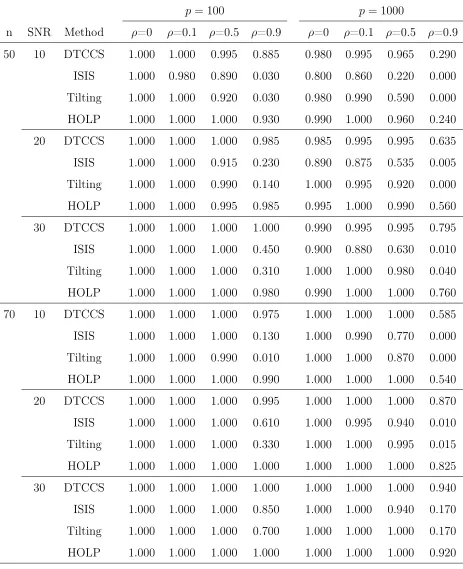
2.1 Screening Accuracy for Scenario I . . . 48
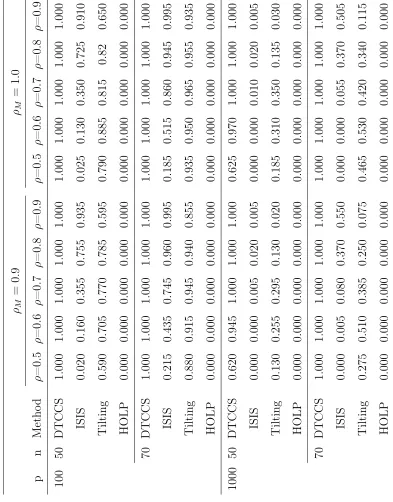
2.2 Screening Accuracy for Scenario II . . . 50
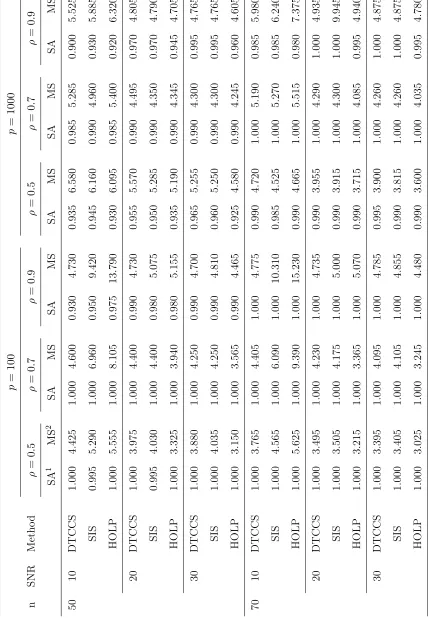
2.3 Screening Accuracy and Final Model Size for Scenario III . . . 52
2.4 Data Analysis of Leukemia Data (LOOCV) . . . 54
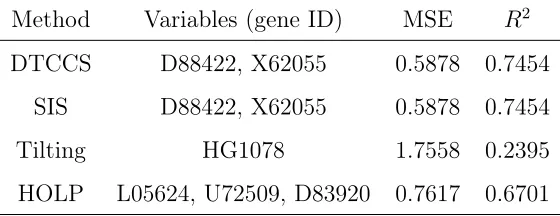
2.5 Final Models for Leukemia Full Data using Different Methods . . . . 54
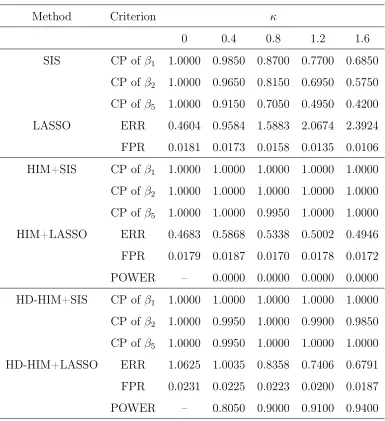
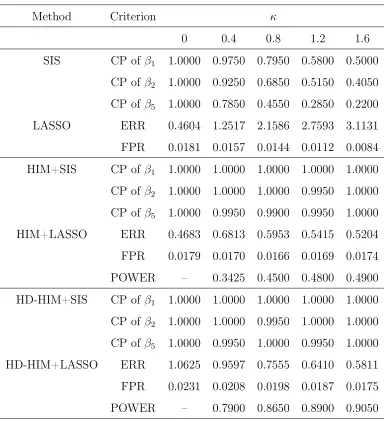
3.1 Influence Detection of EVD-HIM . . . 90
3.2 Simulation results for case 1 withK = 1 . . . 92
3.3 Simulation results for case 1 withK = 2 . . . 93
3.4 Simulation results for case 1 withK = 3 . . . 94
3.5 Simulation results for case 1 withK = 4 . . . 95
3.6 Simulation results for case 1 withK = 5 . . . 96
3.7 Simulation results for case 2 withK = 1 . . . 98
3.8 Simulation results for case 2 withK = 2 . . . 99
3.9 Simulation results for case 2 withK = 3 . . . 100
3.10 Simulation results for case 2 with K = 4 . . . 101
3.11 Simulation results for case 2 with K = 5 . . . 102
3.12 Simulation results for case 3 with K = 1 . . . 104
3.13 Simulation results for case 3 with K = 2 . . . 105
3.14 Simulation results for case 3 with K = 3 . . . 106
3.15 Simulation results for case 3 with K = 4 . . . 107
4.1 Selected Model Size and Selection Accuracy for Scenario I . . . 122
4.2 Selected Model Size and Selection Accuracy for Scenario II . . . 123
4.3 Data Analysis of Eye Microarray Data (LOOCV) . . . 125
List of Figures
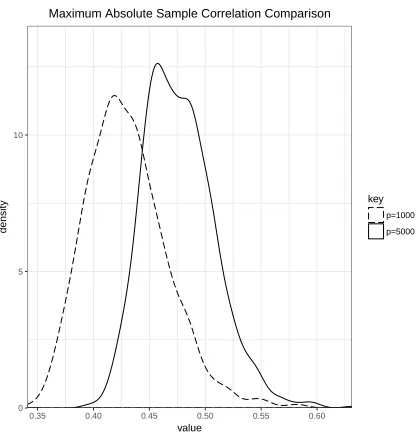
1.1 Distribution of the maximum absolute sample correlation coefficients
between X1 and {Xj}j̸=1 when n = 60; p = 1000 (dashed curve) and
n= 60; p= 5000 (solid curve). . . 14
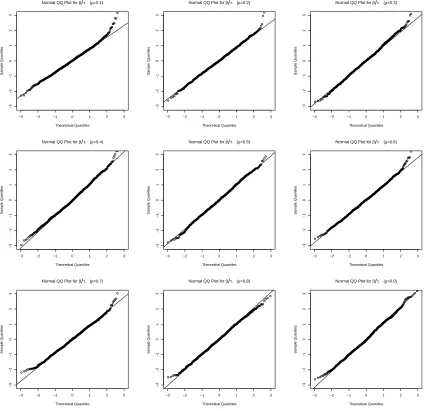
2.1 Normal QQ Plot for β/τ with ρ= 0.1, . . . ,0.9. . . 68
3.1 Power comparison between HIM and HD-HIM of case 1 . . . 97
3.2 Power comparison between HIM and HD-HIM of case 2 . . . 103
3.3 Power comparison between HIM and HD-HIM of case 3 . . . 109
Chapter 1
Introduction
1.1
Motivation and Purpose of the Dissertation
With rapid development in technologies, a growing number of research fields
en-counter data with unprecedented size and complexity, such as researches in artificial
intelligence, economy, finance, biology, genetics, engineering and astronomy. The
importance of data and the vitality of data analysis cannot be downplayed in
con-temporary science. As computational power increases and the expense of data
collec-tion and processing decrease significantly, the dimension of datasets is continuously
becoming large. In those dataset, the dimension of predictor variables p can be as large as or much larger than the sample size n, but very often, among thousands of available predictor variables only a small number of them are informative and it is
critically important to identify them correctly. High-dimensional data analysis has
re-ceived a tremendous of attention recently. Seminal theories ofLeast Angle Regression
(LARS, Efron et al. 2004) and Sure Independence Screening (SIS, Fan and Lv 2008)
both proposed to use correlation between predictor variables and response (or current
residual) to solve high-dimensional problems. The high-dimensional correlation can
be viewed as a counterpart to ordinary least square (OLS) estimator of the parameter
and many data-driven methods based on correlation have been studied for years in
high dimensional statistics. In this dissertation, we develop new methodologies and
The methodologies proposed in this dissertation is aiming to solve but not limited to
the following high-dimensional problems:
Example 1.1.1. Hastie et al. (2009): Microarrays gene expression data
Microarrays gene expression data is one of the classical high-dimensional data
types. DNA microarrays measure the expression of a gene in a cell by measuring the
amount of mRNA present for that gene. A gene expression data set collects together
the expression values from a sequence of DNA microarray experiments, with each
column representing an experiment. There are therefore several thousand (p) rows
representing individual genes and tens (n) of columns representing samples.
Typical questions about microarray data: certain genes show abnormal expression
for certain cancer sample; certain genes are more important in a certain disease and
et cetera. Traditional statistical methods can not be directly applied to answer those
questions.
Example 1.1.2. Biba and Xhafa (2011): High-dimensional text regression
The design matrix of the bag-of-words (BOW) model consists rows of high
dimen-sional vector whose elements are the frequency of words. The BOW model has been
widely applied in machine learning topics such as email filtering. For more details
see Biba and Xhafa (2011). Statistical diagnostic techniques can be also contribute
to these problems. We measure the influence of the high-dimensional observations
(the email) and expect to automatically flag the email category and give warning to
a suspicious email.
Besides the above two examples, other high-dimensional problems to which the
methods developed in this thesis could be applied are image recognition (pixels of the
high resolution images are large); spatial correlation of home prices (up to 1 million
spatial parameters), retailer real-time pricing (for millions of items), amongst others.
In the rest of this chapter, we provide a review of the literature on the relevant
topics covered in this thesis, which include matrices with applications in statistics,
development in high-dimensional sparse modelling and estimation, robust statistics
1.2
The High-dimensional Design Matrix
Over the past decade, advancement of new technologies in the fields of the natural and
social sciences have improved data collection procedures. This has led to the problem
of high-dimensional data analysis which links to the idea of a complicated large design
matrix, denoted X. For this n×pdesign matrix, the number of predictor variables, p, is either on the same order of, or much greater than, the number of observations, n. For instance, data ascertained from spectra, biomedical imaging, high-frequency finance and DNA micro-arrays can be of high-dimension. The traditional methods
that perform well for low-dimensional data run into many severe problems in analyzing
such a dimensional dataset. The common issues that arise in analyzing a
high-dimensional dataset by using traditional methods include: the non-invertibility of the
matrix XTX, the high correlation among predictors in the model, the non-existence
of the inverse covariance matrix (precision matrix), amongst others.
The high-dimensional dataset with p≈n or p > ncan be divided into two cases:
high dimension and ultra-high dimension. If the dimensionalitypgrows polynomially with the sample sizen, i.e.,p=O(nα)for someα >0, we call ithigh dimension; if the dimensionality p grows non-polynomially with the sample size n, i.e., p=O(enι
) for someι ∈(0,1), we call itultra-high dimensionornon-polynomial (NP) dimensionality
(Fan and Lv 2008; Shao and Deng 2012).
We begin with the most important and commonly used regression model, the
classical linear regression model. Linear regression model investigates the
relation-ship between a continuous dependent variable (normally referred to as the response
variable), and at least one explanatory variable (also known as predictor or
covari-ate). In classical statistical model setting, the number of observations is typically
denoted asn, while the number of predictors in a model (referred to as the dimension of the model) is denoted as p. For subject i in a sample of n individuals, let yi be
the response variable and xi = (xi1, xi2, . . . , xip)T be the p dimensional predictors.
and X=
xT
1 xT2 .. .
xTn
be the n×p design matrix including thepdimensional predictors
for n subjects. In this thesis, the subset columns or rows of the design matrix are frequently used. X˜−j denotes the submatrix of deleting the jth predictor variable,
Xj, j = 1, . . . , p. X(−i) denotes the submatrix of deleting the ith observation, xi,
i = 1, . . . , n. To ease the notations, we use Xj, j = 1, . . . , p, for the jth predictor
variable and the its realization in the design matrix. The relationship between the
response y and the predictor variables (X1, . . . ,Xp)T is given by
y=β1X1+β2X2+· · ·+βpXp+ϵ, (1.1)
where ϵ is the random error. Alternatively, this classical model can be written with realization in sample size n,
Y =Xβ+ϵ, (1.2) where β ∈Rp is the vector of the coefficients and ϵ∈Rn is the noise term. Usually,
we assume ϵ ∼ N(0, σ2I). Alternatively, X can be considered as a row of column vectors: X = (X1,X2,· · · ,Xp), where Xj = (x1j, . . . , xnj)T for j = 1, . . . , p. Let
row(X) be the linear p−dimensional space which is spanned by the row vectors of X and col(X) be the linear n−dimensional space which is spanned by the column vectors of X.
Now, let xbe ap dimensional random vector with multivariate distribution with mean µp×1 and covariance Σp×p defined as follows:
E(x) =µ, cov(x) = Σ.
Let ¯xand S denote the sample mean and sample covariance matrix, respectively. Define1n = (1, . . . ,1)T, an n×1 vector of ones, so that we have
¯
x= 1
nX
T1
n (1.3)
and
S = 1
n(X−X¯)
T(X−X¯), (1.4)
whereX¯ is an×pmatrix with each row comprised ofx¯T. It must be noted here that
¯
x and S are unbiased and consistent estimators forµandΣrespectively. The sample covariance matrix S is a good estimator of the population variance if n ≫ p, but it performs poorly when p is close to or larger than n (Cai et al. 2016). In the high-dimensional context, the estimation of the precision matrix (Ω = Σ−1, the inverse of the covariance matrix) is also a difficult and computational complex question.
Cai et al. (2011) proposedconstrainedl1−minimization for inverse matrix estimation
(CLIME) to directly calculate Ω by an optimization problem
min∥Ω∥1 subject to|SΩ−Ip|∞ ≤λn, (1.5)
where ∥ · ∥1 is the elementwise L1 norm (∥Ω∥1 =
∑
i,j|Ωi,j|), ∥ · ∥∞ is the matrix
elementwise infinity norm (∥Ω∥∞= max
1≤i,j≤p|Ωi,j|), andλn= clog(p)
n for some sufficiently
large constant c. This method has been built in the R packageclime, but it is still a time-consuming computing process to obtain the estimated precision matrix in
high-dimensional statistics.
In the random design setting for linear regression, each pair (xTi ,yi)is the
obser-vation sampled from the population, where random vector xi = (xi1, . . . , xip)T ∈ Rp
and random variable yi ∈ R1. If the design matrix X in Eq. (1.2) consists of
random vectors, we call X a random design matrix. The random xi’s are usually
assumed to be independent identically distributed (i.i.d.) and independent of ϵi’s,
and βˆ= [cov\(xi)]−1cov\(xi,yi).
The fixed design setting is the opposite of the random design setting, and the
design matrix in this setting is called deterministic design matrix. Let X˜−j be the
orthogonal complement of the column space of X˜−j. By using a deterministic design
matrix, the least square estimator can be expressed as βˆj = (X⊥j T
Y)/(X⊥j TXj)for a
linear model without intercept, whereX⊥jTXj ̸= 0forn > p(Zhang and Zhang 2014).
These two settings of the design matrix bring two views of parameter estimation:
a probabilistic one and a nonprobabilistic one. The goal of both views is to find
coefficients βˆsuch that the expected prediction error on a new observation from the
population is small enough. For the past two decades, statisticians extended those two
views to high-dimensional data, and developed many contemporary methodologies
and techniques for large random or deterministic design matrix, see details in Fan
and Lv (2008), Shao and Deng (2012), Lv (2013), Zhang and Zhang (2014) and
Wang and Leng (2016).
The column space (also called the range or image) of a design matrix X is
com-monly used in parameter estimation in the case ofn > p. The ordinary least squares (OLS) estimate projects the responseY onto the linear spacecol(X)which is spanned by columns of X. Due to lack of sufficient degrees of freedom, OLS is no longer
fea-sible for high-dimensional statistics. This motivates the idea of variable screening,
i.e., to obtain a subset of features that have significant impact on the response before
building a formal statistical model. In contrast with column space ofX, row space of
X has been studied recently under high-dimensional setting. Shao and Deng (2012)
proposes an approach to project the parameter vectorβonto the linear spacerow(X)
which is spanned by the rows ofXand show that this projection ofβcan discriminate
large and small elements efficiently by choosing a proper thresholding value.
For p > n, considering the ridge regression estimator of β (Hoerl and Kennard 1970) under model (1.2),
ˆ
βridge = (XTX+λIp)−1XTY, (1.6)
where λ > 0 is an appropriately chosen regularization parameter. Shao and Deng (2012) and Wang and Leng (2016) show that the computation of βˆridge involves only
inverting ann×n matrix since(XTX+λI
p)−1XT =XT(XXT+λIn)−1 which implies
1.3
High-dimensional Linear Regression
1.3.1
Penalized Regression
Due to rapid development of technological advances, modern scientific research very
often encounters datasets with unprecedented size and complexity, such as datasets
in genomics, oncology imagery and finance. In practice, it is common to have huge
number of variables for predicting a particular phenomenon or outcome. Suffering
from high dimensionality, variable selection, which is vitally important in statistical
modelling, encounters a big challenge. Many classical variable selection methods,
for instance, backward elimination, forward selection, stepwise selection, all subsets
selection, may be very computationally expensive or even infeasible. Missing relevant
predictors and/or including irrelevant predictors in a statistical model will decrease
model’s predictive ability and/or increase the difficulty of model interpretation.
The circumvention of the above problem has led to the idea of thepenalized
regres-sion. We give some basic notation before introducing some popular penalties which
have been successfully applied to achieve variable selection. For any p−dimensional vector a, ∥a∥0 = ∑pj=1I(aj ̸= 0), ∥a∥∞ = max1≤j≤p|aj| and ∥a∥q = (
∑p
j=1|aj|
q)1/q
for q≥1.
In the regularization framework, consider a sample{(xT
i ,yi)T, i= 1, . . . , n}of size
n from an unknown population, where xi ∈Rp and yi ∈ R1. Taking the square loss
function, we can select variables by solving
ˆ
β= arg min
β ∥Y −Xβ∥
2
2+λJ(β), (1.7) whereλis a non-negative tuning parameter,J(·)is a penalty function which is positive valued for β ̸= 0. A popular choice of the penalty function J(β) is the Lq norm of
the parameters to the qthpower (Tibshirani 1996, Zou and Hastie 2005),
J(β) = ∥β∥qq =
p ∑
j=1
|βj|q, q≥0. (1.8)
(1.8). Ridge regression is very similar to least squares, except that the coefficients
are estimated by minimizing a slightly different quantity,
ˆ
β= arg min
β ∥Y −Xβ∥
2
2+λ∥β∥ 2
2, (1.9)
whereλ≥0 is a tuning parameter. Eq.(1.9) is equivalent to the Lagrangian problem which minimize ∥Y −Xβ∥2
2 subject to ∥β∥22 ≤ t, where t is a non-negative tuning parameter. Ridge regression improves the OLS by shrinking all coefficients towards
zero, but it will still include allppredictors in the final model unlessλ=∞. Regular ridge regression shrinks the variables, but does not select the variables. Shao and
Deng (2012) propose the thresholded ridge regression which uses a threshold value
to select variables from the ridge solution. For the columnwise normalized X, the
estimates solution to the ridge regression is
ˆ
βridge = (XTX+λI)−1XTY
= 1 1 +λ
1 ρˆ12
1+λ . . . . . .
ˆ
ρ1p
1+λ
ˆ
ρ21
1+λ 1 . ..
.. . ..
. . .. ... . .. ... ..
. . .. 1 ρˆp−1,p
1+λ
ˆ
ρp1
1+λ . . . . . .
ˆ
ρp,p−1 1+λ 1
−1
XTY, (1.10)
where ρˆij = corr(Xi,Xj), the sample correlation. The off-diagonal elements of the
correlation matrix XTX are shrunk by the factor 1+1λ, which was termed as
decorre-lation by Zou and Hastie (2005). For the special orthonormal design case: XTX=I
where X is the n×p design matrix, we can check that ridge regression solution is 1
1+λβˆols where βˆols is the ordinary least squares solution. For the non-orthonormal
case, see details in Hoerl and Kennard (1970).
Tibshirani (1996) is the fundamental paper about Least Absolute Shrinkage and
Selection Operator (LASSO) by using L1 penalty which uses q= 1 in equation (1.8),
ˆ
β= arg min
β ∥Y −Xβ∥
2
LASSO shrinks some coefficients and sets others to 0. Hence, LASSO retains the good shrinkage feature of ridge regression and selects variables simultaneously.
Comparing Eq. (1.11) to Eq. (1.9), we see that the LASSO and ridge regression
have similar formulations. The only difference is that the LASSO uses anL1 penalty instead of anL2 penalty. The theoretical properties of LASSO have been well studied in the literature, see detail in Zhao and Yu (2006), Zhang and Huang (2008),
Mein-shausen and Yu (2009), Bickel et al. (2009), Lockhart et al. (2014) and Lee et al.
(2016). LASSO contributed to the rich literature on the path-based regression
meth-ods. The solution path based on those methods potentially make the high-dimensional
variable screening possible. Regardless of false discoveries, the coefficients selected by
the path-based regression algorithms contains the uniquely defined true model with
large probability. If false discovery is taken into consideration, Li and Barber (2017)
proposed a family of ‘accumulation tests’ to efficiently control the false discovery rate
(FDR) on the high-dimensional solution path.
Through the generalized L1 penalties, extensions and modified versions of LASSO have been suggested and studied for the past two decades, examples include adaptive
LASSO (Zou 2006), random LASSO (Wang et al. 2011) and generalized LASSO
(Tibshirani and Taylor 2011). Those generalized L1 penalties arise in a wide variety of areas such as microarray studies and image denoising. By combining a squared
L2 penalty with the L1 penalty, the elastic net was proposed by Zou and Hastie (2005). The elastic net method uses a linear combination of squared L2 and L1 penalties on the regression coefficients and aims to achieve the grouping effect that
highly correlated feathers will be in or out of the model together. Elastic net can be
formulated as the following penalized least squares problem,
ˆ
β= arg min
β ∥Y−Xβ∥
2
2+λ1∥β∥1+λ2∥β∥ 2
2, (1.12)
where λ1, λ2 ≥0 are tuning parameters which must be chosen in advance.
Efron et al. (2004) propose the least angle regression (LARS) algorithm with
a modification that can efficiently compute the LASSO solution path. The LARS
Forward-Stagewise Regression (FSR), but it uses a novel solution direction and step
size for each iteration. LARS can be considered as both a variable screener and a
model selector. The advent of LARS creates an era of correlation learning which
plays an important role in high-dimensional statistics for years. The importance
of correlation learning and the detail of the LARS algorithm will be introduced in
Section 1.3.2.
To achieve an unbiased, sparse and continuous estimator, Fan and Li (2001)
de-signed a smoothly clipped absolute deviation (SCAD) penalty function Jλ(β) with
derivative satisfying
J′λ(t) =λ
{
I(t≤λ) + (aλ−t)·I(aλ > t)
(a−1)λ ·I(t > λ)
}
, (1.13)
for t=|β| and some a >2.
1.3.2
Correlation Learning
Forward-type Regression
Marginal correlation between the individual covariates and response (or current
resid-ual) plays a critical role in both low dimensional and high-dimensional data analysis.
In low dimensional data analysis, the solution path of Forward Stepwise Regression
(FR) andForward-Stagewise Regression (FSR) are both iteratively calculated by
pick-ing the variable which has the largest absolution correlation with current residual.
In high-dimensional data analysis, a vast amount of literature on correlation research
has been done in recent years, including the LARS algorithm (Efron et al. 2004), the
SIS method (Fan and Lv 2008), thetilting procedure (Cho and Fryzlewicz 2012), and
High-dimensional Ordinary Least squares Projection (HOLP, Wang and Leng 2016).
Comparing with the step size at each iteration, FR is an aggressive fitting
tech-nique and it reaches the OLS solution (which is the longest step size) at each iteration,
while FSR is a conservative fitting technique which uses thousands of tiny moving
to obtain the final model. Hastie et al. (2009) describe the FSR as: starting with
Z1 =Y −µˆ1, then the initial marginal correlation is
ˆ
c1 =c(ˆµ1) = XT(Y −µˆ1). (1.14) Then select variable Xj1 which has the largest absolute correlation with the re-sponse (the current residual vector) Y, and the corresponding marginal correlation is
ˆ
C1 =∥ˆc1∥∞,sj1 =sign{XjT1Y}.
The first step is a construction of simple linear regression ofY onXj1 and it leaves a residual vector orthogonal to Xj1. After the first step, update the mean function to
ˆ
µ2 = ˆµ1+ ˆγ1·sj1·Xj1, (1.15) where γˆ1 is a ‘small’ constant (‘small’ is compared to the ‘big’ choice of Cˆ1 in FR), then select Xj2 which has the largest absolute correlation between the variables and the current residual vector Z2(= Y −µˆ2). After kth step, add the predictor Xj k+1 which is most correlated with the (k + 1)th residual vector Zk+1(= Y −µˆk+1) to the model. Stop the algorithm at the kth step if the rest predictors have negligible correlation with the current residual vector Zk.
Similar to FSR, LARS starts with no variables in the initial model, i.e. the active
model set M0 = {∅}. Let c(ˆµk) be the correlation vector of variables and current
residual at the kth stage
ˆ
ck =c(ˆµk) =XTZk =XT(Y −µˆk), k = 1,2. . . , p. (1.16)
At the first stage, LARS selects variableXj1which has the biggest correlation with the initial residual Z1 =Y, then LARS solution path takes the direction ofu1 =Xj1 for a step size ˆγ1 until some other predictor, say Xj2, has the same correlation with the current residualZ2, i.e. |⟨Xj1, Z2⟩|=|⟨Xj2, Z2⟩|. Then LARS solution path takes the direction u2 which bisects Xj1 and Xj2 with step size γˆ2 until a third variable comes into the model, i.e. |⟨Xj1, Z3⟩|=|⟨Xj2, Z3⟩|=|⟨Xj3, Z3⟩|.
At the beginning of the stage k, we have k−1 of the variables in the model. We are going to select variable Xjk which has the largest absolute correlation with the
current residual vectorZk, and the corresponding marginal correlation isCˆk=∥ˆck∥∞,
Sure Independence Screening
The SIS method of Fan and Lv (2008) ranks the absolute value of the marginal
correlations ω = |XTY| = (ω
1, . . . , ωp)T to choose the variables to be kept in the
model. Here, ω is essentially a vector of marginal correlation between the response
and all predictor variables. For any given δ ∈ (0,1), Fan and Lv (2008) sorted the p componentwise magnitudes of the vector ω in a decreasing order and defined a submodel
Mδ ={1≤j ≤p: |ωj| is among the first [δn]largest |ωj|′s},
where [δn] denotes the integer part of δn. This is a straightforward way to shrink the full model F to a submodel Mδ with size |Mδ| < n. The SIS method uses each
variable independently to evaluate its correlation with the response and filters out
the variables which have weak marginal correlations with the response variable. The
SIS method is different from the regularized regression as it does not use penalties to
shrink the estimator, but measures the importance of each predictor variable by its
marginal correlation with the response variable. Due to its independence screening
property, the screening can be implemented even whenpgrows exponentially with the sample size n, i.e., p =O(enι) for some ι ∈ (0,1). This property led to SIS method receiving a large amount of attention in ultra-high dimensional data analysis. Similar
to the Forward-type regression, Fan and Lv (2008) also use an iterative SIS (ISIS)
to screen variables by ranking the correlation between candidate variables and the
current residual for several steps. By using ISIS, important variables that have small
marginal correlation but jointly correlated with the response can be saved since it can
be evaluated again during the next round by using the updated residual. Wang (2009)
used forward regression to find a solution path to reach the minimum residual sum of
square (RSS) at each step, and that variable screening method can also identify all
relevant predictors consistently.
One of the biggest problems one may encounter in high-dimensional variable
screening is the presence of high (most likely spurious) correlations among the
covariates can be large (see Example 1.3.1) due to the increasing dimensionality.
Spu-rious correlation easily brings the fact that an unimportant predictor can be highly
correlated with the response variable due to the presence of important predictors
as-sociated with that predictor. To circumvent this problem, Cho and Fryzlewicz (2012)
discussed the idea of ‘tilting’ which uses an iterative procedure to reevaluate the
im-portance of predictors. Besides the spurious correlations among the predictors, the
multicollinearity arises when the number of predictor variables becomes comparable
or much larger than the number of observations. (Belsley et al. 1980).
Example 1.3.1. Spurious Correlation (Fan and Lv 2008)
Letx1, x2, . . . , xn ben independent observations of ap-dimensional Gaussian
ran-dom vector X = (X1, . . . , Xp)T ∼ Np(0,Ip). Repeatedly simulate the data with
n= 60 and p= 1000,5000 for1000 times. Consider the empirical distribution of the maximum absolute sample correlation coefficient between the first variable with the
remaining ones defined as
ˆ
r = max
2≤j≤p|
ˆ
Corr(X1, Xj)|.
From Figure 1.1, we can see even thoughX1andXj (2≤j ≤q) are independently
simulated, the maximum correlation betweenX1 and other variables can still be very high in high dimensional data. Figure 1.1 shows that the absolute values of maximum
correlations even under independent assumption can be at least 0.4 for the case of p= 5000and at least0.35for the case ofp= 1000, which are both non-negligible. Due to presence of spurious correlation, the independence marginal correlation screening
may be violated.
Column normalization is very popular in high-dimensional data analysis, such as
techniques in Efron et al. (2004), Fan and Lv (2008), Wang (2009), Cho and Fryzlewicz
(2012), Wang and Leng (2016) and Fan et al. (2018). After the normalization of the
column of X, each columns of X has a unit norm. We assume error ϵi, i = 1, . . . , n
0 5 10
0.35 0.40 0.45 0.50 0.55 0.60
value
density
key p=1000 p=5000
Maximum Absolute Sample Correlation Comparison
Figure 1.1: Distribution of the maximum absolute sample correlation coefficients
between X1 and {Xj}j=1̸ when n = 60; p = 1000 (dashed curve) and n = 60; p= 5000(solid curve).
distribution N(0, σ2) with σ2 <∞. The marginal correlation between each variable Xj and the response Y has the decomposition
XTjY =XTj(
p ∑
k=1
βkXk+ϵ) = βj+ ∑
k̸=j
βkXTjXk+XTjϵ. (1.17)
The signal-to-noise ratio (SNR) is defined as SN R = βTσΣ2β whereΣ is the covari-ance matrix of the random vector x(Wang et al. 2011). If the SNR is assumed
suffi-ciently high, for instance,SN R≥10, then the third term of the above decomposition is negligible compared to the first two terms. The second term of the above
decom-position∑
k̸=j
βkXjTXk shows that (a) unimportant variables that are highly correlated
with the important variables will have a high chance to be selected; (b) an important
variable can be marginally uncorrelated but jointly correlated with the response; (c)
collinearity can exist among the variables in high-dimensional data. Hence,
mini-mizing the effect of∑
k̸=j
βkXjTXk is critically important in high-dimensional screening
problem. Recent development in dealing with correlated data can be found in Wang
Cho and Fryzlewicz (2012) proposed a new tilting procedure which can efficiently
reduce the high correlations (possibly spurious) between the predictor variables in
high dimensional data. This method is tilting each column Xj to Xj⋆ such that
the tilted correlation between X⋆
j and Xk is reduced to 0 or negligible and thus
the relationship between the jth covariate and the response can be identified more accurately. For standardized X, denote the sample correlation matrix of X as C=
XTX = (cj,k)pj,k=1. For a threshold value πn ∈ (0,1), define the subset Cj as Cj =
{k ̸= j : |XT
j Xk| = |cj,k| > πn} separately for each variable Xj. Let X˜j denote a
submatrix of X with Xk as its columns, where k ∈ Cj, and the projection matrix
Πj = ˜Xj( ˜XTjX˜j)−1X˜Tj will project Xj onto the space spanned by Xk’s, wherek ∈ Cj.
The tilted variableXj⋆ of eachXj is defined asXj⋆ = (In−Πj)Xj which is orthogonal
to the space that is spanned byXk’s, wherek ∈ Cj. The adjusted correlation between
the tilted variableXj⋆ and Y can still be bounded by0and 1after a proper rescaling.
1.4
Diagnostic Techniques
Many classical statistical methods have been developed and assessed in the context of
assuming a multivariate normal distribution for the predictor vector, denoted byx∼
Np(µ,Σ). The probability density function for random vectorxfrom the multivariate
normal distribution is defined as,
f(x) = (2π)−p/2|Σ|−1/2exp(−1
2(x−µ)
TΣ−1(x−µ)),
where|Σ|denotes the determinant of the matrix Σand |Σ| ̸= 0 for Σ>0, where >0
indicates positive definiteness.
The normality assumption can generally be relaxed when applying many robust
methods. An estimator is called robust if it keeps a reasonable efficiency, and
reason-ably small bias, as well as being asymptotically unbiased when the assumptions are
only approximately met for all values of the parameter. Efficiency and robustness are
two underlying fundamental ideas behind parameter estimation. However, a tradeoff
robust and non-robust. An example of a robust estimator is the median, and that
of non-robust is the mean. Over the decades, the importance of robust procedure in
statistical inference have been stressed by statisticians. The contribution by
Ham-pel (1968, 1973) and Huber (1972, 1973) are very important in the field of robust
statistics. Although the methods they proposed are good at dealing with outliers,
they easily suffer from a loss of efficiency1 if there is no contamination in the assumed
model distribution (Beran 1977).
Hampel (1968) introduced the influence function/curve to distinguish these two
kinds of estimators. He pointed out that in general, the influence curve of an efficient
estimator will show unboundedness, while a robust one will always be bounded below
and above.
In many areas of statistical inference, minimum distance approaches yield robust
estimates. There are several methodologies for measuring distance. Among these
methodologies, theMinimum Hellinger Distance (MHD), which is introduced by
Be-ran (1977), is one of the popular distance-type methods.
1.4.1
Classical Influential Diagnostic Measure
One can measure the level of influence of an observation on Eq. (1.2) by the use of
the residuals (ϵi =yi−xTi β), projection matrix (H =X(XTX)−1XT with diagonal
elementshii=xTi(XTX)−1xi), influence functions and et cetera. We limit our
discus-sion in this section to the influence functions since the proposed methods in Chapter
3 are based on the construction of an influence function (IF).
Hampel (1968) introduced the influence function (IF) to measure the influence
of the ith observation, and the IF is defined as follows: let T(·) be a real-valued functional defined on some subset of the set of all probability measure on R; letF be a probability measure onRwhereT is defined. The parameter estimate for a dataset would be denoted T(F), and let β denote the true value of a parameter. T(F) can be called a robust estimator if ‘small’ changes in F do not produce big fluctuations.
1An unbiased estimatorT of a parameterθ∈Θis called efficient if it attainse(T) = I−1(θ)
var(T) = 1,
The influence function of the ith observation is
Υi(xi, yi;F;T) = lim ϵ→0
T((1−ϵ)F +ϵδxi,yi)−T(F)
ϵ , (1.18)
whereδxi,yi = 1 at (xi, yi)and 0otherwise. The discrete version of influence function
is also called sensitivity curve (Tukey 1970), and
Υi(xi;F;T) =
T(n−n1Fn−1+ n1δxi)−T(Fn−1)
1/n
= n[Tn(x1, x2, . . . , xn)−Tn−1(x1, . . . , xi−1, xi+1, . . . , xn)], (1.19)
where δxi is a distribution with a point mass at xi and Tn(x1, x2, . . . , xn) is a
statis-tic based on a random sample {x1, x2, . . . , xn}. The boundedness of the influence
function/curve usually determines the robustness of the parameter estimator.
Ro-bust estimators usually have bounded influence curve, such as median functional of
F. Non-robust estimators usually have unbounded influence curve, such as mean functional ofF.
The common approach of influence analysis based on influence functions is deleting
(or adding) one observation and see how this deletion (or adding) affects the vector
of parameter estimates. Cook (1977) suggested a measure of the squared distance
between the least square estimate based on all n observations, βˆ and the estimate obtained by deleting the ith point, say βˆ(−i). This measure is called Cook’s distance or Cook’s statistic and it is defined as follows: suppose the parameter of interest is
ˆ
β=T(F), where F is a joint CDF of the (p+ 1)-vector (xT, y) with
EF
x
y
(xT, y)
:=
Σ(F) σ(F)
σT(F) τ(F)
.
The functional corresponding to the least squares estimator of β is T(F) = Σ−1(F)σ(F). The influence function Υi = Tn(F) −Tn−1(F) = ˆβ −βˆ(−i) and it is a vector which can be normalized to a meaningful way. For appropriate choice of
M and c,
Di(M;c) =
ΥT i MΥi
.
Substituting Υi = ˆβ−βˆ(−i), M = XTX and c = pσˆ2 in Eq. (1.20) to get the Cook’s distance,
Di =
( ˆβ−βˆ(−i))TXTX( ˆβ−βˆ(−i))
pσˆ2 , (1.21) where σˆ2 = 1
n−p∥Y−Xβˆ∥
2, the mean squared residual of the full least squares fit.
Cook’s Distance Eq. (1.21) can be easily computed in low-dimensional data since
we do not need to re-estimate the model for each removed observation, see the algebra
detail in Section 3.1. It is implemented in many statistical software such as R, SAS
and SPSS. Besides Cook’s distance, Hadi’s influence measure, likelihood distance,
modified Cook’s distance,tstar (t⋆), and Welsch’s distance are also popular diagnostic measures for linear regression model (Cook and Sanford 1980). All these methods
share the same underlying principle in determining an influential observation which
is deleting one observation and comparing the results obtained from the same model
with and without the deleted observation.
Johnson (1985) proposed the Kullback−Leibler divergence as a discrepancy
mea-sure for identifying observations which are influential in logistic regression. Pardo
(2005) uses a generalization of the divergence type measure using phi–divergences,
which is equivalent to the classical Cook’s distance and Johnson (1985)’s method with
a specific phi function (a convex function with nonnegative support).
1.4.2
Development of High-Dimensional Influence Measure
The information technology industry has became the fastest growing and most
prof-itable sector of the world economy Hastie et al. 2009. Much of this growth can be
attributed to the development, management and storage of data for medical,
engi-neering, commercial and scientific purposes. Examples include, but not limited to,
medical imaging data, genetic data, financial data and satellite data.
Dramatical-ly increasing dimension of data came along with the above development. In that,
observations with comparably or even larger number of variables of interest.
Tra-ditional methods used in low dimensional data are usually not applicable in high
dimensional data.
Linear regression continues to be one of the most important statistical tools in
the era of high dimensional data. To handle these high dimensional sparse problems,
we have witnessed a technological explosion in the development of new regression
methodologies during the last 25 years (for instance, Tibshirani 1996, Efron et al.
2004, Fan and Lv 2008, Shao and Deng 2012, Wang and Leng 2016). In light of this,
for an appropriate model to be chosen, a careful study of the individual data points
(observations) is needed; as some of these individual data points can have tremendous
influence on the model and hence could lead to inaccurate interpretation. Thus, an
appropriate method is needed to identify such data points. This has led to the
issue of ‘influence measure’ again in the high dimensional context. High-dimensional
influence measure aims at detecting the data points which have influence on the model
selection process. This diagnostic step is very crucial since the inclusion of influential
data point(s) may lead to a distorted model building and weak prediction accuracy.
The methods introduced in the previous section are only targeting low dimensional
data and do not work appreciably for the high dimensional data. The ability to
compute reliable estimates of parameters and the associated precision matrix are
critical barriers of applying traditional methods in high dimensional data. Besides
these, other barriers may include the computational cost associated with large number
of covariates, statistical inference accuracy and algorithm stability (Fan and Lv 2008).
In the classical linear regression model setup (1.2), an ordinary least squares (OLS)
estimate ofβ is obtained by minimizing the objective function ∥Y−Xβ∥2, and the
solution requires the calculation of (XTX)−1, which is infeasible when p > n. Recall Eq. (1.21), we notice that(XTX)−1 and(XT
(−i)X(−i))−
A direct consequence is that Cook’s distance is also unstable. Due to these reasons,
new influence measures for high-dimensional data need to be developed.
Zhao et al. (2013) proposed a diagnosis measure for high-dimensional data which
captures the influence on the marginal correlation. First, they defined the marginal
correlation asρj =E[(Xj−µσxj)(Y−µy)
xjσy ], where µxj =E(Xj),µy =E(y), σ
2
xj =var(Xj)
and σ2
y = var(y). The sample estimate of ρj is ρˆj =
∑n
i=1(Xij−µˆxj)(Yi−µˆy)
(n−1)ˆσxjσˆy , for j =
1, . . . , p. Then, they used the leave-one-out technique2 to compute the marginal
correlation with the kth observation removed as
ˆ
ρ(jk) =
∑n
i=1,i̸=k(Xij −µˆ
(k)
xj)(Yi−µˆ
(k)
y )
(n−2)ˆσxj(k)σˆy(k)
, j = 1, . . . , p, k = 1, . . . , n, (1.22) whereµˆ(xjk),µˆy(k),σˆxj(k),σˆ
(k)
y are the corresponding sample estimates with thekth
obser-vation removed. They propose a statistic termed high-dimensional influence measure
(HIM) which is based on the estimator of the marginal correlation:
Dhim(k) = 1
p
p ∑
j=1
( ˆρj−ρˆ
(k)
j )
2. (1.23)
For establishing the theoretical properties of HIM, the following conditions are
re-quired:
(C.1) For any fixedj = 1, . . . , p,ρj is a constant and does not change aspincreases.
(C.2) For the covariance matrix Σ = cov(X), with the eigendecomposition Σ =
QΛQT, the squared L
2 norm of the diagonal elements ofΛ is assumed as
∑p
j=1λ 2
j =
O(pr) for some 0≤r <2.
(C.3) The predictor Xj, j = 1, . . . , p, follows a multivariate normal distribution
and the random noise ϵi follows a normal distribution.
For finding the asymptotic distribution, they assume µxj =µy = 0, σxj =σy = 1
for 1 ≤ j ≤ p and let Kp,ts = ∑
jXtjXsj/p, then D
(k)
him can be decomposed as
B1 +B2 +B3 −2B4, where B1 = (n(n1−1))2
∑n
t=1Y 2
t Kp,tt, B2 = pn(nn−−1)2 2Yk2∥Xk∥2 = n−2
n(n−1)2Y 2
kKp,kk, B3 = (n(n1−1))2
∑
t̸=sYtYsKp,ts and B4 = n(n1−1)2
∑n
t=1,t̸=kYkYtKp,tk.
Cook’s distance detects influential points by finding high leveragehiiand high residual
ri simultaneously, while∥Xk∥2 and Yk in the HIM act the similar roles. In Zhao et al.
(2013)’s Theorem 1, suppose conditions (C.1)-(C.3) hold, when there is no influential
point and min{n, p} → ∞, the asymptotic distribution for n2D(k)
him is a chi-square
distribution with degree of freedom equal to1. Thep-value, P(χ2(1)> n2D(k)
him), can
be used to determine the rejection region of this hypothesis testH0 : ith observation is not an influential one.
Zhao et al. (2013) used the numerical studies to demonstrate that HIM is useful in
models with contamination in both response and predictors. Also, possible extension
to the generalized linear models (GLM) can be expressed as
Dhim(k) = 1
p
p ∑
j=1
∥βˆj−βˆ(k)
j ∥
2
2. (1.24)
HIM is a good method to detect the high dimensional influential observation, but
depends only by using the robust estimates of median and least absolute deviation
(LAD) from the sample. Also, the estimate of marginal correlation is not bounded
by 1 since the standardization is not used for each leave-one-out step. As shown in Example 1.3.1, high dimensionality of the data brings high correlations among the
variables, which results in marginal correlation being unreliable. For those reasons,
new methods are still needed in the high dimensional influence measure.
1.5
Contribution of this Thesis
In high-dimensional sparse modelling, seminal theories ofleast angle regression (Efron
et al. 2004, LARS) and sure independence screening (Fan and Lv 2008, SIS) both
used correlation between predictor variables and response (or current residual) to
deal with selection and estimation problems. The correlation can be viewed as a
high-dimensional counterpart to the ordinary least square (OLS) estimator of the
parameter vector and many data-driven methods based on correlation have been
studied for years in high dimensional statistics. In this thesis, we contribute to the
high-dimensional correlation learning theory from three important problems: variable
post-selection inference. The novel contributions of this dissertation include:
• We propose a new estimator for the correlation between the response and high-dimensional predictor variables, and based on the estimator we develop
a new screening technique termed dynamic tilted current correlation screening
(DTCCS) for high dimensional variables screening. DTCCS is also extended to
the deterministic design matrix.
• We propose two new influence measure and diagnostic procedures from two dif-ferent viewpoints: the extreme value distribution and the robustness of design.
• We propose a new post-selection inference method which is based on a cosine distribution to deal with high-dimensional inference problem.
The rest of the dissertation is organized as follows. In Chapter 2, we study the
problem of high-dimensional variable screening which is among the most widely
stud-ied applications of sparse modelling and estimation. In the ultra-high dimensional
setting, the SIS method was introduced to significantly reduce the dimensionality to
a moderate scale which is below the sample size and preserve the true model with
probability tending to 1. The performance of SIS must depend on the marginal cor-relation which is unreliable due to the dimensionality. In reality, the ‘importance’ of
the variables cannot be easily ranked by their marginal correlation and there exists
high (possible spurious) correlation among predictor variables. To overcome them,
we propose a new estimator for high-dimensional correlation and a novel screening
technique which termed dynamic tilted current correlation screening (DTCCS). The
new method reduce high correlation among predictor variables in a data-driven way.
We show that DTCCS is able to discover all relevant predictors within a finite number
of steps when the dimension of true model meets the sparse assumption. DTCCS’s
sure screening property, consistency property and computational complexity are
il-lustrated theoretically and numerically. To confirm the effectiveness of the proposed
methods, we conduct simulation studies and a real-life data analysis to illustrate the
usefulness of DTCCS. We apply the DTCCS method in the random design matrix
In Chapter 3, we study the problem of high-dimensional influence measure and
diagnostic procedure. Influence diagnosis plays an important role in data analysis.
Some observation can have tremendous influence on the model and hence could lead
to misleading results in regression problems, for instance, distorted variable selection,
inaccurate interpretation. Traditional influence detection methods such as Cook’s
distance measures individual observation’s influence on the least squares regression
coefficient estimates. However, it will have problem when applied to high-dimensional
data. Estimation accuracy and computational cost are two top concerns in
dimensional data analysis. Difficulties in detecting the influential observations in
high-dimensional data may lead to distorted analysis and a high computational complexity.
Zhao et al. (2013) proposeHigh-dimensional Influence Measure (HIM) which captures
the influence on the marginal correlations. However, marginal correlation strongly
relies on the independence assumption among predictors which rarely holds in reality.
Also, HIM highly depends on the robust estimator. Inspired by the recent work
of Cai et al. (2014) and Karunamuni et al. (2015), we propose two new methods
to capture the influence on a function of the correlations. The two methods are
from the perspectives of the extreme value distribution and the robustness of design
respectively. They are both constructed from the high-dimensional correlations. The
asymptotic distributions of these proposed influence diagnostic techniques have been
established by letting the dimension of the explanatory variable approach infinity. To
confirm the effectiveness of the proposed methods, simulation studies are conducted
extensively.
In Chapter 4, we use the geometric arguments to discuss the post-selection
in-ference of LARS. The new procedure is based on truncated cosine distribution. At
each step of the LARS algorithm, we get a corresponding angle from the correlation
between entering variable and current residual. In the high-dimensional context, the
angle will be considered as a random variable from cosine distribution, then we can do
post-selection inference based on that. Also, the limiting distribution of the maximum
angle can be used to do an efficient and robust significance test for each predictor
studies and a real-life data analysis to illustrate the usefulness of this post-selection
method.
In Chapter 5, we draw connections between these different statistical problems
under the overall theme of this thesis, the correlation learning. It contains the
sum-mary and conclusions on the performance of the methods proposed. We also provide
Chapter 2
Dynamic Tilted Current Correlation
for High Dimensional Variable
Screening
Variable screening is a general procedure in high dimensional data analysis to ensure
the applicability of statistical methods. It is a complicated and computationally
burdensome procedure since spurious correlations commonly exist among predictor
variables, and important predictor variables may not have large marginal correlations
with the response variable. In this chapter, we propose a new estimator for the
correlation between the response and high-dimensional predictor variables, and based
on the estimator we develop a new screening technique termeddynamic tilted current
correlation screening (DTCCS) for high dimensional variables screening. DTCCS is
capable of picking up the relevant predictor variables within a finite number of steps.
The DTCCS method takes the popular sure independence screening (SIS) method
and the high-dimensional ordinary least squares projection (HOLP) approach as its
special cases. The DTCCS technique has sure screening and consistency properties
which are demonstrated theoretically and numerically and illustrated through a