Western University Western University
Scholarship@Western
Scholarship@Western
Electronic Thesis and Dissertation Repository
12-12-2017 11:00 AM
Robotic Manipulation of Environmentally Constrained Objects
Robotic Manipulation of Environmentally Constrained Objects
Using Underactuated Hands
Using Underactuated Hands
Mahyar AbdeetedalThe University of Western Ontario
Supervisor
Dr. Mehrdad R. Kermani
The University of Western Ontario
Graduate Program in Electrical and Computer Engineering
A thesis submitted in partial fulfillment of the requirements for the degree in Doctor of Philosophy
© Mahyar Abdeetedal 2017
Follow this and additional works at: https://ir.lib.uwo.ca/etd
Part of the Controls and Control Theory Commons
Recommended Citation Recommended Citation
Abdeetedal, Mahyar, "Robotic Manipulation of Environmentally Constrained Objects Using Underactuated Hands" (2017). Electronic Thesis and Dissertation Repository. 5123.
https://ir.lib.uwo.ca/etd/5123
This Dissertation/Thesis is brought to you for free and open access by Scholarship@Western. It has been accepted for inclusion in Electronic Thesis and Dissertation Repository by an authorized administrator of
Abstract
Robotics for agriculture represents the ultimate application of one of our society’s latest
and most advanced innovations to its most ancient and vital industry. Over the course of
his-tory, mechanization and automation have increased crop output several orders of magnitude,
enabling a geometric growth in population and an increase in quality of life across the globe.
As a challenging step, manipulating objects in harvesting automation is still under investigation
in literature. Harvesting or the process of gathering ripe crops can be described as breaking
environmentally constrained objects into two or more pieces at the desired locations. In this
thesis, the problem of purposefully failing (breaking) or yielding objects by a robotic gripper is
investigated. A failure task is first formulated using mechanical failure theories. Next, a grasp
quality measure is presented to characterize a suitable grasp configuration and systematically
control the failure behavior of the object. This approach combines the failure task and the
ca-pability of the gripper for wrench insertion. The friction between the object and the gripper is
used to formulate the capability of the gripper for wrench insertion. A new method inspired by
the human pre-manipulation process is introduced to utilize the gripper itself as the
measure-ment tool and obtain a friction model. The developed friction model is capable of capturing
the anisotropic behavior of materials which is the case for most fruits and vegetables.
The limited operating space for harvesting process, the vulnerability of agricultural
prod-ucts and clusters of crops demand strict conditions for the manipulation process. This thesis
presents a new sensorized underactuated self-adaptive finger to address the stringent conditions
in the agricultural environment. This design incorporates link-driven underactuated mechanism
with an embedded load cell for contact force measurement and a trimmer potentiometer for
ac-quiring joint variables. The integration of these sensors results in tactile-like sensations in the
finger without compromising the size and complexity of the proposed design. To obtain an
optimum finger design, the placement of the load cell is analyzed using Finite Element Method
(FEM). The design of the finger features a particular round shape of the distal phalanx and
spe-cific size ratio between the phalanxes to enable both precision and power grasps. A quantitative
The effectiveness of the proposed designs and theories are verified through real-time exper-iments. For conducting the experiments in real-time, a software/hardware platform capable of dataset management is crucial. In this thesis, a new comprehensive software interface for
inte-gration of industrial robots with peripheral tools and sensors is designed and developed. This
software provides a real-time low-level access to the manipulator controller. Furthermore, Data
Acquisition boards are integrated into the software which enables Rapid Prototyping methods.
Additionally, Hardware-in-the-loop techniques can be implemented by adding the complexity
of the plant under control to the test platform. The software is a collection of features developed
and distributed under GPL V3.0.
Keywords:Agricultural Robotics, Robotic Grasp, Underactuated Mechanism Design,
Soft-ware Integration Interface
Co-Authorship Statement
This thesis is written by Mahyar Abdeetedal, and reviewed and edited by Dr. Mehrdad R.
Kermani. Parts of this material were submitted and published in peer-reviewed conference
proceedings and journals.
Acknowlegements
I would like to express my sincere appreciation and gratitude to my supervisor Dr. Mehrdad
Kermani, for his guidance, encouragement, and support. I would like to thank Dr. Lionel
Birglen for helpful technical remarks. I would also like to thank Dr. Heidar Ali Talebi and Dr.
Farzaneh Abdollahi, my Master’s supervisors who have been far beyond mentors for me.
I am grateful to my colleagues and friends at the Human-Robot Interactions Laboratory,
Masoud Moghani, Shuwei Qiu, Nikita Kuchinskiy, Sergey Pisetskiy and many others who have
helped me during my Ph.D. journey. I thank Mostafa Pakparvar, Mohammadreza Keshtkaran,
Kamran Jafari, Navid Mesbah, Azad Toloo, Mohammad Davazdahemami, Ali Bakhshi,
Mo-hammadreza Pezeshkian, Azadeh Fereidooni, Afshin Heidar Abady, Reza Faieghi and late
Farshad Rassaei.
I am deeply indebted to my wife, parents, sister, and brother-in-law for their eternal love,
patience, and unwavering support throughout my life and especially in the last four years.
To my love, Sahba,
my parents, Nahid&Mohammad,
my sister, Mahsa, and my lovely niece, Vanda.
Contents
Abstract i
Co-Authorship Statement iii
Acknowlegements iii
List of Figures x
List of Tables xv
List of Appendices xvi
1 Introduction 1
1.1 Motivation . . . 1
1.2 Grasping for Harvesting . . . 3
1.2.1 Grasp Evaluation Method . . . 4
1.2.2 Friction Modeling and Identification . . . 5
1.3 Self-Adaptive Gripper Design . . . 5
1.3.1 Underactuated Mechanism . . . 6
1.3.2 Tactile Feedback . . . 7
1.4 Grasping Test-Bed . . . 7
1.5 Objectives . . . 9
1.5.1 Main contributions . . . 9
Failure Task Definition . . . 9
Optimized Failure Wrench . . . 10
Friction Modeling and Identification . . . 10
Failure Grasp Evaluation Method . . . 10
Contact Position and Force Estimation . . . 10
Underactuation Formulation . . . 11
Self-Adaptive Sensorized Finger . . . 11
1.5.2 Thesis outlines . . . 11
Bibliography 12 2 Grasp Synthesis for Purposeful Fracturing of Object 21 2.1 Introduction . . . 22
2.2 Problem Statement . . . 25
2.3 Failure Grasp Task Definition . . . 29
2.3.1 Ductile Material . . . 30
2.3.2 Brittle Material . . . 31
2.3.3 Task Requirements . . . 31
2.3.4 Task Optimization . . . 32
2.4 Grasp Planning Method . . . 33
2.4.1 Friction Identification . . . 33
2.4.2 Grasp Wrench Space . . . 35
2.4.3 Grasp Evaluation Metric . . . 36
2.5 Results . . . 37
2.5.1 Experimental Setup . . . 38
2.5.2 Experimental Results . . . 41
Friction Identification . . . 41
Gripper Capability . . . 45
Grasp Planner . . . 45
Failure Validation . . . 47
2.6 Conclusions . . . 50
Bibliography 50
3 Development and Grasp Analysis of a Sensorized Underactuated Finger 55
3.1 Introduction . . . 56
3.2 Contact Point Estimation . . . 59
3.3 Underactuated Finger Design . . . 63
3.3.1 Design Properties . . . 63
3.3.2 Sensors Placement . . . 64
3.3.3 Stress Analysis . . . 65
3.4 Results . . . 67
3.4.1 Experimental Setup . . . 68
3.4.2 Shape Adaptability . . . 70
3.4.3 Force Control . . . 71
3.4.4 External Wrench Tolerance . . . 72
3.4.5 Contact Point Estimation . . . 74
3.5 Conclusion and Future Work . . . 78
Bibliography 78 4 An Open-Source Integration Platform for Multiple Peripheral Modules with Kuka Robots 82 4.1 Introduction . . . 83
4.2 Kuka User Interface . . . 85
4.2.1 Communications . . . 85
4.2.2 Multithread . . . 86
4.2.3 Graphical User Interface . . . 87
4.2.4 National Instruments Data Acquisition Device . . . 91
4.2.5 ATI Industrial Force/Torque Sensor . . . 92
4.2.6 Phidgets . . . 93
4.2.7 Simulink Desktop Real-TimeTM . . . 94
4.2.8 On-Line Trajectory Generation . . . 95
4.3 Case study: Fast Prototyping . . . 95
4.4 Case study: Synchronization . . . 99
4.5 Case study: Data Logging . . . 102
4.6 Conclusion and Future Works . . . 105
Bibliography 105 5 Conclusion 108 5.1 Future Works . . . 109
5.1.1 Grasp Control Enhancement Algorithm . . . 109
5.1.2 Active Compliant Grasp . . . 110
5.1.3 Control of the Hand and Arm as One Unit . . . 111
5.1.4 Extending the Kuka User Interface (KUI) . . . 111
Bibliography 111 A Kuka Light Weight Robot IV Kinematics 113 A.1 Forward Kinematics . . . 115
A.2 Jacobian Matrix . . . 115
Curriculum Vitae 120
List of Figures
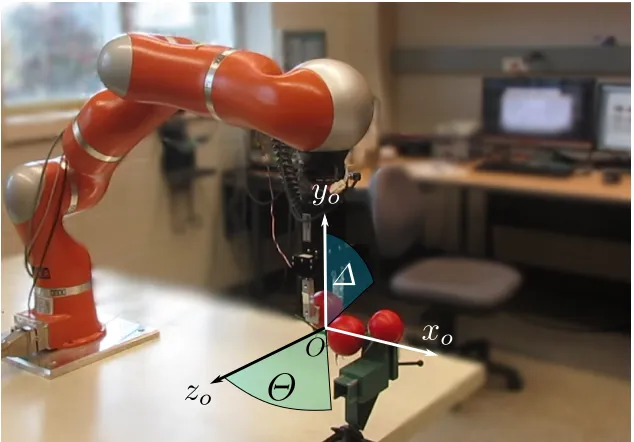
2.1 Harvesting a tomato using a robotic gripper while avoiding damage to the crop
and its neighbours. Systematic object failure at the origin denoted by,O, within
maximum allowable object twist denoted byΘand maximum allowable object
deflection denoted by∆. . . 23
2.2 A typical stress-strain diagram for ductile and brittle materials. Syis yielding
strength, and Su is the ultimate strength. Note that the ultimate strength of
brittle material is not necessarily less than the ultimate strength of ductile material. 26
2.3 Mapping between the forces and moments (withroi arm) applied atnccontact
points (c1tocnc) and the wrenches applied to the object atO. Also mapping
be-tween the moments of jk applied bynqjoints of the gripper and the transmitted
contact forces atnccontact points. . . 27
2.4 For contact forces that obey the Coulomb friction model, they must be inside
the friction cone. (a) Side view of a hard contact with friction, together with its
coordinate system. (b) A friction cone which is approximated by a five-sided
pyramid. . . 34
2.5 Experimental hardware setup. (a) Gripper and the force/torque sensor attached to the manipulator. (b) Finger structure consisting of finger tip plate, load cell,
and the fixture. The contact region is the area on the finger tip which is in
contact with the object. . . 39
2.6 Tangential directions that the robot fingers apply low magnitude normal forces
to the surface of the object while attempting to move upward. Tangential
di-rection of 30◦, 90◦, and 135◦. . . 41
2.7 (a) Anisotropic behavior of the friction in a Steel beam. (b) Anisotropic
be-havior of the friction in a Wood beam. (c) Anisotropic bebe-havior of the friction
in tomato. (d) Steel beam friction model validation at 60◦. (e) Wood beam friction model validation at 90◦. (f) Tomato surface friction model validation at 120◦. (g) Steel beam friction cone. (h) Wood beam friction cone. (i) Tomato surface friction cone. (j) Steel beam normalized grasp wrench space using
15-sided pyramid friction. (k) Wood beam normalized grasp wrench space using
15-sided pyramid friction. (l) Tomato normalized grasp wrench space using
15-sided pyramid friction. . . 42
2.8 Grasp planner results for Steel beam, Wood beam, and tomato. The intended
yielding location is color-coded by the value of grasp evaluation metric. Grasp
evaluation values and their friction-dependent variations for (a) Steel, (b) Wood,
and (c) tomato. The grasp evaluation metric suggests the optimal orientation
for applying torsion. . . 43
2.9 Failure test results. (a) Yielding Steel beam by means of permanently distorting
it. (b) Failing Wood beam by means of breaking it to pieces. The Greenstick
fracture behavior can be explained by anisotropy between the radial and
tan-gential directions. (c) Failing tomato by means of harvesting it from its stem. . 49
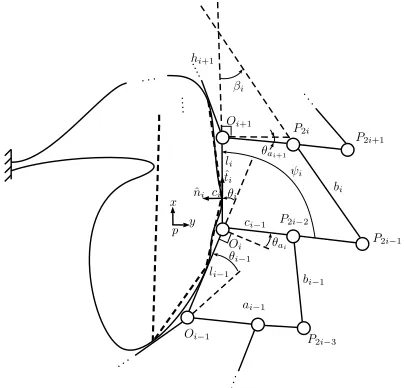
3.1 Two different actuation approaches of a 2-DOF underactuated finger. (a) actu-ation using a revolute joint, and (b) actuactu-ation using prismatic joint. . . 57
3.2 Detailed modeling of a link-driven finger in contact with a general object with
unknown geometry. . . 61
3.3 Underactuated finger packed with a load cell and a potentiometer. Two separate
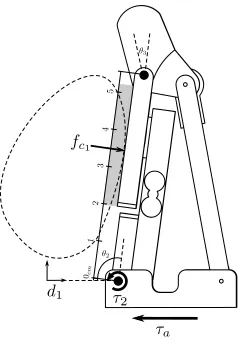
plates attached to the load cell form the first phalanx. The rounded fingertip
allows finger to be bent in precision grasping. . . 64
3.4 Generalized actuation, τa, moves the finger toward the object. Contact force
fc1 results in finger closure which is opposed by spring torque, τ2. d1 is the
first joint variable,θ2is the first unactuated joint variable, andθ3is the second
unactuated joint variable. The first phalanx is graduated and the gray area (on
the second part of the first phalanx) is the effective measuring length (roughly 60% of the first phalanx length). . . 66
3.5 Von Mises stress analysis for 1N force in two different structures. The stress analysis is done for a 3D printed finger with acrylonitrile butadiene styrene
(ABS) plastic material, and Aluminium load cell made of alloy 1060. Fine
meshing was done automatically by SolidworksTM. (a) Two separate plates are
screwed to the load cell. (b) A single plate is screwed to the load cell. . . 67
3.6 Von Mises stress analysis of precision grasping. 1N force is inserted on the
fingertip evenly distributed on a 1mmsquare. The stress analysis is done for
a 3D printed finger with acrylonitrile butadiene styrene (ABS) plastic
mate-rial, and Aluminium load cell made of alloy 1060. Fine meshing was done
automatically by SolidworksTM. . . 68
3.7 Experimental hardware setup. A single driver is used for collecting data from
two load cells and two potentiometers. . . 69
3.8 Adaptability of the designed finger. (a) Precision grasp of a coin. (b) Power
grasp of a spray bottle. (c) Power grasp of an egg. (d) Power grasp of a peach. . 71
3.9 Contact forces and joint variables whered1 is the first joint variable,θ1 is the
first unactuated joint variable, and θ2 is the second unactuated joint variable.
(a), (c) and (e) are force regulation for 3.5N, 5.5N, and 7.0N, and (b),(d), and
(f) are the second joint angles. . . 73
3.10 Four-contact grasp configuration of a circular object. . . 74
3.11 Grasp Wrench Space (GWS). (a) GWS of the four-contact grasp configuration
in the presence of friction with 0.2 friction coefficients. The maximum normal-ized force inxdirection is pinned. (b) GWS of the four-contact grasp
configu-ration in the presence of friction with 0.5 friction coefficients. The maximum normalized force in xdirection is pinned. . . 75
3.12 Grasp external wrench tolerance. (a) Disturbance wrench tolerance in x
direc-tion while fc11 = fc21 =10N. (b) Disturbance wrench tolerance in z direction
while fc11 = fc21 =30N. . . 75
3.13 Contact points estimation using measured contact forces on the first phalanx of
the finger. . . 76
3.14 Object centroid estimation. ’•’ delineates the estimated centroid, and ’+’ de-lineates the actual mass center. (a) square centroid and mass center, (b) circle
centroid and mass center, (c) a concave polygon centroid and mass center, and
(d) a concave object centroid and its mass center. . . 77
4.1 A thread can consist of subsequent instructions depending on previous results,
and running another thread concurrently prevents the computing resources from
becoming idle. . . 87
4.2 The architecture of the software interface. All features run stably in separate
threads. . . 88
4.3 Screen shot of the software. (a) command terminal of the software which can be
used for debugging purposes. (b) The software GUI can be used for monitoring
the robot states, and manually set variables and commands. . . 89
4.4 NI DAQ architecture in which DAQ device is used as both a controller and data
acquisition device. . . 91
4.5 ATI Force/Torque controller software architecture. . . 93 4.6 The experimental setup. . . 96
4.7 Different type of grasping of an egg and a coin. (a) power grasping (egg). (b) precision grasping (coin). . . 98
4.8 A costume designed gripper with four revolute joints. . . 100
4.9 The cooperation of the gripper and Kuka robot for generating orientation around the end-effector of the gripper. . . 100
4.10 Position and velocity synchronous outcome of trajectory generation. (a) Posi-tion ofy6andθ7. (b) Velocity ofy6andθ7. . . 101
4.11 The experimental setup. . . 103
4.12 Yielding plot test results. The steel beam is permanently distorted. . . 104
A.1 KUKA/DLR Light Weight Robot degrees of freedom and Coordinates. . . 114
List of Tables
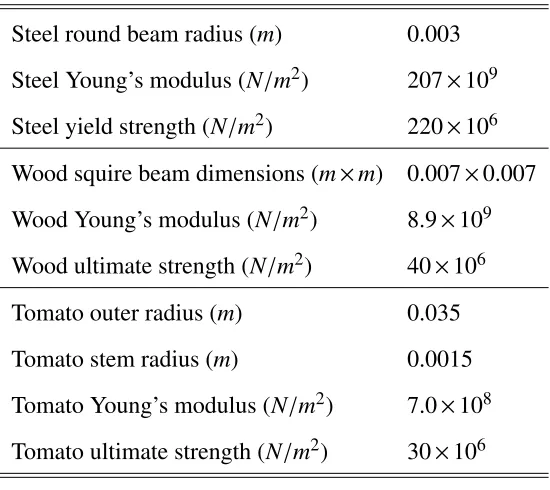
2.1 Properties of materials [20, 18, 16] . . . 39
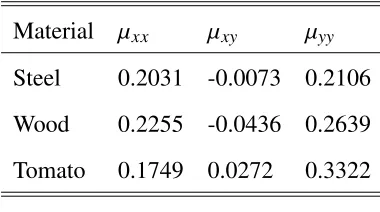
2.2 Friction constants . . . 44
3.1 Selection matrix for planar contacti. . . 62
4.1 Tool geometrical specifications. . . 97
4.2 Trajectory sequence of case study 1 . . . 97
4.3 Trajectory sequence of case study 2 . . . 104
A.1 DH parameters of KUKA/DLR Light Weight Robot. . . 114
List of Appendices
Appendix A Kuka Light Weight Robot IV Kinematics . . . 113
Chapter 1
Introduction
1.1
Motivation
Agriculture is among humankinds most important economic activities, providing the food,
fiber, and fuel necessary for our survival. Rapid population growth requires large amounts
of agricultural output. Scientists predict that agricultural production must double to meet the
demands of nine billion people in 2050 [21]. This cannot be achieved by folding the inputs
(land, water, seeds, labor, etc.) because of constrained resources and environmental concerns.
Hence, the efficiency of the agricultural system must increase sustainably and consistently. On the contrary, agriculture is one of the least technically developed fields due to varying types
of issues. Among which are socioeconomic issues, such as the fragmentation of farms, the
traditional capital investment, low added-value of products, and the seasonality of crops. Labor
is also a vital issue that farmers face and can be expensive in many cases.
In agriculture, labor tasks are tedious (i.e., pruning), repetitive (i.e., harvesting), or even
dangerous for human health (i.e., spraying). Robots offer the promise of reduced costs, in-creased safety, higher yields, reduced use of chemicals, and inin-creased operational flexibility,
including night-time operations. Agricultural robotics has been researched and developed since
the 1980s by many researchers [38]. Agricultural robotics includes the use of mobile robots
2 Chapter1. Introduction
tion droppers, suction pads, etc.
Over the last four decades, significant contributions have been made in the field of robotic
grasping [32, 4, 51, 6]. However, the problem of systematically formulating the robotic
grasp-ing for harvestgrasp-ing is rarely addressed. In robotic harvestgrasp-ing, the primary goal is the failure
and separation of the grasped objects at a certain location. Robotic harvesting process without
grasping formulation is considered in many research and designs. Works on dates [1],
strawber-ries [28], apples [35], citrus fruits [13], grapes [44], watermelon [52], eggplants [27], raddish
[20], peppers [36], mushrooms [50], and cucumbers [60] can be named as examples of piece
harvesting. To the best of our knowledge, there is no investigation on grasp planning to fail
or separate a grasped object purposefully. The studies that emphasize on avoiding deflection
and/or slippage of the object [61, 62, 43, 57] ignore the individual effects of bending, tension, or torsion on the object which are essential for obtaining an accurate characterization of grasp
task intended for object failure.
In robotic harvesting, there are usually stringent constraints which demand creative
ap-proaches and designs for achieving a successful harvest. The human methods can always be
a source of inspiration for performing any manipulation task such as harvesting. The human
hand functions in three important ways: it explores, restrains objects, and manipulates objects
with arbitrary shapes (relative to the wrist and palm) [4]. Exploring using a hand can be within
the realm of haptics [37]. The task of restraining objects is called fixturing, and the task of
manipulating objects with fingers is called dexterous manipulation. Stanford/JPL hand [42], the Utah/MIT hand [31], and other multi-fingered hands are developed to investigate the fun-damentals of restraining and manipulating objects. These multi-fingered hands mostly have
sophisticated designs which make them impractical in agricultural robotics.
The hand is the connection between the manipulator and the environment. Hands include
grippers, pincers, and tongs. Hands can be designed to perform specific tasks. For instance,
they may have suction cups for lifting glass which is not suitable for machined parts, or jaws
operated by compressed air for holding metallic elements which are not fitting for handling
1.2. Grasping forHarvesting 3
of different shapes (cylindrical, parallelepiped, and pyramidal shapes) is performed with only two fingers [23]. This fact discloses the logical reason behind well spread two-finger grasp
in the industrial applications. A limited number of possible grasp configurations, however,
result in the need to change end-effectors frequently for different tasks which cause lack of dexterity. Lack of dexterity and fine force control in grippers limit assembly tasks to the most
rudimentary ones [58].
Adaptability to a variety of grasp configurations and the arm’s manipulative capacity
high-light the need for self-adaptive hands. Self-adaptive hands offer solutions to the problem of endowing a robot with dexterity and versatility. The ability of a self-adaptive hand to
recon-figure itself for performing a variety of different grasps for arbitrary shape objects reduces the need for changing specialized grippers. Harvesting is the exceptional industry that none of
its products is identical. Hence, it is critical to have a capable and adaptive robotic hand to
automate the agricultural industry.
1.2
Grasping for Harvesting
Harvesting is the process of gathering ripe crops; that can be described as breaking objects into
two or more pieces at desired locations. This process has to be systematically controlled to
permit successful application of robotic hands and grasp theories in harvesting and avoiding
damage to the crop. The complete separation of an anisotropic beam such as a fruit stem
or a tree branch is difficult to model in general, since buckling and green-stick fracture in biological beams complicate the process of snapping. Buckling and green-stick fracture result
from anisotropic nature of fiber cell along radial and tangential directions. [59].
As reported in the literature, robotic grasp encompasses a broad range of tasks from a
simple pick and place to more advanced assembly task such as circuit chips insertion. A
com-mon element acom-mong these tasks is the process of putting the object(s) together. In contrast,
in robotic harvesting, the primary goal is the failure and separation of the grasped objects at a
4 Chapter1. Introduction
grasp evaluation method. The grasp evaluation method should be customized for addressing
the grasp tasks involving failure of the object.
1.2.1
Grasp Evaluation Method
A grasp task can be defined by considering the required external force set [19], which is
sup-posed to be balanced by contact forces applied by hand. A grasp evaluation method can index
a grasp based on the required grasp task. Holding a pen can be used as an example for
task-oriented grasp evaluation methods. The usual way to hold a pen while writing is placing the
fingertips close enough to the tip of the pen. Obviously, such grasp cannot easily resist forces
applied on the upper part of the pen. Hence, using the complete surface of the pen as a
do-main for evaluating grasp, based on external force resistance would result in a poor overall
stability for the grasp. One typical task-oriented grasp evaluation method is to choose a
suit-able task wrench space (TWS) and then measure how well it can be fitted into a grasp wrench
space (GWS) ([7], [25], [26], [40], and [48]). Due to computational complexity and difficulty of modeling a task, there are few works that have considered the task information in grasp
planning ([7], [40], and [51]).
There is a challenge in obtaining TWS in reality since sensors are necessary to measure the
contact regions and contact forces in human demonstration. Hence, there are many works in
literature that try to empirically approximate the TWS rather than actually measure it. In [40],
Li and Sastry used a six-dimensional wrench space ellipsoid for better task approximation
which resulted in less computational complexity. TWS was approximated as a task polytope
by Haschkeet al. [26]. A task can be defined using fundamental theories describing the task.
For example, material failure theories are used to describe a separation task (e.g., harvesting
fruit), or fluid dynamics for mass distribution of an object containing liquid (e.g., coffee cup). The goal of a task definition is to compute maximum object wrench (force and torque) during
manipulation (e.g., as the fruit stem is bent or twisted, or the cup is tilted) to obtain optimized
1.3. Self-AdaptiveGripperDesign 5
1.2.2
Friction Modeling and Identification
Robotic manipulators use contact forces to grasp and manipulate objects. Hence, modeling of
the contact points is fundamental to analysis, design, planning, and control of a grasping task.
Contact forces may arise with friction. Friction can play a significant role to apply bending
moment, tension force, and torsion torque for manipulation. Contact points with friction are
necessary when form closure is not achievable. It is common in the literature to use Coulomb’s
law to model the dynamic friction force between the gripper and the object [4]. However,
friction in anisotropic materials such as fruits can vary significantly and cannot be characterized
using a single Coulomb’s friction coefficient.
Using various parameters for friction modeling can make the identification process to be
difficult and time-consuming. Humans perform friction identification in dealing with a new object manipulation fast and efficient. Several studies demonstrate that humans adapt their exploratory movements to improve information gained through mechanical stimulus and elicit
information using interactions [8, 64, 33]. A similar method for covering anisotropic behavior
of friction is needed to be studied without adding more complexity to the system. Such method
improves the grasp success rate dramatically.
1.3
Self-Adaptive Gripper Design
There is no automated design tools for gripper design. Usually, the knowledge and experience
of an expert are required to design new grippers [12]. Design solutions and guidelines for
gripper have appeared in [12], and [11]. Grippers can be classified concerning their task,
size, load, and actuator. Typically, the main property of a gripper is defined by its actuator.
The actuator for robot grippers are usually electric, pneumatic, hydraulic; or in some cases,
vacuum, magneto-rheological fluid and shape memory alloy, etc ([15], [63], and [46]). An
extensive review and discussion on different gripper types and design issues are done in [15]. An industrial gripper is mostly designed to manipulate only preplanned objects of similar
6 Chapter1. Introduction
There are industrial applications, such as agricultural harvesting in which the target objects,
i.e., crops have significant variations in shape and size. In the design of robotic hands, task
adaptation capability usually correlates with complex kinematic structures with a high number
of degrees of freedom, which may increase the size, control complexity and weight of the
device. In addition, in cases where the operation varies from one object to the other, grasp
configuration is different for each grasp scenario. Planning new grasp configurations requires contact forces and locations to fulfill the task objectives toward accurate object placement and
damage avoidance. Addressing all of these challenges often increases the gripper size and
complexity. Tight conditions on space requirements, on the other hand, demand a compact
gripper design.
1.3.1
Underactuated Mechanism
Harvesting needs a mechanism which can passively adapt to the shape of different objects, without requiring additional actuators and/or sophisticated control strategies. When a robotic mechanism has fewer actuators than the degrees of freedom, it is known as an underactuated
mechanism. An underactuated robotic hand provides passive motions imposed by the object
geometry. The first widely known robotic underactuated prototype is Soft Gripper [29]. This
gripper consists of multi-links and a series of pulleys that are actuated by a pair of wires with
neither control nor feedback sensors. There are other underactuated fingers which are based on
tendon-actuated mechanism [17, 41, 9]. Most of the tendon-actuated mechanisms are limited to
small grasping forces that are deteriorated by friction and elasticity [5]. There are a number of
other important underactuation approaches for robotic hands, e.g., eigen-grasps [16], parallel
structure based [5] and adaptive synergies [10, 22]. Another transmission approach in
under-actuated fingers is based on linkage-under-actuated mechanism which is known to have structural
robustness and high force insertion capability [39].
The intrinsic ability of link-driven underactuated fingers to adapt themselves to the objects’
shape makes grasping of unknown geometries possible. In an underactuatedpower grasp, the
1.4. GraspingTest-Bed 7
the design of an underactuated hand is to enableprecision grasp. In this approach, the fingers
are designed such that the fingertips are mostly in contact with the object. In both cases, the
form adaptability of link-driven underactuated fingers is dictated by the shape of the object, not
by the motion of the actuator. In other words, since fingers have one actuator but several contact
forces, the contact forces are known to be uncontrollable and dependent. Hence, the knowledge
of contact forces becomes exceedingly important for evaluating a grasp for a particular task.
One such evaluation is to characterize a grasp based on the set of external wrenches that the
grasp can withstand during object manipulation. This is known as Grasp Wrench Space (GWS)
[6]. Having additional sensors for obtaining contact positions and forces becomes an integral
part of grasp synthesis.
1.3.2
Tactile Feedback
Tactile sensors can be used to acquire contact forces and positions [5], [18]. Tactile feedback
has a wide range of applications from robotic hand to teleoperated devices [65]. The data from
tactile sensors can serve in assessing grasp stability, performing object recognition, detecting
slippage, and detecting collisions [2, 47, 56]. Typically, tactile sensors, also known as robot
skins consist of an array of sensors that cover an area of a finger or hand to provide contact
positions and forces [24]. While robot skins provide an operative means of measuring forces
and positions, their construction is often sophisticated and prohibitively costly [34]. For these
reasons, the application of robot skins in practice has been somewhat limited. Another
ap-proach adopted in [3] takes advantage of negative torque compensation at the inter-phalanx
joints of the finger. This approach provides a rough estimation of the contact positions with no
information about forces.
1.4
Grasping Test-Bed
8 Chapter1. Introduction
hand, and then new objects are fed to the gripper to demonstrate its features. There are works
that validate their methods by using industrial manipulators. Kuka Light-Weight Robot is used
to validate the proposed designs and theories. In most cases, communicating and programming
industrial robots for research purposes are tedious tasks. The programming burdens become
much more extensive when there are different data acquisition boards and hardware. All of these devices need to be synchronized in a single software interface.
The Kuka lightweight robot (LWR) is the outcome of a research collaboration of Kuka
Roboter GmbH and the Institute of Robotics and Mechatronics at the German Aerospace
Cen-ter (DLR) [55]. This robot has unique features such as high payload ratio, active compliance,
and torque sensor feedback which enable researchers to exploit new robot applications. The
development of a software interface for Kuka robots has been investigated by several research
groups. The principal goal varies from taking away the tedious task of programming the
com-munication with robots to extending the controlling freedom of the researchers. An FRI
soft-ware interface with a simple user interface to the Kuka LWR which hides all communication
and set-up issues behind the interface is needed. Such software interface should provide
essen-tial functionalities for rapid prototyping new devices and sensors synchronously running with
Kuka robot.
Kuka Fast Research Interface (FRI) provides direct low-level real-time access to the Kuka
Robot Controller (KRC) at rates of up to 1 kHz. Kuka FRI is a response to the growing robotic
application development demand that is addressed by European Commission funded survey
BRICS [55]. Robotic applications mostly include implementing a haptic input device for
aug-mented reality, attaching a new hand, visual servoing, etc. Several projects considered solving
various issues with Kuka Robots communications independently. OpenKC is a control
soft-ware for Kuka light weight robot which is restricted to the use of Kuka.RobotSensorInterface
package [54]. A reverse engineering of Kuka Robot Language (KRL) is implemented to enable
programming of industrial robots on top of the general purpose language which has safety
limi-tations [45]. A collection of MATLAB functions for motion control of Kuka industrial robots is
1.5. Objectives 9
and requires the use of the Kuka.Ethernet KRL XML package. Kuka Sunrise.Connectivity
is developed for Kuka light weight robots provides a collection of interfaces for influencing
robot motion at various process control levels, but it is not compatible with Kuka LWR IV.
JOpenShowVar is Java open-source cross-platform communication interface to Kuka
indus-trial robots; however, it is limited to soft real-time applications [53]. Robot Operating System
(ROS) is a collection of software frameworks for robot software development [49]. ROS is
designed to be as distributed and modular as possible, so that users can use as much or as little
of it as they desire. However, ROS is limited to the GNU/Linux Operating System. A similar system to ROS for Kuka robot on Microsoft Windows is missing to be used for facilitating the
conducting of experiments.
1.5
Objectives
The chief objective of this thesis is building a compact and capable gripper which then
en-ables the implementing of the proposed grasp planner. A grasp planner which unlike other
existing algorithms is not computationally intensive and at the same time provides robustness
for breaking grasped objects at the desired location. Achieving this objective requires
exten-sive real-world testing which is dependent on a practical test-bed. Interfacing a commercial
manipulator and harnessing its capabilities toward conducting the proposed ideas are another
principal objective of this thesis.
1.5.1
Main contributions
Failure Task Definition
A new failure task definition is introduced to be used in grasp evaluation method. The set of
external wrench that is enough for failing an object is found using mechanical failure theories.
Mechanical failure theories are carefully selected for any types of material including brittle or
10 Chapter1. Introduction
Optimized Failure Wrench
An innovative approach to the problem of motion constraints on robotic manipulator is
pro-posed. This problem is pervasive in robotic harvesting where either the cluster of fruits or
tight working space in indoor farming demand stringent limits on the motion. An optimization
method for finding a wrench sufficient for failing the object while does not require the robotic manipulator to exceed any motion limits is provided.
Friction Modeling and Identification
A new friction identification process is proposed to measure friction parameters. The method
is fast and easy to implement. It consists of moving the gripper on the object in few different directions to capture the anisotropic friction behavior of the object. The acquired frictional
data are used to formulate the gripper wrench insertion capability.
Failure Grasp Evaluation Method
A task-oriented grasp evaluation method considering the gripper capability and the optimized
failure wrench is proposed. Since the gripper capability is dependent on its actuation system,
both cases of the fully-actuated and under-actuated grippers are studied. Failure wrench is
opti-mized to be just enough for failing the grasped object at the desired location. The optimization
considers all motion constraints presented in the environment.
Contact Position and Force Estimation
A new approach is introduced for obtaining tactile information. The proposed approach is
based on combining the data obtained from a potentiometer and a load cell. The sensors are
carefully embedded in the finger structure to provide meaningful readings. Both
experimen-tally and theoretically, it is shown that the suggested approach is capable of contact position
1.5. Objectives 11
Underactuation Formulation
A new modification for the formulation of the transmission matrix for an underactuation
mech-anism is provided. The new transmission matrix is used for the Jacobian matrix derivation
which is needed for the proposed contact estimation method. Unprecedentedly in the
un-deractuation literature, the provided Jacobian matrix considers contact model, and it is also
applicable to both link-driven prismatic and revolute underactuated mechanisms.
Self-Adaptive Sensorized Finger
A new sensorized underactuated finger is designed, and 3D printed. The design logic for the
load cell placement is examined by stress analysis of the finger using FEM. The embedded load
cell not only enables the contact point estimation but also facilitates the grasp of fragile objects
such as egg. The grip robustness is visualized and evaluated by forming the Grasp wrench space
of the prototyped two-finger gripper. Furthermore, unknown object centroid approximation is
implemented via contact estimation, joint variable measurement, and self-adaptation of the
finger.
1.5.2
Thesis outlines
The rest of this thesis is organized as follows, while the overlap between chapters are inevitable
due to the integrated nature of the thesis.
Chapter 2 deals with the problem of purposefully failing (breaking) or yielding objects
by a robotic gripper. A definition of a failure task is first formulated using failure theories.
Next, a grasp quality measure is presented to characterize a suitable grasp configuration and
systematically control the failure behavior of the object. This approach combines information
about the task’s failure and the capability of the gripper for wrench insertion. To validate
the proposed evaluation method, experimental results using a KUKA LightWeight Robot IV
12 Chapter1. Introduction
finger. This design incorporates a two-degrees-of-freedom (DOF) link-driven underactuated
mechanism with an embedded load cell for contact force measurement and a trimmer
poten-tiometer for acquiring joint variables. The integration of these sensors results in tactile-like
sensations in the finger without compromising the size and complexity of the proposed
de-sign. The effectiveness of the proposed design is verified through experimental results that demonstrate the grasp external wrench tolerance, shape adaptability, and tactile capability.
Chapter 4 presents an open-source software interface for integration of Kuka robot
ma-nipulators with peripheral tools and sensors, KUI: Kuka User Interface. KUI is developed
based on Kuka Fast Research Interface (FRI) which enables real-time control of the robot.
Simulink Desktop Real-TimeTMor any User Datagram Protocol (UDP) client can send
real-time commands to Kuka robot via KUI. In KUI, third-party tools can be added and controlled
synchronously with Kuka Light-Weight Robot (LWR). KUI is used to conduct all experiments
presented in this thesis.
Bibliography
[1] AA Aljanobi, SA Al-Hamed, and SA Al-Suhaibani. A setup of mobile robotic unit for
fruit harvesting. In Robotics in Alpe-Adria-Danube Region (RAAD), 2010 IEEE 19th
International Workshop on, pages 105–108. IEEE, 2010.
[2] Yasemin Bekiroglu, Janne Laaksonen, Jimmy Alison Jorgensen, Ville Kyrki, and Danica
Kragic. Assessing grasp stability based on learning and haptic data. IEEE Transactions
on Robotics, 27(3):616–629, 2011.
[3] Bruno Belzile and Lionel Birglen. Stiffness analysis of underactuated fingers and its application to proprioceptive tactile sensing. IEEE/ASME Transactions on Mechatronics,
21(6):2672–2681, 2016.
[4] Antonio Bicchi and Vijay Kumar. Robotic grasping and contact: A review. InRobotics
and Automation, 2000. Proceedings. ICRA’00. IEEE International Conference on,
vol-ume 1, pages 348–353. IEEE, 2000.
[5] Lionel Birglen, Thierry Laliberte, and Clement M Gosselin. Underactuated robotic
hands, volume 40. Springer, 2007.
[6] Jeannette Bohg, Antonio Morales, Tamim Asfour, and Danica Kragic. Data-driven grasp
synthesis-a survey. IEEE Transactions on Robotics, 30(2):289–309, 2014.
[7] Ch Borst, Max Fischer, and Gerd Hirzinger. Grasp planning: How to choose a suitable
task wrench space. InRobotics and Automation, 2004. Proceedings. ICRA’04. 2004 IEEE
International Conference on, volume 1, pages 319–325. IEEE, 2004.
14 BIBLIOGRAPHY
[8] Thierri Callier, Hannes P Saal, Elizabeth C Davis-Berg, and Sliman J Bensmaia.
Kinematics of unconstrained tactile texture exploration. Journal of neurophysiology,
113(7):3013–3020, 2015.
[9] Maria Chiara Carrozza, C Suppo, Fabrizio Sebastiani, Bruno Massa, Fabrizio Vecchi,
Roberto Lazzarini, Mark R Cutkosky, and Paolo Dario. The spring hand: development of
a self-adaptive prosthesis for restoring natural grasping. Autonomous Robots, 16(2):125–
141, 2004.
[10] Manuel G Catalano, Giorgio Grioli, Alessandro Serio, Edoardo Farnioli, Cristina
Pi-azza, and Antonio Bicchi. Adaptive synergies for a humanoid robot hand. In2012 12th
IEEE-RAS International Conference on Humanoid Robots (Humanoids 2012), pages 7–
14. IEEE, 2012.
[11] Greg Causey. Guidelines for the design of robotic gripping systems. Assembly
automa-tion, 23(1):18–28, 2003.
[12] Gregory Carylee Causey.Elements of agility in manufacturing. PhD thesis, Case Western
Reserve University, 1999.
[13] R Ceres, JL Pons, AR Jimenez, JM Martin, and L Calderon. Design and implementation
of an aided fruit-harvesting robot (agribot). Industrial Robot: An International Journal,
25(5):337–346, 1998.
[14] Francesco Chinello, Stefano Scheggi, Fabio Morbidi, and Domenico Prattichizzo. Kuka
control toolbox. IEEE Robotics&Automation Magazine, 18(4):69–79, 2011.
[15] Ho Choi and Muammer Koc. Design and feasibility tests of a flexible gripper based
on inflatable rubber pockets. International Journal of Machine Tools and Manufacture,
46(12):1350–1361, 2006.
BIBLIOGRAPHY 15
A low-dimensional approach to a high-complexity problem. In Robotics: Science and
Systems Manipulation Workshop-Sensing and Adapting to the Real World. Citeseer, 2007.
[17] Aaron M Dollar and Robert D Howe. The highly adaptive sdm hand: Design and
perfor-mance evaluation. The international journal of robotics research, 29(5):585–597, 2010.
[18] Aaron M Dollar, Leif P Jentoft, Jason H Gao, and Robert D Howe. Contact sensing and
grasping performance of compliant hands. Autonomous Robots, 28(1):65–75, 2010.
[19] Sahar El-Khoury, Ravin De Souza, and Aude Billard. On computing task-oriented grasps.
Robotics and Autonomous Systems, 66:145–158, 2015.
[20] Mario M Foglia and Giulio Reina. Agricultural robot for radicchio harvesting. Journal
of Field Robotics, 23(6-7):363–377, 2006.
[21] Jonathan A Foley, Navin Ramankutty, Kate A Brauman, Emily S Cassidy, James S
Ger-ber, Matt Johnston, Nathaniel D Mueller, Christine OConnell, Deepak K Ray, Paul C
West, et al. Solutions for a cultivated planet. Nature, 478(7369):337–342, 2011.
[22] Marco Gabiccini, Edoardo Farnioli, and Antonio Bicchi. Grasp analysis tools for
syner-gistic underactuated robotic hands.The International Journal of Robotics Research, page
0278364913504473, 2013.
[23] Carbone Giuseppe. Grasping in Robotics. Springer-Verlag, 2013.
[24] Frank L Hammond, Rebecca K Kramer, Qian Wan, Robert D Howe, and Robert J Wood.
Soft tactile sensor arrays for micromanipulation. In2012 IEEE/RSJ International
Con-ference on Intelligent Robots and Systems, pages 25–32. IEEE, 2012.
[25] Li Han, Jeffrey C Trinkle, and Zexiang X Li. Grasp analysis as linear matrix inequality problems. IEEE Transactions on Robotics and Automation, 16(6):663–674, 2000.
[26] Robert Haschke, Jochen J Steil, Ingo Steuwer, and Helge Ritter. Task-oriented
Au-16 BIBLIOGRAPHY
tomation, 2005. CIRA 2005. Proceedings. 2005 IEEE International Symposium on, pages
689–694. IEEE, 2005.
[27] Shigehiko Hayashi, Katsunobu Ganno, Yukitsugu Ishii, and Itsuo Tanaka. Robotic
har-vesting system for eggplants.Japan Agricultural Research Quarterly: JARQ, 36(3):163–
168, 2002.
[28] Shigehiko Hayashi, Kenta Shigematsu, Satoshi Yamamoto, Ken Kobayashi, Yasushi
Kohno, Junzo Kamata, and Mitsutaka Kurita. Evaluation of a strawberry-harvesting robot
in a field test. Biosystems engineering, 105(2):160–171, 2010.
[29] Shigeo Hirose and Yoji Umetani. The development of soft gripper for the versatile robot
hand. Mechanism and machine theory, 13(3):351–359, 1978.
[30] Penisi Osvaldo Hugo. Industrial grippers: State-of-the-art and main design
characteris-tics. InGrasping in Robotics, pages 107–131. Springer, 2013.
[31] Stephen C Jacobson, David F Knutti, Richard T Johnson, and Harold H Sears.
Develop-ment of the utah artificial arm. IEEE Transactions on Biomedical Engineering, (4):249–
269, 1982.
[32] Farrokh Janabi-Sharifi and William J Wilson. Automatic grasp planning for visual-servo
controlled robotic manipulators. IEEE Transactions on Systems, Man, and Cybernetics,
Part B (Cybernetics), 28(5):693–711, 1998.
[33] Marco Janko, Richard Primerano, and Yon Visell. On frictional forces between the finger
and a textured surface during active touch. IEEE transactions on haptics, 2015.
[34] Zhanat Kappassov, Juan-Antonio Corrales, and Veronique Perdereau. Tactile sensing in
dexterous robot hands-review. Robotics and Autonomous Systems, 74:195–220, 2015.
[35] L Kassay. Hungarian robotic apple harvester. InAmerican Society of Agricultural
BIBLIOGRAPHY 17
[36] Shinsuke Kitamura and Koichi Oka. Recognition and cutting system of sweet pepper for
picking robot in greenhouse horticulture. InMechatronics and Automation, 2005 IEEE
International Conference, volume 4, pages 1807–1812. IEEE, 2005.
[37] Roberta L Klatzky and Susan Lederman. Intelligent exploration by the human hand. In
Dextrous robot hands, pages 66–81. Springer, 1990.
[38] Naoshi Kondo, Mitsuji Monta, and Noboru Noguchi. Agricultural Robots: Mechanisms
and Practice. Apollo Books, 2011.
[39] Thierry Laliberte, Lionel Birglen, and Clement Gosselin. Underactuation in robotic
grasping hands. Machine Intelligence&Robotic Control, 4(3):1–11, 2002.
[40] Zexiang Li and S Shankar Sastry. Task-oriented optimal grasping by multifingered robot
hands. IEEE Journal on Robotics and Automation, 4(1):32–44, 1988.
[41] Fabrizio Lotti, Paolo Tiezzi, Gabriele Vassura, Luigi Biagiotti, Gianluca Palli, and
Clau-dio Melchiorri. Development of ub hand 3: Early results. InRobotics and Automation,
2005. ICRA 2005. Proceedings of the 2005 IEEE International Conference on, pages
4488–4493. IEEE, 2005.
[42] C Loucks, V Johnson, P Boissiere, G Starr, and J Steele. Modeling and control of the
stanford/jpl hand. In Robotics and Automation. Proceedings. 1987 IEEE International Conference on, volume 4, pages 573–578. IEEE, 1987.
[43] G. De Maria, P. Falco, C. Natale, and S. Pirozzi. Integrated force/tactile sensing: The enabling technology for slipping detection and avoidance. InRobotics and Automation
(ICRA), 2015 IEEE International Conference on, pages 3883–3889, 5 2015.
[44] Mitsuji Monta, Naoshi Kondo, and Y Shibano. Agricultural robot in grape production
system. InRobotics and Automation, 1995. Proceedings., 1995 IEEE International
18 BIBLIOGRAPHY
[45] Henrik Muhe, Andreas Angerer, Alwin Hoffmann, and Wolfgang Reif. On reverse-engineering the kuka robot language. arXiv preprint arXiv:1009.5004, 2010.
[46] A Pettersson, S Davis, JO Gray, TJ Dodd, and T Ohlsson. Design of a magnetorheological
robot gripper for handling of delicate food products with varying shapes. Journal of food
engineering, 98(3):332–338, 2010.
[47] Zachary Pezzementi, Erion Plaku, Caitlin Reyda, and Gregory D Hager. Tactile-object
recognition from appearance information. IEEE Transactions on Robotics, 27(3):473–
487, 2011.
[48] Nancy S Pollard. Parallel methods for synthesizing whole-hand grasps from generalized
prototypes. Technical report, DTIC Document, 1994.
[49] Morgan Quigley, Ken Conley, Brian Gerkey, Josh Faust, Tully Foote, Jeremy Leibs, Rob
Wheeler, and Andrew Y Ng. Ros: an open-source robot operating system. In ICRA
workshop on open source software, volume 3, page 5. Kobe, 2009.
[50] JN Reed, SJ Miles, J Butler, M Baldwin, and R Noble. Aeautomation and emerging
technologies: Automatic mushroom harvester development. Journal of Agricultural
En-gineering Research, 78(1):15–23, 2001.
[51] Anis Sahbani, Sahar El-Khoury, and Philippe Bidaud. An overview of 3d object grasp
synthesis algorithms. Robotics and Autonomous Systems, 60(3):326–336, 2012.
[52] Satoru Sakai, Michihisa Iida, and Mikio Umeda. Heavy material handling manipulator
for agricultural robot. InRobotics and Automation, 2002. Proceedings. ICRA’02. IEEE
International Conference on, volume 1, pages 1062–1068. IEEE, 2002.
[53] Filippo Sanfilippo, Lars Ivar Hatledal, Houxiang Zhang, Massimiliano Fago, and
Kristin Y Pettersen. Controlling kuka industrial robots: Flexible communication interface
BIBLIOGRAPHY 19
[54] Matthias Schoepfer, Florian Schmidt, Michael Pardowitz, and Helge Ritter. Open source
real-time control software for the kuka light weight robot. In Intelligent Control and
Automation (WCICA), 2010 8th World Congress on, pages 444–449. IEEE, 2010.
[55] Gunter Schreiber, Andreas Stemmer, and Rainer Bischoff. The fast research interface for the kuka lightweight robot. In IEEE Workshop on Innovative Robot Control
Architec-tures for Demanding (Research) Applications How to Modify and Enhance Commercial
Controllers (ICRA 2010), pages 15–21. Citeseer, 2010.
[56] Shouhei Shirafuji and Koh Hosoda. Detection and prevention of slip using sensors with
different properties embedded in elastic artificial skin on the basis of previous experience.
Robotics and Autonomous Systems, 62(1):46–52, 2014.
[57] Nicolas Sommer and Aude Billard. Multi-contact haptic exploration and grasping with
tactile sensors. Robotics and Autonomous Systems, 85:48–61, 2016.
[58] Jeffrey C Trinkle. On the stability and instantaneous velocity of grasped frictionless objects. IEEE Transactions on Robotics and Automation, 8(5):560–572, 1992.
[59] A Van Casteren, WI Sellers, SKS Thorpe, S Coward, RH Crompton, and AR Ennos. Why
don’t branches snap? the mechanics of bending failure in three temperate angiosperm
trees. Trees, 26(3):789–797, 2012.
[60] Eldert J Van Henten, Jochen Hemming, BAJ Van Tuijl, JG Kornet, J Meuleman,
J Bontsema, and EA Van Os. An autonomous robot for harvesting cucumbers in
green-houses. Autonomous Robots, 13(3):241–258, 2002.
[61] F. Veiga, H. van Hoof, J. Peters, and T. Hermans. Stabilizing novel objects by learning
to predict tactile slip. InIntelligent Robots and Systems (IROS), 2015 IEEE/RSJ
Interna-tional Conference on, pages 5065–5072, 7 2015.
detec-20 BIBLIOGRAPHY
tion for robotic oil drilling. InRobotics and Automation (ICRA), 2014 IEEE International
Conference on, pages 2255–2261, 5 2014.
[63] Kengo Yamaguchi, Yasuhisa Hirata, and Kazuhiro Kosuge. Development of robot hand
with suction mechanism for robust and dexterous grasping. In Intelligent Robots and
Systems (IROS), 2013 IEEE/RSJ International Conference on, pages 5500–5505. IEEE,
2013.
[64] Takashi Yoshioka, James C Craig, Graham C Beck, and Steven S Hsiao. Perceptual
constancy of texture roughness in the tactile system. The Journal of Neuroscience,
31(48):17603–17611, 2011.
[65] Hanna Yousef, Mehdi Boukallel, and Kaspar Althoefer. Tactile sensing for dexterous
in-hand manipulation in robotics-a review. Sensors and Actuators A: physical, 167(2):171–
Chapter 2
Grasp Synthesis for Purposeful
Fracturing of Object
Parts of the material in this chapter are published in ”Advanced Intelligent Mechatronics
(AIM), 2016 IEEE International Conference on”, and ”The 2017 IEEE/RSJ International
Con-ference on Intelligent Robots and Systems (IROS), 2017, Vancouver, Canada.”, conditionally
accepted in ”Robotics and Autonomous Systems”, and submitted to ”The 2018 International
Conference on Robotics and Automation (ICRA), 2018, Brisbane, Australia.”
This chapter deals with the problem of purposefully failing (breaking) or yielding objects
by a robotic gripper. Robotic harvesting is considered as an application domain that motivates
this study. A definition of a failure task is first formulated using failure theories. Next, a grasp
quality measure is presented to characterize a suitable grasp configuration and systematically
control the failure behavior of the object. This approach combines the failure task and the
capability of the gripper for wrench insertion. The friction between the object and the
grip-per is used to formulate the capability of the gripgrip-per for wrench insertion. A new method
inspired by the human pre-manipulation process is introduced to utilize the gripper itself as
the measurement tool and obtain a friction model. The developed friction model is capable of
22 Chapter2. GraspSynthesis forPurposefulFracturing ofObject
capturing the anisotropic behavior of materials which is the case for most fruits and vegetables.
The evaluation method proposed in this study is formulated as a quasistatic grasp problem and
can include both fully-actuated and under-actuated grippers. To validate the proposed
evalua-tion method, experimental results using a KUKA LightWeight Robot IV manipulator to break
objects purposefully with different material properties are presented.
2.1
Introduction
Harvesting is the process of gathering ripe crops that can be described as breaking objects into
two or more pieces at a desired location. This process has to be systematically controlled to
permit successful application of robotic hands and grasp theories in harvesting and avoiding
damage to the crop (see Fig. 2.1). The complete separation of an anisotropic beam such as
a fruit stem or a tree branch is difficult to model in general, since buckling and green-stick fracture in biological beams complicate the process of snapping. Buckling and green-stick
fracture result from anisotropic nature of fiber cell along radial and tangential directions. [23].
Nevertheless, a grasp evaluation method is proposed to systematically study the process of
failure by taking into consideration the mechanical and physical properties of the material.
Over the last four decades, significant contributions have been made in the field of robotic
grasping [10, 3, 19, 4]. As reported in the literature, robotic grasp encompasses a broad range
of tasks from a simple pick and place to more advanced assembly task such as circuit chips
insertion. A common element among these tasks is the process of putting the object(s)
to-gether. In contrast, in robotic harvesting, the primary goal is the failure and separation of the
grasped objects at a certain location. To the best of our knowledge, there is no investigation
on grasp planning to fail or separate a grasped object purposefully. The studies that emphasize
on avoiding deflection and/or slippage of the object [24, 26, 15, 21] ignore the individual ef-fects of bending, tension, or torsion on the object which is essential for obtaining an accurate
characterization of grasp task intended for object failure.
with-2.1. Introduction 23
Figure 2.1: Harvesting a tomato using a robotic gripper while avoiding damage to the crop
and its neighbours. Systematic object failure at the origin denoted by, O, within maximum
allowable object twist denoted byΘand maximum allowable object deflection denoted by∆.
stand while being manipulated [7]. A task polytope can be defined using all these wrenches
[5] known as Task Wrench Space (TWS). A TWS can be approximated by an ellipsoid [13]
or a convex polytope [29]. The TWS can be used to evaluate the quality of the grasp. For
instance, a well-known task-oriented grasp metric is to choose an appropriate TWS such that
it is well inscribed within the grasp wrench tolerance [9]. The core of the proposed approach
involves computing the maximum force that can be applied to a grasped object so as to yield
a tensile object or fracture a brittle object while optimizing contact forces and analyzing force
capabilities of the gripper. To this end, a new definition of the failure task using mechanical
failure theories is proposed and it is used to evaluate the grasp so as to measure how well the
TWS conforms with the capabilities of the gripper. The grasp capability is formulated using
wrench insertion capability of the gripper and the friction between the gripper and object.
Fric-tion can play a major role and to apply bending moment, tension force, and torsion torque,
contact points with friction are necessary when form closure is not achievable. It is common
24 Chapter2. GraspSynthesis forPurposefulFracturing ofObject
and the object [3]. However, friction in anisotropic materials such as fruits can vary
signif-icantly and cannot be characterized using a single Coulomb’s friction coefficient. Thus, an anisotropic friction model is considered and a method is proposed to identify the parameters
of this model. The method is inspired by the approach used by humans. Several studies have
demonstrated that humans adapt their exploratory movements to improve information gained
through mechanical stimulus and elicit information using such interactions [6, 28, 11]. Inspired
by this natural approach, the gripper itself is used as a friction measurement tool during object
manipulation. The contributions of this work are as follows:
• A new failure task definition is introduced to be used in grasp evaluation method.
Me-chanical failure theories are carefully selected for any brittle or ductile materials for
accurate failure behavior prediction.
• An innovative approach to the problem of motion constraints on robotic manipulator is
proposed. This problem is pervasive in robotic harvesting where either the cluster of
fruits or tight working space in indoor farming demand stringent limits on the motion.
An optimization method for finding a wrench sufficient for failing the object while does not require the robotic manipulator to exceed any motion limits is provided.
• A new friction identification process is proposed to measure friction parameters. The
method is fast and easy to implement. It consists of moving the gripper on the object
in few different directions to capture the anisotropic friction behavior of the object. The acquired frictional data are used to formulate the gripper wrench insertion capability.
• A task oriented grasp evaluation method considering the gripper capability and the
op-timized failure wrench is proposed. Since the gripper capability is dependent on its
actuation system, both cases of the fully-actuated and under-actuated gripper are
consid-ered.
The structure of this chapter is as follows: Section II provides a problem statement.
2.2. ProblemStatement 25
introduces the proposed grasp evaluation method intended for object failure. Section V
eval-uates the validity of the proposed approach using experimental results. Finally, Section VI
concludes the chapter and suggests future work.
2.2
Problem Statement
In this section, grasping an object with the intention of purposefully separating it or
system-atically failing it is formulated. Object failure refers to the separation of the object into two
or more pieces. This definition includes permanent distortion, geometric ruin, downgraded
reliability, or compromised function. Failure theories predict the conditions under which solid
materials fail under the action of external loads. The failure behaviour of a material is usually
classified into brittle failure (fracture) or ductile failure (yield). Failure theories provide criteria
which separate ”failed” states from ”unfailed” states.
Stress is defined as the value of force per unit area. The relative orientation of the force
vector to the surface normal determines the stress as normal or shear stress when the force
vector is normal or parallel to the surface, respectively. Stress can be regarded as a tensor
since it obeys standard coordinate transformation principles of tensors. A stress tensor has real
eigenvalues calledprincipal stressesof the stress.
Applying stress on different materials produces an amount of deformation (strain) specific to the material before failure. Figure 2.2 shows typical stress-strain relationship for ductile and
brittle materials. This figure shows that sufficient amount of stress will result in permanent
deformation or failure. For instance, many ductile materials including some metals, polymers,
and ceramics exhibit a linear stress-strain relationship prior to failing (yield point). As the
deformation increases, the material exhibits a nonlinear behavior characterized by yielding
strengthdenoted bySy andultimate strengthdenoted bySu. Brittle materials exhibit different
stress-strain relations. For instance, many brittle materials including cast iron, glass, and stone,
are characterized by the fact that fracture occurs without any noticeable prior change in the rate
26 Chapter2. GraspSynthesis forPurposefulFracturing ofObject
Stress
Strain
b
b
brittle material
ductile material
Su
Sy
fracture
fracture
Su
b
yield point
Figure 2.2: A typical stress-strain diagram for ductile and brittle materials. Sy is yielding
strength, andSu is the ultimate strength. Note that the ultimate strength of brittle material is
not necessarily less than the ultimate strength of ductile material.
The material information is necessary for a failing process to systematically control the set
of wrenches that are inserted by the robotic gripper on the object. The set of wrenches required
for the task (failure task wrench set) is generated by the forces applied at contact points. The
goal is to insert contact forces which are transformed properly to the point of interest, i.e., the
failing point. For example, to fail the object shown in Fig. 2.3 at pointO, the wrench resulted
from mapping all contact forces at {c1, ...,cnc} to the point O must be enough for failing the
object.
The material failure information is combined with conventional robotic grasp formulation.
A widely used assumption in robot grasp planning is the quasistatic assumption [8, 12]. This
assumption requires parts to move sufficiently slow such that all inertial effects are negligible. The Quasistatic model of the grasp is represented as,
w=−G f (2.1)
wherew∈R6is the wrench exerted on the object by gravity and/or external sources,G∈R6×3nc
is the Grasp matrix, f ∈R3nc is the contact force vector, andG f is the total wrench applied
2.2. ProblemStatement 27
O yo
xo
Gripper
xnc znc ync
ronc
b
b yi
xi
zi
roi
jnq
jk
c1
cnc
Figure 2.3: Mapping between the forces and moments (with roi arm) applied at nc contact
points (c1 to cnc) and the wrenches applied to the object at O. Also mapping between the
moments of jk applied by nq joints of the gripper and the transmitted contact forces at nc
28 Chapter2. GraspSynthesis forPurposefulFracturing ofObject
the set of wrenches that the hand can apply to the object’s origin. In doing so, the arm vector,
roi associated with each contact point is used to obtain the moments (see Fig. 2.3). For failing
the object shown in Fig. 2.3, one needs to obtain contact forces that after being mapped to
the origin result in a balance with the object reaction wrenches. Additionally, internal forces
must not exceed a certain amount to avoid any damages on the object. The null space of the
Grasp matrix (N(G)) represents a subspace containing internal forces. These internal forces
result in wrench intensity but not object motion. It can be easily shown that internal forces are
controllable by joint actions if and only ifN(G)∩ N(JT)=0 whereJis the Jacobian matrix of the hand.
A general solution of (2.1) represents contact forces that are mapped to the origin and result
in a balance with the object reaction wrenches, i.e.,
f =−G+w+Aξ (2.2) whereG+ is assumed to be right inverse of Grasp matrix, and A∈R3nc×g is a matrix whose
column spans the subspace ofN(G), withN(JT) excluded, andξ∈Rgis a freeg-vector which
parametrizes the homogeneous solution. The homogeneous part can be used for controlling
the amount of squeezing of the object to avoid possible damages. This formulation represents
a robotic hand which is locked around an object, e.g., a fruit to be harvested. When the inertial
terms are negligible due to slow motions, the hand and object can be considered as a single
load attached to the end-effector of the manipulator. The contact forces are continually being adjusted according to the external wrenches, such as gravity or the wrenches exerted by the
stem in the case of harvesting.
Suitable contact forces for synthesizing a successful harvesting are highly dependent on the
knowledge of the friction at contact points. It is assumed that the grasp consists of any number
of hard contacts with friction. In the presence of friction, the contact force used in formulating
(2.2) can deviate from the vector pointing in the direction of the inward surface normal. Hence,
contact forces can be adjusted more freely. However, friction modeling of anisotropic materials
such as crops is more challenging. Most epidermal cells of the aerial parts of the higher plants,