Performance analysis for STFC and STFC-MD in OFDM for
wireless communication
Dr. Raja Murali Prasad
Professor, Vardhaman College of Engineering, Hyderabad, Telangana, India
Abstract—Multiple-input multiple-output (MIMO) exposure
algorithms have the immense significance for elite portable correspondences and future waveforms should be MIMO proficient. MIMO decoders have been presented that can outperform Orthogonal Frequency Division Multiplexing (OFDM) in strongly recurrence particular diverts in-types of coded frame error rate (FER). This paper proposes improving of energy efficient allocation of resources for multiple OFDM systems. In general coherent detection, channel estimation requires huge number of symbols for transmission in space time frequency (STF) due to which efficiency of bandwidth reduces. The proposed system for MIMO OFDM systems will increases the efficiency of bandwidth. The proposed STFC-Multiplexing De-multiplexing scheme is derived both multiplexing and de-multiplexing algorithms for 128 QAM (quadrate amplitude modulation). The simulation outcome shows that the use of STFC-MDs can improve the performance of coherent STF bit error. The performance of STFC-MDs is better than STF even in the absence of channel state information.
Keywords—OFDM, Fading Channels, Space Time Frequency, QAM, STFC-MDs
I. INTRODUCTION
The major driver for broadband wireless communications has been reliable high-data-rate services (e.g., real-time multimedia services). These, together with the scarcity of bandwidth resources, provoke research toward implementation of adequate coding and modulation schemes that advances the quality and bandwidth efficiency of wireless systems. In wireless links, multipath fading creates performance decline and constitutes the congestion for growing data rates. Generally, the most popular technique to combat fading has been the exploitation of diversity.
Due to the multipath blurring impact and beneficiary many-sided quality of remote channels, the conventional regulation strategies which depend on single bearer can accomplish restricted data rates. High data-rate is desirable in many recent wireless multimedia applications [1]. However, as the data-rate in communication system increases, the symbol duration gets reduced. In this manner, the correspondence frameworks utilizing single transporter tweak experience the ill effects of serious inter symbol interference(ISI) caused by dispersive channel drive reaction, subsequently requiring a mind boggling evening out system.
Space-time (ST) coding has been proved effective in combating fading, and enhancing data rates; see e.g., [6], [11], and references therein. Misusing the nearness of spatial assorted variety offered by different transmit as well as get receiving wires, ST coding depends on concurrent coding crosswise over space and time to accomplish decent variety pick up without fundamentally giving up valuable transmission capacity. Two commonplace cases of ST codes are ST trellis codes [19] and ST square codes [18], [16]. In ST coding, the most extreme achievable decent variety advantage is equivalent to the result of the quantity of transmit and get receiving wires; in this way, it is compelled by the size and cost a framework can manage. The last thought processes in misuse of additional decent variety measurements like multipath assorted variety.
It has been reported in [2] that information and communication technology already contributes to around 2% of the global carbon dioxide emissions. A general EE–spectral efficiency (SE) trade-off schema in the OFDM systems is described in [3], [28].
Multipath assorted variety ends up accessible when recurrence selectivity is available, which is the run of the mill circumstance for broadband remote channels [6]. Among them, [5] and [8] depend on consolidating ST codes with excess or non-repetitive direct pre-coders. Most extreme decent variety pick up is accomplished in [5] and [8] to the detriment of data transmission effectiveness [5] or expanded deciphering multifaceted nature [5], [8]. Then again, [7], [9], [4], [13], and [12] depend on space-recurrence (SF) coding, which adds up to at the same time coding over space and recurrence. Be that as it may, because of the restrictive unpredictability in developing the codes, no SF codes have been planned in [15], [9], [13], or [10]. Rather, [15], [18], [13], and [10] basically receive existing codes [ST piece codes in [15] and trellis-coded adjustment (TCM) codes in [15], [18], [13], [10], without most extreme assorted variety pick up ensures. In [3], a SF code is proposed to accomplish greatest decent variety pick up to the detriment of transfer speed proficiency. In addition, issues relating to expanding the coding increase of ST-coded transmissions over recurrence particular channels presently can't seem to be tended to.
From the past decades many PAPR reduction techniques have been proposed to improve the digital communication system efficiency, and still the researchers are focusing on developing extended PAPR reduction schemes with more effective results. Among them, couple of strategies like square coding plans [26], Tone Reservation (TR), Tone Injection (TI) [21-22], iterative cutting and separating [25], Partial Transmit Sequence (PTS) [20], Active Constellation Extension (ACE) [11], Adaptive ACE [22-23], Select Level Mapping (SLM) [19], companding systems, for example, direct [10], non-straight, exponential companding [24] are more well known [27].
II. PROPOSED FRAMEWORK
STFC-MDs framework isn't fundamental channel estimation images for transmission is portrayed in Figure.1, two novel squares are presented one is multiplexing and demultiplexing. These two novel squares are straightforward if the consistent encompass tweak plans are utilized, yet in DCM conspire the novel pieces are not straightforward. Multiplexing is the procedure in which information streams, originating from various sources, are joined and transmitted over a solitary information channel. It is finished by hardware called Multiplexer. It is put at the transmitting end of the correspondence interface. At the less than desirable end, the composite flag is isolated by gear called Demultiplexer. The Demultiplexer plays out the switch procedure of multiplexing and courses the isolated signs their corresponding destination..
The process of proposed system starts from MIMO nodes it showing in Figure.1. Here initial transmission occurs then goes for OFDM system, in this divide the channels into sub channels. Consider the data and divide into multiple units. In this particularly space time frequency coding applicable and multiplexing the data. Here transmission over multiple sub channels based on system performance. The receiving side of system de-multiplexing the data and improves the system level.
Fig. 1. Proposed Flowchart
A. 128-QAM Modulation
The proposed algorithm is the technique used to develop the power and capacity of the mobile communication system. Quadrature amplitude modulation is a modulation having two carriers shifted by 90 degrees in phase is modulated and the ensuing output consists of phase variations and amplitude. In R-array QAM, the data bits opt for amplitude and phase shifts, one of R combinations that are apply to the carrier. 128-QAM modulation is having 8 bits per symbol. Diversity techniques are the efficient way for combating channel fading and improve reliable system.
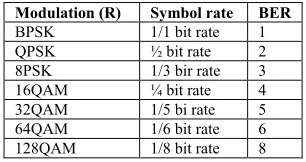
TABLE I. DIFFERENCE BETWEEN BPSK,QPSK,8PSK,16QAM,32QAM, 64QAM,128QAM
Modulation (R) Symbol rate BER
BPSK 1/1 bit rate 1 QPSK ½ bit rate 2 8PSK 1/3 bir rate 3 16QAM ¼ bit rate 4 32QAM 1/5 bi rate 5 64QAM 1/6 bit rate 6 128QAM 1/8 bit rate 8
The combination with limited interleaving and channel coding will provide time diversity. Different copies of the transmitted flag are divided in time and the time separating among transmissions surpasses the intelligibility time of the channel.
B. Steps of process in modulation
In this investigation, it is alluring to restrict b to be an even number for the following reasons:
Half of the bits are represented on the real axis and half the bits are represented on imaginary axis. The in-phase and quadrature signals are independent 𝑏/2 level pulse amplitude modulation signals.
For decoding, symbol decisions may be applied independently on the real and imaginary axis, simplifying the receiver implementation.
𝛼𝑅𝑄𝐴𝑀 = ± 2𝑟 − 1 ± 2𝑟 − 1 𝑗 (11)
Where
𝑟 ∈ {1, … . , 𝑅
2}, for 128QAM change the value based on „R‟
III. SIMULATION ENVIRONMENT
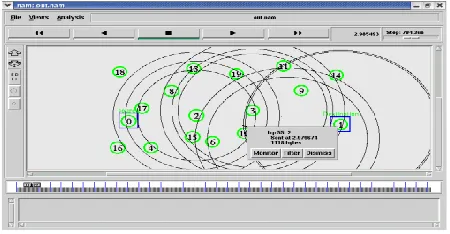
The simulation process starts with the network process with OFDM system. Here MIMO nodes indicate how to request for a channel and share the data with possible ways support of methodology. The process of simulation begins through some parameters and library files with object files. The simulation carried out in a network simulator (NS2). Here AODV protocol used and compares STF with STFC-MDs.
In this paper, we can simulate the process of network should be taking as different objects and library files support of effective protocol and shows the process is good way. Here we can compare different systems like Space time (ST), Space frequency (SF), Space time frequency coding (STFC) and Space time frequency coding with multiplexing de-multiplexing. We compare these all but performance wise STFC-MDs are more efficient than remaining three.
Fig. 2. Multiple data transmitting through TCP
Fig. 3. Request send information from source to detstination
Fig. 4. Clear to send information from source to destination
Fig. 5. Data send through multiple routings based on AOMDV
Fig. 6. Energy Consumption 0
0.5 1 1.5 2 2.5
10 25 50 100 200 300 400 500 600 700 800
Energ
y(j
)
ENERGY CONSUMPTION
STFC
STFC-MD
Fig. 7. Delay Performance
Fig. 8. Dropping Ratio
Fig. 9. THROUGHPUT
To evaluate the proposed approach compare with existing approach, four performance metrics are considered in the experiments: 1) Energy consumption: Individual energy levels of node calculate based on time interval. 2) Delay: The nodes travelling some distance based on time functionality. 3) Packet dropping ratio: how much data loss in network process based on communication levels and 4) Throughput: total data transmission based on simulation time by measuring the bit per sec process. Figure (6), (7), (8), and (9) represents the energy consumption, delay, packet dropping ratio, and throughput parameters with respect to time.
These graphs measure the system process and compared with the existing algorithm and showed that our proposed system has more effective performance than STFC.
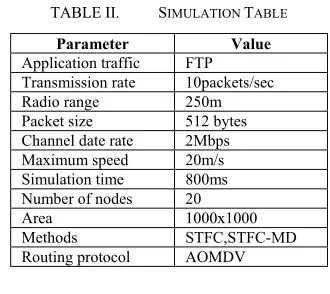
TABLE II. SIMULATION TABLE
Parameter Value
Application traffic FTP Transmission rate 10packets/sec Radio range 250m Packet size 512 bytes Channel date rate 2Mbps Maximum speed 20m/s Simulation time 800ms Number of nodes 20 Area 1000x1000 Methods STFC,STFC-MD Routing protocol AOMDV
IV. CONCLUSION
In this paper designing of STF codes for multi antenna OFDM transmissions over frequency-selective Rayleigh fading channels are described. The scheme of STF coding can be extremely useful for transmitting information which needs high security. This scheme has a very high potential commercially, because of the security and high data rates which will serve the interests of the future mobile customers who demand high bandwidths. MIMO scheme is used to provide high capacity with the same bandwidth. Space time frequency coding method with multiplexing de-multiplexing (STFC-MD) based on 128-QAM for OFDM communications have been used effectively for increasing the system bandwidth efficiency. Without any increase of total transmission power this development is achieved. The performance of wireless communication systems can be improved significantly by adopting space time frequency coding technique with multiplexing de-multiplexing. The proposed STFC-MD principle may be applied to further wireless systems such as Wi-Max-MIMO.
REFERENCES
[1]. Wu Y., W. Y. Zou, “Orthogonal frequency division multiplexing: A multi-carrier modulation scheme,” IEEE Transactions on Consumer Electronics, vol. 41, no. 3, pp.392– 399, Aug. 1995.
[2] G. P. Fettweis and E. Zimmermann, “ICT energy consumption-trends and challenges,” in Proc. 11th Int. Symp. WPMC, Sep. 2008, pp. 1–4.
[3] Xiong, G. Y. Li, S.-Q. Zhang, Y. Chen, and S.-G. Xu, “Energy- and spectral-efficiency tradeoff in downlink OFDMA networks,” IEEE Trans. Wireless Commun., vol. 10, no. 11, pp. 3874–3886, Nov. 2011.
[4] H. Bolcskei and A. Paulraj, “Space-frequency codes for broadband fading channels,” in Proc. IEEE Int. Symp. Inform. Theory, Washington, DC, June 2001.
0 0.5 1 1.5 2 2.5
10 25 50 100 200 300 400 500 600 700 800
Dela
y(m
/s)
DELAY PERFORMANCE
STFC
STFC-MD
Time(ms)
0 0.2 0.4 0.6 0.8 1 1.2 1.4 1.6 1.8
10 25 50 100 200 300 400 500 600 700 800
Dro
pping
ratio
(%
)
DROPPING RATIO
STFC
STFC-MD
Time(ms)
0 0.5 1 1.5 2 2.5
10 25 50 100 200 300 400 500 600 700 800
Thro
ug
hput(
M
b/s)
THROUGHPUT
STFC
STFC-MD
[5] Z. Liu and G.B. Giannakis, “Space-time block coded multiple access through frequency-selective fading channels,” IEEE Trans. Commun, vol.49,pp. 1033-1044, June 2001.
[6] Z. Liu, G.B. Giannakis, B. Muquet, and S. Zhou, “Space-time coding for broadband wireless communications, “ Wireless Syst. Mobile Comput., vol. 1, no. 1,pp.33-53, Jan-Mar. 2001.
[7] Z. Liu, Y. Xin, and G.B. Giannakis, Linear constellation precoding for OFDM with maximum multipath diversity and coding gains.” In Proc. 35th Asilomar Conf. Signals,
Syst., Comput,. Pacific Grove, CA, Nov 4-7,2001, pp. 1445-1449.
[8] S. Zhou and G.B. Giannakis,”Space-time coding with maximum diversity gains over frequency-selective fading channels,” IEEE Signal Processing Lett., vol. 8, pp. 269-272, Oct. 2001.
[9] H. Bolcskei and A. Paulraj, “Space-frequency coded broadband OFDM systems, “ in Proc.of Wireless Commun Networking Conf., Chicago, IL, Sept. 23-28. 2000.pp. 1-6.
[10] B. Lu and X. Wang, “Space-time code design in OFDM systems,” in Proc, Global Telecommun. Conf., vol.2. San Francisco, CA. NOV-Dec. 27-1, 2000, pp. 1000-1004.
[11] A.F. Naguib, N. Seshadri, and R. Calderbank, “Increasing date rate over wireless channels,” IEEE Signal Processing Mag., vol. 17, pp. 76-92, May 2000.
[12] D.L. Goeckel,”Coded modulation with nonstandard signal sets for wireless ofdm systems,” in Proc.Int,Conf,Commun, Vancouver, BC, Canada, June 1999, pp.791-795.
[13] Y. Li, J.C. Chung, and N.R. Sollenberger, “Transmitter diversity for OFDM systems and its impact on high-rate data wireless networks,” IEEE J. Select. Areas Commun, vol.17,pp.1233-1243, July 1999.
[14] V. Tarok, H. jafarkhani, and A.R. Calderbank, “Space-time block coes from orthogonal designs, “IEEE Trans. Inform. Theory, vol. 45, pp. 1456-1467, July 1999.
[15] D. Agarwal, V. Tarokh, A. Naguib, and N. Seshadri, “Space-time coded OFDM high data-rate wireless communication over wideband channels,” in Proc. Veh. Technol. Conf., Ottawa, ON, Canada, May18-21, 1998, pp. 2232-2236.
[16] S.M. Alamouti, “A simple transmit diversity technique for wireless communications, “IEEE J. select areas Commun. Vol.116,pp. 1451-1458, Oct. 1998.
[17] V. Tarokh, N. Seshadri, and A.R. Clderbank, “Space-time codes for high data rate wireless communication:
performance criterion and code construction,” IEEE Trans. Inform. Theory, vol.44, pp. 744-765, Mar, 1998.
[18] Vahid Trokh, Nambi Seshadri, Calderbank. Space time codes for high data rate wireless communication; Performance criterion and code construction. IEEE Transaction on Information theory 1998:44:744-765.
[19] A. E. Jones and T. A. Wilkinson "Block coding scheme for reduction of peak to mean envelope power ratio of multicarrier transmission schemes", IEE Elect. Lett, vol. 30, pp.2098 -2099, march 1994
[20] X. Li and L. J. Cimini, "Effect of clipping and filtering on the performance of OFDM," Proc. IEEE VTC '97, pp. 1634-1638, 1997.
[21] T. Wattanasuwakull, W. Benjapolakul, “PAPR Reduction for OFDM Transmission by using a method of Tone Reservation and Tone Injection” Fifth International Conference on Information, Communications and Signal Processing, ISBN: 0-7803-9283-3, pp. 273- 277, 2005.
[22]. Malhar Chauhan, Prof.Abhishek Chobey, “PAPR Reduction in OFDM System Using Tone Reservation Technique”, International Journal of Computer Technology and Electronics Engineering (IJCTEE), Volume 2, Issue 4, August 2012.
[23]. Luo, R.Z., Li, R., Wu, X.Q., Hu, S.N. and Niu, N. “A PTS Optimization Scheme with Superimposed Training for PAPR Reduction in OFDM System”. Communications and Network, 6, 97-104, Feb 2014.
[24]. Abaurakhia S A, Badran E F and Darwish A E, “Linear Companding Transform for the Reduction of Peak-to-Average Power Ratio of OFDM Signals”, IEEE Transactions on Broadcasting, Vol. 55, No.1, pp. 155 – 160, March 2009.
[25]. Eugen-Victor Cuteanu, Alexandru Isar, “PAPR Reduction of OFDM Signals using Active Constellation Extension and Tone Reservation Hybrid Scheme”, The 8th Advanced International Conference on
[26]. Madhuri. P, Dr. Malleshwari B L, “Peak to Average Power Ratio reduction by CB-ACE and Adaptive ACE algorithms”, International Journal of Emerging Technology and Advanced Engineering, Vol.2, Feb 2012.
[27] Dr. Raja Murali Prasad, “Compensation of PAPR in Optical OFDM Systems based on Distance Cosine and Hartley Method”, IJRECE, Vol.5, Issue 3, July-Sept-2017.