Electronic Thesis and Dissertation Repository
12-12-2016 12:00 AM
Creating Functional Materials with Phosphorus
Creating Functional Materials with Phosphorus
Tyler John Cuthbert
The University of Western Ontario
Supervisor
Elizabeth R. Gillies
The University of Western Ontario Joint Supervisor Paul J. Ragogna
The University of Western Ontario Graduate Program in Chemistry
A thesis submitted in partial fulfillment of the requirements for the degree in Doctor of Philosophy
© Tyler John Cuthbert 2016
Follow this and additional works at: https://ir.lib.uwo.ca/etd
Part of the Inorganic Chemistry Commons, Materials Chemistry Commons, and the Polymer Chemistry Commons
Recommended Citation Recommended Citation
Cuthbert, Tyler John, "Creating Functional Materials with Phosphorus" (2016). Electronic Thesis and Dissertation Repository. 4305.
https://ir.lib.uwo.ca/etd/4305
This Dissertation/Thesis is brought to you for free and open access by Scholarship@Western. It has been accepted for inclusion in Electronic Thesis and Dissertation Repository by an authorized administrator of
i
Abstract
Understanding the relationship between small molecules or polymers and how they affect the properties of materials they compose is the basis of materials science. Using unique and versatile components can impart useful and interesting properties to materials. Here, we aimed to extend this understanding to phosphorus, and the known properties it possesses. This included the production of photopolymerizable coatings containing phosphonium molecules and polymers for antifouling and antibacterial applications. The synthesis and characterization of these phosphonium components was completed and materials were produced utilizing UV curing technology. Addition of these components produced coatings that could resist bacteria attachment and efficiently kill bacteria that come in contact with the surface. Typical polyphosphonium antibacterials all possess similar alkyl functional groups. An alternative approach explored the use of different phosphonium substituents, including sugars and hydroxyl functional groups. The synthesis of these interesting phosphoniums from PH3(g) is described, along with their polymerization and antibacterial activity against
both Gram-positive and Gram-negative bacteria. They were efficient at killing both strains of bacteria at low concentrations with corresponding low hemolytic activity. These results present a new direction for the design of antibacterial polymers in this field. Utilizing hydrophilic phosphonium polymers, self-healing ionic networks with poly(acrylic acid) were produced. The rheological and mechanical properties of the networks were studied to understand the effect of the polyphosphonium content within the networks. These properties were found to directly affected the materials ability to heal. Healing could be completed at low salt concentrations (<0.1 M NaCl) where in vivo applications could be realized. Finally, phosphane-ene chemistry was utilized to create polymer networks directly from PH3(g)
ii
Co-Authorship Statement
The work described in chapter two was coauthored by Cuthbert, T.J.; Guterman, R.; Ragogna, P.J.; Gillies, E.R. J. Mater. Chem. B2015, 3, 1474-1478. Tyler Cuthbert was the primary experimentalist with Ryan Guterman contributing to the initial synthesis of 2.1 and charge density experiments, and Aneta Borecki completed the MTT assay. Tyler Cuthbert wrote the manuscript, but all authors contributed to the editing process.
The work described in chapter three was coauthored by Cuthbert, T.J.; Harrison, T.D; Ragogna, P.J.; Gillies, E.R. J. Mater. Chem. B2016, 4, 4872-4883. Tyler Cuthbert was the primary experimentalist with Tristan Harrison contributing to the synthesis of 3.1, 3.3, 3.1-P, and 3.3-P. Tyler Cuthbert wrote the manuscript, but all authors contributed to the editing process.
The work described in chapter four was coauthored by Cuthbert, T.J.; Ragogna, P.J.; Gillies, E.R. and is in the pre-submission stage for publication. Tyler Cuthbert was the primary experimentalist.
The work described in chapter five was coauthored by Cuthbert, T.J.; Jadischke, J.J.; de Bruyn, J.R.; Ragogna, P.J.; Gillies, E.R. and is pre submission. Tyler Cuthbert was the primary experimentalist with Josh Jadischke contributing to the synthesis of the polymers and some initial healing experiments. Tyler Cuthbert wrote the manuscript, but all authors contributed to the editing process.
The work described in chapter six was coauthored by Cuthbert, T.J.; Bow, J.P; Evoy, E.; Guterman, R.; Gillies, E.R.; Ragogna, P.L.; Blacquiere, J.M. and is pre submission. Tyler Cuthbert, J.P. Bow, and Erin Evoy were the main experimentalists. J.P. Bow and Erin Evoy contributed the Rh and Ru metal scavenging experiments and Tyler Cuthbert contributed the synthesis of 6.1, 6.2, 6.7, 6.8, polymer regeneration and Ru scavenging experiments. Tyler Cuthbert wrote the PH3 polymer section containing 6.7 and 6.8, and Johanna Blacquiere
iii
Acknowledgements
I would like to start by thanking my supervisors Paul J. Ragogna and Elizabeth R. Gillies. Your guidance, support, knowledge, and patience has been an invaluable component of my degree. Thank you for everything that you've done over the past four years to lead to this thesis.
I would like to thank everyone that has been a part of both the Ragogna and Gillies group over the years. There is more to a research group than just the science. We lean on each other every day and you are an indispensable part of a graduate degree. I would also like to thank the support staff: John and Jon in the machine shop, Dr. Mat Willans for all the NMR spectroscopy help, Aneta for the cell work, and the folks in the ChemBioStores.
My family and friends, parents John and Wendy, sister Lauren, niece and nephew Sophie and Connor, my greyhound Tox, Brad and family, I thank you for always being there and your unconditional support.
Lastly, I would like to thank my committee members Dr. Brian Pagenkopf and Dr. Mark Workentin for their feedback on my yearly reports, and my examiners Dr. Michael Brook and Dr. Carole Creuzenet for reading my thesis.
iv
Table of Contents
Abstract ... i
Co-Authorship Statement ... ii
Acknowledgements ... iii
Table of Contents ... iv
List of Tables ... viii
List of Figures ... ix
List of Schemes ... xii
List of Appendices ... xiii
List of Abbreviations ... xiv
Chapter 1 ... 1
1 Introduction ... 1
1.1 Materials chemistry introduction and background ... 1
1.1.1 Functional Materials – Advancing current societal demands ... 1
1.2 Polymerization ... 2
1.2.1 Basics of polymerization ... 2
1.2.2 Radical polymerization ... 3
1.2.3 RAFT agent Z and R substituent effects12,13 ... 6
1.2.4 Step-growth radical polymerization ... 8
1.2.5 Photopolymerization ... 8
1.2.6 Photopolymer (UV cured) networks ... 10
1.3 Phosphorus-based materials and selected applications of these materials ... 11
1.3.1 Functional materials containing phosphorus ... 11
1.3.2 Phosphonium polymers as antibacterial agents and their application in antibacterial materials ... 14
1.3.3 Antibacterial phosphonium-containing materials ... 15
1.3.4 Ionic networks ... 15
1.3.5 Metal scavenging materials ... 16
1.4 Scope of Thesis ... 17
v
Chapter 2 ... 25
2 Contact active antibacterial phosphonium coatings cured with UV light. ... 25
2.1 Introduction ... 25
2.2 Results and Discussion ... 26
2.3 Conclusions ... 32
2.4 Experimental ... 33
2.5 References ... 38
Chapter 3 ... 41
3 Synthesis, properties, and antibacterial activity of polyphosphonium semi-interpenetrating networks ... 41
3.1 Introduction ... 41
3.2 Results and discussion ... 43
3.2.1 Synthesis of polyphosphonium ... 43
3.2.2 Preparation and characterization of polyphosphonium SIPNs ... 47
3.2.3 Antibacterial testing of the SIPNs ... 52
3.3 Conclusions ... 55
3.4 Experimental ... 56
3.4.1 Preparation and characterization of polyphosphonium SIPNs ... 61
3.5 References ... 65
Chapter 4 ... 70
4 Increasing the hydrophilicity of phosphonium polymers to increase antibacterial activity and decrease hemolytic activity. ... 70
4.1 Introduction ... 70
4.2 Results and Discussion ... 73
4.2.1 Synthesis of phosphonium mannoside and glucoside monomers 4.3 and 4.4 ... 73
4.2.2 Polymerization of 4.3 and 4.4. ... 79
4.2.3 Antibacterial testing ... 83
4.3 Conclusions ... 91
4.4 Experimental ... 92
4.5 References ... 100
Chapter 5 ... 103
vi
5.1 Introduction ... 103
5.2 Results and Discussion ... 105
5.2.1 Synthesis and characterization of the polyphosphonium ... 105
5.2.2 Preparation and characterization of ionic networks ... 106
5.2.3 Rheological and mechanical properties ... 113
5.2.4 Self-healing ... 116
5.3 Conclusions ... 118
5.4 Experimental ... 119
5.5 References ... 123
Chapter 6 ... 125
6 A Phosphorus-rich polymer as a homogeneous catalyst scavenger ... 125
6.1 Introduction ... 125
6.2 Results and Discussion ... 126
6.2.1 Metal scavenging with polymers from primary di-phosphine 6.1. ... 126
6.2.2 Polymer Network Metal scavengers from PH3 ... 131
6.3 Conclusions ... 134
6.4 Experimental ... 134
6.5 References ... 139
Chapter 7 ... 141
7 Conclusions and Future work ... 141
7.1 Conclusions ... 141
7.2 Future work ... 143
7.2.1 Antibacterial surfaces with accessible zwitterions ... 143
7.2.2 Solution based antibacterial agents ... 143
7.2.3 Smart Materials ... 144
7.2.4 Phosphane-ene metal scavengers ... 146
7.3 References ... 146
Appendix ... 147
8 Appendix ... 147
8.1 American Chemical Society’s Policy on Theses and Dissertations ... 147
8.2 Supplementary Information for Chapter 2 ... 148
8.2.1 References ... 151
vii
8.3.1 References ... 166
8.4 Supplementary Information for Chapter 4 ... 167
8.5 Supplementary Information for Chapter 5 ... 177
8.6 Supplementary Information for Chapter 6 ... 188
8.6.1 References ... 192
viii
List of Tables
Table 2-1: Effect of film formulation on accessible surface charge, as measured by
fluorescein exchange. ... 27
Table 2-2: Properties of coatings prepared from 47.5 wt% of (2.1), 47.5 wt% (2.2), and 5 wt% (2.3) under air or N2 atmospheres. ... 29
Table 3-1: Summary of the polyphosphonium prepared for this study as well as their molar mass characteristics and thermal properties. ... 46
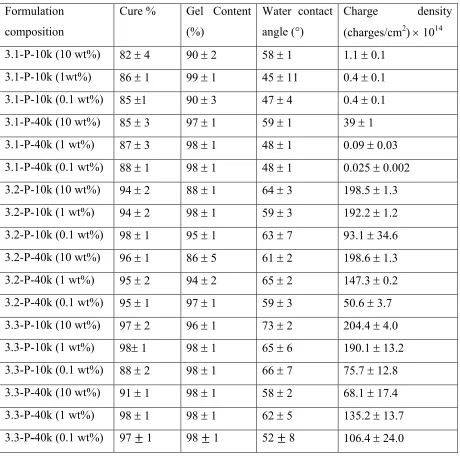
Table 3-2: Summary of the composition and properties of polyphosphonium SIPNs. ... 48
Table 4-1: MIC and MBC values for polyphosphonium and their corresponding monomers. All concentrations correspond to the concentration of phosphonium ion. ... 84
Table 4-2: Selected MIC and HC50 values for previously reported amphiphilic antibacterial polymers. Concentrations correspond to the concentrations of cations.. ... 91
Table 5-1: Summary of the tensile properties of PAA/5.1-P networks. ... 116
Table 6-1: Sequestration of GI from RCM of 6.5.a ... 130
Table 6-2: Regeneration of metal free 6.2 from 6.2-Ru. ... 131
ix
List of Figures
Figure 1-1: Representation of the chain-growth and step-growth polymerization
mechanisms.. ... 3
Figure 1-2: Free radical polymerization processes: initiation, propagation, and termination. . 3
Figure 1-3: RAFT, ATRP, and NMP reagents and radical adducts. ... 4
Figure 1-4: Mechanism of RAFT polymerization. ... 6
Figure 1-5: The components of a RAFT agent and common Z and R substituents ... 7
Figure 1-6: Commercially available photoinitiators. ... 9
Figure 1-7: Jablonski diagram depicting common photochemical processes with HDMAP. 10 Figure 1-8: Schematic diagram of main-chain and side-chain functional groups. ... 11
Figure 1-9: Examples of side-chain (1.8-1.10) and main-chain (1.11) phosphonium polymers. ... 12
Figure 1-10: Copolymer, di-block copolymer, ABA tri-block copolymer, and metallo- phosphonium block copolymers used as precursors for functional materials. ... 13
Figure 1-11: Phosphonium polymer derivatives and their relative antibacterial activities against S. aureus. ... 14
Figure 1-12: Antibacterial phosphonium-functionalized materials. ... 15
Figure 1-13: Phosphonium-based ionically cross-linked networks from polyphosphonium and small molecule anionic cross-linkers ... 16
Figure 1-14: Examples of previously reported and commercially available functionalized silica and polystyrene beads. ... 17
Figure 2-1: Schematic showing the coating preparation process. ... 26
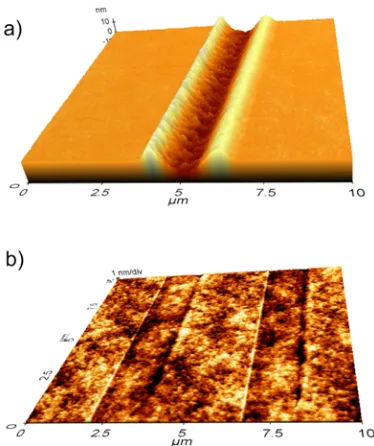
Figure 2-2: AFM images following application of a diamond tip surface profiler with a 0.5 mN force to: a) a film cured in air and b) a film cured under N2. ... 29
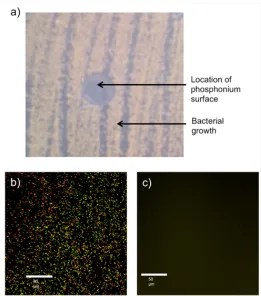
Figure 2-3: Antibacterial testing results for a surface containing 47.5 wt% of 2.1 and cured under N2. ... 31
x
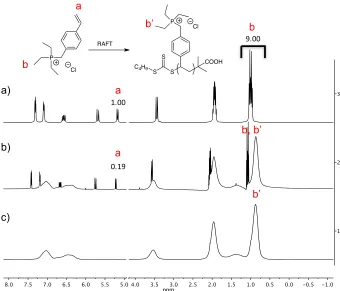
Figure 3-2: 1H NMR spectra (400 MHz, D2O) of a) The 3.1 polymerization mixture prior to
polymerization; b) Unpurified 3.1-P-40k polymerization mixture at 81% conversion; c)
Purified 3.1-P-40k. ... 46
Figure 3-3: DSC curves for 3.2-P-10k, an SIPN prepared using 10 wt% of 3.2-P-10k, and an SIPN prepared from TEGDA without polyphosphonium.. ... 50
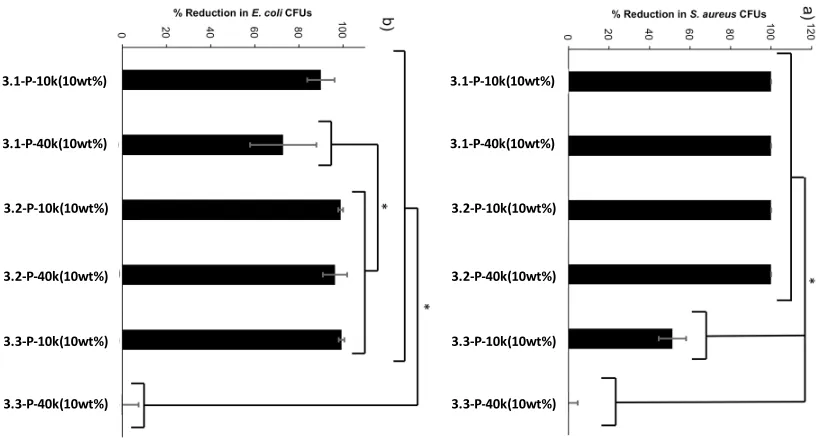
Figure 3-4: SIPN activity versus a) S. aureus and b) E. coli in the dynamic contact antibacterial test. ... 53
Figure 3-5: Control and SIPN surfaces following Live/Dead® analysis after incubation of the surfaces in a suspension of 107 CFUs/mL of S.aureus for 24 hours ... 55
Figure 4-1: Example of hydrophilic-hydrophobic balance by charge-hydrophobic combination vs. separation. ... 71
Figure 4-2: Examples of antibacterial polymers from b-lactams (left), heightened potency of antibiotics when used in conjunction with metabolites such as mannitol (middle), and antibacterial mannoside-derived glycosides (right). ... 72
Figure 4-3: Structure of proposed targeted phosphonium monomer. ... 73
Figure 4-4:31P{1H} (top) and 1H coupled 31P (bottom) NMR spectra of an attempt at creating a tertiary phosphine from an allylether sugar resulting in a mixture of primary, secondary, tertiary, and oxidized products. ... 75
Figure 4-5: 31P{1H} NMR Spectra of the reaction mixtures for the resulting sugar functionalized primary phosphines 4.1.P and 4.2.P from a-allylether mannose (4.1) and a-allylether glucose (4.2). ... 76
Figure 4-6: 31P{1H} NMR spectra of tertiary phosphines 4.1.T and 4.2.T from the reaction of 1-hexene with primary phosphines 4.1.P and 4.2.P, respectively. ... 77
Figure 4-7:31P{1H} NMR spectra of 4.3 and 4.4 from the quaternization of 4.1.T and 4.2.T with 4-vinylbenzyl chloride. ... 78
Figure 4-8: 1H NMR spectrum of the polymerization of 4.3 ... 79
Figure 4-9: 1H NMR spectrum of the polymerization of 4.4. ... 80
Figure 4-10: 1H NMR spectra of the deprotection of 4.5 to 4.5-d. ... 81
Figure 4-11: 1H NMR spectra of the deprotection of 4.6 to 4.6-d.. ... 82
xi
Figure 4-13: Growth of E. coli at different concentrations of phosphonium polymers ... 85 Figure 4-14: Growth of S. aureus at different concentrations of A) polymers 4.5-d and 4.6-d; B) polymer 4.8. ... 86 Figure 4-15: A. log(concentration) plotted against its % hemolysis to determine approximate HC50 values by the intersection with the black line.. ... 89
Figure 5-1: SEM-EDX analyses of ionic networks: A. ... 108 Figure 5-2: Swelling in weight % of polymer networks at different NaCl concentrations. . 113 Figure 5-3: Comparison of the rheology frequency sweep data of PAA/5.1-P networks. ... 114 Figure 5-4: Tensile properties of PAA/5.1-P networks and a sample showing the dog bone
structure used in accordance with ASTM D638 14. ... 116 Figure 5-5: Digital images of a PAA>5.1-P network damaged by a 0.5 mm diameter hole
self-healing over 24 hours in 0.1 M NaCl. ... 117 Figure 5-6: Tensile properties of PAA/5.1-P networks prior to and after healing in 0.1 M
NaCl following complete severing of the sample. ... 118 Figure 6-1: Consumption of styrene (1) by hydrogenation with WI without additive (x) and
with 6.2 (16 g/mmol Rh) added at the outset of reaction (◼). ... 128 Figure 6-3: 31P{1H} NMR spectroscopy of 6.7 and 6.8 composing of primarily tertiary
phosphines... 133 Figure 7-1: Left: Switchable antibacterial-antifouling surface based on acid catalyzed ring
opening to produce carboxy betaine; Right: Accessible antibacterial-antifouling
phosphonium using a phosphonium-thiolate zwitterion. ... 143 Figure 7-2: Proposed sugar containing phosphonium monomers containing different sugars
including b-D-mannose and a/b-D-galactose, and b-D-glucose to determine the effect of the anomeric conformation; 7.2 represents a tri-sugar-substituted phosphonium monomer. ... 144 Figure 7-3: Ionically cross-linked networks for small molecule release. ... 145 Figure 7-4: Proposed UV curable polymer network possessing ionic cross-linking for
xii
List of Schemes
Scheme 1-1: Examples of RAFT agent modification to afford terminal functional groups on the polymer7 ... 7 Scheme 1-2: Step-growth radical thiol-ene polymerization. ... 8 Scheme 3-1: Synthesis of phosphonium monomers and polymers. ... 44 Scheme 4-1: Overall synthetic approach for producing 4.3 and 4.4 from a-allylether sugars
4.1 and 4.2, respectively. ... 73 Scheme 4-2: Deprotection of the polymers 4.5 and 4.6 with sodium methoxide to yield 4.5-d and 4.6-d. ... 81 Scheme 4-3: Deprotection procedure for monomers 4.3 and 4.4 to yield 4.3-d and 4.4-d. .... 82 Scheme 5-1: Synthesis of the polyphosphonium and their combination with PAA to form ion
pairs. ... 105 Scheme 6-1: Loading the Soft Polymer Network (6.2) with Wilkinson’s catalyst (W1) to
give 6.2-Rh. ... 127 Scheme 6-2: Hydrogenation of styrene (6.3) with Wilkinson’s catalyst (W1) and with
xiii
List of Appendices
8 Appendix ... 147
8.1 American Chemical Society’s Policy on Theses and Dissertations ... 147
8.2 Supplementary Information for Chapter 2 ... 148
8.2.1 References ... 151
8.3 Supplementary Information for Chapter 3 ... 153
8.3.1 References ... 166
8.4 Supplementary Information for Chapter 4 ... 167
8.5 Supplementary Information for Chapter 5 ... 177
8.6 Supplementary Information for Chapter 6 ... 188
xiv
List of Abbreviations
wc frequency° degree
°C degrees celsius
ɸr quantum yield
ε extinction coefficient
µg microgram
µL microliter
µM micromolar
λmax maximum absorbance wavelength
3D three dimensional
ATCC American type culture collection ASTM American society for testing materials ATRP atom transfer radical polymerization AFM atomic force microscopy
AIBN azobisisobutyronitrile
BAPO phenylbis(2,4,6-trimethylbenzoyl)phosphine oxide cm centimeter
CFU colony forming unit CTA chain transfer agent
Ð dispersity
DEPA diethyl phosphoramidate
DMPA 2,2-dimethoxy-2-phenylacetophenone DMF N,N-dimethylformamide
DSC differential scanning calorimetry DMSO dimethylsulfoxide
E.coli Escherichia coli FBS fetal bovine serum
g gram
G” viscous modulus G’ elastic modulus
GC-FID gas chromatograph free induction decay Hz Hertz
HDMAP 2-hydroxy-2,2-dimethyl-acetophenone HCPK 1-hydroxycyclohexylphenyl ketone IC internal conversion
ISC intersystem crossing
ICP-MS inductively coupled plasma mass spectrometry kPa kiloPascals
kHz kiloHertz kg kilogram L litre
xv MHz megaHertz
mg milligram mL milliLiter mm millimeter
Mw weight average molecular weight
Mn number average molecular weight
Mi mass of the ith fraction
M molar
MeOH methanol mM millimolar
NMR nuclear magnetic resonance
Ni number of the ith fraction
nm nanometer
NMP nitroxyl mediated polymerization Oz/in ounce per inch
PAA poly(acrylic acid)
PAH poly(allylamine hydrochloride) PEO poly(ethylene oxide)
PET poly(ethylene terephthalate) PBS phosphate buffered saline Pa Pascals
PS polystyrene rad/s radians per second
RAFT reversible addition fragmentation chain transfer RCM ring closing metathesis
SEC size exclusion chromatography
SEM-EDX scanning electron microscope energy dispersive x-ray
S.aureus staphylococcus aureus
SYTO 9 green fluorescent nucleic acid stain SDS sodium dodecyl sulfate
SIPN semi interpenetrating network T1 triplet state
TEGDA tetraethyleneglycol diacrylate TEGDAE tetraethyleneglycol diallylether TGA thermogravimetric analysis Tg glass transition
To onset decomposition temperature
TON turnover number TMEDA tetramethylenediamine THF tetrahydrofuran
TTT 1,3,5-triallyl-1,3,5-triazine-2,4,6(1H,3H,5H)-trione UV ultraviolet
UATR universal attenuated total reflectance mode VR vibrational relaxation
1
Chapter 1
1
Introduction
1.1
Materials chemistry introduction and background
Materials chemistry can be defined as understanding the relationship of the atoms, molecules, or polymers that a material is composed of, and how they affect the resulting bulk properties.1 A material is defined as a solid-state component or device that was used, currently used, or could be used to address a societal need.1 Historically, materials used to create devices were naturally occurring, such as bone, wood, and solid mineral aggregates. As science advanced so did the manipulation of the components to create materials that either performed a task more efficiently or solved a specific problem. Polymers were discovered in the late 19th century and progressed slowly until the 1930s, at which point there was a shortage of natural rubber. This was also when the concept of polymers was introduced by Staudinger. Poly(vinyl chloride) and polyphosphazene were among the first polymers produced as replacements for natural rubber.2 This brought about the first uses of synthetic materials composed of polymers.1
Synthetic materials progressed with the discovery of polyamides (e.g., Nylon), poly(ethylene terephthalate) (PET), and polyurethanes, all of which are still used today. These discoveries resulted in synthetic materials such as fibers, protective coatings, plastics and elastomers. Materials produced from polymers can be divided into two categories: thermoplastics and thermosets.1 Thermoplastics are composed of linear or branched polymers and can be
melted, extruded, and annealed into desired shapes, whereas thermosets are composed of cross-linked linear polymers that do not possess melt temperatures, and therefore cannot be processed after production.
1.1.1
Functional Materials – Advancing current societal demands
2
and physical properties can be utilized to manipulate macromolecules (i.e., polymers) including their chemical and physical characteristics such as elasticity, viscosity, melting temperature, glass transition, and crystallization. These polymer characteristics directly affect the material that it comprises.1 An alternative way to functionalize materials is the use of additives to impart desired properties such as increased hardness, flame-retardancy, pigmentation, or adhesion, and is a popular method for tuning photopolymer network properties. 3–6
1.2
Polymerization
1.2.1
Basics of polymerization
Polymers are macromolecules composed of smaller repeating units.7 Initially, polymers were
composed of organic components with carbon backbones but have progressed to include a wide array of elements of the periodic table. Examples containing main group compounds such as boron, silicon, phosphorus, sulfur; and metals have been known for some time but their potential for many different applications has only been realized since the late part of the 20th century.8,9
1.2.1.1 Chain-growth vs step-growth
3
Figure 1-1: Representation of the chain-growth and step-growth polymerization mechanisms. Chain-growth involves the attachment of monomers to a growing polymer chain. Step-growth creates dimers, which combine to create tetramers, and this process is repeated until high molecular weight species are formed.
1.2.2
Radical polymerization
1.2.2.1 Chain-growth radical polymerizations
Radical chain-growth polymerizations have typically been used in polymerizing olefins such as acrylates, styrenes, and acrylamides, that can be transformed into stable radical intermediates (Figure 1-2).11 C-C bond forming radical polymerizations typically create stable backbones and are the most popular type of chain-growth polymerization.
Figure 1-2: Free radical polymerization processes: initiation, propagation, and termination.
The disadvantage of chain-growth free radical polymerization is the lack of control of molecular weight distribution (or the polymers dispersity), due to unwanted termination processes such as radical combination, and disproportionation. Molecular weight distribution is important because it can affect the resulting properties of the polymer, such as antibacterial activity, which will be discussed later in this chapter. Molecular weight distributions are reported as Dispersities (Đ), and are calculated by Mw/Mn where Mn is the
I I M M Pn
kp
P1
kd ki
M
kt
Pn
4
number average molecular weight, and Mw is the weight average molecular weight. Mn and
Mware the two most commonly used molecular weight values to calculate the average molar
mass. The equations defining Mn and Mware as follows:
𝑀" = ∑&'()'
∑&')' 𝑀* = ∑&')'
∑)' Đ = &,
&- (Eq. 1.1)
Where Ni is the number of moles of a polymer molecule (i) and Miis its molar mass. Mn is
therefore the total mass of all the polymer molecules divided by the number of molecules.
Mwputs more emphasis on the larger molecular weights, weighting the distribution in terms
of their molecular weight instead of just the number of polymers. Mw is always greater than
Mn and therefore Đ will always be ≥ 1, with low dispersity typically defined as ≤ 1.1. To
avoid large molecular weight dispersities, reagents that reversibly combine with propagating radicals to allow control over the polymerization have been developed. The most commonly used types of controlled radical polymerizations include reversible addition fragmentation chain transfer (RAFT),12,13 atom transfer radical polymerization (ATRP),14 and nitroxyl mediated polymerization (NMP)15 (Figure 1-3).
Figure 1-3: RAFT, ATRP, and NMP reagents and radical adducts.
ATRP requires a specific reagent containing a bromine-carbon bond, copper and a catalyst, whereas NMP requires a nitroxyl based molecule. RAFT polymerization utilizes chain-transfer reactions to induce control. All of these controlled polymerization approaches utilize the concept of reversibly forming a dormant species from the propagating radical, thereby
5
minimizing the free radical concentration and consequently the termination reactions. Each controlled living polymerization has its benefits, but RAFT polymerization will be the focus for the remainder of this thesis.
1.2.2.2 RAFT controlled living polymerizations
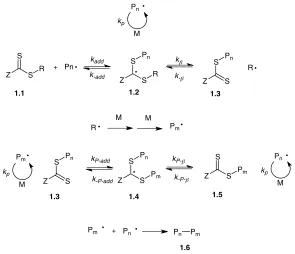
RAFT polymerizations utilize either dithioesters or thiocarbonylthio functionality and have the ability to combine with propagating radical species using a chain-transfer mechanism with resulting control over polymer molecular weight and dispersity. The RAFT controlled polymerization mechanism is as follows (Figure 1-4): Typical thermal radical polymerization initiators such as asobizisobutyronitrile (AIBN) provide a flux of radicals and propagation ensues; propagating radical species then undergo reversible chain-transfer with the RAFT reagent (1.1) to produce an intermediate 1.2; Release of the R substituent produces a macroRAFT agent 1.3 and a radical species able to undergo initiation and polymerization to produce a propagating polymer chain (Pm•); 1.2 can then undergo further
chain-transfer with Pm• to produce 1.4, a chain equilibrium stage that contains both polymer
6
Figure 1-4: Mechanism of RAFT polymerization.
1.2.3
RAFT agent Z and R substituent effects
12,13The reactivity of the RAFT agent can be tuned by changing the R and Z substituents (Figure 1-5).12,13 This is advantageous for tuning the RAFT agent’s chain equilibrium, and is important when utilizing different types of polymerizable monomers. The rate of addition (kadd) to produce chain equilibrium species (Figure 1-4, 1.2) must be slower than the rate of
homolytic cleavage of the R group (kβ>kadd), otherwise polymeric chains may be irreversibly
trapped, preventing further polymerization. The intermediate (Figure 1-4, 1.4) should have a partition coefficient similar to R (kP-β ≥ kP-add), to ensure release of polymer chains for
propagation will happen. The choice of Z group is also important for adjusting the rate of addition to the C=S bond (kadd and kP-add) and rate of fragmentation (kβ and kP-b).
Incorporation of aryl, alkyl, or S-alkyl Z groups increases the rate of addition to the C=S bond, while incorporation of O-alkyl and N-N-dialkyl Z groups decreases the rate of addition, which allows the RAFT agent to be tuned for different polymerizable monomers (Figure 1-5). Pn M kp S S Z R Pn Z S S R Pn Z S S R Pn kadd k-add kβ k-β
M Z S S Pn Z S
S Pm Pn
Z S
S Pm
Pn Pn Pm
R Pm
Pm M Pm M kp Pn M kp
1.1 1.2 1.3
1.3 1.4 1.5
1.6
kP-add
7
Figure 1-5: The components of a RAFT agent and common Z and R substituents guidelines that can be used with different polymerizations. MMA = methyl
methacrylate, S = styrene, MA = methyl acrylate, AM = acrylamide, AN = acrylonitrile, VAc = vinyl acetate.13
RAFT polymerization also results in polymer chains being capped with the RAFT agent. These end capped polymers can be used as macroRAFT agents to create di-block or tri-block copolymers, or cleaved to result in thiol or vinyl functionalities (Scheme 1-1).16,17 This functionality on the product can be useful for further reactivity with small molecules, other polymers, or conjugation to solid substrates or surfaces.
Scheme 1-1: Examples of RAFT agent modification to afford terminal functional groups on the polymer.17
The versatility of RAFT in many different solvents and conditions has been reported. Polymerization conditions can affect the RAFT agent performance, although even high
Z S
S R'
Z =
R =
Ph > > SCH3 ~ CH3 ~ > > > OPh > OEt ~ N(Ph)(CHHN HN 3) > N(Et)2
O
MMA S, MA, AM, AN
VAc CH3 CH3 CN CH3 CH3 Ph H
CO2H Ph CH3 CH3 COOEt CH3 CH3 H2 C CH3 CH3 CN CH3 H CN H CH3 Ph
~ > > ~ ~ >
CH3 CH3 CH3 H H Ph ~ MMA
S, MA, AM, AN, VAc
8
pressure (>5 kbar), and high temperature (140 °C) have been reported to provide polymerization control.13
1.2.4
Step-growth radical polymerization
Step-growth polymerizations can be performed with a wide range of functional groups including esters, alcohols, isocyanates, amines, and acid chlorides, but in the area of main group chemistry a particularly noteworthy example is the use of thiol monomers and di-allyl monomers (Scheme 1-2).18–20 This is commonly referred to as “thiol-ene” chemistry.
Scheme 1-2: Step-growth radical thiol-ene polymerization.
This polymerization process results from initiation of a radical source, abstraction of a hydrogen from the thiol, producing a thiyl radical that can then add to the allyl monomer, resulting in a secondary carbon radical. This radical can then abstract a hydrogen from another thiol, repeating the process, and propagating S-H addition across the olefins. The analogous phosphorus chemistry, phosphane-ene photopolymerization, has also be used for creating functional phosphorus containing materials.21,22
1.2.5
Photopolymerization
1.2.5.1 The basics photoinitiation
Photopolymerization involves the use of light to initiate polymerization.23,24 The advantage of photoinitiation is the spatial control, the speed, and the efficiency of the polymerization. The efficiency of photoinitiation to create radical species is defined by the quantum yield
(ɸ0) of the photochemical process.23 This is defined by the follow equation: # 34 0567893*:
# 6;:30;5< =>383*:= ɸ0 (Eq. 1.2)
The maximum yield is 1, and would correspond to all absorbed photons resulting in the desired chemical process. In this case the chemical process is an α-cleavage reaction,
R SH
S R
I
I H
R SH
S R S R SH
1.6 1.7
R SH S
9
resulting in two radical species. Polymerizations typically use a photoinitiator to start polymerization, although some scenarios do not require them.25 Most commercially
available unimolecular photoinitiators possess an acetophenone functionality that absorbs in the UV range of the spectrum between 300-400 nm (Figure 1-6).26–28
Figure 1-6: Commercially available photoinitiators: HDMAP = 2-hydroxy2-dimethyl acetophenone, DMPA = 2-dimethoxy-2-phenyl-acetophenone, HCPK =
1-hydroxycyclohexylphenyl ketone, BAPO = phenylbis(2,4,6- trimethyl benzoyl)phosphine oxide.
Excitations from n-π* or π-π*, shown in Figure 1-7, are the two relevant excitation processes that occur in acetophenone photoinitiators.27 The initation relies on the excited molecule undergoing the correct sequence of vibrational relaxation (VR), internal conversion(IC), and intersystem crossing (ISC) from the excited state to result in α-cleavage and is best described using a Jablonksi Diagram, with the example of 2-hydroxy-dimethyl-acetophenone (HDMAP) (Figure 1-7). This is an example of a photoinitiator that undergoes α-cleavage from an excited triplet state (T1) to produce two radical species, the benzoyl radical being the dominant initiating species.27
Ph O
OH
Ph O
O
PhO
HDMAP DMPA
O
P
O O
BAPO Ph
O OH
10
Figure 1-7: Jablonski diagram depicting common photochemical processes with HDMAP, resulting in α-cleavage and radical species.
1.2.6
Photopolymer (UV cured) networks
Polymer network formation can be completed using photoinitiation of liquid formulations to create solid thermoset materials.29 The process is advantageous due to the speed of the reaction, the solvent free process, spatial control over polymerization, and a lower energy footprint compared to thermal methods. Photopolymerization is used in electronic integrated circuitry and wiring boards manufacturing, dental materials, 3D printing, coatings and surface modifications.30 Commercially available additives for photopolymer networks are available for coating modification to provide pigments or impart properties such as scratch resistance, adhesion, or hardness.6 These coatings are primarily used for protection of the surface, and do not provide further function.
11
reactions in solvent require oxygen free environments, but often photopolymerization can proceed without the need for an inert atmosphere due to limited oxygen diffusion beyond the surface, resulting in bulk polymerization but incomplete surface curing. This can be overcome by utilizing an N2 atmosphere or additives to reduce oxygen quenching. It is
useful to note that photopolymerization using thiol-ene chemistry can be completed in the absence of a photoinitiator. It is not inhibited completely inhibited by oxygen, but rather proceeds at a slower rate in the presence of oxygen.25
1.3
Phosphorus-based materials and selected applications of
these materials
1.3.1
Functional materials containing phosphorus
Phosphorus has been incorporated into polymers as both a side-chain and main-chain functionality. Side-chain functionalities refer to pendant phosphonium atoms on an organic backbone, whereas main-chain functionalities incorporate phosphorus atoms in the backbone (Figure 1-8).
Figure 1-8: Schematic diagram of main-chain and side-chain functional groups.
Phosphorus in the following examples will be limited to phosphine or phosphonium ions in the +3 or +5 oxidation state, respectively. Main-chain phosphonium polymers have been prepared utilizing a step-growth mechanism (Figure 1-9, 1.11),32 and side-chain examples of
phosphonium polymers with P-N substituents have also been reported (Figure 1-9, 1.10).33
Many of the side side-chain phosphonium polymers incorporate trialkyl phosphoniums. Typically, phosphonium monomers are prepared by a simple quaternization reaction, with an alkyl halide or benzyl halide, producing polymerizable monomers, and resulting in polymers such as in Figure 1-9 compounds 1.8 and 1.9.34–38
= Phosphorus Main-chain
12
Figure 1-9: Examples of side-chain (1.8-1.10) and main-chain (1.11) phosphonium polymers.
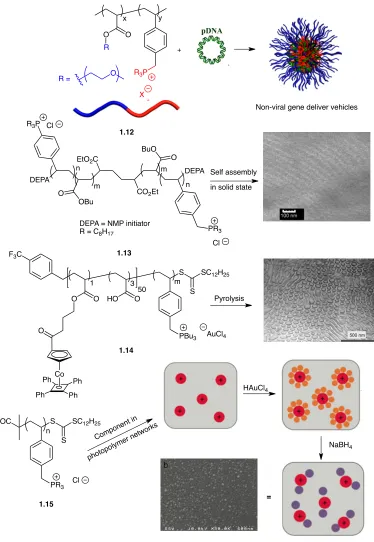
Select examples of higher order phosphonium polymers involved in different applications are outlined in Figure 1-10, including co-polymers for non-viral gene delivery (1.12),39 ABA-triblock copolymers for fuel cell membranes (1.13),40 phosphonium/metallic block copolymers to produce inorganic metallic materials (1.14),41 and the production of gold nanoparticles in polymer networks (1.15).42 Phosphonium containing materials have also been used in applications as part of functional membranes for CO2 capture, desalination,
anion exchange,43–47 carbon nanotube dispersants,48 supramolecular assemblies and ionic cross-linked networks,49–52 and for antibacterial activity.53–58 Phosphonium polymers are often compared to ammonium analogues for many applications, with the ammonium analogues dominating the literature. This is most likely due to the air sensitive properties of the phosphorus starting materials compared to those of analogous amines. This is especially apparent for antibacterial applications, where most work has focused on polyammonium.59–66
O O
P
P R
R
R R
R R
R = alkyl, aryl, C3H6Fc, C6H4F9,
N
P
N N
N X
Cy Cy
Cy
Cy
P P
x Ph
Ph Ph
Ph y n
1.8 1.9 1.10 1.11
X X
X X
13
Figure 1-10: Copolymer, di-block copolymer, ABA tri-block copolymer, and metallo- phosphonium block copolymers used as precursors for functional materials.
O O
R
R3P
X x y O R = 1.12 DEPA DEPA
CO2Et EtO2C
R3P
O BuO O OBu PR3 Cl Cl n n m m
DEPA = NMP initiator R = C8H17
1.13
S SC12H25
S
PBu3 AuCl4 O HO O O O Co Ph Ph Ph Ph
F3C
1 3
50
m
1.14
SC12H25 S S PR3 Cl n HOOC Comp onent i
n
photop olyme
r netw orks
HAuCl4 Pyrolysis Self assembly
in solid state
Non-viral gene deliver vehicles
NaBH4
14
1.3.2
Phosphonium polymers as antibacterial agents and their application
in antibacterial materials
Antibacterial polymers were discovered in 1965 with the discovery of polymers composed of 2-methacryloxytroponones,67 while ammonium antibacterial polymers were first reported in the 1970’s and early 1980’s.68,69 In the early 1990’s, Kanazawa and coworkers showed that phosphonium polymers were also active against bacteria, and performed better than the ammonium analogues.36 Extensive studies were performed examining the activity of phosphonium monomers and polymers, as well as the effects of altering alkyl phosphonium substituent length,36,70 backbone to phosphonium spacer length,71 polymer molecular weight,
phosphonium counter anion,72 phosphonium in the main-chain instead of side-chain,73 copolymers with ammoniums,74 and the functionalization of fibers and filters.53,54,75,76 The results from the antibacterial tests by Kanazawa and coworkers suggested that increasing the length of the alkyl substituent on the phosphonium increased the bactericidal activity. This has complications of increased hemolytic activity against non-bacterial cells, which was not initially reported, but was later reported.77–80 Increasing the length of one alkyl chain
decreased the activity of the phosphonium polymer with respect to Gram-positive bacteria, and little activity was observed against Gram-negative bacteria. Anion exchange for a hydrophobic anion decreased the activity, while increasing the polymer molecular weight increased the activity. Changing the alkyl substituents on the phosphonium to octyl chains increased the activity compared to shorter butyl alkyl chains, and was the best performing phosphonium antibacterial polymer they reported (Figure 1-11).
Figure 1-11: Phosphonium polymer derivatives and their relative antibacterial activities against S. aureus.
P Bu Bu Bu P Bu Bu Bu >
Cl PF6
> > > P Bu Bu Bu Cl n n n
n = 254 n = 85
P Oct Oct Oct Cl n P Bu Bu Bu Cl n P CH3
H3C C9H19
Cl n
P
CH3
H3C C17H35
Cl n
15
1.3.3
Antibacterial phosphonium-containing materials
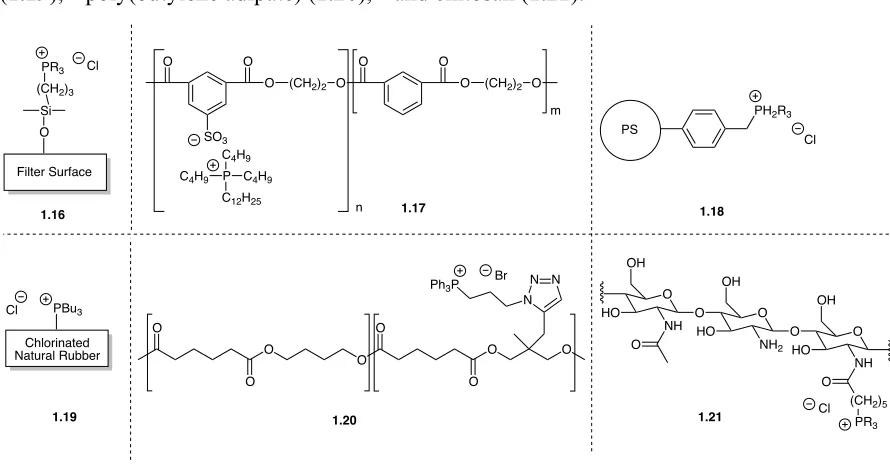
With the knowledge that phosphonium polymers possess antibacterial activity, there have been attempts to use phosphoniums to introduce antibacterial activity into materials. Phosphonium additives have been used to impart antibacterial activity to filters (Figure 1-12,
1.16),54 fibers that release phosphonium biocides (1.17),76 polystyrene beads (1.18),57 rubber (1.19),55 poly(butylene adipate) (1.20),81 and chitosan (1.21).56
Figure 1-12: Antibacterial phosphonium-functionalized materials.
1.3.4
Ionic networks
A recent alternative to covalently cross-linked polymer networks is the creation of materials that have reversible cross-links that can undergo dynamic processes in response to an external stimulus, and that can repair damage or possess shape memory effects.82–86 Examples of these types of cross-links are hydrogen bonds,87 disulfide bonds,88 Diels-Alder adducts,89 metal coordination,90 and ionic bonds.91 These materials are typically made up of linear polymers that can undergo some chemical process to cross-link the materials and achieve thermoset properties. They are also able to revert back to thermoplastic materials by addition of some stimulus that breaks the cross-links and results in material that can be processed, undergo dynamic damage repair, or revert to a memorized shape. Ionic networks are of interest because phosphonium supramolecular networks with tunable viscoelastic
Filter Surface O Si (CH2)3
PR3 Cl O O
O (CH2)2 O
O O
O (CH2)2 O
SO3
P
C12H25 C4H9 C4H9
C4H9
m
n
PS
PH2R3
Cl O NH HO OH O O NH2 O O O NH
(CH2)5 O PR3 Cl OH OH HO HO O O O O O O O N N N Ph3P
Br O Chlorinated Natural Rubber PBu3 Cl
1.16 1.17 1.18
16
properties have previously been reported based on phosphonium monomers and dimers combined with mono-, di-, tri-, and tetra anionic molecule,52 as well as polyanions.51 The
combination of phosphonium polymers with mono- and di- acetate cross-linkers has also been reported.50 In these studies, increasing the cross-linker functionality decreased the fluid-like character in a dehydrated state (Figure 1-13). Polycationic-polyanionic cross-linked networks have been well established, but so far this combination has not yet been reported using phosphonium polymers.
Figure 1-13: Phosphonium-based ionically cross-linked networks from polyphosphonium and small molecule anionic cross-linkers, as well as from polyacrylate and di- and mono- functional phosphoniums.
1.3.5
Metal scavenging materials
Metal removal from processes that utilize homogeneous catalysis can be problematic due to small remaining concentrations of metal that can be problematic in the production of
P C6H13 C6H13
C6H13 n O O O O 9 O O O O O O 4 Brittle network
Sticky elastic material
O O + P P R R R R R
R R P
R R R = Bu, Hex, Oct
Solid Liquid
P C6H13 C6H13
17
pharmaceuticals and electronics.92 Solid-supported metal scavengers have been reported and are currently available commercially for purification techniques that rely on insoluble materials that can be removed by filtration. Some examples of functionalized silica and polystyrene beads are outlined in Figure 1-14.
Figure 1-14: Examples of previously reported and commercially available functionalized silica and polystyrene beads.
The focus of metal scavenging applications will be on the removal of ruthenium-based catalysts. The performance of functionalized silica for metal scavenging has been reported for use on ring closing metathesis reactions of diethyl diallylmalonate using a Ruthenium catalyst (Grubbs 1), with a reported 88.88% reduction in metal concentration using amine functionalized silica (Figure 1-14, 1.22).92 Metal scavengers based on insoluble
phosphine-containing materials have been reported with similar functionalized polystyrene beads, with as high as 96% ruthenium removal (Figure 1-14, 1.23).93 Functionalized silica beads are also commercially available under the names Silicycle, Quadrapure™, and QuadraSil™, with reported > 99% ruthenium removal.94–96
1.4
Scope of Thesis
This dissertation focuses on the use of Phosphorus-containing molecules and polymers for use in material synthesis to impart specific functionality. Chapter 2 focuses on realizing the potential of phosphonium additives for UV cured materials to impart their known antibacterial properties into photopolymerized networks. Inclusion of phosphoniums into these networks was hypothesized to create surfaces with accessible phosphonium biocides that could interact with and kill bacteria. Synthesis, characterization, and bacterial
SH
NH2
HN
NH
NH2
HN
NH
N P
P HO
OH O
O
OH OH
N PPh2 PPh2
18
attachment was explored on these surfaces at different loadings of the phosphonium additive. The attachment of both E. coli and S. aureus to the surfaces was determined, and it was found that the resulting surfaces could resist the attachment of bacteria.
Chapter 3 focuses on creating UV cured surfaces with improved killing of bacteria in solution relative to those described in Chapter 2. We aimed to decrease the amount of additive by using trialkylphosphonium polymers with varied substituent alkyl chain lengths. These polyphosphonium were synthesized by RAFT polymerization. The effects of polymer molecular weight and phosphonium substituent alkyl chain length on the performance and surface characteristics of the photopolymer networks were studied.
Chapter 4 explores the idea of utilizing bacterial attachment, something that is generally undesirable for most antibacterial surfaces and materials, to increase bacterial killing in solution. It focuses on the synthesis and performance of phosphonium polymers with pendant sugars, specifically mannose, a molecule known to bind to E. coli, for increased interaction with the bacteria. The antibacterial activity against E. coli and S. aureus, as well the hemolytic activity against red blood cells were determined.
Chapter 5 describes the use of phosphonium polymers to create self-healing ionically cross-linked materials. Synthesis of high molecular weight polymers and their complexation with poly(acrylic acid) was performed to provide networks with different ratios of components. The rheology and tensile properties of the networks were determined and self-healing at low salt concentrations was demonstrated.
Chapter 6 focuses on the synthesis, characterization, and metal scavenging abilities of phosphine-based polymers that were prepared by a step-growth radical polymerization (phosphane-ene chemistry). Three different networks, two directly from PH3, and one from a
19
1.5
References
1) Fahlman, B. D. Materials Chemistry; Springer: New York, 2007.
2) Maiti, S.; Banerjee, S.; Palit, S. K. Prog. Polym. Sci.1993, 18, 227–261.
3) Grigale-Sorocina, Z.; Kalnins, M.; Simanovska, J.; Vindedze, E.; Birks, I.; Brazdauska, E. Proc. Est. Acad. Sci.2015, 64, 88–92.
4) Funke, W. Additives for Coatings; Bieleman, J.; WILEY-VCH Verlag GmbH & Co. KGaA: Weinheim, Germany, 2001; Vol. 41.
5) Chen, L.; Wang, Y. Z. Materials2010, 3, 4746–4760.
6) Allnex. Industrial Coatings RADCURE. http://allnex.com/industrial.
7) Hiemenz, P. C. Polymer Chemistry The Basic Concepts; Marcel Dekker, Inc.: New York, New York, 1984.
8) Priegert, A. M.; Rawe, B. W.; Serin, S. C.; Gates, D. P. Chem. Soc. Rev. 2016, 45, 922–953.
9) Manners, I. Synthetic Metal-Containing Polymers; WILEY-VCH Verlag GmbH & Co. KGaA: Weinheim, Germany, 2003.
10) Odian, G. Principles of Polymerization; 4th ed.; John Wiley & Sons, Inc: Staten Island, NY, 2004.
11) Moad, G.; Solomon, D. H. The Chemistry of Free Radical Polymerization; Pergamon: Tarrytown, New York, 1995.
12) Keddie, D. J.; Moad, G.; Rizzardo, E.; Thang, S. H. Macromolecules2012, 45, 5321– 5342.
13) Moad, G.; Rizzardo, E.; Thang, S. H. Aust. J. Chem.2005, 58, 379–410. 14) Matyjaszewski, K.; Xia, J. Chem. Rev.2001, 101, 2921–2990.
15) Hawker, C. J.; Bosman, A. W.; Harth, E. Chem. Rev.2001, 101, 3661–3688. 16) Keddie, D. J. Chem. Soc. Rev.2014, 43, 496–505.
17) Willcock, H.; O’Reilly, R. K. Polym. Chem.2010, 1, 149–157.
18) Hoyle, C. E.; Lee, T. Y.; Roper, T. J. Polym. Sci. Part A Polym. Chem. 2004, 42, 5301–5338.
19) Hoyle, C. E.; Bowman, C. N. Angew. Chem. Int. Ed.2010, 49, 1540–1573. 20) Lowe, A. B. Polym. Chem.2010, 1, 17–36.
20
Mater.2015, 27, 1412–1419.
22) Guterman, R.; Gillies, E. R.; Ragogna, P. J. Dalton Trans.2015, 15664–15670.
23) Wardle, B. Principles and Applications of Photochemistry; John Wiley & Sons, Ltd: West Sussex, 2009.
24) Wayne, R. P. Principles and Applications of Photochemistry; Oxford: New York, 1988.
25) Cramer, N. B.; Scott, J. P.; Bowman, C.N. Macromolecules 2002, 35, 5361–5365. 26) Hageman, H. J. Prog. Org. Coatings1985, 13, 123–150.
27) Fouassier, J. P.; Lalevée, J. In Photoinitiators for polymer synthesis: scope, reactivity, and efficiency.; WILEY-VCH Verlag GmbH & Co. KGaA: Weinheim, Germany, 2012; pp. 127–197.
28) Sigma Aldrich. Applications: Free Radical Initiators.
http://www.sigmaaldrich.com/content/dam/sigma-aldrich/docs/Aldrich/General_Information/thermal_initiators.pdf. 29) Bowman, C. N.; Kloxin, C. J. AIChE J.2008, 54, 2775–2795.
30) Peiffer, R. W. Photopolymerization Fundamentals and Applications; Scranton, A. B.; Bowman, C. N.; Peiffer, R. W., Eds; American Chemical Society: Washington, DC, 1996.
31) Faulkner, R. A.; Carstens, R. M.; Omiwade, O.; Cavitt, T. B. Basic Principles and Applications of Photopolymerization Reactions, in Photoinitiators for Polymer Synthesis: Scope, Reactivity and Efficiency; Fouassier, J. P.; Allonas, X., Eds.; Third Edit.; WILEY-VCH Verlags GmbH & Co. KGaA: Weinheim, Germany, 2012.
32) Hemp, S. T.; Zhang, M.; Tamami, M.; Long, T. E. Polym. Chem.2013, 4, 3582. 33) Womble, C. T.; Coates, G. W.; Matyjaszewski, K.; Noonan, K. J. T. ACS Macro Lett.
2016, 5, 253–257.
34) Rabiee Kenaree, A.; Berven, B. M.; Ragogna, P. J.; Gilroy, J. B. Chem. Commun. 2014, 50, 10714–10717.
35) Rabiee Kenaree, A.; Gilroy, J. B. Dalton Trans.2016.
36) Kanazawa, A.; Ikeda, T.; Endo, T. J. Polym. Sci. Part A Polym. Chem. 1993, 31, 335– 343.
21 6466.
38) Guterman, R.; Berven, B. M.; Chris Corkery, T.; Nie, H. Y.; Idacavage, M.; Gillies, E. R.; Ragogna, P. J.; Corkery, C. T.; Nie, H. Y.; Idacavage, M.; Gillies, E. R.; Ragogna, P. J. J. Polym. Sci. Part A Polym. Chem.2013, 51, 2782–2792.
39) Hemp, S. T.; Smith, A. E.; Bryson, J. M.; Allen, M. H.; Long, T. E.
Biomacromolecules2012, 13, 2439–2445.
40) Cheng, S.; Beyer, F. L.; Mather, B. D.; Moore, R. B.; Long, T. E. Macromolecules 2011, 44, 6509–6517.
41) Hadadpour, M.; Gwyther, J.; Manners, I.; Ragogna, P. J. Chem. Mater. 2015, 27, 3430–3440.
42) Guterman, R.; Gillies, E. R.; Ragogna, P. J. Can. J. Chem.2015, 481, 1–24.
43) Wang, J.; Wei Yang, J. G.; Yi, G.; Zhang, Y. Chem. Commun. 2015, 51, 15708– 15711.
44) Wang, K.; Zeng, Y.; He, L.; Yao, J.; Suresh, A. K.; Bellare, J.; Sridhar, T.; Wang, H.
Desalination2012, 292, 119–123.
45) Noonan, K. J. T.; Hugar, K. M.; Kostalik, H. A.; Lobkovsky, E. B.; Abruña, H. D.; Coates, G. W. J. Am. Chem. Soc.2012, 134, 18161–18164.
46) Guterman, R.; Gillies, E. R.; Ragogna, P. J. Langmuir2015, 31, 5181–5189. 47) Ye, Y.; Stokes, K. K.; Beyer, F. L.; Elabd, Y. A. J. Memb. Sci.2013, 443, 93–99. 48) Biswas, Y.; Maji, T.; Dule, M.; Mandal, T. K. Polym. Chem.2016, 7, 867–877. 49) Lin, X.; Navailles, L.; Nallet, F.; Grinstaff, M. W. Macromolecules 2012, 45, 9500–
9506.
50) Godeau, G.; Navailles, L.; Nallet, F.; Lin, X.; McIntosh, T. J.; Grinstaff, M. W.
Macromolecules2012, 45, 2509–2513.
51) Wathier, M.; Grinstaff, M. W. Macromolecules2010, 43, 9529–9533. 52) Wathier, M.; Grinstaff, M. W. J. Am. Chem. Soc.2008, 130, 9648–9649.
53) Kanazawa, A.; Ikeda, T.; Endo, T. J. Polym. Sci. Part A Polym. Chem. 1993, 31, 1467–1472.
54) Kanazawa, A.; Ikeda, T.; Endo, T. J. Polym. Sci. Part A Polym. Chem. 1994, 54, 1305–1310.
22
56) Guo, A.; Wang, F.; Lin, W.; Xu, X.; Tang, T.; Shen, Y.; Guo, S. Int. J. Biol. Macromol.2014, 67, 163–171.
57) Popa, A.; Davidescu, C. M.; Trif, R.; Illia, G.; Iliescu, S.; Dehelean, G. React. Funct. Polym.2003, 151–158.
58) Choi, S. Y.; Rodríguez, H.; Gunaratne, H. Q. N.; Puga, A. V.; Gilpin, D.; McGrath, S.; Vyle, J. S.; Tunney, M. M.; Rogers, R. D.; McNally, T. RSC Adv.2014, 4, 8567– 8581.
59) Hasan, J.; Crawford, R. J.; Ivanova, E. P. Trends Biotechnol.2013, 31, 295–304. 60) Cloutier, M.; Mantovani, D.; Rosei, F. Trends Biotechnol.2015, 33, 637–652.
61) Murata, H.; Koepsel, R. R.; Matyjaszewski, K.; Russell, I. J. Biomaterials 2007, 28, 4870–4879.
62) Muñoz-Bonilla, A.; Fernández-García, M. Prog. Polym. Sci.2012, 37, 281–339. 63) Campoccia, D.; Montanaro, L.; Arciola, C. R. Biomaterials2013, 34, 8533–8554. 64) Siedenbiedel, F.; Tiller, J. C. Polymers2012, 4, 46–71.
65) Timofeeva, L.; Kleshcheva, N. Appl. Microbiol. Biotechnol.2011, 89, 475–492. 66) Nigmatullin, R.; Gao, F. Macromol. Mater. Eng.2012, 297, 1038–1074.
67) Cornell, R. J.; Donaruma, L. G. J. Med. Chem1965, 8, 388–390.
68) Panarin, E. F.; Solovski, M.; Ekzemply, O. Khim.-Farm. Zh.1971, 5, 24–28.
69) Ikeda, T.; Ledwith, A.; Bamford, C. H.; Hann, R. A. Biochim. Biophys. Acta 1984,
769, 57–66.
70) Kanazawa, A.; Ikeda, T.; Endo, T. J. Appl. Polym. Sci.1994, 53, 1237–1244.
71) Kanazawa, A.; Ikeda, T.; Endo, T. J. Polym. Sci. Part A Polym. Chem. 1994, 32, 1997–2001.
72) Kanazawa, A.; Ikeda, T.; Endo, T. J. Polym. Sci. Part A Polym. Chem. 1993, 31, 1441–1447.
73) Kanazawa, A.; Ikeda, T.; Endo, T. J. Polym. Sci. Part A Polym. Chem. 1993, 31, 3031–3083.
74) Kanazawa, A.; Ikeda, T.; Endo, T. J. Polym. Sci. Part A Polym. Chem. 1994, 53, 1245–1249.
23
76) Kanazawa, A.; Ikeda, T.; Endo, T. J. Polym. Sci. Part A Polym. Chem. 1993, 31, 3003–3011.
77) Fischer, D.; Li, Y.; Ahlemeyer, B.; Krieglstein, J.; Kissel, T. Biomaterials 2003, 24, 1121–1131.
78) Ilker, M. F.; Nüsslein, K.; Tew, G. N.; Coughlin, E. B. J. Am. Chem. Soc. 2004, 126, 15870–15875.
79) Sambhy, V.; Peterson, B. R.; Sen, A. Angew. Chem. Int. Ed.2008, 47, 1250–1254. 80) Punia, A.; Lee, K.; He, E.; Mukherjee, S.; Mancuso, A.; Banerjee, P.; Yang, N. L. Int.
J. Mol. Sci.2015, 16, 23867–23880.
81) Anthierens, T.; Billiet, L.; Devlieghere, F.; Du Prez, F. Innov. Food Sci. Emerg. Technol.2012, 15, 81–85.
82) Bekas, D. G.; Tsirka, K.; Baltzis, D.; Paipetis, A. S. Compos. Part B Eng. 2016, 87, 92–119.
83) Hu, J.; Zhu, Y.; Huang, H.; Lu, J. Prog. Polym. Sci.2012, 37, 1720–1763.
84) Ghosh, S. K. Self-healing Materials : Fundamentals , Design Strategies , and Applications; Ghosh, S. K., Eds.; WILEY-VCH Verlag GmbH & Co. KGaA: Weinheim, Germany, 2009.
85) Mauldin, T. C.; Kessler, M. R. Int. Mater. Rev.2010, 55, 317–346. 86) Yang, Y.; Urban, M. W. Chem. Soc. Rev.2013, 42, 7446–7467.
87) Chirila, T. V.; Lee, H. H.; Oddon, M.; Nieuwenhuizen, M. M. L.; Blakey, I.; Nicholson, T. M. J. Appl. Polym. Sci.2014, 131, 1–12.
88) Yoon, J. A.; Kamada, J.; Koynov, K.; Mohin, J.; Nicola, R.; Zhang, Y.; Balazs, A. C.; Kowalewski, T.; Matyjaszewski, K. Macromolecules2012, 45, 142–149.
89) Yoshie, N.; Saito, S.; Oya, N. Polymer2011, 52, 6074–6079.
90) Rao, Y.-L.; Chortos, A.; Pfattner, R.; Lissel, F.; Chiu, Y.-C.; Feig, V.; Xu, J.; Kurosawa, T.; Gu, X.; Wang, C.; He, M.; Chung, J. W.; Bao, Z. J. Am. Chem. Soc. 2016, 138, 6020–6027.
91) Reisch, A.; Roger, E.; Phoeung, T.; Antheaume, C.; Orthlieb, C.; Boulmedais, F.; Lavalle, P.; Schlenoff, J. B.; Frisch, B.; Schaaf, P. Adv. Mater.2014, 2547–2551. 92) McEleney, K.; Allen, D. P.; Holliday, A. E.; Crudden, C. M. Org. Lett. 2006, 8,
24
93) Westhus, M.; Gonthier, E.; Brohm, D.; Breinbauer, R. Tetrahedron Lett. 2004, 45, 3141–3142.
94) Siliacycle. SiliaMetS Selection Guide. http://www.silicycle.com/ca/media/images/SiliaMetS-Selection-Guide.pdf.
95) Sigma-Aldrich. QuadraPure and QuadraSil.
http://www.sigmaaldrich.com/chemistry/chemical-synthesis/technology-spotlights/reaxa/quadrapures.html.
96) Hinchcliffe, A.; Hughes, C.; Pears, D. A.; Pitts, M. R. Org. Process Res. Dev.2007,
25
Chapter 2
2
Contact active antibacterial phosphonium coatings cured with
UV light.
2.1
Introduction
Infections caused by bacteria such as Escherichia coli (E. coli) and Staphylococcus aureus (S. aureus) are widespread and increasingly problematic on a global scale. These bacteria have the ability to survive, proliferate, and form biofilms on surfaces, and can be easily spread through direct contact.1 Therefore, the development of robust and effective antibacterial coatings to reduce bacterial attachment, proliferation, and biofilm formation is of significant interest in order to decrease transfer through common surfaces such as doorknobs, elevator buttons, hospital beds and food packaging. Coatings for medical devices such catheters and implants also have great potential to reduce the bacterial infections that result from these objects.2 A commonly employed approach to antibacterial surfaces involves the physical encapsulation of biocides such as antibiotics,3–5 quaternary ammonium/phosphonium species,6 or active metals on the surface or in the bulk material.7–9 While this approach can be effective, some limitations include the release of toxic species into the environment, and the gradual exhaustion of the biocide, resulting in inactivity as well as subinhibitory concentrations of biocide near the surface and in the environment that will facilitate the development of bacterial resistance.10 Therefore, the covalent immobilization of antibacterial agents is a particularly attractive approach for the development of long-lasting antibacterial surfaces.
26
Phosphonium salts are particularly attractive for surface applications because of their high thermal and chemical stability relative to ammonium salts.27
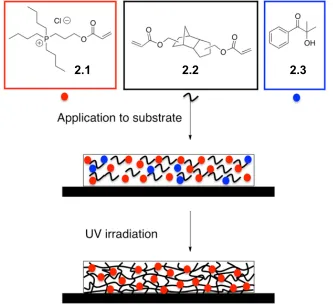
In this context, we describe the development of a new simple and versatile approach towards antibacterial surfaces using polymerizable phosphonium salts and UV curing. The physical and chemical properties of phosphonium cations allow them to be readily coated onto various surfaces in a solvent-free process and cured with UV light to create cross-linked polymer thin films (Figure 2-1). It is demonstrated that the properties of the films can be tuned based on the phosphonium content and the curing conditions. The resultant coatings prevent both the growth and adhesion of bacteria on surfaces.
Figure 2-1: Schematic showing the coating preparation process.
2.2
Results and Discussion
((3-Acryloyloxypropyl)tributyl)phosphonium chloride (2.1) was prepared as previously reported28 and was selected as the phosphonium monomer for this study because the butyl chains were anticipated to provide an appropriate balance of hydrophobicity and
27
hydrophilicity required for interactions with bacteria, and the acrylate functionality is known to exhibit high reactivity in UV curing processes.29 The chloride counter ion results from the
quaternization and acetylation steps used to prepare this molecule. Monomer 2.1 is a liquid at room temperature, allowing it to be cast on surfaces under solvent-free conditions. Tricyclodecanedimethanol diacrylate (2.2) and 2-hydroxy-2-methyl-1-phenylpropanone (2.3) were selected as the cross-linker and photoinitiator respectively, as they are both liquids, are widely used in UV curing and were found to effectively provide cross-linked thin films with 2.1. Fixing the photoinitiator 2.3 concentration at 5 wt%, various weight ratios of
2.1 and 2.2 were formulated (Table 2-1), cast on substrates including poly(ethylene terephthalate) (PET) and glass using a Meyer rod, and irradiated with a mercury light source. This process resulted in smooth films with surface roughnesses less than 2 nm, as measured by atomic force microscopy (AFM) (Figure 8-1). The film thickness was ~25 µm. Adhesion testing using the Tape Test (ASTM D3359 – 09e2) indicated that the films generally exhibited strong adhesion to PET and lower adhesion to glass (Table 8-1). Beyond 47.5 wt% of 2.1, the coatings did not adhere well to either substrate and delaminated upon washing, suggesting insufficient cross-linking.
Table 2-1: Effect of film formulation on accessible surface charge, as measured by fluorescein exchange. aFormulation contains 5 wt% of photoinitiator 2.3 and the remainder is cross-linker 2.2 to make up to 100%.
wt% of phosphonium monomer 2.1a
Accessible surface charge density (cations/nm2)
< 20 None detected
20 5.6
25 34
30 91
37.5 120
47.5 250
28
of phosphonium monomer 2.1 was less than 20%, the charge density was below the detection limit of the assay (approximately 0.01 cations per nm2). However, as detailed in
Table 2-1, from 20 – 47.5 wt% of 2.1, the charge density steadily increased, reaching a value of 250 cations per nm2 at 47.5 wt%. As several studies have suggested that cationic charge density is an important factor in achieving high antibacterial activity, further studies focused on the formulation containing 47.5 wt% of 2.1.14,30
A major advantage of UV curing is the speed with which it can be performed, which is on the order of seconds, in comparison with hours for thermal polymerizations. However, a potential disadvantage of UV curing is the inability to achieve 100% polymerization of the alkene moieties, because of radical termination reactions and limited cure depth.31,32 In particular, UV curing in air is subject to varying degrees of radical termination by oxygen and depends on the radical initiator and the growing polymer chain. To probe the efficiency of UV curing for the 47.5 wt% 2.1 formulation in air, the cure percentage was determined using attenuated total reflection Fourier transform infrared (ATR-FTIR) spectroscopy by comparing the intensity of the alkene peak at 810 cm-1 which disappears upon curing, to that
of the carbonyl peak at 1720 cm-1 which does not change upon curing (Figure 8-2). As shown in Table 2-2, 80 ± 5% curing was obtained in air. The corresponding gel content was measured to be 84 ± 2%. While these values are quite typical for UV curing,31 and are
acceptable for many applications, for antibacterial surfaces it is desirable to minimize the leaching of biocides from the surface as this can lead to ambiguity concerning the mechanism of action of bacterial killing and contribute to environmental contamination. Therefore, curing under an N2 atmosphere was explored as a means of reducing radical
termination by oxygen. This led to an increased cure percentage of 88 ± 4%, and an increased gelcontent of 88 ± 3%. The surfaces cured under N2 were also noticeably harder
and more durable. The application of a diamond tip surface profiler with a 0.5 mN force led to the etching of a 10 nm groove in the film cured in air, whereas the depth of the groove in the film cured under N2 was indistinguishable from the surface roughness (Figure 2-2,