135
† Corresponding author
THE IMPACT OF USING MOBILE TECHNOLOGY ON DEVELOPING EFL LEARNERS’ WRITING SKILL
Abdollah Baradaran1 --- Malihe Akhavan Kharaziyan2†
1
The Head of the English Department for MA Students and PhD Students, Islamic Azad University, Central Tehran Branch, Tehran, Iran
2TEFL MA holder, Islamic Azad University, South Tehran Branch, Tehran, Iran
ABSTRACT
The purpose of the present study was to determine whether using mobile technology had any impact on developing Iranian EFL learners’ writing skill. Moreover, the study intended to find out the type of contribution clues mobile technology could provide in improving the students writing. Two classes of 20 female students were chosen. A Nelson test administered at the beginning of the study showed that the two groups were homogenous in terms of their language proficiency. The design of the study was
quasi-experimental. Both experimental and control groups were taught writing using the traditional method, however, the students in the experimental group submitted their assignments through mobile applications
(Email or Blog or WhatsApp). They also used mobile for recording, sending, and receiving the writing skill materials. After the treatment, on the 12th session, the two groups were given a post-test of writing in
order to measure the improvement of each group. Finally the scores were collected. The result of data analysis demonstrated that using mobile technology had a significant impact on improving learners’ writing skill.
© 2016 AESS Publications. All Rights Reserved.
Keywords:Mobile technology, EFL, Writing development, Typology of contribution.
Received: 30 November 2015/ Revised: 29 March 2016/ Accepted: 28 June 2016/ Published: 13 August 2016
Contribution/ Originality
This study is one of very few studies which have investigated the effect of using mobile technology on the development of EFL learners‟ writing skill. The paper's essential contribution is its finding that utilizing mobile technology has a significant impact on ameliorating students‟ writing skill.
1. INTRODUCTION
Technology and technological devices have drastically influenced all aspect of human life in recent decades. A few years are usually regarded as a long period for the world of technology. The powers and features of these technological devices have increased logarithmically with the developments. In parallel with this, the variety and usage of technological devices have been increasing in education as well. Such a great importance attached to
International Journal of English Language and Literature
Studies
ISSN(e): 2306-0646/ISSN(p): 2306-9910
knowledge and technology and using them in an intensive way in social fields are considered one of the most important factors that require structural changes in the field of education as in other fields (Erişen and Çeliköz, 2007).
Our word today is a rapidly developing and changing world where knowledge is doubled and technology is constantly developing. In line with these developments, new technological devices have gradually emerged. Technological devices have been benefitted throughout the history. Communities and individuals are able to have an access to knowledge, make it available for their own usage and make an addition to it as well as spread it (Warschauer and Meskill, 2000).
Not only our social lives, but also our educational systems have been influenced by technology. According to Al-Ghazo (2008) technology is the best instructional tool to help learners enhance their knowledge of the target language. He also added that technology plays an important role in enhancing the process of language learning and teaching.
According to Al-Ghazo (2008) the use of technology in teaching and learning environment is an important aspect, which has received considerable attention in recent years. Technology can affect teaching methods and students‟ learning. It can effectively improve the educational system and can function as a tool to facilitate learning. By applying technology in the classroom and involving it in the curriculum, teachers can improve their teaching and also encourage collaboration and cooperation among students. However, to integrate technology in the classroom, teachers need to be proficient enough to employ it in their instructions.
Among various technological devices, mobile or smart phones have gained prominence in educational settings as practiced and versatile instructional tools. Pachler et al. (2010) state that mobile devices have increasingly grown toward becoming tools for education and language learning, and all their users such as teachers and students are getting used to this environment to make education as ubiquitous as possible. Moreover, the emergence of the internet made open and distance learning a means of receiving education from all parts of the world. Students do not always have to study a second language in a classroom. They may have the opportunity to learn it using mobile devices when they desire and where they are.
Not so long ago , for example, language teachers would have needed a room to accommodate their language ,laboratory ,desk top, computer ,digital camera ,CD library ,radio ,television ,tape recorder ,microphones ,sound system ,telephone ,text book ,dictionaries and game activates. These –and more-are now covered into a single mobile device. From which our students are inseparable, promoting nomadic or “anytime, anywhere” language learning (Godwin-Jones, 2003; Chinnery, 2006).
1.1. Using Mobile in Language Learning
According to Geddes (2004) mobile learning is a kind of learning which takes place at any time and in any place, that is; it extends teaching and learning outside of the walls of the classroom. An important feature of this type of learning is that students feel responsible for their own learning. Mobile phones are the most widespread devices, all throughout the word and overwhelming majority of students carry a mobile phone with them most of time and make use of various application to aid their learning such as dictionaries on their mobile. It is not surprising then, to see that English language teachers have started to integrate mobile application in their classrooms. A number of studies have focused on how the use of mobile phones affects the developments of vocabulary and grammar
Motallebzadeh and Ganjali (2011) examined the effects of SMS on 40 Iranian EFL learners‟ performance on vocabulary retention and reading comprehension tests. The result showed that mobile phone users outperformed the control group with regards to both vocabulary and reading comprehension scores.
1.2. Using Mobile Technology in Developing Writing Skill
In mobile learning, learners can cross the boundary of the classroom to extend their learning, and continuously learn under suitable and motivated conditions.
Shang (2007) examined the overall effect of using email on the writing performance of Taiwanese students of
English. The major findings demonstrated that students made improvements in terms of the syntactic complexity and grammatical accuracy of their writings. The results also revealed that the email writing was a positive strategy that helped improve foreign language learning and developed positive attitudes towards English.
Leppanen and Kalaja (1995) used computer conferencing to introduce writing as a process. They found that students dominated the discussions and gave each other a great deal of different kinds of feedback while the teacher served as a monitor and not a knowledge-giver. Leppanen and Kalaja (1995) also found that engaging students in on-line discussion on their written assignments improved their writing skills.
The purpose of this study is to investigate the effect of mobile technology on Iranian intermediate EFL students‟ writing skill.
2. RESEARCH QUESTHONS
The ultimate purpose of this study is to provide answers to the following questions:
1. Does the use of mobile technology have any significant impact on developing Iranian EFL learners‟ writing skill? 2. If yes, which kind of contribution clues the mobile technology provide in improving EFL learners‟ writing skill?
3. METHODOLOGY
This study attempts to investigate the effect of using mobile technology on developing Iranian EFL learners‟ writing skill in Tehran city. Actually, the present study intends to find out if using mobile technology as a learning tool could help students improve their writing. Consequently, essential information related to the participants, instruments, procedure of data collection, the general design and procedure taken in this study, and the data analysis will be discussed in the following sections.
3.1. Participants
In this study, the researchers chose 40 female students with an age range between 18 and 22. The participants were all undergraduate students majority in English translation and teaching English as a foreign language at Islamic Azad University (named the branch here) and were all selected based on a convenient non-random sampling. The subject consisted of two homogeneous groups, at the intermediate level. Twenty students were going to be taught as experimental group, and the rest of the students were used as control group. The participants of both group attended the classes once a week, for 12 sessions; with each session lasting for 90 minutes.
3.2. Instruments
For the purpose of data collection in the present study, five instruments were utilized.
2. Pretest/ posttest: Since the time interval between the pretest and posttest was long enough, the same test was used. These consisted of 3 paragraphs according to the course called (Advance Writing).
3.Text book, Advanced Writing Course (Jordan, 1979) :It is paragraph writing course , based on syntactic complexity ,spelling , punctuations , and grammatical accuracy.
4. An Analytic Scoring Rubric: In order to reduce scorer errors and contribute to the reliability and validity of the scores given to each paper, we employed the Roebuck (2001).
5. Mobile Phone: The students in experimental group sent their assignment through mobile (Email or Blog or SMS), also they used mobile for recording, sending, and receiving the writing skill materials.
3.3. Procedure
In order to meet the objectives of the research and to be able to verity the stated hypothesis, the researchers went through the following steps:
1. We chose 40 female BA English major students, at the intermediate level. In order to ensure their homogeneous, the first test administered was Fowler and Coe (1976). It consisted of 30 items of General English Language.
Then, the participants were assigned into two equal groups in different classes. The first class, consisted of 20 students was the experimental group (receiving treatment), and the second class, the control group received no special treatment.
2. Both groups had pretest for measuring their writing performance. It consisted of 3 paragraphs related to the course called „‟ Advanced Writing Course‟‟. For writing correction the Roebuck (2001) was used.
3. In the next stage, both groups went on for 11 sessions of 90 minutes each before administrating the posttest. Students participated in paragraph writing course called (Advanced Writing Course) based on syntactic complexity, spelling, punctuations, and grammatical accuracy.
4. Treatment: In the experimental students had discussed according to the topic chosen, then, each student recorded her voice on her mobile phone. The task assigned to students was to analyze their speech and the researcher detected their grammatical errors and commented on them and then corrected them the next session that they came to the class. The other part of the treatment was that each student played her voice for other students in the class so that any type of errors unnoticed by the individual students herself should be mentioned by other classmates. Their classmates helped her to identify them. They sent their assignment through (E-mail, Blog, SMS or Viber, WhatsApp).They received their teachers‟ comments and correction by the mobile.
5. The second group (the control) had a conventional class and an assignment was handed in paper and pencil. The teacher checked every student‟s assignment and gave her comments and correction.
6. At the end of the treatment period, on the 12sessions, two groups (experimental and control) were going to take the posttest of writing skill for measuring the improvement of each of the group. It consisted of 3 paragraphs, according to the course called „‟Advanced Writing Course‟‟. For writing correction, the Roebuck (2001) was used.
3.4. Design
3.5. Data Analysis
The present study intended to investigate the effect of mobile technology on developing writing skill proficiency of Iranian EFL students. The study consisted of two variables, (One independent variable and one dependent variable). The independent variable of the study was mobile assisted as strategy of teaching and the dependent variable was writing skill. In order to answer the research question, the descriptive statistic regarding the experimental and control groups calculated, and the scores written production test were collected. The computer software of SPSS, for further data analysis was utilized.
4. RESULTS and DISCUSSION 4.1. Reliability Statistics
Nelson Test was administered to 40 participants in order to select homogeneit y intermediate participants.
Table-1. Reliability Statistics of Nelson Test
Nelson Test Number of
Participants
Number of Items
Reliability Index
Reliability Method
General English Language 40 30 .85 Cronbach's Alpha
SPSS
The results of this analysis in Table 1 clarifies that the Nelson Test with 30 items was administered to 40 students, and its reliability was estimated .85 through Cronbach's Alpha Method.
4.3. Testing the Null Hypothesis
The null hypothesis of this study assumed that (Using mobile technology does not have any significant impact on developing EFL learner‟s writing). In order to analyze the data to investigate the null hypothesis, first the descriptive statistics of pretest and posttest scores of both groups were computed. The related descriptive statistics are shown in Table 2 and 3 below. Table 2 shows the measurement that was adopted to clarify the level of the statement.
Table-2. Scale of Statement Levels Depending on the Means Scores
Level 1 Level 2 Level 3
Weak Medium Strong
Beneath 3 3-4 Above 5
SPSS
Table-3. Descriptive Statistics for Writing Pretest in Control and Experimental
Group N Range Min Max Mean Median Mode SD Degree
Control 20 5 1.5 6.5 3.70 3.5 3.5 1.46 Medium
Experimental 20 4.5 1.5 6 3.80 3.5 3.5 1.42 Medium
SPSS
According to the table, the mean score for the control group was 3.70 with the standard deviation of 6..1 and the mean score for the experimental group was 3.80 with the standard deviation 6.42. The range, degree and mean writing pretests of the two groups are not far from each other.
Figure-1. Means Writing Pre-test in Control and Experimental Groups.
SPSS
T-test results revealed that there was no significant difference in the writing performance of the control and experimental groups on the pretest. For that reason, it can be concluded that the two groups have almost similar writing performance prior to the treatment. When the treatment was over, (the 12th session), the participants of both groups took the writing posttest; then their writing posttests were compared. The descriptive statistics for the writing posttest scores of the two groups are presented in Table 4below.
Table-4. Descriptive Statistics for Control and Experimental on Writing Posttest
Group N Range Min Max Mean Median Mode SD Degree
Control 20 5 1.75 7 4.25 4 4 1.39 Medium
Experimental 20 4.5 3.5 8 5.43 5.5 6 1.29 Strong
SPSS
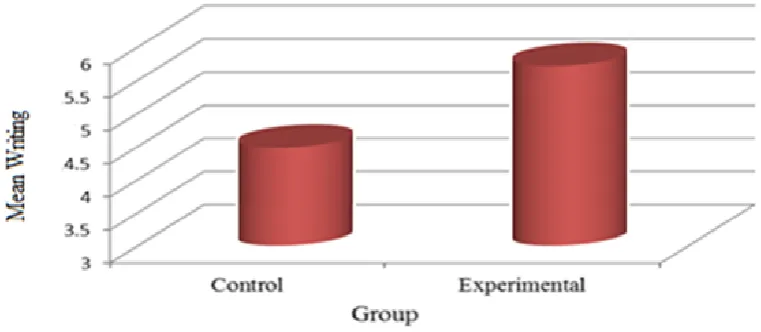
The above table shows that the mean writing posttest scores of the control group was 4.25 with the standard deviation of 1.39 while the mean score of the experimental group was 5.43 with the standard deviation of 1.29.the participants in the experimental groups outperformed those in the control group.
Figure 2 illustrates the graphical representation of the results.
Figure-2. Means Writing Posttest in Control and Experimental Groups
SPSS
Therefore, the null hypothesis of this study was rejected. Since the experimental group had obtained a higher mean score (5.43compared to 4.25), it could be concluded that using mobile technology had a significant impact on EFL learners, writing improvement.
4.4. Testing the Second Question
The purpose of the second research question was to find out which aspects of the learners‟ writing performance were influenced more by the treatment (i.e., using mobile technology).
In order to answer the second question, means scores and standard deviations of the participants' responses on writing were carried out. The comparing mean score of writing showed significant difference (5.43≥ 4.25).
This means that there was a distinct positive influence of using mobile technology on improving writing skills. Then, descriptive statistic regarding the experimental group calculated, and the scores for written production test were collected.
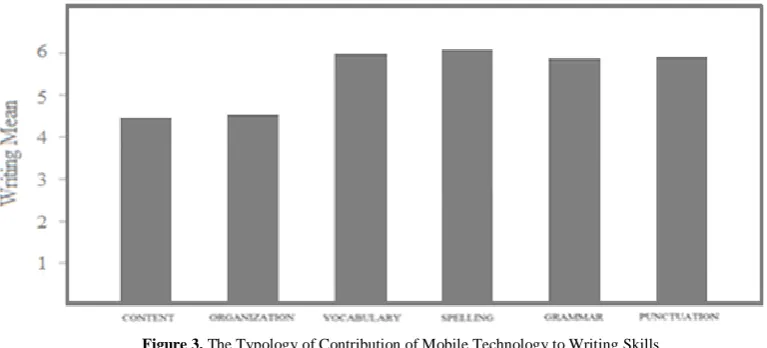
The score of each sub skill (i.e. content, organization, vocabulary, spelling, grammar and punctuation) in each writing sample was the mean of the raters' score.
Figure 3. The Typology of Contribution of Mobile Technology to Writing Skills
SPSS
The results indicate that the students paid more attention to style of mobile writing (e.g. spelling, punctuation marks, and capitalization) than to their choice of words and idiomatic expressions. This could be attributed to the fact that most of the students loved using mobile devices in learning English writing (See Appendix 1).These results of the questions were in line with those of Shang (2007) and Liu (2003) who provided evidence in their studies for the significant effect of mobile application on the participants‟ writing performance.
The descriptive statistics for the typology of contribution of mobile technology to writing skill is presented in Table 5.
Table 5. the Typology of Contribution of Mobile Technology to Writing Skills
Writing Sub Skills Mean
Content 4.42
Organization 4.45
Vocabulary 5.98
Spelling 6.14
Grammar 5.79
Punctuation 5.81
Total grads 5.43
The results listed in Table 5 show that there were statistically significant differences in the domains of spelling, vocabulary and phrases, punctuation and grammar of mobile writing, but not in content and organization of ideas.
5. CONCLUSION
The result of this study showed statistically significant difference in the mean score of writing performance between the two groups on the posttest with (5.43), so it is very high while comparing the number (5.43≥ 4.25 );this means that there was a distinct positive influence of using Mobile technology on improving writing skills. Therefore the null hypothesis of this study is rejected.
Also, these results reveal that the students paid the most attention to forming well sentences with use of adequate spelling, vocabulary, punctuation and grammar. But the content and the organization of their writing were the least influenced aspects of their writing. By using mobile phones devices the students did not only improved their writing achievement, but also improved their collaborative activities in learning English language. Mobile devices could encourage them to learn English writing. Moreover, the students enjoyed the classroom activities during the implementation of mobile technology.
Accordingly the null hypothesis was rejected, and with high degree of confidence it can be claimed that using mobile technology affects English writing learning of Iranian EFL learners positively. The result of the questions were in line with the findings of Shang (2007) and Liu (2003) whose results provided evidence for the effectiveness of mobile devices in writing skill.
The overall findings indicated that students made improvements on grammatical accuracy, spelling, punctuations, and a significant difference was found in writing sentences and short paragraphs. These improvements were brought about by the communicative and corrective nature of the mobile activity. However, further research is required to investigate what technological devices can be implemented to enhance EFL learners‟ writing organization and content.
Funding: This study received no specific financial support.
Competing Interests: The authors declare that they have no competing interests.
Contributors/Acknowledgement: All authors contributed equally to the conception and design of the study.
REFERENCES
Al-Ghazo, A.M., 2008. Technology integration in university teacher's education programs in Jordon: Comparison of competencies,
attitudes and perceptions toward integrating technology in the classroom (Doctoral Dissertation). Retrieved from
ProQuest LLC.
Baki, E., 2010. A comparison of undergraduate students english vocabulary learning: Using mobile phones and flash cards.
TOJET: Turkish Online Journal of Educational Technology, 9(3): 1-7.
Chinnery, G.M., 2006. Emerging technologies going to the mall: Mobile assisted language learning. Language Learning &
Technology, 10(1): 9-16.
Erişen, Y. and N. Çeliköz, 2007. Eğitimde Bilgisayar Kullanımı. Öğretim Teknolojileri ve Materyal Tasarımı. Ankara: PegemA
Yayıncılık.
Fowler, W.S. and N. Coe, 1976. Nelson english language tests. Canada: Thomas Nelson and Sons Ltd.
Geddes, S.J., 2004. Mobile learning in the 21st century: Benefit to learners. Available from http:// •
knowledgetree.flexiblelearning.net.au/edition06/download/geddes.pdf.
Godwin-Jones, R., 2003. Optimising web course design for language learners. In Felix, U. (Ed.). Language learning online:
Jordan, R.R., 1979. Academic writing course. London: Collins.
Leppanen, S. and P. Kalaja, 1995. Experimenting with computer conferencing in english for academic via mobile phone. Journal
of Computer Assisted Learning, 24(6): 515-512.
Liu, J., 2003. The effect and effect of peer review in electronic versus traditional modes on L2 writing. Journal of English for
Academic Purposes, 2(3): 193-227.
Motallebzadeh, K. and R. Ganjali, 2011. SMS: Tool for L2 vocabulary retention and reading comprehension ability. Journal of
Language Teaching and Research, 2(5): 1111-1115. DOI http://dx.doi.org/10.4304/jltr.2.5.1111-1115.
Pachler, N., B. Bachmair and J. Cook, 2010. Mobile learning: Structures, agency, practices. London: Springer.
Roebuck, R.F., 2001. Teaching composition in the college level foreign language class: Insights and activities from socio cultural
theory. Foreign Language Annals, 34(3): 206-215.
Shang, H., 2007. An exploration study of email application on foreign language writing performance. Computer- Assisted
Language Learning, 20(1): s79-96.
Warschauer, M. and C. Meskill, 2000. Technology and second language teaching. In J. W. Rosenthall (Ed.), Handbook of
undergraduate second language education. NJ, Mahwah: Lawrence Erlbaum. pp: 303-318.
APPENDIX-1.
Figure-4. The Participants' Performance English Writing Sub Skill
APPENDIX- 2.
Student-generated Rubric
Name ______________ Date ___________
Level 1 Level 2 Level 3
CONTENT & IDEAS
Writing does not clearly communicate
knowledge. The reader is left with questions.
Writes related, quality paragraphs, with little or no details.
Writing is purposeful and focused. It holds the reader‟s attention.
ORGANIZATION
Poor organization of ideas. No paragraphs
and sentence marker
errors.
Little organization of
ideas. Paragraphs and
sentence markers were
used, but with some errors.
Good organization of ideas. Good use of paragraphs and sentence markers.
VOCABULARY &
SPELLING
Poor use or range of
vocabulary. Many
spelling errors.
Adequate (fair) use of vocabulary. Some spelling errors persist.
Good use of vocabulary. A few spelling errors.
GRAMMAR &
PUNCTUATUION
Poor use of grammar and punctuation. Many errors.
Adequate (fair) use of grammar and punctuation. Some errors still present
Good use of grammar and punctuation. A few errors still present.
Total Score ____