Epilepsy and mood
Steven Karceski, MD WHAT WAS THE STUDY ABOUT?In their article, “Use of antiepileptic drugs in epilepsy and the risk of self-harm or suicidal behavior,” Dr. Andersohn and his coauthors1tried to better understand a very
diffi-cult problem. For years, it has been known that there is a higher rate of suicide in people with epilepsy. People with epilepsy are also more likely to have de-pression, which can lead to suicide. In addition, some of the medications that are used for seizures (also called antiepileptic drugs or AEDs) may cause problems with mood. Because all of these problems overlap, it can be difficult to sort out how they are related.
In early 2008, the United States Food and Drug Administration (FDA) issued a safety alert concern-ing all AEDs. The alert was based on 199 studies. In these studies, an antiepileptic medication was com-pared to placebo. A placebo is a fake medication to see if the actual medication works. When grouped together, the analysis showed that there was an in-creased risk of suicidal thoughts and behavior in peo-ple who were taking an AED.
The FDA analysis grouped all seizure medications together. It was not possible, based on the informa-tion that they had, to decide if there were specific medications that were more likely to cause mood problems. Dr. Andersohn and his coauthors decided to answer this question, if possible. What they wanted to know was simple: Are there certain medi-cations that cause this more often than others?
HOW WAS THE STUDY DONE? Dr. Andersohn and his coauthors wanted to gather as much
informa-September 2005. Of these, 453 were identified who had been diagnosed with suicidal behavior (such as a suicide attempt) or self-harm. In the group, some people were currently taking an AED (defined as us-ing the medication within 14 days of the medical visit). Some people had been on an AED “recently.” Recent use was defined as having taken an AED 15– 183 days before the medical visit. Past use was de-fined as having taken an AED 184 days or more before the medical visit.
Dr. Andersohn and his coauthors looked at the group very carefully. They divided the group into 4 main categories (table 1). In the first group, they placed people who were taking a barbiturate medica-tion for their seizures. A barbiturate is a sedative— or relaxation—medication. In the second group were people taking conventional AEDs. This would mean that doctors have been using these treatments for a long time. The third group consisted of people tak-ing a newer (more recently developed) AED, one that had a low potential for depression. The authors defined low potential very carefully: in the initial placebo-controlled trials of the AED, there had to be a less than 1% reported incidence of depression. In the last group, people were taking an AED that had been associated with depression more than 1% of the time (in the early trials). This group was labeled as having a high potential for depression.
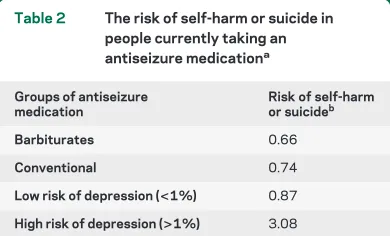
The results (table 2) showed that group 4, the high potential group, had the most problems. In fact, the results showed that this group was 3 times more likely to have suicidal behavior or self-harm than the control group. The risk of suicidal behavior or self-harm in the
PATIENT PAGE
lepsy. Furthermore, it was not possible to analyze a person’s specific type of epilepsy. Knowing that certain medicines are used for specific kinds of ep-ilepsy, it may be that the higher rate of suicidal behavior/self-harm was due to the kind of epi-lepsy, and not the specific medication. Further, because the database included patients to 2005, any medicine approved for use after 2005 would not be included in this analysis.
WHY IS THIS STUDY IMPORTANT? It has long been known that seizures, epilepsy, mood problems, and suicide overlap. A study of many AED trials
sug-gests that the medication itself may contribute to this problem. However, the analyses so far have lumped all antiseizure medications together. There might be only a few medications that cause this. Although the study by Dr. Andersohn and his coauthors suggests that levetiracetam is more likely to cause suicidal behavior/self-harm, they also made it clear that we need to study this problem more carefully. Further, it will be important for doctors to look at all available seizure medications, including the ones that were ap-proved for use after 2005.
Figure The authors carefully looked for patients in the United Kingdom General Practice Research Database (GPRD)
Table 1 The authors grouped seizure medications in a specific way
Groups of antiseizure
medication Generic names of specific medications
Barbiturates Methylphenobarbital, phenobarbital, primidone
Conventional Carbamazepine, ethosuximide, phenytoin, valproate
Low risk of depression (<1%)
Gabapentin, lamotrigine, oxcarbazepine, pregabalin
High risk of depression (>1%)
Levetiracetam, tiagabine, topiramate, vigabatrin
Table 2 The risk of self-harm or suicide in people currently taking an antiseizure medicationa
Groups of antiseizure medication
Risk of self-harm or suicideb
Barbiturates 0.66
Conventional 0.74
Low risk of depression (<1%) 0.87
High risk of depression (>1%) 3.08
aRecent or past use of the antiseizure medication did not increase the risk of suicidal behavior or self-harm. bA value of 1.0 means no risk; a value of⬍1.0 means a reduced risk; a value of⬎1.0 means an increased risk.
About seizures, epilepsy, and mood
SEIZURES, EPILEPSY, AND MOOD: HOW THEY OVERLAP Mood disorders and epilepsy overlap quite a bit. This is especially true when a person has seizures that do not stop with antiseizure medications. When seizures are not completely con-trolled with medicine, they are called refractory. Thirty to fifty percent of people with refractory sei-zures also have some sort of mood problem. They may have depression, anxiety, or both.
Because epilepsy and mood problems overlap, they are called comorbid conditions. By definition, comorbidity means that the associated illness occurs more often than would be expected compared to populations of patients who do not have the other illness. In other words, if 10% of people have depres-sion, we would expect that 10% of people with epi-lepsy also would have depression. However, the number is higher (up to 50%). In other words, the overlap cannot be explained by chance. There must be something else that links the two.
However, comorbidity does not imply causality.2
Even though the two illnesses occur together, this does not mean that one causes the other. What is more likely is that the two illness share a common cause. In other words, the cause of one illness is also the cause of the other. Although not fully under-stood, an abnormality of neurotransmitters may be the link that connects mood with epilepsy. One thing that is very clear is that the comorbid illness can affect quality of life. In fact, the quality of life of people with epilepsy is influenced more by the presence of depression than the frequency of their seizures.3
was sent to over 85,000 people. The survey asked questions about lifelong illnesses like epilepsy, mi-graine, asthma, and diabetes. The survey also asked questions about mood, specifically bipolar disorder.5
The goal was to compare the rates of mood problems in people with epilepsy (1,236 respondents), mi-graine (8,994 respondents), asthma (7,951 respon-dents), and diabetes (7,342 respondents) vs healthy controls (57,172 respondents). Symptoms of bipolar disorder were found in12.2% of people with epi-lepsy, 7.2% of people with migraine, 6.3% of people with asthma, 3.2% of people with diabetes, and 1.7% of the controls. In other words, symptoms of bipolar disorder were 6 times higher in persons with epilepsy than in the control group.
Major depressive disorder is defined as having de-pression for more than 2 weeks. It occurs in about 5.8% of the general population. In those with epi-lepsy, the number with major depressive disorder is 8%– 48% (an average of 29%).2In a
community-based study on people with epilepsy, the rate of de-pression was 37%. In patients referred to an epilepsy center, the rate of depression was 50%. Remember that people referred to an epilepsy center usually have refractory epilepsy. In other words, the reason that people in an epilepsy center are more likely to be depressed probably relates to the severity of their ep-ilepsy.4What this means is that depression occurs 10
times more often in people with refractory epilepsy than in people who have no medical illness.
The number of people who have epilepsy and anxiety is a little more difficult to figure out. There seems to be a connection between anxiety and
sei-PATIENT PAGE
needs medication in order to prevent seizures. If he or she also has depression, medication may be needed for this as well.
It has long been known that some medicines that treat seizures also treat mood problems. Carbamaz-epine, lamotrigine, and valproate are just a few of the seizure medications that also have a positive effect on mood. These medications work in a common way: they increase serotonin levels (serotonin is a neuro-transmitter). Higher serotonin levels seem to help to decrease seizures and to improve mood.
In situations where depression (or anxiety) has been identified as a comorbid illness, a neurologist may ask for help from a psychiatrist. With all of the available medications for depression and anxiety, it may be difficult to know which is best for an individ-ual. In addition, the person might need psychother-apy, which is often overseen by a psychiatrist. In other words, a team approach may be needed in or-der to optimize the person’s epilepsy, mood problem, and quality of life.
CONCLUSIONS Epilepsy, depression, anxiety, and bipolar disorder commonly coexist. Although there are many possible explanations for why these disor-ders are comorbid, it is becoming increasingly evi-dent that both epilepsy and mood disorders require treatment in order to achieve the best quality of life. Some antiepileptic drugs are effective for both ill-nesses: in some instances, selection of one of these agents may result in improvements in both condi-tions. For other patients, combination therapy may be required. Finally, some people will need
psycho-therapy in order to have the best results. A team ap-proach that involves a neurologist, psychiatrist, and psychologist may help to get the best treatment for people with epilepsy and mood disorders.
FOR MORE INFORMATION
AAN.com for patients and caregivers http://patients.aan.com/
Citizens United For Research In Epilepsy (CURE) http://www.cureepilepsy.org
Epilepsy Foundation
http://www.epilepsyfoundation.org Epilepsy Institute
http://www.epilepsyinstitute.org
Family Caregiver Alliance/National Center On Caregiving http://www.caregiver.org
REFERENCES
1. Andersohn F, Schade R, Willich SN, Garbe E. Use of
an-tiepileptic drugs in epilepsy and the risk of self-harm or suicidal behavior. Neurology 2010;75:335–340.
2. Gabb MG, Barry JJ. The link between mood disorders and
epilepsy: why is it important to diagnose and treat? Adv Studies Med 2005;5:S572–S578.
3. Gilliam FG, Mendiratta A, Pack AM, Bazil CW. Epilepsy
and common comorbidities: improving the outpatient ep-ilepsy encounter. Epileptic Disord 2005;7(suppl 1):27–33.
4. Kanner AM. Depression in epilepsy: a neurobiologic
per-spective. Epilepsy Curr 2005;5:21–27.
5. Ettinger AB, Reed ML, Goldberg JF, Hirschfeld RM.
Prevalence of bipolar symptoms in epilepsy vs other chronic health disorders. Neurology 2005;65:535–540.
6. Beyenberg S, Mitchell AJ, Schmidt D, Elger CE, Reuber
M. Anxiety in patients with epilepsy: systematic review and suggestions for clinical management. Epilepsy Behav 2005; 7:161–171.
DOI 10.1212/WNL.0b013e3181ed735b
2010;75;e12-e15
Neurology
Steven Karceski
Epilepsy and mood
This information is current as of July 26, 2010
Services
Updated Information &
http://n.neurology.org/content/75/4/e12.full
including high resolution figures, can be found at:
References
http://n.neurology.org/content/75/4/e12.full#ref-list-1
This article cites 6 articles, 2 of which you can access for free at:
Citations
http://n.neurology.org/content/75/4/e12.full##otherarticles
This article has been cited by 1 HighWire-hosted articles:
Subspecialty Collections
http://n.neurology.org/cgi/collection/antiepileptic_drugs
Antiepileptic drugs
http://n.neurology.org/cgi/collection/all_epilepsy_seizures
All Epilepsy/Seizures
following collection(s):
This article, along with others on similar topics, appears in the
Permissions & Licensing
http://www.neurology.org/about/about_the_journal#permissions
its entirety can be found online at:
Information about reproducing this article in parts (figures,tables) or in
Reprints
http://n.neurology.org/subscribers/advertise