BY JOSEPH F. DRAZKOWSKI, MD JOSEPH I. SIRVEN, MD
A
utomobile driving is an indispensableactivity of daily life. Driving in the United States equates to indepen-dence, freedom, and, in most cases, economic livelihood. Yet vehicular crashes injure millions of people in the United States each year at a cost of more than $250 billion, result-ing in 40,000 annual deaths.1Many medical, neuro-logic, and psychiatric disorders can impair the ability to drive. In particular, conditions such as Alzheimer disease (AD), Parkinson disease (PD), illicit drug use, multiple sclerosis (MS), cerebrovascular disease, sleep disorders, and epilepsy may impair an individual to the point of affecting the safe operation of a motor vehicle. Therefore, the issue of driving is significant for patients, physicians, and the public. Two com-mon questions regarding driving typically arise dur-ing a neurologic consultation: When should drivdur-ing be curtailed? When should a physician report an in-dividual to a public driving authority to terminate their driving privileges? Driving is both a personal and public health issue mired in regulatory and legal language; therefore, it is essential to understand the variables that have an impact on driving.
THE NEUROLOGY OF DRIVINGDriving is a de-ceptively complex task. To effectively drive an auto-mobile, a number of neurologic systems must be intact. These include higher cognitive functioning, vision, motor control, intact coordination, and an
ability to maintain attention. Any functional impair-ment in any of these domains can potentially lead to unsafe driving. Table 1 summarizes examples of common neurologic impairment and paroxysmal conditions that can affect safe driving. Any patient with a neurologic condition containing an impair-ment listed in table 1 should alert the neurologist that driving should be addressed with the patient during the consultation. The presence of either a neurologic deficit or paroxysmal condition does not automatically exclude driving. It is the degree of def-icit, frequency, and type of events that determines fitness for driving.
Of the various neurologic systems involved in driving, cognitive function merits particular atten-tion. Driving requires a number of essential cogni-tive activities for safe and successful vehicle operation. These cognitive activities include the following:
• Perception and attention to stimulus evidence through sensory input and interpretation of a situation on the road
• Formulation of a plan based on the particular driving situation and how to handle it based on previous memory experiences
• Execution of an action such as applying a brake, steering control, or accelerator
• Monitoring the outcome of a behavior as feed-back for subsequent actions
The risk of driving error increases when there is any deficit in the ability to process these various tasks2(table 2). Therefore, pathology that affects at-tention, perception, executive and motor function, and awareness of cognition and behavioral perfor-mance may lead to driving errors resulting in a crash. Additionally, individuals with problems in these do-mains are less likely to be aware of their deficits and
From the Department of Neurology, Mayo Clinic in Arizona, Phoenix. Address correspondence and reprint requests to Dr. Joseph I. Sirven, Department of Neurology, Mayo Clinic in Arizona, 5777 East Mayo Boulevard, Phoenix, AZ 85054; [email protected] Author disclosures are provided at the end of the article.
Neurology®Clinical Practice2011;76 (Suppl 2):S44–S49
errors and self-monitor resulting in the inability to perform appropriate corrective actions.
Establishing fair and accurate performance crite-ria to predict ability to drive in patients with various neurologic conditions may reduce the risk of motor vehicle crashes and protect others from arbitrary and possibly unfair licensing revocation. Although a cli-nician is likely able to identify obviously impaired drivers, a clinician’s assessment alone may not be ac-curate enough to determine driving competency in drivers marginally affected by neurologic disorders. For example, a patient with mild cognitive impair-ment (MCI) as defined by a Clinical Deimpair-mentia Rat-ing (CDR) score of 0.5 may or may not perform well on driving tasks. The same is true of paroxysmal condi-tions like epilepsy. The type and degree of cognitive and visual motor impairment are better predictors of driving skills than age or medical diagnoses.
The signs and symptoms of many neurologic con-ditions with unique neuropathological findings often demonstrate considerable overlap. Thus, a discussion
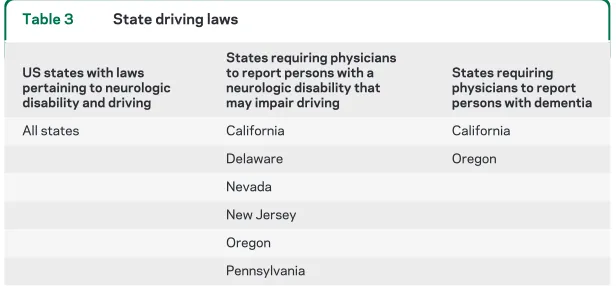
of driving and neurologic disorders is best served by operating on a practical framework that clinicians are likely to encounter while patients are being actively evaluated for a final diagnosis. Neurologic diseases can be broadly classified into those associated with fixed deficits (i.e., neurodegenerative and stroke) or paroxysmal disorders (i.e., epilepsy and sleep disor-ders). This division of neurologic disorders allows the clinician to extrapolate applicable information to help counsel the individual patient regardless of the underlying neurologic process. Because epilepsy and dementia are explicitly cited by legal statutes (all 50 states for epilepsy; 2 states for dementia) (table 3), these 2 conditions serve as representative examples.
FIXED DEFICIT DISORDERS: AD AD is one of the most common forms of dementia with increased prevalence with older age. Because AD leads to cog-nitive impairment, which affects executive function, and memory, driving is a major issue. A survey of patients with AD showed a mean of 0.09 reported crashes per year per person, compared with 0.040 in age-matched controls over the same time period.3 The average number of crashes per year in patients with AD increased dramatically after the first 3 years from symptom onset, consistent with other reports showing a sharp decline in driving abilities 3 years after AD onset.
An American Academy of Neurology (AAN) re-view panel found that drivers with MCI or very mild AD and a CDR score of 0.5 have impairment similar to drivers 16 –20 years of age or those driving under the influence of alcohol at a blood alcohol concentra-tion of less than 0.08%.8The panel recommended reassessing dementia severity in driving fitness every 6 months in patients with very mild AD, but sus-pending driving for patients with mild AD and CDR score of 1 because of a history of increased crashes and poor driving performance.4 However, this rec-ommendation may be unduly restrictive because in some ways it is a one-size-fits-all approach.
Recently, the AAN released a practice parameter update entitled “Evaluation and management of driving risk in dementia: Report of the Quality Stan-dards Subcommittee of the American Academy of Neurology.”5 The parameter was helpful in that it coalesced a number of risk factors into a proposed evaluation algorithm (figure).5Yet the parameter is far from being the final word on the topic. There was no evidence to support or refute the use of cognitive tests in making driving determinations, which is problematic as they are used to track progression of these conditions. Patients scoring at a higher risk may agree to surrender driving privileges. Patients who insist on continued driving may require an
as-“Although a clinician is likely able to
identify obviously impaired drivers, a
clinician’s assessment alone may not be
accurate enough to determine driving
competency in drivers marginally
affected by neurologic disorders”
Table 1 Neurologic impairments and paroxysmal disorders that may affect safe driving
Neurologic impairment that may affect safe driving
Conditions associated with loss of awareness with potential to affect safe driving
Cognitive impairment Epilepsy
Executive dysfunction Excessive daytime sleepiness/sleep disorder Memory impairment Acute hypoglycemia
Inability to multitask Syncope Severe ataxia/balance dysfunction Arrhythmia Motor control impairment Dysautonomia
Generalized Bradykinesia Severe weakness Vision impairment
Visual processing abnormalities Hemianopsia or visual field deficits Toxicity
Alcohol
sessment by trained clinicians who conduct driving evaluations and retraining of patients with impair-ments (commonly poststroke or traumatic brain in-jury). The Association for Driver Rehabilitation Specialists, a professional organization of clinicians working in the field of driver education and training, information referral source, and specialized transpor-tation equipment for disabled persons, may serve as a potential resource for neurologists looking for help in assessing individual patients. Referral to a health pro-fessional involved in driving assessments may help provide objective information needed to make diffi-cult decisions. Patients who continue to drive despite progressive neurologic deficits should be reassessed every 6 months.
There is also considerable ongoing research utiliz-ing drivutiliz-ing simulation to accurately identify at-risk drivers and is based on simulator performance. These studies have not been validated to assess whether sim-ulation tasks are predictive of increased crash rates. Moreover, these simulators are not readily available for widespread clinical use. However, they may prove to be the future for helping clinicians to decide which patients should stop driving.
Regarding other neurologic conditions with fixed deficits, there is considerable ongoing research but no practice parameters or guidelines on when to re-strict driving for common conditions including MS, PD, stroke, and others. Nevertheless, the principles
used to make decisions regarding driving and AD are applicable to these conditions as well.
PAROXYSMAL CONDITIONS: EPILEPSY The ability to legally operate a motor vehicle has been shown to be very important for the person with a paroxysmal disorder such as epilepsy or syncope.6 Driving has an impact on the quality of life for these patients. As opposed to other neurologic conditions, all states within the United States have laws that spe-cifically address the ability to operate a motor vehicle for the person with epilepsy. However, among the various states, there is considerable legal variability as to the degree of seizure freedom one must exhibit in order to drive, with seizure-free intervals (SFI) rang-ing from 3 months to up to 1 year. Recommenda-tions by the Epilepsy Foundation of America, American Academy of Neurology, and the Interna-tional League Against Epilepsy have suggested stan-dardized criteria be used when establishing laws that govern seizures and driving. Driving laws remain states’ rights and not a federal issue, accounting for the heterogeneous approach to policy.7,8
The intent of laws governing the person with epi-lepsy (PWE) who drives is to ensure the public safety foremost with the secondary duty of protecting the in-dividual driver. The optimal SFI that would allow the person with epilepsy to drive while at the same time ensuring public safety is not certain. Little difference in epilepsy-related crash rates has been found when com-paring a reduction in the SFI from 12 to 3 months in Arizona.9The overall death rate attributable to motor vehicle crashes related to a seizure has also been shown not to be dependent on the length of the SFI.9
Web sites from the American Medical Association and the Epilepsy Foundation of America are impor-tant resources listing current state laws regarding driving and epilepsy.7,8These references compile in-formation about local laws to help guide and counsel the PWE about relevant restrictions on driving. Sev-eral states have reporting requirements, where the in-dividual practitioner must notify the driving authorities when a person has the diagnosis of epi-lepsy or other paroxysmal conditions as listed in table 3. Unfortunately, this places the reporting require-ments on the practitioner providing care for the PWE, potentially interfering with optimal care, as the PWE may withhold vital information regarding recurrence and frequency of seizures in an effort to maintain driving privileges.
When comparing the various crash rates to other medical conditions that could affect driving, epilepsy has been shown to present the same relative risk as many other medical conditions. Many other medical conditions do not have specific restrictions against
Table 2 Cognitive impairments and impact on driving
Impairment Impact on driving
Abnormal visual perception and attention
May not perceive, attend, or interpret a stimulus (i.e., signs on the road, obstacles, pedestrians, other vehicles)
Executive dysfunction Cannot plan or execute an immediate response or correction to road conditions such as applying a brake, taking the foot off of the accelerator, steering correction
Abnormal memory Cannot recall how to handle specific driving scenarios, unable to get to a specific location
Motor dysfunction Unable to control, steer, apply brakes, or move foot off of the accelerator
Table 3 State driving laws
US states with laws pertaining to neurologic disability and driving
States requiring physicians to report persons with a neurologic disability that may impair driving
States requiring physicians to report persons with dementia
All states California California
Delaware Oregon
driving despite similar or higher risk of causing a crash. Paroxysmal disorders that are often not explic-itly cited in driving laws include narcolepsy, syncope, and excessive daytime sleepiness. The PWE may have similar defined risk, but it should be noted that laws specifically mention seizures and therefore by nature will be more restrictive to keeping PWE off the road when compared to people with other medical condi-tions. The potential consequences of driving illegally are considerable, ranging from death and self-injury of the driver or a person at large to potential civil or criminal litigation. If a PWE knowingly drives ille-gally and causes a crash with injury to another due to a seizure, criminal prosecution is possible.
There are limited specific exceptions in some lo-cales allowing PWE continue to drive despite still having seizures; these vary by state. Epilepsy advo-cacy groups have suggested specific exemptions be
incorporated into driving regulations for PWE, such as 1) an established pattern of exclusively nocturnal seizures; 2) seizures with a consistent aura of suffi-cient length to allow the operator to safely stop the vehicle; and 3) breakthrough seizures due to nonre-current events (illness or medication change, where typically a shorter SFI is suggested). Not all states have these exemptions.
Most individuals are covered under noncommer-cial license laws. However, if an individual has the requirement to chauffeur or operate a motor vehicle carrying passengers, or drives a commercial vehicle (both interstate and interstate), commercial driving laws apply. Similarly, a person driving large commer-cial trucks across state lines must follow federal laws regulated by the US Department of Transportation.7 Commercial driving laws are typically more restric-tive in that PWE and other applicable neurologic
Figure An evidence-based algorithm to help clinicians decide when a patient with cognitive impairment should not drive
conditions cannot hold a commercial license. Addi-tionally, the use of epilepsy medications, even when used for other medical conditions, will often restrict a commercial license.
COUNSELING A NEUROLOGY PATIENT REGARDING DRIVINGMost health care practitioners have little or no training in medico-legal issues although counsel-ing on these issues typically is done by practitioners. Driving with any health condition has legal implica-tions. The discussion with the patient should be frank and honest, and known facts reviewed using many of the points previously discussed.10The prac-titioner may be conflicted in a situation where he or she suspects the individual is driving against advice. Many, but not all, states allow the practitioner to report such situations to driving authorities with im-munity, to ensure public safety, specifically when re-ported in good faith. Practitioners can remind the driver that he or she is not immune from civil and possibly criminal prosecution if illegal driving contin-ues. Additionally, it is important to inform the patient that auto insurance may not apply if it is determined that the person is driving illegally.
Using these discussion points provides the patient and practitioner with the basis for appropriate deci-sions. Nevertheless, discussions on driving are often quite challenging, even adversarial, as the patient sees such restrictions as a loss of personal freedom. As with many decisions regarding health care, the health care provider should be an advocate, which some-times means no driving. The provider should com-mit to a relationship with the patient and advise him or her based on the individual facts and circum-stances of the case. The discussion requires that the health provider understand local and possibly federal driving laws. Oftentimes, when the facts are ex-plained, the patient generally follows a prudent course of action. Framing the discussion on a per-sonal level and reminding the individual of the con-sequences of causing injury or death to another driver, bystander, passenger, or themselves often helps the patient to arrive at an appropriate decision.
REPORTING PATIENTS TO GOVERNMENT AUTHORITIESWhat should the role of the practi-tioner be in the contentious issue of reporting unsafe
drivers to a public health authority? Currently there are 6 states that have mandatory reporting laws of any unsafe driver for any pathology that can impair driving function (table 3).7,8 These 6 states include California, Oregon, Nevada, New Jersey, Delaware, and Pennsylvania. Moreover, California and Oregon have specific reporting laws for dementia to govern-ment authorities. The AAN addressed the issue of mandatory physician reporting of medical conditions that may affect driving competence in 2007.11 In their official statement, the AAN supports the op-tional reporting of individuals with medical condi-tions that may affect one’s ability to drive safely, especially in cases where public safety has already been compromised or it is clear that the person no longer has the skills needed to drive safely. Further details on the AAN position can be found in refer-ence11. However, there are several concerns that need to be addressed regarding reporting, particularly in-volving trust between physician and patient. In states where mandatory reporting is not required, there is little protection for the physician who chooses to re-port out of concerns for public safety. Perhaps anon-ymous reporting or legal protection of the reporting physician could help the situation as concerns over the potential for litigation likely leads to underre-porting to authorities.
DISCUSSIONThe decision to drive or not depends on the individual facts of the case. There are no easy answers as to exactly when driving should be termi-nated. Neurologists would be well-served by under-standing applicable driving laws and factors that affect driving, clearly documenting telephone con-versations and consultations when driving is dis-cussed, and periodically revisiting the topic to maximize safety and improve quality of life.
DISCLOSURE
Dr. Drazkowski receives research support from NeuroVista Corporation. Dr. Sirven serves on the editorial board of Epilepsy.com; receives royalties from the publication ofClinical Neurology of the Older Adult(Lippincott Williams & Wilkins, 2008) and UpToDate, Inc. (2010); and receives research support from the NIH/NINDS.
Received October 13, 2010. Accepted in final form December 16, 2010.
REFERENCES
1. National Center on Sleep Disorders Research/National High-way Traffic Safety Administration Expert Panel on Driver Fa-tigue and Sleepiness. Drowsy driving and automobile crashes. Available at: http://www.nhtsa.gov/people/injury/drowsy_ driving1/drowsy.html. Accessed October 12, 2010. 2. Uc E, Rizzo M. Driving and neurodegenerative diseases.
Curr Neurol Neurosci Rep 2008;8:377–383.
3. Drachman D, Swearer J. Driving and Alzheimer’s disease: the risk of crashes. Neurology 1993;43:2448 –2456. 4. Dubinsky R, Stein A, Lyons K. Practice parameter: risk of
driving and Alzheimer’s disease (an evidence-based
re-Driving and Neurological Disorders
• Motor vehicle accidents are a major cause of injury, mortality, and financial damage.
• Many neurologic conditions impair driving capability.
• Degree of deficit, frequency, and type of events determine driving fitness. • Reporting drivers: Know the laws in your state.
view): Report of the Quality Standards subcommittee of the AAN. Neurology 2000;54:2205–2211.
5. Iverson D, Gronseth G, Reger M, et al. Practice parameter update: evaluation and management of driving risk in de-mentia. Neurology 2010;74:1316 –1324.
6. Gilliam F, Kuzniecky R, Faught E, Black L, Carpenter G. Patient validated content of epilepsy specific quality of life measurements. Epilepsia 1997;38:233–236.
7. Driving regulations. Available at: http://www. epilepsyfoundation.org/living/wellness/transportation/ drivinglaws.cfm. Accessed October 12, 2010.
8. The impaired driver. Available at: http://www.ama-assn. org/ama/pub/physician-resources/medical-ethics/code-medical-ethics/opinion224.shtml. Accessed December 1, 2010.
9. Drazkowski J, Fisher R, Sirven J, Demaerschalk B, Uber-Zak L, Hentz J. Seizure related motor vehicle crashes in Arizona before and after reducing the driving restriction from 12 to 3 months. Mayo Clin Proc 2003; 78:819 – 825.
10. Drazkowski JF, Neiman E, Sirven J, McAbee G, Noe K. Frequency of physician counseling and attitudes toward driving motor vehicles in people with epilepsy: comparing a mandatory reporting with a voluntary reporting state. Epilepsy Behav 2010;19:52–54.
11. Morris J, Mateen F, Fisher R, et al. AAN position state-ment on physician reporting of medical conditions that may affect driving competence: to drive or not to drive: roles of the physician, patient and state. Neurology 2007;69:1958 –1959.
If you liked this article, you may be interested in ...
Continuum
Alzheimer Disease in Dementia issue (April 2010);www.aan.com/go/elibrary/continuum
Neurology
Dawson et al. Predictors of driving safety in early Alzheimer disease. February 10, 2009;
www.neurology.org
Uc et al. Driving under low-contrast visibility conditions in Parkinson disease. October 6, 2009;
www.neurology.org
Iverson et al. Practice Parameter update: Evaluation and management of driving risk in dementia: Report of the Quality Standards Subcommittee of the American Academy of Neurology. April 20,
2010;www.neurology.org
Neurology Now
Kierstin Wesolowski. When should people with dementia stop driving? May/June 2010;
www.neurologynow.com
Amy Paturel, M.S., M.P.H. Mind Games: Computerized cognitive exercise is big business. But do
the industry’s claims stand up? July/August 2010;www.neurologynow.com
Neurology Today
Kierstin Wesolowski. New AAN guideline on assessing driving risk in dementia patients. April 15,
DOI 10.1212/WNL.0b013e31820c360c
2011;76;S44-S49
Neurology
Joseph F. Drazkowski and Joseph I. Sirven
Driving and Neurologic Disorders
This information is current as of February 14, 2011
Services
Updated Information &
http://n.neurology.org/content/76/7_Supplement_2/S44.full
including high resolution figures, can be found at:
References
http://n.neurology.org/content/76/7_Supplement_2/S44.full#ref-list-1
This article cites 8 articles, 4 of which you can access for free at:
Subspecialty Collections
http://n.neurology.org/cgi/collection/patient__safety
Patient safety
http://n.neurology.org/cgi/collection/parkinsons_disease_parkinsonism
Parkinson's disease/Parkinsonism
http://n.neurology.org/cgi/collection/alzheimers_disease
Alzheimer's disease
http://n.neurology.org/cgi/collection/all_neuropsychology_behavior
All Neuropsychology/Behavior
http://n.neurology.org/cgi/collection/all_epilepsy_seizures
All Epilepsy/Seizures
following collection(s):
This article, along with others on similar topics, appears in the
Permissions & Licensing
http://www.neurology.org/about/about_the_journal#permissions
its entirety can be found online at:
Information about reproducing this article in parts (figures,tables) or in
Reprints
http://n.neurology.org/subscribers/advertise
Information about ordering reprints can be found online:
rights reserved. Print ISSN: 0028-3878. Online ISSN: 1526-632X.