Numerical Simulation of Hypervelocity Impact
FEM-SPH Algorithm Based on Large Deformation
of Material
Aimin Yang1, Jinze Li2, Hengheng Qu1, Yuhang Pan1, Yanhong Kang1and Yuzhu Zhang3,* 1 Hebei Key Laboratory of Data Science and Applications, North China University of Science
and Technology, Tangshan 063009, China; [email protected]
2 College of Grassland and Environment Sciences, Xinjiang Agricultural University, Urumqi 830052, China;
3 Ministry of Education, Key Laboratory with Modern Metallurgical Technology,
North China University of Science and Technology, Tangshan 063009, China * Correspondence: [email protected]; Tel.: +1-863-316-8516
Abstract: In this paper, we first discuss the research status and application progress of the finite element method and the smoothed particle method. By analyzing the advantages of the smoothed particle method and the finite element method, a new coupling algorithm, namely FEM-SPH algorithm, is proposed. By the method of comparison, it shows that finite element method and SPH method in the simulation of large deformation problems each have advantages and disadvantages, the finite element method smoothed particle coupling algorithm is effective to achieve the performance of high computational efficiency and can naturally simulate large deformation problems across. In the process of calculation, the large deformation unit can be freely into an algorithm to facilitate the calculation accuracy and efficiency of three methods of numerical simulation. Through the study found, FEM-SPH algorithm not only overcome the defect of smooth particle tensile instability, but also overcomes the problem of low efficiency of finite element computation. To further test the FEM-SPH algorithm has advantages in the practical engineering, we have carried out the actual test to the example of the super high speed collision, concluded that, since the target of most of the computational domain is always finite element, smoothed particle focused only in contact with the projectile and target of local area, particle number is not much, the whole calculation process just ten minutes, computational efficiency has been greatly improved, at the same time in the simulation of large deformation, the advantage is very obvious .This provides a criterion for the actual project, depending on the specific material deformation mode and choose a more appropriate conversion algorithm.
Keywords: finite element method; smoothed particle method; fem-sph algorithm; large deformation; super high speed collision
1. Introduction
computation. Finally, the application of the coupling algorithm in the simulation of fluid structure interaction is also discussed. This provides a basis for numerical simulation of the selection of more suitable algorithms in practical engineering.
2. Method Research
2.1. Finite Element Method
The concept of finite element had already appeared in 1943[3], was formally introduced in 1960[5]. The finite element method has high computational efficiency, can adapt to the complex geometric boundary, and it is very easy to deal with boundary conditions, material interface and so on. However, the finite element method is not very ideal for the simulation of large deformation problem. When the material has a large deformation, the unit will be distorted, resulting in the interpolation accuracy is poor, and the critical time step size is reduced, so that the accuracy and efficiency of the calculation is low.
At present, the finite element method is used to simulate the large deformation problem, which is mainly based on the unit weight and unit erosion technique to overcome the unit distortion, and the calculation is completed successfully. However, the computational time consuming, material loss, energy loss of the system and the geometry boundary changes, which are still under the influence of the precision of the numerical simulation.
2.2. Smoothed Particle Method
Smoothed particle method was proposed by Lucy and Gingold[8] in 1977. It is a Lagrange type meshless particle method, which was originally used in the study of astrophysics. At present, the smoothed particle method has been developed and improved in the long period of development, but it still has the problems, such as low computational efficiency, the problem of the boundary treatment algorithm is not mature. In order to better exert the potential of the smooth particle method, it is necessary to develop an improved algorithm which is suitable for the numerical calculation of the dynamic numerical calculation, which can effectively solve the engineering problems and improve the computational efficiency. Although some relevant improvements have been carried out, but in the initial stage, the algorithm is still not mature, the application is still less, and mainly for the dynamic numerical calculation.
2.3. Finite Element-Improvement of Smooth Particle Algorithm
2.3.1. Finite Element-Coupling Mechanism of Smooth Particles
Figure 1.Schematic of connection between particles and element nodes
2.3.2. Finite element-Contact of Smooth Particles
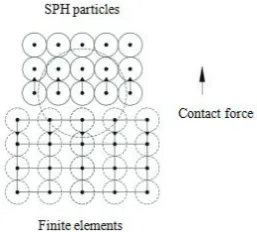
As shown below, figure 2 shows the application of the contact force of the SPH particles and the finite element contact, and among them the small solid circles represent the support domain of SPH particles , the dashed circles represent the support domain of SPH particles , small dotted circles represent set finite element nodes in the background particles. Referring to the thought of contact algorithm of SPH[9], we will depending on the finite element nodes for particles, any finite element nodes located support within the domain of SPH particles are the node generating the contact force, whereas any SPH located within the domain of the finite element nodes support will be the particle contact forces generated. The calculation process is shown in figure 3.
Figure 2.Contact between SPH particles and finite elements
Figure 3.Solution procedure for FEM-SPH contact algorithm
to the contact stiffness in finite element contact algorithm, related to material properties and impact velocity.
The contact forces acting on the SPH particles and the finite element nodes are:
F(xi) = Nc
∑
j Knmj
ρj mi
ρi
Wn−1(rij)
Wn(∆pav)/W(rij)
Under the framework of Lagrange, when coupling with SPH and FEM, both the integral requirements must be synchronized, the data transmission must be at the same time point. This requires that the same time step is used in each step of the calculation, so that the SPH and FEM time steps are selected, that is:
∆tFEM−SPH =min(∆tFEM,∆tSPH)
Among them, the time step of SPH ∆tSPH = αh/c, the time step of FEM∆tFEM = L/c,h is smooth length,Lis minimum cell size,cis sound velocity of material,αis scale factor of time step. The FEM-SPH contact algorithm is consistent with the solution format of SPH, so you can make full use of the SPH near the search list.As long as the distance between particles and nodes up to two times smooth length, contact forces on the particles and related nodes, do not need to define contact particles.
2.3.3. Finite Element-Improvement on Contact of Smooth Particles
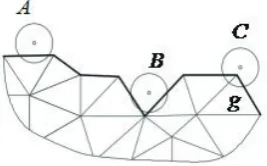
The edge of all finite elements that may occur with each SPH particle is first determined, then, the penetration test is carried out on each SPH particle to determine whether there is a contact between the particles and the cell. Through the penetration test, we can get the 3 typical SPH particles and the contact of the unit as shown in Figure 4.
Figure 4.Types of contact between particles and elements
2.3.4. Finite Element Method for the Treatment of Contact with Smooth Particles
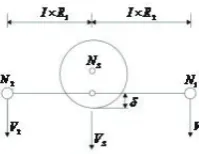
The contact processing algorithm is used to adjust the speed and position of the particle and the node to eliminate the penetration of the particle to the main surface. The algorithm consists of one particle and one main face or the main surface to form a contact pair. For each contact pair, the velocity and the position of the particle and the main surface are adjusted according to the conservation of momentum and conservation of angular momentum.
∆Vsn=
−δn/∆t 1+R2
1Ms/M1+R22Ms/M2 The speed variation of the two main nodes is:
∆V1n=−R1Ms∆Vsn/M1
∆V2n=−R2Ms∆Vsn/M2 Among them,∆Vn
s –PointNs in the ntimes of iteration speed variation Ms–the quality of the nodeδn–Penetration distance in the iterationRi–the proportion of momentum factor∆t–Time Step
Theoretically, for a single contact pair, the penetration can be completely eliminated by a speed adjustment. However, in the actual calculation, there are a lot of contact pairs,so the speed of the main node will be affected by the coupling of multiple contact,which cannot guarantee a one-time elimination of penetration, so it need to be calculated through a number of iterations.
Figure 5.Before adjustment
Figure 6.After adjustment
3. methods comparative analysis
3.1. comparison of FEM-SPH methods in high speed collision problem
Note: Residual velocity of experiment is 947m/s.
Table 2 shows the coupling algorithm in the calculation of the total unit algorithm and particle algorithm accounts for the proportion. From the table can be seen, the whole calculation process time-consuming proportion is the largest unit calculation, because most of the grid are not transformed into particles, still as a form of Lagrange elements involved in the computation; a calculation is followed by a little time consuming, although transformation unit for a small proportion, but the particle in the calculation of the need to search for all particles around it, so the calculation is relatively time-consuming; In addition, particle and contact interface coupling interface, particles and units, units and contact interface calculation also take a certain amount of computing time.
Table 2.Distribution of computing time in FEM-SPH
Time Computing time/s Percentage of total time
Coupling interface 891 7.8
FEM 6187 54.2
SPH 4347 38.0
Total time 11425 100.0
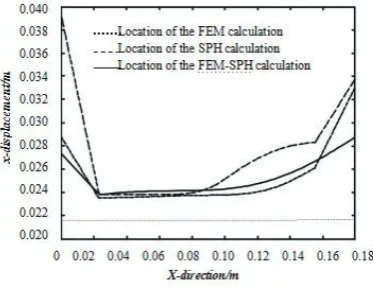
Taking several points on the X axis of the symmetry axis 0.02 to the right of the target body, the displacement of X direction at a certain moment is obtained, and explain the displacement state of the X direction of each point in this line, the calculation results are shown in Figure 9.From the graph we can see that the displacement curve calculated by the SPH method, compared with the finite element method and FEM-SPH coupling algorithm, there is a big gap, which is mainly due to the smooth particle method in the process of calculating the tensile instability problem. The FEM-SPH coupling algorithm is in good agreement with the finite element results, which verifies the effectiveness of the coupling algorithm, and to a certain extent, overcoming the defects of the smoothed particle method.
3.2. Comparison of FEM, SPH and FEM-SPH method
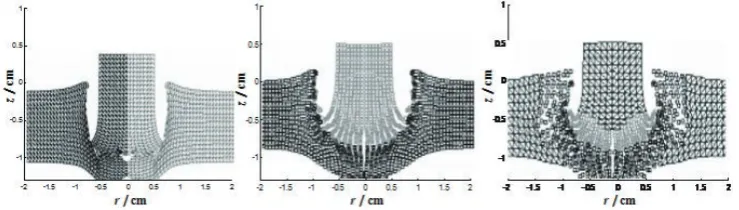
Tungsten carbide flat rod projectile, plays a length of 20 mm, 10 mm in diameter, with muzzle velocity vo = 1.5km/spositive impact to the thickness of 10 mm steel target and calculated by finite element method, smoothed particle method and coupling algorithm, the target plate and rod projectile regarded as ideal elastic plastic bodyref-journal12.
When the finite element program is adopted, the element is taken as the triangular element, and the element is 2048 units. 1024 particles were calculated by the smooth particle method. In the coupling calculation, the initial model only takes 800 triangular elements. Figure 8 are given three methods in 10µsmoments of the calculation results. The top left of the figure is made by FEM, the top right of the figure is made with the SPH method,and the bottom of the figure is made with the FEM-SPH method.
Figure 8.Deformation at t=10µs
The distortion of large units, when the equivalent plastic strain exceeds a certain threshold, is thought to have been destroyed, only under hydrostatic pressure. The limit of the steel target and tungsten alloy were 1.0 and 0.9. SPH method does not exist the unit, when the equivalent plastic strain increases, equivalent to the particle distance decreases, so in the finite element method, it does not appear because the unit deformation is too large resulting in calculation is unable to go on. In FEM-SPH algorithm, 3µs for 98 particles, 10µs for 310 particles, so not only it can effectively deal with the problem of excessive distortion, but also retains the advantages of high efficiency of the finite element calculation.
As can be seen from the Figure, in the finite element method, the damage of the element has no resistance to the bullet, so the speed of the same moment is larger than the result of the smooth particle method. In the finite element method, the velocity of the front of the bullet is relatively small, and become destroying unit. In the smooth particle method, the deformation of the front part of the bullet is larger, the mushroom head is larger than the finite element method, and the radius of the opening is larger than the finite element method. However, the calculation results of FEM-SPH algorithm are more close to the smoothed particle method.
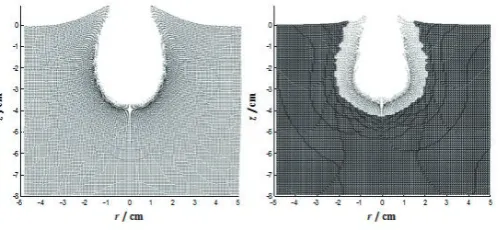
4. The numerical simulation
Figure 9.Deformation at t=10µs
Figure 10.Deformation at t=20µs
Overall, using FEM-SPH algorithm to simulate the high speed impact penetration is obviously the most appropriate, and the deformation of the image is similar to the actual. With the finite element method calculation of super high speed collision will encounter great difficulties, even using maceration and cannot be like SPH Simulation of a open pit. But SPH particles search costs much time and computational efficiency was significantly lower than that of the finite element method, and coupling algorithm sets the advantages of both in a body, the computational efficiency to far higher than that of the smooth particle method, which in the model to calculate the unit more appear particularly evident. In this example, using smoothed particle method need to calculate the number of hours, and coupling algorithm, since the target of most of the computational domain is always finite element, smooth particles only focus on the local region of the target contact, get 20µsfor 1612 particles, the whole calculation process only spends ten minutes, so the computational efficiency has been greatly improved.
5. Conclusion
boundary conditions, providing an efficient and accurate way to simulation of large deformation problems.
However, whether the SPH-FEM algorithm has a more appropriate conversion criterion, there is a need for further research. In practical engineering, it is also needed to select more appropriate switching criteria according to the failure modes of concrete materials, to further improve the accuracy of calculation. It is believed that on the basis of the perfect of the smooth particle method and the finite element coupling algorithm, it is important to develop practical and marketable software and apply it to practical engineering problems.
Acknowledgments: This work was supported by National Key Research and Development Program (no.2016YFB0601403) and the National Natural Science Foundation of Hebei Education Department (no. QN2016088).
Author Contributions:The idea of this study is proposed by Aimin Yang, Jinze Li and Yuzhu Zhang. Yuhang Pan, Yanghong Kang and Hengheng Qu for testing and data analysis. Aimin Yang and Jinze Li to carry out the design and writing of the paper.
Conflicts of Interest:The authors declare no conflict of interest.
References
1. Huang Kai, Bai Hongbai, Lu Chunhong, Cao Fengli. Sumarization on meshfree method and its application in metal forming.Forging Stamping Technology2016,2, 12-17.
2. Hu Dean, Han Xu, Xiao Yihua, Yang Gang. Research developments of smoothed particle hydrodynamics method and its coupling with finite element method. Chinese Journal of Theoretical and Applied Mechanics 2013,5, 639-652.
3. Courant R. Variational methods for the solution of problems of equilibrium and vibrations. Bulletin of the American Mathematical Society1943,1, 1-23.
4. Clough RW. The finite element method in plane stress analysis. Proceedings of American Society of Civil Engineers, 2nd Conference on Electronic Computations, Pittsburg1969,7, 345-378.
5. Clough RW. The finite element method in plane stress analysis. Proceedings of American Society of Civil Engineers, 2nd Conference on Electronic Computations, Pittsburg1969,7, 345-378.
6. Wang Ji. Linking of Smoothed Particle Hydrodynamics Methods to standard finite element methods and its Applicationin Impact DynamicsUniversity of science and techhology of China2006,2, 102-190.
7. Wang Ji, Wang Xiaojun, Bian Liang. Linking of smoothed particle hydrodynamics method to standardfinite elementmethod and its application in impact dynamics.Explosion and shock waves2007,6, 522-528.
8. Cao Zhonghua, Wang Pan, Wu Xianbing, Li Guo, Chen Jian. Research of Dynamic Simulation Method on Soil-ditching Compone Interaction.Journal of Agricultural Mechanization Research2016,3, 236-240.
9. Li Bing, Fang Yi, Feng Pengfei. Process of Damage Research on Shaped-Charge Warheadof Underwater Weapon.Journal of Sichuan Ordnance2016,2, 1-6.
10. Zhang Zhichun, Qiang Hongfu, Wei Ran. Research on Contact Algorithm between Smoothed Particle Hydrodynamicsand Finite Element Method.Chinese Journal of High Pressure Physics2011,2, 97-103. 11. Wang Zuhua, Yang Wenshan, Liu Yong. Numerical simulation of underwater contact explosion based on
SPH.Journal of Ship Mechanics2016,21, 159-167.
12. Xiao Y H,Han X, Hu D A. A coupling algorithm of Finite Element Method and Smoothed Particle Hydrodynamics for impact computations.Computers, Materials Continua2011,1, 9-34.
13. Xiao Yihua. Study on the coupling algorithm of finite element method andsmoothed particle hydrodynamics.Hunan University2012.
14. Huang Gang, SUN Sheng, Tong Mingyan, Wang Hai, SI Dandan. Dropping analysis of radioactive liquid waste transport container based on finite element method coupling with smoothed particle hydrodynamics method.Nuclear Techniques2016,1, 49-55.
c