Article
1
Expert-based speed-precision control in early
2
simulator training for novice surgeons
3
Birgitta Dresp-Langley1
4
1 Centre National de la Recherche Scientifique, UMR 7357 ICube Lab, Université de Strasbourg Faculté de
5
Médecine Pavillon Clovis Vincent; [email protected]
6
* Correspondence: [email protected]; Tel.: +33-3-88119117
7
8
Abstract: Simulator training for image-guided surgical interventions may benefit from artificial
9
intelligence systems that control the evolution of task skills in terms of time and precision of a
10
trainee's performance on the basis of fully automatic feed-back systems. At the earliest stages of
11
training, novice trainees frequently focus on getting faster at the task, and may thereby
12
compromise the optimal evolution of the precision of their performance. For automatically guiding
13
them towards attaining an optimal speed-accuracy trade-off, an effective control system for the
14
reinforcement/correction of strategies must be able to exploit the right individual performance
15
criteria in the right way, reliably detect individual performance trends at any given moment in
16
time, and alert the trainee, as early as necessary, when to slow down and focus on precision, or
17
when to focus on getting faster. This article addresses several aspects of this challenge for
18
speed-accuracy controlled simulator training before any training on specific surgical tasks or
19
clinical models should be envisaged. Analyses of individual learning curves from the simulator
20
training sessions of novices and benchmark performance data of one expert surgeon, who had no
21
specific training in the simulator task, validate the suggested approach.
22
Keywords: surgical simulator training; individual performance trend; speed-accuracy function;
23
automatic detection; performance feed-back
24
25
1. Introduction
26
Technological development and pressure towards a reduction in time available for learning has
27
radically changed the traditional apprenticeship model of surgical training. Simulation now offers
28
the opportunity for repeated practice in safe and controlled environments and the most recent
29
technological advances have led to the development of various simulators, which have already
30
been introduced in surgical training. The complexity and reliability of available simulators vary
31
considerably, and selecting an appropriate simulator for surgical skill training is in itself a
32
challenge. Simulators that are used for specific surgical skills training are generally tested for the
33
highest validity level [1], that of predictive validity, ensuring that assessments of performance in
34
the specific simulator task are likely to predict future performance of the trainee in the same task in
35
a clinical context (animal, patient). However, only a certain percentage of these surgical simulators
36
give some kind of performance feedback to the trainee, and the feed-back systems as such are
37
generally not validated. In other words, whether the feed-back given during training is actually
38
truly useful to a novice is not known. Ideally, within a surgical curriculum, trainees should have
39
dedicated time for simulation-based training with appropriate performance monitoring through
40
truly effective feed-back systems, as the main advantage of computer simulators for surgical
41
training is the opportunity they afford for independent learning. Yet, if the simulator does not
42
provide relevant and truly useful instructional feedback to the user, then instructors need to be
43
present to supervise and tutor the trainee.
44
Relevant performance metrics [2-8] are therefore essential to the development of surgical
45
simulator systems for optimal independent training, and the presentation of such metrics to the
46
user in a way that boosts independent learning by facilitating measurable skill improvement is
47
clearly the most important aspect of developing effective simulator systems [9]. Metric-based
48
simulation ensures that training sessions are more than just simulated clinical procedures and gets
49
rid of subjectivity in evaluating skill evolution, as there is no ambiguity about the progress of
50
training. Benchmarking individual levels of proficiency on the performance levels of experts on a
51
validated metric-based simulation system has well-established intrinsic face validity [9] and
52
appears a better approach than benchmarking on some abstract performance concept based on
53
expert consensus, for example. Building expert performance as a basis for skill assessment into
54
simulator training programs ensures that the “pass” level is defined on realistic criteria set directly
55
by the proficiency levels of individuals who are actually very experienced at performing the actual
56
clinical procedure [9-13]. Artificial intelligence provides well-suited concepts for reinforcement
57
learning procedures and allows building prior benchmark knowledge on expert performance into
58
simulator training most effectively. Specific control procedures [11] based on metric-based
59
benchmark criteria for automatized performance comparisons, leading to decisions of the “if then”
60
kind without supervision, not only enable the generation of learning curves in individual
61
performance at the end of sessions but also, more importantly, enable trial-by-trial feed-back at any
62
given moment in time during training to help individuals reach optimal performance as swiftly as
63
possible [13-21]. This constitutes a far more effective approach compared with merely assessing
64
end-of-session performance status, or differences between users after training. This article here
65
focuses on a generic early simulator training model for automatic skill evolution, well before
66
novices are trained on more specific surgical simulator systems, or in clinical trials on animal
67
models. The approach discussed here is based on a simple and universal psychophysical human
68
performance model [22-29] that allows telling apart individual strategies during motor learning on
69
the basis of individual speed-accuracy trade-off functions. On the basis of this model, data obtained
70
on a pick-and-place task simulator for image-guided eye-hand-tool coordination training are
71
discussed. How automatic performance control and feed-back can be implemented at various steps
72
and in the simplest possible way is then made clear. The training model proposed ensures that
73
novice trainees, at the earliest stages of simulator training, reach optimal precision levels in any
74
image-guided performance simulator system capable of generating reliable and discerning
75
measures of skill evolution with respect to 1) the time of task execution from tzero to tn at any
76
moment of the procedure and 2) the precision with which the task is performed at critical steps of
77
the procedure.
78
2. Materials and Methods
79
The evolution of individual performance measures relative to task speed and precision was
80
monitored using a specifically designed simulator platform for image-based analysis of performance
81
data relative to the time and precision of hand-tool movements in a computer controlled simulator
82
task (pick-and-place). The technical aspects of this platform, which was used in several experimental
83
studies, are described in detail in some of our previous work [2-6].
84
For collecting the performance data shown in this paper here, a single camera view was
85
generated through a 120° fisheye lens camera fully adjustable in 360°. The video input received from
86
the camera was processed by a DELL Precision T5810 model computer equipped with an Intel Xeon
87
CPU E5-1620 with 16 Giga bytes memory (RAM) capacity at 16 bits and an NVidia GForce GTX980
88
graphics card. Experiments were programmed in Python 2.7 for Windows using the Open CV
89
computer vision software library. The computer was connected to a high resolution color monitor
90
(EIZO LCD ‘Color Edge CG275W’), which the Color Navigator 5.4.5 interface for Windows. The
91
colors of objects visualized on the screen can be matched to LAB or RGB color space and the color
92
coordinates for RGB triples can be retrieved from a look-up table at any moment in time. The
93
task-action field consisted of a classic square shaped (45cm x 45cm) light grey LEGO board available
94
worldwide in the toy sections of large department stores. Six square-shaped (4,5cm x 4,5cm) target
95
these target areas, small LEGO pieces of varying shapes and heights were placed to add a certain
97
level of complexity to both the visual configuration and the task and to reduce the likelihood of
98
getting performance ceiling effects. In the pick-and-place task, a small (3cm x 3cm x 3cm) cube made
99
of very light plastic foam but resistant to deformation in all directions had to be placed on the target
100
areas in a specific order. The video input received by the computer from the fisheye camera
101
generated raw image data within a viewing frame of 640 pixels (width) x 480 pixels (height). These
102
data were processed to generate show-image data in a viewing frame of 1280 pixels (width) x 960
103
pixels (height), the size of a single pixel on the screen being 0.32mm to ensure that the size of the
104
task-action field viewed on the computer screen was identical to that in the real world. The training
105
sessions were run under conditions of free viewing, with general illumination levels that can be
106
assimilated to daylight conditions. The task-action field was illuminated by two lamps (40Watt, 6500
107
K) which were constantly lit during the sessions. Participants were comfortably seated at a distance
108
of approximately 75cm from the RA from the screen. Trainees were generally right-handed, as those
109
for whom data are shown here. They were instructed to position the cube, with their dominant hand
110
and using a forceps-like tool, as precisely and swiftly as possible on the center of each target, in the
111
right order, as explained to them. Data from fully completed trial sets only were recorded. A fully
112
complete trial set consists of a set of pick-and-place operations, from target to target in the right
113
order and without dropping the object accidentally. Ten fully completed trial sequences were
114
recorded in each training sessions. For single trial, the computer program generated data relative to
115
the performance measures 'time' and 'precision'. For ‘time’, the computer counted the CPU time (in
116
seconds) from the moment the blue cube object was picked up by the participant to the time it was
117
put on the next target. The rate for image-time data collection was between 25-30 Hz, with an error
118
margin of less than 40 milliseconds for any of the time estimates. For ‘precision’, the computer
119
program counted the cumulated number of blue object pixels at positions "off" the 3cm x 3cm central
120
area of each of the five 4,5cm x 4,5cm target areas whenever the object was placed. The standard
121
errors of these positional estimates, determined in a calibration procedure, were below 10 pixels.
122
Individual time and precision data were written to an excel file by the computer program, with
123
labeled data columns for the different conditions, and stored in a directory for subsequent analysis.
124
All experiments were conducted in conformity with the Helsinki Declaration relative to
125
scientific experiments on human individuals with the full approval of the ethics board of the
126
corresponding author's host institution (CNRS). All participants were volunteers and provided
127
written informed consent. Their identity is not revealed. Some of the data shown here are from eight
128
training sessions of two novices with no experience in image-guided or other surgical procedures
129
(absolute beginners), as in [2-5]. The data relating to the expert performance measures, shown here
130
for comparison, were recorded from a single training session of a highly skilled expert endoscopic
131
surgeon with more than 30 years of experience in image-guided surgery but no training at all in this
132
specific pick-and-place simulator task here.
133
3. Results
134
In several of our previous studies, simulator training data relative to time (in seconds) and
135
precision (in pixels) of image-guided pick-and-place task performance were recorded from a total
136
population of 30 individuals, including absolute beginners, novice surgeons without specific
137
experience in image-guided simulator training, and expert surgeons with variable experience in
138
image-guided surgery. Some of these data have been made available and discussed in our previous
139
work [2, 3, 5].
140
Here, the training data of two novices with no experience in image-guided simulator training,
141
and of one highly proficient expert surgeon with more than 20 years of experience in image-guided
142
endoscopic surgery but no training in the specific simulator task are compared and discussed.
143
Differences in the individual speed-precision trade-off functions and in the individual evolution of
144
task execution times and task precision across sessions are brought to the fore to highlight
145
spontaneously occurring individual learning strategies that lead to consider the AI enhanced
146
between task execution time (in seconds) and precision, expressed here in terms of a score that takes
148
the cumulated number of off-target pixels for a given session with ten repeated trial-sets of five pick
149
and place operations. The higher the cumulated off-target score, the lesser the trainee’s precision. To
150
get these individual trade-off functions, the times taken for each of ten repeated trial sets are sorted
151
in ascending order (x-axis) and plotted against their corresponding precision scores (y-axis) for each
152
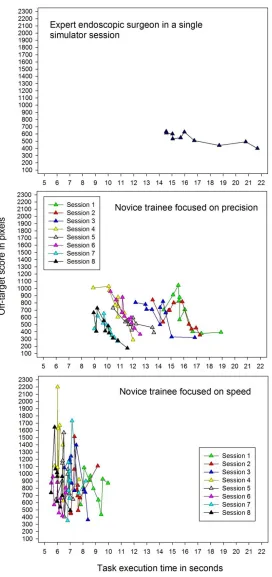
training session (Figure 1).
153
154
Figure 1. The individual trade-off functions between task execution time (in seconds) and precision,
155
trial-sets of five pick and place operations. A higher cumulated off-target score reflects a lesser
157
precision in a given session. The functions show data of an expert with more than 20 years of
158
experience in image-guided precision surgery from a single simulator training session (graph on the
159
left) for comparison with data of two novices from eight successive training sessions revealing two
160
naturally occurring and radically different task strategies, one focused on precision (graph in the
161
middle) and one focused on speed (graph on the right).
162
Comparison between the individual trade-off functions reveal two naturally occurring and
163
radically different training strategies of the two novices. One of them clearly focused on speed
164
(Figure 1, graph on right), in other words on doing the task as fast as he/she can, with task execution
165
times less than half those of the expert with 20 years of experience. Across the eight training
166
sessions, this trainee is getting progressively faster, but the precision score does not improve as
167
training progresses and fails to evolve towards any stable performance pattern across the eight
168
sessions, as shown by the extent of scatter in this trainee’s individual speed-precision trade-off
169
functions for each session. Even in the last session, the precision scores for the ten trial-sets are
170
poorer and highly unstable compared with the consistent and rather stable precision scores of the
171
expert’s single session performance (Figure 1, graph on left), bearing in mind that this expert had no
172
previous training in this specific simulator task here. The other novice’s strategy is clearly far more
173
focused on precision, as is made clear by the individual speed-precision trade-off functions of from
174
the eight training sessions (Figure 1, graph in middle). This novice starts, in the first two sessions,
175
with times in the range of those from the single session of the expert, then gets progressively faster
176
and, ultimately, becomes faster than the expert who had no further training in the task. The
177
precision scores of this novice also improve consistently as training progresses and, ultimately, in
178
the last training session attain a level of stability that is comparable to that of the expert.
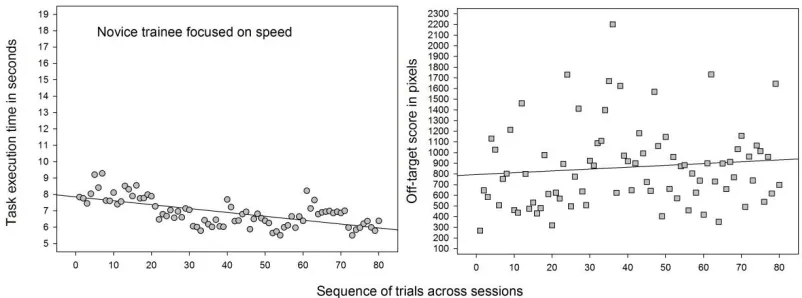
179
Plotting the data for time and precision of the same three trainees as a function of the sequence
180
of the trials across the sessions (a single session for the expert and eight successive training sessions
181
of the two novices) gives a clear overview of the individual evolution of each performance
182
parameter and their relative variability/stability. The novice focused on precision (Figure 2, graph
183
on left) displays a wider range of task execution times with a steeper learning curve compared with
184
the data from the novice focused on speed (Figure 4, graph on left), whose task execution times are
185
scattered around the lowest possible ceiling level, indicating that this trainee clearly started off way
186
too fast. The expert gets naturally and consistently faster in a single session (Figure 3, graph on left).
187
The most revealing learning curves are those for the parameter relative to precision, showing
188
moderate scatter and a clear learning trend for the novice focused on precision (Figure 2, graph on
189
right), and extensive scatter with no learning trend at all for the novice focused on speed (Figure 4,
190
graph on right). The expert’s precision data show almost no scatter at all, indicating a highly stable
191
performance level and a slight trend towards better precision as trials progress in a single session
192
(Figure 3, graph on right).
193
Figure 2. The evolution of task execution times (left) and precision (right) of the novice trainee focused
195
on precision showing a clear learning trend for each performance parameter, with moderate extent of
196
scatter (variability) in the data, shown here as a function of the sequence of the repeated trial-sets (10
197
per session) across eight successive training sessions.
198
199
Figure 3. The evolution of task execution times (left) and precision (right) of the expert surgeon from
200
a single simulator session showing a short-term training effect on task execution times and a close to
201
perfectly stable performance level for precision.
202
203
Figure 4. The evolution of task execution times (left) and precision (right) of the novice trainee
204
focused on speed, withtask execution times scattered around the lowest possible ceiling level, and
205
extensive scatter of the precision parameter with no learning trend at all, indicating that this trainee
206
started off much too fast.
207
The performance data relative to time and precision from the simulator training sessions of
208
three individuals compared here and their differential evolution with training show three typical
209
profiles providing clear proof of concept that the pixel-based precision measures of our simulator
210
system are well-suited to give a reliable and discerning measure for task precision, i.e. a measure
211
that allows 1) a clear performance distinction between a surgical expert and a novice trainee, and 2)
212
a clear distinction between novices who adopt radically different task strategies during learning.
213
The speed-accuracy trade-off functions provide direct insight into the nature of these strategies, as
214
shown previously. They also provide a quantitative basis for what could be considered a general
215
model of effective, and possibly AI-guided, simulator training for any image-guided task where
216
precision matters critically, as in surgical training.
217
As shown and discussed in some of our previous work [2, 3, 5], the strategy differences
218
between novices in simulator training for image-guided hand-tool movements vary between the
219
two extreme cases shown here, which leads to general conclusions that need to be taken into
220
view of either a reinforcement or a correction of task strategies: The performance strategy of trainees
222
who start off too fast needs to be corrected to enable effective precision learning, while the
223
performance strategy of trainees who focus on being as precise as possible should be reinforced
224
because they will naturally and without any further instructions get faster with training. When an
225
individual precision performance can be considered optimal and stable, then and only then the
226
trainee may be instructed to try to get even faster. The performance profile of an expert can serve as
227
a benchmark profile to generate in-built system knowledge of what the desired performance profile
228
of a novice should look like after successful training on a given simulator.
229
On these grounds, we propose a system that automatically corrects for individual strategy at
230
any moment in time during training, and enables trainees to reach the optimal speed-precision
231
strategy as swiftly as possible during training by receiving appropriate feed-back. Such a system
232
must be able to:
233
234
- generate reliable and discerning measures (parameters) relative to time and precision of
235
individual performance at any moment in time during training
236
- compare an individual parameter measure relative to time and precision at any moment in
237
time during training with the desired parameter value based on an already known
238
(“learnt”) performance profile of an expert user
239
- provide feed-back to the user at any moment in time during training about what he/she needs
240
to focus on to optimize his/her performance as swiftly as possible
241
242
H How this may be achieved is illustrated on the example of a single five-step trial of the simulator
243
task here (Figure 5). A single trial of the image guided pick-and-place task has several (here five, but
244
it could be any n in any other system) successive steps. The system starts counting task execution
245
time from the moment the object is picked up by the user with the surgical tool (t0) and ongoing
246
time can be communicated to the trainee at any moment (tn) from then until the object is placed on
247
the last of several (here five) successive targets.
248
Placing the object on a given target is a critical step of the procedure where precision
249
matters as users are instructed to place the object with the surgical tool on the central area of each
250
target as precisely as possible. This is a challenging task and involves specific visual attention to fine
251
eye-hand-tool coordination for placing the target optimally as the precise borders of the target
252
center are only known by the system in terms of pixel coordinates, but not visible to the user. The
253
user only sees the borders of the targets as such in the image guiding his/her action, and the object
254
that needs to be placed centrally is smaller than the target area.
255
Figure 5. System flowchart of a single trial of the image guided pick-and-place task with n successive
257
critical “place object” steps. The system starts counting task execution time from the moment the
258
object is picked up by the user with the surgical tool (t0). Ongoing time can be communicated to the
259
trainee at any moment (tn) from then together with the precision score (pn) until the object is placed
260
on the last targets. The data from a single training session shown in the graphs here above represent
261
the cumulated values Ttotalx10 and Ptotalx10 from a sequence of ten successive trials per session.
262
At each such critical step of the procedure, the system counts the number of pixels corresponding to
263
the object in the image that do not coincide with the pixels that define the central area of a target
264
known by the system and are therefore “off-target” in terms of the task constraints as given (“place
265
object as centrally on target as possible”). Hence, the smaller this measure, the greater the user’s
266
precision at a given critical step. This precision score (pn) also can be communicated to the trainee an
267
any critical moment in time (tn) of the procedure.
268
On the basis of such a system, which automatically monitors the evolution of individual
269
performance parameters at any given moment in time during training, it is possible to suggest a
270
simple AI enhanced system for the control, in terms of either reinforcement or correction, of
271
performance strategies of trainees to ensure effective precision learning. It goes without saying that
272
priority needs to be placed on precision rather than speed, especially in surgical training, and
273
trainees get faster naturally, as shown here above, once they have adopted the right strategy for
274
working on their precision. As is shown here, a single dataset from a single expert can provide
275
effective benchmark data for building prior knowledge into the system and these “learnt” data can
276
be exploited for automatic performance feed-back to the user at any moment in time during
277
training. The data from our expert here were from a single session. In an ideal world, expert data
278
could be collected from multiple simulator sessions, as many as necessary, to allow for even more
279
direct trial-by-trial comparisons where the observed data of a trainee at a given moment of the
280
procedure for a given session Sn are compared to the “ideal” data of an expert for the corresponding
281
moment of the procedure and session Sn of a training sequence.
282
Taken into account the general insight gained from the performance analyses here above
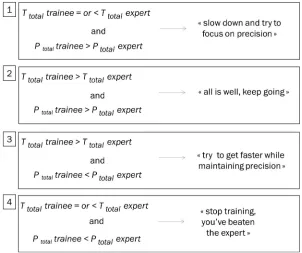
283
(Figures 1-4), leads to suggest a generic AI enhanced control system that makes decisions based on
284
in-built knowledge of expert data as shown here below (Figure 6).
285
286
287
Figure 6. Model for the automatic reinforcement/correction of individual performance strategies during
290
training based on data from a single expert (“learnt” system knowledge) to generate appropriate
291
feed-back. No more than four cases (1, 2, 3 and 4) need to be considered. Any simulator system which
292
automatically and reliably collects individual performance data for time and precision (parameters) can
293
be transformed into an AI enhanced system for the control, in terms of either reinforcement or correction,
294
of performance strategies of trainees to ensure effective precision learning.
295
296
The four cases to be considered by the system may be summarized as follows. 1) At a given moment
297
tn in a training session Sn the trainee is as fast as or faster than the expert and less precise. In this
298
case, the system needs to alert him/her to slow down and start focusing on precision. This is the
299
classic case of a trainee focused on speed who tries to do the task as fast as he/she can and thereby
300
compromises the swift evolution of his/her precision score. 2) At a given momentin a training
301
session the trainee is slower than the expert and less precise. In this case, especially at early
302
moments of training, the system needs to instruct the trainee to keep going, as he/she should get
303
more precise and faster naturally. 3) At a given moment in a training session the trainee is slower
304
than the expert and as precise or more precise. In this case, the system needs to instruct the trainee
305
to try to go a little faster. 4) At a given moment the trainee is faster than or as fast as the expert and
306
as precise or even more. In this case the trainee has beaten the expert. It this occurs, especially early
307
in a training sequence, there is either a problem with the simulator task (i.e. the task does not
308
produce adequate performance data that allow discriminating between levels of expertise, which is
309
a problem that needs to be fixed), or the trainee is not a true novice.
310
311
4. Discussion
312
313
Surgical simulator training requires new forms of sensorimotor learning, an adaptive process that
314
leads to improvement in performance through practice. This adaptive process consists of multiple
315
distinct learning processes [28, 29]. Hitting a target, or even getting closer to it generates a form of
316
implicit reward where the trainee increasingly feels in control. Successful error reduction, which is
317
associated with specific commands relative to the specific motor task [24], can be optimized by
318
gibing the trainee the right external feed-back. In this feed-back process, the integration of
319
information from multiple senses (vision, touch, audition, proprioception) leads to improved
320
adjustments in body, arm, or hand movements leading to perform the task with greater precision.
321
Subjects are able to make use of error signals relative to the discrepancy between a desired and the
322
actual movement or hand-tool-position, or a discrepancy between visual and proprioceptive
323
estimates of body, arm, or hand positions [22, 28, 29]. The effective, if possible computer controlled,
324
monitoring of strategies relative to speed-accuracy trade-offs in individual performance learning is
325
a critical aspect of the skill assessment process given that cognitive theories of motor learning
326
predict that strategy differences occur spontaneously when novices train to perform a motor task
327
in a limited number of sessions [23-26], as is the case in laparoscopic simulator training.
328
Conditional accuracy functions relate the duration of trial or task execution to a precision index
329
reflecting the accuracy of the performance under conditions given. A variable relationship between
330
speed and precision reflects hidden aspects of learning a beginner is usually not aware of [25]. In
331
the fully trained expert, the trade-off between speed and precision does not vary. For the skill
332
evaluator, the individual speed-accuracy trade-offs allow assessing whether a trainee is
333
progressing, and this knowledge needs to be made available as early as possible in the training
334
process. Simply comparing the skill levels of different trainees at the end of the process is not the
335
right approach. What is needed are clear benchmark criteria for what the ideal performance of a
336
successful trainee is to look like at the end of training. Such benchmark knowledge can be built into
337
the computer controlling the simulator task on the basis of results from a certain number of
338
training sessions of a surgical expert, as shown in our example here above.
339
Surgical simulators may be more or less task specific, or more or less "realistic" when compared
340
with actual surgical task constraints they are supposed to train for. Many of them provide highly
341
tasks. One of the most important advantages of a simulation is to facilitate efficient training of skill
343
outside the clinical context, which reduces the risk for patients. Different definitions of the notion
344
of skill itself have produced different approaches to simulation-based surgical training. As pointed
345
out by others previously [9, 10, 18], it is not always clear if more skilled individuals perform better
346
on their assessments than less skilled or experienced individuals (construct validity), whether
347
individuals who perform well on their evaluations will also perform well on other similar or
348
vaguely related tasks (concurrent validity), or whether an assessment based on simulator training
349
will predict future performance in the real-world context (predictive validity). Faced with this
350
problem of providing reliable performance standards, it is essential that the system, the task, the
351
metrics used to control performance learning during the task, and the mechanisms for providing
352
feedback have somehow been validated by an expert to ensure that the training criteria and skill
353
assessment provided by the system match those required real surgical tasks. Many different
354
simulator tasks exist, which poses a problem of generalization of learning curves and skill transfer.
355
The task model and control procedures suggested here should be implemented at the earliest
356
stages of "dry lab" simulator training on eye-hand-tool coordination tasks that allow for computer
357
controlled criteria for precision p at time t (Figure 7, for illustration). The early training task should
358
successfully tell apart the performance levels of a surgical expert not trained on the simulator, as in
359
the case discussed here above, and the performance levels of novice trainees. If an early training
360
system satisfies this criterion, then it is indeed likely to measure critical aspects of surgical skill that
361
will transfer to real surgical tasks and, ultimately, produce a valid selection of trainees that are
362
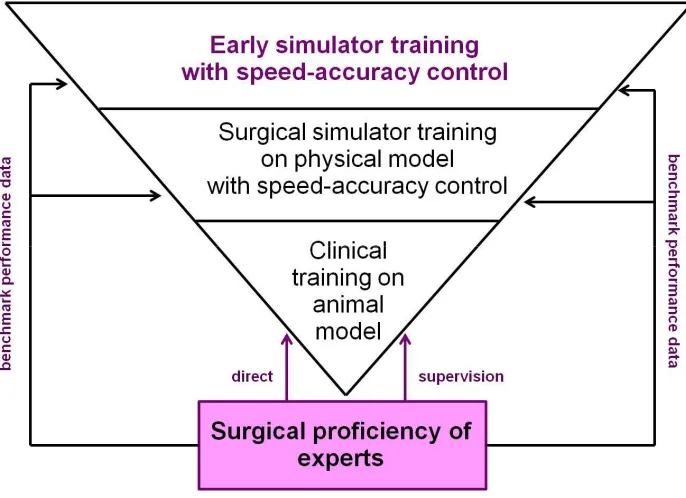
likely to perform well in more specific tasks on physical models and in the clinical context, where
363
direct supervision by experts will enable to promote individual expertise and excellence at the
364
highest levels of surgical proficiency (Figure 8).
365
366
367
368
Figure 7. Illustration of computer controlled precision coding, based on pixel coordinates, for individual
369
performance training in an image-guided simulator task of the pick and place type, as also described in
370
our previous work [2, 5]. What the user sees on the screen in front of him/her is a camera view of an action
371
space of the kind shown in the image at the bottom here. When the task instruction is, for example, to
372
place a small object as swiftly and as precisely as possible on exactly the center of each of the three larger
373
square shaped target areas, the computer may use the reference image coordinates, indicated here in the
374
image on top by the red dotted lines, and compare them with the coordinates of the actual tool-object
375
the desired reference coordinates, and uses them to compute a task precision score (p) in terms of the
377
number of pixels by which the tool-object position or tool-object trajectory produced by the user at a
378
critical moment in time (t) during the task deviates from the supposedly ideal reference coordinates in
379
any direction in space. Based on the known performance score of an expert built into the system,
380
automatic feed-back may be provided to the user at any moment during training to control and/or correct
381
his/her speed-accuracy trade-off.
382
383
Finally, whatever the simulator, a single performance metric inevitably gives a partial assessment of
384
user performance [18]. Task completion time as a sole criterion has been explicitly demonstrated to
385
be a poor or even misleading measure of surgical skill [1, 19]. Some metrics assume a simple global
386
optimum value, such as a minimal tool path length, or a minimal completion time, and other
387
quantities such as forces [4, 19] or velocities [21, 30-33], whose ideal values may vary in relation to
388
changes in conditions, may have to be considered. Analysis of expert performance only can give
389
insight into the nature of such dependencies and help develop better simulators.
390
391
392
393
394
Figure 8. Speed-accuracy control on novice strategies in early training systems based on experts'
395
benchmark performance data allows selecting for critical aspects of surgical skill that will transfer to
396
further training on physical models in increasingly realistic surgical tasks. Ultimately, this will produce a
397
valid selection of trainees that are likely to perform well at the highest levels of training under the direct
398
supervision of an expert.
399
400
The fact that not all the important elements of surgical proficiency have been explored yet, does not
401
change the heuristic validity of the general model for unsupervised training proposed here in this
402
article. The model can, in principle, be adapted to any simulator system that exploits a criterion for
403
task precision in task time. It is based on previously validated cognitive models of human
404
performance learning showing that the individual speed-precision strategies of novices, which
405
occur spontaneously and unconsciously [2, 22, 24, 25], can seriously compromise precision learning
406
at all further stages of training if they are not controlled and corrected for as early as possible in the
407
process. In robot-assisted surgical procedures, for example, where the camera moves along with the
408
tool, for example [10-16], metrics such as camera movement frequency, camera movement duration,
409
or camera movement interval are important indicators of technical skill, i.e. the
410
proficiency/precision with which the trainee controls the tool, combined with other performance
411
decision model for unsupervised training procedures of the kind proposed here in this article could
413
also be adapted to such performance criteria on the basis of device-specific expert performance
414
benchmark data.
415
Funding: This research received no external funding.
416
Acknowledgments: Material support from the Centre National de la Recherche Scientifique (CNRS),
417
Strasbourg University, and the Institut Hospitalo-Universitaire (IHU) de Strasbourg is gratefully
418
acknowledged.
419
Conflicts of Interest: The author declares no conflict of interest.
420
References
421
1. Stunt JJ, Wulms PH, Kerkhoffs GM, Dankelman J, van Dijk CN, Tuijthof GJM. How valid are commercially
422
available medical simulators? Advances in Medical Education and Practice. 2014; 5:385-395.
423
2. Batmaz AU, de Mathelin, M, Dresp-Langley, B. Getting nowhere fast: Trade-off between speed and
424
precision in training to execute image-guided hand-tool movements. BMC Psychology. 2016a; 4: 55.
425
doi:10.1186/s40359-016-0161-0.
426
3. Batmaz AU, de Mathelin, M, Dresp-Langley, B. Effects of indirect screen vision and tool-use on the time
427
and precision of object positioning on real-world targets. Perception. 2016b; 45: Supplement, 286.
428
4. Batmaz AU, Falek M, Nageotte F, Zanne P, Zorn L, de Mathelin M, Dresp-Langley B. Novice and expert
429
haptic behaviours while using a robot controlled surgery system. 2017 ; 13th IASTED International
430
Conference on Biomedical Engineering (BioMed).
431
5. Batmaz, AU, de Mathelin, M, Dresp-Langley, B. Seeing virtual while acting real: Visual display and
432
strategy effects on the time and precision of eye-hand coordination. PLoS One. 2017; 12: e0183789.
433
6. Batmaz, AU, de Mathelin, M, Dresp-Langley, B. Effects of 2D and 3D image views on hand movement
434
trajectories in the surgeon's peri-personal space in a computer controlled simulator environment. Cogent
435
Medecine. 2018; 5.
436
7. Gallagher, AG, O'Sullivan C. Fundamentals In Surgical Simulation: Principles and Practice. Improving Medical
437
Outcome - Zero Tolerance Series. 2011; in P. Apell (Ed.). Springer Business Media, e-book.
438
8. Gallagher AG. Metric-based simulation training to proficiency in medical education: What it is and how to
439
do it. Ulster Med J 2012; 81(3):107-113.
440
9. Gallagher AG, Ritter EM, Champion H, Higgins G, Fried MP, Moses G. Virtual reality simulation for the
441
operating room: proficiency-based training as a paradigm shift in surgical skills training. Ann Surg. 2005
442
Feb; 241(2):364-72.
443
10. Dreyfus HL, Dreyfus SE, Athanasiou T. Mind over machine: the power of human intuition and expertise
444
in the era of the computer. New York: Free Press; 1986.
445
11. Seymour NE, Gallagher AG, Roman SA, O’Brien MK, Andersen DK, Satava RM. Analysis of errors in
446
laparoscopic surgical procedures. Surg Endosc. 2004; 18(4):592-5.
447
12. Van Sickle K, Smith B, McClusky DA, Baghai M, Smith CD, Gallagher AG. Evaluation of a tensiometer to
448
provide objective feedback in knot-tying performance. Am Surg. 2005; 71(12):1018-23.
449
13. Van Sickle KR, Gallagher AG, Smith CD. The effect of escalating feedback on the acquisition of
450
psychomotor skills for laparoscopy. Surg Endosc. 2007; 21(2):220-4.
451
14. AReznick RK. Teaching and testing technical skills. Am J Surg. 1993; 165(3):358–361.
452
15. Chen C et al. Crowd-sourced assessment of technical skills: a novel method to evaluate surgical
453
performance. J Surg Res. 2014; 187(1):65–71.
454
16. Moorthy K et al. Objective assessment of technical skills in surgery. BMJ. 2003; 327(7422):1032–1037.
455
17. Sewell C, Morris D, Blevins NH, Dutta S, Agrawal S, Barbagli F, Salisbury K. Providing metrics and
456
performance feedback in a surgical simulator. Computer Aided Surgery. 2008; 13(2): 63-81.
457
18. Ritter EM, McClusky DA, Gallagher AG, Smith CK. Real-time objective assessment of knot quality with a
458
portable tensiometer is superior to execution time for assessment of laparoscopic knot-tying performance.
459
Surgical Innovation. 2005; 12(3):233–237.
460
19. Rosen J, Hannaford B, Richards CG, Sinanan MN. Markov modeling of minimally invasive surgery based
461
on tool/tissue interaction and force/torque signatures for evaluating surgical skills. IEEE Trans Biomed Eng.
462
20. Jarc AM, Curet MJ. Viewpoint matters: objective performance metrics for surgeon endoscope control
464
during robot-assisted surgery.Surg Endosc . 2017 ; 31:1192–1202.
465
21. Batmaz AU, de Mathelin M, Dresp-Langley B. Effects of indirect screen vision and tool-use on the time
466
and precision of object positioning on real-world targets. Perception, 2016; 45(ECVP Supplement): 196.
467
22. Fogassi L, Gallese V. Action as a binding key to multisensory integration. In Calvert G, Spence C, Stein BE,
468
editors, Handbook of multisensory processes. Cambridge, MA: MIT Press. 2004; p. 425–441.
469
23. Bonnet C, Dresp B. A fast procedure for studying conditional accuracy functions. Behavior Research,
470
Instruments & Computers. 1993; 25: 2-8.
471
24. Fitts P M. The information capacity of the human motor system in controlling the amplitude of movement.
472
Journal of Experimental Psychology. 1954; 47: 381-391.
473
25. Meyer DE, Irwin A, Osman, AM, Kounios J. The dynamics of cognition and action: Mental processes
474
inferred from speed-accuracy decomposition. Psychological Review, 1988; 95: 183-237.
475
26. Luce, RD. Response times: Their role in inferring elementary mental organization. 1986; New York:
476
Oxford University Press.
477
27. Held R. Visual-haptic mapping and the origin of crossmodal identity. Optometry and Vision Science. 2009;
478
86, 595-598.
479
28. Henriques, DY, Cressman, E.K. Visuo-motor adaptation and proprioceptive recalibration. Journal of
480
Motor Behavior. 2012; 44, 435-444.
481
29. Krakauer, JW, Mazzoni, P. Human sensorimotor learning: adaptation, skill, and beyond. Current Opinion
482
in Neurobiology. 2011; 21, 636–644.
483
30. Goh AC et al. Global evaluative assessment of robotic skills: validation of a clinical assessment tool to
484
measure robotic surgical skills. J Urol. 2012; 187(1):247–252.
485
31. Smith R, Patel V, Satava R. Fundamentals of robotic surgery: a course of basic robotic surgery skills based
486
upon a society consensus template of outcomes measures and curriculum development. Int J Med Robot
487
Comput Assist Surg. 2014; 10(3):379–384.
488
32. Aiono S et al. Controlled trial of the introduction of a robotic camera assistant (Endo Assist) for
489
laparoscopic cholecystectomy. Surg Endosc Other Interv Tech. 2002; 16(9):1267–1270.
490
33. King BW et al. Towards an autonomous robot for camera control during laparoscopic surgery. J
491
Laparoendosc Adv Surg Tech. 2013; 23(12):1027–1030.
![Figure 7. Illustration of computer controlled precision coding, based on pixel coordinates, for individual performance training in an image-guided simulator task of the pick and place type, as also described in our previous work [2, 5]](https://thumb-us.123doks.com/thumbv2/123dok_us/7852035.1302085/10.595.212.383.394.649/illustration-controlled-precision-coordinates-individual-performance-simulator-described.webp)