Available Online atwww.ijcsmc.com
International Journal of Computer Science and Mobile Computing
A Monthly Journal of Computer Science and Information Technology
ISSN 2320–088X
IJCSMC, Vol. 4, Issue. 5, May 2015, pg.1002 – 1011
RESEARCH ARTICLE
INTEGRATED DCT, DWT AND MODIFIED SVD
BASED DIGITAL IMAGE WATERMARKING
Ramandeep Kaur, Prof. Jatinder Kumar
Dept. of Computer Science and Engineering, SIET, Amritsar, (Punjab) India [email protected], [email protected]
Abstract:-Watermarking is an effective technology that solves many problems within a digitization. By embedding Intellectual Property data (e.g. the creator, licence model, creation date or other copyright information) within the digital object, the digitiser can demonstrate they are the creator and disseminate this information with every copy, even when the digital object has been uploaded to a third party site. It can also be used to determine if a work has been tampered with or copied. This paper describes methods for establishing if an application requires watermarking techniques and criteria for choosing the most suitable type. This paper has focused on evaluating the role of the SVD, DCT and DWT based image watermarking for secure transmission. And also enhancement is done by using the modified SVD to enhance the results further.
Index Terms: DCT, DWT, MODIFIED SVD, WATERMARKING.
1. INTRODUCTION
The advancing world of digital multimedia communication is faces problems related to security and authenticity of digital data. A click on the computer can send digital data from one network to a different network. Millions of digital data cross network every day. Copyright protection is a way to give authentication of digital data, which can be a severe issue in today’s digital world. Copyright protection of digital data is an important legal issue [2, 3]. Watermarking can be used to protecting redistribution of copyrighted material over the untrusted network like Internet or peer-to-peer (P2P) networks. Watermarking technology protects ownership of multimedia data. A watermark system is said to be secure, if the hacker cannot remove the watermark without having full knowledge of embedding algorithm, detector and composition of watermark. A watermark should only be accessible by authorized parties [6].
Digital watermarking schemes can be categorized as “visible” and “invisible” watermarking. The visible watermarks are easily identified like different logos either on paper or on a TV screen. They are usually not robust against common image processing operation. The invisible watermarks are more secure and robust than visible watermarks. In invisible watermarking, the watermarked image should look similar to the original image [11]. An invisible watermark can be either robust or fragile.
Watermarking algorithms can be classified on several criteria are, according to domain of watermark insertion like watermarks can be embedded in the pixel/spatial domain or a transform domain [9]. Second is according to visibility of watermark (visible and invisible) and according to watermark detection and extraction which contain blind and non blind techniques.
2. PROPOSED ALGORITHM
How Integrated DCT, DWT and modified SVD works: The insertion process is divided into following steps and is briefly
described as given below
2.1 Watermark Insertion Process:
Step 1: Let CI be the Cover image of size N x N. Select color channel and apply DWT to decompose it into; four N/2 x N/2
sub-bands LL, HL, LH and HH.
Step 2: Evaluate LL band and then DWT will come in action to decompose DWT coefficients into four N/4 * N/4 sub bands
LL_LL, LL_HL, LL_LH and LL_HH.
Step 3: Evaluate LL_HH band, and divide it into 484 square blocks and apply DCT on them, select first DCT coefficient of
each block and get DCT coefficient matrix B.
Step 4: Apply modified SVD to B, B=U1*S1*V1T, and acquire U1, S1 and V1.
Step 5: Let OW of size N/16 x N/16 to represent watermark. Apply SVD to it, OW=W_U*W_S*W_V’ and obtain W_U, W_S and W_V.
Step 6: Modify S1 with watermark such that S=S1 + a* WS.
Step 7: Obtain B* using B*= U*S*VT.
Step 8: Apply inverse DCT to B* to produce LL_HH*.
Step 9: Apply inverse DWT to LL_LL, LL_HL, LL_LH and LL_HH* to get matrix LL*.
Step 10: Apply inverse DWT to LL*, HL, LH and HH, set it to selected color channel to get watermarked image WI.
2.2 Watermark Mining Process:
The Mining process has been alienated into subsequent steps and is momentarily designated as given below:
Step 1: Select color channel and apply DWT to WI to get LL*, HL, LH and HH.
Step 2: Apply DWT to WI to get LL_LL, LL_HL, LL_LH and LL_HH*.
Step 3: Select LL_HH* band and divide it into 4X4 square blocks.
Step 6: Obtain SW=(S-WS) /a.
Step 7: Obtain EW= W_U*SW*W_VT.
3. EXPERIMENTAL SETUP
We programmed with Mat lab to realize the algorithm above, and did watermark signal embedding and detecting. These are some following images which helps to compare the results of proposed algorithm with existing approach.
Fig-3.1: a) Extracted watermark image b) Scrambled watermark image
Fig-3.2: c) Original image
Fig-3.3: Watermarked image
4. PERFORMANCE EVALUATION
4.1 NCC Analysis
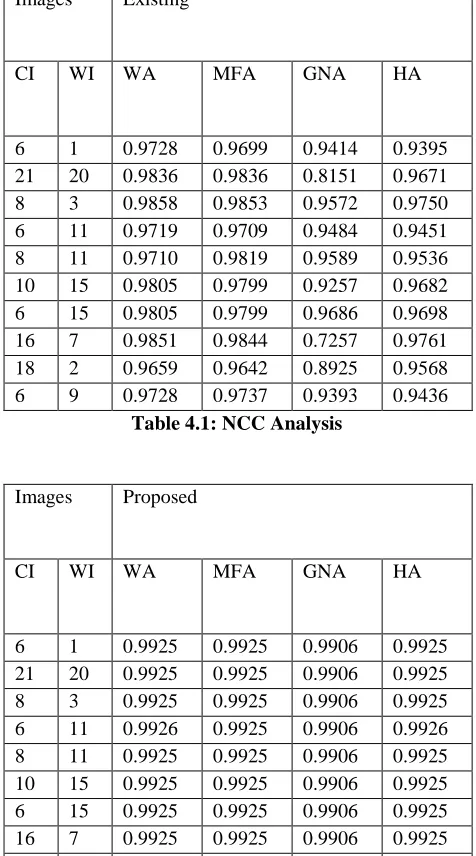
Images Existing
CI WI WA MFA GNA HA
6 1 0.9728 0.9699 0.9414 0.9395
21 20 0.9836 0.9836 0.8151 0.9671
8 3 0.9858 0.9853 0.9572 0.9750
6 11 0.9719 0.9709 0.9484 0.9451
8 11 0.9710 0.9819 0.9589 0.9536
10 15 0.9805 0.9799 0.9257 0.9682
6 15 0.9805 0.9799 0.9686 0.9698
16 7 0.9851 0.9844 0.7257 0.9761
18 2 0.9659 0.9642 0.8925 0.9568
6 9 0.9728 0.9737 0.9393 0.9436
Table 4.1: NCC Analysis
Images Proposed
CI WI WA MFA GNA HA
6 1 0.9925 0.9925 0.9906 0.9925
21 20 0.9925 0.9925 0.9906 0.9925
8 3 0.9925 0.9925 0.9906 0.9925
6 11 0.9926 0.9925 0.9906 0.9926
8 11 0.9925 0.9925 0.9906 0.9925
10 15 0.9925 0.9925 0.9906 0.9925
6 15 0.9925 0.9925 0.9906 0.9925
16 7 0.9925 0.9925 0.9906 0.9925
18 2 0.9925 0.9926 0.9916 0.9925
6 9 0.9925 0.9925 0.9906 0.9925
Table 4.2: NCC Analysis
Graph-4.1: NCC Analysis of previous results and proposed results for different images.
4.2 Peak Signal to Noise Ratio
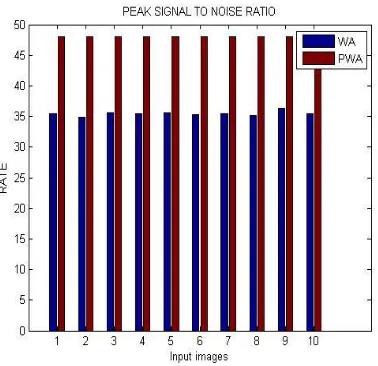
The PSNR is employed to evaluate the difference between an original image and watermarked image. In order to evaluate the transparency of watermarked image, we use parameter peak value signal-to-noise ratio (PSNR). Peak signal-to-noise ratio is defined as the ratio between the maximum possible power of a signal and the power of corrupting noise that affect the reliability of its representation.
Table 4.3 illustrates the comparison of Peak signal-to-noise ratio between existing and proposed method. By using proposed algorithm the value of PSNR becomes improved as compared to previous results.
Table 4.3: Peak signal-to-noise ratio Evaluation
The following graph shows the representation of peak signal to noise ratio between previous and proposed techniques. Blue bar expose the existing method and maroon bar describe the proposed method which are superior as compared to previous ones.
Images Existing Proposed
Cover Image
Watermark Image
WA WA
6 1 35.4553 48.0587
21 20 34.8924 48.0333
8 3 35.6013 48.0479
6 11 35.4553 48.0601
8 11 35.6013 47.9889
10 15 35.3204 48.0323
6 15 35.4553 48.0440
16 7 35.1798 48.0257
18 2 36.2984 48.0491
Graph-4.2: PSNR of previous results and proposed results for different images
4.3 Mean Square Error
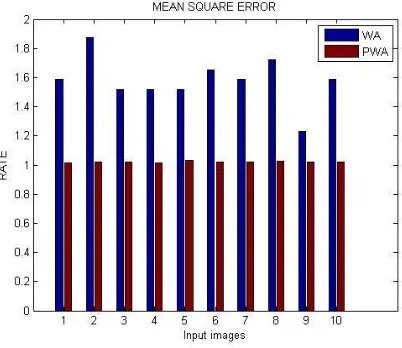
In statistics, the MSE of an estimator measures the average of the squares of the errors that is the difference between the estimator and what is estimated. Table 4.4 illustrates the comparison of Peak signal-to-noise ratio between existing and proposed method. By using proposed algorithm the value of PSNR becomes improved as compared to previous results.
Images Existing Proposed
Cover Image
Watermark Image
Without Attack
Without Attack
6 1 1.5858 1.0167
21 20 1.8771 1.0227
8 3 1.5179 1.0193
6 11 1.5179 1.0164
8 11 1.5179 1.0332
10 15 1.6512 1.0230
6 15 1.5858 1.0202
16 7 1.7222 1.0245
18 2 1.2318 1.0190
6 9 1.5858 1.0183
Table 4.4: Mean Square Error
Graph-4.3: MSE of previous results and proposed results for different images
4.4 Root Mean Square Error
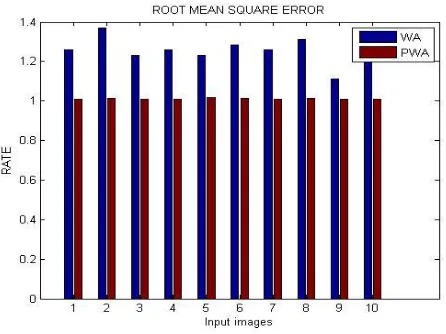
RMSE is a quadratic scoring rule which measures the average magnitude of the error. The RMSE is most useful when large errors are particularly undesirable. Table 4.5 illustrates the comparison of root mean square error ratio between existing and proposed method. By using proposed algorithm the value of RMSE becomes improved as compared to previous results.
Images Existing Proposed
Cover Image
Watermark Image
WA WA
6 1 1.2593 1.0083
21 20 1.3701 1.0113
8 3 1.2320 1.0096
6 11 1.2593 1.0082
8 11 1.2320 1.0165
10 15 1.2850 1.0114
6 15 1.2593 1.0100
16 7 1.3123 1.0122
18 2 1.1099 1.0095
6 9 1.2593 1.0091
Table 4.5: Root Mean Square Error
Graph-4.3: RMSE of previous results and proposed results for different images
4.5: Average Error
Average also called arithmetic mean the result obtained by adding the numbers or quanties in a set and dividing the total by the number of member in the set. Table 4.5 illustrates the comparison of average error between existing and proposed method. By using proposed algorithm the value of average error becomes improved as compared to previous results.
Images Existing Proposed
Cover Image
Watermark Image
Without Attack
Without Attack
6 1 0.0282 0.0120
21 20 0.0287 0.0112
8 3 0.0281 0.0122
6 11 0.0282 0.0120
8 11 0.0281 0.0125
10 15 0.0283 0.0111
6 15 0.0282 0.0120
16 7 0.0284 0.0121
18 2 0.0275 0.0122
6 9 0.0282 0.0126
Table 4.5: Average Error
Graph-4.4: Average error of previous results and proposed results for different images
CONCLUSION
Digital watermarking is a multifaceted technique essentially concerning numerous conflicting necessities and trade-offs thus subsequent in many real-world as well as technical tasks. Digital watermarking using SVD is a rapidly developing arena with heaps of potential in upcoming novel applications, also its present applications in the information security, manufacturing and information hiding areas. A watermark is a recognizable image or pattern in paper that appears as various shades of lightness. Adding a visible watermark is a common way of identifying images and protecting them from unauthorized use online. This paper has proposed a new modified SVD based watermarking to enhance the results further. Various kind of attacks are also applied to evaluate the effectiveness of the proposed technique. The comparison has clearly shown that the proposed technique outperforms over the available methods.
In near future, embedding ++ to enhance the security further. However, further enhancement will also be done by implementing the proposed algorithm in real time environment. Also, some more attack will be considered to evaluate the performance of the proposed algorithm further.
REFERENCES
[1] Zebbiche, Khalil, and Fouad Khelifi, “Efficient wavelet-based perceptual watermark masking for robust fingerprint image watermarking,” IET Image Processing 8, pp.23-32, January 2014.
[2] Zhu, Yong, Xiaohong Yu, and Xiaohuan Liu, “An image authentication technology based on digital watermarking,” IEEE International Conference on Sensor Network Security Technology and Privacy Communication System (SNS & PCS), pp.179-183, May 2013.
[3] Raval, Keta, and S.Zafar, “Digital Watermarking with Copyright Authentication for Image Communication”, IEEE International Conference on Intelligent Systems and Signal Processing (ISSP), pp.111-116, March 2013.
[4] Divecha, Nidhi, and N.N.Jani, “Implementation and performance analysis of DCT-DWT-SVD based watermarking algorithms for color images,” IEEE International Conference on Intelligent Systems and Signal Processing (ISSP), pp.204-208, March 2013.
[5] Hamid Shojanazeri, Wan Azizun Wan Adnan, Sharifah Mumtadzah Syed Ahmad, “Video Watermarking Techniques for Copyright Protection and Content Authentication,” IEEE International Journal of Computer Information Systems and Industrial Management Applications, vol.5, pp. 652–660, 2013.
[6] Qianli, Yang, and Cai Yanhong,“A digital image watermarking algorithm based on discrete wavelet transform and discrete cosine transform,” IEEE International Symposium on Information Technology in Medicine and Education, vol.2, pp.1102-1105, August2012.
[8] Ghosh, Sudip, Pranab Ray, Santi P.Maity, and Hafizur Rahaman, “Spread Spectrum Image Watermarking with Digital Design,” IEEE International Conference on Advance Computing (IACC), pp.868-873, March 2009.
[9] Dorairangaswamy, M.A., and B.Padhmavathi, “An effective blind watermarking scheme for protecting rightful ownership of digital images,” IEEE Region 10 Conference in TENCON, pp.1-6, January 2009.
[10] Harsh K Verma, Abhishek Narain Singh and Raman Kumar, “Robustness of the Digital Image Watermarking Techniques against Brightness and Rotation Attack,”International Journal of Computer Science and Information Security (IJCSIS), 2009. [11] Tiwari, Nirupma, Monika Sharma, Manoj Kumar Ramaiya, and Naveen Hemrajani, “DWT based Self-Embedding watermarking” UACEE International Journal of Advances in Computer Science and its Applications – IJCSIA, Volume 3: Issue 2, [ISSN 2250 – 3765], 05 June 2013.