© 2014, IJCSMC All Rights Reserved 121 Available Online at www.ijcsmc.com
International Journal of Computer Science and Mobile Computing
A Monthly Journal of Computer Science and Information Technology
ISSN 2320–088X
IJCSMC, Vol. 3, Issue. 6, June 2014, pg.121 – 132
RESEARCH ARTICLE
Effect of Human Capital on
Software Development Productivity
Rabia Khan
1, Israr Ahmed
21
Ph.D. Research Scholar, JJTU, Jhunjhunu, Rajasthan, India, [email protected]
2
Jamia Millia Islamia University, [email protected]
ABSTRACT: The term human capital is defined as non-real resource, which increases from social networking and environment. The human capital networking is quite an important term in human community. Human capital is type of an investment not in form of money or physical resources but in form of human relations, which can provide huge returns in software market. In the present paper, we will present our approach on handling the human productivity and human relations in software organizations using the well-known statistical approach of “Structure Equation Modeling” (SEM). The variables that are of hidden nature, and cannot be measured directly i.e. human capital, human productivity and productivity, can be solved using the SEM approach, which can be used to obtain the correlations between them. The whole study was carried out in an industrial environment, so as to get an insight of practical viewpoint about the correlation between hidden and observed variables. To start the analysis, we chose certain critical factors from literature affecting the three hidden variables. In order to make our results more accurate we refined our list of critical factors through the series of group discussion (among software company employees). Finally, after gathering and refining the raw literature data, we applied SEM approach to solve the correlation between different observed and hidden variables. The results indicated good and strong dependence of different observed variables on each of the hidden variables. Also positive correlation was established between different hidden variables. The end conclusion was that the “human capital” understanding is quite important in today’s software industry, for software organization success in the area of software development field.
KEYWORDS: SEM- Structure Equation Modeling, Social Aspects of Software Engineering (SASE), Human Productivity
Human Dynamics:
© 2014, IJCSMC All Rights Reserved 122 interaction with each other. Now days, it is possible to understand the important concepts of the Social Aspects of Software Engineering (SASE) [10] using the definitions covered by the Human Dynamics zone. Also, it is possible to understand the human dynamics concept in the light of SASE. This would help in software organization to facilitate the mutual understanding between different software teams working on same project, and also within organization.
Productivity:
To produce or design any Software there is requirement of the capital, through which the desired outputs are produced at the expense of specified input/inputs depending upon the availability of resources. In order to understand the concept of losses encountered in software development process, it is very important to clear the concept of software productivity, which becomes a very important factor in understanding this economic process of converting inputs/input to output/outputs in software organizations. From the above statement, one can easily conclude that the effectiveness of any production process depends on its productivity. In the literature review, one of the widely used definitions of “software development productivity” is that “It is the ratio between the inputs (e.g. the cost of work/resources) and the outputs (i.e. software output or services) within the production process of software development [7]. There are different means to measure the “software development productivity”, one of such means is “software size” *25]. Apart from “software size”, the “lines of code” could also give good idea about the “software productivity”. Also, it is one of the common measure of complexity of software [17]. Some other measures for measuring the software productivity include function points per hour [20], which is associated more with the user functionality of software, effort measurement [6], etc. If we analyze the different means to measure software development productivity, one can say, it is quite difficult to find out one particular way for calculating software productivity [15]. The type of output in software production process may vary from case to case, therefore as suggested by Scacchi [22] there is need of multi-dimensional analysis of productivity.
The team members of one group in Software Company may expect some profit or gain, while working collectively for one organization in one group. But this gain or profit is not so easy to achieve, and it depends on the level of networking and social connections they have [8]. It was stated by Bourdieu that the term “humanity” is affected by the individual’s knowledge and structure of human thinking [5]. Software Company’s main interest is in increasing the productivity associated with the financial growth and progress. However, software productivity has also a very important social aspect which was referred by Barnett. Generally speaking, both the areas i.e. “financial aspect” and “sociological aspect” of productivity are important for today’s organization firms and companies [1]. It is found that certain sociological factors like individual trust, networks influence, etc. affect the interests of people working in group in software organizations [9]
© 2014, IJCSMC All Rights Reserved 123 motivation level and communication cost in software development process, and hence they also affected the software productivity.
The Value:
The basic purpose of software development is to give good financial returns for the invested capital in the software development process. Boehm [2] claims that many software engineering projects are considered as performed within a value neutral setting.
It is important to give equal weight age to each and every task in software development process, without focusing on the final results. Due to the lack of proper attention on all the software development tasks, the project failure can also result. One of the common software engineering practices is to focus on value creation activities that have financial importance [23]. The financial investors in company are interested in their own profit and goals, which might differ from one investor to another. Therefore, they would focus only on those services or tasks that increase their profit and returns. Also, each financial investor could have a different definition of value, depending upon his interest. The main purpose of any software project is to produce the value more than the value of resources/inputs consumed in software development process, as stated by Halling et al. [12].
In order to obtain good returns from any software project, one should consider software development process as financial activity of investment as suggested by Boehm and Sullivan [3]. The human capital involved in software development projects also affect the financial activity associated with the project tasks. Therefore, the human capital becomes very important factor for analyzing economic aspect of software productivity [24].
Human Capital:
It’s quite important to value the term “human capital”, because from the previous researches it’s crystal clear that the social and official relations which result from the human interactions in organization and social environment affects the growth of an organization or social structure. Understanding and measuring human capital is a challenging process; evidence suggests that quality of social and organizational relations based on several individuals interaction affects the sustainability of any social structure.
One of the widely used definitions of capital is given according to Marx [21], that it is the “excess surplus value left behind after using the capital in necessary tasks”. This value is usually owned by the people controlling the production process. Captured by individuals who control the production processes [21]. Capital is also one of the purposes of investment in business, so to gain profit from it. It is a kind of activity of investment of the resources so as to gain profit. It had been observed from the past experiences, that gradually by gaining the knowledge and experience, laborers rise to the level of capitalists [24]. Human capital theory relies on the fact that laborers become capitalists by accumulation of knowledge and skills and therefore, human experiences are embedded inside the notion of capital [24].
Now days the human capital networking is quite an important term. It may include the opportunities that an employee's network can provide. Human capital is type of an investment not in form of money or physical resources but in form of human relations, which can provide huge returns in software market, Lin defines human capital as investment of social relations with expected returns in the market place [19].
© 2014, IJCSMC All Rights Reserved 124 of economic capital, which is in terms of money and actual physical resources. Bourdieu claims that the value of human capital, which is based on human connections, should easily be convertible to economic form of capital. The above mentioned definition of human capital is general one.
Human capital can also be defined as group or collective working of individual’s in organization for common purpose as stated by Fukuyama, who defined the human capital as the ability of people to work together for common purposes in groups and organizations" [11]. Later, in his works, he considered the term as an intangible value obtained from social groups that promotes collective outcomes. There are different factors like trust, honesty, etc. which are found to effect the human capital.
In our present work, we defined the human capital term as variable like productivity and human productivity, which is affected by many factors mostly associated with human connections and skills of employees/people and found to affect the economic capital of Software Company. Human capital is a multi-dimensional hidden construct, which usually is found in the potential form of intangible resources, based on patterns of human connection and social skills of individuals, teams or social groups who have the ability to contribute to the economic progress of an organization. The software productivity is affected by the human capital, i.e. higher the human capital level obtained from organization people, the higher will be the software productivity of final software product. The higher level of human capital attainable by employees of a software development organization should help to improve the productiveness of teams and individuals in a software company. Improving the people’s networking ability and human connections is found to have significant improvement in software productivity inside different software firms, in present day modern era. Aligned with the improvement efforts, this can be considered as one of the actual benefits of human capital obtained from networks of relations. Exploring and implementing team based social improvements will help us to improve structural and organizational stability. Therefore, human capital enables us to constitute more cohesive information exchange networks, which may have a positive effect on the productivity of a software team.
Human Productivity:
The productivity main focus is related to economic growth and progress, but it has also a very important social aspect. For many researchers, productivity comprises the economic concept; however it also has a sociological aspect which was highlighted by Barnett. The productivity effect on economy is definitely one of the most important area that researchers focus on, but also sociological concept of productivity is very important for today’s organization firms and companies [1]. The economic concept of productivity is undeniably important in explaining the material wealth of groups. Personal observation suggests that understanding organized groups including business firms-requires a sociological concept of productivity. [1]
Every human being has to depend on other for his/her needs, and that is the main reason that humans prefer to live in social groups, communicating and interlinking with each other for daily needs. This means they usually depend on others and prefer to live in interacting groups (or socialites) where they influence one another. It is general tendency of common human being of being highly interested in creating new societies and enhancing the results of the group they are associated with. In fact, they continue to be increasingly interested in establishing a society and improving social outputs of their organized groups. As a result of it, humans can yield more output while working in group with other individuals.
© 2014, IJCSMC All Rights Reserved 125 share the knowledge with each other, so that they can transfer this knowledge to their future generations, which would help in growth and well fare of the society.
Moreover, Barnett stated that the term human productivity emerges as a result of individual’s interaction in team which also result in some form of output affecting the team performance, when a team or group of people interact and create social interactions and outcomes, which certainly affects the functioning of teams [1]. It should also portray the actions and reactions of a social organization. One of the outputs of activities of social group is the human productivity as stated by Barnett. In addition to that, he also describes human productivity as an outcome, which can be provided from a human group activity.
In software companies the development comprises of different social teams co-working so as to yield the desired output (for e.g. new software, development of code, etc.) in an allocated time period. The people working in teams are interacting with each other in close proximity. In this case human productivity can give us the idea of level of communication or interaction people are having in their respective teams.
As previously mentioned, software development is considered as a social activity where people should be working in close proximity. Therefore, the notion of human productivity should measure the level of this interaction. From the economic point of view, interests of people working in group are directed, developed from the certain factors like individual trust, networks influence, etc. [9]. The actions in the group or team are based on human values, communication, interactions, etc. among group members of the team. To understand the complex structure of society in which we are living it’s very important to understand the importance of human productivity. Therefore, human productivity is an important component to understand complex structure of society. The factors or variables defined here are basically the constituents of human capital, as well the output (features) associated with the term human productivity [1]. In order to get the idea about influence of social issues in software company, we need to study several important social variables like society life, trust, etc. To understand the impact of social issues in software organization, we investigate the level of importance of several human factors such as trust, communication, social life, and information awareness. Human productivity should be materialized by several social factors where its relationship with the human capital should also be investigated. Therefore, it’s important to know the correlation between human productivity and human capital. One should not be confused between human capital and human productivity. For more clarification, we re-define the human productivity of software process as: human productivity deals with the influence of human factors (e.g. trust, communication, etc.) on the socio-economic picture of the software development process i.e. human productivity is type of productivity resulting from transforming given human capital (resource) into output (i.e. human productivity).
Research Methodology:
© 2014, IJCSMC All Rights Reserved 126 factors. Based, on that, we modified our list of critical factors again, so as to get the refine list of human capital, human productivity and productivity factors. Lastly, after obtaining the final refined list, we carried out the analysis using the Structural Equation Modeling (SEM) approach through the LISREL Software. The entire modeling using the SEM technique was done in well-known LISREL [16] software, widely used in different industries for Structure equation modeling.
The Systematic Approach:
In this section we will discuss about our basic research approach in a step by step fashion as mentioned below:
Firstly, after reviewing the literature data from available resources, we concluded that there exists a positive correlation between the software development productivity and human factors like human productivity, human capital affecting it. Secondly, after careful selection of critical factors affecting the productivity, human productivity and human capital, we conducted group discussions among company employees so as to refine our list of factors based on industrial viewpoint.
Thirdly, we analyzed the correlation between productivity and human factors i.e. human productivity and human capital using the structural equation modeling approach in LISREL software.
Finally, after obtaining the correlation values from previous step, we made some important conclusions about the effect of human factors on productivity.
The Measurement Model:
In order to build the structural equation model, we need to first define two types of variables i.e. hidden variable (which cannot be measured directly i.e. productivity, human productivity and human capital), and observed variables like different socio-economic factors affecting the above mentioned three hidden variables. In the first step we selected productivity and human productivity as hidden variable for applying the SEM approach. As mentioned before also, after the selection of critical factors affecting the two hidden variables mentioned above, the list of factors was refined through the series of group discussion among the company employees. Apart from participation of normal company employees in the group discussion, few of the higher management personal were also involved in it. The discussion continued for around two and half hours in one of the meeting rooms of company.
The group session was started with an introduction speech to raise the morale of participants about the topic and its importance as mentioned by Krueger [18]. One person was assigned the task of writing notes, while we started asking company’s management team about the productivity related factors importance. A Handbook containing few questions about productivity was given to each of the participant. The questions were as follows:
(1) How do you define productivity in software teams?, (2) Which factors affect the software productivity most in your opinion , (3) Among the factors mentioned in answer of Ques. 2, which is the most important factor , (4)
What do you know about human factors of productivity and (5) Could you name few of the important human factors affecting the productivity?
© 2014, IJCSMC All Rights Reserved 127 Through the literature review and conducting company personal interview, we choose most important factors for measuring the productivity as (i) Technology, (ii) Working culture, (iii) Interest in individual Job, (iv) Complexity, and (v) Team Size. For analyzing the human productivity we chose four widely used observed variables (i) Manager skills, (ii) Team Unity, (iii) Social Life and (iv) Meetings frequency. Finally for the human capital we selected some critical factors as (i) Success characteristics, (ii) Rules, and (iii) trust. After the careful selection of important factors affecting the human capital, the correlation between the human capital, human productivity and productivity was established using the Structure equation modeling approach. The result showed existence of positive correlation among each of these hidden variables. Also, the good fit of data was obtained for different cases of statistical tests.
Productivity Factors as Structural Relations:
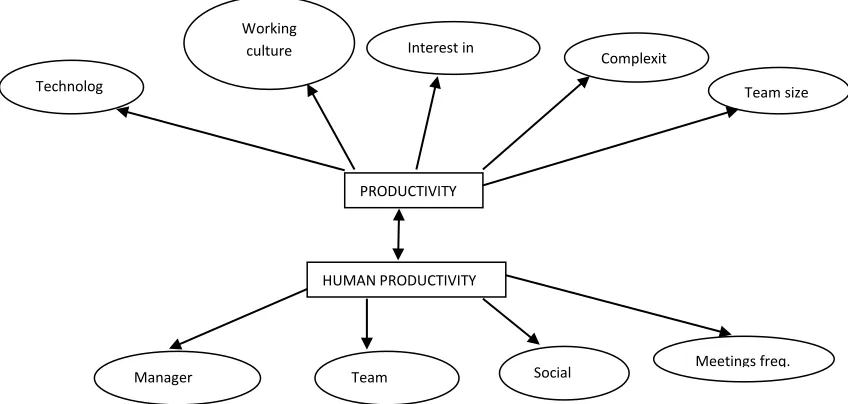
Our first model was based on the fact that both the productivity and human productivity are correlated to each other and can be measured through a set of critical factors mentioned in literature.
The model can be represented as shown in Fig. 1, based on the SEM approach using a set of certain identified factors from literature. As shown in Fig. 1, the hidden variables are represented by rectangular boxes while observed variables are shown by circles. The relationship between different observed and hidden variables is represented by lines connecting the variables. We expressed the human productivity and productivity as hidden variables which are dependent on four and five critical factors as shown in Fig. 1. For the calculation and analysis work using the SEM approach, we used the LISREL software. This software is widely used in different industries to solve multiple equations using the Structural Equation Modeling technique [16]. The raw data was gathered from the answers of potential questionnaire prepared for medium sized software company employees. Total of 210 participants from different teams inside Software Company, participated in the survey questionnaire.
In order to carry out our analysis, the first step was building an empirical model as shown in Fig. 1. After that the relationships and correlation among different variables are evaluated. Next step is to solve the model, using the SEM technique and statistical approach, and try to find the case of “Good fit” for the Structural Equation Model. It has been observed by many researchers, that the “chi-square” test is one of the best fit indices that show how good model fits with the data. In literature, one can find many such indices for determining the data fit on specific model, however “chi-square” is one of the popular one. The “chi-square” test is based on the idea of independence model, which states that variables among the relationships are uncorrelated. Thus more deviation is expected between actual data and model, for case of high “chi-square”. Apart from “chi-square” test, some other well known “fit indices” widely used in statistics are root mean square error of approximation (RMSEA based on degrees of freedom), normed fit index (NFI), Goodness of Fit Index (GFI, a measure to fit model and covariance matrix), adjusted goodness of fit index (AGFI), and comparative fit index (CFI). Generally in case of RMSEA one can expect reasonable data fit when RMSEA value is below 0.075, while for GFI and CFI, value above .85 should be acceptable.
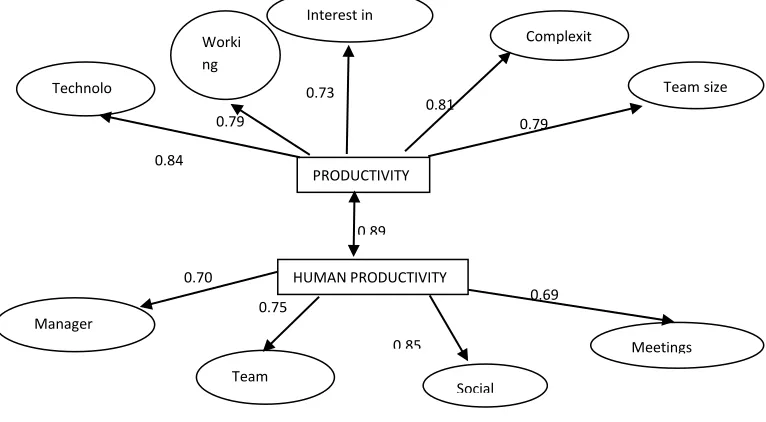
© 2014, IJCSMC All Rights Reserved 128 The conclusion drawn from Fig. 2 is that the factor of “Technology” has the highest impact on productivity, as compared to other critical factors. Similarly “Social Life” has the strongest correlation with “Human productivity” with factor value of 0.85”. Therefore, software organizations should focus more on affecting the social life of their company employees, so as to increase the individual productivity, which in turn will increase the software development productivity, because both the hidden variables are bivariate correlated as shown in Fig. 2 After building the empirical model for human productivity, under the same guidelines we developed human capital model which constituted the human capital and productivity as hidden variables as shown in Fig. 3. The three main observed variables for human capital were i) Trust ii) Success characteristics iii) Rules. For this case, the good fit of data was obtained at λ2(21, N = 210) = 47.36, p <.001), RMSEA = .086, GFI = .97, AGFI = .92, CFI = .97, NFI = .97). The factor values of observed variables for human capital were .90, .46, .75, p < .001.
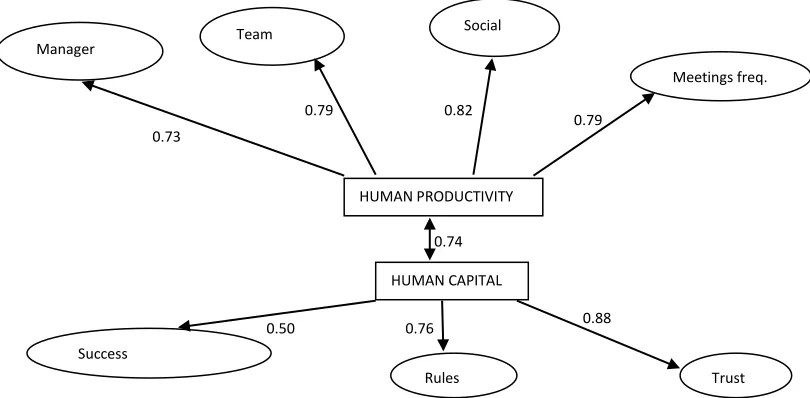
The previous two empirical models suggest that the human capital has good correlation with the software development productivity. Now, our next focus is to find the correlation between human productivity and human capital using the SEM Technique (Fig. 4). For this case, as shown in Fig. 4, both the human capital and human productivity are hidden variables, affected by certain observed variables. The structural equation model showed good data fit for the case λ2(21, N = 210) = 12.57, p< .001), GFI = .95, AGFI = .94, CFI = .98, NFI= .98). Also it can be observed from the path diagram (Fig. 4), that there is strong correlation between the human productivity and human capital.
Figure 1. Empirical model for human productivity and productivity
The model indicates that the factor of “Trust” (with factor value of 0.88) in human life affects the most of “Human capital”. The other factors like “Rules” and “Success characteristics” are not so dominant. . On the other hand human productivity is affected mostly by “Social Life” (factor value of 0.82).
HUMAN PRODUCTIVITY Technolog
y
Working
culture Interest in
Job Complexit
y
Team size
PRODUCTIVITY
Manager skills
Team unity
Social Life
© 2014, IJCSMC All Rights Reserved 129
Figure 2. Structural equation model for productivity and human productivity
Figure 3. SEM for Human capital and Productivity
Technolog y
Workin g cuture
Interest in Job
Complexit y
Team size
PRODUCTIVITY
HUMAN CAPITAL
Trust Rules
Success Characteristics
0.84
0.80
0.73 0.80
0.79
0.90 0.75
0.46
0.85 0.89 0.84
0.81
0.79
0.70
0.85
0.69 0.73
0.79
0.75
PRODUCTIVITY
Social
Team size
HUMAN PRODUCTIVITY
Manager skills
Team unity
Meetings Interest in
Job Complexit
y Technolo
gy
© 2014, IJCSMC All Rights Reserved 130 Figure 4. Empirical model between human capital and human productivity in software organization
RESEARCH LIMITATIONS:
There are some limitation’s associated with our research work, specially related to the time considerations. At the first, we carried out our study for only one industrial case. If we would have extended our research for few different sizes (i.e. small, large, etc.) of software companies, it would be much more beneficial to reach at some strong conclusion.
Secondly, the raw data refinement about the different observed variables was based on group discussion between certain numbers of employees. The results would have been improved by involving more experienced higher management personal in group discussion. Also, a better criterion was to involve more people from different fields and industries into the group discussion.
CONCLUSION:
The importance of term “software productivity” lies in both the economic and sociological fields. In our present research work, we defined several definitions and concepts related to the human capital and productivity, which in turn can affect the software development productivity adversely in software organizations. We selected several different factors, from the literature review, and then refined it through the group discussions between software company employees. This gave us the opportunity to focus only on certain critical factors affecting the software development productivity, in software organizations. We developed three Structural Equation Models to solve the correlation between human productivity, human capital and software development productivity.
After the SEM analysis was completed, the role of critical factors in software organization are analyzed and discussed with the higher authority company personnel, to implement the strategies for controlling such critical factors that affect the software productivity most. The results obtained from the SEM analysis, clearly indicated the strong dependency between the three hidden variables i.e. human capital, human productivity and productivity. Now, this correlation (between software productivity, human productivity and human capital) is quite
HUMAN PRODUCTIVITY Manager
skills
Team unity
Social Life
Meetings freq.
0.73
0.79 0.82
0.79
HUMAN CAPITAL
Success
Characteristics Rules Trust
0.88 0.76
0.50
© 2014, IJCSMC All Rights Reserved 131 useful in practical situations, because most of the software development tasks are assigned to different teams inside organization. And each team constitutes different members. Studying the nature, behavior of each team member becomes a vital factor, in order to enhance the team member productivity, which will in turn enhance the software development productivity also. Human factors like communication skills, trust, etc. play very critical role in such situations. Our analysis could be used as preliminary approach for solving situations related to productivity development in software industries. For future work, our planning is to consider the effect of size of software companies i.e. medium, small and big on the factors affecting productivity, and study their correlation in detail.
REFERENCES:
[1] Barnett, L.: Social Productivity, Law, and the Regulation of Conflicts of Interest in
the Investment Industry," Cardozo Public Law, Policy and Ethics Journal, vol. 3, pp. 793,
2004
[2] Boehm, B.: Value-based software engineering: Reinventing. SIGSOFT Software
Engineering Notes, 28(2), 3, 2003
[3] Boehm, B., & Sullivan, K. J.: Software economics: A roadmap. In Proceedings of the
Conference on the Future of Software Engineering, Limerick, Ireland, pp. 319-343, 2000
[4] Bourdieu, P: The forms of capital," Handbook of Theory and Research for the
Sociology of Education, vol. 241, pp. 241-258, 1986
[5] Bourdieu, P. and Wacquant, L.: An invitation to reexive sociology. University of
Chicago Press, 1992
[6] Bundschuh, M. and Dekkers, C.: The IT measurement compendium: estimating and
benchmarking success with functional size measurement, Springer, 2008
[7] Chemuturi, M.: Software Estimation Best Practices, Tools & Techniques: A Complete
Guide for Software Project Estimators. J. Ross Publishing, 2009
[8] Christakis, N. and Fowler, J.: Connected: The surprising power of our social networks
and how they shape our lives. Little, Brown and Company, 2009
[9] Coleman, J.: Social capital in the creation of human capital, The American Journal of
Sociology, vol. 94, no. 1, pp. 95-120, 1988
[10] Dittrich, Y., Floyd, C., & Klischewski, R.: Social thinking-software practice.
Cambridge, MA: MIT Press, 2002
[11] Fukuyama, F., Trust: The social virtues and the creation of prosperity. Free Pr, 1996
[12] Halling, M., Biffl, S., & Grunbacher, P.: The role of valuation in value-based
software engineering. In Proceedings of the 6th International Workshop on
Economics-Driven Software Engineering Research, pp. 7-10, 2004
[13] Hamid, T.K.A., Madnick, S.: Lessons learned from modeling the dynamics of
software development. Commun. ACM 32, pp. 1426–1438, 1989
[14] Homans, G.: Social behavior as exchange," American journal of sociology, vol. 63,
no. 6, pp. 597-606, 1958
[15] Jones, C.: Software Engineering Best Practices: Lessons from Successful Projects in
the Top Companies, McGraw-Hill Osborne Media, 2009
[16] Joreskog, K., Sorbom, D.: LISREL 8: Users reference guide. Lincolnwood, IL:
Scientific Software International. Inc, 2001
© 2014, IJCSMC All Rights Reserved 132