© 2014, IJCSMC All Rights Reserved 239 Available Online atwww.ijcsmc.com
International Journal of Computer Science and Mobile Computing
A Monthly Journal of Computer Science and Information Technology
ISSN 2320–088X
IJCSMC, Vol. 3, Issue. 6, June 2014, pg.239 – 246
RESEARCH ARTICLE
A Comparison of Performance Metrics for
Various Routing Protocols in MANET
Hemant Rai
M.Tech (Computer Science) Student, Galgotias University, India
Abstract – MANET (Mobile Ad Hoc Network) is an independent set of mobile users that
communicate through wireless connections. The network topology of MANET changes rapidly
over time. Since the nodes are mobile therefore Packet delivery ratio, energy consumption,
Delay is an important constraint of Mobile Ad-Hoc Network (MANET). Routing for MANET
is the keys where we can save some energy and decrease delays. This paper however presents a
comparison of performance metrics for DSDV, AODV, ZRP routing protocol for MANET.
Keywords – MANET, Routing Protocols, AODV, DSDV, ZRP
I.
INTRODUCTION
Wireless technology has been one of the vibrant areas these days. It is technique to transmit or
exchange the information over the two or more devices in the network. With the wireless network
users can communicate with the current network and are then made free to move into the
coverage area of the network. There are two kinds of wireless network first is infrastructure and
the other one is an Ad-hoc network. In the infrastructure network all nodes communicate to the
base station that provides internodes routing and connectivity with fixed network. So far all nodes
© 2014, IJCSMC All Rights Reserved 240
responsibility of base station for coordinating access to one or more than one channel for mobiles
located within their transmission range.
For ad-hoc network, all nodes communicate with other nodes directly or via intermediate
nodes that circulate its packets because of the transmission power limit. Each node is participating
as a router in computing and maintaining the routes. The explicit advantages of ad-hoc network
are cheaper and convenience because there is no base station or fixed infrastructure of network is
needed. At the places where pre-deployment of infrastructure is difficult to set or even
unacceptable, an ad-hoc network is very useful.
To communicate over fairly slow wireless networks, a MANET is created. Moreover it is used in
the communication of unbounded (mobile) users. Mobile Nodes may vary rapidly and unpredictably
overtime on a topographic network. The network lacks a specific central node that could execute the
functions like topology discovery and message delivery, and hence these acts along with the routing
functionalities are carried out by the nodes themselves.
It is a collection of moving nodes that are independent can communicate to each other
through waves. The moving nodes communicate to each node that is in the range of the network,
now those nodes want to help of intermediate nodes to transmit their information. These type of
networks are infrastructure less and they can work at any place because of these networks are
totally distributed.
II.
CLASSIFICATION OF ROUTING PROTOL
Routing Protocols can be further classified into three sub-categories:
1.
Proactive Routing Protocol
2.
Reactive Routing Protocol
3.
Hybrid Routing Protocol
1.
Proactive routing protocol
:
These routing protocol also known as Table-Driven Routing protocol. In proactive routing
protocol, each node maintains routing tables that contains the latest information of the routes to its
neighbor node in the network. Each node has the next hop for reaching to a node and the cost of this
route. The Two types of table update in proactive protocols are the periodic update and triggered update.
In periodic updates, nodes periodically broadcast its tables in network. Each node just arriving in the
network receives that table. Whenever a node finds a change in its neighbors, a table is broadcasted,
© 2014, IJCSMC All Rights Reserved 241
lot of sub-categories of which Destination-Sequenced Distance-Vector (DSDV) and Wireless Routing
Protocol (WRP) are the major ones.
Destination-Sequenced Distance-Vector Routing (DSDV)
:Destination-Sequenced Distance-Vector Routing (DSDV) is a table-driven routing protocol
based on the Bellman-Ford algorithm in ad hoc networks. In DSDV, Every mobile node maintains a
routing table that stores for all reachable destinations the next-hop and number of hops to reach that
destination, and the sequence number assigned by the destination. There are two types of next-hop table
exchanges: full dump or incremental update.
Full dump carries the entire table with all available routing information and this is suitable for
fast changing networks. Incremental dump carries only the updated first appearances since last dump,
which must fit in a packet and is suitable when the network is stable.
DSDV possesses routes available to all destinations at all times, which implies a much less
delay time in the route setup process. The use of sequence number distinguishes stale routes from new
ones, where routes with higher sequence numbers are favorable. Some of the key advantages of DSDV
protocol are that it leads to complete elimination of route looping, it also brings about an increase in the
convergence speed. It also makes sure that there is a reduction in the control message overhead.
2.
Reactive routing protocols
:
On-demand protocol is another name for reactive protocols. As per the latest route topology,
route tables are not maintained or updated in a constant manner. A route discovery process is initiated
only in the case of requirement of a path to the final node. The route maintenance procedure keeps a track
of the established route, till no further routes are possible. Ad hoc on-demand Distance Vector (AODV)
and Dynamic Source Routing (DSR) are some examples of on demand routing protocols.
Ad-hoc on demand Distance Vector (AODV):
AODV is ad hoc on demand distance vector routing. It is reactive routing protocol. It is
extended version of DSDV. The AODV routing protocol is developed for Mobile ad hoc network. It is
capable to handle unicast and multicast routing. It is working only on demand. AODV Routing works by
using Route Request Message (RREQ) and Route Reply Message (RREP). Routing in AODV is carried
out by the process of Route Discovery and Route Maintenance.
When a node wants to transmit a packet to some destination node, it looks into its route table to
see whether it delivers a path to the destination node. If it behaves, it forwards the packet to the next hop
© 2014, IJCSMC All Rights Reserved 242
must initiate a path discovery process. The source node creates a route request (RREQ) packet that holds
the source node's IP address, current sequence number, destination's IP address and last known sequence
number. The RREQ also holds a broadcast ID and this is increased every time the source node initiates a
RREQ. Therefore, the broadcast ID and the source IP address uniquely identify a route request. Once
The RREQ is created, the node sends this packet and puts a timer to wait for a response.
When a node receives a RREQ, it first checks whether it has identified it before observing the
source IP address and broadcast ID pair. If it has already identified a RREQ with the same source IP
address and broadcast ID, it removes the packet. Otherwise, it records this information and processes the
packet. A reverse route entry is set up for the source node in the route table by the current node. Using
this Reverse Route Entry, the IP address for the source node and IP address for the neighbor (from
which the RREQ was received) could be obtained. Also for a particular timeout period, the route entry is
not taken into consideration.
The receiver node acknowledges the Respond Route Reply packet, back to the source. If the
receiver node is not the destination node, it increments the RREQ’s hop counter by one and re-sends it to
all of its neighbors. If at any stage the RREQ is misplaced, a re-initiation of the route discovery is done
by the initial/source node. And once the route is discovered between the source and the destination, a
track of it is maintained till the time it is required by the source node.
3.
Hybrid Routing Protocols
:Hybrid routing protocols combine both the proactive and reactive routing protocols. As the
number of nodes increases, hybrid reactive/proactive protocols are applied to attain higher performance.
The core concept behind the Hybrid Protocols is that it aims at combining the benefits of purely
proactive and reactive protocols.
It is used for the large number of nodes. Examples of hybrid routing protocols is Zone Routing
Protocol (ZRP).
Zone Routing Protocol (ZRP):
ZRP exploits the characteristics of both proactive and reactive protocol. For routing across the
network, the reactive part of the protocol is used. This is where it is different from the proactive part,
which has its existence limited to a relatively smaller area of the node. So this implementation is
advantageous because it results in latency reduction. It also brings about depreciation in the number of
control messages as well.
We use two procedures in ZRP routing protocol. These are Intra-zone routing protocol (IARP)
© 2014, IJCSMC All Rights Reserved 243
zones and IERP is a reactive approach and it is used between routing zones. The zone routing protocol
(ZRP) provides a framework for additional process. The size of the zone is Depending on the strength of
the signal and power which is accessible node consistency etc.
III.
SIMULATION ENVIRONMENT
Simulation Parameter:
Scenario Setup
Value
Routing Protocol
DSDV, AODV, ZRP
Channel
Wireless Channel
Propagation model
Two ray ground
Network area
1000X1000
No. of nodes
50
Simulation time
200 sec
Packet size
512 bytes
Zone radius
1
IV.
PERFORMANCE METRIC
1. Packet delivery ratio.
2. Energy consumption.
3. End to end delay.
Packet Delivery Ratio:
This is ratio of total number of packets successfully received by destination node to the number of
packets sent the source node.
PDR = Number of packets received by destination
Number of packet sent by source
Energy Consumption:
It is the ration of total network energy consumption to the number of data packet successfully
© 2014, IJCSMC All Rights Reserved 244
End To End Delay:
The average time taken by a data packet to reach the destination. End to end delay can also be
defined mathematically as the ratio of the time lapse/interval between the initial/starting and the following
packet to the overall packet delivery.
V.
SIMULATION RESULT
We assume the scenario for MANET to implementation on NS-2.35. Performance metrics used in
this paper are Packet delivery ratio, energy consumption and average delay for different routing protocols.
At last we compare the results of routing protocol.
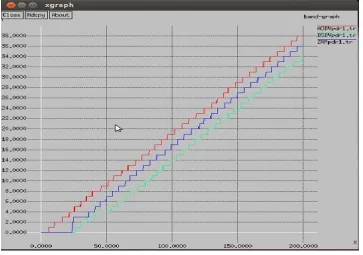
Fig 1: Packet Delivery Ratio
Fig 1 shows the result of packet delivery ratio of different routing protocol and comparison for
DSDV, AODV, ZRP respectively using 50 nodes. Fig 1 shows the comparison that AODV is better than
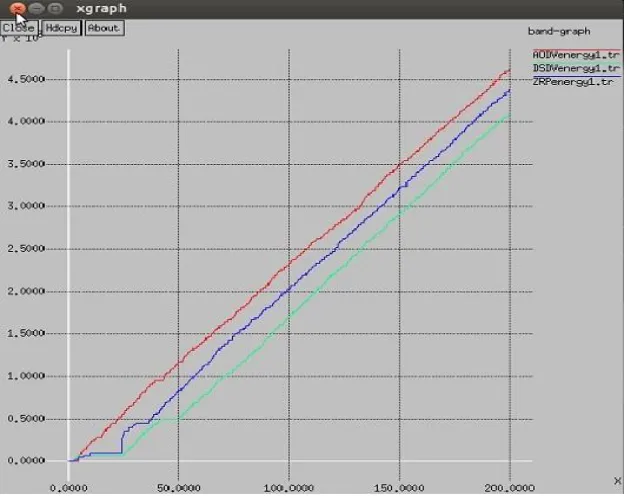
© 2014, IJCSMC All Rights Reserved 245 Fig 2: Energy Level of Different Routing Protocol
Fig 3: Average End-to-End Delay
Fig 3 shows the comparison of end to end delay for DSDV, AODV and ZRP using 50 nodes. In
this figure average delay in DSDV, AODV and ZRP respectively and AODV is better than to other
© 2014, IJCSMC All Rights Reserved 246
VI.
CONCLUSION
In this paper we analyzed different routing protocol for MANET in terms of energy consumption,
packet delivery ratio and average delay between sources to destination using 50 nodes. Comparison
shows in the above figures.
References:
1.
Swati Bhasin, Ankur Gupta, Puneet Mehta, “Comparison of AODV, OLSR and ZRP Protocols inMobile Ad-hoc Network on the basis of Jitter” International Journal of Applied Engineering
Research, ISSN 0973-4562 Vol.7 No.11, 2012.
2.
P.S. Karadge, Dr. S. V. Sankpal, “A Performance Comparison of Energy Efficient
AODV Protocol in Mobile Ad hoc Networks” International Journal of Advanced Research in
Computer and Communication Engineering Vol. 2, Issue 1, January 2013.
3.
M.Shobhna and Dr. S. Karthik, “A Performance Analysis and Compression of various Protocolsin MANET”, International Conference on Pattern Recognition and Informatics and Mobile
Engineering, 2013.
4.
Das Prashanta Kumar, Robin Singh Bhadoria, “Comparative Study of Proactive Protocol ofMobile Ad-Hoc Network”, International Conference on Communication System and Network
Technologies, 2013.
5.
C. E. Perkins, “Ad Hoc Networking”, Addison Wesley, 2000.6.
C.K. Toh, “Ad Hoc Mobile Wireless Networks: Protocols and Systems”, Prentice Hall, 2002.7.
Anurag Malik, Shivanshu Rastogi, Sajendra Kumar, “Performance Analysis of routing protocol inMobile Ad Hoc Network using NS-2” MIT International Journal of Computer Science &
Information Technology Vol. 1 No. 1 Jan 2011 pp 47-50.
8.
Zishan Haider Y. Noorani, “Performance Analysis of DSDV, AODV and ZRP Routing Protocolof MANET and Enhancement in ZRP to Improve its Throughput”, International Journal of