© 2018, IJCSMC All Rights Reserved 124 Available Online at www.ijcsmc.com
International Journal of Computer Science and Mobile Computing
A Monthly Journal of Computer Science and Information Technology
ISSN 2320–088X
IMPACT FACTOR: 6.017IJCSMC, Vol. 7, Issue. 2, February 2018, pg.124 – 130
A Novel Technique to Decrease BER using
Waterfill Algorithm in OFDM-MIMO
Navpreet Kaur
1, Satinder Kaur
2Assistant Professors12, Department of Computer Science, Baba Farid College, Bathinda
[email protected], [email protected]
Abstract: Orthogonal frequency division multiplexing has lot of helpful properties over the single-carrier modulation framework; a wireless communication. Existing research is entirely focused on increasing the quantity of transmitter & receiver antennas in MIMO system. They have not analyzed the data and symbol rate in the MIMO-OFDM diversity with Modulation technique. It's may be the foremost spectrally economical technique discovered thus far, & it allays various drawback of multipath propagation that origins large errors in data& signal loss within microwave & ultrahigh frequency range. To overcome this issue, Waterfill algorithm has been discussed. It is analyzed that with increase of antennas at transmitter & Receiver sides both, BER is decrease.
Keywords: BER; OFDM; MIMO; 5G Technology; water fill algorithm
I. INTRODUCTION
© 2018, IJCSMC All Rights Reserved 125
ultrahigh frequency spectrum [10]. OFDM relies on the idea of multiplexing technique that is frequency-division multiplexing. Signals are produced so that they are orthogonal to at least one another, thus creating very tiny or not at all intrusion to at least one another. In additional sensible relations, it implies that if you space subcarriers from each other by any quantity identical to reciprocal of data signals symbol period, consequential signal frequency response curve is such that primary nulls happen at subcarrier frequencies on contiguous networks. Orthogonal subcarriers all have an integer cycles within symbol period [13]. Here with preparation, modulation on single channel won’t yield inter symbol interference in neighboring channels. OFDM can be viewed as either a modulation approach or a multiplex approach [14].
Orthogonal frequency division multiplexing has lot of helpful properties over the single-carrier modulation framework; a wireless communication. Existing research is entirely focused on increasing the quantity of transmitter & receiver antennas in MIMO framework. They have not analyzed the data and symbol rate in the MIMO-OFDM diversity with Modulation technique. Also the deployment of the 5g technology is the biggest challenge over here. It suffers with beam forming and beam tracking.
II. RELATED WORK
Shreedhar et al 2011,[5] proposed that by using appropriate Space Time Coding techniques on MIMO channels. These STBC methods are executed in MATLAB & analyzed for output according to their bit-error rates utilizing BPSK, QPSK, 16-QAM, and 64-QAM modulation scheme. Shruti Trivedi et al. 2012 [6] presented the analysis of BER utilizing BPSK modulation & after that optimum modulation is examined. Numerous transmit & receive can be utilized to frame numerous channels to expand the capacity and information rate. In MIMO framework identical data can be conveyed and expected from numerous antennas at the same time following the fading for each link between a couple of transmit and receive antennas can usually be thought to be independent, the probability that the data is identified precisely is higher. Hichan Moon et al.2011[7] presented that water filling power distribution schemes for general fading distributions touches point wise to functions in which control allocated to each non-zero network gains is fixed as the SNR technique towards endlessness. Here convergence quickness for above scheme is also investigated. Osama M. Haraz et al. 2016 [8] describes 3-aspect single-band printed inverted Fantenna (PIFA) process running in 28 GHz band for future mm Wave 5G wireless communications is offered. MIMO antenna framework of 3 single-band PIFA antenna factors. Dimensions of a solitary PIFA antenna element is at 28 GHz. Antenna array displays decent isolation traits among carefully spread out antenna factors. Minimal isolation of 13 dB is located among its antenna essentials. Output exhibit that planned antenna has 807 MHz bandwidth. Different principal constraints in any WC method akin to ECC, DG, MEG, and ME, were intended& deliberated. Outcome exhibit that projected antenna array is an effective applicant for long run 5G MIMO conversation requests.
III. PROPOSED METHODOLOGY
In this research work, we are working on the issue of Diversity of modulation technique. For the simulation purpose, MATLAB tool has been used.
A. Waterfill Algorithm:
Water filling is a similitude for arrangement of numerous advancement issues identified with channel limit. In Water filling strategy force for spatial channels are balanced taking into account channels pick up. Channel which has high signal to noise proportion and gain up is allocated much energy. This energy boosts whole of information rates in all small channels [11]. Information rate in every small channel is identified with force allotment by Shannon's Gaussian limit equation
© 2018, IJCSMC All Rights Reserved 126
Availability of a MIMO framework is equivalent to arithmetical aggregate of limits of all channels scientifically it can be composed as:
∑
Fig.3.1 Flowchart of Proposed Work
© 2018, IJCSMC All Rights Reserved 127 Fig.3.2: proposed Water Filling Model
IV. RESULTS AND DISCUSSIONS This unit deliberates outcomes of Waterfill algorithm.
Total quantity on liquid bursting is comparative to SNR ratio of channel.
Power assigned by each network is given by Eq. 1, as exposed in below method
∑∑
In which Pt is power budget of MIMO framework which is assigned among diverse channels & H is network matrix of framework. MIMO framework capacity is algebraic addition of each channel capacities and is assumed by method underneath.
∑
User have to exploit overall bits quantity to be transport, Output displays that planned water-filling power division approach. As per approach succeeding stages are surveyed to perform planned water filling algorithm.
Steps for Algorithm:-
1. User do not require reordering MIMO-OFDM subcategories network gain realization in a downward manner 2. Gross opposite of network gains.
3. Water filling doesn’t non-uniform step structure because reverse of network gain.
4. Firstly take totality of Total Power Pt and channel gain Inverse. It offers whole area in water-filling & reverse power gain.
∑
© 2018, IJCSMC All Rights Reserved 128
5. Check beginning level of water by method given by taking allocation of average power
∑
∑
6. Power values of every subcategories channel are determined by decreasing inverse channel gain of every network.
∑
∑
7. In case Power allocation value converts non-positive halt iteration procedure.
Fig.4.1 Outage capacities for awgn
Figure 4.1 shows the external availability of the awgn. It visualized that when no of transmitter antenna and receiving antenna is increased error rate of water filling algorithm is increased as compared to least number of transmitter antenna and receiver antenna. Bit error rate of 4 transmit and receive antenna is very high 1.e 23bps which is very large as compare when we use single antenna for transmit and receive single.
© 2018, IJCSMC All Rights Reserved 129
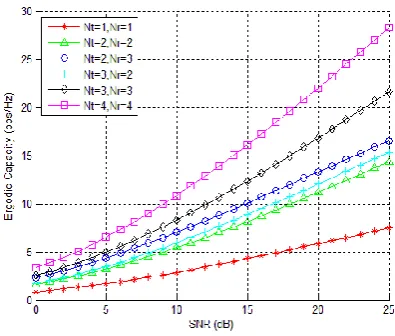
Figure 4.2 shows the Ergosic capacity of the awgn. It is observed that when no of transmitting antenna and receiver antenna is increased error rate of bit for water filling algorithm is rapidly rising as compared to the low no of transmitter antenna and receiving antenna. Bit error rate of 4 transmit and receive antenna is very high 1.e 29bps which is very large as compare when we use single antenna for transmit and receive single. When we compare bit error rate of two Outage as well as Ergodic capacity, it is seen that in case of Ergosic system value of bps is large even in single transmit and receive antenna.
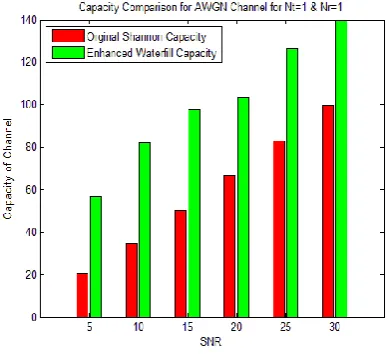
Fig.4.3 Capacity Comparison of AWGN Channel for Nt=1& Nr=1
Above bar graphs compares AWGN Channel capacity for Nt=1 & Nr=1. From graph it is clear that original Shannon capacity is very low when compare with enhanced waterfall capacity. When value of SNR is 5, capacity of original Shannon is just 20 on the other side capacity of enhanced waterfalls 60. Apart from this when value of SNR is 30, capacity of original Shannon is reached at 100 on the other side capacity of enhanced Waterfill is at maximum value i.e.140.
V. CONCLUSION
MIMO Technology is indispensable aspect of the today’s technology and standard of the wireless communication. These emerging fields involves WiMAX, HSPA+, 5G cell, energy efficient satellites etc. MIMO-OFDM is taken as a key innovation in high-information rate frameworks like 4G, IEEE 802.16, and advance digital video broadcasting. In the existing work, BER is more due to fixed number of antennas. Furthermore, main approach of a 5G-centered telecommunications network would reply problems that a 4G technique would provide as soon as it has entered trendy utilization. Beyond aforementioned variety of stakeholders, 5G have to help enhancing range of optimized Wi-Fi solutions (to different software domains, e.g., M2M) and adorning variety and enormous quantity of related contraptions, and associated range of visitor’s forms. It visualized that using water fill algorithm, when no of transmitter antenna and receiving antenna is increased error rate of water filling algorithm is increased as compared to least number of transmitter antenna and receiver antenna. Bit error rate of 4 transmit and receive antenna is very high.
REFERENCES
[1]Part 11: Wireless LAN MAC& PHY Specifications: High-Speed Physical Layer in the 5 GHz Band, IEEE Standard 802.11a-1999.
[2] Local and Metropolitan Area Networks—Part 16, Air Interface for Fixed Broadb& Wireless Access Systems, IEEE Standard IEEE 802.16a.
[3] L. J. Cimini, Jr., ―Analysis and simulation of a digital mobile channel utilizing orthogonal frequency division multiplexing,‖ IEEE Trans. Commun., vol. COM-33, pp. 665–675, July 1985.
© 2018, IJCSMC All Rights Reserved 130
[5] Joshi, Shreedhar A., T. S. Rukmini, and H. M. Mahesh. "Algorithm Design and Prototyping of Alamouti Encoder and
Decoder with MIMO System." Digital Signal Processing 3.2 (2011): 87-92.
[6] Trivedi, Shruti, Mohd Sarwar Raeen, and Shalendra Singh Pawar. "BER analysis of MIMO-OFDM system using BPSK
modulation scheme." channels 7.8 (2012): 9.
[7] H. Bölcskei and A. Paulraj, ―Space-frequency coded broadband OFDM systems,‖ in Proc. IEEE Wireless Communications
Net-working Conf., 2000, pp. 1–6.
[8] Harraz, Osama F., et al. "CaV3. 2 Channels and the Induction of Negative Feedback in Cerebral Arteries Novelty and
Significance." Circulation research 115.7 (2014): 650-661.
[9] G. G. Raleigh and J. M. Cioffi, ―Spatio-temporal coding for wireless communcation,‖ IEEE Trans. Commun., vol. 46, pp. 357–366, Mar. 1998.
[10] D. Agrawal, V. Tarokh, A. Naguib, and N. Seshadri, ―Space–time coded OFDM high data-rate wireless communication over wide-band channels,‖ in Proc. IEEE Vehicular Technology Conf., 1998, pp. 2232–2236.
[11] B. Lu and X. Wang, ―Space–time code design in OFDM systems,‖ in Proc. Globecom, vol. 2, 2000, pp. 1000–1004. [12] H. Bölcskei and A. Paulraj, ―Space-frequency codes for broadband fading channels,‖ in Proc. IEEE Int. Symp.Info. Theory, 2001, p. 219.
[13] H. Bölcskei, M. Borgmann, and A. Paulraj, ―Space-frequency coded MIMO-OFDM with variable multiplexing-diversity tradeoff,‖ pre-sented at the IEEE Int. Conf. Communications (ICC), Anchorage, AK, 2003.