© 2014, IJCSMC All Rights Reserved 562 Available Online atwww.ijcsmc.com
International Journal of Computer Science and Mobile Computing
A Monthly Journal of Computer Science and Information Technology
ISSN 2320–088X
IJCSMC, Vol. 3, Issue. 3, March 2014, pg.562 – 568
RESEARCH ARTICLE
A Comparative Study on Performance Evalution
of Eager versus Lazy Learning Methods
Solomon Getahun Fentie
1Abebe Demessie Alemu
2Bhabani Shankar D. M.
3 1Department of Computer Science, Bahir Dar University, Ethiopia
2
Department of Computer Science, Bahir Dar University, Ethiopia
3
Department of Computer Science, Bahir Dar University, Ethiopia
1
[email protected], 2 [email protected], 3 [email protected]
Abstract: - Classification is one of the fundamental tasks in data mining and has also been studied extensively in statistics,
machine learning, neural networks and expert systems over decades. Naïve Bayes, k-nearest, and decision tree are the most
commonly known classification algorithms ever used in different researches. In this study, the performance evaluation of
eager (naïve Bayes, ADTree) and lazy (IBk, KStar) classification algorithms are experimented. Our findings show that based
on the evaluation metrics precision, recall, F-measure and accuracy, eager learners are slow in training but faster at
classi-fication than lazy classiclassi-fication algorithms because they constructs a generalization model before receiving any new tuples
to classify. Moreover, based on our investigation eager learners outperform the lazy learners in their accuracy.
Keywords: Classification; Eager learner; Lazy learner; ADTree; Naïve Bayes
I. INTRODUCTION
In the recent past few years, the fields of machine learning and data mining have been studied to a great extent and applied in
various fields of studies. It is now realized among the research communities that the contribution of machine learning has
become immense for the development of science and technology. Classification, which is one of the supervised machine
learn-ing methodologies, is related to one of the fundamental tasks in data minlearn-ing and has also been studied extensively in statistics,
neural networks and expert systems over decades [5]. Classification of instances or tuples from a given large data sets requires
© 2014, IJCSMC All Rights Reserved 563
Classification involves two phases-construction of a model for classification/prediction and testing & usage of it for determining
the class labels/ prediction. In this paper, performance evaluation of eager (naïve Bayes, ADTree) and lazy (IBk or K-NN,
KStar) learning algorithms are experimented based on the standard UCI Bank Marketing data set donated on 2012-02-14. The
data is related to direct marketing campaigns through phone calls of a banking institution with the classification goal of
predict-ing if the client will subscribe a term deposit or not.
The learning algorithms are passed through four different training data sets. The rest of paper is organized as: learning
algo-rithms for classification, data preparation, experiment, result & discussion and finally, the conclusions that have been drawn
from the experiment.
II. LEARNING ALGORITHMS FOR CLASSIFICATION
Naïve Bayes: - Naïve Bayes classification algorithm is one of eager learning algorithms that promotes the class conditional
in-dependence and predicts the class label in the fastest manner. Naïve Bayesian classifiers assume that there are no dependencies
amongst attributes. This assumption is called class conditional independence [1] .As in [2], the performance of the naive Bayes
classifier is surprisingly good even if the independence assumption between attributes is unrealistic in most of the data sets.
ADTree: - In classification, there are a number of tree algorithms that are used to classify a number of data instances as
accu-rate as possible. AdaBoost geneaccu-rates rules that have majority votes over the simpler so called “weak” rules. By representing
alternating trees (AD Tree) as such votes, we can make it easy to use AdaBoost to learn alternating trees from data [3]. This
representation generalizes both voted stumps and decision trees in a natural way. One of the nice features of ADTrees is that
they give a measure of confidence which we call the classification margin in addition to a classification.
IBk:-The lazy IBk (commonly known as K- nearest neighbor) is one of classification algorithms that uses distance weighting
measures with capability of various attributes like Date attributes, Numeric attributes, Unary attributes, Nominal attributes,
Missing values, Binary attributes and Empty nominal attributes.
KStar:- KStar (K*) is an Instance-based learners (IBL) that classifies an instance by comparing it to a database of
pre-classified examples [4]. The fundamental assumption is that similar instances will have similar classifications. The question
lies in how to define “similar instance” and “similar classification”. The corresponding components of an instance-based
learn-er are the distance functions which detlearn-ermine how similar two instances are, and the classification functions which specify how
instance similarities yield a final classification for the new instance. It is one of the lazy learners that take long time to classify
an instance of test data sets.
III. DATA PREPARATION
In the classification algorithms, data sets are transformed into training sets and test sets in order to build a model and use it for
the classification purpose respectively. The training set involves the various attributes having one as classifying attribute. On
the other hand the test set includes the same attributes with the unseen tuples of data that the model is going to classify the
in-stances.
The data under study is related to direct marketing campaigns based on the phone calls. Often, more than one contact to the
© 2014, IJCSMC All Rights Reserved 564
In our case we used four different training sets with 17 attributes of each. Each training sets contain 1000, 2000, 3000 and
4000 instances.
The attributes of our training sets are age, job, marital, education, default, balance, housing, loan, contact, day, month,
duration, campaign, pdays, previous, pout and classify.
On these selected 4-training sets, 4-types of learning algorithms have been employed. The experiment is done using one of the
best known data mining software called Weka. To show the performance of the classifiers or learning algorithms, we used the
same experiment procedure of Weka as 66% of the data set as training set and the remaining as test set.
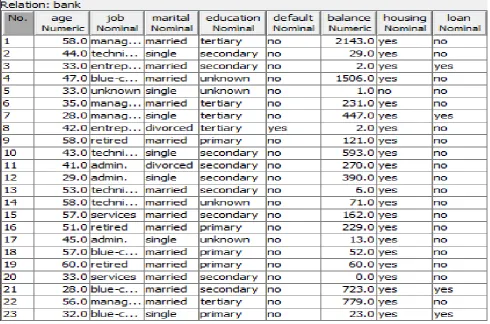
Fig. 1: Example of Data view
IV. EXPERIMENT
To conduct our experiment, we used four classifiers, namely Eager learners (Naïve Bayes, Alternating Decision Tree), and Lazy
learners (IBK, Kstar) on the UCI Bank Marketing data set. The experiment was conducted on the four training data sets based
on test mode of k-fold cross-validation with supplied test sets (where k=10). For each classifier, we considered a classification
time and their respective performance value. For the performance issue of classifiers, we focused on the evaluation parameters:
© 2014, IJCSMC All Rights Reserved 565
TABLE I: Data Description
Training Data Testing Data
Number of instances Train-data-1=1000
Train-data-2=2000
Train-data-3=3000
Train-data-4=4000
Test-data-1=340
Test-data-2=680
Test-data-3=1020
Test-data-4=1360
Number of attributes 17
(7-Numeric, 10-Nominal)
17
(7-Numeric, 10-Nominal)
Missing data none none
A. Experiment Procedures
The experiment was carried out as follows:
Preparing working data: The data for the purpose of manipulation was taken from the UCI Bank Marketing data set which
con-sists of more than 45,000 instances. The training and test data sets are taken from these data tuples independently.
Setting classes of the training set: The last attribute (classify) represents our result set (class label) which has values of “Yes” or “No”. Every qualifying data values of the attributes of our dataset will result “yes” and every inappropriate attribute values will result “no”.
Supplying the chosen values of data: The data values of all 17 attributes are entered to the WEKA data mining software as
train-ing and test sets.
Classification: In this step, the processed data has been taken one-by-one and has been submitted to all classifiers, eager (Naïve
Bayes, Decision Tree) and lazy (IBK, K*) against the training and test sets to determine the result set.
V. RESULT AND DISCUSSION
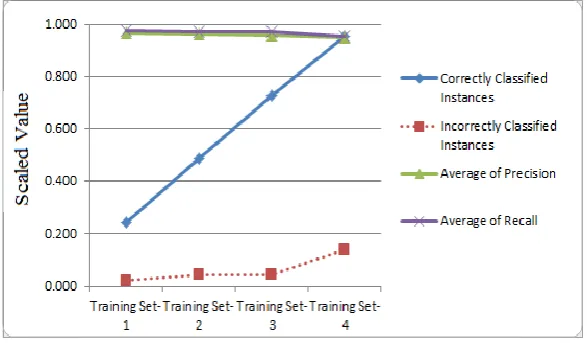
Our experiment demonstrates that the eager learning algorithm (ADTree) outperforms better in its accuracy in all training sets as
shown in Fig-2. On the other hand the precision and recall are compromised as the number of instances increases in the training
sets.
© 2014, IJCSMC All Rights Reserved 566
The average weighted precisions for ADTree outperforms better than Naïve Bayes, IBK and Kstars respectively as shown in the
Figure-3 in all test sets.
Fig. 3. Average precession of all classifiers
F–measure is the harmonic mean of recall and precession, and hence to know which learner is the best in terms of classifiers
both precision and recall, we can infer the F-measure values.
As we can infer from the Figure-4, the average F-measure value of ADTree is the largest among all the other classifiers
fol-lowed byNaïve Bayes, IBk and KStar respectively for all the test sets indicating that in terms of precession and recall
(F-measure), the eager learners outperform than the lazy classifiers.
Fig. 4: F-measure of all classifiers
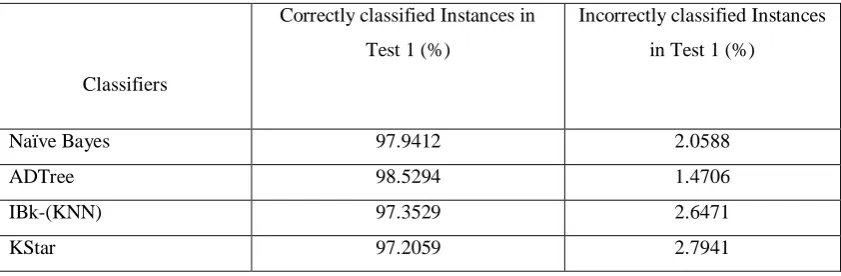
© 2014, IJCSMC All Rights Reserved 567 TABLE 2: Accuracy comparison of different classifiers
On the other hand, in the Table-3, eager learning algorithms (Naïve Bayes, ADTree) require more time to spend in constructing
a model while learning whereas the lazy learning algorithms (IBk, KStar ) do not require more time during model construction.
TABLE 3: The time taken to build a model and classify
VI. CONCLUSION
We consider the precision, recall, F-measure and accuracy as our evaluation matrices for conducting our experiment on the
per-formance evaluation of different classifiers. On the basis of these evaluation metrics, we conclude that eager learners are slow
in training but faster and accurate at classification than lazy classification algorithms because they construct a generalization
model before receiving any new tuples for classification. Moreover, in overall parameters, ADTree (eager) classification
algo-rithm outperforms all the other classifiers followed by Naïve Bayes (eager learner), IBk (lazy learner) and KStar (lazy learner)
respectively. However, as the number of instances in the training set and test set increases for the large data sets, eager learning
algorithms seek much time to construct and train the model which is an open issue for the researchers to minimize the tradeoff
between model construction and classification time. Classifiers
Correctly classified Instances in
Test 1 (%)
Incorrectly classified Instances
in Test 1 (%)
Naïve Bayes 97.9412 2.0588
ADTree 98.5294 1.4706
IBk-(KNN) 97.3529 2.6471
KStar 97.2059 2.7941
Learning Algorithms
Time taken to build a Model on
Training set-4 Time taken to Classify Test set-4
Eager Learning Algorithms Naïve Bayes 0.03 seconds 0.00 seconds
ADTree 0.66 seconds 0.00 seconds
Lazy Learning algorithms IBk 0.00 seconds 0.20 seconds
© 2014, IJCSMC All Rights Reserved 568
REFERENCES
[1] Ahmad Ashari,ImanParyudi, A Min Tjoa:“Performance Comparison between Naïve Bayes, Decision Tree and k-Nearest
Neighbor in Searching Alterntive Design in an Energy Simulation Tool”, (IJACSA) International Journal of Advanced
Computer Science and Applications, Vol. 4, No. 11, 2013.
[2] Franz,Pernkopf: “Bayesian network classifiers versus selective k-NN classifier”, Pattern Recognition 38 (2005) 1 – 10.
[3] YoavFreund ,Llew Mason: “The alternating decision tree learning algorithm”.
[4] John G. Cleary, Leonard E. Trigg:“K*: An Instance-based Learner Using an Entropic Distance Measure”.
[5] D.Lavanya ,Dr. K.Usha Rani : “Performance Evaluation of Decision Tree Classifiers on Medical Datasets”, International
Journal of Computer Applications (0975 – 8887)Volume 26– No.4, July 2011.
[6] S.L. Ting, W.H. Ip, Albert H.C. Tsang: “Is Naïve Bayes a Good Classifier for Document Classification?, International
Journal of Software Engineering and Its Applications Vol. 5, No. 3, July, 2011.
[7] D.Lavanya and Dr.K.Usha Rani: “ENSEMBLE DECISION TREE CLASSIFIER FORBREAST CANCER DATA”,
Interna-tional Journal of Information Technology Convergence and Services (IJITCS) Vol.2, No.1, February 2012.
[8] Reza Entezari-Maleki, Arash Rezaei, and Behrouz Minaei-Bidgoli :“Comparison of Classification Methods Based on the
Type of Attributes and Sample Size”.
[9] Wei-Hao Lin and Alexander Hauptmann : “Meta-classification: Combining Multimodal Classifiers”, O.R. Zaïane et al.