Nucleon Spectroscopy with CLAS
SteffenStrauch1,for the CLAS Collaboration
1University of South Carolina, Columbia, SC 29208
Abstract. Meson photoproduction is an important tool in the study of nucleon reso-nances. The spectrum of broad and overlapping nucleon excitations can be greatly clari-fied by use of polarization observables. TheN∗program at Jefferson Lab with the CEBAF
Large Acceptance Spectrometer (CLAS) includes experimental studies with linearly- and circularly-polarized tagged-photon beams, longitudinally- and transversely-polarized nu-cleon targets, and recoil polarizations. Selected results from these experimental studies will be presented.
1 Introduction
The nature of QCD confinement continues to provide an ongoing challenge to our understanding of non-perturbative QCD. Studying the nucleon spectrum provides one approach to learn more about this unique feature since the location and properties of excited states reflect the dynamics and relevant degrees-of-freedom within hadrons. Symmetric quark models with three independent quark degrees of freedom predict an overabundance of higher-lying excited states compared to what has been ob-served until now [1]. Lattice QCD calculations predict states with the same quantum numbers as
constituent quark models with an underlyingSU(6)×O(3) symmetry and find a counting of levels
that is consistent with those models [2]. Quark-diquark models with a ’frozen’ diquark predict fewer states. To clarify the nucleon resonance spectrum with the help of new experimental data is essential to inform studies of QCD.
Nucleon resonances have hadronic decay channels and are typically short-lived. They have large widths and overlap in the resonance spectrum. Identifying resonances and extracting resonance in-formation in partial-wave analyses (PWA) of experimental data is challenging and requires not only unpolarized cross-section data, but also phase information from polarization observables. The photo-production of a single pion, for example, is fully described by four complex amplitudes. It requires a minimum of eight carefully chosen observables at each energy and angle to determine the amplitudes of the reaction completely [3]. The photoproduction of two mesons requires even more observables
[4]. Most present resonance information originate fromπN reactions. Some resonances, however,
couple weakly to theπNchannel and multiple final states need to be investigated to fully explore the
resonance spectrum.
The CLAS Collaboration has performed a series of photoproduction experiments offnucleons as
part of theN∗program at the Thomas Jefferson National Accelerator Facility to provide the needed
data. These measurements cover a variety of final states including single pseudoscalar-mesons, vector-mesons, pions, and hyperons. The observables include cross sections, single- and double-polarization observables. The incident bremsstrahlung photon beams were energy-tagged [5] and either unpolarized, circularly, or linearly polarized. A central component of this program are
experi-ments offpolarized protons [6–10] and neutrons [11]. These experiments were made possible by the
construction of the frozen-spin polarized butanol (FROST) [12] and hydrogen-deuteride (HDice) [13] targets. Final-state particles were detected in the CEBAF Large Acceptance Spectrometer (CLAS) [14] over a wide angular range, excluding the very beam-forward and backward directions. A toroidal magnetic field and packages of drift chambers allowed for the determination of the particle momen-tum. Time-of-flight detectors helped in the particle identification. The CLAS detector has in the meantime been replaced by CLAS12. Few selected results from these CLAS photoproduction
exper-iments offpolarized nucleons are discussed in the following.
2 CLAS Results
2.1 Pion Photoproduction
The double-polarization observableE in the γp → π+n reaction can be determined in an
experi-ment that measures the helicity asymmetry of circularly-polarized photons incident on longitudinally-polarized protons. The CLAS collaboration measured this process in the center-of-mass energy range
fromW =1.25 GeV toW =2.23 GeV [15]. Figure 1 shows angular distributions of the data for
se-lectedWbins. The upper panels show that previous PWA results describe the new data where the PWA
have been well constrained by previous data at low energies, however they fail to describe the data at higher energies. The data have subsequently been included in new analyses of the SAID, Jülich-Bonn, and Bonn-Gatchina groups. The groups achieved an overall satisfying description of the data, lower panels of Fig. 1, that was obtained by a series of smaller updates of nucleon resonance parameters. The process led to an improved consistency of helicity amplitudes among the various analyses. One
particularly interesting result is strengthened evidence for the poorly known∆(2200)72−resonance in
improving the Bonn-Gatchina fit at the highest energies [16]. The mass of the∆(2200)72−resonance
is significantly higher than the mass of its parity partner∆(1950)72+, which is the lowest-mass∆∗
resonance with spin-parityJP=7
2 +
. This finding has relevance for the hypothesis of chiral-symmetry restoration at high mass.
Other single-pion photoproduction channels are also being studied. For example, results from
γp → π0pofftransversally polarized protons have been obtained in an analysis of the targetT and
beam-targetF polarization observables [20]. The preliminary results agree with world data in the
range of overlap at lower energies, but provide new information up to center-of-mass energies of
W≈2.5 GeV.
The lack of free-neutron targets makes experiments offthe neutron difficult and results for
ob-servables offthe proton dominate the data bases. However, information from both isospin channels
are necessary to completely specify the amplitudes of the reaction. Novel data have been obtained in
quasielastic photoproduction reactions offpolarized neutrons from the CLAS g14 experiments.
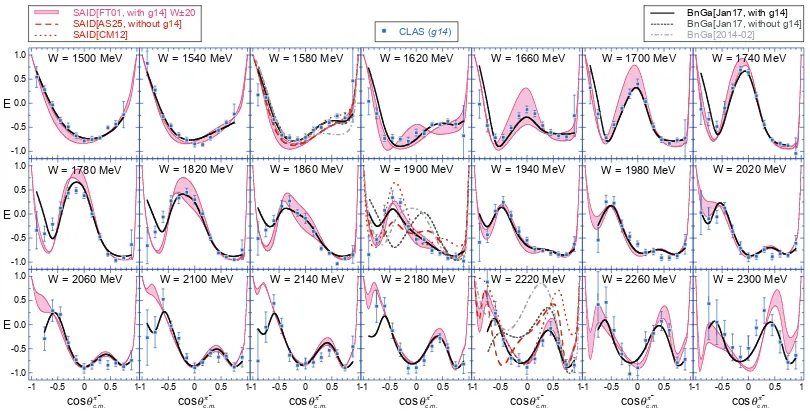
Fig-ure 2 shows CLAS results for the polarization observableE in theγn(p) → π−p(p) reaction [21]
as blue data points. The data are compared to updated fits of the SAID and Bonn Gatchina
analy-ses. Three selectedW bins show also previous fits and demonstrate how much the new data helped
constraining those new analyses. The inclusion of these results in the new analyses has resulted in
re-visedγnN∗couplings and, in the case of theN(2190)7
2−, to convergence among different partial-wave
analyses. TheγnN∗ couplings are sensitive to the dynamical process ofN∗ excitation and provide
data. These measurements cover a variety of final states including single pseudoscalar-mesons, vector-mesons, pions, and hyperons. The observables include cross sections, single- and double-polarization observables. The incident bremsstrahlung photon beams were energy-tagged [5] and either unpolarized, circularly, or linearly polarized. A central component of this program are
experi-ments offpolarized protons [6–10] and neutrons [11]. These experiments were made possible by the
construction of the frozen-spin polarized butanol (FROST) [12] and hydrogen-deuteride (HDice) [13] targets. Final-state particles were detected in the CEBAF Large Acceptance Spectrometer (CLAS) [14] over a wide angular range, excluding the very beam-forward and backward directions. A toroidal magnetic field and packages of drift chambers allowed for the determination of the particle momen-tum. Time-of-flight detectors helped in the particle identification. The CLAS detector has in the meantime been replaced by CLAS12. Few selected results from these CLAS photoproduction
exper-iments offpolarized nucleons are discussed in the following.
2 CLAS Results
2.1 Pion Photoproduction
The double-polarization observableE in the γp → π+n reaction can be determined in an
experi-ment that measures the helicity asymmetry of circularly-polarized photons incident on longitudinally-polarized protons. The CLAS collaboration measured this process in the center-of-mass energy range
fromW =1.25 GeV toW =2.23 GeV [15]. Figure 1 shows angular distributions of the data for
se-lectedWbins. The upper panels show that previous PWA results describe the new data where the PWA
have been well constrained by previous data at low energies, however they fail to describe the data at higher energies. The data have subsequently been included in new analyses of the SAID, Jülich-Bonn, and Bonn-Gatchina groups. The groups achieved an overall satisfying description of the data, lower panels of Fig. 1, that was obtained by a series of smaller updates of nucleon resonance parameters. The process led to an improved consistency of helicity amplitudes among the various analyses. One
particularly interesting result is strengthened evidence for the poorly known∆(2200)72−resonance in
improving the Bonn-Gatchina fit at the highest energies [16]. The mass of the∆(2200)72−resonance
is significantly higher than the mass of its parity partner∆(1950)72+, which is the lowest-mass∆∗
resonance with spin-parityJP=7
2 +
. This finding has relevance for the hypothesis of chiral-symmetry restoration at high mass.
Other single-pion photoproduction channels are also being studied. For example, results from
γp → π0pofftransversally polarized protons have been obtained in an analysis of the targetT and
beam-targetF polarization observables [20]. The preliminary results agree with world data in the
range of overlap at lower energies, but provide new information up to center-of-mass energies of
W≈2.5 GeV.
The lack of free-neutron targets makes experiments offthe neutron difficult and results for
ob-servables offthe proton dominate the data bases. However, information from both isospin channels
are necessary to completely specify the amplitudes of the reaction. Novel data have been obtained in
quasielastic photoproduction reactions offpolarized neutrons from the CLAS g14 experiments.
Fig-ure 2 shows CLAS results for the polarization observable E in theγn(p) → π−p(p) reaction [21]
as blue data points. The data are compared to updated fits of the SAID and Bonn Gatchina
analy-ses. Three selectedW bins show also previous fits and demonstrate how much the new data helped
constraining those new analyses. The inclusion of these results in the new analyses has resulted in
re-visedγnN∗couplings and, in the case of theN(2190)7
2−, to convergence among different partial-wave
analyses. TheγnN∗ couplings are sensitive to the dynamical process ofN∗ excitation and provide
important guides to nucleon structure models.
)
cm
π θ
cos(
-0.5 0 0.5
E
-0.5 0
0.5 SAID ST14W = 1.640 - 1.660 GeV Juelich14 BnGa11E ) cm π θ cos(
-0.5 0 0.5
E
-0.5 0 0.5
W = 1.640 - 1.660 GeV SAID ST14E Juelich14E BnGa14E ) cm π θ cos(
-0.5 0 0.5
E
-0.5 0
0.5 W = 1.900 - 1.940 GeV
)
cm
π θ
cos(
-0.5 0 0.5
E
-0.5 0 0.5
W = 1.900 - 1.940 GeV cm)
π θ
cos(
-0.5 0 0.5
E
-0.5 0
0.5 W = 2.140 - 2.200 GeV
)
cm
π θ
cos(
-0.5 0 0.5
E
-0.5 0 0.5
W = 2.140 - 2.200 GeV
Figure 1. CLAS data for the beam-target polarization observableEin theγp→π+nreaction for selectedW bins. The shaded bands indicate systematic uncertainties. The curves are results of partial-wave analyses before (upper panels) and after (lower panels) including the new CLAS data. The previous analyses are from SAID ST14 [17], Jülich14 [18], and BnGa11E [19]. Figure from Ref. [15].
g14v24 W1660wSAID[FT01]BoGa
W = 1660 MeV
g14v24 W1620wSAID[FT01]BoGa
W = 1620 MeV
-1.0 -0.5 0.0 0.5 1.0 g14v24 W1500wSAID[FT01]BoGa
W = 1500 MeV
E
CLAS (g14)
BnGa[Jan17, with g14]
BnGa[Jan17, without g14]
BnGa[2014-02]
g14v24 W1540wSAID[FT01]BoGa
W = 1540 MeV
g14v24 W1580 all SAIDft&BnGa
W = 1580 MeV
g14v24 W1700wSAID[FT01]BoGa
W = 1700 MeV
g14v24 W1740wSAID[FT01]BoGa
W = 1740 MeV
-1.0 -0.5 0.0 0.5 1.0 g14v24 W1780wSAID[FT01]BoGa E
W = 1780 MeV
g14v24 W1820wSAID[FT01]BoGa
W = 1820 MeV
g14v24 W1860wSAID[FT01]BoGa
W = 1860 MeV
g14v24 W1900 allSAIDft&BoGa
W = 1900 MeV
g14v24 W1940wSAID[FT01]BoGa
W = 1940 MeV
g14v24 W1980wSAID[FT01]BoGa
W = 1980 MeV
g14v24 W2020wSAID[FT01]BoGa
W = 2020 MeV
-1.0 -0.5 0.0 0.5 1.0 g14v24 W2060wSAID[FT01]BoGa
-1 -0.5 0 0.5 1
W = 2060 MeV
E
g14v24 W2100wSAID[FT01]BoGa
-1 -0.5 0 0.5 1
W = 2100 MeV
g14v24 W2140wSAID[FT01]BoGa
-1 -0.5 0 0.5 1
W = 2140 MeV
g14v24 W2180wSAID[FT01]BoGa
-1 -0.5 0 0.5 1
W = 2180 MeV
g14v24 W2220 allSAIDft&BoGa
-1 -0.5 0 0.5 1
W = 2220 MeV
g14v24 W2260wSAID[FT01]BoGa
-1 -0.5 0 0.5 1
W = 2260 MeV
g14v24 W2300wSAID[FT01]BoGa
-1 -0.5 0 0.5 1
W = 2300 MeV
SAID[FT01, with g14] W±20
SAID[AS25, without g14] SAID[CM12]
cosθc.m. π−
cosθc.m. π−
cosθc.m. π−
cosθc.m. π−
cosθc.m. π−
cosθc.m. π−
cosθc.m. π−
Figure 2.CLAS data for the beam-target polarization observableEin theγn→π−preaction (blue data points).
-1 -0.5 0 0.5 1
1.5 -1.0<cosθcm<-0.8
Juelich 2014 (fit)
1500 1600 1700 1800 1900 2000 2100 -1
-0.5 0 0.5 1
1.5 -0.4<cosθcm<0.0
<-0.4 cm θ -0.8<cos
1500 1600 1700 1800 1900 2000 2100
<0.4 cm θ 0.0<cos
W (MeV) E(W)
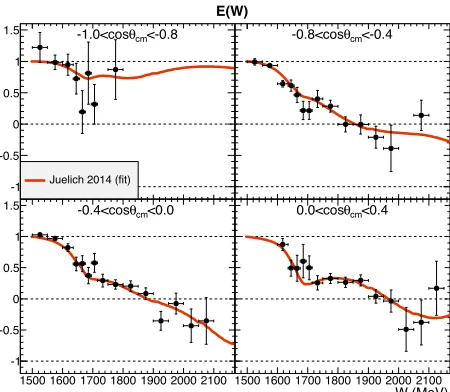
Figure 3.Energy dependence of the helicity asymmetryEin theγp→ηp
reaction for various angular bins. The red curves show calculations of the
Jülich-Bonn dynamical coupled-channel model that were fit to the CLAS data (black points). Figure from Ref. [22].
2.2 Eta Photoproduction
Theηmeson is an isospin-zero particle andηphotoproduction selectively excites isospin-12resonances
of the nucleon resonance spectrum. The CLAS collaboration has measured the polarization observable
E in theγp → ηp reaction from threshold toW = 2.15 GeV [22]. Figure 3 shows the energy
dependence ofE. In the threshold regionEapproaches unity. The data were fit with the Jülich-Bonn
dynamical coupled-channel model (red curves). The fit describes the data quite well without the need for an additional narrow resonance near 1.68 GeV, which was previously suggested [22].
2.3 Hyperon Photoproduction
The analysis of the angular distribution of the parity-violating weak decay of hyperons allows for the
reconstruction of the hyperon recoil polarization in the reactionsγp →K+Λandγp→ K+Σ0. This
gives access to additional recoil-polarization observables. CLAS measurements of theΛinduced
po-larizationP[23, 24] as well as the polarization-transfersCxandCzfrom circularly-polarized photons
to the recoiling hyperons [25] were critical input to a coupled-channel analysis by the Bonn-Gatchina group [26, 27]. In particular, the analysis found further evidence for the, at the time, poorly known
N(1900)3
2 +
resonance. This resonance is predicted by symmetric three-quark models, but is not ex-pected to exist in earlier quark-diquark models. New hyperon-photoproduction data with
linearly-polarized photons offan unpolarized proton target have been obtained up toW ≈2.2 GeV. Together
with the recoil polarization of the hyperon, this gives access to five polarization observables:Σ,P,T,
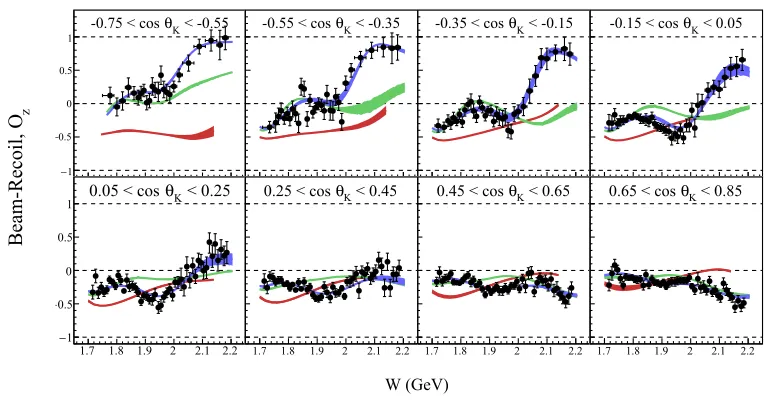
Ox, andOz. Figure 4 shows as an example the beam-recoil polarization observableOzfor theK+Λ
channel as a function of center-of-mass energyW for eight angular bins of cosθKof the kaon’s polar
angle. The data are compared with predictions of the ANL-Osaka (red bands) coupled-channel model and the 2014 Bonn-Gatchina partial-wave analysis (green bands). None of those describe the new data well. A refit of the BnGa analysis to the data gives an excellent description. This refit includes
two new nucleon resonances with spin and parity ofJP = 3
2 +
and 5
2 +
-1 -0.5 0 0.5 1
1.5 -1.0<cosθcm<-0.8
Juelich 2014 (fit)
1500 1600 1700 1800 1900 2000 2100 -1
-0.5 0 0.5 1
1.5 -0.4<cosθcm<0.0
<-0.4 cm θ -0.8<cos
1500 1600 1700 1800 1900 2000 2100
<0.4 cm θ 0.0<cos
W (MeV) E(W)
Figure 3.Energy dependence of the helicity asymmetryEin theγp→ηp
reaction for various angular bins. The red curves show calculations of the
Jülich-Bonn dynamical coupled-channel model that were fit to the CLAS data (black points). Figure from Ref. [22].
2.2 Eta Photoproduction
Theηmeson is an isospin-zero particle andηphotoproduction selectively excites isospin-12resonances
of the nucleon resonance spectrum. The CLAS collaboration has measured the polarization observable
E in theγp → ηp reaction from threshold to W = 2.15 GeV [22]. Figure 3 shows the energy
dependence ofE. In the threshold regionEapproaches unity. The data were fit with the Jülich-Bonn
dynamical coupled-channel model (red curves). The fit describes the data quite well without the need for an additional narrow resonance near 1.68 GeV, which was previously suggested [22].
2.3 Hyperon Photoproduction
The analysis of the angular distribution of the parity-violating weak decay of hyperons allows for the
reconstruction of the hyperon recoil polarization in the reactionsγp → K+Λandγp→ K+Σ0. This
gives access to additional recoil-polarization observables. CLAS measurements of theΛinduced
po-larizationP[23, 24] as well as the polarization-transfersCxandCzfrom circularly-polarized photons
to the recoiling hyperons [25] were critical input to a coupled-channel analysis by the Bonn-Gatchina group [26, 27]. In particular, the analysis found further evidence for the, at the time, poorly known
N(1900)3
2 +
resonance. This resonance is predicted by symmetric three-quark models, but is not ex-pected to exist in earlier quark-diquark models. New hyperon-photoproduction data with
linearly-polarized photons offan unpolarized proton target have been obtained up toW ≈2.2 GeV. Together
with the recoil polarization of the hyperon, this gives access to five polarization observables:Σ,P,T,
Ox, andOz. Figure 4 shows as an example the beam-recoil polarization observableOzfor theK+Λ
channel as a function of center-of-mass energyWfor eight angular bins of cosθKof the kaon’s polar
angle. The data are compared with predictions of the ANL-Osaka (red bands) coupled-channel model and the 2014 Bonn-Gatchina partial-wave analysis (green bands). None of those describe the new data well. A refit of the BnGa analysis to the data gives an excellent description. This refit includes
two new nucleon resonances with spin and parity ofJP = 3
2 +
and5
2 +
. However, no strong evidence for their existence can be derived from the data.
1.7 1.8 1.9 2 2.1 2.2 1
− 0.5 −
0 0.5
1 -0.75 < cos θK < -0.55
1.7 1.8 1.9 2 2.1 2.2 1
− 0.5 −
0 0.5
1 0.05 < cos θK < 0.25
1.7 1.8 1.9 2 2.1 2.2 1
− 0.5 −
0 0.5
1 -0.55 < cos θK < -0.35
1.7 1.8 1.9 2 2.1 2.2
1
−
0.5
−
0 0.5
1 0.25 < cos θK < 0.45
1.7 1.8 1.9 2 2.1 2.2 1
− 0.5 −
0 0.5
1 -0.35 < cos θK < -0.15
1.7 1.8 1.9 2 2.1 2.2
1
−
0.5
−
0 0.5
1 0.45 < cos θK < 0.65
1.7 1.8 1.9 2 2.1 2.2 1
− 0.5 −
0 0.5
1 -0.15 < cos θK < 0.05
1.7 1.8 1.9 2 2.1 2.2
1
−
0.5
−
0 0.5
1 0.65 < cos θK < 0.85
z
Beam-Recoil, O
W (GeV)
Figure 4. CLAS data of the beam-recoil double-polarization observableOz in theγp → KΛreaction. The red and green curves show predictions from the ANL-Osaka coupled-channel and Bonn-Gatchina partical-wave analyses, respectively. The blue curves show a Bonn-Gatchina refit to the new data. Figure from Ref. [28].
2.4 Double-Pion Photoproduction
Higher-lying nucleon resonances above about 1.6 GeV have significant branching ratios forN∗→π∆
orN∗ → ρN that lead toππNfinal states. This reaction channel and the study of the sequential
de-cays contain potentially rich information about the nucleon-resonance spectrum. Many polarization
observables are accessible in two-pion photoproduction offthe nucleon [4]. The CLAS Collaboration
was first to study the beam-helicity asymmetryIfor theγp →π+π−preaction. The measurements
covered energies betweenW =1.35 and 2.30 GeV [29]. Many more polarization observables were
measured with the FROST experiment: the target observablesPi, beam-target observablesPi for
cir-cularly polarized photons, and beam-target observablesPs,c
i for linearly polarized photons;i=x, yare
for reactions offtransversely- andi=zofflongitudinally-polarized nucleons. Figure 5 shows as one
example preliminary results for observablePxas a function of the azimuthal angleφ∗in seven cosθCM
bins forW ≈1600 MeV. See Fig. 6 for the definition of the angles. This observable is accessible in
measurements with unpolarized photons offtransversally-polarized protons. The observable is an odd
function of the azimuthal angleφ∗. This is highlighted by a fit of a sum of sinnφ∗terms to the data (red
curves). The data are compared to bin-averaged results of a calculation by Fix and Arenhövel [30]
based on an effective Lagrangian approach (green curves). The model results resemble key features
of the preliminary data, but seem to be offin phase. Once finalized, the data will strongly constrain
x
P
* [degrees] φ
0 90 180 270 360
x P -1 -0.8 -0.6 -0.4 -0.2 0 0.2 0.4 0.6 0.8 1
= [-1.00 , -0.75]
CM
Θ cos
W = 1550 - 1650 MeV
* [degrees] φ
0 90 180 270 360
x P -1 -0.8 -0.6 -0.4 -0.2 0 0.2 0.4 0.6 0.8 1
= [-0.75 , -0.50]
CM
Θ cos
W = 1550 - 1650 MeV
* [degrees] φ
0 90 180 270 360
x P -1 -0.8 -0.6 -0.4 -0.2 0 0.2 0.4 0.6 0.8 1
= [-0.50 , -0.25]
CM
Θ cos
W = 1550 - 1650 MeV
* [degrees] φ
0 90 180 270 360
x P -1 -0.8 -0.6 -0.4 -0.2 0 0.2 0.4 0.6 0.8 1
= [-0.25 , 0.00]
CM
Θ cos
W = 1550 - 1650 MeV
* [degrees] φ
0 90 180 270 360
x P -1 -0.8 -0.6 -0.4 -0.2 0 0.2 0.4 0.6 0.8 1
= [0.00 , 0.25]
CM
Θ cos
W = 1550 - 1650 MeV
* [degrees] φ
0 90 180 270 360
x P -1 -0.8 -0.6 -0.4 -0.2 0 0.2 0.4 0.6 0.8 1
= [0.25 , 0.50]
CM
Θ cos
W = 1550 - 1650 MeV
* [degrees] φ
0 90 180 270 360
x P -1 -0.8 -0.6 -0.4 -0.2 0 0.2 0.4 0.6 0.8 1
= [ 0.5, 1]
CM
Θ cos
W = 1550 - 1650 MeV
Figure 5.Preliminaryφ∗angular
distributions for the target-polarization observablePxin theγp→π+π−p reaction for a center-of-mass energy of
W=1550−1650 MeV and seven bins in
cosθCMfrom CLAS. Angles are defined in Fig. 6. The green cuves show bin-averaged results of a model calculation from A. Fix [30]. The red curves are fits of a sum of sinnφ∗terms to
the data. Figure from [31].
cm
k
p'
π
+π
−z’
x’
θ θ∗ φ∗p
Figure 6.Cartoon of theγp→π+π−p
reaction with definitions of kinematic variables.
3 Conclusion
The Particle Data Group routinely updates its compilation ofN- and∆-resonance information. Major
input came from analyses of CLAS data. CLAS data continue to make an impact as new results for
polarization observables in photoproduction reactions offprotons and neutrons become available. The
x
P
* [degrees] φ
0 90 180 270 360
x P -1 -0.8 -0.6 -0.4 -0.2 0 0.2 0.4 0.6 0.8 1
= [-1.00 , -0.75]
CM
Θ cos
W = 1550 - 1650 MeV
* [degrees] φ
0 90 180 270 360
x P -1 -0.8 -0.6 -0.4 -0.2 0 0.2 0.4 0.6 0.8 1
= [-0.75 , -0.50]
CM
Θ cos
W = 1550 - 1650 MeV
* [degrees] φ
0 90 180 270 360
x P -1 -0.8 -0.6 -0.4 -0.2 0 0.2 0.4 0.6 0.8 1
= [-0.50 , -0.25]
CM
Θ cos
W = 1550 - 1650 MeV
* [degrees] φ
0 90 180 270 360
x P -1 -0.8 -0.6 -0.4 -0.2 0 0.2 0.4 0.6 0.8 1
= [-0.25 , 0.00]
CM
Θ cos
W = 1550 - 1650 MeV
* [degrees] φ
0 90 180 270 360
x P -1 -0.8 -0.6 -0.4 -0.2 0 0.2 0.4 0.6 0.8 1
= [0.00 , 0.25]
CM
Θ cos
W = 1550 - 1650 MeV
* [degrees] φ
0 90 180 270 360
x P -1 -0.8 -0.6 -0.4 -0.2 0 0.2 0.4 0.6 0.8 1
= [0.25 , 0.50]
CM
Θ cos
W = 1550 - 1650 MeV
* [degrees] φ
0 90 180 270 360
x P -1 -0.8 -0.6 -0.4 -0.2 0 0.2 0.4 0.6 0.8 1
= [ 0.5, 1]
CM
Θ cos
W = 1550 - 1650 MeV
Figure 5.Preliminaryφ∗angular
distributions for the target-polarization observablePxin theγp→π+π−p reaction for a center-of-mass energy of
W=1550−1650 MeV and seven bins in
cosθCMfrom CLAS. Angles are defined in Fig. 6. The green cuves show bin-averaged results of a model calculation from A. Fix [30]. The red curves are fits of a sum of sinnφ∗terms to
the data. Figure from [31].
cm
k
p'
π
+π
−z’
x’
θ θ∗ φ∗p
Figure 6.Cartoon of theγp→π+π−p
reaction with definitions of kinematic variables.
3 Conclusion
The Particle Data Group routinely updates its compilation ofN- and∆-resonance information. Major
input came from analyses of CLAS data. CLAS data continue to make an impact as new results for
polarization observables in photoproduction reactions offprotons and neutrons become available. The
new data will contribute to complete or nearly-complete experiments, and will challenge previously
poorly constrained models. It is very likely that these data will have a tremendous impact on the un-derstanding of baryon resonances and may provide evidence for new states found in coupled-channel analyses.
This work was supported in parts by the U.S. National Science Foundation: NSF PHY-1505615.
References
[1] V. Credé, W. Roberts, Rept. Prog. Phys.76, 076301 (2013)
[2] R.G. Edwards, J.J. Dudek, D.G. Richards, S.J. Wallace, Phys. Rev. D84, 074508 (2011),
1104.5152
[3] W.T. Chiang, F. Tabakin, Phys. Rev.C55, 2054 (1997)
[4] W. Roberts, T. Oed, Phys.Rev.C71, 055201 (2005),nucl-th/0410012
[5] D. Sober et al., Nucl. Instrum. Meth. A440, 263 (2000)
[6] Jefferson Lab Experiment E02-112, “Search for Missing Nucleon Resonances in Hyperon
Pho-toproduction”, P. Eugenio, F. Klein, and L. Todor, spokespersons
[7] Jefferson Lab Experiment E03-105, “Pion Photoproduction from a Polarized Target”, N.
Ben-mouna, W. Briscoe, G. O’Rielly, I. Strakovsky, S. Strauch, spokespersons
[8] Jefferson Lab experiment E04-102, “Helicity Structure of Pion Photoproduction”, D. Crabb,
M. Khandaker, and D. Sober, spokespersons
[9] Jefferson Lab experiment E05-012, “Measurement of polarization observables in η
-photoproduction with CLAS”, M. Dugger and E. Pasyuk, spokespersons
[10] Jefferson Lab Experiment E06-013, “Measurement of π+π− Photoproduction in
Double-Polarization Experiments using CLAS”, M. Bellis, V. Credé, S. Strauch, spokespersons
[11] Jefferson Lab Experiment E06-101, “N* Resonances in Pseudoscalar-meson photo-production
from Polarized Neutrons inH·D and a complete determination of theγn →K0Λamplitude”,
F. Klein and A.M. Sandorfi, spkespersons
[12] C. Keith, J. Brock, C. Carlin, S. Comer, D. Kashy, J. McAndrew, D. Meekins, E. Pasyuk,
J. Pierce, M. Seely, Nucl. Instrum. Meth. A684, 27 (2012)
[13] M.M. Lowry et al., Nucl. Instrum. Meth. A815, 31 (2016)
[14] B.A. Mecking et al., Nucl. Instrum. Meth. A503, 513 (2003)
[15] S. Strauch et al. (CLAS), Phys. Lett.B750, 53 (2015),1503.05163
[16] A.V. Anisovich, V. Burkert, J. Hartmann, E. Klempt, V.A. Nikonov, E. Pasyuk, A.V. Sarantsev,
S. Strauch, U. Thoma, Phys. Lett.B766, 357 (2017),1503.05774
[17] R.L. Workman, M.W. Paris, W.J. Briscoe, I.I. Strakovsky, Phys. Rev.C86, 015202 (2012)
[18] D. Rönchen, M. Döring, F. Huang, H. Haberzettl, J. Haidenbauer, C. Hanhart, S. Krewald, U.G.
Meißner, K. Nakayama, Eur. Phys. J.A50, 101 (2014),1401.0634
[19] A.V. Anisovich, R. Beck, E. Klempt, V.A. Nikonov, A.V. Sarantsev, U. Thoma, Eur. Phys. J.
A48, 15 (2012),1112.4937
[20] H. Jiang, Ph.D. thesis, University of South Carolina (2017)
[21] D. Ho et al. (CLAS), Phys. Rev. Lett.118, 242002 (2017),1705.04713
[22] I. Senderovich et al. (CLAS), Phys. Lett.B755, 64 (2016),1507.00325
[23] J.W.C. McNabb et al. (CLAS), Phys. Rev.C69, 042201 (2004),nucl-ex/0305028
[24] M.E. McCracken et al. (CLAS), Phys. Rev.C81, 025201 (2010),0912.4274
[25] R.K. Bradford et al. (CLAS), Phys. Rev.C75, 035205 (2007),nucl-ex/0611034
[26] A.V. Sarantsev, V.A. Nikonov, A.V. Anisovich, E. Klempt, U. Thoma, Eur. Phys. J.A25, 441
[27] V.A. Nikonov, A.V. Anisovich, E. Klempt, A.V. Sarantsev, U. Thoma, Phys. Lett.B662, 245
(2008),0707.3600
[28] C.A. Paterson et al. (CLAS), Phys. Rev.C93, 065201 (2016),1603.06492
[29] S. Strauch et al. (CLAS Collaboration), Phys. Rev. Lett.95, 162003 (2005),hep-ex/0508002
[30] A. Fix, H. Arenhövel, Eur.Phys.J.A25, 115 (2005),nucl-th/0503042