The Number of Boolean Functions with
Multiplicative Complexity 2
Magnus Gausdal Find1, Daniel Smith-Tone1,2, and
Meltem S¨onmez Turan 1,3
1
National Institute of Standards and Technology,
2
University of Louisville
3
Dakota Consulting Inc.
{magnus.find,daniel.smith,meltem.turan}@nist.gov
Abstract. Multiplicative complexity is a complexity measure defined as the minimum number of AND gates required to implement a given primitive by a circuit over the basis (AND, XOR, NOT). Implementa-tions of ciphers with a small number of AND gates are preferred in pro-tocols for fully homomorphic encryption, multi-party computation and zero-knowledge proofs. In 2002, Fischer and Peralta [12] showed that the number ofn-variable Boolean functions with multiplicative complexity one equals 2 23n. In this paper, we study Boolean functions with multi-plicative complexity 2. By characterizing the structure of these functions in terms of affine equivalence relations, we provide a closed form formula for the number of Boolean functions with multiplicative complexity 2.
Keywords:Affine equivalence; Boolean functions; Cryptography; Mul-tiplicative complexity; Self-mappings
1
Introduction
Multiplicative complexity is a complexity measure defined as the minimum number of AND gates required to implement a given prim-itive by a circuit over the basis (AND, XOR, NOT). In recent years, the relationships between multiplicative complexity and cryptogra-phy has been pointed out in several studies:
the references therein for a comprehensive list of examples. More-over, efficiency of some of the countermeasures against side channel attacks is related to the number of AND gates in the implementa-tion. For example, complexity of the higher-order masking schemes for s-boxes mainly depends on the masking complexity which is de-fined as the minimal number of nonlinear multiplications required to evaluate a polynomial representation of an (n, m)-bit s-box over F2n [?]. In Eurocrypt’15, Albrecht et al. [4] used this motivation to design the family of block ciphers LowMC. On the other hand, hav-ing a certain multiplicative complexity is essential for security, e.g., Boyar et al. [6] showed that a cryptographic hash function must have a certain multiplicative complexity to be collision resistant.
Multiplicative Complexity and Circuit Design Determining the mul-tiplicative complexity of a given function is computationally intractable, even for functions with a small number of variables. For general n, it is known that under standard cryptographic assumptions it is not possible to compute the multiplicative complexity in polynomial time in the length of the truth table [7]. The multiplicative complexity of a random n-variable Boolean function is at least 2n/2 −O(n) with
high probability [8]. In 2010, Boyar et al. [9] proposed a two-stage heuristic method to minimize the gate complexity of Boolean cir-cuits. In the first stage, the heuristic minimizes the number of AND gates required to implement the function, and then in the second stage, the linear components are optimized. Using this method, they constructed efficient circuits for the AES S-box over the basis (AND, XOR, NOT). In 2014, Turan and Peralta [10] studied the multiplica-tive complexity of five variable Boolean functions and showed that any five variable Boolean function can be implemented with at most four AND gates. Also in 2014, Zajac and J´okay [11] showed that any bijective 4×4 Sbox can be implemented with at most five AND gates.
Previous work In [13], Mirwald and Schnorr studied the multiplica-tive complexity of quadratic forms and showed that multiplicamultiplica-tive complexity of a Boolean function f is M iff f is isomorphic to the canonical form Ln
i=1x2i−1x2i. They also showed that the fraction of 2n-ary forms that has multiplicative complexity n is Qn−1
2−(2n−2k−1)). Boyar et al. [8] showed that the number of functions with multiplicative complexity M is at most 2M2+2M+2M n+n+1
. For large values of n and M, this bound is essentially tight [8], but it is unclear to what extent this is true for small constant values of M. In 2002, Fischer and Peralta [12] showed that there are precisely 2 23n Boolean functions on n variables with multiplicative complex-ity one. Their result was based on properties on polynomial represen-tations of such Boolean functions and the authors mention that this technique is unlikely to generalize to the case of even multiplicative complexity two.
This Paper In this work, we develop an alternative approach to count the number of Boolean functions with a given multiplicative com-plexity. Our approach relies on affine equivalence relations. First, we find the exhaustive list of affine equivalence classes with a given mul-tiplicative complexity, and then, we obtain the number of functions with a certain multiplicative complexity by summing the number of Boolean functions within each equivalence class. From a theoretical perspective this gives an algorithm, that given as inputM, outputs a formula for the number of functions innvariables with multiplicative complexity M. Using this approach, we reprove the result of Fischer and Peralta [12], and extend the result to show that the number of Boolean functions with multiplicative complexity exactly 2 equals:
2n(2n−1)(2n−2)(2n−4)
2 21+
2n−8
12 +
2n−8 360
.
We remark that this is asymptotically a factor of 5921 smaller than the bound from [8].
2
Preliminaries
Let F2 be the binary field. An n-variable Boolean function f is a
mapping fromFn
2 toF2. LetBnbe the set ofn-variable Boolean func-tions. A Boolean functionf ∈ Bncan be represented uniquely by the
list of output values for each inputTf = (f(0, . . . ,0), f(0, . . . ,0,1), . . . , f(1, . . . ,1)). This list is called the truth table (representation) of f. Since the
truth table has length 2n and there are two possibilities for each,
|Bn| = 22 n
. Another way of representing a Boolean function f ∈ Bn is by the unique multilinear polynomial called the algebraic normal form (ANF)
f(x1, . . . , xn) =
X
u∈Fn2
auxu, (1)
where au ∈ F2 and xu = xu11x
u2
2 · · ·xunn is a monomial containing the variables xi where ui = 1. The degree of the monomial xu is the number of variables appearing in xu. The degree of a Boolean function, denoteddf, is the highest degree of monomials occurring in its ANF. Functions with degree 2 are called quadratic and functions with degree 1 are called affine.
Themultiplicative complexity of a Boolean functionf is the mini-mum number of AND gates (multiplications inF2) that are sufficient
to evaluate the function over the basis (AND, XOR, NOT) where all gates have fanin 2. It is known that a function with degree dhas multiplicative complexity at leastd−1 [14]. This bound is called the
degree bound.
3
Affine Transformations and Equivalence
Classes
Definition 1 [15] A map S: Bn → Bn is called an affine transfor-mation if g 7−→S f is defined by
f(x) = g(Ax+a) +b>x+c, for all x,
where A is a non-singular n×n matrix over F2; a,b,x are column
vectors in Fn
An affine transformation can be characterized by the values of A,a,b, c, and we represent the affine transformation from f(x) to f(Ax+a) +b>x+c using the tuple S = (A,a,b, c).
Directly from the definition of an affine transformation, it follows that the relation
R={(f, g)| ∃an affine transformation from f to g},
is an equivalence relation on Bn. This relation imposes equivalence classes on Bn, and two functions in the same class are said to be
affine equivalent. An algorithm to determine whether two functions are equivalent is given in [16].
By counting the number of choices of the A, a, b, and c from Definition 1, we get that for all n ∈N, the total number of distinct affine transformations applicable to any given function f ∈ Bn is
τn = 22n+1 n−1
Y
i=0
(2n−2i).
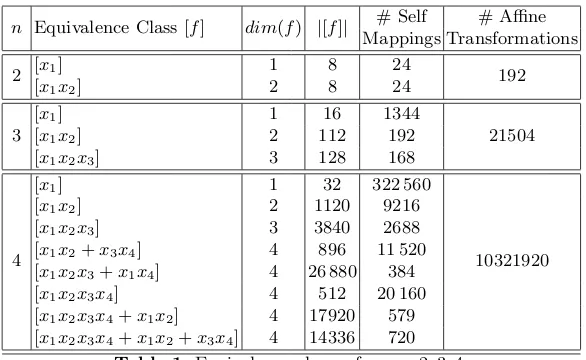
It was shown in 1972 by Berlekamp and Welch that B5 has 48 equivalence classes [15]. Maiorana [17] proved that B6 has 150 357 equivalence classes. This was independently verified by Fuller [16] and Braeken et al. [18]. It was shown by Hou [19] that B7 has 63 379 147 320 777 408 548(≈265.78) classes. See Table 1 for the equiv-alence classes with n=2,3,4 variables.
It should be noted that multiplicative complexity isaffine invari-ant, i.e., the multiplicative complexity of a Boolean function does not change after applying an affine transformation to the function. Hence functions in the same equivalence class all have the same mulitiplica-tive complexity.
3.1 Self-Mappings
In this section we establish a few facts on a particular kind of affine transformations, called self-mappings.
Definition 2 [16] A self mapping off ∈ Bnis an affine
transforma-tion such that f(x) =f(Ax+a)+b>x+c, whereAis a non-singular
n×n matrix over F2; a,b,x are column vectors in Fn
n Equivalence Class [f] dim(f) |[f]| # Self # Affine
Mappings Transformations
2 [x1] 1 8 24 192
[x1x2] 2 8 24
3
[x1] 1 16 1344
21504
[x1x2] 2 112 192
[x1x2x3] 3 128 168
4
[x1] 1 32 322 560
10321920
[x1x2] 2 1120 9216
[x1x2x3] 3 3840 2688
[x1x2+x3x4] 4 896 11 520
[x1x2x3+x1x4] 4 26 880 384
[x1x2x3x4] 4 512 20 160
[x1x2x3x4+x1x2] 4 17920 579
[x1x2x3x4+x1x2+x3x4] 4 14336 720 Table 1.Equivalence classes forn= 2,3,4.
The collection of affine transformations forms a group An under the operation⊗defined by the composition of the affine transforma-tions (A1,a1,b1, c1) and (A2,a2,b2, c2) ∈ An. The group operation ⊗ can be expressed as
(A1,a1,b1, c1)⊗(A2,a2,b2, c2) = (A2A1, A2a1+a2, A>1b2+b1,b>2a1+c1+c2).
Let Θ(f) be the set of self-mappings of f ∈ Bn. We first re-mark that Θ(f) is closed under the group operation ⊗. This follows from the fact that ⊗ corresponds to composition of affine transfor-mations. For every pair of self-mappings (S1, S2), (S1⊗S2)(f(x)) =
S2(S1(f(x))) =S2((fx)) =f(x). Since Θ(f) is finite,Θ(f) forms a
subgroup of An.
3.2 Size of Equivalence Classes
By the Orbit-Stabilizer Theorem, the size of the equivalence class [f],f ∈ Bn, is given by
|[f]|= τn
θ(f, n), (2)
Definition 3 Let f ∈ B`. The embedding of f in Bn, n ≥` is
de-fined as then-variable Boolean function that satisfiesfn(x1, . . . , x`, x`+1, . . . , xn) =
f(x1, . . . , x`).
For the purposes of this paper, we are interested in determining the size of the equivalence class [fn], f ∈ Bn, given the size of [f], f ∈ B`, ` < n, wherefn is the embedding of f in Bn.
Lemma 4 Let f, g ∈ B`. Let fn and gn be the embedding of f and g
in Bn, n ≥`, respectively. Then f and g are affine equivalent if and
only if fn and gn are affine equivalent.
Proof. Suppose that f and g are affine equivalent. Then there ex-ists an affine transformation S = (A,a,b, c) such that S(f) = g. Consider the affine transformation
˜ S = A0 0 I , a 0 , b 0 , c ,
whereAis`×`,I is (n−`)×(n−`), andaand bare`-dimensional. It is obvious that for all x∈Fn2 with x=x1||x2 where x1 ∈F`2 and x2 ∈Fn2−` that
˜
S(fn)(x) =fn A0 0 I x1 x2 + a 0 + b 0 > x1 x2 +c
=fn((Ax1+a)||x2) +b>x1 +c =f(Ax1+a) +b>x1+c
=g(x1) =gn(x).
Thus fn and gn are affine equivalent.
For the converse, suppose that fn and gn are affine equivalent. Then there exists an affine transformationS ∈ Ansuch thatS(fn) = gn. We may write
S = A B C D , a1 a2 , b1 b2 , c ,
where A is `×`, B is `×(n−`), C is (n−`)×`, D is (n−`)×
(n −`), a1 and b1 are `-dimensional, and a2 and b2 are (n − `)-dimensional. Let x1 =
x1 · · · x`
>
and x2 =
x`+1 · · · xn
>
variables x`+1, . . . , xn do not occur in the ANF of gn, so if the
vari-ables occur in
fn A B C D x1 x2 + a1 a2 ,
they must have been added to the expression by the affine transfor-mation and are therefore linear in x2. Thus
fn A B C D x1 x2 + a1 a2 =fn A 0 C D x1 x2 + a1 a2
+0 b02> x1 x2 . Adding b1 b2 > x1 x2
+cto both sides of this equation we obtain on the left hand side gn and on the right hand side
fn A 0 C D x1 x2 + a1 a2 + b1 (b2+b02)
>
x1
x2
+c.
Since the output of fn doesn’t involve the variablesx`+1, . . . , xn, we
learn thatb02 =b2. ClearlyAis of full rank. Then for allx=x1||x2,
g(x1) =gn(x1||x2) = fn A 0 C D x1 x2 + a1 a2 + b1 0 > x1 x2 +c
=fn([Ax1+a1]||[Cx1+Dx2+a2]) +b1>x1+c =f(Ax1+a1) +b1>x1+c.
Therefore f and g are affine equivalent, as was required. ut
Definition 5 Let Lf denote the number of distinct input variables appearing in the ANF of f. The dimension of f, denoted dim(f) is defined by
dim(f) = min g∈[f]Lg.
Proposition 6 Let f ∈ B` with dim(f) = ` ≥ 2 and let x = (x1, . . . , xn)
>
, n ≥ `. For any full rank linear map L: Fn
2 → F`2
and for any constant vector a ∈ F`
2, every variable xi occurring in
Lx+a occurs in a nonlinear term in f(Lx+a).
Lemma 7 Let θ(f, `)be the number of self-mappings of f ∈ B`. Let fn be the embedding off in Bn, n≥`. If the dimension of f is`≥2
then the number of self-mappings of fn is
θ(f, n) = 2n−`θ(f, `) n−1
Y
i=`
(2n−2i).
Proof. Consider Sn, a self-mapping offn. We may write
Sn = A B C D , a1 a2 , b1 b2 , c ,
whereAis`×`,B is`×(n−`),C is (n−`)×`,Dis (n−`)×(n−`),
a1 and b1 are `-dimensional, anda2 and b2 are (n−`)-dimensional. For every x=x1||x2 we have
fn(x) =fn A B C D x1 x2 + a1 a2 + b1 b2 > x1 x2 +c =f A B x1 x2
+a1 + b1 b2 > x1 x2 +c (3)
By Proposition 6 given in Appendix and the fact that xi for i > `doesn’t occur in the ANF of fn, we conclude thatB is the zero matrix. This fact further implies, from (3), that b2 =0. Therefore
f(x1) =fn(x) =Sn(fn)(x) =f(Ax1+a1) +b1>x1+c.
SinceSn is an affine transformation andB =0, it is necessary for A to be nonsingular. Consequently,S = (A,a1,b1, c) is a self-mapping of f.
where S = (A,a1,b1, c) is a self-mapping of f, we conclude that for every self-mapping S of f, for every (n−`)×` matrix C, for every nonsingular (n−`)×(n−`) matrix D and for every (n− `)-dimensional vector a2, there is an unique self-mapping of fn.
There are θ(f, `) self-mappings S of f, 2`(n−`) possible choices of C and 2n−` choices of a
2. Since, in addition, D is required to be invertible, there are Qn−`−1
i=0 (2n
−`−2i) choices of D. Thus
θ(f, n) = 2n−`θ(f, `)2`(n−`)
n−`−1
Y
i=0
(2n−`−2i) = 2n−`θ(f, `) n−1
Y
i=`
(2n−2i),
as required. ut
We note here explicitly that the condition that dim(f) = ` in the above lemma is a necessary condition. It can be shown that if dim(f) < `that the result is a strict inequality instead of equality. This lemma allows us to prove the main tool of this paper.
Theorem 8 Let f ∈ B` ,with dim(f) =`. Let fn be the embedding
of f in Bn, n ≥`. The size of the equivalence class [fn] is
|[fn]|= 2n−`|[f`]| `−1
Y
i=0
Proof. Using (2) and Lemma 7, the size of the equivalence class [fn]
can be written as
|[fn]|= τn θ(f, n) =
22n+1Qn−1
i=0(2n−2i)
θ(f, n) ,
= 2
2n+1Qn−1
i=0(2n−2i)
2n−`θ(f, `)Qn−1
i=`(2n−2i) ,
= 2
n+`+1Q`−1
i=0(2n−2i)
θ(f, `) ,
= 2n−`2
2`+1Q`−1
i=0(2l−2i)
θ(f, `)
`−1
Y
i=0
(2n−2i) (2l−2i),
= 2n−` τ` θ(f, `)
`−1
Y
i=0
(2n−2i) (2l−2i),
= 2n−`|[f`]| `−1
Y
i=0
2n−2i 2`−2i.
u t
4
Boolean Functions with Multiplicative
Complexity One
Fischer and Peralta [12] provided the number of Boolean func-tions with multiplicative complexity one. In this section, we reprove their result using an alternative method which can easily be extended for multiplicative complexity two.
Proposition 9 Let f be an n-variable Boolean function with multi-plicative complexity 1. f is affine equivalent to x1·x2.
Proof. Letf ∈ Bn have multiplicative complexity exactly 1. Then f is of the form
f(x) = (a>x)·(b>x) +c>x+d,
Define the function g ∈ Bn by
g(x1, . . . , xn) =x1·x2.
We want to show that f and g are affine equivalent. It suffices to show that there exists an invertible A such that
f(x) = g(Ax) +c>x+d.
One can let the first row ofA bea>, the second row beb>. The last n−2 vectors can be chosen arbitrarily under the condition that they together with a,b form a basis of Fn
2. This is possible since a,b are
distinct and therefore linearly independent. ut
Thus it suffices to count the number of functions in the equiva-lence class from Proposition 9. To this end, we use Theorem 8.
Proposition 10 Letn >1. The number ofn-variable Boolean func-tions with multiplicative complexity 1 is exactly 2 23n
.
Proof. The size of the equivalence class [x1x2],x1x2 ∈ B2corresponds
to the number of non-affine functions inB2, which is equal to 8. Since
the dimension of this function is 2, we can use Theorem 8. The size of the equivalence class [x1x2], x1x2 ∈ Bn is
2n−28
2n−1 22−1
2n−2 22−2
= 2
2n
3
u t
5
Boolean Functions with Multiplicative
Complexity Two
In this section, we use the proof technique from the previous sec-tion to count the number of funcsec-tions with multiplicative complexity 2. We start by showing that there exist exactly three equivalence classes with multiplicative complexity 2.
1. x1x2x3
2. x1x2x3+x1x4
3. x1x2+x3x4
Proof. First we show that each function with multiplicative complex-ity 2 falls in one of three classes. Consider a circuit, C, containing exactly two AND gates computing a function with multiplicative complexity two. Suppose first that there is no directed path from either of the AND gate to the other. In this case there exists affine forms r1, , . . . , r5 such that the circuit computes the function
C(x) =r1(x)·r2(x) +r3(x)·r4(x) +r5(x).
This function is affine equivalent tox1x2+x3x4via an affine
transfor-mation similar to the one demonstrated in the proof of Proposition 9. Now suppose that there exist a directed path from one of the AND gates to the other. Call the functions computed by the two AND gatesfA1, fA2, respectively. Suppose the topologically minimal
AND gate computes the function fA1(x) = r1(x)r2(x) for suitably
chosen affine forms r1, r2.
We now claim that there exist affine forms r3, r4, r5 such that the
circuit computes the function
(r1·r2+r3)·r4+r5.
First, we can assume that fA1 occurs only in one of the two inputs
of fA2. To see this, notice that
(fA1 +r3)·(fA1 +r4) = (fA1 +r3)·(r4+r3+ 1).
Therefore the topologically last AND gate, fA2, computes the
func-tion
fA2 = (fA1 +r3)·r4.
So we have that the output of the circuit is either fA2+r5, orfA2+
fA1 +r5. for some affine functionr5.
We claim that the output can be assumed to be of the first form. SupposeA2 = (A1+r3)·r4, and letA02 = (A1+r3)·(r4+1),r50 =r5+r3
A0
This proves the claim. Now suppose thatr3 ∈spanF2{r1, r2, r4}, and
let
r3 =c1r1+c2r2+c4r4.
By adding constants to r1, r2 we can assume that c1 =c2 = 0. That
is we have that the function computed is: (r1r2+c4r4)r4+r5,
again we can assume that c4 = 0 since otherwise
(r1r2+r4)r4+r5 =r1r2r4+r4+r5.
We observe that the affine functions r1, r2, r4 must be linearly
in-dependent (otherwise the function has multiplicative complexity at most 1). We conclude that this function is affine equivelant tox1x2x3.
Now suppose that r3 is linearly independent of r1, r2, r4. In this
case the function computed is
r1r2r4+r3r4+r5,
for linearly independent functionsr1, r2, r3, r4. This function is clearly
linearly equivalent to the function x1x2x3+x1x4.
Finally we notice that these three functions indeed belong to three distinct equivalence classes. The function (3) has degree two, and is therefore not affine equivalent to a function of degree 3. Fur-thermore, by Lemma 4 a simple calculation shows that [x1x2x3] has
dimension 3 whereas [x1x2x3 +x1x4] has dimension 4. Thus these
equivalence classes are distinct. ut
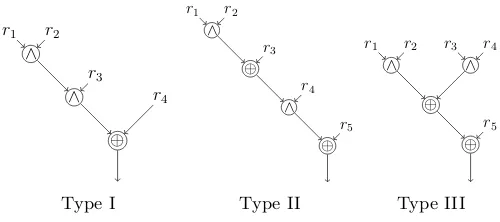
The result readily implies that there are three different circuit types computing functions with multiplicative complexity 2. These are shown in Figure 1.
Theorem 12 The number ofn-variable Boolean functions with mul-tiplicative complexity 2 is exactly
2n(2n−1)(2n−2)(2n−4)·
2 21+
2n−8
12 +
2n−8 360
.
r1 r2
r3 r4
⊕ ∧
∧
r1 r2 r3
r4 r5
∧
⊕
∧
⊕
r1 r2 r3 r4
r5
∧
⊕ ∧
⊕
Type I Type II Type III
Fig. 1.The three different circuit types for the three equivalence classes.ridenotes an affine form on the input variables. Every function with multiplicative complexity 2 can be computed by exactly one of the three displayed circuits.
1. [x1x2x3]
2. [x1x2x3+x1x4]
3. [x1x2 +x3x4]
Type I: The size of the equivalence class [x1x2x3], x1x2x3 ∈ B3 is
the number of functions with degree 3, which is equal to 128. The dimension of this function is 3. Using Theorem 8, the size of the equivalence class [x1x2x3], x1x2x3 ∈ Bn is
2n+1(2n−1)(2n−2)(2n−4) 21
Type II: Letf1, f2 ∈ B4 bex1x2x3 andx1x2x3+x1x4 respectively.
It is easy to see that, for n = 4, |[f1]|+|[f2]| equals the number of
Boolean functions inB4 with degree 3, which is equal to 30720. Using the result presented above,|[f1]|= 3840, hence|f2|= 30720−3840 =
26880. The dimension of f2 is 4. Using Theorem 8, the size of the
equivalence class [x1x2x3+x1x4],x1x2x3+x1x4 ∈ Bn is
2n(2n−1)(2n−2)(2n−4)(2n−8)
12 .
Type III:Letf1, f2 ∈ B4bex1x2andx1x2+x3x4 respectively. For
n = 4, there are two equivalence classes ([x1x2] and [x1x2 +x3x4])
that include the quadratic functions. Hence, |[f1]|+|[f2]| is equal to
the total number of quadratic function, which is 2016. Using that
|[x1x2]|= 2 2 4 3
896 for n = 4. The dimension of f2 is 4. Using Theorem 8, the size
of the equivalence class [x1x2+x3x4], x1x2x3+x1x4 ∈ Bn is 2n(2n−1)(2n−2)(2n−4)(2n−8)
360 .
We conclude that the total number of functions with multiplicative complexity 2 is
2n(2n−1)(2n−2)(2n−4)·
2 21+
2n−8
12 +
2n−8 360
,
which concludes the proof. ut
6
Conclusion
One can count the number of Boolean functions with multiplica-tive complexity M by exhaustively listing the equivalence classes with multiplicative complexity M and finding the size of each class. In this paper, we showed that there are only three equivalence classes [x1x2x3], [x1x2x3+x1x4] and [x1x2+x3x4] with multiplicative
com-plexity two, and the number of n-bit Boolean functions with multi-plicative complexity two is 2n(2n−1)(2n−2)(2n−4)(212 +2n12−8+2360n−8). However, for multiplicative complexity three, it is hard to list the equivalence classes exhaustively. For functions on n = 4, one can show that [x1x2x3x4],[x1x2x3x4+x1x2] and [x1x2x3x4+x1x2+x3x4]
are the only equivalence classes with multiplicative complexity 3. For n = 5, the exhaustive list of classes with multiplicative complexity 3 is not known. Turan and Peralta [10] showed that the number of such classes is between 16 and 24. For n = 6, there are 2497 equivalence classes having degree at most 4. This provides an upper bound on the number of equivalence classes that can be computed by circuits with three AND gates, since some of these might have multiplicative complexity 4 or more.
Acknowledgments
References
1. Zvika Brakerski, Craig Gentry, and Vinod Vaikuntanathan. (leveled) fully homo-morphic encryption without bootstrapping. In Shafi Goldwasser, editor, Innova-tions in Theoretical Computer Science 2012, Cambridge, MA, USA, January 8-10, 2012, pages 309–325. ACM, 2012.
2. Vladimir Kolesnikov and Thomas Schneider. Improved garbled circuit: Free XOR gates and applications. In Luca Aceto, Ivan Damg˚ard, Leslie Ann Gold-berg, Magn´us M. Halld´orsson, Anna Ing´olfsd´ottir, and Igor Walukiewicz, editors, Automata, Languages and Programming, 35th International Colloquium, ICALP 2008, Reykjavik, Iceland, July 7-11, 2008, Proceedings, Part II - Track B: Logic, Semantics, and Theory of Programming & Track C: Security and Cryptography Foundations, volume 5126 of Lecture Notes in Computer Science, pages 486–498. Springer, 2008.
3. Joan Boyar, Ivan Damg˚ard, and Ren´e Peralta. Short non-interactive cryptographic proofs. J. Cryptology, 13(4):449–472, 2000.
4. Martin R. Albrecht, Christian Rechberger, Thomas Schneider, Tyge Tiessen, and Michael Zohner. Ciphers for MPC and FHE. In Elisabeth Oswald and Marc Fis-chlin, editors,Advances in Cryptology - EUROCRYPT 2015 - 34th Annual Inter-national Conference on the Theory and Applications of Cryptographic Techniques, Sofia, Bulgaria, April 26-30, 2015, Proceedings, Part I, volume 9056 ofLecture Notes in Computer Science, pages 430–454. Springer, 2015.
5. Nicolas Courtois, Daniel Hulme, and Theodosis Mourouzis. Solving circuit opti-misation problems in cryptography and cryptanalysis, 2011.
6. Joan Boyar, Magnus Find, and Ren´e Peralta. Four measures of nonlinearity. In Paul G. Spirakis and Maria J. Serna, editors,CIAC, volume 7878 ofLecture Notes in Computer Science, pages 61–72. Springer, 2013.
7. Magnus Gausdal Find. On the complexity of computing two nonlinearity mea-sures. In Edward A. Hirsch, Sergei O. Kuznetsov, Jean- ´Eric Pin, and Nikolay K. Vereshchagin, editors,Computer Science - Theory and Applications - 9th Interna-tional Computer Science Symposium in Russia, CSR 2014, Moscow, Russia, June 7-11, 2014. Proceedings, volume 8476 ofLecture Notes in Computer Science, pages 167–175. Springer, 2014.
8. Joan Boyar, Ren´e Peralta, and Denis Pochuev. On the multiplicative complexity of Boolean functions over the basis (∧,⊕, 1).Theor. Comput. Sci., 235(1):43–57, 2000.
9. Joan Boyar and Ren´e Peralta. A new combinational logic minimization technique with applications to cryptology. In Paola Festa, editor, SEA, volume 6049 of Lecture Notes in Computer Science, pages 178–189. Springer, 2010.
10. Meltem S¨onmez Turan and Ren´e Peralta. The multiplicative complexity of boolean functions on four and five variables. In Thomas Eisenbarth and Erdin¸c ¨Ozt¨urk, editors,Lightweight Cryptography for Security and Privacy - Third International Workshop, LightSec 2014, Istanbul, Turkey, September 1-2, 2014, Revised Selected Papers, volume 8898 ofLecture Notes in Computer Science, pages 21–33. Springer, 2014.
11. Pavol Zajac and Matus Jokay. Multiplicative complexity of bijective 4 x 4 s-boxes. Cryptography and Communications, 6(3):255–277, 2014.
13. Roland Mirwald and Claus-Peter Schnorr. The multiplicative complexity of quadratic Boolean forms. Theor. Comput. Sci., 102(2):307–328, 1992.
14. Claus-Peter Schnorr. The multiplicative complexity of Boolean functions. In AAECC, pages 45–58, 1988.
15. Elwyn R. Berlekamp and Lloyd R. Welch. Weight distributions of the cosets of the (32, 6) Reed-Muller code. IEEE Transactions on Information Theory, 18(1):203– 207, 1972.
16. Joanne Elizabeth Fuller. Analysis of affine equivalent boolean functions for cryp-tography. PhD thesis, Queensland University of Technology, 2003.
17. James A. Maiorana. A classification of the cosets of the Reed-Muller code R(1,6). Mathematics of Computation, 57(195):403–414, 1991.
18. An Braeken, Yuri L. Borissov, Svetla Nikova, and Bart Preneel. Classification of Boolean functions of 6 variables or less with respect to some cryptographic prop-erties. In Lu´ıs Caires, Giuseppe F. Italiano, Lu´ıs Monteiro, Catuscia Palamidessi, and Moti Yung, editors,ICALP, volume 3580 ofLecture Notes in Computer Sci-ence, pages 324–334. Springer, 2005.
19. Xiang-Dong Hou. AGL (m, 2) acting on R (r, m)/R (s, m). Journal of Algebra, 171(3):927–938, 1995.
Appendix
Proof of Propositon 6
Proof. Suppose without loss of generality (by renaming the variables if necessary) that the variable x1 occurs in Lx+a. By elementary
row operations, there exists a nonsingular linear transformation P such that the matrix representation of P Lis in reduced row echelon form. We may further, without loss of generality, assume that the first ` columns of the matrix representation of P L form an ` × ` identity matrix. Define z=P(Lx+a)∈F`
2.
Let F = f ◦P−1, so that F(z) = f(Lx+a). Since dim(f) = `
and F ∈ [f], we have that dim(F) = `; therefore, the variable z1
occurs in nonlinear terms in F. Let d ≥2 be the maximum among degrees of monomials in z1, . . . , z` in whichz1 occurs.
Clearly, for all 1 ≤i≤`,
zi =xi+Li(x`+1, . . . , xn) + ˜ai.
Thus for an arbitrary permutation σ of 1, . . . , `, we have
zσ(1)· · ·zσ(d) =xσ(1)· · ·xσ(d)+p(x`+1, . . . , xn) + lower degree terms,
Since the maximum degree monomials in which z1 occurs are
of degree d, the collection of degree d monomials in x1, . . . , x` is
linearly independent, and the collection of the degree d monomials inz1, . . . , z` is linearly dependent, for any degree dmonomial in the
ANF of F containing z1 there is a degree d monomial in the ANF
of f(Lx+a) containing x1. Sinced ≥2, the variablex1 occurs in a