© 2017, IJCSMC All Rights Reserved 182
Available Online atwww.ijcsmc.com
International Journal of Computer Science and Mobile Computing
A Monthly Journal of Computer Science and Information Technology
ISSN 2320–088X
IMPACT FACTOR: 6.017
IJCSMC, Vol. 6, Issue. 1, January 2017, pg.182 – 189
The Edge Domination in Prime
Square Dominating Graphs
Narayana. B
1, Raghava Lakshmi. V
2, Sudhakaraiah. A*
1
Research Scholar, Department of Mathematics, Rayalaseema University, Kurnool, A. P., India
2
Department of S&H (Mathematics), Vijaya Institute of Technology for Women, Vijayawada, A. P. - 521108, India *Department of Mathematics, S. V. University, Tirupati, Andhra Pradesh-517502, India
1
[email protected], 2 [email protected], * [email protected]
Abstract— This paper brings into view various findings related to edge domination numbers of prime square dominating graphs. Some classified prime square dominating graphs are chosen for this means of study and their edge domination numbers are resolved.
Keywords— prime square dominating graph, edge dominating set, edge domination number, independent edge dominating set,
independent edge domination number.
I. INTRODUCTION
Graphs considered in this paper are all undirected, connected and simple graphs. Throughout this paper, the graph G = (V, E). Terms not defined here are used in the sense of Harary [1].
Mitchell and Hedetniemi [2] introduced the concept of edge domination. A subset X of E is called an edge dominating set of G if every edge not in X is adjacent to some edge in X. The edge domination number (G) of G is the minimum cardinality taken over all edge dominating sets of G. An edge dominating set X is called an independent edge dominating set if no two edges in X are adjacent. The independent edge domination number (G) of G is the minimum cardinality taken over all independent edge dominating sets of G. The edge independence number (G) is defined to be the number of edges in a maximum independent set of edges. Arumugam and S. Velammal [ 3] derived many results related to edge domination.
© 2017, IJCSMC All Rights Reserved 183
II. IMPORTANT RESULTS
The following results obtained by S. R. Jayaram [ 6 ] characterize edge dominating sets of graphs and their edge domination number.
Result 1: For any graph G, =
Result 2: For any (p; q) -graph G; ≤ q - where denotes the maximum degree of an edge in G.
Result 3: For any (p; q) - graph G; = q - + where is the number of isolated edges in G. Result 4: For any (p; q) - graph G; + ≤ q + 1.
III. MAIN THEOREMS
A. Theorem 1
Let the vertex set V = { , , ,..., }, n ≥ 2 of a prime square dominating graph G be such that a vertex , 1≤ i ≤ n is labeled
with a prime number and the remaining all vertices are labeled with composite numbers , ,... , so that divides for k = 2, 3, 4, …, n. Then the edge domination number of the prime square dominating graph G is one.
Proof: Let the vertex set V={ , , ,…, } of the prime square dominating graph G be labeled with composite numbers and prime numbers satisfying the conditions mentioned in the theorem. Obviously, { is an edge of the graph
since divides for k = 2, 3, 4, …, n. As there is no other vertex labeled with prime except cannot be adjacent to any other vertex, except for k = 2, 3, 4, ……, n. Therefore, the distinct edges of the graph are { }, { }, .….., { } and
moreover, every edge dominates every other edge of the graph. The set of every edge is an edge dominating set. Edge domination number of a graph is always greater than or equal to one. Hence, edge domination number of the graph is one.
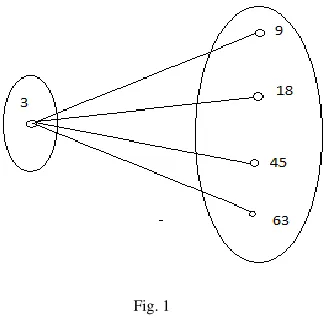
1) Experimental problem: Consider the prime square dominating graph G with vertex set V ={3, 9, 18, 45, 63, }. The graph satisfies all the conditions stated in the above theorem for = 3, , , , Clearly, minimum edge dominating sets are { }, where k = 2, 3, …, 5. The edge domination number of the graph is one. Prime square dominating
graph in this case will be as shown in the Fig. 1.
Fig. 1
B. Theorem 2
© 2017, IJCSMC All Rights Reserved 184
composite and prime numbers so that divides all the composite numbers and all the squares of primes divide only , then the edge domination number of the prime square dominating graph G is one.
Proof: Let the vertex set V = { , , ,………, }, of a prime square dominating graph G labeled with composite numbers and prime numbers satisfy the conditions mentioned in the theorem.
By hypothesis, except , the squares of all the other primes divide only one composite number . So, all the vertices labeled with primes, except , are adjacent only to . Moreover, all the composite numbers, except , are divisible only by . Vertex labeled with is adjacent to all the vertices labeled with composite numbers and is adjacent to all the vertices labeled with prime numbers. It follows that, all the edges are adjacent to the edge { }.The edge set consisting of
single edge { } is an edge dominating set and further more it is a minimum edge dominating set. Hence, the edge domination
number of the graph is one.
1) Experimental problem: Consider the prime square dominating graph with vertex set V = {2, 3, 5, 8, 900, 12, 16}. Prime square dominating graph in this case will be as shown in the Fig. 2.
Fig. 2.
Here 22 divides 8, 900, 12, 16 and 32 divides only 900. Also, 52 divide only 900. The vertices = 2 and = 900 satisfy all the conditions mentioned in the theorem. The edge { 2, 900 } is adjacent to all the remaining edges. Hence, the set consisting of the single edge { 2, 900 } is a minimum edge dominating set. Hence, the edge domination number of the graph is one.
C. Theorem 3
Let G be a prime square dominating graph with vertex set V= { , , ,…, }, n ≥ 3. Let the vertices with even suffixes be labeled with prime numbers , ….respectively starting with and the vertices with odd suffixes be labeled with composite numbers , ….respectively starting with such that divides only and for 1≤ i ≤ n and for even values of i. Then
for n = 3, 6, 9, …..
the edge domination number of the graph G = for n = 4, 7, 10, …..
for n = 5, 8, 11, ….. Proof: Let the vertex set V = { , , ,………, } of the graph G be labeled with composite numbers and prime numbers
satisfying the conditions mentioned in the theorem. It is supposed that divides only and for 1≤ i ≤ n and for even values
of i. Two cases will arise i.e., n may be odd or even
Case ( i): Let n be even. Then
divides only and ; divides only ; divides only ; ……….; divides only . As the graph is a prime square dominating graph, the edges of the graph will be { , }, { , }, { , ,
© 2017, IJCSMC All Rights Reserved 185
Case ( ii ): Let n be odd. Then
divides only ; divides only ; divides only ; ……….;
divides only & . The edges of the graph will be { , },{ , }, { , , { , }, ……… …..,
{ , , { , },{ , , { , }.
Clearly, the minimum edge dominating set of the graph G in the two possible cases will be as follows
{{ , },{ , { , },{ , ,……….,{ , }} for n = 3, 9, 15, ….
{{ , { , },{ , { , },………..,{ , }} for n = 6, 12, 18, …..
{{ , },{ , ,{ , },{ , ,……,{ , }} for n = 4, 10, 16, …..
{{ , ,{ , },{ , ,{ , }, ,……,{ , }} for n = 7, 13, 19, …..
{{ , },{ , },{ , { , },{ , ,………..,{ , }} for n = 5, 11, 17, ….
{{ , { , { , },{ , { , },……….,{ , }} for n = 8, 14, 20, …..
for n = 3, 6, 9, …..
Hence, the edge domination number of the graph G = for n = 4, 7, 10, …..
for n = 5, 8, 11, …..
1) Experimental problem: Consider the following prime square dominating graphs.
© 2017, IJCSMC All Rights Reserved 186
Fig.4 Fig.5 Fig.6
Prime Square Dominating Graphs
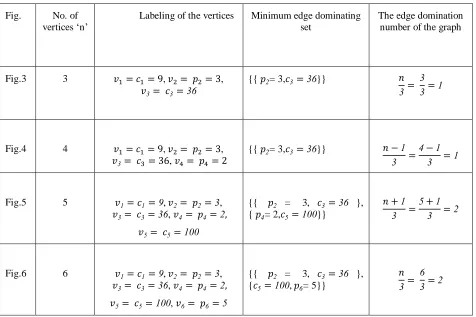
The above prime square dominating graphs satisfy all the conditions mentioned in the theorem for n=3, n=4, n=5, n=6, n=7 and n=8. Therefore, the minimum edge dominating sets of all the graphs in the above figures will be as in Table. I.
TABLE. I
Minimum Edge Dominating Sets of Prime Square Dominating Graphs
Fig. No. of vertices „n‟
Labeling of the vertices Minimum edge dominating set
The edge domination number of the graph
Fig.3 3 , ,
{{ = 3, }}
Fig.4 4 , ,
,
{{ = 3, }}
Fig.5 5 , ,
,
{{ = 3, }, { = 2, }}
Fig.6 6 , ,
,
,
{{ = 3, }, { , = 5}}
9 3
3
7 100 1225
© 2017, IJCSMC All Rights Reserved 187
Fig.7 7 , ,
,
,
{{ = 3, },
{ , = 5}}
Fig.8 8 , ,
,
,
{{ = 3, }, { , = 5},
{ , = 7}}
D. Theorem 4
Let G be a prime square dominating graph with vertex set V= { , , ,…, }, n ≥ 4. Let the vertices with even suffixes be labeled with prime numbers , ….respectively starting with and the vertices with odd suffixes be labeled with composite numbers , ….respectively starting with such that divides only and for i = 2, 4, 6, ……2n-2 and divides
only and . Then
for 2n = 4, 10, 16, …..
the edge domination number of the graph G = for 2n = 6, 12, 18, …..
for 2n = 8, 14, 20, …..
Proof: Let the vertex set V = { , , ,………, } of the graph G be labeled with composite numbers and prime numbers satisfying the conditions mentioned in the theorem. It is assumed that divides only
, divides only , divides and ……….. divides and and divides and .
As
the graph is a prime square dominating graph, the distinct edges of the graph will be { , }, { , }, { , , { , }, ………….………., { , , { , }, { , and { , }. For every three consecutive edges starting from
the initial vertex , every second edge can be placed in the edge dominating set. Every second edge in three consecutive edges is adjacent to the edges that precede it and follow it. As a result, the minimum edge dominating set of the graph G in all the possible cases will be as follows:
{{ , },{ , },{ , ,{ , },{ , ,……….,{ , }} for 2n = 4, 10, 16, …..
{{ , { , },{ , { , },………..,{ , }} for 2n = 6, 12, 18, …..
{{ , }, { , { , }, { , { , }, ……..,{ , }} for 2n = 8, 14, 20, …..
for 2n = 4, 10, 16, …..
Hence, the edge domination number of the graph G = for 2n = 6, 12, 18, …..
© 2017, IJCSMC All Rights Reserved 188
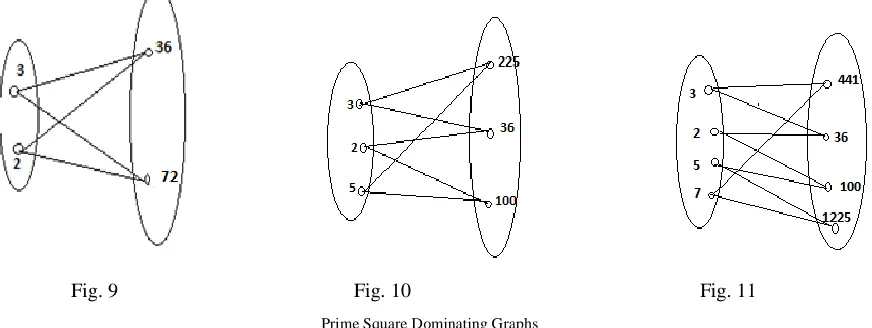
1) Experimental problem: Consider the following prime square dominating graphs
Fig. 9 Fig. 10 Fig. 11
Prime Square Dominating Graphs
The above prime square dominating graphs satisfy all the conditions mentioned in the theorem for n=4, n=6, n=7 and n=8. Therefore, the minimum edge dominating set of all the graphs in the above figures will be as in Table. II.
TABLE. II
Minimum Edge Dominating Sets of Some Prime Square Dominating Graphs
Fig. No. of vertices „2n‟
Labeling of the vertices Minimum edge dominating set The minimum edge domination number of the graph
Fig.9 4 , ,
,
{{ , = 2}
{ = 3, }}
Fig.10 6 , ,
,
,
{{ , = 5}
{ = 3, }}
Fig.11 8 , ,
,
,
{{ = 7, },
{ , = 5},
{ , = 36}}
© 2017, IJCSMC All Rights Reserved 189
IV. CONCLUSION
Initially the paper has outlined the results regarding the edge domination in graphs and headed out into exploring the edge domination number of some prime square dominating graphs. This can be considered innovation in the field of theory related to prime square dominating graphs. In due course, efforts in the paper open up many an avenue in the field of research on prime square dominating graphs.
REFERENCES
[1] F. Harary, Graph Theory, Addison-Wesley, Reading Mass., 1969.
[2] S. Mitchell and S. T. Hedetniemi, Edge domination in trees, Congr. Numer.19 (1977), 489-509.
[3] S. Arumugam and S. Velammal, “Edge domination in graphs”, Taiwanese Journal of Mathematics Vol. 2, No. 2, pp. 173-179, June 1998 .
[4] Seod M.A.and Youssef M.Z., “On prime labeling of graphs”, Congr. Number.141(1999), 203-215.