A Scheme for Review, Annotation and Correction of Specifications Anthony Finkelstein
Imperial College of Science, Technology & Medicine, Department of Computing
Abstract
In this paper we outline a scheme for marking suggested edits and
annotations on specifications during the process of review and correction. The scheme is based on a formal model of negotiation and typographic marking methods used in conventional document preparation. The scheme permits precise and interpretable marking and annotation of complex structured documents which use many different notations. It supports and guides the process of correction. Some examples and a sample visual notation are given. Tool support for using this scheme is discussed.
1 Introduction
Specifications, like all large and complex documents, are prone to error, whether simply slips or more serious faults. The process of eliminating errors has two parts, spotting an error and correcting the specification. In the study of specification much attention has been paid to the business of spotting errors through, for example, animation, automated reasoning and inspection, but virtually no attention has been paid to that of correcting specifications.
The task of correcting specifications is, at least, as complex as constructing a specification de novo. Once the error has been spotted, and tentatively tied down to a part (or parts) of the specification, a strategy for remediating the error must be developed and agreed. It must be ascertained whether the error is, indeed, an error and whether the cost of correcting it exceeds the likely costs incurred by allowing it to remain in the specification. It may be important to determine who is responsible for the error so as to eliminate further errors. Where correcting the specification requires expertise or authority outside that of the person who spotted the error this needs to be obtained. This may mean informing further people of the nature and location of the error.
Specifiers are seldom very disciplined about this process. Specifications are distributed, in draft form, to reviewers who, having applied their tools and analytical skills, will return comments, questions and corrections. Unless a special purpose comment form or questionnaire has been included the reviewer will most often scribble on the draft itself, occasionally complementing the draft with "post-it" notes or memos. It is, in principle, possible for a reviewer using automated tools to directly edit the specification creating a new version which can subsequently be merged into the finalised specification. However, many of the reviewers comments are not direct edits but rather requests for clarification and the like. Even where there is a need to make direct edits it is often too difficult for the reviewer to learn to use the variety of high functionality
automated tools that may be necessary.
for this scheme and illustrate how it is used for some small examples. We discuss the relation between our approach and other methods and give an account of tool support and scaling-up.
2 Requirements Specifications
In this section we discuss requirements specifications, the most complex and least well understood documents in software development, and explain why they are of particular interest when investigating review annotation and correction.
We have concentrated on requirements specifications for two reasons. Errors introduced at the requirements specification stage become increasingly costly to correct as development proceeds, hence it makes sense to fix errors as early as possible. Reviewing and correcting
requirements specifications is made significantly more complex, and hence more interesting, by their particular structure and content.
The commonly accepted definition of a requirements specification is that it is a document which establishes, as precisely as possible, the services that the software is required to provide and the constraints under which those services are provided. A systematic model of the real world from which these requirements arise provides a structure within which this
information is presented. While this definition accounts for the central core of a requirements specification it is in fact a considerably more multi-faceted document than the definition suggests. It may contain: a large amount of general domain information to orient the developers; those design decisions fixed by policy; assessments of the feasibility of satisfying the requirements with available technologies; contractual information; an outline of the projected software development process; accounts of
management procedures; quality assurance standards; and so on. As such it both addresses and is reviewed by a large and various audience with a mix of skills and interests.
A distinguishing feature of the requirements for large and complex
The means we have for expressing requirements are relatively poor. The representation schemes used can only express limited aspects of the requirements. The consequence of this is that no single representation scheme is a wholly appropriate medium in which to construct a
requirements specification. For example, petri nets might be used to describe behaviour, entity-relationship-attribute diagrams to capture static data and data flow diagrams to express data transformation. The whole document might be glued together by passages of natural language which state non-functional requirements such as quantity and timing
constraints, the relations which hold between the other parts of the specification, and so on. Most requirements specifications are thus
tapestries of different representation schemes. Errors and consequently the need to correct the specification span across many representation schemes. Thus, requirements specifications consist of many different types of
knowledge couched in a mixture of representation schemes - formal, informal and formatted. They are reviewed by many different people with different and partial knowledge of the requirements and the
representation schemes used. In the discussion which follows we examine how we can support the process of review and correcting errors in such documents.
3 Document Preparation Methods
Over time publishers and others who have to produce many complex documents have developed schemes for removing as many errors as possible from their documents. These schemes have, for obvious reasons, concentrated on correcting documents rather than on spotting errors. New text processing techniques have changed many time honoured practices in this area beyond recognition. Nevertheless, as in the case of printing and graphic design, we disregard the experience that has been gained at our peril.
We may divide the processes of preparation into three broad phases, acquisition, copy-editing and proof. The acquisition phase determines if the document, as a whole, is suitable for publication. It establishes whether its content and structure are broadly suitable, if it meets the objectives set for it, if it is of an appropriate standard, and so on. If a document is
In this section we will largely be concerned with copy-editing though we will also draw on techniques of proof correction.
Copy-editing begins once the manuscript has been placed before the copy-editing department by the acquisitions editor. The manuscript will be read through by the copy-editor who may perform three types of editing. The first is syntactic, which covers such routine matters as spelling and
hyphenation. The second is style editing, which covers both "press style", for example use of quotations, presentation of bibliographies and indexes, and the more familiar "literary style" or means of expression, for example sentence structure, choice of words and so on. The third is substantive editing, which covers rewriting and reorganising the text.
The copy-editor will mark the edits on the manuscript in a blue pencil. Different colour pencils are used to distinguish who is marking what -there are accepted conventions governing the colours used. Author corrections or queries are marked in a black pencil, printer corrections of printer errors or general queries are marked in a green pencil, author or editors corrections of printer errors are marked in a red pencil.
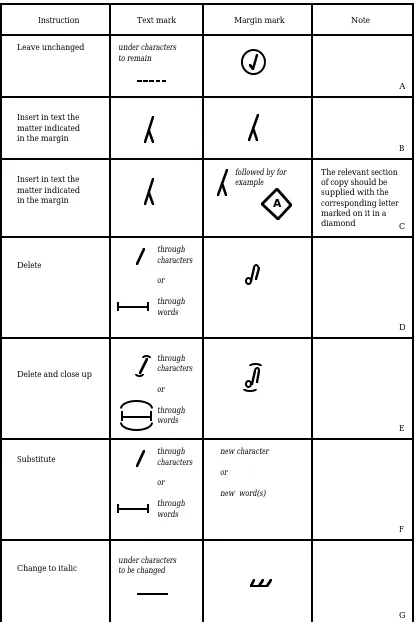
The edits are marked using a simple scheme which allows the author to examine the edits and determine whether they are correct and appropriate. Each editing operation has an associated pair of marks - a text mark, to appear in the text at the exact place where the edit is to be made and a marginal mark to signify and amplify the meaning of the text mark. Marginal marks are essential in a large document so that the document can be rapidly scanned for edits, it is however common to omit marginal marks during the early editing stages where the editing is very heavy. There are special marks for types of error which frequently occur, such as character transposition.
Tables 1 & 2 show a small sample of copy-editing marks taken from BS 5261, the UK standard on copy preparation and proof correction. Some are probably familiar, others less so. Certain marks can be combined to give composite edits, G and H to give I. Some marks are more complex
A
Instruction Text mark Margin mark Note
Leave unchanged under characters to remain
Insert in text the matter indicated in the margin
Insert in text the matter indicated in the margin
followed by for example
The relevant section of copy should be supplied with the corresponding letter marked on it in a diamond
Delete
through characters
or
through words
Delete and close up
through characters
or
through words Substitute
through characters
or
through words
new character
or
new word(s)
under characters to be changed Change to italic
A
B
C
D
E
F
G
3 2 1
123
Instruction Text mark Margin mark Note
under characters to be changed
Change to bold
under characters to be changed
Change to bold italic
circle characters to be changed
Change capital letters to lower case letters
Start new paragraph
Run on
Transpose characters or words
between characters or words
Transpose characters or words
The vertical strokes are made through characters or words to be transposed
H
I
J
K
L
M
N
Table 2
Marginal marks generally appear on the margin closest to the text mark and are sequenced so that the farthest text mark from the edge of the block of text corresponds to the margin mark nearest the edge of the block of text. Each mark is concluded with a single angled stroke. For an
B. Keyset Reception Device (KRD)
- the KRD receives the digtis
that constitute the dialled
number.
C. Register Functions (RF) - this
block stores and analyzes the
dialled number. The RF blocck
recognises the expected number of
digits and consults tables for
selection of outgoing routes. It
also supervises the set up phase
of a telephone call.
this
An important feature of copy-editing marks is that they are (more or less independent) of the language in which the document is written. The same marks apply if the document is in Italian or English (clearly, certain
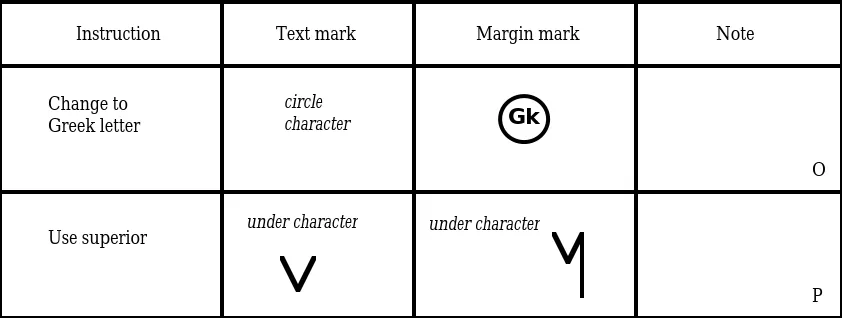
languages such as Chinese may be more problematic). Special additional copy-editing marks are used for mathematical notation. See for example Table 3.
Instruction Text mark Margin mark Note
O
P Change to
Greek letter Gk
circle character
Use superior under character under character
Table 3
Once the copy-editor has completed marking up the document it is
returned to the author, generally with a covering letter giving a rationale for the changes. The author will check through the edits to ensure that they are correct and appropriate. The document may go through several copy-edit - author correction cycles before the manuscript is accepted by both parties as complete.
expedient of having a single master document. Both copy-editor and author keep copies of preceding versions. Edits can be cancelled by placing the word stet by the original margin mark.
The completed manuscript is sent to the printer who will prepare a proof or early printed version which shows type, justification, and so on, as they will appear in the finished document (depending on the printing
technique there may be many of these - galley proofs, page proofs, and so on). The proof will undergo some editing and revision by both author and copy-editor. The edits will, at this stage, mostly concern errors introduced during typesetting. A rule of thumb is that a maximum of 10-15% of the document may be changed after the initial proof version, any changes above this amount will probably result in considerable additional cost. Some specialist marks to denote common printers errors such as marks from visible paper edges are used, see Table 4: Q. Generally the printer will find some problems with the manuscript and will mark these on the proofs returned to author and copy-editor using, for example, mark R.
Instruction Text mark Margin mark Note
Q
R Remove
extraneous marks
circle marks
Refer to appropriate authority anything of doubtful accuracy
circle words
?
Table 4
Increasingly automated approaches are being adopted to marking formatting during document preparation. An example of these are generalized markup schemes in which the document structure and attributes are described and subsequently associated with processing
instructions. These are likely to make much of the traditional style editing task obsolete. Nevertheless the conventional techniques still apply in syntactic and substantive editing or in documents where limited and highly localised style changes are to be made to a pre-existing text.
4 Analysis
These marks have the following benefits:
they provide a categorisation of common types of edits and queries and thus provide a vehicle for communication between reviewer and author;
they are simple to understand and manipulate;
they are independent of the underlying representation and hence can be used in documents consisting of heterogeneous representations; they mark errors and queries explicitly and by identifying potential conflicts support the resolution of disagreements.
The existing copy-editing and proof correction marks are, however, of limited use in specification review, annotation and correction being very low-level, in the sense of largely addressing character and word
manipulation rather than larger text units, and concentrating on syntactic rather than semantic elements of the document.
Below we attempt to develop a scheme of marks and give a sample notation which:
preserves and builds on the benefits of copy-editing and proof correction marks;
addresses corrections and annotations to specifications at the appropriate level;
is (notationally) consistent and well (formally) defined; is amenable to automated support.
5 Model of Specification Construction and Review
A requirements specification, at its most basic level, consists of a set of statements. These statements may be textual, graphical, mathematical or some hybrid. A simple example is:
"All transactions with the auto-teller are in units of £5"
Each such statement is an effective restriction on the freedom of action on the part of the developer who must build a system that satisfies the
specification. By making a statement the specifier is, in effect, making a "commitment" that is, holding him or herself out as liable for the consequences of that statement. If, in the example above, the specifier subsequently demands that the auto-teller allows customers to withdraw cash in any units they demand, we would not be surprised if the developer complained.
We see specification as a process by which commitments are negotiated and established by the parties having responsibility for the description and development of the system. This process takes the form of a dialogue or organised sequence of locutions.
Our model permits the following locution types: ask a question - "Is it the case that...?";
make an assertion - "It is the case that...";
make a denial - "I deny that it is the case that...". withdraw a statement - "No commitment to..."; make a challenge - "Why is it to be supposed that...";
demand that the consistency of the other participant's commitments is checked (resolve commitments) - "Are these commitments consistent?"; demand that the consistency of the other participant's commitments is checked with respect to a given statement (resolve consequences) - "Given a commitment to...are your commitments consistent"
Dialogues have an "etiquette" which governs the legitimate shape of the interaction. The permitted sequences are described in dialogue (or
response) rules
Performing a locution will generally have an effect on the commitments of both the "speaker" and the "hearer". In our model we give
Additionally we can define, syntactically, the form of reasoning
permissible within the dialogue and common to it's participants. Our model primarily involves "modus ponens", though addition of other schemas to fit various logical tastes is a relatively simple matter.
In the section which follows we outline how this model can be applied to support a scheme for review, annotation and correction.
6 Scheme
In this section we develop a scheme for review, annotation and correction of specifications consequent upon the discovery of a flaw in the
specification, generally during validation. The scheme has a formal underpinning described in the model above and is inspired by and develops the visual marking schemes used in traditional document preparation.
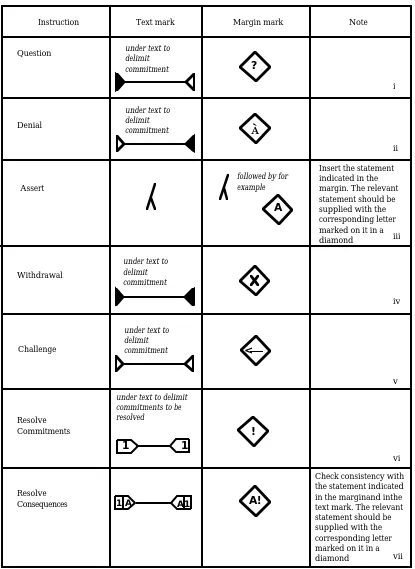
We use a simple graphic notation for our marking scheme which, with minor variations, can be applied to specifications in natural language and formal notations or some mixture of both (we can envisage a variant notation which could be used for diagrammatic specifications - Appendix A). We are not particularly attached to our notation, and it is intended as illustrative, though some attention has been given to its design. Further research attention will be paid to the human factors issues of the notation. As a starting point is, of course, important to distinguish who is
reviewing, annotating and correcting what. We shall consider two participants which, following the copy editing convention we shall distinguish by the colour used for marks - black and blue. In our figures blue is shown as shaded. In the following discussion we distinguish two roles specifier and reviewer. These roles are interchangeable (akin to the speaker/hearer roles in dialogue) thus if initially black is the specifier, once black has handed over the specification for comment to blue and blue starts making marks on the specification the roles are reversed - black is the reviewer and blue the specifier. Black always starts. This shifting of roles can be confusing and should be kept in mind when reading the description of the scheme which follows.
Instruction Text mark Margin mark Note
Question under text to delimit
commitment ?
Denial
under text to delimit
commitment
¬
Assert
A
Insert the statement indicated in the margin. The relevant statement should be supplied with the corresponding letter marked on it in a diamond followed by for
example
Withdrawal
under text to delimit commitment
under text to delimit commitment > Challenge Resolve Commitments 1
under text to delimit commitments to be resolved
1
!
11 A A1 A!
Resolve Consequences
Check consistency with the statement indicated in the marginand inthe text mark. The relevant statement should be supplied with the corresponding letter marked on it in a diamond i ii iii iv v vi vii Table 5
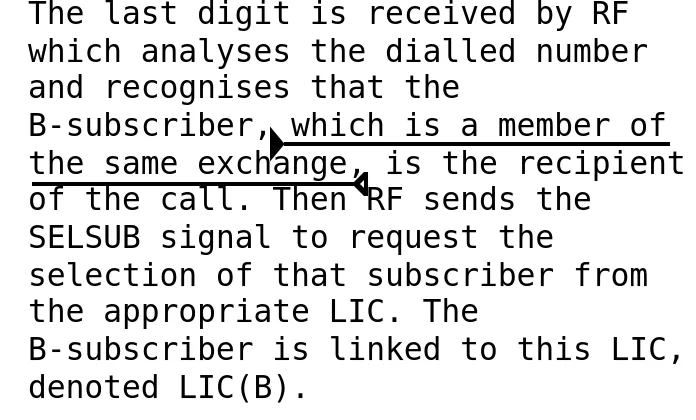
The last digit is received by RF
which analyses the dialled number
and recognises that the
B-subscriber, which is a member of
the same exchange, is the recipient
of the call. Then RF sends the
SELSUB signal to request the
selection of that subscriber from
the appropriate LIC. The
B-subscriber is linked to this LIC,
denoted LIC(B).
?
Figure 2
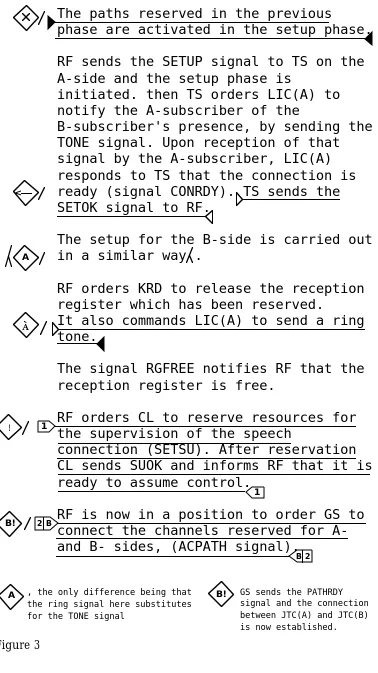
The paths reserved in the previous
phase are activated in the setup phase.
RF sends the SETUP signal to TS on the
A-side and the setup phase is
initiated. then TS orders LIC(A) to
notify the A-subscriber of the
B-subscriber's presence, by sending the
TONE signal. Upon reception of that
signal by the A-subscriber, LIC(A)
responds to TS that the connection is
ready (signal CONRDY). TS sends the
SETOK signal to RF.
The setup for the B-side is carried out
in a similar way .
RF orders KRD to release the reception
register which has been reserved.
It also commands LIC(A) to send a ring
tone.
The signal RGFREE notifies RF that the
reception register is free.
RF orders CL to reserve resources for
the supervision of the speech
connection (SETSU). After reservation
CL sends SUOK and informs RF that it is
ready to assume control.
RF is now in a position to order GS to
connect the channels reserved for A-
and B- sides, (ACPATH signal).
GS sends the PATHRDY signal and the connection
between JTC(A) and JTC(B)
is now established.
>
A
, the only difference being that
the ring signal here substitutes
for the TONE signal
A
¬
1
1 !
1
2 B
B!
2 B
B!
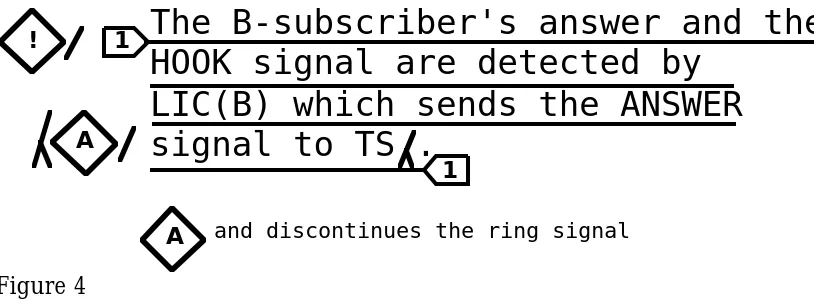
There are some simple syntactic rules governing the application of these marks. The marks for questions, denials, assertions, and withdrawals and challenges must not overlap. The marks for resolutions can overlap with questions denials and assertions. In these circumstances the statements to be checked are the ammended versions of the original statements. See for example Figure 4 in which the mark indicates that the statement to be resolved includes the assertion.
The B-subscriber's answer and the
HOOK signal are detected by
LIC(B) which sends the ANSWER
signal to TS .
A
and discontinues the ring signal A
1 !
1
Figure 4
As in our dialogue model the way in which a text has been marked conditions the responses that can be made to it. We can state these in dialogue rules that describe the ways in which replies may be made. Thus, for example, after the questioning of a statement, the appropriate response must be either the assertion (confirmation) of that statement, it's
withdrawal or it's denial. Or, the reply to a challenged statement must be the withdrawal of the statement or it must be the assertion of a statement to which the challenger is not committed.
Similarly each mark has an effect on the commitments of the participant making that mark, the specifier, and on the commitments of the
participant who receives the marked document, the reviewer. These are given in the form of commitment rules.
Assertions add a commitment on the part of the specifier to the assertion and also have the effect of committing the reviewer. The same is true for denials. Questions have no effect on the commitments of the specifier nor of the reviewer. Demands to resolve commitments also have no effect on commitments. Demands to resolve consequences have no effect on
commitments of either specifier or reviewer, the given statement is treated as a fact to be assumed solely for the purpose of consistency checking. A withdrawal removes a commitment to the withdrawn statement on the part of the specifier but remains a commitment of the reviewer. Challenges also have the effect of removing the commitment of the specifier to that statement, the challenged statement becomes a
There is a type of special commitment rule which we call an argument form, our scheme only includes one of these. If the response to a challenge (for example in Figure 3, a challenge to the statement "TS sends the
SETOK signal to RF") is a statement given as a ground for the challenged statement (for example,"the setup for the A-side is now complete") both the specifier and the reviewer are committed to the response ("the setup for the A-side is now complete") and to the latter logically implying the former ("the setup for the A-side is now complete hence TS sends the SETOK signal to RF").
We have given an outline of the marking scheme and the role of dialogue and commitment rules in defining the effect of the marks and permitted responses. In the section which follows we show how the scheme can be applied.
7 Using the Scheme
In this section we consider in more detail how the review, annotation and correction scheme discussed above can be used.
Let us consider a typical scenario. The specifier (who only has limited knowledge about the domain) will not be fully aware of the consequences of some of the corrections that he or she is making. That is, the
consequences of marks when placed in the context of unmarked text which have become part of the commitments by "default". Typically the reviewer's response will be to demand that the specifier checks for inconsistencies in some marked portion of what are now the specifier's commitments or determines their consistency against some given statement. Alternatively, the reviewer may simply deny a statement asserted by the specifier.
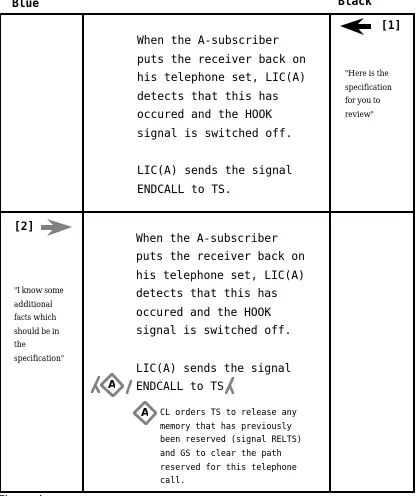
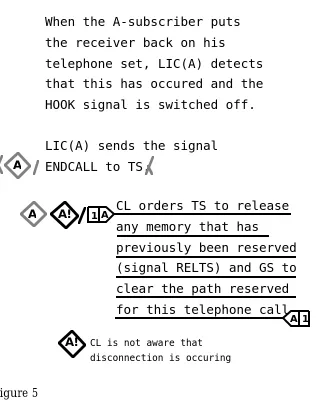
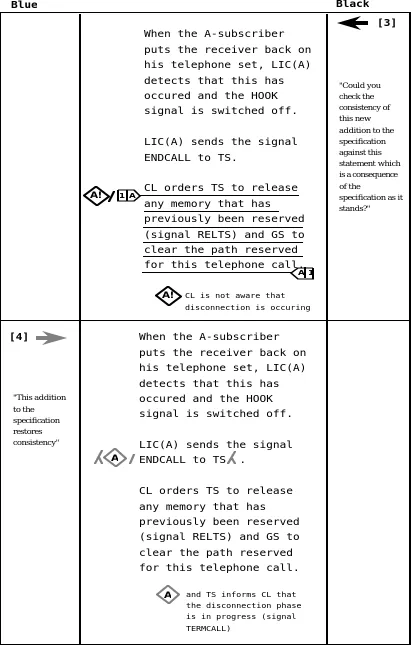
In such a manner corrections bounce back and forward until there are no further outstanding marks and all changes to the specification have been agreed. There may of course come a point where one side or another will have to exert authority to ensure that this is the case. A simple fixing sequence is shown in Figures 4 & 6. In the columns on the left and right hand sides of the figures we indicate the specifying party, the position in the sequence of marks and, for pedagogic reasons, an explanatory
comment.
Because we wish to avoid the situation where the specification becomes cluttered with marks we assimilate the changes into the main body of the specification as we go along. This leads to a the following three step
made in the preceding set of changes are assimilated into the specification and the cleaned up specification is passed on.
The assimilation of changes is done in accordance with the commitment rules thus assertions and denials lead to direct changes while questions and demands to resolve consequences or commitments have no effect on the specification. Withdrawals and challenges are somewhat more
complex. In the case of a withdrawal the commitments are reinstated (the mark is removed and no change made to the specification) unless the marked withdrawal has been immediately overlayed by another withdrawal in which both marks are removed and the text excised.
Challenges are marked indelibly, the mark persists and cannot be removed from the specification. This is to avoid circular arguments.
Black Blue
When the A-subscriber
puts the receiver back on
his telephone set, LIC(A)
detects that this has
occured and the HOOK
signal is switched off.
LIC(A) sends the signal
ENDCALL to TS.
[2]
When the A-subscriber
puts the receiver back on
his telephone set, LIC(A)
detects that this has
occured and the HOOK
signal is switched off.
LIC(A) sends the signal
ENDCALL to TS.
CL orders TS to release any
memory that has previously
been reserved (signal RELTS)
and GS to clear the path
reserved for this telephone
call.
A A
[1]
"Here is the specification for you to review"
"I know some additional facts which should be in the
specification"
When the A-subscriber puts
the receiver back on his
telephone set, LIC(A) detects
that this has occured and the
HOOK signal is switched off.
LIC(A) sends the signal
ENDCALL to TS.
CL orders TS to release
any memory that has
previously been reserved
(signal RELTS) and GS to
clear the path reserved
for this telephone call.
A A
1
1 A
A!
1 A
CL is not aware that
disconnection is occuring A!
Black Blue
When the A-subscriber puts the receiver back on his telephone set, LIC(A) detects that this has occured and the HOOK signal is switched off.
LIC(A) sends the signal ENDCALL to TS.
CL orders TS to release any memory that has previously been reserved (signal RELTS) and GS to clear the path reserved for this telephone call.
A A [3] [4] 1 1 A A! 1 A
CL is not aware that
disconnection is occuring A!
When the A-subscriber puts the receiver back on his telephone set, LIC(A) detects that this has occured and the HOOK signal is switched off.
LIC(A) sends the signal ENDCALL to TS .
CL orders TS to release any memory that has previously been reserved (signal RELTS) and GS to clear the path reserved for this telephone call.
and TS informs CL that
the disconnection phase
is in progress (signal
TERMCALL)
"Could you check the consistency of this new addition to the specification against this statement which is a consequence of the
8 Experience and Tool Support
We believe that our scheme is of value to discipline and make systematic review, annotation and corrrection. We have gained experience on a significant number of small examples and are currently working on larger "real-life" examples from the telecommunications and computer
integrated manufacture domain. Clearly our scheme is amenable to automated support. We are developing a simple "desk accessory" which can be used alongside existing CASE and document preparation tools and will support the use of the scheme described above. To this end we have simulations of the underlying model both in Prolog and Smalltalk and are working a hypertext based tool which will allow us to examine the
application of the scheme in more detail. This tool will deploy a revised notation using highlighting and icons.
We have not, to date, considered in detail the complexities that can arise when many people concurrently revise a specification though they are clearly important. This topic will be receiving further attention.
9 Comparison and Relations
We have been unable to find any precise equivalent to the approach we have adopted here. There are however a number of related areas which are worthy of mention.
For details of traditional approaches to document preparation reference may be made to The University of Chicago (1982) or to Butcher (1975). Some interesting comments on hand marking of documents can be found in Gould & Salaun (1987) also Welbourn & Whitrow (1988). Hartley (1984) has examined the comments provided by colleagues about an academic article. Many of the categories of comment he observes are supported within our scheme. His work suggests that some empirical analysis of specification marking and editing might be worthwhile.
In the area of software engineering Fickas & Nagarajan (1988) have conducted some interesting work on critiquing specifications. What we provide can be seen as complementary to this work. Feather (1987) examines how specifications are constructed, his use of the term high-level editing is suggestive of links with the work outlined above.
they provide a rough categorisation of meta-text objects (essentially those document items not intended for inclusion in a finished document). It is interesting to note that correction marks are the only class of such objects which have not received attention from those involved in specification. Attaching annotations to software and specification objects is widely used (Reiss 1990). We have used notes attached to specifications as a basis for method guidance in a CASE tool (Kramer, Finkelstein et al. 1987). An interesting development in this area is the use of hypertext to support software development notably Conklin (1989).
10 Conclusions
What have we achieved with this scheme? We have developed a simple way of reviewing, annotating and supporting the correction of
specifications. It gives a discipline to the ill organised activity of review, annotation and correction specifications by providing guidance and support to both specifier and reviewer. With a fairly simple set of marks rich and complex annotations can be made. The scheme is precisely interpretable and can be applied to specifications consisting of many different representation schemes. Further, by basing our review scheme on a formal model of negotiation and specification construction we can preserve a rationale for the specification and maintain traceablity of requirement during reviews.
Acknowledgements
Thanks to my colleagues and students, in particular thanks to Hugo Fuks, Jeff Kramer and Jeff Magee. Thanks also to the CEC and Esprit project REX (2080) who provided the funding for this work. The examples are extracted from Votsis & Papoulias (1989) and Reed (1989).
References
Butcher, J. (1975); Copy-editing: the Cambridge handbook; CUP, Cambridge.
Conklin, J. (1989); Design Rationale and Maintainability; Proc 22nd Hawaii International Conference on System Sciences; II, pp533-539; IEEE CS Press. Feather, M. (1987); Constructing Specifications by Combining Parallel Elaborations; [To appear] IEEE Trans. Software Engineering.
Finkelstein, A. & Fuks H. (1989); Multi-Party Specification; Proc 5th International Workshop on Software Specification & Design, pp 185-195; IEEE CS Press (also as Special Issue of ACM Software Engineering Notes). Gould, J. & Salaun, J. (1987); Behavioural Experiments on Handmarkings; (full reference not available).
Hartley, J. (1984); The Role of Colleagues and Text-Editing Programs in Improving Text; IEEE Trans. on Professional Communication; PC27,1. Kramer, J.; Finkelstein, A.; Ng, K.; Potts, C. & Whitehead, K. (1987);"Tool Assisted Requirements Analysis: TARA final report”; Imperial College, Dept. of Computing, Technical Report 87/18.
Reed, J. (1989); A Design Specification of a Telephone Switch Using CSP & Z; Private Communication.
Reiss, S. (1990); On the Use of Annotations for Integrating the Source in a Program Development Environment; In: Finkelstein, A. Tauber, M. & Traunmuller R. (Eds) Human Factors in Information Systems Analysis and Design; North Holland, pp25-36.
Sharples, M. & Pemberton, L. (1990); Starting from the Writer: guidelines for the design of user-centred document processors; University of Sussex, School of Cognitive & Computing Sciences Technical Report, CSRP 154. The University of Chicago (1982); The Chicago Manual of Style (13th Edition); The University of Chicago Press, Chicago.
Votsis, G. & Papoulias, A. (1989); Internal Call Between Subscribers in the Same Digital Switching Exchange Equipment; REX (Esprit Project 2080) Telecommunications Demonstrator.
Welbourn, L. & Whitrow, R. (1988); A Gesture Based Text Editor; HCI'88 -People & Computers IV, Jones & Windsor (Eds); (full reference not
Appendix A
The notation we have shown apply primarily to natural language and formal representation schemes. An alternate (but semantically equivalent) set of marks can be devised for graphical schemes. An off-the-cuff example of the use of such marks is given below. Note that we can mark a resolve consequences between a graphic element and a piece of formal notation.
A
LIC TS
KRD RF GS
TS LIC
B
CL
TONE CONRDY
HOOK TONE
SETOK SETUP
SETOK
SETUP
CONRDY
RING RING
SETSU SUOK
TAKEOVER RG REL
RG FREE
ACT PATH
PATH RDY
A!
A! T= offhook → D <>
I ring (offhook → Speech) I T)