https://edupediapublications.org/journals/index.php/IJR/
online: Available
224 |
P a g e
Manifestation of Interpersonal Aspect of Systemic Functional Grammar in
Bush's and Al-Assad's First Inaugural
Imad Hayif Sameer Ishraga Bashir El-Hassan
Department of English Department of English
University of Anbar / Iraq Al-Neelain University Khartoum, Sudan.
[email protected] [email protected]
صلختسملا
لا ربتعت
ةيحاتتفلاا ةيسائرلا تاباطخ
نم
و .ةيسايسلا تاباطخلا مهأ
با
لا
امتع
د
ا
و
هيلك ةروصب
عونلا اذه ىلع
ربكأ سامتلاو ، سانلا ةقث زيفحتو ، مهتايونعم زيزعتو ، نينطاوملا عانقإ ىلإ سيئرلا فدهي ، باطخلا نم
طاوم نم معدلا نم ردق
، ةمهملا هذه قيقحتلو .هين
يفتني
هثيدح لقصيو ، هباطخ يف هتاملك ةيانعب سيئرلا
يف .ةفلتخم ةيوغل تايجيتارتساو تاراهم ىلإ ءوجللاب
ىلإ ةساردلا فدهت ، كلذ ءوض
يلجتلا ميدقت
ل
تانوكم
تانوكم دحا وه يذلاو يقئلاعلا رصنعلا
ي ، فدهلا اذه قيقحتلو .ةيجهنملا ةيفيظولا دعاوقلا
مت
يحاتتفلاا نيباطخلا ليلحت
نمزلا لماع ىلغ اءانب امهرايتخا مت ناذللاو دسلااو شوبل ني
ناأدبي امهلاك نلأ
ميمصت يف يسيئر رود هل تقولا لماع .ةرتفلا سفن يف
مادختسا متي .عونلا اذه
ةغللا ملع
يفيظولا
يجهنملا
نم جهنك
CDA
نايبلا ليلحتل
ىلع زكرت يتلا تا
لا
modality
و
ةفرعم اهللاخ نم نكمي يتلا
.ةددحم ةوقو تايجولويديإ قيقحتل ةغللا اهب لمعت يتلا ةقيرطلا
ةيوحنلا دعاوقلاو ةللادلا ملع نيب ةقلاعلا
لاث للاخ نم
لا تافلاتخلاا يه تلااجم ةث
ةيهجوت
لعافتلا .ةيرظنلا هذه رهوج يه ةيصنلاو ةيضارتفلااو ،
لثم ةيللادلا تايجيتارتسلاا نيب نم اهرايتخا متي يتلا ةيصخشلا تاقلاعلا نم ةعومجم ، نيرخلآا عم
، رارصلإا ، بلطلا ، عانقلإا
نأ ىلإ ةساردلا تصلخو .ةيجازملا ةلاحلا ىمسي امب ىلجتي كلذ ىلإ امو
ت ، ةطيسبو ةريصق ، ةلهس لمج ىلع دمتعي شوب
يف ، تلااحلا مظعم يف ، ىلجت
عراضملا نمز مادختسا
لا
طيسب
لوصحلل
نأ نيح يف ، روهمجلا ةقث ىلع
باطخ
قيقحتل ةدقعمو ةليوط لمج ىلإ دنتسي دسلأا
.هسفن فدهلا
Abstracthttps://edupediapublications.org/journals/index.php/IJR/
online: Available
225 |
P a g e
Systematic Functional Grammar. To achieve this objective, Bush’s speech and Al-Assad speech which are not chosen randomly but they are chosen because both of them start within the same period are analyzed. The factor of time has its major role in designing the form of this genre. Systematic Functional Linguistics is used as an approach of CDA to analyze the data focusing on the point of modality by which it is possible to know the way by which language serves to achieve specific ideologies and power. The relationship between semantics and grammar by three areas which are interpersonal, ideational and textual metafunctions is the core of this theory. The interaction with other people, a range of interpersonal relationships which are chosen among semantic strategies such as persuading, requesting, insisting, and so on is manifested by what is called mood. The study concludes that Bush depends on easy, short and simple sentences which are , in most cases, manifested in present simple tense to get the audience’ trust while that of Al-Assad is based on long and complex sentences to achieve the same goal.
Key Words: Critical Discourse Analysis, Political Discourse, Systemic Functional Grammar,
Transitivity, Modality and Textuality.
1-Introduction
Opaque relationships of causality and determination between texts, events, practices and social and cultural structures, relations and processes are explored by Critical Discourse Analysis. It is studied to make a clear investigation about the way by which such texts, events, practices are ideologically shaped or designed by relations of power and reflect the struggles over power. It aims at changing linguistics by introducing critical perspectives on language which are drawn or derived from critical theory in social sciences. To analyze any discourse, a better understanding of relations between discourse and other elements of social life such as relations of power, ideologies, social institutions and organizations and social identities are required. Political discourse forms a contribution to the development of critical discourse analysis. It views political discourse as primarily a form of argumentation which is more specifically practical one for or against particular way of acting by which the decision can be grounded. To make a decision, agents consider both reasons that favour a particular tentative line of action investigate the reasons against it, as well as reasons in favour or against alternatives. This is not mean that political discourse contains only practical arguments but it is most fundamentally about making choices about how to act in response to circumstances and goals and such choices and actions follow from them are based on practical argumentation.
https://edupediapublications.org/journals/index.php/IJR/
online: Available
226 |
P a g e
factors (Critical discourse analysis, Political Discourse and Systemic Functional Grammar) within the most important genre of political discourse which is the inaugural speech.
2-Theoretical Review
A-Critical Discourse Analysis (CDA)
According to Wodak and Meyer (2008:3-5), the terms critical linguistics (CL) and Critical
Discourse Analysis (CDA) are often used interchangeably. They argue that CDA is not interested in investigating a linguistic unit per se but in studying social phenomena which require a complexity to a great extent and thus require a disciplinary and multi-methodical approach. They stress that CDA has never been and has never attempted to be or to provide one single or specific theory. Neither is one specific methodology characteristic of research in CDA. The reverse is completely true, studying in CDA are multifarious, derived from quite different theoretical background, oriented towards different data and methodologies.
Van Dijk as cited in Schiffrin et al (2001: 353) argues that CDA is a type of discourse analytical research that focuses on studying the way social power abuse, dominance, and inequality are enacted, reproduced, and resisted by text and talk in the social and political context. This definition motivates him to mention a number of requirements which characterize critical research on discourse which are:
1-Its main focus is on social and political issues, rather than on current paradigms and fashions.
2-It tries to explain them in term of properties and social interaction and especially social structure rather than merely describe discourse structures.
3- The ways discourse structures enact, confirm, legitimate, reproduce, or challenge relations of power and dominance in society is the main focus of CDA.
Fairclough and Wodak as mentioned in Hart (2010:15) state that CDA has its own tenets which may be summarized by eight points. These tenets are:
A-CDA addresses social Problems.
B- Power relations are discursive.
C- Discourse constitutes society and culture.
D- Discourse does ideological work.
E- Discourse is historical.
F- The link between text and society is mediated.
https://edupediapublications.org/journals/index.php/IJR/
online: Available
227 |
P a g e
H- Discourse is form of social action.
B- Political Discourse
Van Dijk as cited in Fairclough and Fairclough (2012: 18) argues that political discourse analysis (PDA) is the analysis of political discourse which is understood from critical perspective which focuses on the production and contestation of political power through political discourse, this discourse is characterized by political actors- individuals (politicians, citizens), political institutions and organizations, engaged in political processes and events. These characteristics have not any role without the notion of context because they do not form political discourse, if they found outside political discourse. What form this context are institutional contexts which make it possible for actors to exert their agency and empower them to act on the world in a way that has an impact on matters of common concern.
According to Chilton (2004:4), the ambivalence is an apparent characteristic of language and this characteristic manifests when anyone wants to take account to the ' intention' of a speech act in a political discourse, he cannot find or distinguish a single or straightforward intention. He proposes three categories to describe the strategic use of language when conditions have constrains on communication or distort it which are: (i) Coercion (ii) Legitimization and delegitimisation and (iii) Representation and misrepresentation. Political actors often act coercively in discourse, claiming access to resources and power, and controlling others’ use of language. Legitimization is linked to coercion, establishing power through the discursive claim to legitimacy. Delegitimisation manifests itself in negative other-presentation, attaching negative features to a particular group or groups. Representation and misrepresentation is a powerful means of control through discourse.
C- Systemic Functional Grammar
https://edupediapublications.org/journals/index.php/IJR/
online: Available
228 |
P a g e
They (ibid: 5-10) clarify the relationship between semantics and grammar by three areas which are interpersonal, ideational and textual metafunctions. When we are interacting with other people, we enter into a range of interpersonal relationships which are chosen among semantic strategies such as persuading, requesting, insisting, and so on. Grammar provides as with the basic resource for doing that. It can do that by presenting set of clause systems which can be called mood. The most general choice in mood is that between "indicative" and "imperative" clauses. Each one of them has its own systemic features. The former has a finite verb, whereas the latter does not, the former has a subject, whereas the latter may or may not have one because it is typically absent. Looking at the system itself, the former has many choices to differentiate the tense among( past/ present/ future) and the persons while the situation is different with the latter where there is one tense (present) and one person( the addressee).The choice between ' indicative' and ' imperative' is the most general one in this area of grammar. Indicative clauses can be either declarative or interrogative. The former are tagged or untagged. The latter are either of WH-type or Yes /No type.
Fontaine (2013:78) argues that the meaning can be created by grammar within highly generalized metafunctions that relate to the phenomena outside language which are interpersonal and ideational. The interaction between speaker(s) and addressee(s) is the concern of the interpersonal metafunction. The grammatical resources for enacting social roles in general and speech roles in particular, in dialogic interaction are used for establishing, changing, and maintaining interpersonal relations. One of its major grammatical systems is MOOD. Grammatical resources for construing our experience of the world around us and inside us are the focus of the ideational metafunction having Transitivity as one of its major grammatical systems. These two metafunctions orient towards two 'extra-linguistic' phenomena, the social world and the natural world; we construe the natural world in the ideational mode and to enact the social world in the interpersonal mode. In addition, there is a third metafunction, intrinsic to language that is the textual metafunction. The creation of text is the main interest of the textual metafunction which is concerned with the presentation of ideational and interpersonal meanings as information that can be shared by speaker and listener in text unfolding in context. One of the major textual systems is THEME where a local point of departure in the flow of information is selected. The role of the textual metafunction is to enable the presentation of ideational and interpersonal meaning as information that can be shared. It provides the speaker with strategies for guiding the listener in his/ her interpretation of the text. She affirms that MOOD (interpersonal), TRANSITIVITY (ideational), and THEME (textual) are simultaneous strands within the system network of the clause.
https://edupediapublications.org/journals/index.php/IJR/
online: Available
229 |
P a g e
expressions. Both meanings and expressions interface with the extra- linguistic- meanings with social life, expression with bodily processes such as those of vocal mechanism.
Chapman and Routledge (2009:225) state that Systemic Functional grammar consists of two components which are systemic grammar and functional grammar. These two parts are inseparable parts of an integral framework of this theory. SFG is an approach to linguistic description which aims to provide a comprehensive account of how language is used in context for communication. This approach deals with language as a source that is mainly shaped by the uses the people make of it. For this reason, it aims to explain the forms of language in terms of the meanings that they express. The development of grammar which is designed to make it possible to say sensible and useful things about any text is another aim of this approach.
Two main distinguishing features which are contained in the name form this theory. First, whereas many approaches study the syntagmatic (horizontal) dimension of how constituents may be combined with other constituents in a well- formed structure, this theory gives a priority to the choices that are open to the speaker at any particular point in an utterance- the paradigmatic (vertical) dimension. In other words, the grammatical structures are seen as the outcome of choices from those available. Sets of choices between options can most economically be shown in the form of systems. (Halliday and Matthiessen, 2006:313)
According to Chouliaraki and Fairclough (ibid: 143-145), the other key feature of functional nature where SFG is designed is to map the relationships between forms and meaning in a consistent way. This side of grammar has a number of important implications. First, the most important labels are functional (semantic: telling us what the elements mean), rather than formal (telling us what they consist of).
The second implication is that SFG is extravagant. In order to capture the multivariate relations between meaning and structure, the grammatical model has to allow for different perspectives on the clause to provide a much richer and more informative set of descriptions.
The third implication studies or shows that the communicative function of utterances can only be fully understood in relation to their meaning in context.
Mattiessen and Halliday (1997: 12-20) argue that these two key bases of this model combine together in the concept of metafunctions which are:
https://edupediapublications.org/journals/index.php/IJR/
online: Available
230 |
P a g e
2-The experiential metafunction in which language is seen from the perspective of how it is used to talk about events, states and entities in the world, to interpret or construe the speaker's view of the world. An experiential analysis of a clause focuses on the process (realized by the verb), the participants in that process (typically, but not always, realized by nominal groups), and the circumstances in which the process happens (typically realized by adverbial groups or prepositional phrases).To make sense of the events around us, we use the cognitive categories which are reflected by the six main types of specific processes which are:
A-Material (processes of action).
B-Mental (processes of sensing which clarify or construe our interior world).
C- Relational (process of being and having).
D- Verbal (processes of conveying messages, by saying, and so on.).
E- Behavioral (human physiological processes).
F- Existential (processes of existing).
3-The textual metafunction which is concerned with how the meanings in the clause are organized to fit in with the context of surrounding messages and with the wider context of the utterance.
Chouliaraki and Fairclough (ibid: 145) mention that the stratal organization of language means that the link between meaning and expression strata is mediated by a stratum which does not itself directly interface with the extra linguistic- lexicogrammar (grammar plus lexis, which is seen as functionally grounded, shaped by the social functions it serves. The grammar is structured as three major ' networks' of grammatical systems (transitivity, mood and modality, and information- including theme/ rheme and given/ new which correspond to these three macrofunctions. Every clause in a text is seen as grammatically constituted simultaneously as semiotic production ( textual function) which constructs the world( ideational function) while enacting social relations between its producers and others who inhabit that world( interpersonal function). Thus the social is built into grammatical issue of language.
3. The Grammar of Interpersonal Meaning: (Mood)
https://edupediapublications.org/journals/index.php/IJR/
online: Available
231 |
P a g e
dialogue. In other words, this means that the dialogue is the means language gives us for expressing interpersonal meaning about roles and attitudes. The person who is able to take part in dialogue means that he is able to negotiate the exchange of interpersonal meanings. As a result, he is able to realize social relationships with other language users. This justifies how the description of structures of clauses explains how interpersonal meanings are being realized in interactive texts.
Halliday as cited in (Halliday & Matthiessen, 2004:106-111) states that whenever we use language to interact, we establish relationship between us (between the person is speaking now and the person who will speak next). We take turns at speaking to establish this relationship. As we take turns, we take on different speech roles in the exchange. Speech role can be one of the following: giving, demanding, information and exchanging goods and services. These speech roles are manifested through statement, question, offer and command. When the speaker initiates one of these speech roles, another speaker is very likely to respond. This means that here are two choices between initiating and responding moves. The second one is either supporting or confronting. There is a correlation between the different structures of an initiating move and the structure of responding moves. The second ones are shorter than the former because they contain some kinds of abbreviations, ellipsis or what we call minor clauses. The kind of differences is not random. They have to do with what is called the MOOD structure which refers to the organization of a set of functional constituents. Exploring the MOOD structure must be done by concentrating on how clauses are structured to enable us to exchange information. The beginning will be with what Halliday called a Proposition which is used to exchange information while the clause which enables us to exchange goods and services is called Proposal.
Eggins (ibid: 155-60) argues that the MOOD constituent of clause (Written in capital letters) is used to differentiate it from the general term mood which describes the overall structure of the clause. Each clause consists of MOOD and Residue such as:
He is a teacher
MOOD Residue
To differentiate MOOD from Residue, we can ask ' which part of the clause cannot disappear when the responding speaker takes up his position. In other words, we must look for the essential part of the clause which contains the nub of the argument. Another test is the question tag where elements that get picked up in the Tag are the MOOD constituents of the clause. We can say that the clause consists of two functional constituents: a MOOD element which functions to carry the argument and Residue which can be left out or ellipsed. Halliday as cited in (Halliday and Matthiessen, 2004:106) states that MOOD element carries the burden of the clause as an interaction event. Two main elements form the constituents of MOOD which are:
https://edupediapublications.org/journals/index.php/IJR/
online: Available
232 |
P a g e
2-A verbal –type element (Finite)
The function of the Finite is to anchor the proposition, to bring it down to the earth so we can argue about it.
Halliday and Matthiessen (ibid: 116) argue that Finite can be either Temporal Finite Verbal Operators or Finite Modal Operators. The former supply the clauses with tense (past, present and future) while the latter anchor the proposition not by reference to the tense but by reference to Modality. The Finite carries either tense or Modality to make a Proposition debatable. Finite also includes the semantic feature of polarity, since to make something arguable it has to be either positive or negative.
Fontaine (2013:121-22) indicates that polarity is always presents in the Finite, even though it does not appear as separate element when it is positive. After discussing the constituents of MOOD, an idea about Residue must be acquired. It contains a predicator, one or more complement and any number of different types of Adjuncts. The predicator can be defined as the lexical or content part of the verbal group as shown in the following example:
I Am Reading a story
Subject Finite Predicator complement
MOOD Residue
In the above example, the verb phrase (VP) consists of two elements ' am reading'. The first part belongs to the Finite because it carries the features of number, tense and polarity while the second part tells us what process is actually going on. Resorting to the predicator, we can specify the actual event, action or process being discussed. It can be identified as being all the events of VP after the single Finite element such as:
They should have been doing their homework at time that I called
Subject Finite Predicator
MOOD Residue
In clause where there is only a single verbal constituent such as simple present, simple past, we have fusion of the elements of the Finite and the Predicator as in:
I Knew Him
Subject Finite Predicator Complement
MOOD Residue
Halliday and Matthiessen (2004: 122) mention three additional functions of predicator which are:
https://edupediapublications.org/journals/index.php/IJR/
online: Available
233 |
P a g e
2-It specifies aspects and phrases.
3-It specifies the voice of the clause.
A second component of the Residue is the complement which is defined as non- essential participant in the clause; it is somehow affected by argumentation of the proposition. The following bold words clarify what is meant by complement:
The headmaster gave the clever studenta gift.
The headmaster is the man who has a stick.
Eggins (2004:160-3) mentions that Modal Adjuncts form the final constituents that we need to describe or understand the structures of clause by which we can realize the first metafunction of Systemic Functional Linguistics. Modal Adjuncts are clause constituents which add interpersonal meaning to the clause. They impact Mood element either directly or adding some qualifications to the (Subject /Finite) or indirectly by merely adding an expression of attitude. Modal Adjuncts can be of four types which are:
A-Mood Adjuncts
B-Polarity Adjuncts
C-Comment Adjuncts
D-Vocative Adjuncts
The first two act directly on the MOOD constituent while the last two affect the clause as a whole.
1-Mood Adjuncts
I) Expressions of probability: (perhaps, may be)
II) Expressions of usuality: (sometimes, usually)
III) Expressions of intensification or minimization: (really, absolutely)
IV) Expressions of presumption: (obviously, evidently)
V) Expressions of inclination: (happily, willingly)
https://edupediapublications.org/journals/index.php/IJR/
online: Available
234 |
P a g e
Admission: frankly
Assertion: honestly, really
How valid: broadly speaking, generally
How sensible: understandable, wisely
How expected: as expected, amazingly
3.1. Modality
Modality is a grammatical category associated with many expressions such as obligation, permission, necessity, prohibition, possibility and ability. This definition of the term proposed by (Trask, 2005: 125) makes the process of separation between Modality and Mood so easy. The last expresses degree or kind of reality. The first term is particularly convenient in discussing language which contains a specific set of modals and auxiliaries to express or show these concepts. The modals of English comprise: can, could, will, would, shall, should, may, might, must and ought to in addition to their negated forms. Studying this category is so important in discourse because it has its shade on several other categories such as: Evidentially (the amount and the nature of the evident which the speaker has to say something), Modalization (the probability or regularity of a utterance), Modularity (the degree of commitment or willingness involved on somebody part), Hedging (when the speaker reduces his commitment to what he is saying) and vague language.
Eggins (180-83) mentions that Modality has its own sub-types such as:
(a) Modalization
When we exchange information (A proposition) we are arguing about whether something is or is not but these two cases or poles of polarity are not the only possibilities. A number of choices of degree of certainty, or usuality are in between. These intermediate positions are what we called Modalization. It is one half of the general grammatical area of modality. It is a complex area of English grammar which has to do with different ways in which language users can intrude on his message, expressing attitudes and judgments of various kinds. When the speaker uses modality to argue about the probability of proposition, it is called Modalization but when it is used to argue about the obligation or inclination of proposals, it is nominated Modulation.
Halliday and Matthiessen (2004:617-21) argue that Modalization involves expressions of two kinds of meaning:
1-Probability = likelihood
https://edupediapublications.org/journals/index.php/IJR/
online: Available
235 |
P a g e
Modality can be traced by three ways:
1-Through the choice of finite modal operator such as:
The Bostonian' Might have been written by Henry James
Subject Finite Modal Predicator Adjunct: Cir
MOOD Residue
2- Through the use of Mood Adjuncts of probability and certainty.
The Bostonian' Was Possibly Written By Henry James
Subject Finite Adjunct: mood Predicator Adjunct: Cir
MOOD Residue
3-Through both together: a modal Finite and a Mood Adjunct.
Both modal operators and Mood Adjuncts can be of three types or kinds depending on the degree of certainty or usuality they express:
High = (must, certainly, always)
Median= (will, probably, usually)
Low = (may, possibly, sometimes)
(b)- Modulation
Fontaine (2013:120) argues that aside from the imperative and modulated interrogative structures, we also have other ways of using language to get people to do things for us, or of offering to do things for them. Finite verbal operators such as 'should' 'must' do this task. They are described as modulated Finite as shown in:
You shouldn't take this copy
Subject Finite: Modulate Predicator Complement
MOOD Residue
You Must read this copy
Subject Finite: Modulate Predicator Complement
MOOD Residue
You are obliged to read this copy
Subject Finite Predicator: modulated: complex Complement
MOOD Residue
You are required to read this copy
https://edupediapublications.org/journals/index.php/IJR/
online: Available
236 |
P a g e
MOOD Residue
With proposals, we do not just argue about do or do not but there is also scale but this time the scale is not of possibility or usuality, but of obligation and inclination. We can recognize degrees of modulation (high: must / required/ determined), median (will/ supposed to/ keen) and Low: may/ allowed to/willing)
Modulation is a way for speakers to express their judgments or attitudes about actions and events. Inclination is another type of modulation which expresses how willing I am to do something for you such as: I want to. I'd like, I am willing to, I am happy to, I am determined to
Data Analysis of Modality
Table (1): Frequency of Tenses in the Two Speeches
Past continuous
Past Present Future Total
simple Perfect
First Speech
0 13 122 6 22 163
0% 7.97% 74.84% 3.68% 13.49% 100%
Second Speech
4 132 433 47 45 661
0.60% 19.96% 65.50% 7.11% 6.80% 100%
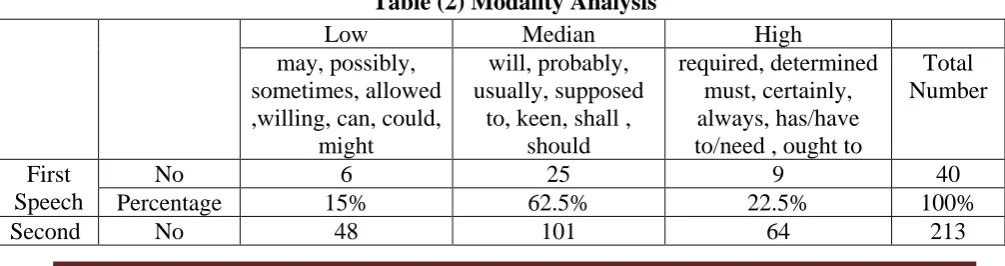
Table (2) Modality Analysis
Low Median High
may, possibly, sometimes, allowed ,willing, can, could,
might
will, probably, usually, supposed
to, keen, shall , should
required, determined must, certainly, always, has/have to/need , ought to
Total Number
First Speech
No 6 25 9 40
Percentage 15% 62.5% 22.5% 100%
https://edupediapublications.org/journals/index.php/IJR/
online: Available
237 |
P a g e
Speech Percentage 22.53% 47.41% 30.04% 100%
According to the Interpersonal metafunction which is reflected by Mood, it is expected to recognize high percentage of the use of modal verbs because they are more easily understood and identified in this kind of speech where the speaker does not have the sufficient time to reflect his ideas and projects depending on indirect way. With this metafunction, we also guess that the simple present tense is most frequently used. The top priority of this tense is due since the speeches are to present or deal with the domestic and worldwide situations ranging from economic, cultural and political fields at present. This tense facilitates or in other sense aims at creating a close relationship between the president and his audience. The second rank is to future tense which is used to show the expected things in the future. Depending on it, the president lay out his government's following reforms to foster the buildup of the country and reflecting the corresponding changes or results of the measures in his term (in the future). The president does his best to draw a rosy future in this kind of speech to achieve the audience's support. Recalling the positive or negative experiences of the past is done by simple past and present perfect. The point that deals with personal pronouns is not tackled in this metafunction of this kind of speech because it is clear that the priority will be on behalf of the following pronouns: 'I', 'we', 'my' and 'our'.
Conclusion
On the basis of the above discussion, we can conclude the following results:
1-Bush uses short sentences which contain simple words instead of difficult ones while Al-Assad resorts to long sentences involving many difficult words.
2-Bush's language is easy one. The easiness of his language helps him to shorten the distance between him and the audience while that of Al –Assad is difficult to some extent.
3- Depending on the Interpersonal metafunction, both of them are capable of making their audience accept what they have said. They tackle the tenses with the same balance giving the simple present tense the priority to achieve their first objective which is the audience's confidence. Both of them are talent and qualified to persuade the public and get their support but Bush speech has the priority in terms of the point collected because his speech tackles many topics depending on clear and simple style taking in consideration the factor of time required to deliver the speech.
https://edupediapublications.org/journals/index.php/IJR/
online: Available
238 |
P a g e
Blackledge Adrian.(2005).Discourse and Power in a Multilingual World. John Benjamins
Publishing Company. Amsterdam / Philadelphia.
Chapman, S & Routledge. C.(2009). Key Ideas in Linguistics and the Philosophy of
Language. Edinburgh University Press.
Chilton. P.(2004). Analyzing Political Discourse: Theory and Practice. Routledge.
Taylor & Francis Group. London and New York.
Chouliaraki, L & Fairclough, N. (1999). Discourse in Late Modernity: Rethinking
Critical Discourse Analysis. Edinburgh University Press.
Eggins, S. (2004). An Introduction to Systemic Functional Linguistics. 2nd.edn.London:
Continuum
Fairclough, N.L. and Wodak, R.(1997).Critical Discourse Analysis. In T. A. Van Dijk
(ed.), Discourse Studies. A Multidisciplinary Introduction, Vol, 2.Discourse
as Social Interaction.
Fairclough, I & Fairclough N. (2012). Political Discourse Analysis: A Method for
Advanced Studies. Routledge.2Park Square, Milton Park, Abingdon, Oxon
Ox 144RN.
Fontaine, L. (2013). Analyzing English Grammar: A Systemic Functional Introduction.
Cambridge: Cambridge University Press.
Halliday, M. A. K. and Hassan. ( 1976). Cohesion in English. London: Longman.
Halliday, M.A.K. (1994). An Introduction to Functional Grammar.2nd edn. London:
Arnold.
Halliday, M.A.K and C. Matthiessen. (2004). An Introduction to Functional Grammar.
3rd edn. London: Hodder Arnold.
Halliday, M. A. K. & Christian M. I. M. Matthiessen (2006). Construing Experience
https://edupediapublications.org/journals/index.php/IJR/
online: Available
239 |
P a g e
London and New York: Continuum.
Trask.R.L. (2005) Key Concepts in Language and Linguistics. Tayor & Francis. E-
Library
Van Dijk, T.A. (2001). "Critical Discourse Analysis" in "The Handbook of Discourse
Analysis " by Schiffrin, D, Tennen, D and Hamilton. H, E. Blackwell Publishers
Ltd.
Wodak, R & Meyer. M. Critical Discourse Analysis: History, Agenda, Theory, and