A Pairing-Based DAA Scheme Further Reducing TPM Resources
Ernie Brickell
Intel CorporationJiangtao Li
Intel LabsAbstract
Direct Anonymous Attestation (DAA) is an anonymous signature scheme designed for anonymous attestation of a Trusted Platform Module (TPM) while preserving the privacy of the device owner. Since TPM has limited bandwidth and computational capability, one interesting feature of DAA is to split the signer role between two entities: a TPM and a host platform where the TPM is attached. Recently, Chen proposed a new DAA scheme that is more efficient than previous DAA schemes. In this paper, we construct a new DAA scheme requiring even fewer TPM resources. Our DAA scheme is about 5 times more efficient than Chen’s scheme for the TPM implementation using the Barreto-Naehrig curves. In addition, our scheme requires much smaller size of software code that needs to be implemented in the TPM. This makes our DAA scheme ideal for the TPM implementation. Our DAA scheme is efficient and provably secure in the random oracle model under the strong Diffie-Hellman assumption and the decisional Diffie-Hellman assumption.
1
Introduction
The concept and a concrete scheme of Direct Anonymous Attestation (DAA) were first introduced by Brickell, Camenisch, and Chen [5] for remote anonymous authentication of a Trusted Platform Module (TPM). The DAA scheme was adopted by the Trusted Computing Group (TCG) [22], an industry standardization body that aims to develop and promote an open industry standard for trusted computing hardware and software building blocks. The DAA scheme was standardized in the TCG TPM Specification Version 1.2 [21] and has recently been adopted by ISO/IEC as an international standard.
A DAA scheme involves three types of entities: an issuer, signers, and verifiers. The issuer is in charge of verifying the legitimation of signers and of issuing a membership credential to each signer. A signer can prove membership anonymously to a verifier by creating a DAA signature. The verifier can verify the membership of the signer from the DAA signature but he cannot learn the identity of the signer. DAA scheme can be seen as a special group signature scheme without the open feature, i.e., a DAA signature cannot be opened by anyone including the issuer to find out the identity of the signer.
One interesting feature of DAA is that the signer role of DAA is split between two entities: a TPM and a host where the TPM is attached. The TPM is the main signer but has limited bandwidth, computational capability, and storage. The host is a helper with more computational power but is less trusted. The TPM is the real signer and has the private signing key. The host helps the TPM to compute DAA signatures, but is not allowed to learn the private signing key or forge a DAA signature without the involvement from the TPM.
After DAA was first introduced, it has drawn a lot of attention from both industry and cryptographic community, e.g., in [10, 18, 1, 8, 6, 12, 11], to list a few. The original DAA scheme [5] is based on the strong RSA assumption. Recently several groups of researchers have constructed pairing-based DAA schemes to achieve better efficiency. The first pairing-based DAA scheme was proposed by Ernie, Chen, and Li [6, 7]. Chen, Morrissey, and Smart improved the BCL-DAA scheme using asymmetric pairing [12, 13]. These DAA schemes are based on the LRSW assumption [19].
scheme [11] on top of the EPID scheme [9] by reducing the size of the private signing key. As compared in [11],q-SDH based DAA schemes [15, 9, 11] are more efficient than LRSW-based DAA schemes [6, 7, 12, 13], especially in the efficiency of the signature verification algorithm.
To the best of our knowledge, Chen’s DAA scheme [11] is the most efficient DAA scheme and it requires least amount of TPM resources1. In this paper, we give a simple improvement to Chen’s DAA scheme. Our DAA scheme is about 5 times more efficient for the TPM implementation using the Barreto-Naehrig curves [2]. In addition, our scheme requires much smaller size of software code that needs to be implemented in the TPM. This makes our DAA scheme ideal for the TPM implementation. More specifically, lete:G1×G2→GT be
a bilinear map function. The DAA scheme in [11] requires two exponentiations inG1and one exponentiation
inGT. Whereas our DAA scheme in this paper requires only three exponentiations inG1. Our improvement
seems to be small, but has significant impact to TPM for the following two reasons:
• Usually operations in G1 are more efficient than the operations in GT. According to the arguments
in [13], exponentiation inG1is about 1/4 the cost of exponentiation inGT for symmetric pairing. For
highly efficient curve choices such as Barreto-Naehrig curves [2] with 128-bit security,G1is an elliptic
curve group over Fq while GT is a subgroup of Fq12. Exponentiation in G1 is about 14 times more
efficient than the one in GT. Thus the computation needed for TPM in our scheme is about 5 times
more efficient than the one in DAA scheme [11] using the Barreto-Naehrig curves.
• In our scheme TPM only requires to implement G1 while the other DAA schemes [13, 11, 15]
re-quire TPM to implement both G1 and GT. For small hardware devices such as TPM, more software
code means larger firmware image, larger flash storage needed, and more software validation required. Note that if TPM has already implemented EC-DSA or other ECC primitives for other purposes, the additional software code needed for implementing our DAA scheme is very minimum.
Rest of this paper is organized as follows. We first review the formal specification and security require-ments of DAA in Section 2. We then review the definition of pairing and related security assumptions in Section 3. We present our DAA scheme in Section 4 and give the security proof in Section 5. We compare our scheme with the existing DAA schemes in Section 6 and conclude our paper in Section 7.
2
Review Security Model of DAA
In this section, we review the specification and security model of DAA proposed in [7]. The security model in [7] is simpler than the original DAA definition [5] and easier to understand the security properties of DAA. There are four types of players in a DAA scheme: an issuerI, a TPMMi, a hostHi and a verifierVj. Mi
andHiform a platform in the trusted computing environment and share the role of a DAA signer. A DAA
scheme has three polynomial-algorithms (Setup,Verify,Link) and two interactive protocols (Join,Sign):
Setup: On input of a security parameter 1k,I uses this randomized algorithm to produce a pair (gpk,isk),
where iskis the issuer’s secret key, andgpkis the public key including the global public parameters. Join: This randomized algorithm consists of two sub-algorithmsJoint andJoini. Mi usesJoint to produce
a pair (ski,commi), whereskiis the TPM’s secret key andcommi is a commitment ofski. On input of
commiandisk,I usesJoinito producecrei, which is a DAA credential associated withski. Note that
the value crei is given to bothMi andHi, but the valueski is known toMionly.
Sign: On input ofski,crei, a basenamebsnj(the name string ofVj or a special symbol⊥), and a message
m that includes the data to be signed and the verifier’s nonce nV for freshness,Mi and Hi use this
randomized algorithm to produce a signature σ on m under (ski,crei) associated with bsnj. The
basenamebsnj is used for controlling the linkability.
Verify: On input of m, bsnj, a candidate signature σ for m, and a set of revoked secret keysRL, Vj uses
this deterministic algorithm to return either 1 (accept) or 0 (reject). How to build the revocation list is out the scope of the DAA scheme.
Link: On input of two signaturesσ0 and σ1, Vj uses this deterministic algorithm to return 1 (linked), 0
(unlinked) or⊥(invalid signatures). Linkwill output⊥if, by using an emptyRL, eitherVerify(σ0) = 0
orVerify(σ1) = 0 holds. Otherwise,Linkwill output 1 if signatures can be linked or 0 if the signatures
cannot be linked.
A DAA scheme is secure if it is correct, user-controlled-anonymous, and user-controlled-traceable.
Correctness If both the signer and verifier are honest, that implies ski 6∈ RL, the signatures and their
links generated by the signer will be accepted by the verifier with overwhelming probability. This means that the DAA scheme must meet the following consistency requirement.
(gpk,isk)←Setup(1k), (sk
i,crei)←Join(isk,gpk), (mb, σb)←Sign(mb,bsnj,ski,crei,gpk)|b={0,1},
=⇒1←Verify(mb,bsnj, σb,gpk,RL)|b={0,1} ∧ 1←Link(σ0, σ1,gpk)|bsnj6=⊥.
User-Controlled-Anonymity A DAA scheme is user-controlled-anonymous if no probabilistic polynomial-time adversary can win the following game between a challengerCand an adversaryAas follows:
• Initial: Cruns Setup(1k) and gives the resultingiskandgpktoA.
• Phase 1: C is probed byAwho makes the following queries:
– Sign. Asubmits a signer’s identityS, a basenamebsn(either⊥or a data string) and a message mof his choice toC, who runsSignto get a signatureσand responds withσ.
– Join. A submits a signer’s identityS of his choice to C, who runs Joint withAto createskand
to obtaincrefrom A. Cverifies the validation of creand keepssksecret.
– Corrupt. Asubmits a signer’s identity S of his choice to C, who responds with the value skof the signer.
• Challenge: At the end of Phase 1, A chooses two signers’ identities S0 and S1, a messagem and a
basenamebsnof his choice toC. Amust not have made any Corrupt query on eitherS0orS1, and not
have made the Sign query with the samebsnifbsn6=⊥with eitherS0orS1. To make the challenge,C
chooses a bitbuniformly at random, signsmassociated withbsnunder (skb,creb) to get a signature
σand returnsσto A.
• Phase 2: A continues to probeC with the same type of queries that it made in Phase 1. Again, it is not allowed to corrupt any signer with the identity eitherS0orS1, and not allowed to make any Sign
query with bsnifbsn6=⊥with either S0or S1.
• Response: Areturns a bitb′. We say that the adversary wins the game ifb=b′.
Definition 1 Let Adenote an adversary that plays the game above. We denote byAdv[Aanon
DAA] =|Pr[b′=
b]−1/2|the advantage ofAin breaking the user-controlled-anonymity game. We say that a DAA scheme is user-controlled-anonymous if for any probabilistic polynomial-time adversary A, Adv[Aanon
DAA] is negligible.
User-Controlled-Traceability A DAA scheme is user-controlled-traceable if no probabilistic polynomial-time adversary can win the following game between a challengerCand an adversaryAas follows:
• Initial: Cexecutes Setup(1k) and gives the resultinggpktoA. It keepsisksecret.
• Probing: C is probed byAwho makes the following queries:
– Sign. The same as in the game of user-controlled-anonymity.
– Semi-sign. A submits a signer’s identity S along with the data transmitted from Hi to Mi in
Signof his choice toC, who acts asMi inSignand responds with the data transmitted fromMi
– Join. There are two cases of this query. Case 1: Asubmits a signer’s identityS of his choice toC, who runsJointo createskandcrefor the signer. Case 2: Asubmits a signer’s identityS with a
skvalue of his choice toC, who runsJoinito createcrefor the signer and puts the givenskinto
RL. Cresponds the query withcre. Suppose thatAdoes not use a singleS for both of the cases.
– Corrupt. This is the same as in the game of user-controlled-anonymity, except that at the endC puts the revealedskinto the list ofRL.
• Forge: Areturns a signer’s identityS, a signatureσ, its signed messagemand the associated basename
bsn. We say that the adversary wins the game if
1. Verify(m,bsn, σ,gpk,RL) = 1 (accepted), but σis neither a response of the existing Sign queries nor a response of the existing Semi-sign queries (partially); and/or
2. In the case ofbsn6=⊥, there exists another signatureσ′ associated with the same identity and
bsn, and the output ofLink(σ, σ′) is 0 (unlinked).
Definition 2 Let Abe an adversary that plays the game above. LetAdv[Atrace
DAA] =Pr[Awins] denote the
advantage thatAbreaks the traceability game. We say that a DAA scheme is user-controlled-traceable if for any probabilistic polynomial-time adversaryA,Adv[Atrace
DAA]is negligible.
3
Pairings and Complexity Assumptions
3.1
Background on Bilinear Maps
Our DAA scheme use bilinear maps as a fundamental building block. We follow the notation of Boneh, Boyen, and Shacham [4] to review some background on pairings. LetG1 andG2to two multiplicative cyclic
groups of prime orderp. Letg1be a generator ofG1 andg2be a generator ofG2. We saye:G1×G2→GT
is an admissible bilinear map, if it satisfies the following properties:
1. Bilinear. For allu∈G1, v∈G2, and for alla, b∈Z, e(ua, vb) =e(u, v)ab.
2. Non-degenerate. e(g1, g2)6= 1 and is a generator ofGT.
3. Computable. There exists an efficient algorithm for computinge(u, v) for anyu∈G1, v∈G2.
We call the two groups (G1, G2) in the above a bilinear group pair. In the rest of this paper, we consider
bilinear mapse:G1×G2→GT whereG1,G2, and GT are multiplicative groups of prime orderp.
3.2
Strong Diffie-Hellman Assumption
The security of our DAA scheme is related to the hardness of the q-SDH problem introduced by Boneh and Boyen [3]. LetG1 andG2 be two cyclic groups of prime order p, respectively, generated byg1 andg2. The
q-Strong Diffie-Hellman (q-SDH) problem in (G1, G2) is defined as follows: Given a (q+ 3)-tuple of elements
(g1, g1γ, . . . , g (γq)
1 , g2, gγ2) as input, output a pair (g 1/(γ+x)
1 , x) where x∈Z∗p. An algorithmAhas advantage
ǫin solvingq-SDH problem in (G1, G2) if
PrhA(g1, g1γ, . . . , g (γq)
1 , g2, g2γ) = (g 1/(γ+x) 1 , x)
i
≥ǫ
where the probability is over the random choice ofγ and the random bits ofA.
Definition 3 We say that the (q, t, ǫ)-SDH assumption holds in (G1, G2) if not-time algorithm has
advan-tage at leastǫin solving theq-SDH problem.
3.3
Decisional Diffie-Hellman Assumption
LetG, generated byg, be a cyclic group of prime orderp. The Decisional Diffie-Hellman (DDH) problem in Gis defined as follows: Given a tuple of elements (g, ga, gb, gc) as input, output 1 ifc=aband 0 otherwise.
An algorithmAhas advantageǫin solving DDH problem inGif
Pr
g←G, a, b←Zp :A(g, ga, gb, gab) = 1 − Prg←G, a, b, c←Zp:A(g, ga, gb, gc) = 1≥ǫ
where the probability is over the random choice of the parameters toAand over the random bits ofA.
Definition 4 We say that the (t, ǫ)-DDH assumption holds in G if no t-time algorithm has advantage at leastǫin solving the DDH problem inG.
Let (G1, G2) be a bilinear group pair. Our DAA scheme requires the DDH problem forG1to be hard. The
DDH assumption onG1is often known as the External Diffie-Hellman (XDH) assumption. This assumption
is also used in Chen’s DAA scheme [11].
4
The Proposed DAA Scheme
In this section, we present our construction of DAA scheme from bilinear maps. Our construction builds on top of the recent pairing-based EPID scheme [9] and Chen’s DAA scheme [11]. The DAA scheme has three algorithmsSetup,Verify,Linkand two interactive protocolsJoinandSignwhich are defined as follows.
4.1
Setup Algorithm
The setup algorithm is exactly the same as the one in [11]. On input of the security parameters 1t, the setup
algorithm takes the following steps:
1. Choose an asymmetric bilinear group pair (G1, G2) of prime orderpand a pairing functione:G1×G2→
GT. Letg1 andg2 be the generators ofG1 andG2, respectively.
2. Chooseh1, h2←G1,γ←Z∗p, and computew:=g2γ.
3. Select five hash functionsH1:{0,1}∗→Zp,H2:{0,1}∗→Zp,H3:{0,1}∗→G1,H4:{0,1}∗→Zp,
H5:{0,1}∗→Zp.
4. ComputeT1=e(g1, g2),T2=e(h1, g2),T3=e(h2, g2), andT4=e(h2, w).
5. Output the DAA public key and the issuer’s private key
(gpk,isk) := ((G1, G2, GT, p, e, g1, h1, h2, g2, w, H1, H2, H3, H4, H5, T1, T2, T3, T4), γ)
Note that T1, T2, T3, and T4 are optional in gpk, as they can be computed fromg1, h1, h2, g2, w by the
signers and verifiers. Also note that, in the actual implementation, we can choose the same hash function forH1,H2,H4, and H5. We use different hash functions in order to prove the security.
4.2
Join Protocol
The join protocol is the same as in [11] as well. This protocol is performed by a TPMM, the corresponding hostH, and an issuerI. AssumeM and I have already established a secure authenticated channel using M’s endorsement key [21]. Let DAAseedbe M’s internal secret seed. LetKI be I’s long term public key.
In the join protocol,Mchooses a unique secret keysk=f and then obtains a credentialcre= (A, x) from I such thatA= (g1·hf1)1/(x+γ). The join protocol takes the following steps.
1. I chooses a noncenI ∈ {0,1}tand sends nI as a challenge to M.
2. M computesf :=H1(DAAseedkcntkKI), wherecntis a count value. M sets its secret keysk:=f.
3. Mchooses at randomrf ←Zp and computesF :=hf1 andR:=h rf
1 .
4. Mcomputesc:=H2(gpkknIkFkR) andsf :=rf+c·f (modp).
5. Msetscomm:= (F, c, sf, nI) and sendscommtoI.
6. I verifies the value ofnI and checksF against the revocation list.
7. I computes ˆR:=hsf
1 ·F−c and verifies that c=H2(gpkknIkFkR). If verification fails, thenˆ abort.
8. I chooses at randomx←Zp and computesA:= (g1·F)1/(x+γ).
9. I sets the DAA credentialcre:= (A, x) and sendscretoM. 10. MforwardsF andcretoH.
11. Hverifies thate(A, wgx
2) =e(g1F, g2). If verification fails, thenabort.
Note that the TPMMand the hostHhave a DAA signing key (A, x, f) such thate(A, wgx2) =e(g1hf1, g2).
In the DAA schemes [9, 15], the signing key is (A, x, y, f) such that e(A, wgx
2) =e(g1hf1h y
2, g2). Therefore
our scheme has a smaller signing key.
4.3
Sign Protocol
This join protocol is performed by a TPMM and a hostH, whereMhas the secret keyf andHhas the credential (A, x). The other input of the protocol is the DAA public keygpk, a messagemto be signed, and a basenamebsnand a noncenV from the verifier. In this protocol, the signer choosesB∈G1and computes
K:=Bf, then uses zero-knowledge proof to prove
PK{(A, x, f) :e(A, wgx
2) =e(g1hf1, g2) ∧ K=Bf}
As in most of DAA schemes, the (B, K) pair is used for revocation check. To provee(A, wgx
2) =e(g1hf1, g2)
holds, the signer first computesT =A·ha
2 whereais randomly chosen, then proves the following equation
e(T, g2)−x·e(h1, g2)f·e(h2, g2)ax·e(h2, w)a =e(T, w)/e(g1, g2).
The overall approach here is the same as in [11]. The main difference between our scheme and Chen’s DAA scheme [11] is on how we divide the computation betweenMandHin a secure way. The join protocol takes the following steps:
1. Ifbsn=⊥,MchoosesB←G1, otherwise,McomputesB:=H3(bsn).
2. Mchooses at randomrf ←Zp and computes
K:=Bf, R
1:=Brf, R2t:=hr1f.
3. Msends (B, K, R1, R2t) toH.
4. Hchoosesa←Zp, computesb:=a·x(modp), andT :=A·ha2.
5. Hrandomly picks
rx←Zp, ra←Zp, rb←Zp.
6. Hcomputes
R2:=e(T, g2)−rx·e(h1, g2)rf ·e(h2, g2)rb·e(h2, w)ra,
7. Hcomputesch:=H4(gpkkBkKkTkR1kR2knV) and sendschto M.
8. Mchooses a random noncenT ← {0,1}tand computesc:=H5(chknTkm).
9. Mcomputes insf :=rf+c·f (modp).
10. Msends (c, nT, sf) toH. Merasesrf after sending this message.
11. Hcomputes
sx:=rx+c·x(modp), sa :=ra+c·a(mod p), sb:=rb+c·b(modp).
12. Houtputsσ:= (B, K, T, c, nT, sf, sx, sa, sb).
Note that the signing protocol is a three-message protocol: In the first message,Msends (B, K, R1, R2t)
toH. In the second message,HsendschtoM. In the third message,Msends (c, nT, sf) toH. The way we
divide the computation between the TPM and the host is similar to the one in the original DAA paper [5]. As pointed out by Chen et al. [13] recently, such signing protocols are vulnerable to “replay” attack. That is, if a malicious host engages with a TPM on the signing protocol by submitting a ch value and obtains
(c, nT, sf) from the TPM. The host then re-submits ch again and somehow tricks the TPM to start from
step 8 of the protocol, then the TPM will output a different set (c′, n′
T, s′f). The host can figure the private
key f from (c, c′, s
f, s′f). In fact, this type of vulnerability applies to any interactive zero-knowledge proof
protocol. If attacker can replay the challenge, then he can extract the prover’s knowledge. Such vulnerability can be easily mitigated using stage control mechanism. For example, if the TPM receives the second message ch from the host, it checks whether it has a pending signing protocol. If not, it simply rejectsch. In our
scheme, we use an even simpler method: the TPM deletesrf after sendingsf to the host. This can prevent
the replay attack.
4.4
Verify Algorithm
On input of a messagem, a basenamebsn, a noncenV, a signature (B, K, T, c, nT, sf, sx, sa, sb), the public
keygpk, and the revocation listRL(a list of revoked secret keys), the verification algorithm takes the following steps:
1. Verify thatB, K, T ∈G3 andsf, sx, sa, sb∈Zp.
2. Compute ˆR1:=Bsf ·K−c.
3. Compute
ˆ
R2:=e(T, g2)−sx·e(h1, g2)sf ·e(h2, g2)sb·e(h2, w)sa·(e(g1, g2)/e(T, w))c.
:=e(T, g−sx
2 ·w−c)·T1c·T sf
2 ·T3sb·T4sa
4. Verify that
c=? H5(H4(gpkkBkKkTkRˆ1kRˆ2knV)knTkm).
5. For eachf′∈RL, ifK=Bf′
, output 0 (reject).
6. If any of the above verifications fails, output 0 (reject), otherwise, output 1 (accept).
4.5
Link Algorithm
On input of two message-signature pairs (m0, σ0) and (m1, σ1), a basenamebsn, and the public keygpk, the
link algorithm performs the following steps:
1. For each signature σb where b ∈ {0,1}, run the verify algorithm Verify(σb, mb,bsn,gpk). If either of
two verifications returns 0 (reject), output ⊥.
5
Security Proof
In this section, we prove our DAA scheme is secure under the security definitions stated in Section 2. We show that our DAA scheme is correct, user-controlled-anonymous, and user-controlled-traceable. The security of the DAA scheme based on theq-SDH assumption andG1-DDH assumption defined in Section 3.
Theorem 1 The DAA scheme in Section 4 is correct.
Proof. To show the DAA scheme is correct, we prove that a signature created by a valid and unrevoked signer can be successfully verified by any verifier. In order to have a success signature verification, ˆR1,Rˆ2
in the verify algorithm must be equal toR1, R2 in the sign protocol, respectively. We prove ˆR1 =R1 and
ˆ
R2=R2 as follows.
ˆ
R1=Bsf ·K−c=Brf ·Bcf·(Bf)−c =Brf =R1
ˆ
R2=e(T, g2)−sx·e(h1, g2)sf ·e(h2, g2)sb·e(h2, w)sa·(e(g1, g2)/e(T, w))c
=R2·e(T, g2)−cx·e(h1, g2)cf·e(h2, g2)cb·e(h2, w)ca·(e(g1, g2)/e(T, w))c
=R2·(e(g1, g2)·e(h1, g2)f·e(h2, g2)b·e(h2, w)a·e(T, g2)−x·e(T, w)−1)c
=R2·(e(g1, g2)·e(h1, g2)f·e(h2, g2)ax·e(h2, w)a·e(T, g2xw)−1)c
=R2·(e(g1hf1, g2)·e(ha2, gx2w)·e(A, g2xw)−1·e(ha2, g2xw)−1)c=R2
The last equation holds because for a valid private key (A, x, f), e(A, gx
2w) =e(g1hf1, g2) holds. We now
show that two signatures created by a single signer using a basenamebsn6=⊥can be linked. This is obvious from the description of the DAA scheme, as two signatures will have the same (B, K) pair if the signatures
are created using the same private keyf. 2
Theorem 2 Under the G1-DDH assumption, the DAA scheme in Section 4 is user-controlled-anonymous.
More specifically, if there is an adversaryAthat succeeds with a non-negligible probability to break the user-controlled-anonymity game, then there is a polynomial-time algorithm B that solves the G1-DDH problem
with a non-negligible probability.
Proof. Suppose an algorithmAbreaks the user-controlled-anonymity game of the DAA scheme with non-negligible probability. We can build a polynomial-time simulator B that breaks the G1-DDH problem as
follows. Bis given as input a tuple (u, v=ua, w=ub, z) whereu←G
1,a, b,←Zp, and eitherz=uaborz
is a random element inG1. Bdecides which zwas given by interacting withAas follows.
We first give an overview of the proof. Bfirst creates a special signerS∗ where its secret keyf = log
uv,
howeverBdoes not know the secret key. Bcreates rest of the signers by running the join protocol withA. To respond to a sign query for signerS∗,Bsimulates the signature using the (u, v) pair. In the challenge phase,
ifS∗ is selected as one of the (S
0, S1) pair, BpicksS∗ for creating a signature by simulating the signature
using the (w, z) pair, i.e., simulates using the secret key f = logwz. If z=uab, then loguv=logwz,Ahas
non-negligible advantage guessing the random bit b correctly. If z 6=uab, A does not have any advantage
guessingb orAmay abort the game. Bcan use the output ofAto decide whetherz=uab.
Setup. Let (G1, G2) be a bilinear group pair of prime order pwith generator g1 and g2, respectively. B
chooses a randomγ←Z∗pasiskand sets the public keygpk= (G1, G2, GT, p, e, g1, h1:=u, h2, g2, w:=
gγ2, H1, H2, H3, H4, H5, T1, T2, T3, T4) by running the setup algorithm. BsendsiskandgpktoA.
Hash Queries. We model the hash functionsH2,H3, andH5 as three random oracles. B responds to the
hash queries for H2,H3, andH5as follows.
• H2(m): If m has not been queried before, B choosesH2(m) uniformly at random fromZ∗p and
• H3(m): Letqhbe the expected number of uniqueH3queries. Bchooses a randomi← {1, . . . , qh}.
Ifmhas been queried before,Breturns the previously queried result onmto ensure consistency. Otherwise, if m is the i-th unique query on H3, B chooses chooses a random r ← Z∗p and sets
H3(m) :=wr. For rest of the queries,Bchooses a randomr←Z∗pand setsH3(m) :=ur. We use
bsn∗ to denote thei-th unique query.
• H5(m): BchoosesH5(m) uniformly at random fromZ∗p while ensuring consistency.
Join Queries. Arequests for creating a new signerS. Letqjbe the expected number of join requests from
A. Bchooses a randomi← {1, . . . , qj}. There are two cases forB to respond:
• If the query is the i-th join query: B sets F := v without knowing the secret key f = loguv,
and then forges rest of the join protocol as follows: it chooses randomlyc, sf ←Zp and computes
R=hsf
1 ·F−c. It then patches the oracle by settingH2(gpkknIkFkR) :=c. IfH2(gpkknIkFkR)
has been queried before,Bquites and outputs “abortion 0”. Breceives a credential fromA. We useS∗ to denote the identity of this signer.
• If the query is not thei-th join query: Bchooses a randomf ←Z∗p, computesF :=h f
1. IfF =v,
Bquites and outputs “abortion 0”. Bruns the rest of the join protocol as the signer withAas the issuer, and obtains a credentialcre= (A, x). Bverifiescreand stores (S, f, A, x) in its log.
Sign Queries. Given a signer’s identityS, a messagemto be signed, a noncenV fromA, a basenamebsn,
B responds with a signatureσas follows: Assuming the signer S has already joined, ifS is notS∗,B
finds the corresponding secret key and credential (f, A, x) associated withS, runs the sign protocol, and outputsσto A. IfS=S∗,Bneeds to forge a signature as follows:
1. Ifbsn=⊥,B chooses a randomr←Zpand sets B:=urandK:=vr.
2. Ifbsn=bsn∗,Bquits and outputs “abortion 1”.
3. Ifbsn6={⊥,bsn∗},Bsearches the log ofH3queries and retrievesrwhere H3(bsn) =ur. B sets
B:=ur and computesK:=vr.
4. BchoosesT ←G1,nT ← {0,1}t, andc, sf, sx, sa, sb←Zp.
5. BcomputesR1:=Bsf ·K−c.
6. BcomputesR2:=e(T, g2)−sx·e(h1, g2)sf ·e(h2, g2)sb·e(h2, w)sa·(e(g1, g2)/e(T, w))c.
7. Bpatches the oracleH5by settingH5(H4(gpkkBkKkTkR1kR2knV)knTkm) :=c. IfH5(H4(gpkk
BkKkTkR1kR2knV)knTkm) has been queried before,B quites and outputs “abortion 0”.
8. Boutputs the signatureσ:= (B, K, T, c, nT, sf, sx, sa, sb).
Corrupt Queries. If a corrupt query is for a signerS 6=S∗, then B responds with the secret key
corre-sponding toS. Otherwise,Bquits and outputs “abortion 2”.
Challenge. In the challenge, A outputs a messagem, a basename bsn, and two signer’s identity S0 and
S1. IfS∗6∈ {S0, S1}or bsn6∈ {⊥,bsn∗}, thenB quits and outputs “abortion 3”. Otherwise,B picks
b∈ {0,1}such that Sb=S∗, and generates a signatureσ∗ formby performing the following steps:
1. Ifbsn=⊥,B chooses a randomr←Zpand sets B:=wr andK:=zr.
2. If bsn =bsn∗, B searches the log of H3 queries and retrievesr where H3(bsn∗) = wr. B sets
B:=wr and computesK:=zr.
3. The rest of the sign algorithm follows the sign queries above.
B sends the resultingσ∗ toA.
Output. In the end,Aoutputsb′∈ {0,1}as the guess forbor aborts without any output. Ifb=b′, thenB
outputs 1, which means thatz=uab. OtherwiseBoutputs 0, which means thatzis a random element
We now discuss the probability that algorithmBdoes not abort in the above game. There are four cases whereBcan abort. We study each case as follows:
1. Abortion 0. The chance of this type of abortion isO(1/p). Sincepis a large prime, the probability of this abortion is negligible.
2. Abortion 1. Recall thatAcannot use the same non-emptybsnin the sign query and challenge query for signersS0 andS1. In other words,Acannot query all possiblebsnforS∗in the sign queries. The
probability thatBdoes not abort in this case is at least 1/qh.
3. Abortion 2. AsAcannot corrupt all the signers, the probability thatBdoes not abort is at least 1/qj.
4. Abortion 3. B does not abort in this case ifAselectsS∗ andbsn∗ in the challenge query. Thus the
probability thatBdoes not abort in this case is 1/(qh·qj).
B does not abort if (1) bsn∗ was not chosen in the sign queries for S∗, (2) S∗ was not chosen in the
corrupt queries, and (3) S∗ and bsn∗ were chosen in the challenge query. The probability that Bdoes not
abort the above game is roughly 1/(qh·qj).
Let ǫ be the probability that A succeeds in breaking the user-controlled-anonymity game. Suppose B does not abort during the above simulation. Ifz=uab, then log
uv= logwz,Bsimulates the game perfectly,
i.e., Pr [b=b′]> 12 +ǫ. If z is a random element in G1, thenσ∗ in the challenge query is simulated using
the (w, z) pair. In other words, the secret key used in generatedσ∗ is different from either secret key ofS
0
orS1. Observe thatBin this case does not simulate the game perfectly, especially in the challenge query. A
could abort the game. IfA does not abort the game,Adoes not have any advantage guessingb. It follows that Pr [b=b′] = 1
2. Therefore, assuming B does not abort, it has probability at leastǫ/2 in solving the
DDH problem inG1. 2
Theorem 3 Under theq-SDH assumption, the DAA scheme in Section 4 is user-controlled-traceable. More specifically, if there is an adversary A that succeeds with a non-negligible probability to break the user-controlled-traceability game, then there is a polynomial-time algorithmBthat solves theq-SDH problem with a non-negligible probability.
Proof. The proof of this theorem derives from the user-controlled-traceability proof in Chen DAA scheme [11]. We show how to construct an algorithmB that solves the q-SDH problem by interacting withAthat suc-ceeds with a non-negligible probability to break the user-controlled-traceability game. We use a technique from Boneh and Boyen [3] that, given g1 ∈G1, g2 ∈G2, w=g2γ, andq−1 SDH pairs (Bi, xi) such that
e(Bi, wg2xi) =e(g1, g2), one more SDH pair (B, x) can be transformed into a solution to theq-SDH problem.
We now describe howBinteracts withAas follows:
Setup. Bruns the setup algorithm as follows: Lete:G1×G2→GT be a bilinear map function. Bis given
(g1, g2, w) and q−1 SDH pairs (Bi, xi) as input, where g1 =ψ(g2), w=gγ2, and Bi =g1/(γ+x1 i). B
choosesa, b, x←Z∗p and computes
h1:=ψ(((w·g2x)b·g2−1)1/a) =g
((γ+x)b−1)/a
1 .
B sets the public keygpk= (G1, G2, GT, p, e, g1, h1, h2, g2, w, H1, H2, H3, H4, H5, T1, T2, T3, T4). Note
that Bdoes not know the value ofisk=γ. B sendsgpkto A.
Hash Queries. We model the hash functionsH2,H3, andH5 as three random oracles. B responds to the
hash queries for H2,H3, andH5as follows.
• H2(m): BchoosesH2(m) uniformly at random fromZ∗p while ensuring consistency.
• H3(m): If m has not been queried before, B choosesH2(m) uniformly at random from G1 and
Join Queries. Arequests for creating a new signerS. There are two cases of the join queries as defined by the user-controlled-traceability game in Section 2:
1. Given a new signerS,Bhas freedom to chooseskof its choice and then createscre.
2. Given a new signerS and a secret keyskchosen by theA,B creates a credentialcreforsk. B sendscretoAand putskin the revocation listRL.
For case 1,Bselects one query randomly and setsf :=aandcre:= (A, x) whereA:=gb
1. For rest of
the queries, eitherBchoosesfiat random (case 1) or receivesfi fromA,Buses one SDH pair (Bi, xi)
to computescrei:= (Ai, xi) forfi as follows:
Ai = (g1·hf1i)1/(γ+xi)=B
1−fi/a+fib(x+γ)/a
i :=B
1−fi/a+fib(x−xi)/a
i ·g
fib/a
1 .
Corrupt Queries. Arequests to corrupt a signerS. We assume that the signerShas been joined before,B responds with the secret key skand credentialcrecorresponding toS. Binsertsskto the revocation listRL.
Sign Queries. Given a signer’s identityS, a messagemto be signed, a noncenV fromA, a basenamebsn,
B computes the signatureσby invoking the sign protocol. Breturnsσto A.
Semi-sign Queries. Given a signer’s identityS, a messagemto be signed, a noncenV fromA, a basename
bsn,Bruns the sign protocol as a TPM by interacting withAas a host. BcomputesB, choosesrf at
random, computesK, R1, R2t, and sends (B, K, R1, R2t) to A. On receivingch fromA,BchoosesnT
at random and computescand sf.
Output. In the end, A outputs a signer S, a messagem, a basenamebsn, and a signature σ. There are two cases to consider:
1. If σ can be successfully verified, i.e., Verify(m,bsn, σ,gpk,RL) = 1, B can rewind A to extract the underlying the signing key (f∗, A∗, x∗) such thate(A∗, wgx∗
2 ) =e(g1hf ∗
1 , g2). To rewindA,B
controls the result ofH5 by choosing two differentcvaluesc′ andc′′to the sameB, K, T, R1, R2.
Aresponds withs′
f, s′x, s′a, s′b ands′′f, sx′′, s′′a, s′′b. Bcomputes ∆ =c′−c′′and extracts
f∗:= (s′f−sf′′)/∆, x∗:= (s′x−s′′x)/∆, a∗:= (s′a−s′′a)/∆, A∗:=T /(ha ∗ 2 ).
Also note thatf∗6∈RL, otherwise, signature verification would fail. There are two possible results
(a) Ifx∗ 6∈ {x
i, x}for any i,Bcan compute
B∗:= (A∗·g−1bf∗/a)a/(a−f
∗+bf∗(x−x∗))
.
(b) Ifx∗ ∈ {x
i, x}andA∗6∈ {Ai, A}for anyi. Ife∗6=e,Baborts and outputs failure. With the
probability of 1/q,e∗=e,Bcomputes
B∗:= (A∗·g−bf∗/a 1 )a/(a−f
∗)
.
In either of the above two cases,Bobtains (B∗, x∗) as the extra SDH pair so that it can solve the givenq-SDH problem.
2. Ifbsn6=⊥,Awins in this case if there exists another signatureσ′ by the signerS using the same
basenamebsnfrom the sign queries, such thatLink(σ, σ′,gpk) = 0. Letσ= (B, K, T, c, n
T, sf, sx,
sa, sb) and σ′ = (B′, K′, T′, c′, n′T, s′f, s′x, s′a, sb′). Since the same bsn is used, B =B′. Because
two signatures are unlinkable, thusK6=K′. This meansAmanaged to create a differentskfor
the signer S. B can use the same method as case (1) to extract a different (f, A, x) tuple as a valid secret key and credential pair, thus obtain an extra SDH pair. Bcan also solve the q-SDH problem in this case.
In either of the above two cases,B can solve theq-SDH problem with a non-negligible probability if Acan
6
Comparisons with Existing DAA Schemes
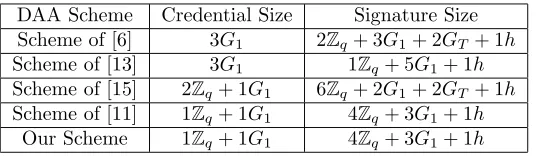
In this section, we compare our DAA scheme with several existing pairing-based DAA schemes [6, 13, 15, 11]. Note that we do not include the original CMS-DAA scheme [12] in the comparisons, as it is not secure, instead we compare ours with the patched version [13]. We also do not include the pairing-based EPID scheme [9] in the comparison, because EPID does not have the feature of splitting computation between a TPM and a host.
We compare the credential and signature sizes of our scheme with other DAA schemes in Table 1. We useZq to denote the size of an element inZq,hto denote the size of a hash result,G1 to denote the size of
an element inG1, andGT to denote the size of an element in GT. For bilinear maps with 128-bit security,
GT needs to be around 3072 bits [17]. Our DAA scheme has the same credential and signature sizes as in
Chen’s DAA scheme [11]. The credential and signature sizes in our scheme are smaller than other DAA schemes [6, 13, 15].
DAA Scheme Credential Size Signature Size Scheme of [6] 3G1 2Zq+ 3G1+ 2GT + 1h
Scheme of [13] 3G1 1Zq+ 5G1+ 1h
Scheme of [15] 2Zq+ 1G1 6Zq+ 2G1+ 2GT + 1h
Scheme of [11] 1Zq+ 1G1 4Zq+ 3G1+ 1h
Our Scheme 1Zq+ 1G1 4Zq+ 3G1+ 1h
Table 1: A comparison between our DAA scheme and other DAA schemes in credential and signature sizes
We compare the efficiency of signing and verification algorithms of our scheme with other DAA schemes in Table 2. We use P to denote a pairing operation, G1 to denote an exponentiation operation in G1,G21
to denote a multi-exponentiation operation, and so on. A multi-exponentiation is slightly more expensive than an exponentiation. As we mentioned earlier in Section 1, operations inG1are much more efficient than
ones inGT. Therefore, our DAA scheme has significant advantage for computationally weak device such as
TPM. The efficiency of the sign protocol for our scheme is approximately 5 times more efficient than the rest of pairing-based DAA schemes [6, 13, 15, 11] using Barreto-Naehrig curves.
DAA Scheme TPM Sign Host Sign Verify
Scheme of [7] 3GT 3G1+ 1GT + 3P 1G2T+ 1G3T+ 5P+ (n+ 1)GT
Scheme of [13] 2G1+ 1GT 3G1+ 1P 1G2T+ 1G2T+ 5P+nG1
Scheme of [15] 2G1+ 1G2T 1G1+ 2G21+ 1G31+ 1G3T 1G21+ 2G31+ 1G5T + 3P+nGT
Scheme of [11] 2G1+ 1GT 1G1+ 1G3T 1G21+ 1G22+ 1G4T + 1P+nG1
Our Scheme 3G1 1G1+ 1G21+ 1GT + 1P 1G21+ 1G22+ 1G4T + 1P+nG1
Table 2: A comparison between our DAA scheme and other DAA schemes in the efficiency of sign and verify algorithms
Observe that the efficiency we gain in TPM comes with a price – the host needs to perform an additional pairing. The total efficiency of the sign protocol is 4G1+ 1G21+ 1GT + 1P in our scheme, whereas it is
3G1+ 1GT + 3G3T in Chen’s DAA scheme [11]. Note that TPM is much slower than the host platform, e.g.,
probably 100 times slower or more. Based on the performance simulation by Chen, Page, and Smart [14], a pairing operation on a host takes less than 15 millie-seconds for a 64-bit 2.4 GHz Intel Core 2 processor, while 2G1+ 1GT operation takes more than 3 seconds for a 32-bit 33 MHz simulated TPM. Base on these
performance data, we estimate that the overall sign protocol will take less than 1 second in our scheme, whereas the sign protocol in [11, 13] will take more than 3 seconds.
7
Conclusions
In this paper, we proposed an efficient DAA scheme from bilinear maps. Our new DAA scheme takes much less resources for TPM implementation (both computation and software code size) compared to the existing DAA schemes. We believe our DAA scheme is a good candidate for the next generation of TPM initiated by the TCG TPM working group, assuming that a TPM can support multiple DAA algorithms.
References
[1] Michael Backes, Matteo Maffei, and Dominique Unruh. Zero-knowledge in the applied pi-calculus and automated verification of the direct anonymous attestation protocol. InProceedings of IEEE Symposium on Security and Privacy, pages 202–215. IEEE Computer Society, 2008.
[2] Paulo S. L. M. Barreto and Michael Naehrig. Pairing-friendly elliptic curves of prime order. In Pro-ceedings of the 12th International Workshop on Selected Areas in Cryptography, volume 3897 ofLNCS, pages 319–331. Springer, 2005.
[3] Dan Boneh and Xavier Boyen. Short signatures without random oracles. InAdvances in Cryptology — EUROCRYPT ’04, volume 3027 ofLNCS, pages 56–73. Springer, 2004.
[4] Dan Boneh, Xavier Boyen, and Hovav Shacham. Short group signatures. InAdvances in Cryptology — CRYPTO ’04, volume 3152 ofLNCS, pages 41–55. Springer, 2004.
[5] Ernie Brickell, Jan Camenisch, and Liqun Chen. Direct anonymous attestation. InProceedings of the 11th ACM Conference on Computer and Communications Security, pages 132–145. ACM Press, 2004.
[6] Ernie Brickell, Liqun Chen, and Jiangtao Li. A new direct anonymous attestation scheme from bilinear maps. InProceedings of 1st International Conference on Trusted Computing, volume 4968 of LNCS, pages 166–178. Springer, 2008.
[7] Ernie Brickell, Liqun Chen, and Jiangtao Li. Simplified security notions of direct anonymous attestation and a concrete scheme from pairings.International Journal of Information Security, 8(5):315–330, 2009.
[8] Ernie Brickell and Jiangtao Li. Enhanced Privacy ID: A direct anonymous attestation scheme with enhanced revocation capabilities. InProceedings of the 6th ACM Workshop on Privacy in the Electronic Society, pages 21–30. ACM Press, October 2007.
[9] Ernie Brickell and Jiangtao Li. Enhanced Privacy ID from bilinear pairing. Cryptology ePrint Archive, Report 2009/095, 2009. http://eprint.iacr.org/.
[10] Jan Camenisch and Jens Groth. Group signatures: Better efficiency and new theoretical aspects. In Proceedings of 4th International Conference on Security in Communication Networks, volume 3352 of LNCS, pages 122–135. Springer, 2005.
[11] Liqun Chen. A DAA scheme requiring less TPM resources. InProceedings of the 5th China International Conference on Information Security and Cryptology, LNCS. Springer, 2009.
[12] Liqun Chen, Paul Morrissey, and Nigel P. Smart. Pairings in trusted computing. In Proceedings of the 2nd Internation Conference on Pairing-Based Cryptography, volume 5209 of LNCS, pages 1–17. Springer, 2008.
[13] Liqun Chen, Paul Morrissey, and Nigel P. Smart. DAA: Fixing the pairing based protocols. Cryptology ePrint Archive, Report 2009/198, 2009. http://eprint.iacr.org/.
[14] Liqun Chen, Dan Page, and Nigel P. Smart. On the design and implementation of an efficient DAA scheme. Cryptology ePrint Archive, Report 2009/598, 2009. http://eprint.iacr.org/.
[16] Jung Hee Cheon. Security analysis of the strong diffie-hellman problem. InAdvances in Cryptology — EUROCRYPT ’06, volume 4004 ofLNCS, pages 1–11. Springer, 2006.
[17] Neal Koblitz and Alfred Menezes. Pairing-based cryptography at high security levels. InProceedings of the 10th IMA International Conference on Cryptography and Coding, volume 3796 ofLNCS, pages 13–36. Springer, 2005.
[18] Adrian Leung and Chris J. Mitchell. Ninja: Non identity based, privacy preserving authentication for ubiquitous environments. In Proceedings of 9th International Conference on Ubiquitous Computing, volume 4717 ofLNCS, pages 73–90. Springer, 2007.
[19] Anna Lysyanskaya, Ronald L. Rivest, Amit Sahai, and Stefan Wolf. Pseudonym systems. InProceedings of the 6th Workshop on Selected Areas in Cryptography, volume 1758 ofLNCS, pages 184–199. Springer, 1999.
[20] Victor Shoup. Lower bounds for discrete logarithms and related problems. InAdvances in Cryptology — EUROCRYPT ’97, volume 1233 ofLNCS, pages 256–266. Springer, 1997.
[21] Trusted Computing Group. TCG TPM specification 1.2, 2003. Available at http://www. trustedcomputinggroup.org.