Predicate-Based Key Exchange
James Birkett and Douglas Stebila
Information Security Institute, Queensland University of Technology, Brisbane, Queensland, Australia Email:[email protected],[email protected]
February 16, 2010
Abstract
We provide the first description of and security model for authenticated key exchange protocols with predicate-based authentication. In addition to the standard goal of session key security, our security model also provides for credential privacy: a participating party learns nothing more about the other party’s credentials than whether they satisfy the given predicate. Our model also encompasses attribute-based key exchange since it is a special case of predicate-based key exchange.
We demonstrate how to realize a secure predicate-based key exchange protocol by combining any secure predicate-based signature scheme with the basic Diffie-Hellman key exchange protocol, providing an efficient and simple solution.
Keywords:predicate-based, attribute-based, key exchange, security models, protocols, cryptog-raphy
1
Introduction
Two of the fundamental goals of key exchange are authentication and confidentiality. Entity authentication inherently depends on some pre-established piece of trusted information; the most common examples include a shared symmetric key, a shared password, or a certified public key. Recently, cryptographers have developed ways of providing more fine-grained access control in cryptographic operations.
Identity-based encryption allows a sender to encrypt a message for a recipient based solely on the recipient’s identity (and public parameters for the system) – in other words, without requiring a recipient-dependent public key. The identities used in identity-based cryptography may be simple usernames, but they could contain more structured information as well, for example by appending an expiry date or security level. The utility of this idea is limited by the fact that identities must be encoded as strings, and a trusted key generation centre must generate decryption keys for each resulting string.
In attribute-based encryption, a message can be encrypted so that it can only be decrypted by keys whose attributes satisfy a certain policy. Attributes are boolean variables, such as “
student=false
”, “CS_department=false
”, “Math_department=true
”, and policies are expressed as boolean func-tions. Decryption keys are constructed based on the user’s attributes, and decryption only succeeds if the user’s attributes satisfy the policy encoded in the ciphertext.1 Research in attribute-based cryptography has focused primarily on encryption and signature schemes.The subject of this paper, predicate-based cryptography, is a generalization of identity- and attribute-based cryptography. Like attribute-based cryptography, it allows for fine-grained access control based on whether the given credentials satisfy a certain policy. However, credentials and access policies can be more general than in the attribute-based case. Credentials can consist of
1We have describedciphertext-policyattribute-based encryption, in which keys have attributes and ciphertexts have
name-value pairs, where the values can be from arbitrary sets, not just boolean values. Access policies are expressed as predicates over the set of credentials, and can for example involve equality, comparison, subset, AND, and OR gates. Existing work in predicate-based cryptography has focused on encryption, particularly on expanding the expressiveness of predicates.
Our goal in this work is to consider the use of predicate-based cryptography in a multi-user inter-active network setting, specifically examining the cryptographic task ofpredicate-based authenticated key exchange.
1.1
Contributions
Predicate-based key exchange security model. We give the first security model for authenticated
key exchange using predicate-based authentication. Our security model has two security experiments: 1. Session key security: The session key should be indistinguishable to an adversary. Unlike attribute-based encryption, attribute-based group key exchange, and predicate-based encryp-tion, the session key should be secret even from other parties satisfying the same predicates as either of the two original parties in the key exchange.
2. Credential privacy: In a key exchange, it should not be possible for anyone – including the legitimate peer – to learn anything more about a user’s credentials other than whether they satisfy the chosen predicate. We argue that this is an essential property for predicate-based key exchange: without it, we might as well return to identity- or public-key-based key exchange with certified lists of credentials.
When restricted to the special case of attribute-based credentials, our security model for predicate-based key exchange also serves as the first full security model for attribute-predicate-based key exchange.
A generic predicate-based key exchange protocol. We present a protocol for predicate-based key
exchange that satisfies the two security properties above, session key security and attribute privacy. The protocol is a signed-Diffie-Hellman construction that can be used with any secure predicate-based signature scheme. Although our definition of predicate-based signature scheme is new, attribute-based signature schemes are a special case of predicate-attribute-based signatures, so attribute-attribute-based signature schemes can be employed in our protocol construction.
1.2
Outline
The remainder of this paper is organized as follows. We begin in Section 2 with a motivating example. We review existing work in Section3and introduce notation in Section4. In Section5, we present our security model for predicate-based key exchange protocols – including session key security and attribute privacy – and comment on implementation issues. We define predicate-based signature schemes in Section6, and show in Section7how to build a secure predicate-based key exchange protocol using predicate-based signatures and a Diffie-Hellman construction. We conclude in Section8.
2
Motivation
When one party wishes to establish a shared secret key with another party, it may not be as simple as Alice saying that she wants to talk to Bob. Alice may in fact wish to talk a customer service supervisor in the international trading group of the Bank of Bob. In other words, Alice has anpolicyagainst which she checks the credentialsof the other party. Predicate-based cryptography allows parties to specify fine-grained access control policies and has been used in the context of encryption. It is natural to consider the problem in the context of key exchange protocols, which allow two parties to authentically establish a secure channel.
against her in another context. The goals of the psychologist are to verify that the patient has valid insurance coverage from an insurer and to ensure that no one else can eavesdrop on the conversation so as to maintain patient-doctor confidentiality.
There are four types of security goals seen in the example above. The first goal is policy-based
authentication, where one party can be confident the other party’s credentials satisfy some security policy, and moreover that multiple parties cannotcolludeto combine their credentials to satisfy a policy that none of them individually satisfies. The second goal isconfidentiality, where the parties are ensured that no one except the other authenticated party is able to read their communications; this means only the party with whom we started communicating, not just any partner who satisfies the authentication policy, for we do not want all patients to be able to read messages sent to one patient. The third and fourth goals are interrelated: we seekanonymity, so an adversary cannot distinguish between two parties who have credentials satisfying the same policy, and credential privacy, meaning that no information is leaked about which precise combination of credentials were used to satisfy the policy.
We aim to achieve these security goals using predicate-based key exchange. The credentials held by a party can be expressed using name-value pairs assigned by one or more credential authorities. For example, a patient with medical insurance may have a private key that corresponds to the credentials “Employer=Acme Widgets”, “Coverage=Gold”, “Expires=2011/06/30”, and “Insurer
=Red Cross”.
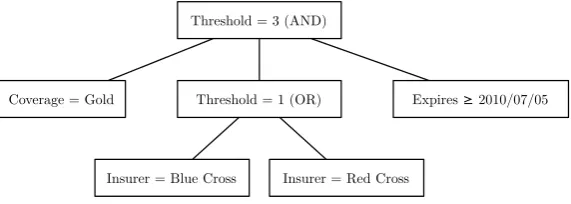
The policy used by party to evaluate credentials will be expressed as apredicateover credentials; the predicate may be composed of a variety of operations, such as equality and subset tests, AND, OR, and threshold gates, and comparisons. A natural example of a predicate is a threshold access tree. Leaves of a threshold access tree consists of boolean-valued functions such as equality tests and comparisons. Interior nodes of a threshold access tree indicate how many of the children nodes must be satisfied; for example, an interior node with threshold 1 having 4 children corresponds to an OR gate, while an interior node with thresholdnhaving nchildren corresponds to an AND gate. An example threshold access tree for the case of a psychologist checking the medical insurance is given in Figure1.
Threshold = 3 (AND)
Coverage = Gold Threshold = 1 (OR)
Insurer = Blue Cross Insurer = Red Cross
Expires ≥ 2010/07/05
Figure 1: A threshold access tree describing a predicate for checking medical insurance coverage.
3
Related work
Identity-, attribute-, and predicate-based encryption.Identity-based encryption, in which
individ-ual parties need not have public keys but only identity strings, was first proposed by Shamir[Sha84]
and has recently been the subject of much research. It was extended by Sahai and Waters[SW05]to
fuzzy identity-based encryptionin which parties must match at least a certain number – a threshold – of attributes. Anattribute, usually labeled by a string, is a boolean variable: it is either present or absent. Goyal et al. [GPSW06a] extended fuzzy identity-based encryption to attribute-based encryptionsupportingboolean threshold access treepredicates, which consist of boolean combinations of attributes using AND, OR, and threshold gates.
conjunctions, and subset conjunctions; the support of arbitrary, not just boolean, values is what distinguishespredicate-basedcryptography from attribute-based cryptography. Katzet al. [KSW08a]
developed a technique for disjunctive predicates and inner products and Shen et al. [SSW09]
introduced the notion of predicate privacy for symmetric encryption. The improvement of predicate expressivity continues to be an active area of research.
Key exchange. The first protocol for identity-based key exchange was presented by Günther in
1989[Gün89]but it was not until 2003 that the first formal security model for identity-based key exchange protocols was proposed by Chen and Kudla[CK03]; their model was an extension of the public key authenticated key exchange security model of Blake-Wilsonet al.[BWJM97](itself based on the Bellare-Rogaway model[BR93a]). Kudla and Paterson[KP05]subsequently created a generic key exchange security model to allow for modular security proofs which is also suitable for identity-based key exchange. A more refined security model for identity-based key exchange was proposed by Chen, Cheng, and Smart[CCS07]. A common approach to designing secure key exchange protocols is using a signed-Diffie-Hellman construction (for example,[CK01a]).
Wang, Xu, and Ban [WXB09]and Wang, Xu, and Fu[WXF09a,WXF09b]have protocols for what they call attribute-based key agreement protocols (in the random oracle and standard models, respectively). The security proofs treat attributes as identification strings and then revert to the security model of Chenet al. [CCS07]for identity-based authenticated key exchange. These two papers provide no mechanism for evaluating policy predicates and do not consider attribute privacy at all. As such, we consider these schemes to be merely identity-based. Ateniese et al. [AKB07]
provide a protocol for secret handshakes – key exchange where participating parties do not learn either the credentials or the predicate of the other party unless the protocol succeeds – using fuzzy attribute matching. Their protocol is secure in the fuzzy selective ID model for encryption[SW05]. Gorantlaet al. [GBG10]present a protocol for attribute-based group key exchange, which differs from our work in that all members of the group satisfying the predicate can compute the session key. In contrast, we allow each user to specify a predicate which the peer must satisfy, and these predicates need not be the same. Moreover the session key can only be computed by the two participants in the key-exchange protocol, not all parties that satisfy the predicate – this is related to the notion of forward-security.
Signature schemes. Attribute-based signatureswere first introduced by Majiet al. [MPR08], who
provided a scheme that supported predicates containing threshold access trees, with a proof in the generic group model. Additional schemes supporting single threshold gates, in either the standard or random oracle models, have been proposed by Shahandashti and Safavi-Naini[SSN09a]and Li
et al. [LAS+10], and a scheme with threshold access trees by Khader[Kha08]. These schemes all achieve the goal ofattribute privacy, in which the attributes used to satisfy a predicate are unknown the verifier. An attribute-based authentication scheme was proposed by Khaderet al. [KCD09]with some additional properties beyond signature schemes such as traceability by an authorized entity.
There are also a number of attribute-based group or ring signature schemes that provide lesser privacy guarantees, namely that the signer is anonymous among all signers possessing the same attributes[Kha07b,Kha07a,LK08].
4
Notation
We will use different typefaces to refer to variables,
algorithms
andoracles
, and constants. The notationa←B
(c)indicates that algorithmB
is run on inputcand the output is assigned toa, anda←R X denotes a value x being chosen uniformly at random from the set X. The notation
B
(c)→aand
B
(c)→R adefine deterministic and probabilistic algorithms, respectively, with inputcand outputa. We letλ∈Z+denote a security parameter. We typically use Ato denote the adversary;AB(·) denotesArun with oracle access to
B
. SupposeAis a finite set of sizenandA∈A;IAdenotes thef isnegligibleif, for sufficiently largex,|f(x)|is smaller than the inverse of any polynomial inx.
Credentials and predicates. LetCbe a finite set; we will callCthe set ofcredentials. Apredicateis
a functionΦ:C→ {true,false}. We say that a credentialC ∈Csatisfiesa predicateΦifΦ(C) =true.
LetP⊆ {true,false}C denote a set of predicates.
5
Predicate-based key exchange
In this section, we define the functionality and security of a predicate-based key exchange protocol.
Definition 1(Predicate-based key exchange protocol). Letλbe a security parameter. A
predicate-based key exchange protocolΠconsists of the following algorithms:
•
Setup
(1λ)→R (M P K,M SK): Returns public parameters M P K and a master secret M SK. The public parameters must uniquely define the key space K, the set C of credentials used in the system and a setPof predicates overC; we implicitly assume M P K is an input to all subsequent algorithms.•
KeyGen
(M SK,C ∈C) R→sk: The credential issuing authority generates a secret key sk corre-sponding to the credentials C∈C
•
Initiate
(sk,r ol e∈ {init,resp},Φ∈P)→R st at e: The user initiates a new session with the given role and predicateΦ.•
Action
(sk,m,st at e)→R (m0,st at e,st atus,k): This is the core of the protocol: it takes a secret key, an incoming message (or the empty string if no messages have yet been exchanged) and the corresponding session state as input and returns the next message in the the protocol, an updated session state, the status of the session (one ofIncomplete,Established, orFailed), and a session key k∈K, which should be set to⊥until the session isEstablished.We have defined predicate-based key exchange in terms of non-interactive algorithms so that it is independent of any networking layer for message delivery. In particular, we deliberately do not specify how the user determines what predicates to use or to which session an incoming message belongs. For example, when using TCP over the Internet, messages may be directed to an IP address (specifying the user) and a port number (specifying the session), but a key-exchange protocol should be substrate-neutral; whether messages are delivered by carrier pigeon or pneumatic tube, the protocol actions are the same. In the case of predicate-based key exchange, these implementation issues have important implications for the security properties we desire, and any application making use of predicate-based key exchangemusttake them into consideration. We will discuss problems that arise from these networking details further in Section5.3.
5.1
Correctness
A predicate-based key exchange is correct if, whenever two users who each satisfy their peer’s predicate run the protocol over a benign network which faithfully delivers their messages unaltered, both parties complete the session in stateEstablishedand they agree on a key.
Letr ol e(j) =Rif jis even andr ol e(j) =I if jis odd. Let
Correct
(M SK,CI,CR,ΦI,ΦR)be as fol-lows: SetskI←KeyGen
(M SK,CI)andskR←KeyGen
(M SK,CR). Letst at eI←Initiate
(skI,init,ΦI), andst at eR←Initiate
(skR,resp,ΦR). Set(m1,st at eI,st atusI,k)←Action
(skI,⊥,st at eI). For j=1, . . . ,r−1, set(mj+1,st at er ol e(j+1),st atusr ol e(j+1),kr ol e(j+1))←
Action
(skr ol e(j),mj,st at er ol e(j)). If st atusI=Established=st atusRandkI=kR, then returntrue, otherwise returnfalse.Definition 2 (Correctness). A predicate-based key-exchange protocol is said to be correct if, for
(M P K,M SK)←
Setup
(1k), for allΦI,ΦR∈Pand for all CI,CR∈Csuch thatΦR(CI) =true= ΦI(CR),
Pr(
Correct
(M SK,CI,CR,ΦI,ΦR) =true) =1.5.2
Security model
[BR93b] model for key exchange, the Maji et al. model for attribute-based signature schemes
[MPR08], and aspects of predicate-based encryption from Boneh and Waters[BW07]. We define these properties using security games, played by an adversary against a challenger. In both cases, the challenger maintains a list of users U1, . . . ,UN, which is not fixed, but is under control of the
adversary. Each user Uu has credentials Cu and a secret keysku, and the challenger maintains a numbered list of sessions,su,1, . . . ,su,nu, with the following associated variables:
• mu,`,1, . . . ,mu,`,i: The protocol messages exchanged in sessionsu,`.
• st at eu,`: The private session state information.
• st atusu,`∈ {Established,Incomplete,Failed}: The status of the session.
• ku,`∈K: The session key.
• Φu,`∈P: The predicate which the peer of the session must satisfy.
• Φ0u,`∈P: The predicate which the owner of the session must satisfy; in our example
construc-tion, this value is sent to the peer as part of the first protocol message, but it could in principle be specified by some other means.
• r ol eu,`∈ {init,resp}: The role (initiator or responder) played by the userUu in session`.
We now present the queries available to the adversary in both games:
•
Create
(C ∈C): The challenger increments N, the number of users, setsCN =C, computes skN←KeyGen
(M SK,CN)and returnsN.•
Activate
(u,r ol e,Φ∈P): The challenger incrementsnu, setsst at eu,nu←Initiate
(sku,r ol e,Φ),and returnsnu.
•
Send
(u,`,mu,`,i): The challenger sets(mu,`,i+1,st at eu,`,st atusu,`,ku,`)←Action
(sku,mu,`,st at eu,`)and returns(mu,`,i+1,st atusu,`). Ifr ol eu,`=initandi=0, thenmu,`,i must be⊥. •
SKReveal
(u,l): Returnsku,`.•
Corrupt
(u): Returnssku.5.2.1 Session key security
The definition of session key security is based on the idea that an adversary should not be able to distinguish the session key of a sufficiently uncompromised session from a random string, except with negligible probability. First, we adapt the Bellare-Rogaway definition of a matching conversation
[BR93a]to our setting as follows.
Definition 3(Matching session). A session su0,`0 is a peer ofa session su,`ifΦu,`= Φ0u0,`0,Φu0,`= Φu0,`0, and any of the following rules hold.
• For protocols where r, the number of rounds, is odd:
– r ol eu,`=init, r ol eu0,`0=resp, and(mu,`,1, . . . ,mu,`,r−1) = (mu0,`0,1, . . . ,mu0,`0,r−1);
– r ol eu,`=resp, r ol eu0,`0=init, and(mu,`,1, . . . ,mu,`,r) = (mu0,`0,1, . . . ,mu0,`0,r). • For protocols where r is even:
– r ol eu,`=init, r ol eu0,`0=resp, and(mu,`,1, . . . ,mu,`,r) = (mu0,`0,1, . . . ,mu0,`0,r);
– r ol eu,`=resp, r ol eu0,`0=init, and(mu,`,1, . . . ,mu,`,r−1) = (mu0,`0,1, . . . ,mu0,`0,r−1). We use the terms “is a peer of” and “matches” interchangeably.
This captures the idea that the owner and the peer of the session must satisfy each other’s predicates and agree on all of the messages exchanged, except perhaps if the owner of the session
su,` sent the final message. In this case the owner of the session completes the protocol without knowing if the final message was delivered, or if a different message was delivered instead, so we do not require that the final messages are equal in this case. Note that the relation “is a peer of” isnot
symmetric!
Definition 4(Session key security). Letλbe a security parameter and let Abe a polynomial-time
(in λ) probabilistic algorithm. A predicate-based key exchange protocol Π is session-key-secure if
Adv
PBΠ,A−SK(λ):=Pr
Expt
PBΠ,A−SK(λ) =true−12
is negligible, where
Expt
PB−SK
1. Set(M P K,M SK)←
Setup
(1λ).2. Let
Test
(u,`)be the following algorithm. Choose a bit b← {R 0, 1} at random. If b=0, then return ku,`, otherwise return kR ←K.
3. Set b0←A(M P K), whereA has oracle access to
Create
,Activate
,Send
,SKReveal
,Corrupt
, andTest
. Ais restricted as follows:• Amay make a single query to the
Test
oracle; let u,`be the arguments to that query. • Amust not have made any query of the formCorrupt
(u0)for any u0such thatΦu,`(Cu0) =trueprior to the
Test
query;• when the
Test
query is made, it must be that st atusu,`=Established; and• A may not query
SKReveal
(u,`) orSKReveal
(u0,`0)for any (u0,`0) such that su0,`0 is a peer of su,`, even after theTest
query is made.4. If b0=b, then returntrue, otherwise returnfalse.
This definition of session key security also implies collusion resistance, since the adversary may perform
Corrupt
queries for multiple users with credentials that collectively, but not individually, satisfy the predicate.5.2.2 Credential privacy
For the credential privacy experiment, the adversary should not be able to distinguish between two users whose credentials satisfy the same predicate, even if they have different credentials.
Definition 5 (Credential privacy). Let λ be a security parameter and let A be a polynomial-time
(in λ) probabilistic algorithm. A predicate-based key exchange protocol Π is credential-private if
Adv
PBΠ,A−Priv(λ):=Pr
Expt
PBΠ,A−Priv(λ) =true−12
is negligible, where
Expt
PB−Priv
Π,A (λ)is the following algorithm:
1. Set(M P K,M SK)←
Setup
(1λ).2. Let
TestActivate
(u0,u1,r ol e,Φ∈P) be the following algorithm. Choose a bit b R← {0, 1}at random. Set Cu∗ ← Cu
b, sku∗ ← skub, where u
∗ is a distinguished user identifier. Compute
st at eu∗,1←
Initiate
(sku∗,r ol e,Φ)and return(u∗, 1).3. Set b0←A(M P K), whereA has oracle access to
Create
,Activate
,Send
,SKReveal
,Corrupt
, andTestActivate
. Ais restricted as follows:• Amay make a single query to the
TestActivate
oracle.• Amay not make any queries of the form
Activate
(u∗,·,·), but the challenger responds toSend
(u∗,·,·)the same way as for any other user identifier.• The predicateΦ0u∗,1which Cu∗has to satisfy (which is determined by the
Send
(u∗, 1,·)queries made by the adversary) must be chosen such thatΦ0u∗,1(Cu0) = Φ0u∗,1(Cu1). (If this were not the case then the adversary could trivially distinguish Uu0 from Uu1.)4. If b0=b, then returntrue, otherwise returnfalse.
Credential privacy captures the notion of anonymity: the adversary cannot distinguish between two users satisfying the same predicate. It also ensures that the adversary cannot tell whether two sessions with the same predicate are owned by the same user; we call this propertyunlinkability. To see why this holds, suppose that an adversary executes a session withUu0, and the test session with Uu∗ using the same predicate. If the adversarycouldtell whether those two sessions are owned by
the same user, then it can discover the identity ofUu∗ and win the credential privacy experiment.
5.3
Implementation issues
users public key declaring that they hold a given credential. This shows that there is simply no need for predicate-based key exchange unless credential-privacy is desired.
Our definition of credential privacy ensures that the contents of the protocol messages exchanged reveal no information about either party’s credentials, except whether they satisfy their peer’s chosen predicate. Unlike predicate-based encryption or signatures, predicate-based key exchange faces an additional challenge: in an interactive setting, users need to be identified by some means in order to deliver messages. It seems unavoidable that this should leak some information about a user’s credentials, but we will discuss some approaches that may be fruitful.
Suppose that a predicate-based key exchange protocol is used on an IP network, with each user having a fixed IP address. An adversary may initiate multiple sessions with the same user using different predicates to exhaustively search the credential space. A user initiating a session may mitigate this problem if she is able to obtain a new IP address for each session, for example by using tunnelling, or an anonymising service such as Tor[DMS04]. Unfortunately, a user acting as a responder cannot use this solution, since the initiator must know an address to initiate a session. Depending on the application, it may be that only the initiator needs credential privacy. In the example from Section2, the patient desires to remain anonymous when discussing their mental-health problems, but it seems unlikely that the psychologist has the same requirement. However, a society of secretive psychologists acting together could preserve some degree of anonymity by operating a trusted proxy which knows their individual credentials, and could choose a psychologist who satisfies a given predicate at random from among the society.
6
Predicate-based signature scheme
Our definition of predicate-based signature schemes is a natural extension from the definition of attribute-based signature schemes[MPR08].
Definition 6(Predicate-based signature scheme). Letλbe a security parameter. Apredicate-based
signature schemeS is a tuple consisting of the following polynomial-time (inλ) algorithms:
•
Setup
(1λ)→R (mpk,msk): The credential authority obtains a master private key msk and public parameters mpk. The public parameters must uniquely define the setCof credentials and a setP of predicates overC; we assume mpk is an implicit input to all subsequent algorithms.•
KeyGen
(msk,C ∈C) R→sk: The authority generates a signing key sk for credentials C. •
Sign
(sk,m,Φ∈P)R
→σ: The signer generates a signatureσfor a message m against a predicate
Φ, provided sk was generated with C such thatΦ(C) =true.
•
Verify
(m,Φ ∈ P,σ) → {true,false}: The verifier checks if σ is a valid signature on m for predicateΦ.Definition 7(Correctness). A predicate-based signature schemeS iscorrect if, for (mpk,msk) ←
Setup
(1λ), all messages m, all credentials C ∈C, all signing keys sk←KeyGen
(msk,C), and all predicatesΦ∈Psuch thatΦ(C) =true, we havePr(Verify
(m,Φ,Sign
(sk,m,Φ)) =true) =1.Definition 8 (Perfect privacy). A predicate-based signature scheme S is perfectly private if, for
(mpk,msk)←
Setup
(1λ), all messages m, all credentials C1,C2∈C, all signing keys sk1←KeyGen
(msk,C1),sk2←
KeyGen
(msk,C2), and all predicatesΦ∈Psuch thatΦ(C1) = Φ(C2) =true, the distributionsSign
(sk1,m,Φ)andSign
(sk2,m,Φ)are equal.A perfectly private predicate-based signature scheme does not leak any information about which credentials or secret keys were used to generate the signature.
Definition 9 (Unforgeability). Let λ be a security parameter and let A be a polynomial-time (in
λ) probabilistic algorithm. A perfectly private predicate-based signature scheme S isunforgeableif
Adv
PBS,A−Forge(λ):=PrExpt
SPB,A−Forge(λ) =true is negligible, whereExpt
PBS,A−Forge(λ) is the following algorithm:2. Let
AltSign
(msk,m,C ∈C,Φ ∈P) be an algorithm that, provided Φ(C) = true, sets sk ←KeyGen
(msk,C), and returnsSign
(sk,m,Φ).3. Set(m,Φ,σ)←AKeyGen(msk,·),AltSign(msk,·,·)(mpk).
4. If
Verify
(m,Φ,σ) =true,Bnever queriedAltSign
(m,·,Φ), andBnever queriedKeyGen
(C)for any C∈Csuch thatΦ(C) =true, then returntrue, otherwise returnfalse.The security experiment for unforgeability is slightly different than is typical for signature schemes, because the signing oracle generates a new key for each signature rather than using an existing key. However, for a predicate-based signature scheme with perfect privacy, the signature depends on the predicate used, but not the specific credentials (or secret key) used, so the definition is appropriate.
An example instantiation.Attribute-based signature schemes are a special case of predicate-based
signature schemes induced by the change of notation indicated in Figure 2. Since the security definitions we have presented for predicate-based signatures incorporate this change of notation, it follows that a secure attribute-based signature scheme such as the scheme of Majiet al.[MPR08]is also a secure predicate-based signature scheme.
Attribute-based[MPR08] Predicate-based (Section4)
Credential universe A,|A|=n C={0, 1}|A|
Credentials A⊆A C∈C,C =IA
Predicate Υ:{0, 1}n→ {true,false} Φ:
C→ {true,false}
AsatisfiesΥiffΥ(IA) =true C satisfiesΦiffΦ(C) =true
Figure 2: Representation of attribute-based notation in predicate-based notation.
7
A signed Diffie-Hellman construction
We present a simple signed-Diffie-Hellman protocol using a secure predicate-based signature scheme and a group in which the Decisional Diffie-Hellman (DDH) problem is hard (see AppendixAfor the definition of the DDH problem).
7.1
Protocol definition
Let S = (
Setup
S,KeyGen
S,Sign
,Verify
) be a predicate-based signature scheme. We define the protocolΠS,Gas the following tuple of algorithms:•
Setup
(1λ): Set(mpk,msk)←Setup
S(1λ); recall thatmpkdefines a setCof credentials anda setPof predicates overC. LetG be a finite cyclic group of orderq generated by g. Set M P K←(mpk,G,g,q)andM SK←msk. Return(M P K,M SK).
•
KeyGen
(M SK,C ∈C): ReturnKeyGen
S(msk,C). •Initiate
(sk,init,ΦI): Returnst at e←ΦI.•
Initiate
(sk,resp,ΦR): Returnst at e←ΦR.•
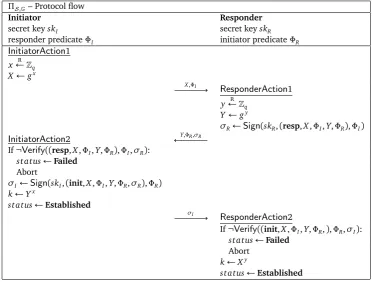
Action
(sk,m,st at e): For clarity, we write the protocol action as four separate algorithms which may be combined in the natural way. We also present the protocol diagrammatically in Figure3.–
InitiatorAction
1(sk,⊥,ΦI): Set x ←R Zq and X ← gx. Set m0 ←(X,ΦI)and st at e0 ←(ΦI,x). Return(m0,st at e0,Incomplete,⊥).
–
ResponderAction
1(sk,(X,ΦI),ΦR): If ΦI(CR) = false, return (⊥,⊥,Failed,⊥). Oth-erwise, set y ←R Zq and Y ← gy. Set σR ←Sign
(sk,(resp,X,ΦI,Y,ΦR),ΦI). Set m0←(Y,ΦR,σR)andst at e0←(X,ΦI,Y,y,ΦR). Return(m0,st at e0,Incomplete,⊥).–
InitiatorAction
2(sk,(Y,ΦR,σR),(ΦI,x)): IfVerify
((resp,X,ΦI,Y,ΦR),ΦI,σR) =falseor ΦR(CI) =false, then return(⊥,⊥,Failed,⊥). SetσI←Sign
(sk,(init,X,ΦI,Y,ΦR,σR),ΦR).–
ResponderAction
2(sk,σI,(X,ΦI,Y,y,ΦR)): IfVerify
((init,X,ΦI,Y,ΦR,σR),ΦR,σI) 6=true, then return(⊥,⊥,Failed,⊥). Set k←Xy. Return(⊥,⊥,Established,k). It is straightforward to see that theΠS,Gis correct when the signature scheme is correct.
ΠS,G– Protocol flow
Initiator Responder
secret keyskI secret keyskR
responder predicateΦI initiator predicateΦR InitiatorAction1
x←R Zq
X←gx
X,ΦI
−−−−−→ ResponderAction1
y←R Zq
Y←gy
σR←Sign(skR,(resp,X,ΦI,Y,ΦR),ΦI) InitiatorAction2 Y,ΦR,σR
←−−−−−
If¬Verify((resp,X,ΦI,Y,ΦR),ΦI,σR):
st atus←Failed Abort
σI←Sign(skI,(init,X,ΦI,Y,ΦR,σR),ΦR)
k←Yx
st atus←Established
σI
−−−−−→ ResponderAction2
If¬Verify((init,X,ΦI,Y,ΦR,),ΦR,σI):
st atus←Failed Abort
k←Xy
st atus←Established
Figure 3: Protocol flow ofΠS,G.
7.2
Credential privacy
Theorem 1. IfS is a perfectly-credential-private signature scheme, thenΠS,Gis credential-private.
Proof (sketch). Consider the test sessionsu∗,1in the credential privacy experiment for the
predicate-based key exchange protocol. Ifu∗does not satisfy the chosen predicate, specified by the adversary – that is, ifΦ0u∗,1(Cu∗) =false– then the session terminates with statusFailed, by definition of the
protocol. However, the choice ofΦ0u∗,1is restricted so that Φ0u∗,1(Cu0) = Φ
0
u∗,1(Cu1), so in this case
the responses of the challenger are independent of the bit b. Similarly, ifΦ0u∗,1(Cu∗) =true, the
distribution of the signature returned to the adversary does not depend on the bitbby the perfect privacy ofS. Since the bitbis not used in answering any other queries, we now see that the responses to the adversary’s queries are all independent of b, so Pr(b0=b) = 12 and
Adv
PBΠS−Priv,G,A(λ) =0.
7.3
Session key security
Theorem 2. IfS is unforgeable and the DDH problem is hard inG, thenΠS,Gis session-key secure.
Proof. LetAbe an adversary against the session key security ofΠS,Gand consider the experiment
Expt
PBΠS−SK,G (λ)
. Letu∗,`∗be the test session. DefineM to be the event that a matching sessionsu0,`0 of su∗,`∗ exists.
Case 1: No session matchingsu∗,`∗ exists (event ¬M). We construct an adversaryB against the
unforgability ofS as follows.BrunsA(mpk)and simulates the challenger’s responses according to the definition of the
Expt
PBΠS−SK,G,λ
input(msk,m,Cu,Φ). WheneverAmakes a
Corrupt
(u)query,Bresponds by queryingKeyGen
S(Cu)and returning the result.
Now consider the test sessionsu∗,`∗. By the definition ofΠS,G,mu∗,`∗,1= (X,Φu∗,`∗)for someX∈
G,mu∗,`∗,2= (Y,Φ0u∗,`∗,σR)for someY ∈G, andmu∗,`∗,3=σI. WhenAterminates, ifr ol eu∗,`∗=init,
thenBchoosesm∗←(resp,X,Φu∗,`∗,Y,Φ0u∗,`∗)as the message to forge a signature on and returns
(m∗,Φu∗,`∗,σR)as the forgery. Ifr ol eu∗,`∗ =resp,Bchoosesm∗←(init,X,Φ0u∗,`∗,Y,Φu∗,`∗,σR)and
returns(m∗,Φu∗,`∗,σI)as the forgery.
We must now show that if the test session has no peer, then B satisfies the requirements of Definition9, namely that
Verify
(m,Φ,σ) =true,Bnever queriedAltSign
(msk,m,·,Φ)andBnever queriedKeyGen
S(C)for any credentialC such thatΦ(C) =true.Since the test session must be anEstablishedsession, it follows that
Verify
(m,Φu∗,`∗,σR) =true.Because of the constraints onAconcerning the test session, it follows thatAnever queried
Corrupt
(u)for any usatisfying Φu∗,`∗(Cu) =true, which implies that B never queried
KeyGen
S(C) for anycredentialC such thatΦu∗,`∗(C) =true.
Finally, suppose A made a query of the form
Send
(u0,`0,mu0,`0,i) which caused B to queryAltSign
(m∗,C,Φu∗,`∗), wherem∗is the forged message defined above.If r ol eu∗,`∗ =init, then m∗ = (resp,X,Φu∗,`∗,Y,Φ0u∗,`∗), and the only circumstances where B
could query
AltSign
(msk,m∗,C,Φu∗,`∗)are ifΦu0,`0= Φ0u∗,`∗,Φ0u0,`0= Φu∗,`∗,mu0,`0,1= (X,Φ0u0,`0), and mu0,`0,2 = (Y,Φu0,`0,σR): in other words, when su0,`0 is a peer of su∗,`∗, contradicting our originalassumption. Conversely, ifr ol eu∗,`∗ =resp, thenm∗= (init,X,Φu0∗,`∗,Y,Φu∗,`∗,σR), and ifBqueried
AltSign
(m∗,C,Φu∗,`∗)thenΦu0,`0= Φ0u∗,`∗,Φ0u0,`0= Φu∗,`∗,mu0,`0,1= (X,Φu0,`0),mu0,`0,2= (Y,Φ0u0,`0,σR)and mu0,`0,3 =σI. Once again this implies that su0,`0 is a peer of su∗,`∗ contradicting our original
assumption.
ThereforeBwins the forgery game wheneverAselects a test session with no peer, so Pr(¬M) =
Adv
PBS,B−Forge(λ), which is negligible.Case 2: There is a session su0,`0 which matches su∗,`∗ (event M). Sincesu∗,`∗ is required to be
Established, andsu0,`0 matchessu∗,`∗ by assumption, we see thatmu∗,`∗,1= (X,Φu∗,`∗) = (X,Φ0u0,`0) = mu0,`0,1,mu∗,`∗,2= (Y,Φu0,`0,σR) = (Y,Φ0u∗,`∗,σR) =mu0,`0,2.
In particular, this shows that both X and Y were chosen by the challenger in response to the corresponding
Send
queries. This allows us to construct a DDH adversary C as follows. LetqActivate(λ)be an upper bound on the number of
Activate
queries that an adversary in the PB−SK experiment makes. The adversaryC takes a DDH tuple(g,X∗,Y∗,Z∗)as input and choosesi,j←R {1, . . . ,qActivate(λ)}. It then generates a key pair(mpk,msk)←KeyGen
S(1λ)and runsA(msk). Cresponds to all ofA’s queries according to the rules of
Expt
PBΠS−SK,G,A(λ), except that it inserts the Diffie-Hellman valuesX∗andY∗into theithand jthsessions instead of generating a random group element. Let us abuse notation slightly and refer to these session as si and sj. If A queries
SKReveal
(si)or
SKReveal
(sj), C aborts. When A queriesTest
(su∗,`∗), C abortsunless su∗,`∗ =si and su0,`0 =sj.Assuming it does not abort,Csetsk←Z∗. WhenAterminates and returns a guess b0,Creturns b0
as its guess for the DDH problem.
Since the test sessionsu∗,`∗ and its matching sessionsu0,`0 are chosen by the adversaryA
indepen-dently of the choice ofiand j, Pr(C does not abort)≥ 1
q2Activate. Whenever it does not abort,C wins
the DDH game if and only ifAwins the PB−SK experiment. Combining results from Case 1 and Case 2, we see that
Adv
PBΠS−SK,G,A(λ) =
Pr(b0=b)
= Pr(b0=b|M)Pr(M) +Pr(b0=b|¬M)Pr(¬M)
≤ 1
q2Activate(λ)
Adv
DDH
G,C (λ)Pr(M) +Pr(b
0=b|¬M)
Adv
PB−Forge≤ 1
q2Activate(λ)
Adv
DDH
G,C (λ) +
Adv
PB−Forge
S,B (λ)
which is negligible as required.
8
Conclusions
We have introduced the notion of predicate-based key exchange, given a security model, and presented a secure protocol satisfying the security definitions. Our security model for predicate-based key exchange can also be specialized to attribute-based key exchange, a cryptographic task for which there was previously no rigourous security definition.
Our security model incorporates two notions of security: session key security and credential privacy. We have argued that credential privacy is an essential property of predicate-based key exchange; without it, we might as well use certificates to link public keys and a list of credentials. However, achieving credential privacy requires careful consideration of the networking layer over which the protocol runs, as the addressing information of messages – the headers – may leak information that compromises credential privacy. Thus, in practice, a secure deployment of predicate-based key exchange may rely on an anonymising network such as Tor.
The protocol we have presented is a generic protocol that combines any secure predicate-based signature scheme with a Diffie-Hellman construction, providing efficiency and simplicity.
Future work. The major security models for public-key-based authenticated key exchange have an
ad-ditional query to allow the reveal of some of the session variables: either a
SessionStateReveal
query[CK01a], which reveals the session state variables stored during the protocol, or an
EphemeralKeyReveal
query[LLM07]which reveals all randomness used during the run of a protocol. Adding either of these queries to our security model would be a natural way to improve its security guarantees. Our generic protocol construction may still be secure with aSessionStateReveal
query, but cannot be secure with anEphemeralKeyReveal
query unless the underlying signature scheme is secure against revealing the randomness used in signature generation. No existing schemes have been shown to have this property, at least in the case of attribute-based or predicate-based signatures.Our definition of credential privacy for predicate-based key exchange is computational in nature, but our proof for the generic construction relies on the perfect privacy of the underlying signature scheme, as defined by Majiet al. [MPR08]. However, it seems plausible that a suitably defined computational notion of credential privacy would suffice. It may also be possible to give alternative constructions based on ciphertext-policy predicate-based encryption schemes, though as yet only ciphertext-policy attribute-based encryption schemes have been proposed.
Finally, predicate-based key exchange could be extended to support multiple, independent, mutually distrusting, potentially corrupt, credential authorities, similar to the case of multiple attribute authorities for attribute-based signature schemes[MPR08, §4].
Acknowledgements
The authors are grateful for helpful discussions with Juanma González Nieto. J.B. was supported by Australian Research Council (ARC) Discovery Project DP0666065.
References
[AKB07] Guiseppe Ateniese, Jonathan Kirsch, and Marina Blanton. Secret handshakes with dynamic and fuzzy matching. InProc. Internet Society Network and Distributed System Security Symposium (NDSS) 2007. Internet Society, 2007. URL http://www.isoc.org/isoc/conferences/ ndss/07/papers/secret-handshakes.pdf.
[BR93a] Mihir Bellare and Phillip Rogaway. Entity authentication and key distribution. In Douglas R. Stinson, editor,Advances in Cryptology – Proc. CRYPTO ’93,LNCS, volume 773, pp. 232–249. Springer, 1993. DOI:10.1007/3-540-48329-2_21. Full version available as[BR93b].
[BR93b] Mihir Bellare and Phillip Rogaway. Entity authentication and key distribution, 1993. URL
http://www-cse.ucsd.edu/~mihir/papers/key-distribution.html. Extended ab-stract published as[BR93a].
[BW07] Dan Boneh and Brent Waters. Conjunctive, subset, and range queries on encrypted data. In Salil Vadhan, editor,Theory of Cryptography Conference (TCC) 2007,LNCS, volume 4392, pp. 535–554. Springer, 2007. DOI:10.1007/978-3-540-70936-7_29.
[BWJM97] Simon Blake-Wilson, Don Johnson, and Alfred Menezes. Key agreement protocols and their security analysis. In Michael Darnell, editor,Cryptography and Coding – 6th IMA International Conference,LNCS, volume 1355. Springer, 1997.DOI:10.1007/BFb0024447.
[CCS07] Liqun Chen, Z. Cheng, and Nigel P. Smart. Identity-based key agreement protocols from pairings. International Journal of Information Security,6(4):213–241, July 2007. DOI:10.1007/ s10207-006-0011-9. EPRINThttp://eprint.iacr.org/2006/199.
[CK01a] Ran Canetti and Hugo Krawczyk. Analysis of key-exchange protocols and their use for building secure channels, 2001. EPRINThttp://eprint.iacr.org/2001/040. Extended abstract published as[CK01b].
[CK01b] Ran Canetti and Hugo Krawczyk. Analysis of key-exchange protocols and their use for building secure channels. In Birgit Pfitzmann, editor,Advances in Cryptology – Proc. EUROCRYPT 2001, LNCS, volume 2045, pp. 453–474. Springer, 2001. DOI:10.1007/3-540-44987-6_28. Full version available as[CK01a].
[CK03] Liqun Chen and Caroline Kudla. Identity based authenticated key agreement protocols from pairings. InProceedings 16th IEEE Computer Security Foundations Workshop (CSWF-16), pp. 219–233. IEEE, 2003. DOI:10.1109/CSFW.2003.1212715. Revised version appears as[CK04].
[CK04] Liqun Chen and Caroline Kudla. Identity based authenticated key agreement protocols from pairings, 2004. EPRINThttp://eprint.iacr.org/2002/184. Revised version of[CK03].
[DMS04] Roger Dingledine, Nick Mathewson, and Paul Syverson. Tor: The second-generation onion router. InProc. 13th USENIX Security Symposium. The USENIX Association, 2004. URLhttp: //www.usenix.org/events/sec04/tech/dingledine.html.
[GBG10] Malakondayya Choudary Gorantla, Colin Boyd, and Juan González Nieto. Attribute-based authenticated key exchange. Unpublished manuscript, 2010.
[GPSW06a] Vipul Goyal, Omkant Pandey, Amit Sahai, and Brent Waters. Attribute-based encryption for fine-grained access control of encrypted data. In Rebecca Wright, Sabrina De Capitani de Vimercati, and Vitaly Shmatikov, editors,Proc. 13th ACM Conference on Computer and Communications Security (CCS), pp. 89–98. ACM, 2006. DOI:10.1145/1180405.1180418. Full version available as[GPSW06b].
[GPSW06b] Vipul Goyal, Omkant Pandey, Amit Sahai, and Brent Waters. Attribute-based encryption for fine-grained access control of encrypted data, 2006. EPRINThttp://eprint.iacr.org/2006/ 309. Extended abstract published as[GPSW06a].
[Gün89] Christoph G. Günther. An identity-based key-exchange protocol. In Jean-Jacques Quisquater and J. Vandewalle, editors,Advances in Cryptology – Proc. EUROCRYPT ’89,LNCS, volume 434, pp. 29–37. Springer, 1989. DOI:10.1007/3-540-46885-4_5.
[KCD09] Dalia Khader, Liqun Chen, and James H. Davenport. Certificate-free attribute authentication. In Matthew G. Parker, editor,Cryptography and Coding – 12th IMA International Conference,LNCS, volume 5921, pp. 301–325. Springer, 2009. DOI:10.1007/978-3-642-10868-6_18.
[Kha07a] Dalia Khader. Attribute based group signature with revocation, 2007. EPRINThttp://eprint. iacr.org/2007/241.
[Kha08] Dalia Khader. Authenticating with attributes, 2008.EPRINThttp://eprint.iacr.org/2008/ 031.
[KP05] Caroline Kudla and Kenneth G. Paterson. Modular security proofs for key agreement protocols. In Bimal Roy, editor,Advances in Cryptology – Proc. ASIACRYPT 2005,3788, volume LNCS, pp. 549–565. Springer, 2005. DOI:10.1007/11593447_30.
[KSW08a] Jonathan Katz, Amit Sahai, and Brent Waters. Predicate encryption supporting disjunctions, polynomial equations, and inner products. In Nigel Smart, editor,Advances in Cryptology – Proc. EUROCRYPT 2008,LNCS, volume 4965, pp. 146–162. Springer, 2008. DOI:10.1007/ 978-3-540-78967-3_9. Full version available as[KSW08b].
[KSW08b] Jonathan Katz, Amit Sahai, and Brent Waters. Predicate encryption supporting disjunctions, polynomial equations, and inner products, July 2008. EPRINThttp://eprint.iacr.org/ 2007/404. Extended abstract published as[KSW08a].
[LAS+10] Jin Li, Man Ho Au, Willy Susilo, Dongqing Xie, and Kui Ren. Attribute-based signature and its applications. InProc. 2010 ACM Symposium on Information, Computer and Communica-tions Security (ASIACCS’10). ACM Press, 2010. URL http://www.ece.iit.edu/~kren/ Attribute-based%20Signature%20and%20its%20Application.pdf. To appear.
[LK08] Jin Li and Kwangjo Kim. Attribute-based ring signatures, 2008. EPRINThttp://eprint.iacr. org/2008/394.
[LLM07] Brian LaMacchia, Kristin Lauter, and Anton Mityagin. Stronger security of authenticated key exchange. In Willy Susilo, Joseph K. Liu, and Yi Mu, editors,First International Conference on Prov-able Security (ProvSec) 2007,LNCS, volume 4784, pp. 1–16. Springer, 2007.DOI:10.1007/ 978-3-540-75670-5_1.
[MPR08] Hemanta Maji, Manoj Prabhakaran, and Mike Rosulek. Attribute-based signatures: Achieving attribute-privacy and collusion-resistance, 2008.EPRINThttp://eprint.iacr.org/2008/ 328.
[Sha84] Adi Shamir. Identity-based cryptosystems and signature schemes. In G. R. Blakley and David Chaum, editors, Advances in Cryptology – Proc. CRYPTO ’84,LNCS, volume 196, pp. 47–53. Springer, 1984. DOI:10.1007/3-540-39568-7_5.
[SSN09a] Siamak F. Shahandashti and Reihaneh Safavi-Naini. Threshold attribute-based signatures and their application to anonymous credential systems. In Bart Preneel, editor,Progress in Cryptology – AFRICACRYPT 2009,LNCS, volume 5580, pp. 198–216. Springer, 2009. DOI:10.1007/ 978-3-642-02384-2_13. Full version available as[SSN09b].
[SSN09b] Siamak F. Shahandashti and Reihaneh Safavi-Naini. Threshold attribute-based signatures and their application to anonymous credential systems, 2009. EPRINThttp://eprint.iacr.org/ 2009/126. Short version published as[SSN09a].
[SSW09] Emily Shen, Elaine Shi, and Brent Waters. Predicate privacy in encryption systems. In Omer Reingold, editor,Theory of Cryptography Conference (TCC) 2009,LNCS, volume 5444, pp. 457– 473. Springer, 2009. DOI:10.1007/978-3-642-00457-5_27.
[SW05] Amit Sahai and Brent Waters. Fuzzy identity-based encryption. In Ronald Cramer, editor, Advances in Cryptology – Proc. EUROCRYPT 2005,LNCS, volume 3494, pp. 457–473. Springer, 2005. DOI:10.1007/11426639_27.
[WXB09] Hao Wang, Qiuliang Xu, and Tao Ban. A provably secure two-party attribute-based key agreement protocol. InProceedings of the 2009 Fifth International Conference on Intelligent Information Hiding and Multimedia Signal Processing, pp. 1042–1045, 2009.DOI:10.1109/IIH-MSP.2009.92.
[WXF09a] Hao Wang, Qiuliang Xu, and Xiu Fu. Revocable attribute-based key agreement protocol without random oracles.Journal of Networks,4(8):787–794, October 2009. DOI:10.4304/ jnw.4.8.787-794.
A
The Decisional Diffie-Hellman problem
The Decisional Diffie-Hellman (DDH) problem[Bon98]for a groupGis to distinguish a tuple of
the form(g,gx,gy,gz) from a tuple of the form(g,gx,gy,gx y), where x,y andz are uniformly distributed onZ|G|.
Definition 10(Decisional Diffie-Hellman problem).Let(Gλ)λ∈Nbe a family of multiplicatively written
cyclic groups of prime order qλ, indexed by a security parameterλ. Fix a security parameterλ; let g be a generator ofGλand let x,y,z
R
←Zqλ. For any probabilistic polynomial-time algorithmA, we define
Adv
DDHGλ,A(λ) =
Pr A(g,gx,gy,gz) =1
−Pr A(g,gx,gy,gx y) =1 .
The DDH problem ishardif, for any probabilistic polynomial-time algorithmA,