Hardness-Preserving Reductions via Cuckoo Hashing
∗Itay Berman†§ Iftach Haitner‡§ Ilan Komargodski¶ Moni Naor¶
October 20, 2015
Abstract
The focus of this work ishardness-preserving transformations of somewhat limited pseudo-random functions families (PRFs) into ones with more versatile characteristics. Consider the problem ofdomain extension of pseudorandom functions: given a PRF that takes as input el-ements of some domain U, we would like to come up with a PRF over a larger domain. Can we do it with little work and without significantly impacting the security of the system? One approach is to first hash the larger domain into the smaller one and then apply the original PRF. Such a reduction, however, is vulnerable to a “birthday attack”: afterp|U |queries to the resulting PRF, a collision (i.e., two distinct inputs having the same hash value) is very likely to occur. As a consequence, the resulting PRF isinsecureagainst an attacker making this number of queries.
In this work we show how to go beyond the aforementioned birthday attack barrier by re-placing the above simple hashing approach with a variant ofcuckoo hashing, a hashing paradigm that resolves collisions in a table by using two hash functions and two tables, cleverly assigning each element to one of the two tables. We use this approach to obtain: (i) a domain extension method that requiresjust two callsto the original PRF, can withstand as many queries as the original domain size, and has a distinguishing probability that is exponentially small in the amount of non-cryptographic work; and (ii) a security-preservingreduction from non-adaptive to adaptive PRFs.
1
Introduction
The focus of this work is hardness-preserving transformations of somewhat limited pseudorandom functions families (PRFs) into ones with more versatile characteristics. Examples of somewhat limited such families include those with small domain or those that can withstand only non-adaptive (also known as static) attacks, in which the attacker chooses its queries ahead of time, before seeing any of the answers. In contrast, less limited families might have large domain or be
∗
A preliminary version appeared in the proceedings of TCC 2013 [8].
†
MIT Computer Science and Artificial Intelligence Laboratory (CSAIL). Email: [email protected]. Most of this work was done while the author was in the School of Computer Science, Tel Aviv University.
‡
School of Computer Science, Tel Aviv University. Email: [email protected].
§
Research supported in part by Check Point Institute for Information Security and the (I-CORE) program (Center No. 4/11) of the Planning and Budgeting Committee.
¶
secure against adaptive (dynamic) attacks, in which the attacker’s queries might be chosen as a function of all previous answers.
A common paradigm, first suggested by Levin [29,§5.4], for increasing the usability and security of a PRF, is to “hash” the inputs into a smaller domainbeforeapplying the PRF. This approach was originally suggested in order to achieve “PRF domain extension” (using a short, e.g., fixed, input length PRF to get a variable-length PRF); more recently, it was used to transform non-adaptive PRFs into adaptive ones [7]. Such reductions, however, are vulnerable to the following “birthday attack”: after p|U | queries to the resulting PRF, where U is the hash function range, a collision (i.e., two distinct inputs having the same hash value) is very likely to occur. Such collisions are an obstacle to the indistinguishability of the PRF, since in a random function we either do not expect to see a collision at all (if the range is large enough) or expect to see fewer collisions. Hence, the resulting PRF isinsecure against an attacker making this number of queries.
In this work we study variants of the above hashing approach to go beyond the birthday attack barrier. In a high-level, our approach, which can be traced back to Siegel [51], is based on applying a dictionary data structure1, in which the locations accessed in the search of an element are de-termined by its value and some fixed random string (i.e., the same string is used for all elements), and not on values seen during the search. Now to do the conversion to domain extension we as-sign random values to all locations (by the underlying PRF). We think of the large domain as the universe from which the elements of the dictionary are taken. The resulting value of the extended function at pointx will be some (simple) function of the values assigned to the locations accessed during the search for x. For instance, one can view Levin’s construction above as an instance of this framework, where the fixed random string describes a hash function from large domain to a smaller-size setU, and the PRF, whose domain is U, assigns random values for|U | locations. The distinguishing probability of the resulting scheme is the distinguishing probability of the underlying PRF plusthe probability of failure of the dictionary (which in Levin’s construction is determined by the “birthday paradox”). The cost of the extension is related to the worst case search time of the dictionary (which in Levin’s construction is a single invocation of the hash function).
We focus on constructions based on cuckoo hashing: a hashing paradigm typically used for resolving hash collisions in a table by using two hash functions and two tables, assigning each element to one of the two tables, and enabling lookup using only two queries (see Section1.2). We use this paradigm to present a new PRF domain extension method that requiresjust two callsto the original PRF, can withstand as many queries as the original domain size, and has a distinguishing probability that is exponentially small in the amount of non-cryptographic work. We also obtain a security-preserving reduction from non-adaptive to adaptive PRFs, an improvement upon the recent result of Berman and Haitner [7].
Before stating our results, we discuss in greater detail pseudorandom functions and cuckoo hashing.
1.1 Pseudorandom Functions
Pseudorandom function families (PRFs), introduced by Goldreich, Goldwasser, and Micali [21], are function families that cannot be distinguished from a family of truly random functions by an efficient distinguisher given an oracle access to a random member of the family. PRFs have an
1
extremely important role in cryptography, allowing parties who share a common secret key to send secure messages, identify themselves, and authenticate messages [20,30]. They have many other applications as well, and can be used in just about any setting that requires a random function provided as a black-box [5,10,13,19,31,41]. Different PRF constructions, whose security is based on different hardness assumptions, are known in the literature. The construction most relevant to this work is the one of [21], hereafter the GGM construction, which uses a length-doubling pseudorandom generator (and thus can be based on the existence of one-way functions [23]).
We use the following definitions: an efficiently computable function family ensemble F =
{Fn}n∈N is a (q, t, ε)-PRF, if (for large enough n) a q(n)-query oracle-aided algorithm
(distin-guisher) of running time t(n), getting access to a random function from the family, distinguishes between Fn and the family of all functions (with the same input/output domains), with proba-bility at most ε(n). F is a non-adaptive (q, t, ε)-PRF if it is only required to be secure against non-adaptive distinguishers (i.e., ones that prepare all their queries in advance). Finally, F is a t-PRF if q is only limited by tand ε= 1/t.
We also make use of the information-theoretic analog of at-PRF, known as at-wise independent family, that is formally defined in Definition2.5.
1.2 Cuckoo Hashing and Many-wise Independent Hash Function
Cuckoo hashing, introduced by Pagh and Rodler [43], is an efficient technique for constructing dynamic dictionaries. Such data structures are used to maintain a set of elements, while supporting membership queries as well as insertions and deletions of elements. Cuckoo hashing maintains such a dynamic dictionary by keeping two tables of size only slightly larger than the number of elements to be inserted, and two hash functions mapping the elements into cells of those tables. It then applies a clever algorithm for placing at most a single element in each cell. Each membership query requires just two memory access (in the worst case) and they are determined by the hash functions. Many variants of cuckoo hashing have been proposed since its introduction, and extensive literature has been devoted to its analysis (cf., [17,14,28,18,2]).
Pagh and Pagh [42] used ideas in the spirit of cuckoo hashing to construct efficient many-wise independent hash functions. Let H, G and F be function families from D to S, from D to R
and from S to R respectively, where R is a group with operation ⊕. Define the function family
PP(H,G,F) from DtoR as
PP(H,G,F) = (F ◦ H)⊕(F ◦ H)⊕ G, (1)
where F1 ◦ F2, for function families F1 and F2, is the function family whose members are the elements of F1 × F2 and (f1, f2)(x) is defined by f1(f2(x)) (F1 ⊕ F2 is analogously defined).
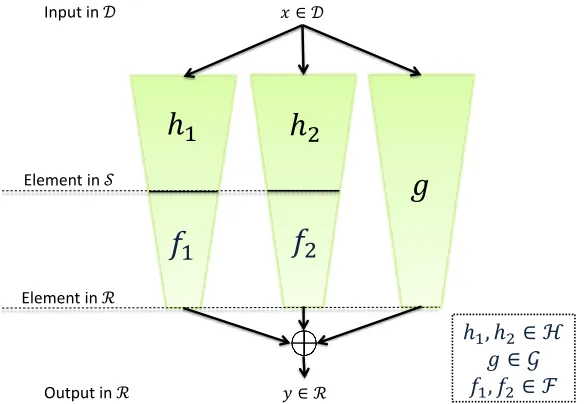
In other words, given f1, f2 ∈ F, h1, h2 ∈ H and g ∈ G, design a function PPf1,f2,h1,h2,g(x) =
f1(h1(x))⊕f2(h2(x))⊕g(x). Pagh and Pagh [42] showed that when the families H and G are
of “high enough” independence, that is, roughly (c·log|S|)-wise independent, then the family
PP(H,G,Π) isO(|S|−c)-indistinguishable from random by a|S|-query,non-adaptivedistinguisher, where Π is the set of all functions fromS toR. Note that the security of the resulting family goes well beyond the birthday attack barrier: it is indistinguishable from random by an attacker making
|S| p|S| queries.
independent that [42] used). Specifically, for a given s ≥ 0, Aum¨uller et al. [4] constructed a function familyADWs(H,G,Π) that isO(|S|−(s+1))-indistinguishable from random by a|S|-query, non-adaptive distinguisher, where Π is the set of all functions from S to R.2 The idea to use more sophisticated hash functions, in the sense that they require less combinatorial work, already appeared in previous works, e.g., the work of Arbitman et al. [2,§5.4].
In Section 3we take the above results a step further, showing that they hold also for adaptive distinguishers.3 Our approach for this transformation has many predecessors. For instance, the work of Naor and Reingold [38], and of Jetchev et al. [26]. Furthermore, it turns out that by using the above function family with a pseudorandom function F, namely the family PP(H,G,F) (or
ADWs(H,G,F)), we get a pseudorandom function that is superior to F (the actual properties of
PP(H,G,F) are determined by the properties ofFand the choice ofHandG). This understanding is the main conceptual contribution of this paper, and the basis for the results presented below.
We note that the works of Pagh and Pagh [42], Dietzfelbinger and Woelfel [15], and Aum¨uller et al. [4] have gone almost unnoticed in the cryptography literature so far.4 In this work we apply, in a black-box manner, the analysis of [42] and of [4] in cryptographic settings.
1.3 Our Results
We use a construction inspired by cuckoo hashing to improve upon two PRF reductions: PRF domain extension and non-adaptive to adaptive PRF.
1.3.1 PRF Domain Extension
PRF domain extensions use PRFs with “small” domain size to construct PRFs with larger (or even unlimited) domain size. These extensions reduce the cost of a single invocation of the PRF and increase its usability. Domain extension methods are typically measured by the security of the resulting PRFs, and by the number of calls the resulting PRF makes to the underlying PRF.
Among the known domain extension techniques are the MAC-based constructions, such as CBC-MAC and PCBC-MAC (a survey on their security can be found in [37]). The number of calls made by these constructions to the underlying (small domain) PRF can be as small as two. Assuming that the underlying PRF is a random function over{0,1}n, then the resulting family is (q,∞, O(q2/2n ))-PRF (i.e., the∞in the second parameter means that the distinguisher’s running time is unlimited). A second technique is the Feistel or Bene˘s transformations (e.g., [1,44,45], a survey of which can be found in [46]). The Bene˘s based construction makes 8 calls to the underlying PRF and is (q,∞, O(q/2n))-PRF, whereas a 5-round Feistel based construction (which makes 5 calls to the underlying PRF) is (q,∞, O(q/2n))-PRF.
Our cuckoo hashing based function family (see below) is (q,∞, O(q/2n))-PRF and makes only two calls to the underlying PRF. Moreover, our construction can extend the domain size to any
2
TheADW’s function family is in fact more complicated than the above simplified description. See Section6for the formal definition.
3
Note that in some cases an adaptive adversary is a more powerful distinguisher than a non-adaptive one. For example, when a trying to distinguish between a truly random function and a random involution (permutations where the cycle length is at most 2). There exists an adaptive distinguisher that will succeed with very high probability by asking two queries while any non-adaptive distinguisher will fail with very high probability (see [27,40]).
4Pagh and Pagh [42] did notice this connection, and in particular mentioned the connection of their work to that
poly(n) length, unlike the aforementioned constructions, which only double the domain size.5
Theorem 1.1 (informal). Let k≤n, letHandG be efficientk-wise independent function families mapping strings of length `(n) to strings of lengthn, and let Π be the family of all functions from
{0,1}n to{0,1}n. Then the familyPP(H,G,Π), mapping strings of length`(n) to strings of length n, is a(q,∞, q/2Ω(k))-PRF, for q≤2n−2.
For k = Θ(n), Theorem 1.1 yields a domain extension that is (q,∞, q/2n)-PRF, and makes only two calls to the underlying PRF. Replacing in the above construction the function family
PP(H,G,Π) with the familyADWs(H,G,Π) yields a more versatile domain extension that offers a tradeoff between the number of calls to the PRF and the independence required for the hash functions. For details, see Section6.2.
PRG to PRF reductions. Theorem1.1can also be used to get a hardness-preserving construc-tion of PRFs from pseudorandom generators (PRG) in settings where there is a non-trivial bound on the number of queries to the PRF. Jain et al. [25], who were the first to propose this goal, noted that one can realize it using a domain extension constructions. Thus, we apply Theorem1.1to get constructions of PRFs from PRGs which improves some of the parameters of Jain et al. [25], but require longer keys. See Appendix Bfor details.
1.3.2 From Non-Adaptive to Adaptive PRF
Adaptive PRFs can be constructed from non-adaptive ones using general techniques such as using the PRG-based construction of Goldreich et al. [21] or thesynthesizer based construction of Naor and Reingold [39]. These constructions, however, make (roughly) n calls to the underlying non-adaptive PRF (where n is the input length). Recently, Berman and Haitner [7] showed how to perform this security uplift at a much lower cost: the adaptive PRF makes only a single call to the non-adaptive PRF. Their construction, however, incurs a significant degradation in the security: assuming the underlying function is a non-adaptivet-PRF, then the resulting function is an (adaptive) O(t1/3)-PRF. The reason for this degradation is the birthday attack we mentioned earlier.
We present a reduction from non-adaptive to adaptive PRFs thatpreserves the security of the non-adaptive PRF. The resulting adaptive PRF makes only two calls to the underlying non-adaptive one.
Theorem 1.2 (informal). Let t be a polynomial-time computable integer function, let H =
{Hn: {0,1}n 7→ [4t(n)]{0,1}n}n∈N (where [4t(n)]{0,1}n are the first 4t(n) elements of {0,1}n) and
G={Gn:{0,1}n7→ {0,1}n}n∈N be efficient O(logt(n))-wise independent function families, and let F be a length-preserving non-adaptivet-PRF. Then PP(H,G,F) is a length-preserving(t/4)-PRF.
Also in this case, replacing the function family PP(H,G,F) with the family ADWs(H,G,F), yields a more versatile non-adaptive to adaptive transformation that offers a trade-off between the number of calls to the PRF and the requisite independence. See Section6.3 for details.
5Of course, one can use these constructions to extend the domain to any poly(n) length by a recursive construction.
1.4 More Related Work
Bellare et al. [6] introduced a paradigm for using PRFs in the symmetric-key settings that, in retrospect, is similar to cuckoo hashing. Assume that two parties, who share a secret function f would like to use it for (shared-key) encryption. The ‘textbook’ (stateless) solution calls for the sender to choose r at random and send (r, f(r)⊕M) to the receiver, where M is the message to be encrypted. This proposal breaks down if the sender chooses the samer twice (in two different sessions with different messages). Thus, the scheme is subject to the birthday attack and the length parameters should be chosen accordingly. This requires the underlying function to have a large domain. Instead, [6] suggested choosing t > 1 values at random, and sending (r1, . . . , rt, f(r1)⊕
· · · ⊕f(rt)⊕M). They were able to show much better security than the singler case. They also showed a similar result for message authentication. Our domain extension results (see Section 4) improve upon the results of [6].
The problem of transforming a scheme that is only resilient to non-adaptive attack into one that is resilient to adaptive attacks has received quite a lot of attention in the context of pseudo-random permutations (or block ciphers). Maurer and Pietrzak [33] showed that, given a family of permutations that are information-theoretic secure against non-adaptive attacks, if two members of this family are independently composed, then the resulting permutation is also secure against adaptive attacks (see [33] for the exact formulation). Pietrzak [47] showed, however, that this is not necessarily the case for permutations that are random-looking under a computational assumption (see also [36,48]), reminding us that translating information-theoretic results to the computational realm is a tricky business.
Paper Organization
Basic notations and formal definitions are given in Section 2. In Section 3 we formally define the hashing paradigm of Pagh and Pagh [42] and show how to extend their result to hold against adaptive adversaries. Our domain extension reduction based on [42] is described in Section4, and the improved non-adaptive to adaptive reduction, also based on [42], is described in Section 5. In Section6 we present the more advanced (and more complex) hashing paradigm of Aum¨uller et al. [4], and use it to obtain a more versatile version of the above reductions. Some possible directions for future research are discussed in Section 7.
2
Preliminaries
2.1 Notations
All logarithms considered here are in base two. We use calligraphic letters to denote sets, uppercase for random variables, and lowercase for values. Let ‘||’ denote string concatenation. For an integert, let [t] ={1, . . . , t}. For a setSand integert, letS≤t={s∈ S∗: |s| ≤t ∧ s[i]6=s[j] ∀i6=j∈[|s|]}, and let [t]Sbe the firsttelements, in increasing lexicographic order, ofS(equal toSin case|S|< t). For setsU andV, let ΠU 7→V stands for the set of all functions fromU toV, and for integersn and `, let Πn,`= Π{0,1}n7→{0,1}`.
Let poly denote the set all polynomials, and letpptmbe abbreviation for probabilistic (strictly) polynomial-time Turing machine. For s ∈ N and t, q:N 7→ N, we say that D is a t-time q-query
most q(n) queries to each of its s oracles. Given a random variable X, we write X(x) to denote Pr[X=x], and writex←X to indicate that xis selected according toX. Similarly, given a finite set S, we let s ← S denote that s is selected according to the uniform distribution on S. The statistical distance of two distributionsP andQover a finite setU, denoted asSD(P, Q), is defined as maxS⊆U|P(S)−Q(S)|= 12P
u∈U|P(u)−Q(u)|.
2.2 Pseudorandom Generators
Definition 2.1 (Pseudorandom Generators). A polynomial-time function G:{0,1}n 7→ {0,1}`(n)
is (t, ε)-PRG, if `(n)> n for every n∈N (Gstretches the input), and
Prx←{0,1}n[D(G(x)) = 1]−Pry←{0,1}`(n)[D(y) = 1]
≤ε(n)
for every algorithm (distinguisher) D of running time t(n) and large enough n. A (t,1/t))-PRG is called at-PRG. If `(n) = 2n, we say thatG is length-doubling.
2.3 Function Families
2.3.1 Operating on Function Families
We consider two natural operations on function families.
Definition 2.2 (composition of function families). Let F1:D1 7→ R1 and F2:D2 7→ R2 be two
function families with R1 ⊆ D2. The composition of F1 with F2, denoted F2◦ F1, is the function
family {(f2, f1)∈ F2× F1}, where (f2, f1)(x) :=f2(f1(x)).
Definition 2.3 (group operation of function families). Let F1:D 7→ R1 and F2:D 7→ R2 be two
function families with R1,R2 ⊆ R, where R is a group with operation ⊕. The group operation of
F1 with F2, denoted F2LF1, is the function family {(f
2, f1) ∈ F2 × F1}, where (f2, f1)(x) :=
f2(x)⊕f1(x).
In all of our applications, the group Rfrom the above definition will simply be{0,1}nfor some n∈N, with XOR as the group operation.
2.3.2 Function Family Ensembles
A function family ensemble is an infinite set of function families, whose elements (families) are typically indexed by the set of integers. Let F = {Fn:Dn 7→ Rn}n∈N stands for an ensemble of
function families, where eachf ∈ Fnhas domainDnand its range is a subset ofRn. Such ensemble islength preserving, if Dn=Rn={0,1}nfor every n. We naturally extend Definitions2.2and2.3 to function family ensembles.
For a function family ensemble to be useful it should have an efficient sampling and evaluation algorithms.
Definition 2.4 (efficient function family ensembles). A function family ensemble F ={Fn:Dn7→ Rn}n∈N isefficient, if the following hold:
Efficient sampling. F is samplable in polynomial-time: there exists apptmthat given1n, outputs (the description of ) a uniform element in Fn.
2.3.3 Many-Wise Independent Hashing
Definition 2.5 (k-wise independent families). A function family H = {h:D 7→ R} is k-wise independent (with respect to D and R), if
Prh←H[h(x1) =y1∧h(x2) =y2∧. . .∧h(xk) =yk] = 1
|R|k,
for every distinct x1, x2, . . . , xk∈ D and every y1, y2, . . . , yk ∈ R.
For every`, k∈poly, the existence of efficientk(n)-wise independent family ensembles mapping strings of length `(n) to strings of length n is well known ([11, 52]). A simple and well known example of k-wise independent functions is the collection of all polynomials of degree (k−1) over a finite field. This construction has small size, and each evaluation of a function at a given point requires koperations in the field.
Fact 2.6. For `, n, k ∈N, there exists an k-wise independent function family H ={h:{0,1}` 7→
{0,1}n}, such that sampling a random element in H requires k·max{`, n} random bits, and eval-uating a function fromH is done in time poly(`, n, k).
We mention that a k-wise independent families (as defined in Definition 2.5) look random for k-query distinguishers, both non-adaptive and adaptive ones. On the other hand, almost k-wise independent families6 are only granted to be resistant againstnon-adaptive distinguishers.7 Yet, the result presented in Section 3 yields that, in some cases, the adaptive security of the latter families follows from their non-adaptive security.
2.4 Pseudorandom Functions
Definition 2.7 (Pseudorandom Functions). An efficient function family ensemble F =
{Fn:{0,1}m(n) 7→ {0,1}`(n)}n∈N is an (adaptive) (q, t, ε)-PRF, if for every t-time q-query
oracle-aided algorithm (distinguisher) D, it holds that
Prf←Fn[D
f(1n) = 1]−Pr
π←Πm(n),`(n)[D
π(1n) = 1]
≤ε(n),
for large enough n. Ifq(n) is only bounded by t(n) for every n∈N, then F is called(t, ε)-PRF. A (t,1/t)-PRF is called a t-PRF.
If D is limited to benon-adaptive (i.e., it has to write all his oracle calls before making the first call), thenF is callednon-adaptive(q, t, ε)-PRF(and we apply the above notational conventions also for this case).
Some applications require the pseudorandom functions to be secure against distinguisher with access to many oracles (and not just a single oracle as in Definition2.7).
6
Formally, a function familyH={h:D 7→ R}is (ε, k)-wise independent if for any x1, . . . , xk ∈ Dand for any
y1, . . . , yk ∈ Rit holds that
Prh←H[h(x1) =y1∧ · · · ∧h(xk) =yk]− |R| −k
≤ε. We call a family of functions an
almostk-wise independent family, if it is (ε, k)-wise independent for some smallε >0.
7
Definition 2.8 (pseudorandom functions secure against many-oracle distinguishers). An efficient function family ensemble F ={Fn:{0,1}m(n) 7→ {0,1}`(n)}
n∈N is an s-oracle (q, t, ε)-PRF, if for every t-time q-query s-oracle-aided algorithm (distinguisher) D, it holds that
Prf←Fns[D
f(1n) = 1]−Prπ←
Πs
m(n),`(n)[D
π(1n) = 1]
≤ε(n),
for large enough n.
The following lemma shows that a standard (single oracle) PRF is also a many-oracle one, with only slight worse parameters.
Lemma 2.9 (cf., [9], Theorem 1). Let F ={Fn:{0,1}m(n)7→ {0,1}`(n)}n∈N be a function family ensemble. Then for every t-time q-query s-oracle adaptive [resp., non-adaptive] distinguisher D, there exists a (t+s·q·eF)-time q-query single-oracle adaptive [resp., non-adaptive] distinguisher
b
D, where eF stands for the evaluation time of F,8 with
Prf←Fn[Db
f(1n) = 1]−Prπ←
Πm(n),`(n)[Db
π(1n) = 1]
≥ 1
s·
Prf←Fns[D
f(1n) = 1]−Prπ←
Πs
m(n),`(n)[D
π(1n) = 1] ,
for everyn∈N.
Lemma 2.9is proven using a standard hybrid argument. For a complete proof see [9].9
3
From Non-Adaptive to Adaptive Hashing
In this section we show that non-adaptively secure function families with a certain combinatorial property are also adaptively secure, yielding that the function families of Pagh and Pagh [42] and Aum¨uller et al. [4] are adaptively secure. In the next sections we take advantage of the latter implication to derive our hardness-preserving PRF reductions. We note that the above approach is not useful for (arbitrary) non-adaptive PRFs, since a PRF might no posses the required combinatorial property (indeed, not every non-adaptive PRF is an adaptive one).
To define the aforementioned combinatorial property, we use the notion of left-monotone sets.
Definition 3.1 (left-monotone sets). Let S and T be sets. A set M ⊆ S∗× T isleft-monotone, if for every(s1, t)∈ M and every s2 ∈ S∗ that hass1 as a prefix, it holds that (s2, t)∈ M.
Namely, a product set is left monotone, if it is monotone with respect to its left-hand-side part, where all sequences having a prefix in a monotone set, are also in the set. The main result of this section is stated as follows.
Lemma 3.2. Let U and V be non-empty sets, let F = F(U,V) = {fu,v:D 7→ R}(u,v)∈U ×V be a function family and let BAD ⊆ D∗ × U be left monotone. Let t ∈
N, and assume that for every
q= (q1, . . . , q|q|)∈ D≤t:10
8
That is,D(1n) runs in timet(n) +s·q(n)·eF(n). Moreover, we implicitly assume that the evaluation time ofF
is greater than the time needed to sample`(n) random bits.
9
[9] only states, and proves, the adaptive case, but the very same lines also yields the non-adaptive case.
10
Recall that for a setS and an integert,S≤t
denotes the set{s∈ S∗
1. f(q1), . . . , f(q|q|)
f←{fu,v:v∈V} is uniform overR
|q|, for everyu∈ U with(q, u)6∈BAD, and
2. Pru←U[(q, u)∈BAD]≤ε.
Then
Pru←U v←V[D
fu,v = 1]−Pr
π←Π[Dπ = 1]
≤ε,
for every t-query oracle-aidedadaptive algorithmD, letting Π be the set of all functions fromD to
R.
Note that the above properties of the family F mean that F is non-adaptively secure. The proof that F is also adaptively secure, which critically uses the above structure of the set BAD, can be found in AppendixA.11
3.1 The Pagh and Pagh [42] Function Family
We show that Lemma 3.2can be applied to the function family of Pagh and Pagh [42].
Definition 3.3 (The Pagh and Pagh [42] function family). Let H be a function family from D to
U, letG be a function family fromD toR and letF be a function family from S to R, with U ⊆ S
and R being a group with respect to the operation ⊕. The function family PP(H,G,F) from D to
R, is defined by
PP(H,G,F) := (F ◦ H)⊕(F ◦ H)⊕ G.
For h1, h2∈ H, let PPh1,h2(G,F) := (F ◦h1)⊕(F ◦h2)⊕ G.
Graphically, this function family is given in Figure 1. Pagh and Pagh [42] showed that when instantiated with the proper function families, the above function family has the following proper-ties:
Theorem 3.4 ([42]). Let t∈N, let H={h:D 7→ U } and G ={g:D 7→ R} be function families with Rbeing a group with respect to the operation ⊕, and let Π = ΠS7→R.
If U ⊆ S and |U | ≥4t, then for every k∈Nthere exists a left-monotone set BAD⊆ D≤t× H2
such that the following holds for every q= (q1, . . . , q|q|)∈ D≤t:
1. Assuming that G is k-wise independent over the elements of q, then f(q1), . . . , f(q|q|)
f←PPh1,h2(G,Π) is uniform overR
|q|for everyu∈ Usuch that(q, u)6∈BAD.
2. Assuming thatH isk-wise independent over the elements ofq, then Pru←H2[(q, u)∈BAD]≤
t/2Ω(k).12 11
Lemma3.2 can be derived as a special case of a result given in [26, Theorem 12] (closing a gap in the proof appearing in [32]). Yet, for the sake of completeness, we include an independent proof of this lemma here.
12
The function family we consider above (i.e.,PP) is slightly different than the one given in [42]. Their construction maps element x ∈ D to F1[h1(x)]⊕F2[h2(x)]⊕g(x), where F1 and F2 are uniformly chosen vectors from Rt,
h1, h2:D 7→[t] are uniformly chosen from a function familyHand g:D 7→ Ris chosen uniformly from a function
𝑥 ∈ 𝒟
Input in 𝒟
𝑓
1
1
2𝑔
1, 2∈ ℋ
𝑔 ∈ 𝒢 𝑓1, 𝑓2 ∈ ℱ
𝑓
2𝑦 ∈ ℛ
Output in ℛ
Element in ℛ Element in 𝒮
Figure 1: The function familyPP(H,G,F). Hhashes down a domainDto a domain S. ThenF
maps S toR. We do this twice and xor it withG, that hashes the domain Ddirectly to R.
Pagh and Pagh [42] concluded that for (the many) applications where the analysis is applied with respect to a static set it is safe to use this family instead. However, as we can see, the function familyPP(H,G,Π) is not only close to being uniform in the eyes of a non-adaptive distinguisher, but also allows us to apply Lemma3.2to deduce its security in the eyes of adaptive distinguishers. By plugging in Theorem3.4into the general framework lemma (Lemma 3.2), we get the following result:
Lemma 3.5. Let t∈ N, let H, G and Π be as in Theorem3.4, and let D be an adaptive, t-query oracle-aided algorithm. Assuming thatH and G arek-wise independent, then
Prf←PP(H,G,Π)[D
f = 1]−Pr
π←Π[Dπ = 1]
≤t/2
Ω(k).
Proof. LetU =H×HandV= Π×Π×G. For (h1, h2)∈ Uand (π1, π2, g)∈ V, letF(h1,h2),(π1,π2,g)=
π1◦h1⊕π2◦h2⊕g, and let F ={Fu,v:D 7→ R}(u,v)∈U ×V. Finally, let BAD be the set BAD of Theorem 3.4. We prove the lemma showing that the above sets meet the requirements stated in Lemma3.2.
Item1of Theorem3.4and the assumed independence ofGandH, yield that the first requirement of Lemma3.2is satisfied. Item2of Theorem 3.4yields that the second requirement of Lemma3.2
is satisfied forε=t/2Ω(k). Hence, the proof of the lemma follows by Lemma3.2.
We use the above function family of Pagh and Pagh [42] to extend the domain of pseudorandom functions (see Section4), and to transform a non-adaptive pseudorandom function into an adaptive one (see Section 5). In Section 6 we instantiate the above framework with the more advanced function family of Aum¨uller et al. [4], to get more versatile variants of the above applications.
4
PRF Domain Extension
In this section we use the function family PP of Pagh and Pagh [42] (see Section 3) to extend a domain of a given PRF. We start with instantiation ofPP in a settings of strings in {0,1}∗.
Corollary 4.1. Let k,d,sandr be integers, letH={h:{0,1}d7→ {0,1}s}andG={g:{0,1}d7→
{0,1}r} be function families. Assume that H andG are k-wise independent function families, and let PP be as in Definition 3.3. Then for any q-query adaptive distinguisherD, it holds that
Prf←PP(H,G,Πs,r)[D
f = 1]−Prπ←
Πd,r[D π = 1]
≤q/2
Ω(k),
for anyq ≤2s−2.
Proof. The proof follows Lemma 3.5. Set t = q, D ={0,1}d, U =S ={0,1}s and R = {0,1}r. Note that|U |= 2s≥4q= 4t. Hence, the proof follows a simple implication of Lemma 3.5.
The above corollary shows that PP(H,G,Π), where Π is the set of all functions with domain
{0,1}s and range {0,1}r, is statistically close to the set of all functions with domain {0,1}d and range {0,1}r, where s can be smaller than d. Our next step is, given a PRF F, to show that
PP(H,G,F) is computationally close to PP(H,G,Π). Recall that if H, G and F are ensembles of function families indexed by an integer n, then PP(H,G,F) is also an ensemble of function families, and we denoted its n’th function family asPP(Hn,Gn,Fn).
Lemma 4.2. Let H={Hn:{0,1}d(n)7→ {0,1}s(n)}
n∈N, G ={Gn:{0,1}d(n) 7→ {0,1}r(n)}n∈N and
F ={Fn:{0,1}s(n) 7→ {0,1}r(n)}n∈N be function families. Then, for every t-time q-query
oracle-aided distinguisher D, there exists a (t+ 2q·(eH+eG+eF))-time q-query distinguisher Db, where
eH,eG,eF:N7→N are the evaluation and sampling times of H, G and F respectively,13 with
Prf←Fn[Dbf(1n) = 1]−Prπ←Π
s(n),r(n)[Db
π(1n) = 1]
≥ 1
2·
Prf←PP(Hn,Gn,Fn)[Df(1n) = 1]−Prf←PP(Hn,Gn,Π
s(n),r(n))[D
f(1n) = 1] ,
for everyn∈N.
Proof. Let De be the following two-oracle distinguisher:
Algorithm 4.3 (De).
Input: 1n.
Oracle: functions φ1, φ2 fromDn to Rn. 13
That is, e.g.,eH(n) is an upper bound for the time it takes to sampleh← Hn, as well as the time it takes to
1. Set h1, h2 ← Hn, g← Gn.
2. Set f = (φ1◦h1)⊕(φ2◦h2)⊕g.
3. Emulate Df(1n).
Note that De(1n) makes q(n) queries to φ1 and φ2, and it can be implemented to run in time
t(n) +q(n)·(eH(n) +eG(n)). Observe that in case φ1 and φ2 are uniformly drawn from Fn, then
the emulation of Df(1n) done in Deφ1,φ2(1n) is identical to a random execution of Df(1n) with
f ← PP(Hn,Gn,Fn). Similarly, in case φ1 and φ2 are uniformly drawn from Πs(n),r(n), then the
emulation is identical to a random execution of Df(1n) withf ← PP(Hn,Gn,Πs(n),r(n)). Thus,
Pr(f
1,f2)←Fn×Fn[De
f1,f2(1n) = 1]−Pr
(π1,π2)←Πs(n),r(n)×Πs(n),r(n)[De
π1,π2(1n) = 1]
(2)
=Prf←PP(Hn,Gn,Fn)[Df(1n) = 1]−Prf←PP(Hn,Gn,Π
s(n),r(n))[D
f(1n) = 1] .
Hence, Lemma 2.9 yields that there exists a single-oracle distinguisher Db that when invoked on
input of lengthnmakes q(n) queries to its oracle and runs in timet(n) +q(n)·(eH(n) +eG(n)) + 2q(n)·eF(n)≤t(n) + 2q(n)·(eH(n) +eG(n) +eF(n)), such that
Prf←Fn[Dbf(1n) = 1]−Prπ←Π
s(n),r(n)[Db
π(1n) = 1]
≥ 1
2·
Prf←PP(Hn,Gn,F
n)[D
f(1n) = 1]−Pr
f←PP(Hn,Gn,Πs(n),r(n))[D
f(1n) = 1] .
Assuming thatF ={Fn:{0,1}s(n) 7→ {0,1}r(n)}n∈N is (q, t, ε)-PRF, Lemma 4.2yields that for every (t+ 2q(eH+eG+eF))-time distinguisherD, it holds that
Prf←PP(Hn,Gn,F
n)[D
f(1n) = 1]−Pr
f←PP(Hn,Gn,Πs(n),r(n))[D
f(1n) = 1]
≤2ε(n),
for large enoughn. Hence, assumingHandGarek-wise independent function families, Corollary4.1
and the triangle inequality yield that
Prf←PP(Hn,Gn,Fn)[D
f(1n) = 1]−Prπ←
Πd(n),r(n)[D
π(1n) = 1]
≤2ε(n) +q(n)/2
Ω(k(n))
for large enoughn. We get the following domain extension using thePP construction.
Theorem 4.4 (Restating Theorem 1.1). Let H = {Hn:{0,1}d(n) 7→ {0,1}s(n)}n∈N and G = {Gn:{0,1}d(n) 7→ {0,1}r(n)}n∈N be efficient k(n)-wise independent function family ensembles, and
let F ={Fn:{0,1}s(n)7→ {0,1}r(n)}
n∈N be a (q, t, ε)-PRF. Then,
PP(H,G,F) ={PP(Hn,Gn,Fn) :{0,1}d(n)7→ {0,1}r(n)}n∈N
is a (q, t−p·q,2ε+q/2Ω(k))-PRF, where p is a polynomial determined by the evaluation and sampling time of H, G and F and q(n)≤2s(n)−2 for everyn∈N.
Note that in order for Theorem4.4to be useful, we have to setk(n) = Ω(logq(n)). In Section6
5
From Non-Adaptive to Adaptive PRF
In this section we use the function family PP of Pagh and Pagh [42] (see Section 3), to transform an non-adaptive PRF into an adaptive one in a security preserving manner. As in Section 4, we start with instantiating PP in a convenient setting. To ease notations, we assume that the given non-adaptive PRF is length preserving.
Corollary 5.1. Let k, q,d andn be integers with q ≤2n−2, let H={h:{0,1}d7→[4q]
{0,1}n} and let G = {g: {0,1}d 7→ {0,1}n}. Assume that H and G are k-wise independent function families, then for any q-query adaptive distinguisherD, it holds that
Prf←PP(H,G,Πn)[D
f = 1]−Pr
π←Πd,n[D π = 1]
≤q/2
Ω(k).
Proof. The proof follows from Lemma3.5. Set t=q, D={0,1}d,S ={0,1}n,U = [4q]{
0,1}n and
R={0,1}n. Note that |U |= 4q= 4t.
We begin by showing thatPP(H,G,F) is computationally indistinguishable fromPP(H,G,Π), whereF is non-adaptive pseudorandom function and Π is a truly random function with the same domain and range as F. Recall that if H,G and F are ensembles of function families indexed by an integer n, then PP(H,G,F) is also an ensemble of function families, and we denoted its nth function family asPP(Hn,Gn,Fn).
Lemma 5.2. Let q and d be integer functions, let H ={Hn:{0,1}d(n) 7→ [4q(n)]{0,1}n}n∈N, G =
{Gn:{0,1}d(n) 7→ {0,1}n}, and F ={F
n:{0,1}n7→ {0,1}n} be function families. Then for every t-timeq-query oracle-aided adaptive distinguisherD, there exists a(eq+t+ 8q(eH+eG+eF))-time 4q-query, non-adaptive, oracle-aided distinguisherDb, where eq is the evaluation time of q, andeH,
eG and eF are the sampling and evaluation time ofH, G and F respectively, with
Prf←Fn[Dbf(1n) = 1]−Prπ←Πn[Dbπ(1n) = 1]
≥ 1
2·
Prf←PP(Hn,Gn,Fn)[Df(1n) = 1]−Prf←PP(Hn,Gn,Πn)[Df(1n) = 1] ,
for everyn∈N and q(n)≤2n−2.
Proof. The proof follows along similar lines to the proof of [7, Lemma 3.3]. LetDe be the following
two-oracle distinguisher:
Algorithm 5.3 (De).
Input: 1n.
Oracles: Functions φ1 and φ2 from{0,1}n to{0,1}n.
1. Compute φ1(x) and φ2(x) for everyx∈[4q(n)]{0,1}n.
2. Set f = (φ1◦h1)⊕(φ2◦h2)⊕g, where h← Hn and g← Gn.
3. Emulate Df(1n): answer a query xto φ1 andφ2 made byDwithf(x), using the information
Note that De(1n) makes 4q(n) non-adaptive queries to φ1 and φ2, and it can be implemented
to run in time eq(n) + 8q(n) +t(n) +q(n)·(eH(n) +eG(n)). Observe that the definition of PP guarantees that φ1 and φ2 are only queried on the first 4q(n) elements of their domain. Hence,
in case φ1 and φ2 are uniformly drawn from Fn, then the emulation of Df(1n) done in Deφ1,φ2 is
identical to a random execution of Df(1n) with f ← PP(Hn,Gn,Fn). Similarly, in case φ1 and
φ2 are uniformly drawn from Πn, then the emulation is identical to a random execution of Df(1n)
withf ← P(Hn,Gn,Πn). Thus,
Pr(f1,f2)←Fn×Fn[De
f1,f2(1n) = 1]−Pr
(π1,π2)←Πn×Πn[De
π1,π2(1n) = 1]
(3) =
Prf←P(Hn,Gn,Fn)[D
f(1n) = 1]−Pr
f←P(Hn,Gn,Πn)[D
f(1n) = 1] .
Hence, Lemma 2.9yields that there exists a non-adaptive, single-oracle distinguisherDb that when
invoked on input of length n makes 4q(n) queries and runs in time eq(n) + 8q(n) +t(n) +q(n)· (eH(n) +eG(n)) + 2q(n)·eF(n)≤eq(n) +t(n) + 8q(n)·(eH(n) +eG(n) +eF(n)), such that
Prf←Fn[Db
f(1n) = 1]−Pr
π←Πn[Db
π(1n) = 1]
≥ 1
2·
Prf←P(Hn,Gn,Fn)[D
f(1n) = 1]−Pr
f←P(Hn,Gn,Πn)[D
f(1n) = 1] ,
for everyn∈N.
Let q be an integer function with q(n) ≤ 2n−2 for every n ∈ N, let F = {Fn: {0,1}n 7→
{0,1}n}
n∈N be a non-adaptive (4q, p·t, ε)-PRF, forp(n)≥eq(n) +t(n) + 8q(n)·(eH(n) +eG(n) +
eF(n)). Lemma5.2 yields that for every t-time q-query oracle-aided algorithm D, it holds that
Prf←P(Hn,Gn,Fn)[D
f(1n) = 1]−Pr
f←P(Hn,Gn,Πn)[D
f(1n) = 1]
≤2ε(n),
for large enough n. Hence, assuming H and G are k(n)-wise independent, Corollary 5.1 and the triangle inequality yield that
Prf←PP(Hn,Gn,Fn)[D
f(1n) = 1]−Pr
π←Πn[D
π(1n) = 1]
≤2ε(n) +q(n)/2
Ω(k(n))
for large enoughn∈N. Settingk(n) = Θ(logq(n)) yields the following theorem.
Theorem 5.4. Let q be a polynomial-time computable integer function with q(n)≤2n−2 for every n∈N, let H={Hn:{0,1}n 7→[4q(n)]{0,1}n}n∈N and G ={Gn:{0,1}n 7→ {0,1}n}n∈N be efficient (c ·logq)-wise independent function family ensembles, where c > 0 is universal, and let F =
{Fn:{0,1}n 7→ {0,1}n}
n∈N be a non-adaptive (4q, p·t, ε)-PRF, where p ∈ poly is determined by the evaluation time of q,H,G and F. Then PP(H,G,F) is an adaptive (q, t,2ε+ 1/q)-PRF.
Theorem 5.4implies the following simpler corollary.
Corollary 5.5 (Restatement of Theorem 1.2). Let t be a polynomial-time computable integer function with t(n) ≤ 2n−2 for every n ∈ N, let H = {Hn: {0,1}n 7→ [4t(n)]
{0,1}n}n∈N and
G ={Gn: {0,1}n7→ {0,1}n}
n∈N be efficient (c·logt)-wise independent function family ensembles, where c > 0 is universal, and let F ={Fn:{0,1}n 7→ {0,1}n}n∈N be a non-adaptive (p·t)-PRF,
where p ∈ poly is determined by the evaluation time of t,H,G and F. Then PP(H,G,F) is an adaptive t-PRF.
6
Hardness-Preserving Reductions via Advanced Cuckoo Hashing
In this section we apply the reductions given in Sections4and 5using the function family of Pagh and Pagh [42], with the function family of Aum¨uller et al. [4], to get a more versatile reduction (for comparison see Section6.2.1). Roughly speaking, the function family of Aum¨uller et al. [4] requires less combinatorial work (i.e., smaller independence) than the Pagh and Pagh [42] family. On the other hand, the function family of Aum¨uller et al. [4] requires more “randomness” (i.e., has a longer description) and is harder to describe. In Section 6.1 we formally define the hash function family of Aum¨uller et al. [4], state their (non-adaptive) result, and apply Lemma 3.2to get an adaptive variant of this result. In Section 6.2 we use the function family of Aum¨uller et al. [4] to obtain a PRF domain extension, where in Section6.3 we use this family to get a non-adaptive to adaptive transformation of PRFs.
6.1 The Aum¨uller et al. [4] Function Family
The function family of Aum¨uller et al. [4] (building upon Dietzfelbinger and Woelfel [15]) follows the same basic outline as the Pagh and Pagh [42] function family, but uses more complex hash functions. Recall that the members of the Pagh and Pagh [42] function family PP(H,G,F) are of the form (f1 ◦h1)⊕(f2 ◦ h2) ⊕g, for f1, f2 ∈ F, h1, h1,∈ H and g ∈ G. In the function
family ADW(H,L,G,F,M,Y) described below, the role of h1, h2 ∈ H is taken by some variant
of tabulation hashing (and not simply from a relatively highk-wise independent family as in [42]). Roughly, at the heart of these functions lies a functionah,g,m:D 7→ S of the form:
ah,g,m(x) :=h(x)
M
1≤i≤z
mi(gi(x)),
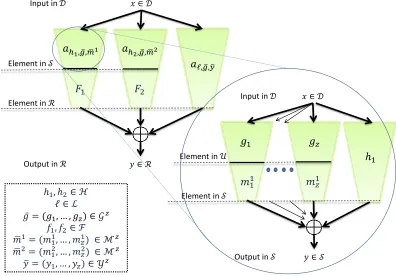
for h: D 7→ S, g = (g1,· · ·, gz) where gi: D 7→ U and m = (m1,· · · , mz) where mi:U 7→ S. Jumping ahead, the mi’s will be chosen to be random functions (or pseudorandom functions) and the gi’s and h will be chosen from a relatively low independence family. The Aum¨uller et al. [4] construction uses several functions of the above form that, unlike [42], are chosen in a correlated manner (in particular, sharing thesame function vectorg). The precise definition is:
Definition 6.1 (The Aum¨uller et al. [4] function family). Forz∈Nlet
1. D,U be sets andS,Rbe commutative groups defined with respect to an operation⊕S and⊕R, respectively (we will omit the subscript when it is clear);
2. function families H={h:D 7→ S}, L={`:D 7→ R}, F ={f:S 7→ R}, G ={g:D 7→ U },
M={m:U 7→ S}and Y ={y:U 7→ R};
3. functions h1, h2 ∈ H, `∈ L, f1, f2∈ F;
4. function vector g= (g1,· · · , gz), where gi ∈ G for every1≤i≤z;
5. function vectors m1 = (m1
1, . . . , m1z), m2 = (m21, . . . , m2z), where m j
i ∈ M for each j ∈ {1,2} and 1≤i≤z; and
Define adwm1,m2,y,h
1,h2,`,g,f1,f2:D 7→ R by
adwm1,m2,y,h
1,h2,`,g,f1,f2 := (f1◦ah1,g,m1)⊕R(f2◦ah2,g,m2)⊕Ra`,g,y, (4) where ah,g,m(x) :=h(x)L
1≤i≤zmi(gi(x)).14 For m1, m2 ∈ Mz, h
1, h2 ∈ H and g∈ Gz, function family L,F and Y as above, let
ADWz,(m1,m2,h
1,h2,g)(L,F,Y) :={adwm1,m2,y,h1,h2,`,g,f1,f2:y ∈ Y
z, `∈ L, f
1, f2∈ F }.
Finally, let
ADWz(H,L,G,F,M,Y) :={adwm1,m2,y,h
1,h2,`,g,f1,f2:
m1, m2 ∈ Mz, y ∈ Yz, h1, h2 ∈ H,
`∈ L, g ∈ Gz, f1, f2∈ F }.
Graphically, this function family is described in Figure 2.
𝑥 ∈ 𝒟
Input in 𝒟
𝐹1
𝑎ℎ1,𝑔 ,𝑚1 𝑎ℎ 2,𝑔 ,𝑚2
𝑎ℓ,𝑔 ,𝑦
1, 2∈ ℋ ℓ ∈ ℒ 𝑔 =(𝑔1, … , 𝑔𝑧) ∈𝒢𝑧
𝑓1, 𝑓2∈ ℱ 𝑚1= (𝑚
1 1, … , 𝑚
𝑧
1) ∈ ℳ𝑧 𝑚2= (𝑚
1 2, … , 𝑚
𝑧
2) ∈ ℳ𝑧 𝑦 = (𝑦1, … , 𝑦𝑧) ∈ 𝒴𝑧
𝐹2
𝑦 ∈ ℛ
Output in ℛ Element in ℛ
Element in 𝒮
𝑥 ∈ 𝒟
Input in 𝒟
𝑚11
𝑔1 𝑔𝑧
1
𝑚𝑧1
𝑦 ∈ 𝒮
Output in 𝒮 Element in 𝒮
Element in 𝒰
Figure 2: The function family ADWz(H,L,G,F,M,Y) in the top left corner. On the bottom right corner the function ah1,g,m1 is depicted. The function ah
2,g,m2 is similar. In a`,g,y the range of the functions` andy1. . . , yz isR (rather than S).
Aum¨uller et al. [4] proved the following result with respect to the above function family.
14
Theorem 6.2([4]). Lett, k, z ∈Nand letD,R,S,U be commutative groups defined with respect to an operation ⊕ such that |U | ∈[t] and |S| ≥4t.15 Assume that z·k∈O(logt). Let H={h:D 7→ S}, L={`:D 7→ R}and G={g:D 7→ U }be 2k-wise independent hash families. Then there exist
a universal constant const >0 and a left-monotone set BAD ⊆ D≤t×((ΠU 7→S)z)2× H2× Gz, such that the following holds for every q= (q1, . . . , q|q|)∈ D≤t:
1. f(q1), . . . , f(q|q|)
f←ADWz,u(L,ΠS7→R,ΠU 7→R) is uniform overR
|q| for every u∈((ΠU 7→S)z )2× H2× Gz such that(q, u)6∈BAD, and
2. Pru←((Π
U 7→S)z)2×H2×Gz[(q, u)∈BAD] =const·t/|U | z·k/2
.
Remark 6.3. The construction from Definition 6.1 and Theorem 6.2 are taken from [3, Section 6] which is the conference version of [4]. In [3] the authors only considered the case where z·k is constant, independent of t. The proof for the case where z·k∈O(logt) follows from the proof of [4, Theorem 2].
Applying Lemma 3.2, the above yields that, for the right choice of parameters, the function family ADWz(H,L,F,G,M,Y) is not only close to being uniform in the eyes of a non-adaptive distinguisher, but also in the eyes of an adaptive one. Specifically, combining Lemma 3.2and the-orem 6.2yields the following result.
Lemma 6.4. Let t, k, z,const,D,R,S,U,H,L,G be as in Theorem 6.2 and let D be an adaptive, t-query oracle-aided algorithm. Then
Prf←ADWz(H,L,G,ΠS7→R,ΠU 7→S,ΠU →R)[D
f = 1]−Prπ←
Π[Dπ = 1]
=const·t/|U |
z·k/2
.
Proof. LetU0 = ((ΠU 7→S)z)2× H2× Gz,V = (ΠU →R)z×
(ΠS→R)2× L. For (m1, m2, h1, h2, g)∈ U0
and (y, π1, π2, `)∈ V, let
F(m1,m2,h
1,h2,g),(y,π1,π2,`)= (π1◦ah1,g,m1)⊕(π2◦ah2,g,m2)⊕a`,g,y, and let
F ={Fu0,v:D 7→ R}(u0,v)∈U0×V.
Finally, let BAD be the set BAD of Theorem 6.2.
The above sets meet the requirements stated in Lemma 3.2: Item 1 of Theorem 6.2 assures that the first property of Lemma 3.2 is satisfied, and according to Item 2 of Theorem 6.2 we set ε of Lemma 3.2 to be const·t/|U |k·z, and thus the second property is also satisfied. Hence,
applying Lemma3.2 concludes the proof of the lemma.
We note that for large enoughz, and in contrast to the Pagh and Pagh [42] family, usingADW
we get meaningful results even when using an underlying k = o(logt)-wise independent family. (For a thorough comparison between PP and ADW see Section 6.2.1). In particular, for specific settings of parameters we get the following corollaries.
15
The actual setting in [4] is more general. Specifically, an additional parameterε >0 is used to set the size of
Corollary 6.5. Let t,const,D,R,S,U,H,L,G be as in Theorem 6.2. Let c ∈ N, z = 2(c+ 2),
|U |=t andk= 1. Let D be anadaptive,t-query oracle-aided algorithm. Then
Prf←ADWz(H,L,G,ΠS7→R,ΠU 7→S,ΠU 7→R)[D
f = 1]−Pr
π←Π[Dπ = 1]
=const/t
c+1.
Proof. Since Hand L are pairwise independent,z= 2(c+ 2), andk= 1 it holds that
const·t/|U |z·k/2 ≤const/tc+1.
Plugging this into Lemma 6.4completes the proof.
Corollary 6.6. Let t,const,D,R,S,U,H,L,G be as in Theorem6.2. Letc∈N,z= 2(c+ 2)·logt, k= 1 and |U |= 2. LetD be an adaptive, t-query oracle-aided algorithm. Then
Prf←ADWz(H,L,G,ΠS7→R,ΠU 7→S,ΠU 7→R)[D
f = 1]−Pr
π←Π[Dπ = 1]
=const/t
c+1.
Proof. Since Hand L are pairwise independent,z= 2(c+ 2)·logt, and k= 1 it holds that
const·t/|U |z·k/2 ≤const/tc+1.
Plugging this into Lemma 6.4completes the proof.
6.2 PRF Domain Extending Via the ADW Family
In this subsection we present a PRF a domain extension using the Aum¨uller et al. [4] family,ADW. This allows us to avoid the large independence required for using the Pagh and Pagh [42] family
PP.
Instantiating the above construction in the setting of strings over {0,1}∗, we get the following corollaries, analogous to Corollary 4.1.
Corollary 6.7. Let d, u, s, r, q, c > 0 be integers such that u ≤ s ≤ r, let z = 2(c+ 2) and let
H={H:{0,1}d7→ {0,1}s}, L={L:{0,1}d7→ {0,1}r} and G={G:{0,1}d7→ {0,1}u}. Assume
H,L and G are pairwise independent function family, then for any q-query adaptive distinguisher
D, it holds that
Prf←ADWz(H,L,G,Πs,r,Πu,s,Πu,r)[D
f = 1]−Pr
π←Πd,r[D π = 1]
≤O 1/q
c+1
,
for anyq ≤2r−2.
Corollary 6.8. Let d, s, r, q, c > 0 be integers, let u = 2, let z = 2(c+ 2)·logq and let H =
{H:{0,1}d7→ {0,1}s}, L={L:{0,1}d7→ {0,1}r} and G ={G:{0,1}d7→ {0,1}u}. Assume H,L and G are pairwise independent function family, then for any q-query adaptive distinguisherD, it holds that
Prf←ADWz(H,L,G,Πs,r,Πu,s,Πu,r)[D
f = 1]−Prπ←
Πd,r[D π = 1]
≤O 1/q
c+1
,
In what follows we state two domain extension results (whose proofs are similar to that of Theorem4.4). Recall thatADWzmakes two calls toF, 2zcalls toM, andzcalls toY (in total 3z+ 2 calls). In the first theorem (see Theorem6.9) we rely on Corollary6.7and implement the function families Πs,r,Πu,s and Πu,r using a single pseudorandom function family F = {Fn:{0,1}s(n) 7→
{0,1}r(n)}
n∈N. Assuming u(n) ≤s(n) and s(n)≤r(n), the implementation is done in the natural way by padding with leading zeroes. This results with a PRF that makes 3z+ 2 calls to the underlying PRF. In the second theorem (see Theorem6.10) we take advantage of the fact that in Corollary 6.8u= 2. This enables us to implement the function families M and Y as small tables of random values which are embedded into the PRF key. This results with a PRF that makes just two calls to the underlying PRF (but has a longer key).
Theorem 6.9. Let d and q be integer functions, let c > 1 be a constant, let z = 2(c+ 2), let
H={Hn:{0,1}d(n) 7→ {0,1}s(n)}
n∈N, L ={L:{0,1}d(n) 7→ {0,1}r(n)} and G = {G:{0,1}d(n) 7→
{0,1}u(n)} be efficient pairwise independent function family ensembles, where u(n)≤s(n)≤r(n),
and let F ={Fn:{0,1}s(n) 7→ {0,1}r(n)}n∈N be a (q, t, ε)-PRF. Then ADWz(H,L,G,F,F,F) = {ADWz(Hn,Ln,Gn,Fn,Fn,Fn) :{0,1}d(n)7→ {0,1}r(n)}
n∈N is a(q, t−p·q,(3z+ 2)·ε+ 1/qc+1
)-PRF, where p∈ poly is determined by the evaluation and sampling time of H and F and q(n)≤
2n−2.
Theorem 6.10. Let d and q be integer functions, let c > 1 be a constant, let z = z(n) = 2(c+ 2)·logq(n), let H = {Hn: {0,1}d(n) 7→ {0,1}r(n)}n∈N, L = {L:{0,1}d(n) 7→ {0,1}s(n)}
and G = {G:{0,1}d(n) 7→ {0,1}u(n)} be efficient pairwise independent function family
ensem-bles, let M = {Mn}n∈N (resp., Y = {Yn}n∈N) be family of tables, such that Mn (resp.,
Yn) is a table of two (resp., z(n)) random elements from {0,1}s(n) (resp., {0,1}r(n)), and let
F = {Fn: {0,1}s(n) 7→ {0,1}r(n)}
n∈N be a (q, t, ε)-PRF. Then ADWz(H,L,G,F,M,Y) =
{ADWz(n)(Hn,Ln,Gn,Fn,Mn,Yn) :{0,1}d(n)7→ {0,1}r(n)}n∈Nis a(q, t−p·q,2ε+ 1/qc+1)-PRF, where p∈poly is determined by the evaluation and sampling time of H and F and q(n)≤2n−2.
Roughly speaking, the difference between Theorems 6.9 and 6.10 is that in Theorem 6.9 the resulting PRF makes a large constant (i.e., 6c+ 12) number of queries to the underlying PRF, whereas in Theorem6.10it only makes two calls to the underlying PRF but the PRF key is longer (i.e., it has (6c+ 12)·logq random values embedded into it).
6.2.1 Comparing the PP and ADW Based Constructions
Theorems 4.4, 6.9 and 6.10 present different tradeoffs between two types of resources: “crypto-graphic work” — the total evaluation time of the calls to the underlying short-domain PRF, and “combinatorial work” — the independence needed from the function families used.16 In the PP -based construction (Theorem4.4), we minimize the number of calls to the PRF, thus keeping the cryptographic work small. But on the other hand, we require relatively high independence, thus requiring fairly much combinatorial work. In the first ADW-based construction (Theorem 6.9), the situation is somewhat reversed: we minimize the independence needed, but make more calls to the PRF. In the second ADW-based construction (Theorem 6.10), we minimize both the number of calls to the PRF and the independence needed, but we require much more hash functions, thus increasing again the combinatorial work.
In the following we instantiate Theorems 4.4, 6.9 and 6.10 in a specific setting, and compare their performance in terms of required randomness complexity, and evaluation time.17 Our starting point is a length-preserving (q, t, ε)-PRFF ={Fn}n∈N. Our goal is to construct a function family
with a larger domain, {0,1}d(n), whose security only deteriorates, comparing to that of F, by an
additive factor of 1/q(n)c, for c:=c(n)>1. Let rF(n) be the amount of random bits required to sample a random element inFn, and leteF(n) be the evaluation time of a single call to an element in Fn. Let e(`,nk) be the evaluation time of a k-wise independent function family from {0,1}` to
{0,1}n. Recall that by Fact 2.6, sampling a random element in the latter function family requires k·max{`, n} random bits.
Theorem 4.4 yields the following result, which makes only two calls to F, but requires hash functions of high independence.
Corollary 6.11. Let c >1 be an integer, letH={Hn:{0,1}d(n) 7→ {0,1}n}n∈N be Ω(c·logq(n
))-wise independent function family, let F = {Fn: {0,1}n 7→ {0,1}n}
n∈N be (q, t, ε)-PRF and let
PP(H,F) = {PP(Hn,Fn) : {0,1}d(n) 7→ {0,1}n}n∈N be according to Definition 3.3. Then the
following holds:
1.
Prf←PP(Hn,Fn)[D
f(1n) = 1]−Prπ←
Πd(n),n[D
π(1n) = 1]
= O(ε(n) + 1/q(n)
c), for any
adap-tive(t−p·q)-time q-query oracle-aided algorithm Dand large enoughn∈N, where p∈poly is according to Theorem 4.4, and q(n)≤2n−2.
2. The randomness complexity of PP(H,F) is O(c·d·logq) + 2·rF. Namely, there exists an algorithm that on input 1n, uses O(c·d(n)·logq(n)) + 2·rF(n) random bits, and outputs a random element in PP(Hn,Fn).
3. The evaluation time of PP(H,F) isO
e(d,nc·logq)
+ 2·eF. Namely, there exists an algorithm
that on input f ∈ PP(n) and x ∈ {0,1}d(n), runs in time Oe(c·logq(n))
d(n),n
+ 2·eF(n), and outputs f(x).
In comparison, Theorem 6.9 allows us to reduce the independence needed, in the price of increasing the number of calls toF.
Corollary 6.12. Let c >1 be an integer, let z= 2(c+ 2), let H={Hn:{0,1}d(n) 7→ {0,1}n} n∈N
be efficient pairwise independent function family ensembles, let F = {Fn:{0,1}n 7→ {0,1}n} n∈N be a (q, t, ε)-PRF and let ADWz(H,F) := ADWz(H,H,H,F,F,F) = {ADWz(Hn,Fn) :=
ADWz(Hn,Hn,Hn,Fn,Fn,Fn) :{0,1}d(n) 7→ {0,1}n}
n∈N be according to Definition 6.1.
1.
Prf←ADWz(Hn,Fn)[D
f(1n) = 1]−Pr
π←Πd(n),n[D
π(1n) = 1]
= O(c·ε(n) + 1/q(n)
c), for any
(t−p·q)-time q-query adaptive oracle-aided algorithm D and large enough n ∈ N, where p∈poly is according to Theorem 6.9, and q(n)≤2n−2.
2. The randomness complexity of ADWz(H,F) isO(c·d) + (6c+ 14)·rF. Namely, there exists an algorithm that on input 1n, uses O(c·d(n)) + (6c+ 14)·rF(n) random bits, and outputs a random element in ADWz(Hn,Fn).
17
Function Family Randomness Complexity (Key Size) Evaluation Time
PP (Corollary 6.11) O(c·d·logq) + 2·rF O
e(d,nc·logq)+ 2·eF
ADW (Corollary6.12) O(c·d) + (6c+ 14)·rF O
c·e(2)d,n+ (6c+ 14)·eF
ADW (Corollary6.13) O(c·d·logq) + 2·rF O
c·logq·e(2)d,n+ 2·eF
Table 1: Comparison between the domain extension results based on the function family PP
instantiated as in Corollary6.11 and the function family ADW instantiated as in Corollaries6.12
and 6.13.
3. The evaluation time of ADWz(H,F) isO
c·e(2)d,n
+ (6c+ 14)·eF. Namely, there exists an
algorithm that on inputf ∈ ADWz(Hn,Fn) andx∈ {0,1}d(n), runs in timeO
c·e(2)d(n),n
+ (6c+ 14)·eF(n), and outputsf(x).
Finally, Theorem 6.10 allows us to make only two calls to F and keep both the independence needed low, in the price of needing much more hash functions.
Corollary 6.13. Let c >1 be an integer, letq be an integer function, letz(n) = 2(c+ 2)·logq(n), let H={Hn:{0,1}d(n)7→ {0,1}n}n∈Nbe efficient pairwise independent function family ensembles,
let M={Mn}n∈N (resp., Y={Yn}n∈N) be a family of tables, whereMn (resp., Yn) is a random
table of two (resp., z) elements from {0,1}n, let F = {F
n:{0,1}n 7→ {0,1}n}n∈N be a (q, t, ε )-PRF and let ADWz(H,F,M,Y) :=ADWz(H,H,H,F,M,Y) ={ADWz(n)(Hn,Fn,Mn,Yn) :=
ADWz(n)(Hn,Hn,Hn,Fn,Mn,Yn) :{0,1}d(n)7→ {0,1}n}
n∈N be according to Definition 6.1.
1.
Prf←ADWz(n)(Hn,Fn,Mn,Yn)[D
f(1n) = 1]−Pr
π←Πd(n),n[D
π(1n) = 1]
=O(ε(n) + 1/q(n)
c), for
any(t−p·q)-time q-query adaptive oracle-aided algorithm Dand large enoughn∈N, where p∈poly is according to Theorem 6.9, and q(n)≤2n−2.
2. The randomness complexity of ADWz(H,F,M,Y) is O(c·d·logq) + 2·rF. Namely, there exists an algorithm that on input 1n, uses O(c·d(n)·logq(n)) + 2·rF(n) random bits, and outputs a random element in ADWz(n)(Hn,Fn,Mn,Yn).18
3. The evaluation time ofADWz(H,F,M,Y) isOc·logq·e(2)d,n+ 2·eF. Namely, there exists an algorithm that on input f ∈ ADWz(n)(Hn,Fn,Mn,Yn) and x ∈ {0,1}d(n), runs in time
O
c·logq(n)·e(2)d(n),n
+ 2·eF(n), and outputs f(x).
The above corollaries are summarized in Table 1.
6.3 From Non-Adaptive to Adaptive PRF Via the ADW Family
In this subsection we present a non-adaptive to adaptive transformation using the Aum¨uller et al. [4] family,ADW. As in the previous section, this allows us to avoid the large independence required for using the function familyPP of Pagh and Pagh [42]. For simplicity we state only the reduction
18The constant hidden in the bigOnotation in this item is slightly larger than the corresponding constant in the