Improvements on two password-based authentication protocols
Yalin Chen1, Jue-Sam Chou2,* , Chun-Hui Huang3
1Institute of information systems and applications, National Tsing Hua University
2Department of Information Management, Nanhua University, Taiwan, R.O.C
*: corresponding author [email protected] Tel: 886+ (0)5+272-1001 ext.56536
3Department of Information Management, Nanhua University, Taiwan, R.O.C
Abstract
Recently, Liaoet al.and Hölblet al.each proposed a user authentication protocol, respectively. Both claimed that their schemes can withstand various attacks. However, Xiang et al. pointed out Liao et al.’s protocol suffers from three kinds of attacks, the replay attack, the guessing attack, and the Denial-of-service (DoS) attack. Moreover, we and Munilla et al. also found Hölbl et al.’sprotocolsuffersfromthe password guessing attack. In this paper, we will propose the two protocols’improvements respectively. After analyses and comparisons, we conclude that our improvements are not only more secure but also more efficient in communication cost than all of the password based schemes that we know.
Keywords: smart card, password authentication protocol, password change, man-in-the-middle attack, denial-of-service attack, smart-card-lost attack, off-line password guessing attack, mutual authentication
1. Introduction
Password-based authentication protocols are widely adopted for logging into the remote servers. To a minimum, they can provide authentication between the client and the server to ensure the legality of the user over an open network. Many schemes in this area have been proposed such as, two-party password authenticated key exchange (PAKE) protocols for the client-server architecture [1-19, 30-36], three-party PAKE (3PAKE) protocols for the client-client-server architecture [20-26], and multi-server PAKE protocols for the client-servers architecture [27-29]. In a two-party PAKE (2PAKE) protocol, a clientcan accessa server’sresources; in a 3PAKE protocol, any two clients can communicate with each other after having been authenticated by the server; and in a multi-server PAKE protocol, a client can access many servers’
In a traditional two-party password-based authentication scheme without using smart card, the server has to store the verifier table for authenticating the client. It may therefore suffer from the stolen verifier table attack. Hence, a better solution is the use of a smart card. In 2006, Liao et al.[9] and Peyravian et al.[4] each proposed a password authentication scheme using smart card, respectively. Both claimed that their protocols are secure. However in 2008, Xianget al.[14] found that [9] has the security loopholes: the replay attack, the guessing attack, and the denial-of-service (DoS) attack and Hölblet al.[12] found that [4] suffers from the password guessing attack. In addition, Hölblet al. further proposed an improvement on [4]. But we [17] and Munillaet al.[18] each found a password guessing attack on their improvement in 2008 and 2009, respectively. Also in 2008, Liu et al.[10] proposed a new mutual authentication scheme based on nonces and smart cards, Bindu et al.[7] proposed an improved remote user authentication scheme on Chienet al.’s protocol [1], and Juang
et al.[8] proposed an efficient password authenticated key agreement scheme, respectively. All of them claimed that their schemes are secure. Nevertheless, in 2009, Sunet al.[16] demonstrated that [10] suffers the man-in-the-middle attack. In addition, we will demonstrate that [7] suffers from the smart-card-lost attack (see Appendix A.1), and [8] suffers from the password guessing attack if the smart card is lost (see Appendix A.2). In the same year, Rhee et al.[11] proposed a remote user authentication scheme without using smart card. But Tsaiet al.[19] found that their protocol suffers the insider attack. Additionally, also in 2009, Goriparthiet al.[6], Kim
et al.[30], Wang et al.[31], Hsiang et al.[32], Chung et al.[33], Xu et al.[34], and Hwang et al.[35] each proposed a 2PAKE protocol, respectively. However, after analysis, we found that both the protocols [6, 31], proposed by Goriparthi et al. and Wang et al. respectively, are vulnerable to the DoS attack on the password change phase (which makes the password invalid after the protocol run, see Appendix A.3), [30, 32] suffer from the smart-card-lost attack (see Appendix A.4), [34] is vulnerable to the insider impersonation attack (see Appendix A.5), and the others [33, 35] are not efficient enough for that they need four and three passes to establish the session keys, respectively. In the same year, Hölblet al.[37] proposed two improved two-party key agreement protocols. But, we found that both of their protocols fail since the KGC’s secret xscan be found (see Appendix A.6). Also in 2009, Yang et al.[38] proposed a
remote mutual authentication agreement protocol. However, their method isn’t a password based scheme. Moreover, it is problematic in the registration phase, since they use the group, Gp, in the manner as if it were multiplicative, which contradicts
their definition (in the system initializing phase) that Gpis a cyclic addition group. In
From the above-mentioned, we know that there still lacks a secure protocol in this area. Accordingly in this paper, we will propose two improvements on schemes [9] and [12] respectively to make them safer and more efficient. We consider that the reason why a smart card based protocol suffers from the password guessing attack when it is lost is that an attacker can read out the parameters and guess the possible passwords to check whether his guessing is correct, and that for preventing DoS attack, a client should be able to change his password only after he has been authenticated by the server (in the password change phase). Based on these two considerations, we design our two improvements, hoping that they can get rid of the DoS attack and the password guessing attack when the smart card is lost, and that both can reduce the communicational passes and satisfy the requirement that the clients can choose and change their passwords at will. We will examine both of our improvements by checking whether they can resist against the replay attack, password guessing attack, insider attack, man-in-the-middle attack, DoS attack, and smart-card-lost attack, and examine whether the smart-card based improvement on Liaoet al.’sprotocolcan achieve the ten requirements proposed by Liao et al.(for a password-based authentication protocol using smart card).
The remainder of this paper is organized as follows: In Section 2, we review both the protocols of Liaoet al.and Hölblet al., respectively. In Section 3, we present our two improvements and then analyze the security in Section 4. After that, some discussions are made in Section 5. Finally, a conclusion is given in Section 6.
2. Review of Liaoet al.’sand Hölblet al.’sprotocols
In this section, we review Liaoet al.’sprotocol[9] in Section 2.1 and Hölblet al.’s
protocol [12] in Section 2.2, respectively. Before that, the notations used are first described below.
C, S : a client and a server, respectively. E : an adversary/attacker.
ID : the identity of C.
PW : the password of C. p : a large prime number.
g : a primitive element in a Galois field GF(p), where GF(p) is a set of integers {0,1,…,p-1} with arithmetic operations defined on modulo p.
H : a collision-resistant one-way hash function.
(a,b) : a string denotes that stringais concatenated with stringb. ⊕ : an exclusive-or operation.
△T : the tolerant time for transmission delay.
=> : a secure channel. → : a common channel.
2.1 Review of Liaoet al.’sprotocol
In this section, we first briefly review Liaoet al.’sschemein Section 2.1.1 through 2.1.4 then list their ten proposed requirements for a password-based authentication protocol using smart card in Section 2.1.5 (for more details see [9]). Their scheme consists of four phases, registration phase, login phase, authentication phase, and password change phase. We describe them as follows and also illustrate it in Fig. 1.
C
S
Registration phase
1.choosesIDandPW
calculates H(PW) {ID, H(PW)}
2. calculates
B=gH(s, ID)+H(PW)
issues a smart card which containsID,B, p, andgtoC.
Login phase
1. keysIDandPW {ID}
2. generatesRandy
calculatesB''=gH(s, ID)R
M=gy
H(B'',M) {H(B'',M),R,M}
3.calculatesB'= (B.g−H(PW))R
checks H(B',M) =? H(B'',M) selectsx
calculatesN=gx
V= H(T,B',N)
generatesT {ID,V,T,N}
Authentication phase
1. checksID, generatesT'
comparesT'−T<? △T 2. computesV'= H(T,B'',N)
checksV=?V'
3. computes session key
K=M x=gxy
3. computes session key
K=N y=gxy
Password change phase
1. selects PW'
2. computesY=gH(PW') Z=B.g−H(PW)
β=Y.Z
Fig. 1. Liaoet al.’sprotocol
2.1.1 Registration phase
In this phase, C performs the following two steps to register at S for obtaining a smart card.
1. C freely chooses his ID and PW, and calculates H(PW). C then sends {ID, H(PW)} to S through a secure channel.
2. S calculatesB=gH(s, ID)+H(PW) mod p and then issues C a smart card, which
containsID,B, p, andg, through a secure channel.
2.1.2 Login phase
When C wants to login to S, he inserts his smart card and cooperates with S to perform the following steps.
1. C keys hisIDandPWto the smart card and sends {ID} to S.
2. S selects two random numbers R and y, and calculatesB''= gH(s, ID)R mod p and M=gy. He then computes H(B'',M) and sends {H(B'',M),R,M} to C. 3. After receiving the message from S, C calculates B'= (B.g−H(PW))Rmod p and
checks to see if H(B',M) is equal to the received H(B'',M). If so, S is authentic. C then selects a random number x, calculates N=gx mod p, and computes V= H(T,B',N), where Tis the timestamp of the system. He then sends {ID,V,T,N} to S.
2.1.3 Authentication phase
In this phase, S executes the following steps to determine whether C is allowed to login or not.
1. S checksID, generates the timestampT', and compares ifT'−Tis less than △T. If ID is invalid orT'−T>△T, the login request is rejected.
2. S computes V' = H(T, B'',N), and then checks if V is equal to V'. If it is, C is authentic. Otherwise, S stops the protocol.
3. After authenticating C, S computes the session key as K=N y=gxy. And C also computes the session key asK=M x=gxy.
2.1.4 Password change phase
1. selects a new passwordPW'.
2. computes Y=gH(PW') mod p,Z=B.g−H(PW) mod p, andβ=Y.Z, wherePW
is the old password andBis the variable stored in the smart card. 3. assignsB=βin the smart card.
2.1.5 The ten requirements for a password-based authentication protocol using smart card
In 2006, Liaoet al.[9] proposed ten requirements for evaluating the goodness of a password-based authentication protocol using smart card. We list them as follows.
R1. It needs no password or verifier table.
R2. The clients can choose and change their passwords freely. R3. The clients need not to reveal their passwords to the server. R4. The passwords are not transmitted in plaintext over the Internet. R5. It can resist the insider (a legal user) attack.
R6. It can resist replay attack, password guessing attack, modification-verifier-table attack, and stolen-verifier attack.
R7. The length of a password is appropriate for memorization. R8. It is efficient and practical.
R9. It can achieve mutual authentication.
R10. It can resist password guessing attack even if the smart card is lost.
2.2 Review of Hölblet al.’sprotocol
In this section, we first review Hölblet al.’suser authentication protocol in Section 2.2.1 and then review the password change protocol in Section 2.2.2.
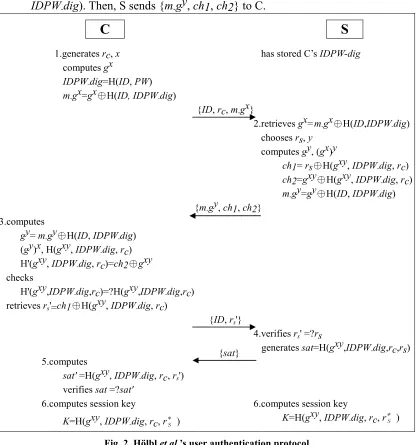
2.2.1 User authentication protocol
In this protocol, user C has to register at server S to become a legal client and S
storesC’sIDPW-dig(=H(ID, PW)), instead of PW. They both perform the following
steps. We also depict them in Fig. 2.
1. C chooses two random values rc,xand computesgx. Then, C masksgxasm-gx
by computing m-gx=gx⊕H(ID, IDPW-dig), and sends message {ID, rc, m-gx}
to S.
2. After receiving the message, S retrieves gx by computing gx=m-gx⊕H(ID, IDPW-dig). Then, S chooses two random values rs, y and computes gy. He
calculates (gx)y, generates ch1 = rs⊕H(gxy, IDPW-dig, rc) and ch2 = gxy⊕
IDPW-dig). Then, S sends {m-gy,ch1,ch2} to C.
C
S
1.generatesrc,x has stored C’sIDPW-dig
computesgx
IDPW-dig=H(ID,PW)
m-gx=gx⊕H(ID, IDPW-dig)
{ID,rc,m-gx}
2.retrievesgx=m-gx⊕H(ID,IDPW-dig) choosesrs,y
computesgy, (gx)y
ch1=rs⊕H(gxy,IDPW-dig,rc)
ch2=gxy⊕H(gxy,IDPW-dig,rc)
m-gy=gy⊕H(ID,IDPW-dig) {m-gy,ch1,ch2}
3.computes
gy=m-gy⊕H(ID,IDPW-dig) (gy)x, H(gxy,IDPW-dig,rc) H'(gxy,IDPW-dig,rc)=ch2⊕gxy
checks
H'(gxy,IDPW-dig,rc)=?H(gxy,IDPW-dig,rc) retrievesrs'=ch1⊕H(gxy,IDPW-dig,rc)
{ID,rs'}
4.verifiesrs' =?rs
generatessat=H(gxy,IDPW-dig,rc,rs)
5.computes {sat}
sat'=H(gxy,IDPW-dig,rc,rs') verifiessat=?sat'
6.computes session key 6.computes session key
K=H(gxy,IDPW-dig,rc,r*
S ) K=H(gxy,IDPW-dig,rc,r * S )
Fig. 2. Hölblet al.’suserauthentication protocol
3. After receiving the message, C derives gy= m-gy⊕H(ID,IDPW-dig). Then, he
computes (gy)xand H(gxy,IDPW-dig,rc), and derives H'(gxy,IDPW-dig,rc) by
computing ch2⊕gxy. C checks to see if the derived H' (gxy, IDPW-dig, rc) is
equal to the computed H(gxy, IDPW-dig, rc). If it is, C then retrieves rs' by
computingch1⊕H(gxy,IDPW-dig,rc) and sends {ID,rs'} to S. Otherwise, S is
not genuine and C terminates the protocol.
4. After receiving {ID, rs'}, S verifies if the received rs' is the same as his
generatedrs (in step 2). If they are the same, C is authentic. Then, S generates an authentication tokensat=H(gxy,IDPW-dig,rc,rs) and sends {sat} to C.
5. After receiving {sat}, C computessat'=H(gxy,IDPW-dig,rc,rs') and verifies if
fixed value in order forKto be different fromsat.
C
S
1.generates
IDPW-dig-new=H(ID,new-PW) computesmask=H(gxy,rc,rs')
mac= H(gxy,IDPW-dig-new,rc,rs')
m-IDPW-dig-new=mask⊕IDPW-dig-new
{m-IDPW-dig-new,mac}
2.computes H(gxy,rc,rs)
IDPW-dig-new=H(gxy,rc,rs)⊕-IDPW-dig-new mac'= H(gxy,IDPW-dig-new,rc,rs) checksmac'=?mac
computescode=H(gxy,IDPW-dig,Flag,rc,rs) {code}
Fig. 3. Password update protocol of Hölblet al.’spassword changeprotocol
2.2.2 Password change protocol
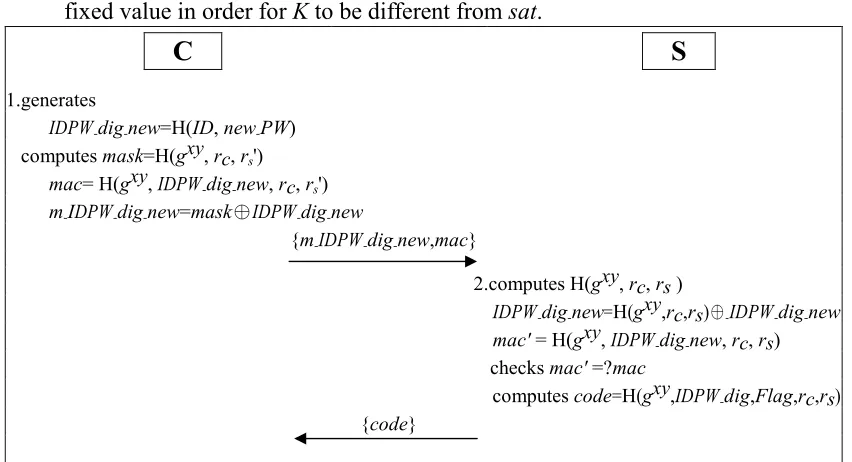
In this protocol, when C wants to update his passwordPWtonew-PW, he performs
the password update protocol as follows. We also show it in Fig. 3.
1. After authenticating the server, C computes mask=H(gxy, rc, rs'), mac=H(gxy, IDPW-dig-new, rc, rs'), and m-IDPW-dig-new=mask⊕IDPW-dig-new, where IDPW-dig-new=H(ID,new-PW). Then, he sends {m-IDPW-dig-new,mac} to S.
2. After receiving the message, for verifing the validity of mac, S retrieves
IDPW-dig-new by computing H(gxy, rc, rs)⊕m-IDPW-dig-new, computes mac'= H(gxy,IDPW-dig-new,rc,rs), and comparesmac'with the receivedmac.
If they are equal, S accepts the password change and replaces IDPW-dig with IDPW-dig-new (Otherwise, he rejects the password change.). S then sends a
message code=H(gxy, IDPW-dig, Flag, rc, rs) to C, where Flag is set to be either ‘accept’ or ‘reject’, depending upon whether the password change is accepted or rejected.
3. Our improvements
In this section, we present our two improvements on Liao et al.’sprotocol and Hölblet al.’sprotocol in Section 3.1 and Section 3.2, respectively.
3.1 Improvement on Liaoet al.’sprotocol
of three phases, registration phase, login phase, and authentication phase. We describe them as follows.
3.1.1 Registration phase
Our registration phase is the same as in the original scheme. That is, C gets a smart card containingID, p, andB(=gH(s, ID)+H(PW)).
3.1.2 Login and authentication phases
Since the purpose of logining to a server is usually for authentication only, seldom for password change, for efficiency consideration, we divide our improvement into two scenarios: (A) authentication only (as shown in Fig. 4), and (B) authentication and password change (as shown in Fig. 5).
(A) Authentication only (1) Login phase
If C wants to communicate with S without changing his password, C will run the following steps.
C
S
Login phase
1. keys {ID,PW} 2. generatesT,x
computesN=gx
B'=(B.g−H(PW) ).N V=H(T,B')
3.{ID,V,T,N}
Authentication phase
1. generatesT'
checksID
comparesT'−T<?△T 2. generatesy
calculatesM=gy
B''=(gH(s, ID) ).N
H(T,B'') checks H(T,B'') =?V
{M,U} calculatesU=H(M,B'')
Authentication phase
3. calculates H(M,B') comparesU=?H(M,B') 4. computes
session keyK=M x=gxy
4. computes
Fig. 4. Our improvement for authentication only (on Liaoet al.’s protocol)
1. inserts his smart card and keys {ID,PW}.
2. generates a timestampTand a random noncex, and computesN=gxmod p,B'=(B.g−H(PW) mod p).N, andV=H(T,B').
3. sends {ID,V,T,N} to S.
(2) Authentication phase
When receiving the message {ID, V, T, N} from C, S runs the following steps to verify the legitimacy of C and negotiates their common session key.
1. S generates a timestamp T', checks ID, and compares to see if T'−T is less than △T. If ID is valid andT'−T<△T, S accepts the login request. 2. S generates a random nonceyand calculatesM=gymod p,B''=(gH(s, ID)
mod p).Nmod p, and H(T,B''). He checks to see if H(T,B'') is equal toV. If so, C is authentic. S then computesU=H(M,B'') and sends {M,U} to C.
3. After receiving the message, C calculates H(M,B') and compares ifUis equal to H(M,B'). If it is, S is authentic.
4. After above successful mutual authentication, S can compute the common session key as K=Ny=gxy and C also can compute the common session key asK=M x= gxy.
(B) Authentication and password change (1) Login phase
Although in the password change phase of Liao et al.’s protocol, C can change his password without communicating with S. However, Xiang et al.
found that it suffers from the DoS attack. Hence, in the following, we propose our improvement to resist such an attack.
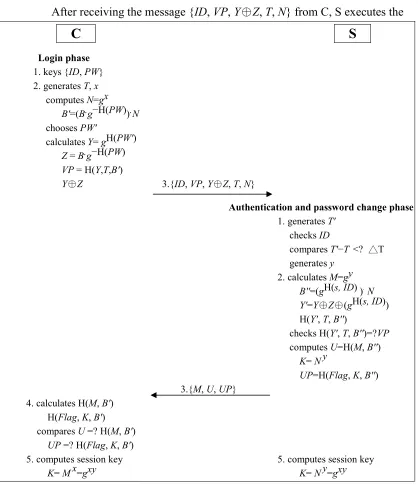
Assume that C wants to change his password fromPWtoPW', he performs the following steps.
1. inserts his smart card and keys {ID,PW}.
2. generates a timestampTand a random noncex, and computesN=gxmod p, B'=(B.g−H(PW) mod p).N. He chooses a new password PW' and calculatesY= gH(PW') mod p,Z = B.g−H(PW) mod p (=gH(s, ID) mod
p),VP= H(Y,T,B'), andY⊕Z(=gH(PW')⊕gH(s, ID) mod p).
(2) Authentication and password change phase
After receiving the message {ID,VP,Y⊕Z,T,N} from C, S executes the
C
S
Login phase
1. keys {ID,PW} 2. generatesT,x
computesN=gx B'=(B.g−H(PW)).N
choosesPW'
calculatesY=gH(PW') Z=B.g−H(PW) VP= H(Y,T,B')
Y⊕Z 3.{ID,VP,Y⊕Z,T,N}
Authentication and password change phase
1. generatesT'
checksID
comparesT'−T <? △T generatesy
2. calculatesM=gy B''=(gH(s, ID) ).N Y'=Y⊕Z⊕(gH(s, ID))
H(Y',T,B'')
checks H(Y',T,B'')=?VP
computesU=H(M,B'')
K=N y
UP=H(Flag,K,B'') 3.{M,U,UP}
4. calculates H(M,B') H(Flag,K,B') comparesU=? H(M,B')
UP=? H(Flag,K,B') 5. computes session key
K=M x=gxy
5. computes session key
K=N y=gxy
Fig. 5. Our improvement for authentication and password change (on Liaoet al.’s protocol)
following steps to identify C. If C is legal, S accepts the login request for password change and then computes the session key.
1. After receiving the message, S generates a timestampT', checks ID, and compares if T'−T is less than △T. If ID is valid and T'−T < △T, the login request continues.
2. S generates a random nonce y and calculates M=gy mod p, B''=
gH(s,ID).Nmod p, Y'=Y⊕Z⊕gH(s, ID) mod p (=gH(PW') mod p), and
refuses the request and terminates the protocol. Otherwise, C is authentic. S accepts the password change request and computes U=H(M,B'') , K=
N ymod p, andUP=H(Flag,K,B''), whereFlagissetto ‘accept’.
3. S sends {M,U,UP} to C.
4. After receiving the message, C calculates H(M,B') and H(Flag,K,B'). He compares if U is equal to H(M, B'). If it is, S is authentic. C then compares UP with the value H(Flag, K, B'). If they are equal, C confirms that his password change request is accepted.
5. After successful mutual authentication, S can compute the common session key asK= N y=gxyand C also can compute the common session key asK=M x=gxy.
3.2 Improvement on Hölblet al.’sprotocol
In this section, we describe our improvement on Hölbl et al.’s authentication
protocol as follows and also show it in Fig. 6.
Our improvement performs the following steps.
1. C generates a random nonce x, computes gx mod p, and masks it as m-gx by
C
S
1.choosesx
computesgx
m-gx=gx⊕H(ID,IDPW-dig)
{ID,m-gx}
2. retrievesgx=m-gx⊕H(ID,IDPW-dig). choosesrs,y
computesgy
(gx)y
ch=rs⊕H(gxy,IDPW-dig)
sat=H(gxy,IDPW-dig,rs)
m-gy=gy⊕H(ID,IDPW-dig) {m-gy,ch,sat}
3.derives
gy=m-gy⊕H(ID,IDPW-dig) computes (gy)x
rs' =ch⊕H(gxy,IDPW-dig)
sat'=H(gxy,IDPW-dig,rs') checkssat=?sat'
computes
rsc=H(gxy,rs',IDPW-dig)
{rsc} 4.computes
5.computes session key
K=H(gxy,rs')
5.computes session key
K=H(gxy,rs)
Fig. 6. Improvement on Hölblet al.’sauthentication protocol
computing m-gx=gx⊕H(ID, IDPW-dig). Then C sends message {ID, m-gx} to
S.
2. After receiving the message, S retrieves gx by computing gx=m-gx⊕H(ID, IDPW-dig). Then, he chooses two random noncesrs,yand computesgymod p.
S calculates (gx)y mod p, generates ch= rs⊕H(gxy, IDPW-dig), sat=H(gxy, IDPW-dig, rs), and masks gy as m-gy by computing m-gy=gy⊕H(ID, IDPW-dig). Then, S sends {m-gy,ch,sat} to C.
3. After receiving the message from S, C derives gy= m-gy⊕H(ID, IDPW-dig),
computes (gy)xmod p, and retrieves rs' by computing ch⊕H(gxy, IDPW-dig).
He computessat'=H(gxy,IDPW-dig,rs' ) and checks to see if the receivedsatis
equal to the computedsat'. If it is, S is authentic. C then computes rsc=H(gxy,
rs',IDPW-dig) and sends {rsc} to S.
4. After receiving {rsc}, S computes rsc'=H(gxy,rs,IDPW-dig) and verifies ifrsc'
is the same as the receivedrsc. If they are, C is authentic.
5. After successful mutual authentication, C and S each can compute the common session keyK=H(gxy,rs')=H(gxy,rs).
4. Security analysis for the two improvements
In this section, we show that both of our improvements not only can provide mutual authentication, perfect forward and backward secrecy and key freshness but also can resist the following attacks: replay attack, off-line password guessing attack, insider attack, man-in-the-middle attack, on-line password guessing attack, and DoS attack. We show them in turn below. For abbreviation, we make the analysis behind notation (a) denotes that it is for the improvement on Liao et al.’s protocol. The notations and following notation (a) stand for that they are the analyses for authentication only (as shown in Fig. 4) and for authentication and password change (as shown in Fig. 5), respectively. In addition, we also make the analysis behind notation (b) stands for that it is for the improvement on Hölbl et al.’sprotocol(as shown in Fig. 6).
4.1 Mutual authentication
Mutual authentication means that both the server and the user can authenticate each other before generating the common session key. In the following, we demonstrate how our protocol can achieve this goal.
validity of V=H(T, B') and to authenticate S, C must check the validity of
U=H(M, B''), where B'=B''. Since, these two evidences, V and U, are computed with the common secretB'/B''and only C and S know the common secret, no one else can forge V and U. In other words, when both the validities of V and U are confirmed by S and C respectively, the mutual authentication between them is achieved.
In the phase of authentication and password change, to authenticate C, S has to verify the validity ofVP= H(Y,T,B') and to authenticate S, C must check the validities of both U=H(M,B'') andUP=H(Flag,K,B''). Since,VP,Uand
UP are computed with the common secret B'/B''and only C and S know the common secret, no one else can forge these values. In other words, when the validities ofVP,UandUPare confirmed by S and C respectively, the mutual authentication between them is achieved.
(b) For authenticating S, C has to verify the validity ofsat=H(gxy, IDPW-dig,rs').
Conversely, for authenticating C, S must check the validity of rsc=H(gxy, rs,
IDPW-dig). For only S and C can know or deduce the common secrets, gxy, IDPW-dig, andrs, no one else can forge the value ofsatorrsc. In other words,
after the validities of sat and rsc are confirmed by C and S respectively, the mutual authentication in our protocol is achieved.
4.2 Perfect forward and backward secrecy
Perfect forward and backward secrecy means that if an intruder gets the session key, he can’t reconstructany previous or subsequent session keys. In both of our improvements, a compromised password PW can’t be used to reconstruct any previous or subsequent session keys for that we use the Diffie-Hellman key agreement protocols whose session keys are based on large random nonces. If an intruder gets
PW in our two protocols, he can’t deduceK=gxy in (a), or K=H(gxy, rs) in (b), without the knowledge of the two random numbers, xand y. Therefore, both of our protocols can provide perfect forward and backward secrecy.
4.3 Key freshness
Key freshness means that the key used in each session is different from the ones used in other sessions. Since each party picks his random nonce secretly when computing the session key in our protocols, it can be easily seen that the freshness of the used session keys in our protocols is guaranteed.
Replay attack meansthatalegalpeer’stransmission message is intercepted and replayed by an adversary for fooling another legal peer to regard him as authentic. However, the fresh nonces chosen at each protocol run are used to avoid such replay attacks in our improvements. More clearly, we list the reason for each case below.
(a) An adversary cannot be authenticated by resending previous messages transmitted by a legal client for that we use the random nonces x, y, and the timestamp Tto withstand such kind of attack. Hence, the replay attack can be avoided in this improvement.
(b) Similarly, we use the random nonces rs, x, y to prevent replay attack in this protocol. An attacker thus cannot be authenticated by resending previous messages transmitted by a legal client. Hence, our protocol can prevent the replay attack.
4.5 Preventing the off-line password guessing attack
Off-line password guessing attack means that a passive attacker slinkingly intercepts the communication line between a legal client and the server, and tries to guess the client’s password off line. In the following, we prove why our protocols can resist against such an off-line password guessing attack.
(a) In the authentication only scenario, although an adversary E may intercept the message {V,T,N}, whereN=gx,V= H(T,B'), andB'=(B.g−H(PW)).N. However, he doesn’tknow both the values of B (stored in C’ssmartcard)
and C’spassword. Therefore, he may guess PW as PW1, but without the
knowledge of B, he can’tcompute the value H(T, (B.g−H(PW1)).N ) to
compare with the intercepted value V. Thus, the off-line password guessing
attack can’twork.
In the authentication and password change scenario, although E might intercept the message {VP,Y⊕Z,T,N}, whereN=gx,Z=B.g−H(PW),Y=
gH(PW'), VP = H(Y, T, B'), and B'=(B.g−H(PW)). However, he doesn’t
know the values ofB(storedin C’ssmartcard),PW(kept secret by C), and
PW'(chosen by C). Therefore, E may guessPWand PW'asPW1and PW2,
respectively but without the knowledge of B, he can’tcompute the value H(gH(PW2), T, B.g−H(PW1)) to compare with the intercepted value VP. In
other words, the off-line password guessing attack fails.
m-gy=gy⊕H(ID,IDPW-dig), ch=rs⊕H(gxy,IDPW-dig), sat=H(gxy,IDPW-dig, rs), andrsc=H(gxy,rs',IDPW-dig), even E has the knowledge ofgxorgy, due
to the one-way property of the hash function, E can hardly figure out
IDPW-digfrom bothm-gxandm-gy. Similarly, even E has the knowledge ofrs, rs' andgxy, he can by no means figure out IDPW-dig from ch,sator rsc. Not
to mention, all the above parameters are kept secret. Therefore, E can’t
implement the off-line password guessing attack.
4.6 Preventing the insider attack
Insider attack means that a legal client D can impersonate another legal client C to gain the service of server S.
(a)Assume that D wants to impersonate C to login to S. However, without the knowledge of C’s password pw and B, he can not deduce V and consequently be authenticated by S. Therefore, the insider attack fails.
Similarly, if D wants to impersonate C to login to S. Without the knowledge of B and C’s password, he can not deduce VP and be successfully authenticated by S. Therefore, the insider attack fails.
(b) If D wants to impersonate C to login to S. Without the knowledge of C’s
IDPW-dig, the valuegx he uses would be different from the value S retrieves.
Hence, the value ofrscwhich D will produce in step 3 would be different from the value of rsc' computed by S in step 4 (of Fig. 6). That is, D can’t be authenticated by S successfully. Therefore, the insider attack fails.
4.7 Preventing man-in-the-middle attack ( MIMA )
Man-in-the-middle attack means that an active attacker intercepts the communication line between a legal user and the server and uses some means to successfully masquerade as both the server to the user and the user to the server. Then, the user will believe that he is talking to the intended server and vice versa.
However, since that for verifying U’, C should compute H(M, B') and for verifyingV’, S should calculate H(T,B''), whereB'= (B.g−H(PW) ).N=B''= (gH(s, ID) ).N, without the knowledge of PWors, E can’t send validU’and
V’. Hence, the MIMA fails.
C
E(S)
E(C)
S
1.{ID,V,T,N} 2.{ID,V’,T’,N’}
4.{M’,U’} 3.{M,U}
Fig. 7. The MIMA on authentication only in section 3.1.2.(A)
In Fig. 8, we depict a MIMA on the authentication and password change (as described in Section 3.1.2.(B)). In the figure, after E intercepts the message transmitted between S and C, he impersonates C by sending {ID,VP’,Y’⊕
Z’, T’,N’} to S and masquerades as S by sending {M’,U’, UP’} to C. If C can successfully verify U’and UP’and S can successfully verify VP’, E is regarded as being authentic by both of them. That is, E would have the two same session keys shared with C and S, respectively. Therefore, C can make them believe that they each are talking to the intended party. However, for verifying U’and UP’, C should compute H(M, B') and H(Flag, K,B'). And for verifying VP’, S should calculate H(Y', T, B''), where B'= (B.g−H(PW) ).N=B''=(gH(s, ID) ).N. Without the knowledge of PW or s, E can’t compute validU’,UP’, andVP’. Hence, the MIMA fails.
C
E(S)
E(C)
S
1.{ID,VP,Y⊕Z,T,N} 2.{ID,VP’,Y’⊕Z’,T’,N’}
4.{M’,U’,UP’} 3.{M,U,UP}
Fig. 8. The MIMA on authentication and password change in section 3.1.2.(B)
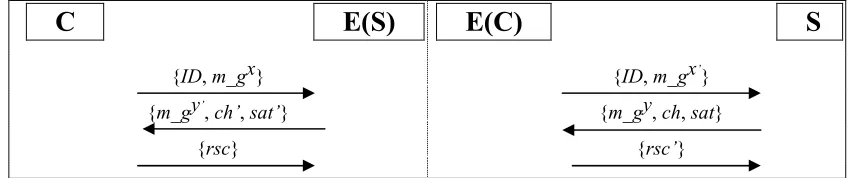
(b) Similarly, we launch a MIMA on the proposed improvement in section 3.2 and also illustrate it in Fig. 9. In the figure, after C sends {ID, m_gx} to S, for impersonating S, E forgesm_gxto bem_g x’, then he forwards {ID,m_gx’} to S. Likewise, after S sends out {m_gy, ch, sat}, E replaces it and sends his forged message {m_gy’,ch’,sat’} to C. Subsequently, after C sends out {rsc}, E replaces it and sends {rsc’} to S. If C and S can successfully verifysat’and
for verifying rsc’, S should calculate H(gxy, rs, IDPW_dig), where x is a random number chosen by C, and rs,y are chosen by S (as shown in Fig. 6). Obviously, without the knowledge of IDPW_dig, E can’t successfully be authenticated by C and S, respectively. Not to mention, E doesn’t know the values ofrsandgxy. Therefore, the MIMA on this improvement fails.
C
E(S)
E(C)
S
{ID,m_gx} {ID,m_gx’}
{m_gy’,ch’,sat’} {m_gy,ch,sat}
{rsc} {rsc’}
Fig. 9. The MIMA on (b) in section 3.2
4.8 Preventing the on-line password guessing attack
Suffering on-line password guessing attack means that an attacker can successfully guess a legal user’s password on line. Since the two improvements we proposed have the mutual authentication function. Only the user with the right password can pass the authentication of the server. Therefore, any attempt to launch a password guessing attack will be detected by the server. Moreover, we can set both improvements to tolerate some times of wrong password logins, e.g., three time. If the number of wrong login times is reached, the system would reject the login request. Under such a setting, both of our schemes can resist the on-line password guessing attack.
4.9 Preventing smart-card-lost attack
Smart-card-lost attack means an attacker can launch various attacks when he gets a legal user’s smart card. In the following, we discuss two of the most common attacks launched under such a situation, impersonation attack and off-line password guessing attack.
(a) Suppose C’ssmart card is lost and obtained by E. Through, E can read the value of B. However, without the knowledge ofs, E still can’tgetthevalue
of gH(s, ID), where s is the secret of S. Hence, E can’tlaunch the off-line password guessing attack, for example, he may guess passwordPWasPW'
and verify whether B.g−H(PW') is equal to gH(s, ID). Therefore, the off-line
password guessing attack can’t work.As for the impersonation attack prevention, we analyze them respectively below for the two scenarios.
by S. However, he doesn’t know C’s password PW. He can not deduce C’s
B'(=(B.g−H(PW)).N) and henceforth V(= H(T, B')) which will be verified by S (as shown in Fig. 4). Therefore, he can’t be authenticated by S successfully. In other words, the impersonation attack fails.
Similarly, in the scenario of authentication and password change, assume
thatE hasgotC’ssmartcardand knows B. He starts the authentication protocol for being authenticated by S (as shown in Fig. 5). However, he faces the same problem as stated above in that he doesn’t know C’s password PW. He can not deduce C’s B' and hence VP. Since for being authenticated by S, E generates a randomx, computes N=gx, and randomly selects two passwords PW'' and PW'''as the old and new one respectively. He then computes Y=g−H(PW'''),B'=B.g−H(PW'').N, and Z= B.g−H(PW''), and letVP=H(Y,T,B'). However, due toB=gH(s, ID)+H(PW)andPWis not equal toPW''with nonnegligible probability, without the knowledge ofsandPW,
VP can hardly be authenticated by S since B'(computed by E) is not equal to B''(deduced by S). That is, he can not be authenticated by S. Therefore,
E can’tlaunch the impersonation attack.
(b) For the protocol using no smart cards, we needn’texamineit.
4.10 Preventing DoS attack after password changing
Suffering DoS attack means that if an attacker temporarily gets access to the
client’ssmartcard and successfully guesses the password. Then, he can perform the password change phase to replace the old password with his new one. This would result in making the legal user’s password invalid and thereafter the server will deny providing any service to the legal user. However, we have shown above that both of our improvements can prevent smart-card-lost attack, on-line, and off-line password guessing attack (as shown in section 4.5, 4.8, and 4.9 respectively). That is, even an attacker E can temporarily get access to the client’s smart card, he can’t successfully launch smart-card-lost attack, on-line, or off-line password guessing attack. Consequently, our two improvements can resist against the DoS attack.
5. Discussion and comparison
5.1 Low communication cost
From in Fig. 1 and Fig. 2, we know that Liao et al.’sprotocol[9] needs three passes and Hölblet al.’sprotocol[12] needs four passes. However, our improvement on Liaoet al.’sprotocolneedsonly two passesin both of the two scenarios (as shown in Fig. 4 and 5 respectively), and the improvement on Hölblet al.’sprotocolneeds only three passes. Due to the reason that when we estimate the efficiency of a protocol, the number of passes is always the dominant factor when compared with its computational overhead. Therefore, our improvements are more efficient than [9] and [12], respectively.
In the following, we make comparisons, in the aspects of needed number of passes and whether it can satisfy the ten security features (STSF) listed in Section 4, among our two schemes and other existing 2PAKE protocols [1-12, 30-36] as mentioned in Section 1 (Here, we ignore schemes [13-19] since they didn’t propose improvements or new methods). We show the results for the smart-card password based schemes in Table 1, and for the non-smart-card password based schemes in Table 2, respectively. For convenience, in the tables, we use notations i(1) and i(2) to denote the improvements on [9] and [12], respectively.
Table 1. Comparisons in passes and STSF for smart-card password based schemes
schemes i(1) [1] [2] [3] [5] [6] [7] [8] [9] [10] [30] [31] [32] [33] [34] [35] [36]
passes 2 2 3 3 3 1 3 3 3 4 2 2 2 3 2 4 3
STSF ○ × ○ ○ ○ × × × × × × × × ○ × ○ ×
Table 2. Comparison in passes and STSF for the non-smart-card password based schemes
schemes i(2) [11] [12] [4]
passes 3 2 4 4
STSF ○ × × ×
From Table 1 and 2, we can see that both of our improvements, i(1) (smart-card password based) and i(2) (non-smart-card password based), are the most efficient and secure than all of the proposed schemes.
R1. It needs no password or verifier tables.
Our improvement (as described in Section 3.1) needs no password or verifier tables stored in the server’s memory or in the clients’smartcards.
Hence, it meets this requirement.
R2. The clients can choose and change their passwords at will.
Since in our schemes, the password change request can only be accepted after successful mutual authentication. This guarantees that only the real card holder can securely and freely change his password. We have shown this in Section 3.1.2.(B). Put it another way, the improvement we proposed on the password change protocol can let the client choose and change his password freely and securely.
R3. The clients need not reveal their password to the administrator of the server.
Our register phase is the same as the one in Liaoet al.’sprotocol.Hence, the password is not revealed to the administrator of the server.
R4. The passwords are not transmitted in plaintext over the Internet.
In the two scenarios, (A) and (B), of our improvement in Section 3.1, the password is not transmitted in a clear form. Hence, the improvement can satisfy this requirement.
R5. It can resist the insider (a legal user) attacks.
We have demonstrated this in Section 4.6.(a).
R6. It can resist against the replay attack, password guessing attack, modification-verifier-table attack, and stolen-verifier attack.
Since our improvement needs no verifier table (as does in Liao et al.’s
protocol), it can resist the modification-verifier-table attack and stolen-verifier attack. In addition, we have demonstrated that our protocol can resist the replay attack in Section 4.4, and password guessing attack in Section 4.5 and 4.8, respectively.
R7. The length of a password is appropriate for memorization.
communication line and get the value of V (in Fig. 4) or VP (in Fig. 5). However, the value ofBin both of them is first randomized byg−H(PW).Nand then hashed by a hash function H. Due to the one-way property of a secure hash function, the attacker has no idea about the value of B in both cases. Therefore, he hasn’t any information available to guess the password. Not to mention, our scheme can prevent on-line and off-line password guessing attack. That is, our improvement is really secure even if the client uses a weak easily-memorized password. In other words, our protocol can let the client use an easy-remember password.
R8. It is efficient and practical.
Other than its low communication cost as described in Section 5.1, our improvement has another advantage that it needs no complex computation (such as bilinear pairing [1, 6, 7]), it only uses the computations of hash functions and Diffie-Hellman key agreement as performed in the original one [9]. Hence, our improvement is efficient and practical.
R9. It can achieve mutual authentication.
We have demonstrated this in Section 4.1.(a).
R10. It can resist password guessing attacks even if the smart card is lost.
We have demonstrated this in Section 4.9.(a).
6. Conclusion
In this article, we have analyzed and improved the two password-based authentication protocols, [9] and [12], and shown that both of our improvements are not only more secure but also more efficient than the two original schemes (reviewed in Section 2). Especially, we also have shown that our improvement on Liaoet al.’s
Appendix A
In the following (A.1 to A.7), we first briefly review the scheme then show the attack.
A.1 Why does Bindu etal.’s scheme [7] suffer from the smart-card-lost attack launched by an insider?
Review
There are three phases in Bindu et al.’s scheme: the registration phase, the login phase and the authentication phase.
In the registration phase, the server S issues to legal user i a smart card which containsmiandIi, wheremi=H(IDi⊕s)⊕H(s)⊕H(PWi),Ii=H(IDi⊕s)⊕s, andsis S’ssecretkey.
When i wants to login to S, he starts the login phase by computingri=gx(xis a
random number chosen by i),M=mi⊕H(PWi), U=M⊕ri,R=Ii⊕ri= H(IDi⊕s)⊕s
⊕ri, and ER[ri, IDi, T] (T is a timestamp, and ER[ri, IDi, T] is a ciphertext
encrypted by the secretR). He then sends {U,T, ER[ri,IDi,T]} to S.
In the authentication phase, after receiving {U,T, ER[ri, IDi,T]} at timestamp Ts, S computes R= U⊕H(s)⊕s =M⊕ri⊕H(s)⊕s =mi⊕H(PWi)⊕ri⊕H(s)⊕s =
H(IDi⊕s)⊕H(s)⊕H(PWi)⊕H(PWi)⊕ri⊕H(s)⊕s = H(IDi⊕s)⊕ri⊕s, decrypts
ER[ri,IDi,T], checks to see ifTs−T is less than △T, and compares R with H(IDi
⊕s)⊕s⊕rito see if they are equal. If they are, he sends {Ts, ER[rs,ri+1,Ts]} to i,
where rs=gy and y is a random number chosen by S. After that, i verifies the
validity of the time interval, decrypts ER[rs, ri+1,Ts], and checks to see ifri+1 is
correct or not. If it is, S is authentic. Then, i sends {EKus[rs+1]} to S, where Kus=rsx=gxy. S decrypts the message and checks to see ifrs+1 is correct or not. If
it is, i is authentic.
Attack
If C lost his smart card and the card is got by an insider E, E can impersonate C to log into S. We show the attack in the following.
For that C’s smart card storesmc=H(IDc⊕s)⊕H(s)⊕H(PWc) andIc=H(IDc⊕s)
⊕s, and E’s smart card stores me=H(IDe⊕s)⊕H(s)⊕H(PWe) and Ie=H(IDe⊕s)
⊕s, suppose E gets C’s smart card but doesn’t have the knowledge ofPWc, E can
choose a random number x and computes rc=gx, V= me⊕Ie⊕H(PWe)=H(s)⊕s, M=Ic⊕V= H(IDc⊕s)⊕s⊕H(s)⊕s=H(IDc⊕s)⊕H(s) which equalsmc⊕H(PWc), U=M⊕rc, andR=Ic⊕rc. Then, E masquerades as C by sending {U,T, ER[rc,IDc, T]} to S. After receiving the message, S computesR=U⊕H(s)⊕sand compares
rc+1, Ts]}. E intercepts the message, decrypts ER[rs, rc+1, Ts], and uses rs to
computeKus=rsx=gxy. E then can send a correct message {EKus[rs+1]} to S, to let
S authenticate him as C. In other words, insider E can successfully launch a smart-card-lost attack.
More clarity, we demonstrate whyR=U⊕H(s)⊕sis equal to H(IDc⊕s)⊕s⊕rc
by the following equations.
R=U⊕H(s)⊕s
=M⊕rc⊕H(s)⊕s ··· ∵ U=M⊕rc
=Ic⊕V⊕rc⊕H(s)⊕s··· ∵ M=Ic⊕V
= H(IDc⊕s)⊕s⊕V⊕rc⊕H(s)⊕s ··· ∵ Ic=H(IDc⊕s)⊕s
= H(IDc⊕s)⊕s⊕H(s)⊕s⊕rc⊕H(s)⊕s ··· ∵ V=H(s)⊕s
= H(IDc⊕s)⊕s⊕rc
A.2 Why isJuang etal.’s [8] protocol vulnerable to the password guessing attack if the smart card is lost?
Review
In [8], if an attacker gets C’s smart card, he can successfully launch an off-line password-guessing attack for impersonating C to log into the server S. In the following, we first review Juanget al.’s protocol and then show the attack.
Their protocol consists of four phases: the setup phase, the registration phase, the login and authentication phase, and the password changing phase.
In the setup phase, S chooses two secretss,xand publishesPs=sP, wherePis a
generator of an additive cyclic groupG1with a prime orderq.
In the registration phase, the server S issues to legal user i a smart card which containsbi(bi=Ex[H(PWi,b),IDi, H(H(PWi,b), IDi)] and Ex[M] is a ciphertext of
M encrypted by S’s secret keyx) andb(a random number chosen by i).
When i wants to log into S, i starts the login and authentication phase and sends {aP,α} to S, whereais a random number chosen by i,α=EKa[bi],Ka=H(aP, Ps, Q, ê(Ps, aQ)), ê: G1×G1→G2 is a bilinear mapping, Q=h(IDs), h(.) is a
map-to-point hash function h:{0,1}*→G1, and IDs is S’s identification.
Subsequently, S chooses a random number r, computes the session key
sk=H(H(aP, Ps, Q, ê(aP, sQ)), r, IDi, IDs) =H(Ka, r, IDi, IDs) since ê(Ps, aQ)=
ê(aP, sQ) , and sends {Auths, r} to user i, where IDi is i’s identification, Auths=H(Ka, H(PWi,b), r, sk), and H(PWi,b) is obtained from decryptingαand bi. Then, i computes the session keysk. For authenticating S, he verifiesAuthsto
to S, whereAuthi=H(Ka, H(PWi,b), r+1,sk) and H(PWi,b) is the hash result ofb
stored in the smart card with PWi inputted by i. Finally, for authenticating i, S
checks to see ifAuthiis equal to H(Ka, H(PWi,b),r+1,sk).
Attack
In this protocol, it can be easily seen that if user C lost his smart card and the card is got by an insider E, E can impersonate C to log into S. We show the attack in the following.
E reads out b and bc (which equals Ex[H(PWc, b), IDi, H(H(PWi, b), IDi)])
stored in C’s smart card but he doesn’t have the knowledge of PWc. He can
choose a random numberc, computescP,Kc=H(cP,Ps,Q, ê(Ps,cQ)),α=EKc[bc],
starts the protocol, and masquerades as C to send {cP, α} to S. After receiving the message, S chooses a random number r, computes session key sk=H(Kc, r,
IDc,IDs), Auths=H(Kc, H(PWc, b), r,sk), and sends {Auths,r} to C. E intercepts
the message and launches an off-line password guessing attack. He chooses a possible password PW', computes Kc=H(cP,Ps, Q, ê(Ps, cQ)), sk=H(Kc, r, IDc, IDs), H(Kc, H(PW',b), r,sk) and checks to see if it is equal to the received Auths.
If it is, the attacker successfully gets C’s password PWc which is equal to PW'.
Subsequently,E can masquerade as C by usingPW'andC’s smart card to log into S.
A.3 Why are the protocols of Goriparthi et al.[6] and Wang et al.[31] vulnerable to the DoS attack on the password change phase which can make the password invalid after their protocol run?
Review of [6]
In the password change phase of Goriparthiet al.’s protocol [6], when client C wants to change his passwordPW, he keys his IDandPW to his smart card. The smart card verifiesID(without verifying his password PW) to see if it is correct. If it is, the smart card will subsequently receive a new password PW*submitted by C and compute Reg*ID= RegID –h(PW)+h(PW*)= s.h(ID)+h(PW*), where RegID= s.h(ID) + h(PW) is stored in C’s smart card, h(.) is a map-to-point hash
function h:{0,1}*→G1, andG1is a group on an elliptical curve. Finally, the smart
card will replaceRegIDwithReg*ID.
Attack on [6]
In [6], assume that there is an attacker temporarily gets access to C’ssmartcard. He randomly selects two passwords PW' and PW'' as the old and the new ones, respectively. The smart card will then computeReg'ID=RegID–h(PW') +h(PW'')=
C’s passwordPWinvalid.
Review of [31]
In Wanget al.’s protocol [31], C inserts his smart card, keys PW, and requests to change the password PW to a new one PW*. Then, the smart card computes
Ni* =Ni⊕H(PW)⊕H(PW*) and replacesNiwithNi*, whereNi=H(PWi)⊕H(x) is
stored in C’s smart card, PWi is chosen by the user when he registers at the
remote server S, andxis S’s secret key.
Attack on [31]
Obviously, protocol [31] also exits the same security loophole as does in [6]. Since if an attacker temporarily gets access to C’s smart card and reads the value ofNi, he can use two random valuesPW'and PW''to computeNi' =Ni⊕H(PW')
⊕H(PW'') and replace Ni with Ni'. From then on, client C can never pass the
authentication and the attack succeeds.
A.4 Why do [30, 32] suffer from the smart-card-lost attack? Review of [30]
In [30], when user C wants to change his password, he inserts his card and types his ID and PW. The smart card computes K*1=R⊕H(PW) and compares K*1 with K1 to see if they are equal, where R(=K1⊕H(PWc)) and K1(=H(ID⊕x)
⊕N) are stored in C’s smart card,PWcis chosen by the user when he registers at
the remote server S, and N is a random number. If they are, the card accepts the password change request and C inputs a new password PW*. Then, the card computes R*= K*1⊕H(PW*) and K*2= K2⊕H(PW⊕H(PW))⊕H(PW*⊕
H(PW*)), whereK2=H(ID⊕x⊕N)⊕H(PWc⊕H(PWc)) is also stored in C’s smart
card. Finally, the smart card will replaceRandK2withR* andK*2, respectively.
Attack on [30]
An attacker who gets C’s smart card and reads the values of R,K1, andK2can
launch a password-guessing attack. He chooses a possible password PW', computesK'1=R⊕H(PW'), and checks to see if K'1 andK1are equal. If they are, PW'is the correct password. Then, for changing the password fromPW'to PW*, the attacker logins to the server and computesR*= K'1⊕H(PW*) and K2*= K2⊕
H(PW'⊕H(PW')) ⊕H(PW*⊕H(PW*)). He then replaces R andK2 with R*and K2*, respectively. Eventually, he can masquerade as C to log into the server. That
is, he can successfully implement a smart-card-lost attack.
Review of [32]
⊕H(PW )), and compares V* with V, where PW is C’s password inputted for being changed, andR,b, andVare stored in C’s smart card. If they are equal, the card accepts the password change request and then computes Rnew=P*⊕H(b⊕ PW*) andVnew=H(P*⊕H(PW*)), wherePW*is a new password submitted by C.
Finally, the smart card replacesVwithVnew.
Attack on [32]
Assume that an attacker who can get C’s smart card reads the values of R, b, and V and implements a password-guessing attack. He chooses a possible passwordPW', computesP'=R⊕H(b⊕PW') andV'=H(P'⊕H(PW')), and checks to see if V' and V are equal. If they are, PW' is the correct password. Then, for changing the password from PW' to PW'', the attacker logins to the server and computes R''=P'⊕H(b⊕PW'' ) and V''=H(P'⊕H(PW'' )), where PW'' is a new password submited by E. Finally, the smart card replacesRandVwithR''andV'', respectively. The attacker can therefore masquerade as C to log into the server. That is, the attacker successfully implements a smart-card-lost attack.
A.5 Why does Xuet al.’s protocol [34] is vulnerable to the insider impersonation attack?
Review
We first briefly review the protocol [34] and then present our attack.
Xu et al.’s protocol consists of three phases: the registration phase, the login phase and the authentication phase.
In the registration phase, user C submits his IDc and PWc to the server S. S
issues C a smart card which stores C’s identity IDc, and B=H(IDc)x+H(PWc),
wherexis S’s secret key andPWcis C’s password.
In the login phase, user C inputs IDc and PWc to his smart card. The card
obtains system’s timestamp T, chooses a random number v, computes
Bc=(B-H(PWc))v=H(IDc)x v,W=H(IDc)v, andC1=H(T,Bc,W,IDc), and sends {IDc, C1,W,T} to S.
In the authentication phase, after receiving { IDc, C1, W, T } at time T*, S
computesBs=Wx, and checks to see ifIDc is valid,T*−T< △T, andC1 is equal
to H(T, Bs, W, IDc). If they are, S selects a random number m, sets Ts to be the
current time, computesM=H(IDc)m,Cs=H(M,Bs,Ts,IDc), and sends {IDc,Cs,M, Ts} to C. After receiving the message, C validatesIDcandTs, computes H(M,Bc, Ts, IDc), and compares it with the receivedCs. If they are equal, S is authentic.
sk=H(IDc,M,W,Wm), respectively.
Attack
Assume that a malicious insider U wants to masquerade as C to access S’s resource. He readsBfrom his smart card, obtains system’s timestampTu, chooses
a random number r, computes Bu=(B-H(PWu))r= H(IDu)xr,W=H(IDc)r, C1=H(Tu, Bu,W,IDc), and sends {IDc,C1,W,Tu} to S.
After receiving the message, S validatesIDcandTu, computes Bs=Wx=H(IDc)r x, and checks to see if the receivedC
1is equal to the computed H(Tu,Bs,W,IDc).
In this case, we can see thatC1is doomed to be equal to H(Tu,Bs,W,IDc). So, U
(who masquerades as C) is authentic. Finally, S obtains the system’s timestampTs
and sends {IDc,Cs,M,Ts} to U, where M=H(IDc)m and mis a random number
chosen by S. U also can compute the session key assk=H(IDc,M,W,Mr) shared
with S. Therefore, user U’s impersonation attack succeeds.
A.6 Why do both Hölblet al.’s protocols [37] fail ?
Hölblet al.proposed two improvements of two-party key agreement protocols. In the following, we first briefly review then present our attack on both of their protocols, respectively.
Review of the first protocol
Hölblet al.’s first protocol consists of three phases: the system setup phase, the private key extraction phase, and the key agreement phase.
In the system setup phase, key generation center (KGC) chooses a random numberxsand keeps it secret. He computesys=gxsand publishes it.
In the private key extraction phase, with each user having his identityID, KGC selects a random numberki, and calculates i’s private keyvi=Iiki+xsui (mod p-1)
and public keyui=gki(mod p), whereIi=H(IDi).
In the key agreement phase, user A chooses a random numberra, computesta= gra , and then sends { ua, ta, IDa} to user B. After receiving { ua, ta, IDa}, B
chooses a random number rb , calculates tb= grb, and then sends { ub, tb, IDb}
back to A. Finally, A and B can compute their common session key,
K=(ubIb.ysub.tb)(va+ra)=g(vb+rb) .(v
a+ra) andK=(uaIa.ysua.ta)(vb+rb)=g(va+ra).(vb+rb),
respectively, whereIa=H(IDa) andIb=H(IDb).
Attack on the first protocol
Assume that an insider C calculatesIc=H(IDc) andq=gcd(Ic,uc), and computes w=Ic/q,z=uc/q, andj=vc/q, wherevc is C’s private key. Hence, gcd(w,z)=1. Then,