about Security Protocols
★Xinfeng Lei1Rui Xue1 and Ting Yu2
1
State Key Laboratory of Information Security
Institute of Software, Chinese Academy of Sciences, Beijing, China {leixinfeng, rxue}@is.iscas.ac.cn
2 Department of Computer Science, North Carolina State University, USA [email protected]
Abstract. Many logical methods are usually considered suitable to
ex-press the static properties of security protocols while unsuitable to model dynamic processes or properties. However, a security protocol itself is in fact a dynamic process over time, and sometimes it is important to be able to express time-dependent security properties of protocols. In this paper, we present a new timed logic based on predicate modal logic, in which time is explicitly expressed in parameters of predicates or modal operators. This makes it possible to model an agent’s actions, knowl-edge and beliefs at different and exact time points, which enables us to model both protocols and their properties, especially time-dependent properties. We formalize semantics of the presented logic, and prove its soundness.
We also present a modeling scheme for formalizing protocols and secu-rity properties of authentication and secrecy under the logic. The scheme provides a flexible and succinct framework to reason about security pro-tocols, and essentially enhances the power of logical methods for protocol analysis. As a case study, we then analyze a timed-release protocol using this framework, and discover a new vulnerability that did not appear previously in the literature. We provide a further example to show addi-tional advantages of the modeling scheme in the new logic.
1
Introduction
To formally analyze security protocols, a variety of methods, such as methods of logic [1–4], process calculus [5, 6], and strand spaces [7–10], have been proposed. Logical methods[1–4] are usually considered suitable to express properties rather than operational steps of a protocol. Process algebras is suitable to specify the operational behavior of protocols while unsuitable to express knowledge-related properties[11–13]. In this paper, we present a new logic for modeling and rea-soning about security protocols. The proposed logic is suitable to model both a
★This work is partially supported by the Fund of the China Scholarship Council,
security protocol itself and its properties, especially time-dependent properties. The key idea is to refine the logical method by explicitly using of time.
To see why time is necessary when modeling protocols, let us consider two simple scenarios. First, assume a logic without time involved is used to analyze a protocol. In this protocol, agent 𝑖 receives message 𝑚. Then, the formula 𝜑 which means that𝑖holds𝑚is usually consideredfalse before occurrence of the receiving action and true after that. It seems that both ¬𝜑and 𝜑 are true in that logic, which makes the logic inconsistent. Where is the problem? Is there something being ignored? Obviously, it is time. One may argue that, without time involved, everything could be handled in a fixed time point by default. Let us see another scenario which takes the end of the protocol as the default time, when everything is discussed. Assume that agent 𝑖 sends a message (in encrypted form) to 𝑗 and hopes 𝑗 to hold this message only after a specific time. Since everything is discussed in a fixed time, we even cannot express this property, let alone to analyze it.
Actually, in security protocols, time is an important factor related to their security. For one thing, each protocol is composed of a sequence of actions over time. Further, some protocols explicitly aim at a time-dependent requirement. For secrecy purposes, agents involved in protocols may require some messages be kept secret before a specific time [14],[15]. For authentication, agent’s beliefs may change over time [16]. For fair non-repudiation, the lack of timeliness will lead to violation of fairness [17]. Therefore, it is necessary to take time into consideration when analyzing security protocols.
The logic provided in this paper is based on predicate modal logic. The time factor is expressed by parameters of predicates or modal operators. This makes it possible to model an agent’s actions, knowledge and beliefs at different and exact time points, which enables us to describe the dynamic process of proto-cols and their properties, especially time-dependent properties. For example, in the scenarios mentioned above, we can use some formulas like¬𝜑(𝜏) and𝜑(𝜏′) instead of ¬𝜑 and 𝜑, respectively, to avoid inconsistency and express similar assertions at different time𝜏 and𝜏′. Moreover, since a security protocol is com-posed of a sequence of actions over time, to model a protocol, we can firstly model each action at a specific time, and then use a formula to reflect the time ordering. So, the proposed logic have advantages to model both protocols and their properties. Such advantages essentially enhance the expressiveness of the logical method in modeling and reasoning about security protocols.
One may wonder why a temporal logic (such as LTL or CTL) is not good enough for our purpose. In fact, a temporal logic is also more suitable to model properties, like safety or liveness. The time notion in it is expressed by temporal connectives such as𝐹(some future state), G(all future state), U(until), etc. How-ever, to model a security protocol, we often need to express a concrete process over a series of time, which is hard to be captured by today’s temporal logics.
ap-proaches to protocol analysis. This work proposes a combined framework which allows for modeling the behavior of a protocol in a process language and supports reasoning about properties expressed in a logic. [12] uses the set of traces gen-erated by a process as models, and then defines a logic which has constructs for reasoning about the intruder’s epistemic knowledge. [13] uses a hybrid method to verify security protocols, which firstly expresses the protocols in process cal-culus and then translates them into Horn clause in Horn logic. This method can take both advantages of process calculus and Horn logic. However, The trans-lation from a process-style expression to a logic-style formula introduces some abstraction which makes some security protocols cannot be verified in it. For example, it fails to prove protocols that first need to keep some value secret and later reveal it[13]. Our work differs from the works mentioned above mainly in that the protocols and their security goals are all modeled in an unified logi-cal framework instead of using two different frameworks to model protocols and properties respectively. Moreover, due to explicitly using of time, the proposed logic can capture time-dependent properties of a security protocol.
Many logical methods, such as BAN-logic[1] and BAN-like logics[2],[3],[4], are usually considered suitable to express the static properties of security pro-tocols while unsuitable to model dynamic processes or properties. For example, protocol step permutation is undetectable by the BAN logic [18]. Moreover, since time is not used explicitly in these logics, we cannot directly use them to ana-lyze a time-dependent security protocol. Some logics have been proposed with time involved to express time-dependent properties. A logic proposed by Cof-fey and Saidha [19] which we refer to as the CS logic uses time explicitly. It originally aims at analysis of the public-key protocols, and mainly focuses on the authentication property of protocols. Moreover, it lacks of formal semantics and does not give a systematic approach to model protocols. Michiharu Kudo and Anish Mathuria[20] extend the CS logic to analyze a timed-release protocol. Their extended logic mainly aims at a specific protocol and also lacks in seman-tics. Another method to model time in security protocols is to use modal logic and temporal logic as well [21–23]. As be mentioned above, the time notion in temporal logic is abstract, and is unsuitable to model a protocol. Haack and Jef-frey [24] use timed Spi calculus to analyze protocols. Their intention is to model the time in cracking an encrypted message which is different from our goal. In the protocol composition logic (PCL) [25], a temporal ordering relation is used to strengthen the authentication properties by imposing ordering between ac-tions of different participants. However, in PCL, time is not explicitly used, so it is not suitable to express a time-dependent properties. The increasing works about timed property ([26],[27],[28],[29],[30]) in recent years show importance of time in analyzing protocols.
goals, is provided. All these improvement and newly developed method make the logic more expressive and powerful in modeling the protocols and properties in reasoning about security protocols.
Other than a formal view[32] in analyzing security protocols, there is also a computational view[33, 34]. Each has its advantages and drawbacks. Some recent works focus on reconciling these two views [35–37] to provide a computational sound formal methods ([38][39][40]). Our work in this paper is within formal model. By elaborative definition, we expect it can provide computational sound-ness which is left to a further study.
Organization.The rest of the paper is organized as follows. Section 2 presents the syntax of the language and the axioms of the logic. In Section 3, the semantics of the logic is defined and the soundness of the logic is proved. Then, in Section 4, a concrete modeling scheme is provided to specify protocols and their security properties. Two examples are given in Section 5 to illustrate reasoning about protocols in the proposed modeling scheme. Further discussions about the timed logic and the modeling scheme are give in 6. We conclude this paper in section 7 and discuss possible future directions following this.
2
The Proposed Logic
2.1 Syntax
To simplify the description, we use many-sorted variables in the proposed logic
ℒ. There are four types of variables:𝔸,𝕋,𝕂and𝕄, which, in intuitively, denote the agents, time, keys and messages respectively.
Definition 1 (Symbols inℒ).The language consists of the following symbols:
1. Constants
⊥ contradiction;
𝑒 constant of type 𝔸, a special agent which abstracts all the factors of en-vironment including attackers;
𝜏0 constant of type 𝕋, the starting time to run the protocol; 𝜏𝑐 constant of type𝕋, the time when the protocol completes.
2. Variables
𝑖, 𝑗, . . . , 𝑖′, 𝑗′, . . .: variables of type𝔸;
𝑘, 𝑘′, 𝑘′′, . . .: variables of type𝕂;
𝑚, 𝑚′, 𝑚′′, . . .: variables of type𝕄;
𝜏, 𝜏′, 𝜏′′, . . .: variables of type𝕋. 3. Functions
𝑘(−⋅) : 𝔸→𝕂, returns private key of an agent; 𝑘(+⋅) : 𝔸→𝕂, returns public key of an agent;
𝑘(⋅,⋅) : 𝔸×𝔸→𝕂, returns shared key of two agents; [⋅,⋅] : 𝕄×𝕄→𝕄, returns concatenation of two messages;
[⋅](⋅) : 𝕄×𝕂→𝕄, returns encrypted form of a message with a key; ˜
+(⋅,⋅) : 𝕋×𝕋→ 𝕋, returns sum of two time. +(𝜏, 𝜏′) is often written as 𝜏+𝜏′.
4. Predicates
The following are predicates and their informal meaning:
– <: 𝕋×𝕋, priority relation between two time points. For example,𝜏 < 𝜏′
means that the time𝜏 is prior to time 𝜏′;
– 𝐶 : 𝕄×𝕄, containing relation between two messages.𝐶(𝑚, 𝑚′)means
that message 𝑚contains message𝑚′;
– 𝐺 : 𝔸×𝕋×𝕄×𝕄, message getting. 𝐺(𝑖, 𝜏, 𝑚, 𝑚′)means that agent 𝑖
can get message 𝑚′ from 𝑚at time𝜏;
– 𝜈 : 𝔸×𝕋×𝕄, message newly generating.𝜈(𝑖, 𝜏, 𝑚)means that agent𝑖
newly generates a fresh message𝑚at time𝜏.
– 𝑅 : 𝔸×𝕋×𝕄, message receiving.𝑅(𝑖, 𝜏, 𝑚)means that agents𝑖receives
message𝑚at time𝜏;
– 𝑆 : 𝔸×𝕋×𝕄, message sending. 𝑆(𝑖, 𝜏, 𝑚) means that agent 𝑖 sends
message𝑚at time𝜏;
– 𝐻 : 𝔸×𝕋×𝕄, message holding. 𝐻(𝑖, 𝜏, 𝑚) means that agent 𝑖 holds
message𝑚at time𝜏. 5. Equalities
=𝜏,=𝑎,=𝑘 and=𝑚denote the equalities of times, agents, keys and messages
respectively. Sometimes we use=to include all the four cases. 6. Quantifiers
∀𝜏,∀𝑎,∀𝑘 and∀𝑚 are the universal quantifiers of time, agent, key and
mes-sage respectively. Sometimes we use∀to include all the four cases. 7. Connectives
¬and→are negation and implication in first order logic. 8. Modal operator
𝐵𝑖,𝜏: agent𝑖 believes something at time𝜏.
The terms in the logic are introduced as follows.
Definition 2 (Terms). Terms inℒ include𝑡𝑎, 𝑡𝜏, 𝑡𝑘 and𝑡𝑚, which denote the
terms of type𝔸, type 𝕋, type𝕂and type𝕄respectively, and they can be defined
in Backus Naur form as follows:
𝑡𝑎::=𝑒∣𝑖 𝑡𝜏 ::=𝜏∣𝜏0∣𝜏𝑐∣𝑡𝜏+𝑡𝜏
𝑡𝑘::=𝑘∣𝑘+𝑡𝑎 ∣𝑘 −
𝑡𝑎 ∣𝑘𝑡𝑎𝑡𝑎 ∣𝑡˜𝑘 𝑡𝑚::=𝑚∣𝑡𝜏 ∣𝑡𝑎 ∣𝑡𝑘 ∣[𝑡𝑚, 𝑡𝑚]∣[𝑡𝑚]𝑡𝑘 Now we look at formulas inℒ.
Definition 3 (Formulas).Formulas ofℒinclude atomic formula 𝜑𝐴and
for-mula𝜑. They are shown in Backus Naur form as follows:
𝜑𝐴::=⊥ ∣(𝑡𝜏 < 𝑡𝜏)∣𝐶(𝑡𝑚, 𝑡𝑚)∣𝐺(𝑡𝑎, 𝑡𝜏, 𝑡𝑚, 𝑡𝑚)∣𝜈(𝑡𝑎, 𝑡𝜏, 𝑡𝑚)∣𝑆(𝑡𝑎, 𝑡𝜏, 𝑡𝑚)∣
𝑅(𝑡𝑎, 𝑡𝜏, 𝑡𝑚)∣𝐻(𝑡𝑎, 𝑡𝜏, 𝑡𝑚)∣(𝑡𝑎 =𝑎 𝑡𝑎)∣(𝑡𝜏=𝜏 𝑡𝜏)∣(𝑡𝑘=𝑘𝑡𝑘)∣(𝑡𝑚=𝑚𝑡𝑚)
To facilitate presentation, some notations are used as abbreviation inℒ.
Definition 4 (Abbreviations).
1. Messages Abbreviation:
– [𝑚1, 𝑚2, . . . , 𝑚ℓ] is an abbreviation of [𝑚1,[𝑚2,[⋅ ⋅ ⋅ ,[𝑚ℓ−1, 𝑚ℓ]]⋅ ⋅ ⋅].
– J𝑚K is an abbreviation of a message which contains 𝑚. More precisely, we have𝐶(J𝑚K, 𝑚).
– J𝑚K𝑘 is an abbreviation of a encrypted message in which one can get
𝑚 only through ˜𝑘. More precisely, we have 𝐶(J𝑚K𝑘, 𝑚)∧(𝐻(𝑖, 𝜏,˜𝑘)↔
𝐺(𝑖, 𝜏,J𝑚K𝑘, 𝑚)
)
.
These notations allow us to focus on what we are interested in without listing all the other components.
2. Abbreviation of the connective
𝜑∨𝜓 a
=¬𝜑→𝜓 𝜑∧𝜓
a
=¬(𝜑→ ¬𝜓)
𝜑↔𝜓 a
= (𝜑→𝜓)∧(𝜓→𝜑)
3. Abbreviation of predicate
𝜏 ≤𝜏 a
= (𝜏 < 𝜏′)∨(𝜏 =𝜏 𝜏′)
𝜏1∗1𝜏2∗2⋅ ⋅ ⋅𝜏ℓ−1∗ℓ−1𝜏ℓ
a
= (𝜏1∗1𝜏2)∧ ⋅ ⋅ ⋅(𝜏ℓ−1∗ℓ−1𝜏ℓ).
where∗𝑖∈ {=𝜏, <,≤}for𝑖= 1,2, . . . , ℓ−1. For example,𝜏1=𝜏𝜏2< 𝜏3≤𝜏4
is an abbreviation of(𝜏1=𝜏 𝜏2)∧(𝜏2< 𝜏3)∧(𝜏3≤𝜏4).
4. Abbreviation of quantifiers
∃𝑥 𝜑 a
=¬∀𝑥¬𝜑
Also, we follow the conventional priority of all the connectives in a formula to evaluate.
2.2 Axioms and inference rules
The axioms of the logic consist of axiom schemas and inference rules. All the axioms include the instantiation and universal closure of the axiom schemas.
A 1 All the axioms of predicate logic with many-sorted variables and equality.
A 2 Barcan formula
∀𝑥𝐵𝑖,𝜏𝜑↔𝐵𝑖,𝜏∀𝑥𝜑 (no free occurrence of 𝑖, 𝜏 in𝜑)
where𝑥can be a variable of any type, and∀are the quantifiers corresponding to the type of 𝑥.
A 3 Axioms of Monotonicity
1. 𝐻(𝑖, 𝜏, 𝑚)∧(𝜏 < 𝜏′)→𝐻(𝑖, 𝜏′, 𝑚)
2. 𝐺(𝑖, 𝜏, 𝑚, 𝑚′)∧(𝜏 < 𝜏′)→𝐺(𝑖, 𝜏′, 𝑚, 𝑚′)
3. 𝐵𝑖,𝜏𝜑∧(𝜏 < 𝜏′)→𝐵𝑖,𝜏′𝜑 (no free occurrence of𝜏, 𝜏′ in 𝜑)
𝐴3 states that knowledge, abilities, and beliefs of an agent will not be lost over time. One may argue𝐴3,3) with the following example. If agent𝑖believes that he does not hold some message, then he will believe his ‘not holding’ even when this message is sent to him. Of course this is not the case. Actually, considering that there is no free occurrence of 𝜏 in 𝜑, if agent 𝑖 believes that he does not hold message𝑚at time𝜏, and he gets𝑚later, say𝜏′, then he still believes that he does not hold 𝑚at𝜏, but holds𝑚at𝜏′.
A 4 Axiom of time
(𝜏 < 𝜏′)∧(𝜏′< 𝜏′′)→(𝜏 < 𝜏′′)
A4 indicates that the relation<is transitive.
A 5 Axioms of key
1. 𝐻(𝑖, 𝜏, 𝑘−𝑖 ) 2. 𝐻(𝑗, 𝜏, 𝑘−𝑖 )→(𝑗=𝑎𝑖)
3. 𝐻(𝑖, 𝜏, 𝑘𝑖𝑗)∧𝐻(𝑗, 𝜏, 𝑘𝑖𝑗) 4. 𝐻(𝑖′, 𝜏, 𝑘𝑖𝑗)→(𝑖′ =𝑎 𝑖)∨(𝑖′=𝑎𝑗)
5. ˜𝑘+𝑖 =𝑘𝑘𝑖−∧𝑘˜
−
𝑖 =𝑘 𝑘+𝑖 ∧˜𝑘𝑖𝑗 =𝑎𝑘𝑖𝑗
This group of axioms is about long-term keys, including symmetric key and asymmetric keys, which formulate the perfect encryption about symmetric and asymmetric encryption.
A 6 Axioms of getting messages
1. 𝐺(𝑖, 𝜏, 𝑚, 𝑚)
2. 𝐺(𝑖, 𝜏,[𝑚′]𝑘, 𝑚)↔𝐻(𝑖, 𝜏,˜𝑘)∧𝐺(𝑖, 𝜏, 𝑚′, 𝑚)
3. 𝐺(𝑖, 𝜏,[𝑚, 𝑚′], 𝑚′′)↔𝐺(𝑖, 𝜏, 𝑚, 𝑚′′)∨𝐺(𝑖, 𝜏, 𝑚′, 𝑚′′)
4. 𝐺(𝑖, 𝜏, 𝑚, 𝑚′)∧𝐺(𝑖, 𝜏, 𝑚′, 𝑚′′)→𝐺(𝑖, 𝜏, 𝑚, 𝑚′′)
A 7 Axioms of message containment
1. 𝐺(𝑖, 𝜏, 𝑚, 𝑚′)→𝐶(𝑚, 𝑚′) 2. 𝐶(𝑚, 𝑚′)∧𝐶(𝑚′, 𝑚′′)→𝐶(𝑚, 𝑚′′)
The former one focuses on the relationship between message getting and message containing, and the later one indicates that𝐶 is transitive.
A 8 Axioms of actions
1. 𝜈(𝑖, 𝜏, 𝑚)∧𝜈(𝑖′, 𝜏′, 𝑚′)→𝑚∕=𝑚𝑚′
2. 𝑅(𝑖, 𝜏,J𝑚K𝑘− 𝑗
)→ ∃𝜏𝜏′
(
𝜏′ < 𝜏∧𝐻(𝑗, 𝜏′, 𝑚)∧𝑆(𝑗, 𝜏′, J𝑚K)
3. 𝜈(𝑖, 𝜏, 𝑚)∧𝑆(𝑖, 𝜏,J𝑚′K𝑘+
𝑗 )∧𝐶(𝑚
′, 𝑚)∧𝑅(𝑖, 𝜏′, 𝑚′′)∧𝐺(𝑖, 𝜏′, 𝑚′′, 𝑚)→
∃𝜏𝜏1∃𝜏𝜏2
(
𝜏 < 𝜏1≤𝜏2< 𝜏′∧𝑅(𝑗, 𝜏1,J𝑚 ′
K𝑘+
𝑗 )∧𝑆(𝑗, 𝜏2,J𝑚K)
)
4. 𝑅(𝑖′, 𝜏,J𝑚K𝑘𝑖𝑗)→ ∃𝜏𝜏 ′(
𝜏′< 𝜏 ∧𝑆(𝑖, 𝜏′,J𝑚K)∧𝐻(𝑖, 𝜏′, 𝑚)) ∨ ∃𝜏𝜏′′
(
𝜏′′< 𝜏∧𝑆(𝑗, 𝜏′′,J𝑚K)∧𝐻(𝑗, 𝜏 ′′, 𝑚))
5. (𝑖∕=𝑎 𝑗)∧𝜈(𝑖, 𝜏, 𝑚)∧𝐻(𝑗, 𝜏′,J𝑚K)→ 𝜏 < 𝜏′∧ ∃𝜏𝜏1∃𝜏𝜏2
(
𝜏≤𝜏1< 𝜏2≤𝜏′∧𝑆(𝑖, 𝜏1,J𝑚K)∧𝑅(𝑗, 𝜏2,J𝑚K)
)
This group of axioms describes the properties about actions, Often used for authentication or non-repudiation purposes. A8,1) indicates that a message comes from anewaction is unique. A8,2) indicates that a message in private-key-encrypted form reveals its original sender. A8,3) implies that a message in public-key-encrypted form can designate its uniquely possible receiver. Furthermore, when a newly generated message is sent in such an encrypted form and sent back in a can-be-decrypted form later, one can assure that the message must have passed through that designated receiver(note that a newly generated message is unique). A8,4) states that a message in shared-key-encrypted form reveals its possible sources. A8,5) shows that a newly generated message will never be held by someone before the time, and if it is held by another agent later, then it must come from its generator.
A 9 Axioms of holding messages
1. 𝜈(𝑖, 𝜏, 𝑚)∨𝑆(𝑖, 𝜏, 𝑚)∨𝑅(𝑖, 𝜏, 𝑚)→𝐻(𝑖, 𝜏, 𝑚)
2. 𝐻(𝑖, 𝜏, 𝑚)∧𝐺(𝑖, 𝜏, 𝑚, 𝑚′)→𝐻(𝑖, 𝜏, 𝑚′)
3. 𝐻(𝑖, 𝜏, 𝑚)∧𝐻(𝑖, 𝜏, 𝑚′)↔𝐻(𝑖, 𝜏,[𝑚, 𝑚′])
4. 𝐻(𝑖, 𝜏, 𝑚)∧𝐻(𝑖, 𝜏, 𝑘)→𝐻(𝑖, 𝜏,[𝑚]𝑘)
A9 summarizes in what cases one holds a message.
A 10 Axioms of belief
1. 𝐵𝑖,𝜏(𝜑→𝜓)∧𝐵𝑖,𝜏𝜑→𝐵𝑖,𝜏𝜓 2. 𝐺(𝑖, 𝜏, 𝑚, 𝑚′)→𝐵𝑖,𝜏𝐺(𝑖, 𝜏, 𝑚, 𝑚′)
3. 𝜈(𝑖, 𝜏, 𝑚)→𝐵𝑖,𝜏𝜈(𝑖, 𝜏, 𝑚) 4. 𝑆(𝑖, 𝜏, 𝑚)→𝐵𝑖,𝜏𝑆(𝑖, 𝜏, 𝑚)
5. 𝑅(𝑖, 𝜏, 𝑚)→𝐵𝑖,𝜏𝑅(𝑖, 𝜏, 𝑚) 6. 𝐻(𝑖, 𝜏, 𝑚)→𝐵𝑖,𝜏𝐻(𝑖, 𝜏, 𝑚)
7. 𝐻(𝑖, 𝜏, 𝑚)∧𝐻(𝑖, 𝜏, 𝑘)→𝐵𝑖,𝜏𝐶([𝑚]𝑘, 𝑚)
A10,1) is a variant of 𝐾 axiom in modal logic. A10,2) means that an agent believes his ability to get messages. The followed four axioms mean that an agent believes what is done and what is held by himself. The last one implies that when an agent can construct an encrypted message with another message and key, then he believes the encrypted message contains the message (not including the encrypted key) used to construct it.
IR Inference Rule
1. 𝜑→𝜓, 𝜑
𝜓 2.
⊢ 𝜑
⊢𝐵𝑖,𝜏𝜑
where⊢ 𝜑is an abbreviation for⊢ℒ 𝜑which means that𝜑is a theorem in logic
3
SEMANTICS
To give the semantics ofℒ, we firstly define model in the logic. The model is based on a Kripke structures and is defined step by step with a series of definitions. The semantics of the formulas are given afterwards.
3.1 Model
Definition 5 (Domain). We define the domain of the model as a set 𝒟 =
𝒜 ∪ 𝒯 ∪ 𝒦 ∪ ℳ, where
1. 𝒜is the set of agents, i.e., the (possible) participants of the protocol; 2. 𝒯 is a set of times. In our method, we use concrete time, or alternatively
the integer to model time.<is an order relation on𝒯;
3. 𝒦is a set of keys. Keys can be divided into public keys, private keys, shared keys and session keys, etc. They can be used to encrypt, decrypt, sign and verify some messages. In this model, we assume that a private key can only be known by its owner, and a shared key can only be known by those who share it. If a message encrypted by one key can be decrypted by another key, we say these two keys are reverse of each other. So, as usual, the public key and private key of the same agent are reverse, and a shared key is also considered as a reverse key of itself;
4. ℳis a set of messages including atomic messages, encrypted messages and combined messages. An atomic message is a message which has not be com-bined or encrypted, including agent, time, key, nonce, and single plaintext. Let 𝑚,𝑚′ be any two messages and 𝑘 be any key, then encrypted messages are defined as the messages encrypted by 𝑘, written as [𝑚]𝑘, and the
com-bined messages are defined as the concatenation of 𝑚 and 𝑚′, written as
[𝑚, 𝑚′].
Definition 6 (Message Extraction). Given 𝐾⊆ 𝒦and𝑀 ⊆ ℳ, we define
extract𝐾(𝑀)as the set of messages which can be extracted from𝑀 with the help
of 𝐾, and is recursively defined as follows:
1. If𝑚∈𝑀, then𝑚∈extract𝐾(𝑀);
2. If[𝑚, 𝑚′]∈extract𝐾(𝑀), then𝑚∈extract𝐾(𝑀) and𝑚′∈extract𝐾(𝑀);
3. If[𝑚]𝑘∈extract𝐾(𝑀),˜𝑘∈𝐾or𝑘˜∈extract𝐾(𝑀), then𝑚∈extract𝐾(𝑀).
extract𝐾({𝑚}) is denoted as extract𝐾(𝑚). Message extraction can be used to
interpret the predicate 𝐺.
Definition 7 (Message Construction). Given 𝐾 ⊆ 𝒦 and 𝑀 ⊆ ℳ , we define construct𝐾(𝑀)as the set of messages which can be constructed with the
help of𝑀 and𝐾. Formally, we recursively define construct𝐾(𝑀)as follows:
1. If𝑚∈𝑀, then𝑚∈construct𝐾(𝑀);
2. If𝑚, 𝑚′∈construct𝐾(𝑀), then[𝑚, 𝑚′]∈construct𝐾(𝑀);
construct𝐾({𝑚}) is denoted as construct𝐾(𝑚). Message construction can be
used to define message reconstruction and message containing.
Definition 8 (Message Reconstruction). Given 𝐾 ⊆ 𝒦 and 𝑀 ⊆ ℳ , we define reconstruct𝐾(𝑀) as the set of messages which can be reconstructed
with the help of𝑀 and𝐾. Formally, we recursively definereconstruct𝐾(𝑀)as
follows:
1. If𝑚∈𝕄, then𝑚∈reconstruct𝐾(𝑀);
2. If𝑚∈construct𝐾∪𝑘𝑒𝑦(𝑒𝑥𝑡𝑟𝑎𝑐𝑡𝐾(𝑀))(𝑒𝑥𝑡𝑟𝑎𝑐𝑡𝐾(𝑀)), then𝑚∈reconstruct𝐾(𝑀).
reconstruct𝐾({𝑚}) is denoted as reconstruct𝐾(𝑚). Message reconstruction can
be used to interpret the predicate𝐻.
Definition 9 (Message Containment).Given a message𝑚, we callcontain(𝑚)
as the set of messages which are contained in message 𝑚. That is, either some-one can extract them from𝑚, or someone can construct𝑚with them. Formally, we define contain(𝑚)as follows:
1. If there exists a key set𝐾such that𝑚′∈extract𝐾(𝑚), then𝑚′∈contain(𝑚);
2. If there exists a key set𝐾and a message𝑚′, such that𝑚∈construct𝐾(𝑚′),
then𝑚′∈contain(𝑚).
Definition 10 (State machine of protocol). A state machine of protocol is defined as a 4-tuple(𝑄, 𝐸, 𝛿, 𝑞0), in which
1. Q is the set of agents’ states. The state of agent 𝑖 at time 𝜏, written as
𝑞𝜏
𝑖, is presented by the original messages and keys held by agent 𝑖 till time
𝜏, written as𝑀𝜏
𝑖 and𝐾𝑖𝜏 respectively. Here, we use the original messageto
mean the message which keeps its form when it is received without any further reconstruction. So, we have 𝑞𝑖𝜏 = (𝑀𝑖𝜏, 𝐾𝑖𝜏), especially, 𝑞𝜏0
𝑖 = (𝑀 𝜏0
𝑖 , 𝐾 𝜏0
𝑖 )is
the initial state of agent𝑖.𝑞0 is a vector of each agent’s initial state, which is used to record the messages and keys initially held by each agent.
2. E is the set of actions. In a protocol, an agent can execute three types of actions: send(𝑚),receive(𝑚) and new(𝑚), which mean sending message , receiving message and newly generating a fresh value respectively. A fresh value is unique. That is, two newly generated messages will never be equal. To simplify our analysis, we assume that an agent can execute several ac-tions with different types simultaneously; for example, an agent can execute a receive action and a send action at the same time, but is not allowed to execute several receive actions simultaneously. Generally 𝑒, 𝑒1, 𝑒2, . . . range over the single action, and𝛼𝜏
𝑖 denotes the set of actions agent𝑖executes at
time𝜏.
Furthermore, we can define the concept of action history. The action history of an agent is a finite sequence of action sets in which the agent has executed up to some moment in time. The set of action histories is denoted by 𝛴. Often, we use 𝜎𝑖𝜏 =< 𝛼𝜏0
𝑖 𝛼 𝜏1
𝑖 ⋅ ⋅ ⋅𝛼 𝜏
𝑖 > to denote the action history of agent
𝑖 at time 𝜏. An action 𝑒 is said to appear in action history 𝜎𝑖𝜏, written as
With action history, we can define two cases of sending message, i.e.,firstly sendand forward. An agent 𝑖is said to firstly send message 𝑚means that, there is a message𝑚′ ∈ ℳ such that 𝑚∈contain(𝑚′),send(𝑚′)∈𝜎𝑖𝜏, and for all𝑖′ ∈ 𝒜, 𝜏′ ∈ 𝒯, 𝑚′′ ∈ ℳ, if 𝑚 ∈ contain(𝑚′′) and send(𝑚′′)∈ 𝜎𝜏′
𝑖′,
then𝜏≤𝜏′. Otherwise, we say that agent 𝑖 only forwards message𝑚; 3. 𝛿 : 𝑄×2𝐸 → 𝑄, the function of state transition. More specifically, let
𝑞𝑖𝜏 = (𝑀𝑖𝜏, 𝐾𝑖𝜏), and 𝜏′ be the next time after 𝜏 when some actions occur, we have 𝑞𝑖𝜏′ = (𝑀𝑖𝜏′, 𝐾𝑖𝜏′) =𝛿(𝑞𝑖𝜏, 𝛼𝜏𝑖′) = ⎧ ⎨ ⎩
(𝑀𝑖𝜏, 𝐾𝑖𝜏) if𝛼𝜏𝑖′ ={send(𝑚)} (
𝑀𝜏
𝑖 ∪ {𝑚}, 𝑉
)
if𝛼𝜏′
𝑖 ={receive(𝑚)}
(
𝑀𝑖𝜏∪ {𝑚}, 𝐾𝑖𝜏∪key({𝑚}))
if 𝛼𝜏′
𝑖 ={new(𝑚)}
where𝑉 a =𝐾𝜏
𝑖∪key(extract𝐾𝜏 𝑖(𝑀
𝜏
𝑖 ∪{𝑚}))andkey(⋅)is a function to select
keys from a set of messages. Given a set of messages𝑀, we say𝑘∈key(𝑀)
if and only if𝑘 ∈𝑀 and𝑘∈ 𝒦. When agent 𝑖 does more than one action at time𝜏, namely,𝛼𝜏𝑖 ={𝑒1, 𝑒2, . . . , 𝑒𝑛}(2≤𝑛≤3), then, we define
𝛿(𝑞𝜏𝑖, 𝛼𝜏𝑖′) =∪𝑒∈𝛼𝜏′ 𝑖
𝛿(𝑞𝜏𝑖,{𝑒})
in which the union of the states is defined below. Let 𝑞′ = (𝑀′, 𝐾′) and
𝑞′′= (𝑀′′, 𝐾′′), then
𝑞′∪𝑞′′= (𝑀′∪𝑀′′, 𝐾′∪𝐾′′)
Naturally, we can extend the state transition function to a similar function which can be applied to action history instead of action set, i.e.,𝛿 : 𝑄×𝛴→
𝑄, then, we have,
𝑞𝑖𝜏 =𝛿(𝑞𝜏0
𝑖 , 𝜎 𝜏 𝑖) =𝛿(⋅ ⋅ ⋅𝛿(𝛿(𝑞 𝜏0 𝑖 , 𝛼 𝜏1 𝑖 ), 𝛼 𝜏2 𝑖 ),⋅ ⋅ ⋅, 𝛼 𝜏 𝑖)
From Definition 10, the state of an agent at a time tells only what is held by the agent at that time. But it cannot capture how this state is formed. Moreover, the execution of an action does not necessarily lead to the change of the state. To reflect the protocol precisely, besides the agent’s local state, its action history is involved. This idea can help us define the concept of world.
Definition 11 (World). We divide world into two local worlds and two global worlds.
The local world of agent𝑖at time𝜏 is defined as𝜔𝜏 𝑖 = (𝑞
𝜏0
𝑖 , 𝜎𝜏𝑖), where𝑞 𝜏0
𝑖 is
the initial state of the agent𝑖, and 𝜎𝜏
𝑖 is the action history of agent𝑖 at time𝜏.
The local world of agent𝑖is composed of the local worlds of agent𝑖at all the time points in protocol, written as 𝜔𝑖= (𝜔𝑖𝜏0, 𝜔
𝜏1
𝑖 ,⋅ ⋅ ⋅ , 𝜔 𝜏𝑐
𝑖 ) 𝑇.
The global world at a specific time 𝜏 is composed of local worlds of all the
agents at time 𝜏, written as
The global world of a protocol (abbr. as world) is composed of the local worlds, written as 𝜔, denoted as follows:
⎛
⎜ ⎜ ⎜ ⎝
𝜔𝜏0
𝑖 𝜔 𝜏0
𝑗 ⋅ ⋅ ⋅ 𝜔 𝜏0
𝑒
𝜔𝜏1
𝑖 𝜔 𝜏1 𝑗 ⋅ ⋅ ⋅ 𝜔 𝜏1 𝑒 .. . ... ... ... 𝜔𝜏𝑐 𝑖 𝜔 𝜏𝑐 𝑗 ⋅ ⋅ ⋅ 𝜔𝑒𝜏𝑐 ⎞ ⎟ ⎟ ⎟ ⎠ = (𝜔𝑖 𝜔𝑗 ⋅ ⋅ ⋅ 𝜔𝑒) = ⎛ ⎜ ⎜ ⎜ ⎝
𝜔𝜏0 𝜔𝜏1
.. . 𝜔𝜏𝑐 ⎞ ⎟ ⎟ ⎟ ⎠
In the following, we use 𝜔𝑖𝜏 to denote the local world of agent 𝑖 at time𝜏, and 𝑞𝜏𝑖(𝜔) the local state of agent𝑖at time𝜏 in world𝜔. Similar understanding can be applied to𝛼𝜏𝑖(𝜔), 𝜎𝜏𝑖(𝜔), 𝑀𝑖𝜏(𝜔) and𝐾𝑖𝜏(𝜔).
Definition 12 (Possible World). We define𝑊 as the set of all the possible worlds. A world 𝜔 is called a possible world, i.e.𝜔 ∈𝑊, if and only if it meets the following conditions:
1. Ifnew(𝑚)∈𝛼𝜏
𝑖(𝜔), then
(a) 𝑚is atomic; and
(b) for any𝑖′∕=𝑖, 𝜏′∕=𝜏, we have new(𝑚)∕∈𝛼𝜏′
𝑖′(𝜔); and
(c) for any𝑖′∈ 𝒜, 𝜏′< 𝜏, we have 𝑚∕∈reconstruct𝐾𝜏′ 𝑖′(𝜔)
(𝑀𝑖𝜏′′(𝜔)).
2. Ifsend(𝑚)∈𝛼𝜏
𝑖(𝜔), then𝑚∈reconstruct𝐾𝜏 𝑖(𝑀
𝜏
𝑖(𝜔)). Especially, an atomic
message 𝑚 is firstly sent (see Definition 10 2)) by agent 𝑖 at time 𝜏, then
new(𝑚)∈𝛼𝜏 𝑖(𝜔).
3. If receive(𝑚) ∈ 𝛼𝜏𝑖(𝜔), then, there must exist 𝑖′ ∕= 𝑖, 𝜏′ ≤ 𝜏, such that
send(𝑚) ∈ 𝛼𝜏′
𝑖′. Especially, if 𝑚′ ∈ contain(𝑚) and receive(𝑚) ∈ 𝛼𝜏𝑖(𝜔),
then, there must exist𝑖′ ∈𝐴, 𝜏′< 𝜏 and agent 𝑖′ firstly send 𝑚in 𝜔.
Informally, 1a) means that a newly generated message must be an atomic mes-sage; 1b) means that a message can only be generated once; and 1c) means that no agent can hold a newly generated message before it is generated.
The item 2) means no holding, no sending. Also, if an agent has firstly sent an atomic message 𝑚 at 𝜏, he must generate this message at 𝜏. It seems that 𝑚is not necessarily being generated at𝜏. Maybe, it can be generated before𝜏, but never be sent till𝜏. This is possible, but makes no difference in essence.
Intuitively, the item 3) means no sending, no receiving. It also implies that a received message may be forwarded many (but finite) times, but there must exist someone firstly sends it.
Definition 13 (Accessible Relationship).Accessible relationship between pos-sible worlds is written as𝑅𝜏
𝑖 ⊆𝑊×𝑊. Let𝜔, 𝜔′∈𝑊, then
𝜔𝑅𝜏𝑖𝜔′ iff 𝜔𝜏𝑖 =𝜔′𝜏𝑖
We are finally ready to define the model.
Definition 14 (Model).The model ofℒis defined as𝔐= (𝑊,{𝑅𝜏𝑖}𝑖∈𝒜,𝜏∈𝒯, 𝐷, 𝐼)
1. 𝑊, the set of possible worlds which is defined in Definition 12. The possible worlds are often written as𝜔′, 𝜔′′, 𝜔1, 𝜔2,⋅ ⋅ ⋅.
2. 𝐷, the domain of the proposed logic which is defined in Definition 5. Here we assume that𝒟=𝒜 ∪ 𝒯 ∪ 𝒦 ∪ ℳ be the fixed domain of all the possible worlds.
3. 𝑅𝜏𝑖, the accessible relationship which is defined in Definition 13. Different from the normal modal logic, 𝑅𝜏𝑖 is not a single relation, but a set of rela-tions. That is, for any 𝑖 ∈ 𝐴, 𝜏 ∈ 𝑇, there exists a definition of accessible relationship.
4. 𝐼, a function of interpretation which maps the symbols of constant, function, predicate and modal operator into its counterpoints in model𝔐.
– For each constant 𝑐, 𝐼(𝑐) is an element of the corresponding domain, also denoted as𝑐;
– For each function 𝑓, 𝐼(𝑓) is a function on the corresponding domain, also denoted as𝑓;
– For each predicate 𝑃, 𝐼(𝑃) is a predicate on the corresponding domain (equality and modal operator can be considered as special predicate).
For convenience, in the following, some syntax symbols will be self explained and conduct no confusions within the contexts to judge them to be in syntax form or semantic form.
3.2 Semantics
We are now in a position to compute a truth value for all formulas in ℒ.
Definition 15 (Assignment and Designation). Assignment is defined as a mapping 𝑠 : {𝑣1, 𝑣2, . . .} → 𝒟, where 𝑣𝑖 is a variable, and is used to map
variables of type𝔸,𝕋,𝕂,𝕄 to the sub-domain𝒜,𝒯,𝒦,ℳ, respectively.
For such an𝑠, we denote by 𝑠[𝑥7→𝑑] the mapping which maps 𝑥to𝑑, and any other variable𝑦 to𝑠(𝑦).
Designation of terms can be obtained by extending the assignment 𝑠. We define 𝑠 as the mapping from the set of terms to its domain, then, to any term
𝑡, we have
𝑠(𝑡) =
⎧
⎨
⎩
𝑠(𝑣) when𝑡 is variable𝑣 𝑐 when𝑡 is constant𝑐
𝑓(𝑛)(𝑠(𝑡1), . . . , 𝑠(𝑡𝑛)) when𝑡=𝑓(𝑛)(𝑡1, . . . , 𝑡𝑛)
We now define the semantics to the formulas. It is defined in conventional ap-proach by computing a truth value.
Definition 16 (Semantics of the Formulas).Let ∣=𝑠𝔐,𝜔𝜑indicate that for-mula 𝜑 is true in the possible world 𝜔 of model 𝔐 under an assignment 𝑠. It will be abbreviated as ∣=𝑠𝜔 𝜑 when 𝔐 defaulted. The semantics of the formulas
1. ∕∣=𝑠 𝜔⊥.
2. ∣=𝑠
𝜔(𝑡𝜏< 𝑡′𝜏)iff𝑠(𝑡𝜏)< 𝑠(𝑡′𝜏).
3. ∣=𝑠
𝜔𝐶(𝑡𝑚, 𝑡′𝑚)iff 𝑠(𝑡′𝑚)∈contain(𝑠(𝑡𝑚)).
4. ∣=𝑠
𝜔𝐺(𝑡𝑎, 𝑡𝜏, 𝑡𝑚, 𝑡′𝑚)iff𝑠(𝑡′𝑚)∈extract𝐾𝑠(𝑡𝜏)
𝑠(𝑡𝑎)(𝜔)
(
𝑠(𝑡𝑚)).
5. ∣=𝑠
𝜔𝐻(𝑡𝑎, 𝑡𝜏, 𝑡𝑚)iff𝑠(𝑡𝑚)∈reconstruct𝐾𝑠(𝑡𝜏) 𝑠(𝑡𝑎)(𝜔) ( 𝑀𝑠(𝑡𝜏) 𝑠(𝑡𝑎)(𝜔) ) .
6. ∣=𝑠
𝜔𝜈(𝑡𝑎, 𝑡𝜏, 𝑡𝑚)iff new(𝑠(𝑡𝑚))∈𝛼 𝑠(𝑡𝜏)
𝑠(𝑡𝑎)(𝜔).
7. ∣=𝑠
𝜔𝑆(𝑡𝑎, 𝑡𝜏, 𝑡𝑚)iffsend(𝑠(𝑡𝑚))∈𝛼 𝑠(𝑡𝜏)
𝑠(𝑡𝑎)(𝜔).
8. ∣=𝑠𝜔𝑅(𝑡𝑎, 𝑡𝜏, 𝑡𝑚) iffreceive(𝑠(𝑡𝑚))∈𝛼 𝑠(𝑡𝜏)
𝑠(𝑡𝑎)(𝜔).
9. ∣=𝑠
𝜔(𝑡𝑎=𝑎𝑡′𝑎)iff𝑠(𝑡𝑎) =𝑎 𝑠(𝑡′𝑎);
∣=𝑠
𝜔(𝑡𝜏=𝜏 𝑡′𝜏)iff𝑠(𝑡𝜏) =𝜏 𝑠(𝑡′𝜏);
∣=𝑠
𝜔(𝑡𝑘=𝑘𝑡′𝑘)iff𝑠(𝑡𝑘) =𝑘𝑠(𝑡′𝑘);
∣=𝑠
𝜔(𝑡𝑚=𝑚𝑡′𝑚)iff𝑠(𝑡𝑚) =𝑚𝑠(𝑡′𝑚).
10. ∣=𝑠
𝜔¬𝜑iff∕∣=𝑠𝜔𝜑.
11. ∣=𝑠
𝜔(𝜑→𝜓)iff∕∣=𝑠𝜔𝜑or∣=𝑠𝜔𝜓.
12. ∣=𝑠
𝜔∀𝑎𝑖𝜑(𝑖)iff for all 𝑗∈ 𝒜,∣= 𝑠[𝑖7→𝑗]
𝜔 𝜑[𝑗];
∣=𝑠
𝜔∀𝜏𝜏 𝜑(𝜏) iff for all𝜂∈ 𝒯,∣= 𝑠[𝜏7→𝜂]
𝜔 𝜑[𝜂];
∣=𝑠𝜔∀𝑘𝑘𝜑(𝑘) iff for all𝜅∈ 𝒦,∣= 𝑠[𝑘7→𝜅]
𝜔 𝜑[𝜅];
∣=𝑠𝜔∀𝑚𝑚𝜑(𝑚)iff for all 𝜇∈ ℳ,∣= 𝑠[𝑚7→𝜇]
𝜔 𝜑[𝜇].
13. ∣=𝑠𝜔𝐵𝑖,𝜏𝜑iff for all 𝜔′∈𝑊, if 𝜔𝑅 𝑠(𝜏)
𝑠(𝑖)𝜔
′ then∣=𝑠 𝜔′ 𝜑.
3.3 Soundness
When a formula 𝜑 keeps true under all assignments and all possible worlds in model 𝔐, we say that 𝜑is valid in 𝔐, written as∣=𝔐 𝜑, and ∣= 𝜑 for short.
𝛤 ∣=𝜑means that when𝛤 evaluates to be true,𝜑evaluates to be true as well.
Theorem 1 (Soundness). For any formula𝜑, and formula set 𝛤, we have
1. if⊢𝜑, then∣=𝜑; 2. if𝛤 ⊢𝜑, then𝛤 ∣=𝜑.
Before giving the proof, we need some lemmas.
Lemma 1. For any𝜔∈𝑊,𝜏1, 𝜏2∈ 𝒯, if𝜏1< 𝜏2, then
𝑀𝜏1
𝑖 (𝜔)⊆𝑀 𝜏2
𝑖 (𝜔) (1)
𝐾𝜏1
𝑖 (𝜔)⊆𝐾 𝜏2
𝑖 (𝜔). (2)
Proof. From the state transition function in Definition 10 3), we can get this lemma directly.
Lemma 2. For any set of messages𝑀 and set of keys𝐾,
Proof. For any𝑚∈extract𝐾(𝑀), we have𝑚∈construct𝐾∪𝑘𝑒𝑦(𝑒𝑥𝑡𝑟𝑎𝑐𝑡𝐾(𝑀))(𝑒𝑥𝑡𝑟𝑎𝑐𝑡𝐾(𝑀))
from Definition 7 1); then from Definition 8 2), we have𝑚∈reconstruct𝐾(𝑀).
Therefore, extract𝐾(𝑀)⊆reconstruct𝐾(𝑀).
Lemma 3. For any atomic message𝑚, a set of messages𝑀 and a set of keys
𝐾, if𝑚∈reconstruct𝐾(𝑀), then𝑚∈extract(𝑀).
Proof. Since 𝑚 is atomic, and 𝑚 ∈ reconstruct𝐾(𝑀), from Definition 8 and
Definition 6, the only case is𝑚∈extract(𝑀).
Lemma 4. For any message set 𝑀, 𝑀′ and key set 𝐾, 𝐾′, if 𝑀′ ⊆ 𝑀 and
𝐾′⊆𝐾, then
extract𝐾′(𝑀′)⊆extract𝐾(𝑀) (3) reconstruct𝐾′(𝑀′)⊆reconstruct𝐾(𝑀) (4)
Proof. A strict proof can be given by mathematical induction. We just give its main idea. Suppose𝑚∈extract𝐾′(𝑀′). By Definition 6, we know that𝑚can be gained by (several times of) transformations (separation, or decryption). Let the number of times of transformations be 𝑛. We can use mathematical induction on𝑛according to Definition 6 to get the first conclusion. The second one can be obtained with a similar approach using Definition 6, Definition 7 and Definition 8.
From Lemma 1 and Lemma 4, we can get the following corollary:
Corollary 1. For any 𝜔∈𝑊, 𝜏1, 𝜏2∈ 𝒯, if𝜏1< 𝜏2, then
extract𝐾𝜏1 𝑖 (𝜔)(𝑀
𝜏1
𝑖 (𝜔))⊆extract𝐾𝜏2 𝑖 (𝜔)(𝑀
𝜏2
𝑖 (𝜔)) (5)
reconstruct𝐾𝜏1 𝑖 (𝜔)(𝑀
𝜏1
𝑖 (𝜔))⊆reconstruct𝐾𝜏2 𝑖 (𝜔)(𝑀
𝜏2
𝑖 (𝜔)) (6)
Lemma 5. For any 𝜔∈𝑊,𝑖∈ 𝒜, 𝜏, 𝜏′∈ 𝒯 with𝜏 < 𝜏′, then{𝜔′∣𝜔𝑅𝜏𝑖′𝜔′} ⊆ {𝜔′′∣𝜔𝑅𝜏𝑖𝜔′′}.
Proof. Suppose𝜔1 satisfies𝜔𝑅𝜏𝑖′𝜔1 and by Definition 13. We have 𝜔𝜏𝑖′ =𝜔1𝜏𝑖′, i.e. (𝑞𝜏0
𝑖 (𝜔), 𝜎𝜏
′
𝑖 (𝜔)) = (𝑞 𝜏0
𝑖 (𝜔1), 𝜎𝜏
′
𝑖 (𝜔1)), and thus𝜎𝜏
′
𝑖 (𝜔) =𝜎𝜏
′
𝑖 (𝜔1). Considering
that 𝜏 < 𝜏′, by Definition 10 2) we have
⟨𝛼𝜏0
𝑖 (𝜔)⋅ ⋅ ⋅𝛼 𝜏 𝑖(𝜔)⋅ ⋅ ⋅𝛼 𝜏′ 𝑖 (𝜔)⟩=⟨𝛼 𝜏0
𝑖 (𝜔1)⋅ ⋅ ⋅𝛼 𝜏
𝑖(𝜔1)⋅ ⋅ ⋅𝛼 𝜏′ 𝑖 (𝜔1)⟩
which implies
⟨𝛼𝜏0
𝑖 (𝜔)⋅ ⋅ ⋅𝛼 𝜏
𝑖(𝜔)⟩=⟨𝛼 𝜏0
𝑖 (𝜔1)⋅ ⋅ ⋅𝛼𝜏𝑖(𝜔1)⟩. Specifically,𝜎𝜏
𝑖(𝜔) =𝜎𝜏𝑖(𝜔1), and thus
(𝑞𝜏0
𝑖 (𝜔), 𝜎 𝜏
𝑖(𝜔)) = (𝑞 𝜏0
𝑖 (𝜔1), 𝜎 𝜏 𝑖(𝜔1))
Lemma 6. Given 𝜔 ∈𝑊, 𝜏 ∈ 𝒯, 𝑖∈ 𝒜, if agent𝑖 firstly sent message J𝑚K𝑘 at
time𝜏, then 𝑚∈reconstruct𝐾𝜏 𝑖(𝜔)𝑀
𝜏
𝑖(𝜔)and𝑘∈𝐾 𝜏 𝑖(𝜔).
Proof. Suppose the contradictory that 𝑚 ∕∈ reconstruct𝐾𝜏 𝑖(𝜔)𝑀
𝜏
𝑖(𝜔) or 𝑘 ∕∈
𝐾𝜏
𝑖(𝜔). Since𝑖has sentJ𝑚K𝑘, Definition 12, 2) tells usJ𝑚K𝑘 ∈reconstruct𝐾𝑖𝜏(𝜔)𝑀
𝜏 𝑖(𝜔).
From Definition 8 and Definition 10, also considering that J𝑚K𝑘 is not atomic,
we know that agent 𝑖 must have received the messageJ𝑚K𝑘 previously. This is
in contradiction with the fact that agent𝑖firstly sent the message J𝑚K𝑘 at time
𝜏.
Lemma 7. For any 𝜔∈𝑊, if receive(J𝑚K𝑘− 𝑗
)∈𝜎𝜏
𝑖(𝜔), then, there exists 𝜏′ <
𝜏, so that agent 𝑗 firstly sent messageJ𝑚K𝑘−𝑗 at time𝜏′.
Proof. Assume thatJ𝑚K𝑘− 𝑗
is not firstly sent by agent 𝑗, then, there must exist
another agent who firstly sent it. Assume that 𝑖′ firstly sentJ𝑚K𝑘−𝑗 at time𝜏′,
and 𝑖′ ∕=𝑎 𝑗. From Lemma 6, we have 𝑘−𝑗 ∈ 𝐾 𝜏′
𝑖′(𝜔). That is, 𝑖 knows 𝑘−𝑗. By Definition 5, 3), we have𝑖′=𝑎𝑗. This is in contradiction with our assumption, so
J𝑚K𝑘−𝑗 is firstly sent by agent𝑗. Accordingly, by the definition of firstly sending
in Definition 10 2), we have𝜏′< 𝜏.
Lemma 8. For any𝜔 ∈𝑊, if receive(J𝑚K𝑘𝑖,𝑗)∈𝜎
𝜏
𝑖′(𝜔), then there must exist
time𝜏′ < 𝜏 so that agent 𝑖or 𝑗 firstly sent the message J𝑚K𝑘𝑖𝑗 at time𝜏 ′.
Proof. It can be proved using an approach similar to that of Lemma 7.
Lemma 9. For any 𝜔 ∈ 𝑊, 𝑖 ∈ 𝒜, 𝜏 ∈ 𝒯, we have the following conclusions about reconstruct𝐾𝜏
𝑖(𝜔)𝑀
𝜏 𝑖(𝜔):
1. If𝑚 is an atomic message, then 𝑚∈reconstruct𝐾𝜏 𝑖(𝜔)𝑀
𝜏
𝑖(𝜔) if and only if
one of the following conditions holds: (a) 𝑚∈reconstruct𝐾𝜏0
𝑖 (𝜔)𝑀
𝜏0
𝑖 (𝜔);
(b) new(𝑚)∈𝜎𝑖𝜏(𝜔);
(c) There exists𝑚′so thatreceive(𝑚′)∈𝜎𝑖𝜏(𝜔)and𝑚∈extract𝐾𝜏 𝑖(𝜔)𝑀
𝜏 𝑖(𝜔).
2. [𝑚]𝑘∈reconstruct𝐾𝜏 𝑖(𝜔)𝑀
𝜏
𝑖(𝜔)if and only if one of the following conditions
holds:
(a) There exist message𝑚′so thatreceive(𝑚′)∈𝜎𝜏𝑖(𝜔)and[𝑚]𝑘∈extract𝐾𝜏 𝑖(𝜔)(𝑚
′);
(b) 𝑚, 𝑘∈reconstruct𝐾𝜏 𝑖(𝜔)𝑀
𝜏 𝑖 (𝜔).
3. [𝑚, 𝑚′]∈reconstruct
𝐾𝜏 𝑖(𝜔)𝑀
𝜏
𝑖(𝜔)if and only if𝑚, 𝑚′∈reconstruct𝐾𝜏 𝑖(𝜔)𝑀
𝜏 𝑖(𝜔).
Proof. The above conclusion can be drawn from Definition 6, 7,8, 10 3) and Definition 12. We omit the details here.
Lemma 10. All the axioms inℒare valid.
Proof. Let us prove the validity of all the axioms inℒone by one.
Given model𝔐, for any possible world 𝜔∈𝑊, any assignment𝑠, to prove
𝐴1 Validness of axiom𝐴1 can be got by the soundness of predicate logic. 𝐴2 Because the domain of our model is fixed, we can get the validity of𝐴1 from
the theory of predicate modal logic. 𝐴3 1) Suppose ∣=𝑠
𝜔 𝐻(𝑖, 𝜏, 𝑚)∧(𝜏 < 𝜏′). From Definition 16, we know that
𝑠 ∈ reconstruct𝐾𝑠(𝜏) 𝑠(𝑖)
(𝑀𝑠𝑠((𝑖𝜏))(𝜔)), and 𝑠(𝜏) < 𝑠(𝜏′). By Corollary 1 2), we
have 𝑠(𝑚)∈reconstruct𝐾𝑠(𝜏′) 𝑠(𝑖) (𝜔)
(𝑀𝑠(𝜏 ′)
𝑠(𝑖) (𝜔)). So, from Definition 16 5), ∣=
𝑠 𝜔
𝐻(𝑖, 𝜏′, 𝑚) holds. 2) Suppose∣=𝑠
𝜔𝐺(𝑖, 𝜏, 𝑚, 𝑚′)∧(𝜏 < 𝜏′). From Definition 16, we have𝑠(𝑚′)∈
extract𝐾𝑠(𝜏) 𝑠(𝑖)
(𝑠(𝑚)) and𝑠(𝜏)< 𝑠(𝜏′). By Corollary 1, 1), we can get it.
3) Suppose ∣=𝑠𝜔 𝐵𝑖,𝜏𝜑∧(𝜏 < 𝜏′) From Definition 16, for any 𝜔′ ∈ 𝑊,
if 𝜔𝑅𝑠𝑠((𝜏𝑖))𝜔′, then ∣=𝑠
𝜔′ 𝜑. That is, for any possible world 𝜔′ in set {𝜔′ ∣ 𝜔𝑅𝑠𝑠((𝜏𝑖))𝜔′}, we have∣=𝑠𝜔′ 𝜑. Since we have 𝑠(𝜏)< 𝑠(𝜏′), with Lemma 5, we know that {𝜔′′ ∣ 𝜔𝑅𝑠𝑠((𝑖𝜏)′)𝜔′′} ⊆ {𝜔′ ∣ 𝜔𝑅𝑠𝑠((𝑖𝜏))𝜔′}. So, for all 𝜔′′ satisfying 𝜔𝑅𝑠(𝜏
′)
𝑠(𝑖) 𝜔
′′}, we also have ∣=𝑠
𝜔′′ 𝜑. This means that∣=𝑠𝜔 𝐵𝑖,𝜏′𝜑by Definition 16 13).
𝐴4 From Definition 5 2), we know that<is an ordering relation on 𝒯, so, it is transitive.
𝐴5 The validity of axioms𝐴5 is obtained by Definition 5 3).
𝐴6 𝐴6 is obtained by Definition 6, Definition 8, Definition 16,4),5) and Lemma 3.
𝐴7 1)∣=𝑠𝜔𝐺(𝑖, 𝜏, 𝑚, 𝑚′). From Definition 16,4), we have𝑠(𝑚′)∈extract𝐾𝑠(𝜏) 𝑠(𝑖)(𝜔)
(𝑠(𝑚)).
Then from Definition 9,1), 𝑠(𝑚′)∈ contain(𝑠(𝑚)). By Definition 16,3), we have∣=𝑠
𝜔𝐶(𝑚, 𝑚′).
2) can be proved by Definition 6 7, 8, 9 and Definition 16 3). 𝐴8 1) The validity of this axiom is from Definition 10 2).
2)Suppose∣=𝑠
𝜔𝑅(𝑖, 𝜏,J𝑚K𝑘−𝑗 ). From Definition 16 8) and Lemma 7, we know
that agent𝑠(𝑗) firstly sent message𝑠(J𝑚K𝑘−
𝑗 ) before time𝑠(𝜏). Then, by the definition of firstly sending in Definition 10 2), we have
∣=𝑠𝜔∃𝜏𝜏′∃𝑚𝑚′′((𝜏′< 𝜏)∧𝑆(𝑗, 𝜏′,J𝑚K𝑘−𝑗 )).
Also, by Lemma 6, we have 𝑠(𝑚) ∈ reconstruct𝐾𝑠(𝜏) 𝑠(𝑖)
(𝑀𝑠𝑠((𝑖𝜏))(𝜔)). i.e. ∣=𝑠 𝜔
𝐻(𝑖, 𝜏, 𝑚).
3) and 4) can be proved in a similar way with the help of Lemma 8 and Lemma 9.
𝐴9 can be proved by definitions as follows:
1) by Definition 16,5),6),7),8), and Definition 10 3); 2) by Definition 16,4),5), and Lemma 2;
3) and 4) by Definition 16,5) and Definition 7.
𝐴10 1) is the 𝐾 axiom in modal logic and its validity can be obtained by the Definition 16,13) and the corresponding conclusion in modal logic.
Other proofs of axioms A10 can proceed in a similar way. So, we just give the proof of 4)and 7).
4) Suppose∣=𝑠
𝜔𝑆(𝑖, 𝜏, 𝑚). We have send(𝑚)∈𝛼 𝑠(𝜏)
𝑠(𝑖). Let𝜔
′ be any possible
world so that𝜔𝑅𝑠𝑠((𝜏𝑖))𝜔′, then, we can get𝜔𝑠𝑠((𝑖𝜏))=𝜔𝑠′𝑠((𝑖𝜏)), i.e.
(𝑞𝑠𝑠((𝜏𝑖)0)(𝜔), 𝜎𝑠𝑠((𝑖𝜏))(𝜔)) = (𝑞𝑠𝑠((𝜏𝑖)0)(𝜔′), 𝜎𝑠𝑠((𝑖𝜏))(𝜔′)).
Accordingly,𝜎𝑠𝑠((𝜏𝑖))(𝜔) =𝜎𝑠𝑠((𝜏𝑖))(𝜔′), thus𝛼𝑠𝑠((𝜏𝑖))(𝜔) =𝛼𝑠𝑠((𝑖𝜏))(𝜔′). Since send(𝑚)∈
𝛼𝑠𝑠((𝜏𝑖))(𝜔), hence send(𝑚) ∈ 𝛼𝑠𝑠((𝑖𝜏))(𝜔′), i.e. ∣=𝑠𝜔′ 𝑆(𝑖, 𝜏, 𝑚). From Definition 16,13), we get the conclusion∣=𝑠
𝜔𝐵𝑖,𝜏𝑆(𝑖, 𝜏, 𝑚).
7) Suppose∣=𝑠
𝜔𝐻(𝑖, 𝜏, 𝑚)∧𝐻(𝑖, 𝜏, 𝑘). From Definition 16,5), we get
𝑠(𝑚), 𝑠(𝑘)∈reconstruct𝐾𝑠(𝜏) 𝑠(𝑖)(𝜔)
(𝑀𝑠𝑠((𝑖𝜏))(𝜔)).
Together with Definition 8, we know that there exists a key set{𝑠(𝑘)}, and a message𝑠(𝑚) such that [𝑠(𝑚)]𝑠(𝑘) ∈reconstruct𝑠(𝑘)(𝑠(𝑚)). According to Definition 9,2), we have𝑠(𝑚)∈contain([𝑠(𝑚)]𝑠(𝑘)), i.e.∣=𝑠𝜔𝐶([𝑚]𝑘, 𝑚). For
any𝜔′∈𝑊, if𝜔𝑅𝑠𝑠((𝜏𝑖))𝜔′, then, by Definition 13, we have𝜔𝑠𝑠((𝜏𝑖))=𝜔𝑠′𝑠((𝑖𝜏)). Thus, 𝑀𝑠𝑠((𝑖𝜏))(𝜔) = 𝑀𝑠𝑠((𝑖𝜏))(𝜔′), and 𝐾𝑠𝑠((𝑖𝜏))(𝜔) =𝑠𝑠((𝜏𝑖)) (𝜔′). Therefore, 𝑠(𝑚), 𝑠(𝑘) ∈
reconstruct𝐾𝑠(𝜏) 𝑠(𝑖)(𝜔′)
(𝑀𝑠𝑠((𝑖𝜏))(𝜔′)). As the above, we obtain ∣=𝑠
𝜔′ 𝐶([𝑚]𝑘, 𝑚).
Thus, from Definition 16,13),∣=𝑠𝜔′ 𝐵𝑖,𝜏𝐶([𝑚]𝑘, 𝑚).
Lemma 11. If the premise of the inference rule is valid, then the conclusion will keep valid.
Proof. We will prove two inference rulesIR1), 2), respectively.
1) Suppose ∣=𝑠
𝜔(𝜑→𝜓). From Definition 16,11), we have∕∣=𝜔𝑠 𝜑or ∣=𝑠𝜔 𝜓. By
∣=𝑠
𝜔𝜑, hence∣=𝑠𝜔𝜓.
2) Since⊢𝜑shows that𝜑is a theorem, there must exist a proof sequence about it. We will use mathematical induction over size𝑛of such a sequence. Base case: If𝑛 = 1,𝜑 must be an axiom. From Lemma 10, we have ∣=𝜑, namely, in model𝔐, for any possible world𝜔 ∈ 𝑊 and assignment 𝑠, we have ∣=𝑠𝜔 𝜑. Thus, for any 𝑖 ∈ 𝒜, 𝜏 ∈ 𝒯, and any possible world 𝜔′ which
Induction step: Assume ∣=𝑠
𝜔 𝐵𝑖,𝜏𝜑 when 𝑛 ≤ 𝑘, we will prove that when
𝑛=𝑘+1, we also have∣=𝑠𝜔𝐵𝑖,𝜏𝜑. If𝜑is an axiom, then, from the proof of the
basic case, we have∣=𝑠𝜔𝐵𝑖,𝜏𝜑. If𝜑is deduced from𝜓, 𝜓→𝜑viaIR1), then,
from the assumption of induction, we have∣=𝑠𝜔𝐵𝑖,𝜏𝜓and∣=𝑠𝜔𝐵𝑖,𝜏(𝜓→𝜑).
Thus, with the validity of𝐴10,1), we get∣=𝑠𝜔𝐵𝑖,𝜏𝜑.
Theorem 1 (Soundness): For any formula𝜑
– If⊢𝜑, then∣=𝜑. – If𝛤 ⊢𝜑, then𝛤 ∣=𝜑.
Proof. Since 1) is a special case of 2), we only give the proof of 2).
If 𝛤 ⊢ 𝜑, there must exist a sequence of formulas 𝜑1𝜑2⋅ ⋅ ⋅𝜑𝑛 such that
𝜑𝑛=𝜑in which either𝜑𝑖is an axiom, or𝜑𝑖∈𝛤, or𝜑is deduced from previous
𝜑𝑗’s via inference rules. Also, we use mathematical induction over the size 𝑛of
this sequence.
Base case: If𝑛= 1,𝜑is an axiom or in𝛤. From Lemma 10, we see that𝜑is valid in the former case. Then in the later case, if all the formulas in𝛤 is valid, it’s natural that𝜑is valid. So, in both cases we can get𝛤 ∣=𝜑.
Induction step: Assume that the proposition holds when 𝑛 ≤ 𝑘. We show that it holds when 𝑛=𝑘+ 1. If 𝜑 is an axiom or in 𝛤, from the proof of the base case, we have 𝛤 ∣= 𝜑. If 𝜙 is deduced from 𝜑𝑖, 𝜑𝑗(𝑖, 𝑗 ≤𝑘) via inference
rules, by the assumption of induction, we have𝛤 ∣=𝜑𝑖, 𝛤 ∣=𝜑𝑗. By Lemma 11,
we conclude that𝜑is valid, i.e.𝛤 ∣=𝜑.
4
Modeling
Before analyzing protocols, we must model the protocol and its security goals. In this section, we will give such a modeling scheme.
4.1 Protocol
Usually, a protocol is a sequence of protocol statements. A protocol statement is often in the form of ‘𝑖↣𝑗 : ˆ𝑚’, meaning that agent𝑖 sends message ˆ𝑚 to agent𝑗. In our modeling scheme, the original protocol (written as ˆ𝑃) is modeled as a set of formal formulas, which is called a formalized protocol, written as𝑃. Since some information in ˆ𝑃 is often expressed implicitly, to model ˆ𝑃 accu-rately, we need to make these information explicit.
Implicit information Usually, given a protocol ˆ𝑃, there are three types of information being implicitly expressed.
The first type of information is the identity of agent 𝑖 in message [𝑚]𝑘− 𝑖 is usually implicitly expressed. Recall that a message in private-key-encrypted form reveal its original sender. To make the identity information in a message explicit, in our scheme, such message𝑚in form of [𝑚′]𝑘−
𝑖 will be replaced by [𝑖, 𝑚 ′]
𝑘𝑖−.
statements in it are arranged. Fortunately, logicℒ has an advantage to express these orders explicitly. Firstly, we need to attach two time labels on each protocol statement, and then, use some formulas to express time order according to the running order implied by ˆ𝑃.
The last type is that message newly generated is expressed implicitly in ˆ𝑃. Certainly, we can assume some messages are generated before running protocol and thus are initially held by some agents. But this assumption does not apply to a fresh value such as a nonce, a random number or a timestamp. So, when a fresh value first appears in ‘𝑖↣𝑗 : ˆ𝑚’ of ˆ𝑃, we can make it explicit that agent 𝑖newly generates this value at the time he sends ˆ𝑚.
Protocol FormalizationIn our modeling scheme, we will model a protocol ˆ𝑃 by a set of formulas, writhen as𝑃.
Usually, a protocol ˆ𝑃 defines the actions of every agent participating in the protocol. This gives us a global view of ˆ𝑃. However, in each agent’s view, what he can confirm is what actions(receiving, sending, and generating messages) he does himself. Therefore, we first model protocol by each agent’s local view which is expressed by a subset of𝑃. Formally, a local view of agent𝑖 about protocol
ˆ
𝑃 is written as𝑃𝑖.
Let ˆ𝑃 be the original protocol including𝑛 protocol statements, ˆ𝑃𝑟 be the
𝑟-th (1≤𝑟≤𝑛) statement in ˆ𝑃 with the form of ‘𝑖′↣𝑗′ : ˆ𝑚𝑟’,𝑖be any agent
of ˆ𝑃. The following procedure is used to formalize the protocol by constructing the local view of𝑖about ˆ𝑃, say𝑃𝑖, which is initialized by an empty set:
1. Message transformation. For each ˆ𝑚𝑟 of ˆ𝑃𝑟, if there exists a message 𝑚′
and a key𝑘𝑖− such that [𝑚′]𝑘− 𝑖
is contained in ˆ𝑚𝑟, then transform ˆ𝑚𝑟 into
𝑚𝑟by
𝑚𝑟=
{
ˆ 𝑚𝑟
(
[𝑚′, 𝑖]𝑘− 𝑖 /[𝑚
′]
𝑘𝑖−
)
if¬𝐶(𝑚′, 𝑖)
ˆ
𝑚𝑟 if𝐶(𝑚′, 𝑖)
in which𝑚(𝑦/𝑥) means replacing all𝑥contained in𝑚 with𝑦.
2. Time association.Associate two time labels on each ˆ𝑃𝑟, and get a timed
protocol statement in the form of
𝜏𝑟(𝑖′↣𝑗′ : 𝑚𝑟)𝜏𝑟′
3. Message generation.For each timed protocol statement ‘𝜏𝑟(𝑖′↣𝑗′ : 𝑚𝑟)𝜏𝑟′’,
if𝑖=𝑎𝑖′, and there is a newly generated message𝑚contained in𝑚𝑟, then3,
𝑃𝑖:=𝑃𝑖∪ {𝜈(𝑖, 𝜏𝑟, 𝑚)}.
4. Statement transformation. For each timed protocol statement ‘𝜏𝑟(𝑖′ ↣𝑗′ :
𝑚𝑟)𝜏𝑟′’4,
if𝑖=𝑎𝑖′, then, 𝑃𝑖:=𝑃𝑖∪ {𝑆(𝑖, 𝜏𝑟, 𝑚𝑟)};
3 Here, we use ‘:=’ to denote evaluating, and thus, ‘𝑃
𝑖 :=𝑃𝑖∪𝜑’ means that, 𝑃𝑖 is
evaluated by adding an additional formula𝜑.
4 When the timed protocol statement is in form of ‘𝜏
𝑟(if𝜑, 𝑖↣𝑗 : 𝑚𝑟)𝜏𝑟′’, we also
if𝑖=𝑎𝑗′, then,𝑃𝑖:=𝑃𝑖∪ {𝑅(𝑖, 𝜏𝑟′, 𝑚𝑟)}.
5. Time ordering. Let the number of𝑖’s actions in the protocol beℓ, and the 𝑥’th(1≤𝑥≤ℓ) action of agent 𝑖is associated with time 𝜏𝑖𝑥, then, add the formula about time ordering into𝑃𝑖:
𝑃𝑖:=𝑃𝑖∪ {𝜏0< 𝜏𝑖1 < 𝜏𝑖2 <⋅ ⋅ ⋅< 𝜏𝑖ℓ < 𝜏𝑐}.
Let us give further explanation about this procedure.
– Step 1 is used to explicitly express the identity message in a private-key-encrypted message. An immediate question is that, whether [𝑚]𝑘+
𝑗 can be replaced by [𝑚, 𝑗]𝑘+
𝑗 . The answer isyes, but doing so is meaningless, because a private key can keep the integrity of a message while a public key cannot. – Step 2 is used to explicitly express the time factor. In ‘𝜏𝑟(𝑖′↣𝑗′ : 𝑚𝑟)𝜏𝑟′’,
𝜏𝑟 indicates the time of 𝑖′’s sending action and𝜏𝑟′ indicates the time of 𝑗′’s
receiving action. Moreover, recall that𝜏0and𝜏𝑐are the beginning time and
end time of a protocol. Thus, if 𝜏𝑟(𝑖′ ↣ 𝑗′ : 𝑚𝑟)𝜏𝑟′ is the first protocol
statement, we have𝜏𝑟=𝜏 𝜏0, and if 𝜏𝑟(𝑖′ ↣𝑗′ : 𝑚𝑟)𝜏𝑟′ is the last protocol
statement, we have𝜏𝑟′ =𝜏 𝜏𝑐.
– In step 3, we use predicate𝜈 to capture freshness of a message, like a nonce, a random number, a timestamp etc. Obviously, freshness is time-dependent, so, the predicate𝜈 can naturally be used to model it. Note that some other messages which are not fresh are often considered as the initial knowledge of an agent.
– In step 4, the sending or receiving action is modeled and the time when such action takes place is specified.
– Step 5 explicitly expresses the time ordering in locally running the protocol by an agent𝑖.
Given the local view𝑃𝑖 of agent 𝑖about protocol ˆ𝑃, we can get the global
view 𝑃:=∪
𝑖{𝑃𝑖}
Unlike the idealization process of BAN logic, the protocol formalization in our method is unambiguous. Although we provide 5 steps in the procedure, it is in fact very succinct and, given ˆ𝑃, one can even write down each 𝑃𝑖 and 𝑃
directly.
Initial Assumptions. Before modeling goals of the protocol, we need to talk about initial assumptions. Initial assumptions can provide a more idealized en-vironment, but often can also make things unpractical. So, we only give as few assumptions as possible. The following form of assumptions is often used in our reasoning:
1. 𝐻(𝑖, 𝜏, 𝑘+𝑗)∧𝐵𝑖′,𝜏′𝐻(𝑖, 𝜏, 𝑘𝑗+) 2. (𝑥∕=𝑦)∧𝐵𝑖,𝜏(𝑥∕=𝑦)
The first assumption is about the public key. That is, public keys are well-known. The second one makes sense when some terms are obviously unequal. For example, an atomic message is assumed never equal to an encrypted one; a protocol with identical initiator and responder is also considered meaningless. The third one is often used in proof of a secrecy goal. If a message𝑚′is obviously not contained in message 𝑚, no one can get 𝑚′ from 𝑚. To avoid such vain attempt, we can explicitly announce it. Other initial assumptions may depend on a specific protocol. The initial assumption is expressed by a set of formulas, written as𝑆.
4.2 Security goals
Security goals is central to the analysis of security protocols. In this subsection, we will show how to model authentication, secrecy as well as a time-dependent property.
Authentication Intuitively, authentication in a protocol between two agents means that an agent believes another agent is just who he claimed to be. There are three implications about this intuition:
– Each agent has claimed his identity to the other agent; – Each agent needs to provide the proof of his own identity; – Each agent believes the other agent’s identity.
Such things can also be modeled inℒ. Given a formal protocol 𝑃 which is intended to complete the authentication between agent𝑖 and𝑗, authenticating 𝑗 by𝑖at time𝜏 can be modeled as one of the following expressions:
𝑃𝑖∪𝑆⊢𝐵𝑖,𝜏∃𝜏𝜏′
(
𝜏0≤𝜏′∧𝑅(𝑗, 𝜏′,J𝑖K)∧𝐻(𝑗, 𝜏 ′, 𝑖))
𝑃𝑖∪𝑆⊢𝐵𝑖,𝜏∃𝜏𝜏′
(
𝜏0≤𝜏′∧𝑆(𝑗, 𝜏′,J𝑖K)∧𝐻(𝑗, 𝜏 ′, 𝑖))
.
Note that the appearance of 𝑖 at a message field just indicates an identity of agent𝑖. In the former expression, “𝜏0≤𝜏′∧𝑅(𝑗, 𝜏′,J𝑖K)” assures that the message containing𝑖’s identity received by𝑗is a new message; “𝐻(𝑗, 𝜏′, 𝑖)” assures that𝑗 holds𝑖’s identity in current run. The most important thing is that, all these must be believed by 𝑖 in 𝑖’s local view. Someone may say that only “𝐵𝑖,𝜏∃𝜏𝜏′
(
𝜏0 ≤
𝜏′∧𝑅(𝑗, 𝜏′,J𝑖K)” can model the authentication of𝑗by𝑖. Consider that a received message may be in an encrypted form and thus the receiver may not get the identity information from it. Still, one may say that only “𝐵𝑖,𝜏∃𝜏𝜏′
(
𝜏0 ≤ 𝜏′∧
𝐻(𝑗, 𝜏′, 𝑖))
” can model the authentication of 𝑗 by 𝑖. Consider that 𝑗 received 𝑖’s identity before 𝜏0, 𝑗 will also hold 𝑖’s identity at 𝜏′, but nothing can be authenticated from such ‘holding’.
We provide two expressions of authentication. In general, the former is suit-able for a protocol using the public key, and the latter is suitsuit-able for a protocol using the private key. Both can be used in a protocol with the shared key.
Secrecy Intuitively, secrecy of a protocol means to keep a specific message in this protocol secret. That is, after running a protocol, the secret message can never be got from the messages transmitted in the protocol by the agents other than its intended holders. This intuition can be easily modeled in ℒ. Given a formal protocol 𝑃 and its initial assumptions𝑆, let𝑚be that needs to be kept secret, agents𝑖and𝑗be the intended holders of𝑚,𝜏 be the specific time before which 𝑚 needs to be kept secret, 𝑀𝜏𝑐 be all the messages transmitted in ˆ𝑃. Then, the secrecy property can be modeled as follows:
𝑃∪𝑆⊢𝑖′ ∕=𝑎 𝑖∧𝑖′=∕ 𝑎𝑗→ ¬𝐺(𝑖′, 𝜏𝑐, 𝑀𝜏𝑐, 𝑚) 𝑃∪𝑆⊢𝐻(𝑖, 𝜏𝑐, 𝑚)∧𝐻(𝑗, 𝜏𝑐, 𝑚)
Additionally, for compatibility of message types, we define𝑀𝜏𝑟 as a combined message instead of a message set. More formally, using the notation in protocol formalization, we have
𝑀𝜏𝑟 a
= [𝑚1, 𝑚2, . . . , 𝑚𝑟].
Note that, in modeling secrecy, we use a global view 𝑃 instead of a local view 𝑃𝑖. The reason is that, after showing the authentication of a protocol,
an agent can confirm the identity of the agents who communicate with him. In another words, the authentication extend the local view to a global view. Without authentication, such secrecy is in a passive setting.
Time-dependent propertiesSometimes we also need a time-dependent prop-erty. A time-dependent authentication may need an agent to believe something at a specific time other than the time after running a protocol. A time-dependent secrecy may need some message to be kept secret before a specific time other than during the whole protocol. To express such properties, we only need to replace the 𝜏𝑐 in corresponding goals mentioned above by a specific time𝜏.
Time-dependent properties also have other advantages. Sometimes, we need to know what will happen when the protocol is stopped in the middle of its run. For example, in a fair exchange protocol, an agent may take advantage of a partially executed protocol. This situation can be easily modeled by using a time-dependent property. Specifically, if we need to know whether an agent 𝑖 holds a message 𝑚 when a running protocol stops at time 𝜏, we just need to check whether𝐻(𝑖, 𝜏, 𝑚) holds.
5
Reasoning
In general, reasoning about a protocol ˆ𝑃 requires the following steps:
1. formalize Protocol (𝑃);
3. list the protocol goals(𝐺);
4. prove the protocol goals 𝐺in the proposed logic.
In the following, we will give two examples to illustrate how to reason about security protocols under our modeling scheme using the proposed logic.
5.1 Timed-release protocol
This protocol is proposed by Michiharu Kudo and Anish Mathuria [20]. The protocol aims to provide some time-dependent security properties using the no-tion of timed-release crypto described in Rivest, Shamir and Wagner [14]. In this protocol,𝐴 wants to send a confidential message 𝑋𝑎(in encrypted form) to 𝐵,
but hopes 𝐵 to hold𝑋𝑎 only after a specific time 𝜏𝑠. To complete this goal, a
trusted agent𝑇 is used. Firstly,𝐴send𝜏𝑠to𝑇, requiring 𝑇 to generate a
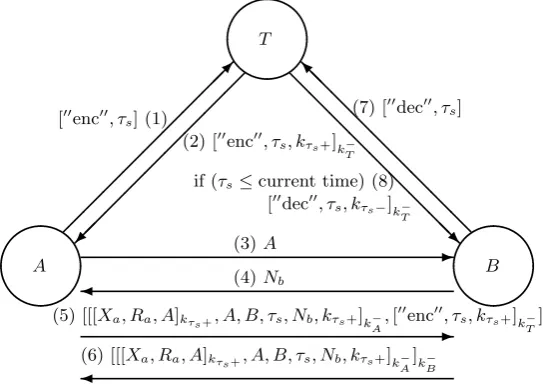
time-key pair for the future time𝜏𝑠. After generating a time-key pair𝑘𝜏𝑠+ and𝑘𝜏𝑠−, 𝑇 will reply a signed message containing the encryption key𝑘𝜏𝑠+to𝐴, and holds the decryption key 𝑘𝜏𝑠− until time𝜏𝑠. Then, after initializing a communication with𝐵,𝐴encrypts 𝑋𝑎 with the encryption key𝑘𝜏𝑠+, and sends it to 𝐵. Upon receiving the encrypted message,𝐵 acknowledges the receipt of it, and then re-quests the decryption key𝑘𝜏𝑠− from𝑇. If the current time is greater or equal to 𝜏𝑠, 𝑇 will return the decryption key to 𝐵; otherwise he does not respond. The
detailed protocol is described in fig.1, in which 𝑅𝑎 and 𝑁𝑏 are used to denote
the random number and the nonce generated by𝐴and𝐵 respectively.
&% '$
𝐴
&% '$
𝐵
&% '$
𝑇
[′′enc′′, 𝜏𝑠] (1)
(2) [′′enc′′, 𝜏𝑠, 𝑘𝜏𝑠+]𝑘− 𝑇
-(3)𝐴
(4)𝑁𝑏
-(5) [[[𝑋𝑎, 𝑅𝑎, 𝐴]𝑘𝜏𝑠+, 𝐴, 𝐵, 𝜏𝑠, 𝑁𝑏, 𝑘𝜏𝑠+]𝑘𝐴−,[
′′
enc′′, 𝜏𝑠, 𝑘𝜏𝑠+]𝑘−𝑇]
(6) [[[𝑋𝑎, 𝑅𝑎, 𝐴]𝑘𝜏𝑠+, 𝐴, 𝐵, 𝜏𝑠, 𝑁𝑏, 𝑘𝜏𝑠+]𝑘−𝐴]𝑘−𝐵
@ @ @ @ @ @ @ @ @ I
(7) [′′dec′′, 𝜏𝑠]
@ @
@ @
@ @
@ @
@ R if (𝜏𝑠≤current time) (8)
[′′dec′′, 𝜏𝑠, 𝑘𝜏𝑠−]𝑘𝑇−
Fig. 1.Timed-Release Protocol