On the Secure Obfuscation of Deterministic Finite Automata
(Extended Abstract)W. Erik Anderson∗
Sandia National Laboratories
Abstract
In this paper, we show how to construct secure obfuscation for Deterministic Finite Au-tomata, assuming non-uniformly strong one-way functions exist. We revisit the software protec-tion approaches originally proposed by [5, 10, 12, 17] and revise them to the current obfuscaprotec-tion setting of Barak et al. [2]. Under this model, we introduce an efficient oracle that retains some “small” secret about the original program. Using this secret, we can construct an obfuscator and two-party protocol that securely obfuscates Deterministic Finite Automata againstmalicious ad-versaries. The security of this model retains the strong “virtual black box” property originally proposed in [2] while incorporating the stronger condition of dependent auxiliary inputs in [15]. Additionally, we show that our techniques remain secure under concurrent self-composition with adaptive inputs and that Turing machines are obfuscatable under this model.
Keywords: Obfuscation, deterministic finite automata, state machines, Turing machines, au-thenticated encryption, oracle machines, provable security, game-playing.
1
Introduction
Program obfuscation, if possible and practical, would have a considerable impact on the way we pro-tect software systems today. It would be instrumental in propro-tecting intellectual property, preventing software piracy, and managing use-control applications. The work of Barak et al. [2] initiated the first formal study of obfuscation. They define an obfuscator O to be an efficient, probabilistic compiler that takes a programP and transforms it into a functionally equivalent yet unintelligible program O(P). Unintelligible is defined in the strictest sense, to imply that the program O(P) behaves ideally like a “virtual black box”. That is, whatever can be efficiently extracted from the obfuscated program can also be extracted efficiently when given only oracle access toP.
Unfortunately, in [2] it was proven that obfuscation in general is impossible. Namely, there exist a family of functions that are unobfuscatable under the “virtual black box” notion of security. This would seem to suggest that having physical access to the program is a much stronger capability than having only access to its input and output behavior. In addition to this main impossibility result, the authors also prove that if secure symmetric key encryption schemes exist, pseudorandom functions exist, or message authentication schemes exist, then so do unobfuscatable versions of each. The authors conclude that the “virtual black box” property is inherently flawed, and if we hope for any positive obfuscation results, then either this model needs to be abandoned or we need to accept that many programs are not obfuscatable [2].
Unobfuscated Code
Obfuscated Code
Oracle Communication
Link Remove
Code
Protected Volume
Compiler
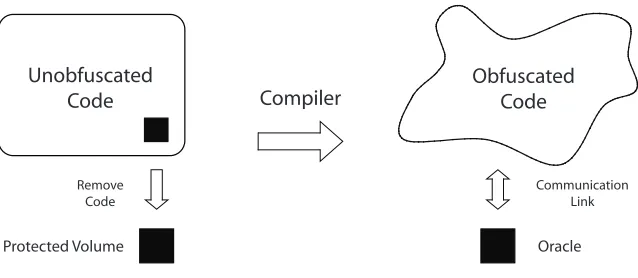
Figure 1: Obfuscation with respect to oracle machines
Numerous other impossibility results have also shed light on the problem of obfuscation. For example, Goldwasser et al. [15] showed that many natural circuit classes are unobfuscatable when auxiliary inputs are added to the obfuscation model. Auxiliary inputs provide for a more robust model of obfuscation, since the adversary is assumed to have some a priori information about the underlying program. This additional layer of security is useful in practice, since it is likely that the obfuscated code will be utilized in a large system, and the system may reveal partial information about the functionality of the code.
In spite of the numerous impossibility results, other works such as Lynn et al. [18] have examined alternative models of obfuscation in the hope of achieving meaningful possibility results. Under the random oracle model of obfuscation, they assume that both the obfuscator and obfuscated code have access to a public random oracle. Under this assumption, they are able to show that both point functions and complex access control schemes are obfuscatable. Similar results were obtained by [6, 8, 21] under a slightly weaker notion of “virtual black box” obfuscation (without random oracles). For example, Wee showed in [21] that point functions are (weakly) obfuscatable, provided that strong one-way permutations exist.
In this paper, we introduce a new model of obfuscation that has wide and meaningful possibility results beyond those described above. To demonstrate the utility of this model, we show that both deterministic finite automata and Turing machines are securely obfuscatable, provided non-uniformly strong one-way functions exist. We call this model of obfuscation obfuscation w.r.t. oracle machines.
1.1 Notation
We will use the notation PPT to stand for probabilistic polynomial-time Turing machine. If A is a PPT, B an oracle, and x an input to A, then by AB(x) we mean the algorithm that runs on
inputx using oracle access toB. We will often refer to Aas a PPT oracle machine. When writing x ⇐ A we mean the value x is returned by A. Additionally, A(1k) implies A is given the value
k. In our algorithm descriptions, we make use of the statements return y and Returnz. When using the syntax return, we imply that the value y is returned internally to the algorithm (such as the output of a function call), while by using Return, we imply that the value z is written to the output tape. As usual, we use the notation{0,1}k to denote the set of allk-bit binary strings,
and by x ← {$ 0,1}k we mean x is uniformly chosen from {0,1}k. We also use the conventional
notation ofk and ⊕to denote the string operators concatenate and exclusive or. Unless explicitly stated otherwise, we will assume all references to log are based 2. A function µ : N → R+ is
said to be negligible, if for any positive polynomial p there exists an integer N such that for any k > N,µ(k)<1/p(k). We will sometimes use the notationneg(·) to denote an arbitrary negligible function. A polynomial-time computable function f : {0,1}∗ → {0,1}∗ is called non-uniformly strong one-way if for every non-uniform PPT A there is a negligible function neg(·) such that for sufficiently large k, Pr
x←{$ 0,1}k[f
−1(f(x))∋y←A(f(x),1k) ]≤neg(k).
2
Obfuscation with respect to Oracle Machines
In this section we introduce the framework for obfuscating w.r.t. oracle machines. Under this framework we model obfuscation as a two-party protocol, where one party represents the obfus-cated code and the other an oracle containing some “small” secret. The communication between the two parties is characterized using interactive Turing machines introduced by [13]. Under this model, we assume the adversary has complete control over both the obfuscated code and message scheduling. We further assume the adversary is malicious, and may deviate from the protocol in any way. This allows the adversary to adaptively query the oracle with messages of its own choice. We define an interactive Turing machine as follows.
Interactive Turing Machines. An interactive Turing machine (ITM) is a Turing machine that has an additional communication tape, together with its read-only input tape, read-only random tape, write-only output tape, and read-and-write work tape. The communication tape consists of two tapes, a write-onlyoutgoing communication tapeand a read-onlyincoming communication tape. When the incoming and outgoing communication tape of one ITM are shared with the outgoing and incoming communication tapes of the other ITM we call this pair aninteractive pair of Turing machines.
We denote a pair of interactive Turing machinesMandN as the tuple (M, N). The pair (M, N) is assumed to be ordered in the sense that at any one time only one Turing machine is active. The active Turing machine can compute on its internal work tapes, read from its input tapes, write to its output tape, and send a message to the other Turing machine on its outgoing communication tape. When one Turing machine has completed its computation, it transfers control over to the other. This process continues until one machine reaches a halt state.
if the tape’s contents are preserved between each successive execution of R. The other internal working tapes do not share this property and are assumed to be blank after each execution. Given a particular input and internal state, the oracle R computes an output (which may be ⊥) on its outgoing communication tape along with a new internal state,internal state′.
(output,internal state′)← R(input,internal state)
IfR does not have access to a random tape then we sayRis deterministic.
Before finalizing the oracle’s computational model, we need to capture the idea of a resource-limited device. This will help clarify our meaning of an oracle maintaining a “small” secret. To explore this idea more throughly, we consider the following two illustrations. In our first example, we examine the case when the internal statetape is assumed to be very large, so large in fact that it can store the entire program that is being obfuscated. In this instance, we can create a trivial obfuscator that loads the entire program into the oracle’s internal state at setup. This simulates a true black box and maintains the security properties we are after. However, in practice very large programs may not physically fit on a device, or it may be prohibitively expensive to do so, especially if the device requires tamper and read-proof protection.
As another example, we consider the parallel case when the input tape is very large. In this case we can devise a protocol that loads an authenticated encrypted version of the program onto the oracle’s work tape (for each input query), which the oracle later decrypts, authenticates, and runs internally. Having a large input tape does not make sense in practice, as the input is usually comparatively smaller than the program size. To avoid these trivialities we consider placing bounds on both the size of theinternal stateand input tape of the oracle. Under this supposition, we assume there exists a polynomial s(·) such that for each k ∈ N, both tapes are polynomial bounded by
s(k). In this framework, we will consider only the non-trivial case when s(k) =o(f(k)),1 where the device’s resources are asymptotically smaller than the program itself. In the special case when s(k) =O(k), we will say that the oracle maintains a “small” internal state.
Definition 1 (Obfuscation w.r.t. Oracle Machines)A probabilistic polynomial time algorithm
O and oracle R are said to comprise an obfuscator of the family F ={Fk}k∈N w.r.t.
polynomial-time bounded oracle machines, if the following three conditions hold:
• (Approximate Functionality) There exists a negligible function µsuch that for all kand M ∈ Fk, OR(M,1k) describes an ITM that computes the same function as M with probability at
least 1−µ(k).
• (Polynomial Slowdown) The description length and running time of OR(M,1k) is at most
polynomial larger than that ofM. That is, there exists a polynomial psuch that for all kand
M ∈ Fk, |O(M,1k)| ≤p(k) and if M takes ttime steps on an input x, thenOR(M,1k) takes
at most p(k+t) time steps on x.
• (Virtual Black Box) For every PPT A, there is a PPT simulator S and a negligible function
ν such that, for all k andM ∈ Fk, and every polynomial q with bounded auxiliary inputz of
size q(k), we have
Pr[A
R(OR(M,1k),1k, z) = 1]−Pr[SM(1|M|,1k, z) = 1]
≤ν(k).
1The size of eachM ∈ F
For convenience, when our family F is a family of Turing machines, we will adopt the convention that each program is represented by its binary string encoding for some fixed2 polynomial time
universalTuring machine. Therefore, the size of each Turing machine is measured as the size of its binary string representation. To simulate the adversaries view correctly, we will also leak to S the number of steps taken on each oracle query toM. So not only willS be able to observe the input and output behavior of M, but it will also observe its timing as well.
2.1 Non-Resettable Deterministic Finite Automata
We define a Deterministic Finite Automaton (DFA) as a machine Ψ = (Q,Σ, δ, s0, G) with a finite set of states Q, finite alphabet Σ, transition functionδ, initial state s0 ∈Q, and accepting states G. The structure of the DFA is determined by its transition functionδ, which maps each state and a given input symbol to a new state. The output function (which imitates black box behavior) of the DFA Ψ is defined as
Ψ(s, α) :=
1 ifδ(s, α)∈G 0 ifδ(s, α)∈/G
where the “user”-selectable input isα, andsis the current “internal” state. We note that the user does not have control of the state input. Rather Ψ must internally maintain the state over each execution. We will often write just Ψ(α).
When modeling DFAs, it is often convenient (unless stated otherwise) to assign aresetcapability, which allows the DFA to transition back to its initial state. In practice, having a reset capability is not always a desired characteristic, especially when developing software use-control applications, such as subscription policies and digital rights management. To differentiate between DFAs that have a reset capability and those that don’t, we define anon-resettable DFA to be a deterministic finite automaton that is not resettable. We note that we can always build in resettability if we add an additional reset symbol to every state.
A topic of related interest that has been actively studied over the years has been on the prob-lem of developing efficient learning algorithms. A learning algorithm takes a given input-output sample (i.e., transcript) and tries to construct a DFA that is consistent with this sample. Finding a minimum-state DFA that is consistent for a given sample was shown by Gold [9] to be NP-Hard. This holds for any passively observable learning algorithm of an unknown DFA (with a particular representation). Angulin extends this result and shows that active learning that allows user se-lectable inputs, is equally hard [1]. Specifically, one can construct a family of DFAs that cannot be learned in less than exponential time. A common interest to this line of work has been the re-lationship of resettability and learning. Non-resettability under certain frameworks can sometimes lead to efficient learning algorithms [19]. In general, though, learning a non-resettable DFA is a very difficult problem.
2.2 Necessary Conditions for Obfuscating a DFA
In this section we develop several necessary conditions for securely obfuscating a non-resettable DFA. In particular, we show that obfuscation is feasible only provided that the oracle’s internal state is both read-proof and non-static. To facilitate the proof in Proposition 1, we begin by constructing a family of non-resettable DFAs that are hard to characterize given only black box access, yet easy given some additional power, such as reset. We define the family of non-resettable DFAs Ψi,j,i, j ∈ {0,1} to be the set of machines with the following characteristics: Q={0,1,2},
|Σ| ≥2, initial state 0, accept statesGi,j ={1 iffi= 1,2 iff j= 1}, and transition function
δ(q, λ) :=
0 ifq = 0 and λ∈Σ− {α, β}
1 if (q= 0 and λ=α) or q= 1 2 if (q= 0 and λ=β) or q = 2.
The family described above branches into two distinct states, depending on whether the first input symbol isα orβ. Clearly, one can learn the DFA’s full description if resets are allowed. We exploit this simple observation in the following result.
Proposition 1 If non-resettable DFAs are obfuscatable w.r.t. oracle machines then the following conditions must hold:
(1) The oracle’s internal state tape cannot be static.
(2) The oracle must be read-proof.
Proof: For the first condition we let O be any secure non-resettable DFA obfuscator. We show that having a static internal state gives the adversary a non-negligible advantage. Suppose|Σ| ≥2 and consider the non-resettable DFAs Ψi,j described above with alphabet symbolsα, β ∈Σ. Since
O is a secure obfuscator we must have for every PPT A and auxiliary input z, the existence of a PPT simulator S satisfying
Pr[A
R(OR(M
Ψi,j,1k),1k, z) = 1]−Pr[SMΨi,j(1|MΨi,j|,1k, z) = 1]
≤ν(k)
LetAbe the adversary that takes the original obfuscated codeO(Ψi,j), stores a copyC ← O(Ψi,j)
and runsi←CR(α) andj←CR(β). The distinguishing bit returned byAisb←i⊕j. Now since
1−Pr[SΨi,j(1|MΨi,j|,1k, z) = 1]≤ν(k) fori6=j
and
Pr[SΨi,j(1|MΨi,j|,1k, z) = 1]≤ν(k) fori=j
we must have
1−ν(k)≤ 1
2
X
i6=j
Pr[SΨi,j(1|MΨi,j|,1k, z) = 1]
and
1 2
X
i=j
Pr[SΨi,j(1|MΨi,j|,1k, z) = 1]≤ν(k).
But the following equality
X
i6=j
Pr[SΨi,j(1|MΨi,j|,1k, z) = 1] =X i=j
Pr[SΨi,j(1|MΨi,j|,1k, z) = 1]
3
DFA Obfuscation
Following the framework described in Section 2, we show how to construct a DFA obfuscator that is secure with respect to dependent auxiliary inputs. Our goal is to develop a compact, yet very efficient DFA obfuscator that is not only of theoretical interest, but useful in practice as well. To obtain our results, we use a simple authenticated encryption scheme to hide the structure of the DFA and authenticate the execution of the protocol. As noted earlier, we view a Turing machine as a program running on auniversal TM. Therefore, when describing our DFA representations, we will informally write their descriptions as pseudocode.
Representation. We model each DFA Ψ as a polynomial-time Turing machineMΨ with an addi-tionalpersistentread-and-write tape, calledinternal state. Theinternal statemaintains a record of the values needed to compute the DFA, such as the DFA’s current state. Each MΨ is represented by a table where,∀α∈Σ,∀ s∈Q, there is a table entry containing α,s,δ(s, α), andacpt (which equals 1 iffδ(s, α)∈G). Without any loss of functionality, we compress the table by employing an injective map that encodes each α ∈Σ to a string in {0,1}⌈log|Σ|⌉. Using the table described, we can create a program MΨ that simulates Ψ’s output behavior. The program consists of the DFA table, high-level code, and two persistent variables current state and current acpt. The high-level code describes the programming language used, table lookup algorithm, alphabet Σ, and function calls that manipulate the persistent variables. The program MΨ works as follows: On user input α, the table lookup algorithm searches each table entry for the pair α,current state. If a match is found, the acpt bit is updated and δ(current state, α) is recorded temporarily. The program continues to search the rest of the table for a match. At the end of the table search, the user is given the recordedacpt bit, and the variablecurrent state ←δ(current state, α) is updated. After theacptbit has been returned, the DFA is ready to accept its next input.
Following this description, our next goal is to define an encoding scheme of MΨ. Our choice of encoding is important for several reasons. First, it allows us to calculate the size of|MΨ|, which is needed for evaluating the polynomial slowdown property. And second, depending on our choice of encoding, the size of |MΨ|may drastically affect the simulator’s ability to simulate the obfuscated code. We formalize our encoding scheme as follows.
Encoding. We begin our encoding by splitting up the description of MΨ into its individual com-ponents: high-level code and DFA table (which is further broken down by individual table entries). We create a parsing scheme that takes the bit description of each component and adds a trailing bit of a 1 or 0 to the end of each individual bit. The trailing bit allows the parser to recognize the end of a component’s description. For example if the high-level code has a bit description h0. . . hm then its new bit description is h00h10. . . hm1. Adopting this encoding scheme, we can
find a t ≥ 0 such that the size of each table entry satisfies 2t ≤ |table entry| < 2t+1. Given t, we pad each table entry with the string 00. . .01 (which is a multiple of two in length) until its length is exactly 2t+1. If the number of tables entries is even, we pad the last table entry with an additional 2t+1 bits of the form 00. . .01 and add a single 1 bit value on the end. If, on the other hand, the number of table entries is already odd, then we do nothing. For convenience we denote the number of edges in Ψ as |E(Ψ)|. By prefixing the parser to the encoded MΨ, it follows that
|MΨ| = |Parser|+|High-level code|+|Table|, where |Table| = 2t+1|E(Ψ)| if the number of table entries is odd and 2t+1(|E(Ψ)|+ 1) + 1 if the number of table entries is even.
size of |MΨ| implies that one also knows the size of |Table|. But one can efficiently extract the number of edges|E(Ψ)| based on our encoding above. We use this deduction later in the proof of Proposition 2 to swap the simulator’s input 1|MΨ| with 1|E(Ψ)|.
Based on the encoding above, we define the family FDFA := {Fk}k∈N to be the set of all
polynomial boundedMΨ satisfying
Fk:={MΨ| |MΨ| ≤f(k) and 2 log|States(Ψ)|+ log|Σ|+ 1< k}3
for some fixed polynomialf(k). The parameter k is called thesecurity parameter.
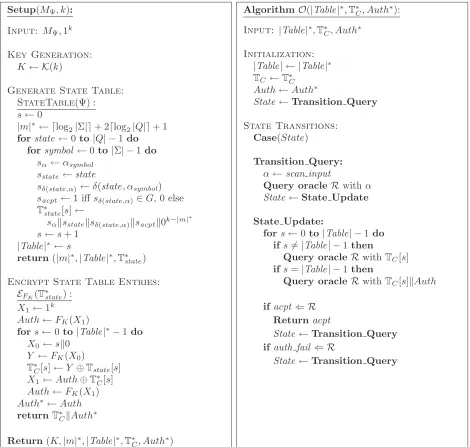
Obfuscation. To simplify our description of the DFA obfuscator, we split the obfuscation into three separate algorithms, Setup, O, and R. The Setup algorithm, shown in Figure 2, takes a DFA encodingMΨ and generates inputs for both the obfuscated code and oracle. Without loss of generality, we view our encoding of MΨ to be the DFA state transition table of Ψ. The parsing operation and high-level code was left out for simplicity.
The obfuscated code O, also shown in Figure 2, can be described as a protocol template. The template takes as input the encrypted table TC, authentication tag Auth, and table size |Table|returned by the Setup algorithm. During theTransition Queryphase the obfuscated code scans in the user’s input α, queries the oracle R, and enters a new phase called State Update. During State Update, the obfuscated code submits the table TC along with the authentication
tagAuth. The oracle processesTC one table entry at a time and verifies the table’s integrity. If the authentication passes, the oracle returns an accept value corresponding to whether the new state is an accept state.
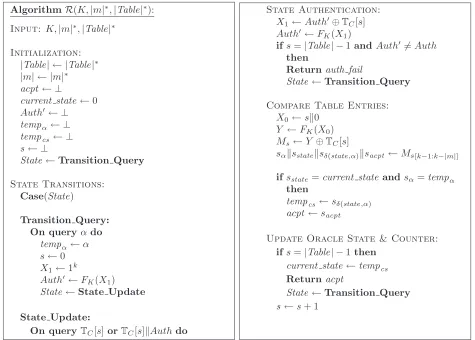
The oracle R, shown in Figure 3, describes the oracle’s behavior. Just like the obfuscated code
O, the oracle is nothing more than a protocol with a symmetric key and a few additional variables. Other than the padding length |m|, table size |Table|, and current state, the oracle maintains no information about the DFA.
Proposition 2 If non-uniformly strong one-way functions exist, then non-resettable DFAs are obfuscatable with respect to oracle machines.
Proof: Let f(k) be some positive polynomial and consider the family FDFA defined over f(k). We will assume without loss of generality for the remainder of the proof thatkis sufficiently large so that the inequality 2 log|States(Ψ)|+ log|Σ|+ 1 < k is satisfied for every MΨ ∈ Fk. This
assumption follows from the fact that every MΨ ∈ Fk is polynomial bounded, and therefore there
exists a fixed t >0 with|MΨ| ≤kt for every ksufficiently large. Thus |States(Ψ)||Σ|<|MΨ| ≤kt implies log|States(Ψ)|+ log|Σ|< tlogkwhence 2 log|States(Ψ)|+ log|Σ|+ 1≤2tlogk+ 1< kfor ksufficiently large. This last restriction was added to guarantee that the size of each table entry is no larger than the size of the pseudorandom function’s output length.
To prove that the obfuscator in Figure 2 and 3 obfuscates non-resettable DFAs, we need to show that the aforementioned three conditions hold: Approximate Functionality,Polynomial Slowdown, and Virtual Black Box.
Approximate Functionality: The oracle may be in only one of two states at any one time. In the first state,Transition Query, the user submits a transition symbol to the oracle, which the oracle internally stores on its internal state tape. After this value has been written, the oracle’s state is
3The condition 2 log|States(Ψ)|+ log|Σ|+ 1< kmay be removed by modifying the encryption scheme in Figure 3
Setup(MΨ, k):
Input: MΨ,1k
Key Generation:
K← K(k)
Generate State Table: StateTable(Ψ) : s←0
|m|∗← ⌈log
2|Σ|⌉+ 2⌈log2|Q|⌉+ 1 forstate←0 to|Q| −1 do
forsymbol ←0 to|Σ| −1 do sα←αsymbol
sstate ←state
sδ(state,α)←δ(state, αsymbol) sacpt ←1 iffsδ(state,α)∈G, 0 else
T∗state[s]←
sαksstateksδ(state,α)ksacptk0k−|m|
∗
s←s+ 1 |Table|∗←s
return(|m|∗,|Table|∗,T∗ state)
Encrypt State Table Entries:
EFK(T∗state) : X1←1k
Auth←FK(X1)
fors←0to|Table|∗−1do X0←sk0
Y ←FK(X0)
T∗C[s]←Y ⊕Tstate[s] X1←Auth⊕T∗C[s]
Auth←FK(X1)
Auth∗←Auth
returnT∗CkAuth∗
Return(K,|m|∗,|Table|∗,T∗
C, Auth∗)
AlgorithmO(|Table|∗,T∗
C, Auth∗):
Input: |Table|∗,T∗C, Auth∗
Initialization:
|Table| ← |Table|∗ TC←T∗C
Auth←Auth∗
State←Transition Query
State Transitions:
Case(State)
Transition Query: α←scan input
Query oracleRwithα State←State Update
State Update:
fors←0to |Table| −1 do ifs6=|Table| −1 then
Query oracleRwithTC[s] ifs=|Table| −1 then
Query oracleRwithTC[s]kAuth ifacpt⇐ R
Returnacpt
State←Transition Query ifauth fail ⇐ R
State←Transition Query
Figure 2: Algorithm Setup andO.
updated to its second state, called State Update. In State Updatethe user transmits the en-crypted table to the oracle (from top to bottom). The oracle checks the ciphertext integrity in each table entry and compares the underlying plaintext with the current state and stored transition sym-bol. If a match occurs, the oracle stores the new transition state and accept bit in itsinternal state. Provided that the protocol has been executed faithfully, the oracle will return the acpt bit on the last query. After this stage has been completed, the oracle reverts back to itsTransition Query
state, and this cycle repeats indefinitely. Given this short description, it is not difficult to verify that the obfuscated DFA computes the original DFA with a probability of 1.
Polynomial Slowdown: In order to show that the obfuscator satisfies polynomial slowdown we must prove there exists a polynomial p satisfying: for all k and MΨ ∈ Fk the description length
AlgorithmR(K,|m|∗,|Table|∗):
Input: K,|m|∗,|Table|∗
Initialization:
|Table| ← |Table|∗ |m| ← |m|∗ acpt← ⊥
current state←0 Auth′ ← ⊥ tempα← ⊥ tempcs ← ⊥ s← ⊥
State←Transition Query
State Transitions:
Case(State)
Transition Query: On queryαdo
tempα←α s←0 X1←1k
Auth′ ←FK(X
1)
State←State Update
State Update:
On queryTC[s] orTC[s]kAuthdo
State Authentication:
X1←Auth′⊕TC[s]
Auth′←FK(X
1)
ifs=|Table| −1and Auth′6=Auth
then
Returnauth fail
State←Transition Query
Compare Table Entries:
X0←sk0
Y ←FK(X0)
Ms←Y ⊕TC[s]
sαksstateksδ(state,α)ksacpt←Ms[k−1:k−|m|]
ifsstate =current state andsα=tempα then
tempcs ←sδ(state,α)
acpt←sacpt
Update Oracle State & Counter:
ifs=|Table| −1then
current state←tempcs Returnacpt
State←Transition Query
s←s+ 1
Figure 3: Oracle R.
at most p(k+t) time steps on x. We do this by constructing two polynomials, one that bounds the description size of the obfuscated code and the other bounding the number of steps. We then construct a suitable polynomial from both of these that satisfies the above requirement.
Observe that the size of the obfuscated code is asymptotically bounded above by|O(MΨ,1k)|= O(|High-level Code|+k|E(Ψ)|). Since MΨ ∈ Fk, we must have |E(Ψ)| ≤ |MΨ| ≤ f(k). But this implies |O(MΨ,1k)| = O(kf(k)); hence the description length is polynomial bounded. For the time complexity, observe that the string comparisons for each table entry under MΨs takes at least ⌈log|Σ|⌉+⌈log|States(Ψ)|⌉ ≥ log|E(Ψ)| steps. Since this operation is repeated |E(Ψ)|
times it follows that the total number of steps needed to compute MΨ on any input is at least t ≥ |E(Ψ)|log|E(Ψ)|. On the other hand the number of steps needed for OR(MΨ,1k) to send the table to the oracle is at most O(k|E(Ψ)|log|E(Ψ)|), while the oracle, which is polynomial time computable, takes at most q(k) polynomial number of steps per query. Therefore, the total number of steps taken on any input (including the number of steps for the oracle) is at most O(k q(k)|E(Ψ)|log|E(Ψ)|). Without loss of generality, we may assume that both polynomials f(k) and q(k) absorb the constants for the asymptotic bounds of the description length and time complexity. Therefore, we can find a suitable n, c >0 such that for all k, max{f(k), q(k)} ≤ ckn.
We claim that p(k) := ckn+2 satisfies the polynomial slowdown requirement. This is clear since the description length|O(MΨ,1k)| ≤kf(k) ≤ckn+2 and the time complexity of OR(MΨ,1k) is at mostk q(k)|E(Ψ)|log|E(Ψ)| ≤c(k+t)n+2. Our claim follows.
simulator input 1|MΨ| with 1|E(Ψ)| which can be extracted (based on our encoding of M
Ψ). This reduces the virtual black box inequality to Equation (1).
We begin our analysis by breaking up Equation (1) into four separate equations, each equation representing the indistinguishability of obfuscating with different oracles. Other than the first oracle RFK we do not place any computational assumptions on the others. This allows them to maintain a much larger internal state.
Pr[A
RFK(ORFK(Ψ), z) = 1]−Pr[SΨ(1|E(Ψ)|, z) = 1]
(1)
≤
Pr[ARFK(ORFK(Ψ), z) = 1]−Pr[ARFun(ORFun(Ψ), z) = 1]
(2)
+
Pr[A
RFun(ORFun(Ψ), z) = 1]−Pr[AR∗Fun(OR∗Fun(Ψ), z) = 1]
(3)
+
Pr[A
R∗
Fun(OR∗Fun(Ψ), z) = 1]−Pr[AR∗Rand(OR∗Rand(Ψ), z) = 1]
(4)
+
Pr[A
R∗
Rand(OR∗Rand(Ψ), z) = 1]−Pr[SΨ(1|E(Ψ)|, z) = 1]
. (5)
In Equation (2) we introduce the oracle RFun in order to measure the pseudorandomness of
RFK. Both RFun and RFK have the same description, except every call to FK in RFK is replaced with a similar call to a random function (independent ofz) with the same input and output length. For convenience we refer to this random function as Fun. Using algorithms E and V shown in Figure 10 (with the IV′s removed), we can reduce the distinguishability of Equation (2) to the distinguishability of the pair of oracles (EFk,VFk) and (EFun,VFun). We base this reduction on adversaryBA,Ψ given in Figure 4.
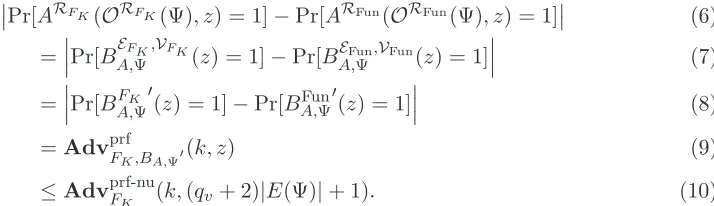
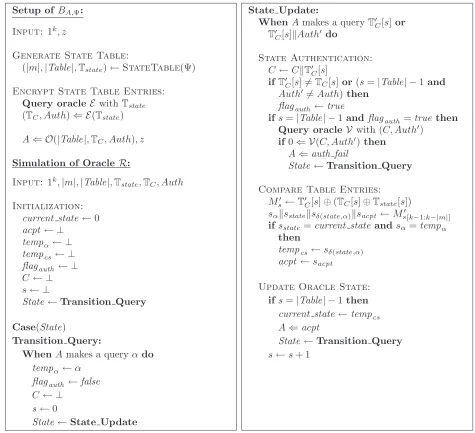
In our description ofBA,Ψ, we use the parameter Ψ to indicate the hardwiring ofB’s oracle query toE (which is dependent onStateTable(Ψ)). BA,ΨusesE’s response to construct the obfuscated code, which is given toA. Using A,BA,Ψ simulatesA’s query-response interaction with the oracle. The distinguishing bit breturned by BA,Ψ is the same bit returned by A. Therefore Equation (6) reduces to Equation (7). If we replace every oracle call to E and V with multiple calls to either FK or Fun then we can reduce Equation (7) even further. We denote this simulation byBA,Ψ′ to distinguish itself fromBA,Ψ. Therefore Equation (7) reduces to Equation (8). But this last equation is just the pseudorandom distinguishability of FK given auxiliary inputz. Using our assumption
that non-uniformly strong one-way functions exist, we can use the Goldreich et al. construction in [11] to generate a pseudorandom function that is secure against non-uniform PPT adversaries (denoted as prf-nu). If the adversary A makes no more than qv distinct4 State Update queries,
then the total number of queries made toFK or Fun by BA,Ψ′ is no more than (qv+ 2)|E(Ψ)|+ 1.
Therefore Equation (6) reduces to Equation (10), which is negligible following our assumption.
Pr[ARFK(ORFK(Ψ), z) = 1]−Pr[ARFun(ORFun(Ψ), z) = 1]
(6)
=
Pr[B
EFK,VFK
A,Ψ (z) = 1]−Pr[B
EFun,VFun
A,Ψ (z) = 1]
(7)
=
Pr[B
FK A,Ψ
′
(z) = 1]−Pr[BA,FunΨ′(z) = 1]
(8)
=AdvprfF
K,BA,Ψ′(k, z) (9)
≤Advprf-nuF
K (k,(qv + 2)|E(Ψ)|+ 1). (10)
For Equation (3), we would like to perform a similar reduction as performed for Equation (8) except, instead of measuring the pseudorandomness of FK, we would like to measure the
unforge-4Eachq
Setup ofBA,Ψ:
Input: 1k, z
Generate State Table:
(|m|,|Table|,Tstate)←StateTable(Ψ)
Encrypt State Table Entries:
Query oracleE withTstate (TC, Auth)⇐ E(Tstate) A⇐ O(|Table|,TC, Auth), z Simulation of Oracle R:
Input: 1k,|m|,|Table|,T
state,TC, Auth
Initialization:
current state←0 acpt← ⊥
tempα← ⊥ tempcs ← ⊥ flagauth ← ⊥ C← ⊥ s← ⊥
State←Transition Query
Case(State)
Transition Query:
WhenAmakes a queryαdo
tempα←α flagauth ←false C← ⊥
s ←0
State←State Update
State Update:
WhenAmakes a queryT′C[s]or T′C[s]kAuth′ do
State Authentication:
C←CkT′C[s]
ifT′C[s]6=TC[s]or(s=|Table| −1 and Auth′6=Auth)then
flagauth ←true
ifs=|Table| −1 andflagauth =true then Query oracleV with (C, Auth′)
if0⇐ V(C, Auth′)then A⇐auth fail
State←Transition Query
Compare Table Entries:
M′
s←T′C[s]⊕(TC[s]⊕Tstate[s])
sαksstateksδ(state,α)ksacpt←Ms′[k−1:k−|m|] ifsstate =current state andsα=tempα
then
tempcs ←sδ(state,α)
acpt←sacpt
Update Oracle State:
ifs=|Table| −1 then
current state←tempcs A⇐acpt
State←Transition Query s←s+ 1
Figure 4: AdversaryBA,Ψ.
ability provided by the verifier V. To do this, we introduce the oracle R∗Fun. Internally, the oracle
R∗
Fun looks identical toRFun except during the state authentication process. Instead of computing a partial authentication tag for each State Update query, as is done in Figure 3, it collectively gathers all of the ciphertext queries and final authentication tag and submits them to a verifier
V∗. To do this,R∗Fun stores the values (TC, Auth) returned by the initialSetup(MΨ, k) algorithm.
During the State Update phase, the oracle checks to see if the table entries queried by the user are the same entries as those in TC. If any of the table entries are incorrect, including the final
authentication tag, or if they are queried in a different order, the oracle R∗Fun returns auth fail. This is equivalent to queryingV∗,
1← V∗(CkAuth) iff CkAuthwas a response of E,0 else
Setup of (BA,Ψ)p:
Encrypt State Table Entries:
WhenBA,Ψ makes a queryM to oracleEFun do
(C, Auth)← EFun(M)
BA,Ψ⇐(C, Auth) Simulation of Oracle R:
State Authentication:
fori←1 toqv do
WhenBA,Ψmakes a query (C′, Auth′) to oracle (VFun orV∗)do if(C′, Auth′)6= (C, Auth)then
BA,Ψ⇐0 elseBA,Ψ⇐1
b′⇐BA,
Ψ Returnb′
Figure 5: Adversary (BA,Ψ)p
call this advantage IND-VERF, since it measures the indistinguishability between the two verifiers. Therefore
Pr[A
RFun(ORFun(Ψ), z) = 1]−Pr[AR∗Fun(OR∗Fun(Ψ), z) = 1]
=
Pr[B
EFun,VFun
A,Ψ (z) = 1]−Pr[B EFun,V∗
A,Ψ (z) = 1]
=Advind-verfSEFun,BA,Ψ(k, qe, qv, ηe, ηv, z). (11)
with qe = 1 denoting the number of encryption queries and ηe = ηv−1 = |E(Ψ)| the maximum
number ofk-bit blocks each encryption or verification query may have. We claim this advantage is bounded above by the INT-CTXT-msecurity of SEFun. See Appendix A.1 for more details on the security definition of INT-CTXT-m.
Claim 1 Advind-verfSEFun,BA,Ψ(k, qe, qv, ηe, ηv, z)≤Advint-ctxt-mSEFun,(BA,Ψ)ctxt(k, qe, qv, ηe, ηv, z)
Proof: We will assume throughout the rest of this claim thatqe = 1 and ηe =ηv −1 =|E(Ψ)|.
To simplify the notation, we omit writing the variables qe, ηe, and ηv. Given a bit b chosen at
random, we let b= 0 represent oracle access to (EFun,VFun) and b= 1 to (EFun,V∗) in IND-VERF. LetE be the event (over the randomness of Fun and A) that BA,Ψsubmits at least one ciphertext authentication pair that passes verification (after at most qv distinct State Updatequeries) and
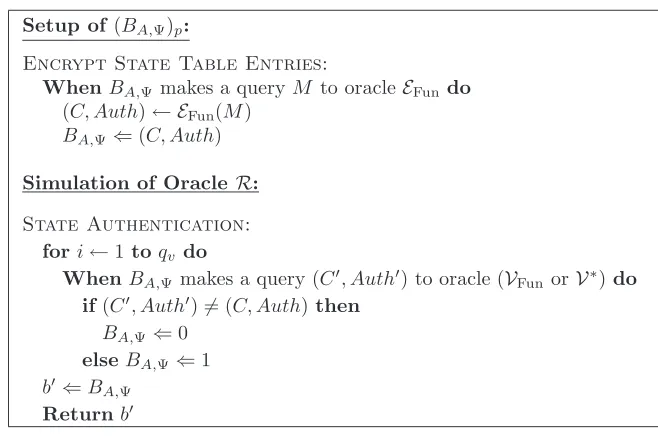
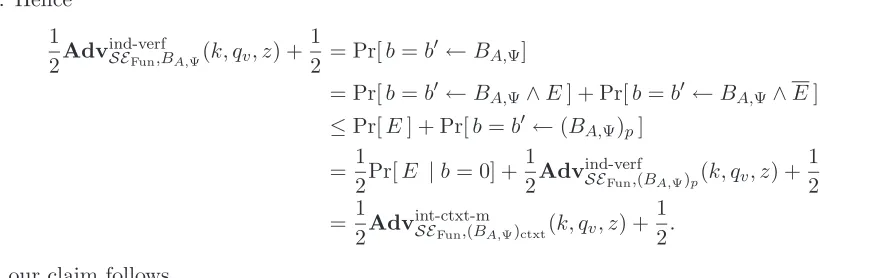
was never a response from EFun. In Figure 5 we define a new adversary (BA,Ψ)p that simulates
BA,Ψ’s interaction with the verifier V∗.
Given the eventE it follows that both (BA,Ψ)p andBA,Ψreturn the same distinguishing bitb′. Therefore
Pr[b=b′←BA,Ψ∧E] = Pr[b=b′ ←BA,Ψ|E]·Pr[E]
= Pr[b=b′ ←(BA,Ψ)p |E]·Pr[E]
≤Pr[b=b′ ←(BA,Ψ)p]
= 1 2Adv
ind-verf
SEFun,(BA,Ψ)p(k, qv, z) +
But Advind-verfSEFun,(BA,Ψ)p(k, qv, z) must be equal to
Pr[B
EFun,V∗
A,Ψ (z) = 1]−Pr[B EFun,V∗
A,Ψ (z) = 1]
which
is 0. Hence
1 2Adv
ind-verf
SEFun,BA,Ψ(k, qv, z) +
1
2 = Pr[b=b ′←B
A,Ψ]
= Pr[b=b′←BA,Ψ∧E] + Pr[b=b′ ←BA,Ψ∧E]
≤Pr[E] + Pr[b=b′←(BA,Ψ)p]
= 1
2Pr[E |b= 0] + 1 2Adv
ind-verf
SEFun,(BA,Ψ)p(k, qv, z) +
1 2
= 1 2Adv
int-ctxt-m
SEFun,(BA,Ψ)ctxt(k, qv, z) +
1 2.
and our claim follows.
Now that we have bounded Equation (3) by the INT-CTXT-m security of SEFun we are now ready to move onto Equation (4).
In Equation (4) we measure the chosen plaintext distinguishability between encrypting with either EFun or ERand, where ERand(M) is a random string of length |M|. The oracles R∗Rand and
R∗Fun are identical except for their calls to EFun or ERand. As before we will use the ∗ in R∗Rand to denote that verifier V∗ is used. We define B∗
A,Ψ to be the algorithm BA,Ψ that uses V∗ as its verifier (which can be easily simulated given the output of E). Therefore Equation (4) reduces to inequality (12)
Pr[A
R∗
Fun(OR∗Fun(Ψ), z) = 1]−Pr[AR∗Rand(OR∗Rand(Ψ), z) = 1]
=
Pr[B
∗ EFun
A,Ψ (z) = 1]−Pr[BA,∗ EΨRand(z) = 1]
=Advind$-cpaSEFun,B∗
A,Ψ(k, qe, ηe, z). (12)
withqe= 1 andηe=|E(Ψ)|.
In the final Equation (5), we introduce the simulator S, which as you recall has only black box access to Ψ. In order for S to properly simulate A’s view, it needs to know the number of edges
|E(Ψ)|. This can be easily extracted knowing just the size ofMΨbased on our encoding. Given the number of edges|E(Ψ)|,S can easily simulateA’s view of the obfuscated code by givingAa copy of
O(|E(Ψ)|,TC, Auth), whereTC is a random table of the appropriate size (dependent on|E(Ψ)|and
k) and Auth a k-bit random string. Using its oracle access to Ψ, S can simulate A’s interaction with R∗
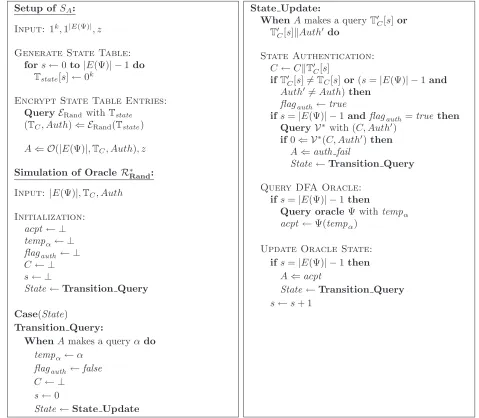
Rand using the values |E(Ψ)|,TC, and Auth. Therefore, the entire simulation, which we
denote by SA, consists of passing A the obfuscated code O(|E(Ψ)|,TC, Auth) and simulating the
interaction between R∗Rand and A using oracle Ψ. The full description of simulatorSA is given in
Figure 6.
To help with the analysis, we model adversary AR∗Rand(OR∗Rand(Ψ), z) as we did in
Equa-tion (4) by replacing it with B∗ ERand
A,Ψ (z). From this we have Pr[AR ∗
Rand(OR∗Rand(Ψ), z) = 1] =
Pr[B∗ ERand
A,Ψ (z) = 1]. Notice that during the State Update phase of BA,∗ Ψ, in order for the final query to reach Update Oracle State and return an output other than auth fail, R∗Rand must pass the verifier V∗. This implies that the adversary submits the table T
C free of modifications.
Hence the operations under Compare Table Entries may be completely replaced with a sim-ulated oracle call to the DFA in much the same way simulator SA does. Replacing this code, we
obtain a newB∗
A,Ψ′ which is functionally equivalent toBA,∗ Ψ. Since the variablescurrent state and
Setup ofSA:
Input: 1k,1|E(Ψ)|, z
Generate State Table:
fors←0to|E(Ψ)| −1do Tstate[s]←0k
Encrypt State Table Entries:
QueryERandwithTstate (TC, Auth)⇐ ERand(Tstate) A⇐ O(|E(Ψ)|,TC, Auth), z Simulation of Oracle R∗
Rand:
Input: |E(Ψ)|,TC, Auth
Initialization:
acpt← ⊥ tempα← ⊥ flagauth ← ⊥ C← ⊥ s← ⊥
State←Transition Query
Case(State)
Transition Query:
WhenAmakes a queryαdo
tempα←α flagauth ←false C← ⊥
s ←0
State←State Update
State Update:
WhenAmakes a queryT′C[s]or T′C[s]kAuth′ do
State Authentication:
C←CkT′C[s]
ifT′C[s]6=TC[s]or(s=|E(Ψ)| −1 and Auth′6=Auth)then
flagauth ←true
ifs=|E(Ψ)| −1 andflagauth =true then QueryV∗with (C, Auth′)
if0⇐ V∗(C, Auth′)then A⇐auth fail
State←Transition Query
Query DFA Oracle:
ifs=|E(Ψ)| −1 then
Query oracleΨ withtempα acpt←Ψ(tempα)
Update Oracle State:
ifs=|E(Ψ)| −1 then A⇐acpt
State←Transition Query s←s+ 1
Figure 6: Simulator SA.
Finally, observe that an oracle call toERand inEncrypt State Table Entries returns random strings regardless of the particular input. Therefore encrypting with the real state table Tstate or
one containing all zeroes provides a random output that is of the same size. Hence it follows B∗
A,Ψ′ and SA have a distinguishability of 0. Thus
Pr[A
R∗
Rand(OR∗Rand(Ψ), z) = 1]−Pr[SΨ
A(1|E(Ψ)|, z) = 1]
=
Pr[B
∗ ERand
A,Ψ ′
(z) = 1]−Pr[SAΨ(1|E(Ψ)|, z) = 1]
= 0.
following result
Pr[A
RFK(ORFK(Ψ), z) = 1]−Pr[SΨ(1|E(Ψ)|, z) = 1]
(13)
≤Advprf-nuF
K (k,(qv+ 2)|E(Ψ)|+ 1) +Advint-ctxt-mSEFun,(B
A,Ψ)ctxt(k, qe, qv, ηe, ηv, z) +Adv
ind$-cpa
SEFun,B∗A,Ψ(k, qe, ηe, z)
≤Advprf-nuFK (k,(qv+ 2)|E(Ψ)|+ 1)
+qv(4|E(Ψ)|2+|E(Ψ)|)2−k+
1
2(3|E(Ψ)|
2+|E(Ψ)|)2−k.
The amount of persistent state needed to obfuscate the DFA in the above Proposition is in fact quite small. In the next Proposition we show that we need at most O(k)-bits. This is especially ideal if the oracle is implemented on a computationally limited device with a minimal amount of tamper protection.
Corollary 1 If non-uniformly strong one-way functions exist, then non-resettable DFAs are ob-fuscatable with respect to oracle machines with small internal state.
Proof: In Proposition 2 we used the Goldreich et al. construction in [11] to generate a pseudo-random function that is secure against non-uniform PPT adversaries. The key generated for this construction is the same size as the security parameter k. But this implies that the size of the ora-cle’s internal state is no more than O(log|State(Ψ)|+ log|Σ|+k) =O(k), following our definition of Fk.
3.1 Composition of Obfuscations
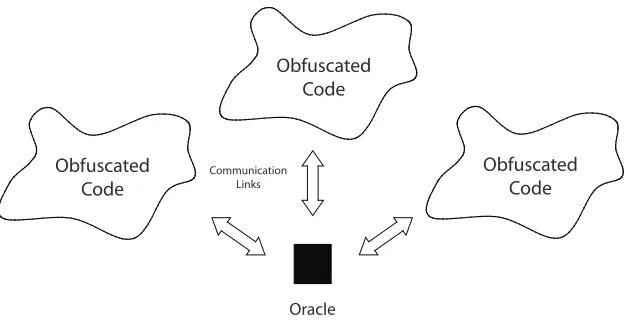
So far, we have looked at the case of DFA obfuscation in a stand-alone setting, where the obfuscated code is operating in isolation. Suppose now we allow multiple obfuscations to execute alongside one another, all sharing the same oracle as shown in Figure 7. If we compose obfuscations in such a manner, is the resulting scheme any less secure? That is, does running multiple obfuscations provide any more information that couldn’t otherwise be efficiently extracted by running their respective black boxes? Using a simple modification to the obfuscation algorithm presented earlier, we show that it is possible to securely compose obfuscations in this manner.
We model the composed DFA obfuscations as a system of ITMs whose communication tapes are connected via a polynomial-time computable control function. The control function interfaces with the oracle’s input and output communication tapes and delegates the order in which messages are sent to the oracle. In practice, the control function may implement a quality of service scheduling algorithm that gives certain DFAs a higher priority over others.
Obfuscated Code
Oracle
Communication Links
Obfuscated Code
Obfuscated Code
Figure 7: Composition of obfuscations w.r.t. single oracle
Concurrent Composition. Any interleaving of messages to the oracle is allowed. Multiple DFA executions operate independently of one another and submit messages to the oracle at their own discretion.
Adaptively Chosen Inputs. The inputs into each DFA execution are determined adaptively by the environment. No assumptions are placed on the inputs.
Self-composition. The number of DFA executions is fixed in advance, but may be chosen arbitrarily from the same family Fk for a given security parameter k.
Using the definitions above, we now present the main composition result.
Proposition 3 If non-uniformly strong one-way functions exist, then there exists a DFA obfuscator that remains secure under concurrent self-composition with adaptively chosen inputs.
Proof: The DFA obfuscator used in Proposition 2 can easily be modified to account for composi-tion. Let{MΨi}i=1,...,tbe a finite family of DFAs inFkwith the same encoding scheme as described
in Section 3. Our goal is to show that the following inequality is negligible:
Pr[ARFK(ORFK(Ψ1), . . . ,ORFK(Ψt), z) = 1]
−Pr[SΨ1,...,Ψt(1|E(Ψ1)|, . . . ,1|E(Ψt)|, z) = 1]
. (14)
To make sure the messages sent between the oracle and the obfuscated DFAs are properly routed, we assign a unique ID to each of them. This allows the oracle to distinguish the messages sent from each party. The following changes were made to the obfuscation algorithmsSetup,O, andR
in Figure 2:
• Setup(MΨ1, . . . , MΨt, k)
– The schemeEFK underEncrypt State Table Entriesis replaced with the encryption scheme in Figure 10.
– A uniqueIDi is assigned to each MΨi, corresponding to theIV used for encryption.
– All communications are prefixed with the DFA’s uniqueID.
– If a message is received with anID different than it’s own, it is ignored.
• R(K,ID1,|m|∗1,|Table|∗1, . . . ,IDt,|m|∗t,|Table|∗t)
– EachO(IDi,|Table|∗i,T∗C,i, Auth∗i) is assigned it’s own set of persistent variables|Table|IDi,
|m|IDi,acptIDi,current stateIDi,Auth ′
IDi,tempα,IDi,tempcs,IDi,sIDi, and StateIDi.
– All outgoing messages are prefixed with the input message ID.
– If an incoming message uses an unrecognizedID, anIDkinvalid id message is returned.
– The assignment ofX1 underTransition Queryis changed to X1 ←IDk1k−|ID|,
|ID|< k.
– The assignment ofX0 underCompare Table Entriesis changed to X0 ←IDksk0.
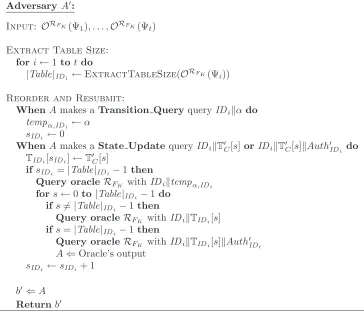
We begin our analysis by breaking up inequality (14) into four separate problems in much the same way as we did in Proposition 2. The oracles RFun, R∗Fun, and R∗Rand are reused with the above ID modifications. Since obfuscations may operate concurrently, we must show that this additional capability does not give an adversary a non-negligible advantage. In our particular case, concurrency implies only that messages are interleaved, since a single oracle can process messages only sequentially. In Proposition 2, the adversary BA,Ψ in Figure 4 was able to assemble a chain of State Update queries to construct a single verification query. This was easily achieved since only a single DFA obfuscation was communicating with the oracle at a time. We would like to use this same basic idea to help us here; unfortunately things are more complicated since messages are now interleaved. To mitigate this issue, we create an adversaryA′ (usingA as a subprotocol) that untangles the messages and resubmits them to the oracle in an orderly fashion. A description of adversaryA′ is given in Figure 8.
SinceAreceives an output message from the oracle only when an obfuscated DFA has submitted its finalState Updatequery, we can simulate the oracle’s output by holding back all ofA’s queries until a complete chain ofState Updatequeries have been submitted. Therefore, we can untangle A’s queries and resubmit them in the following order (Transition QueryIDi
1,State UpdateIDi1) , . . . ,(Transition QueryIDim,State UpdateIDim)5. Hence it follows that
Pr[ARFK(ORFK(Ψ1), . . . ,ORFK(Ψt), z) = 1]
= Pr[A′RFK(ORFK(Ψ1), . . . ,ORFK(Ψt), z) = 1].
Throughout the rest of the proof we will denote adversary A′ as A and assume A submits oracle queries only as described above.
Now that the oracle messages have been untangled, we can use adversaryBA,Ψto help complete our analysis. To account for the multiple DFA obfuscations, we relabel BA,Ψ as BA,(Ψ1,...,Ψt) and
make the following modifications in Figure 4:
• Under Generate State Tablereplace the existing code with:
for i←1tot do
(|m|i,|Table|i,Tstate,i)←StateTable(Ψi)
5(Transition Query
Adversary A′:
Input: ORFK(Ψ1), . . . ,ORFK(Ψt)
Extract Table Size:
fori←1 tot do
|Table|IDi ←ExtractTableSize(O
RFK(Ψi))
Reorder and Resubmit:
WhenAmakes a Transition QueryqueryIDikαdo tempα,IDi ←α
sIDi ←0
WhenAmakes a State UpdatequeryIDikT′C[s]orIDikT′C[s]kAuth′IDi do TIDi[sIDi]←T′C[s]
ifsIDi =|Table|IDi−1 then
Query oracle RFK withIDiktempα,IDi fors←0 to|Table|IDi−1do
ifs6=|Table|IDi−1then
Query oracle RFK withIDikTIDi[s] ifs=|Table|IDi−1then
Query oracle RFK withIDikTIDi[s]kAuth ′ IDi A⇐Oracle’s output
sIDi ←sIDi+ 1 b′⇐A
Returnb′
Figure 8: AdversaryA′
• Under Encrypt State Table Entriesreplace the existing code with:
for i←1tot do
Query oracleE with Tstate,i
(IDi,TC,i, Authi)⇐ E(Tstate,i)
A⇐ O(IDi,|Table|i,TC,i, Authi), . . . ,O(IDt,|Table|t,TC,t, Autht), z
• UnderSimulation of Oracle R: Inputinclude the inputsIDi,|m|i,|Table|i,Tstate,i,TC,i,
Authi fori= 1, . . . t.
• Under Simulation of Oracle R: Initialization assign each IDi a unique copy of the
variables listed.
• Modify all incoming and outgoing messages to account forIDs.
Following Proposition 2, we replace every oracle call made to E and V in BA,(Ψ1,...,Ψt)with
multiple calls to either FK or Fun and call this simulation BA,(Ψ1,...,Ψt)
′. Therefore, given that adversary A makes no more than qv distinct State Update queries, it follows that the total
number of queries made to FK or Fun byBA,(Ψ1,...,Ψt)
′ is no more than (q
Hence
Pr[ARFK(ORFK(Ψ1), . . . ,ORFK(Ψt), z) = 1] −Pr[ARFun(ORFun(Ψ
1), . . . ,ORFun(Ψt), z) = 1]
=
Pr[B
EFK,VFK
A,(Ψ1,...,Ψt)(z) = 1]−Pr[B
EFun,VFun
A,(Ψ1,...,Ψt)(z) = 1] = Pr[B FK
A,(Ψ1,...,Ψt)
′
(z) = 1]−Pr[BA,Fun(Ψ1,...,Ψt)′(z) = 1]
=AdvprfF
K,BA,(Ψ1,...,Ψt)′ (k, z)
≤Advprf-nuF
K (k,(qv+ 2t) maxi |E(Ψi)|+t).
Similarly it follows that
Pr[ARFun(ORFun(Ψ1), . . .ORFun(Ψt), , z) = 1]
−Pr[AR∗Fun(OR∗Fun(Ψ1), . . . ,OR∗Fun(Ψt), z) = 1]
=
Pr[B
EFun,VFun
A,(Ψ1,...,Ψt)(z) = 1]−Pr[B
EFun,V∗
A,(Ψ1,...,Ψt)(z) = 1]
=Advind-verfSEFun,B
A,(Ψ1,...,Ψt)(k, qe, qv, ηe, ηv, z) ≤Advint-ctxt-mSE
Fun,(BA,(Ψ1,...,Ψt))ctxt(k, qe, qv, ηe, ηv, z).
and
Pr[A
R∗
Fun(OR∗Fun(Ψ1), . . . ,OR∗Fun(Ψt), z) = 1]
−Pr[AR∗Rand(OR∗Rand(Ψ1), . . . ,OR∗Rand(Ψt), z) = 1]
=
Pr[B
∗ EFun
A,(Ψ1,...,Ψt)(z) = 1]−Pr[B
∗ ERand
A,(Ψ1,...,Ψt)(z) = 1]
=Advind$-cpaSE
Fun,B∗A,(Ψ1,...,Ψt)(k, qe, ηe, z).
where qe =tdenotes the number of encryption queries made and ηe =ηv −1 = maxi|E(Ψi)|the
maximum number of k-bit blocks each encryption and verification query may have.
Making similar changes to the simulator given in Figure 6 as those made to BA,Ψ above, we may construct our final simulator SΨ1,...,Ψt
A . As before, we let each of the tables Tstate,i consist of
all zeroes. Therefore, following the arguments made in Proposition 2 we have
Pr[A
R∗
Rand(OR∗Rand(Ψ1), . . . ,OR∗Rand(Ψt), z) = 1]
−Pr[SΨ1,...,Ψt
A (1
|E(Ψ1)|, . . . ,1|E(Ψt)|, z) = 1]
=
Pr[B
∗ ERand
A,(Ψ1,...,Ψt)
′
(z) = 1]−Pr[SΨ1,...,Ψt
A (1|
E(Ψ1)|, . . . ,1|E(Ψt)|, z) = 1]
= 0.
the following result
Pr[ARFK(ORFK(Ψ1), . . . ,ORFK(Ψt), z) = 1] (15) −Pr[SΨ1,...,Ψt(1|E(Ψ1)|, . . . ,1|E(Ψt)|, z) = 1]
≤Advprf-nuF
K (k,(qv+ 2t) maxi |E(Ψi)|+t) +Advint-ctxt-mSE
Fun,(BA,(Ψ1,...,Ψt))ctxt(k, qe, qv, ηe, ηv, z) +Advind$-cpaSE
Fun,BA,∗(Ψ1,...,Ψt)
(k, qe, ηe, z)
≤Advprf-nuF
K (k,(qv+ 2t) maxi |E(Ψi)|+t)
+5
2qv(t+ 1) 2(max
i |E(Ψi)| 2)2−k
+t 2
2(3 maxi |E(Ψi)|
2+ max
i |E(Ψi)|)2
−k.
which is negligible.
3.2 Beyond DFA Obfuscation
Now that we have shown how to obfuscate DFAs w.r.t. oracle machines, we would like to investigate if these same results can be extended to more complex computational models. Namely, we are interested in determining whether Turing machines are obfuscatable as well. Since a Turing machine is a DFA with access to an infinite tape, we need to figure out how to integrate tapes into our DFA obfuscation techniques. This, as we will show, is quite easy.
We define a Turing machine as a machine Φ = (Q,Σ,Γ, δ, s0, G) with finite input alphabet Σ (not including the blank symbol ⊔), finite tape alphabet Γ (with ⊔ ∈ Γ and Σ ⊆ Γ), transition functionδ :Q×Γ→ Q×Γ× {L, R}, initial state s0 ∈ Q, and accepting statesG. The read and write tape is assumed to be infinite in both the left and right directions. For this discussion we will associate an integer to each cell with the initial cell being 0 and the left and right cells being -1 and 1, respectively.
To obfuscate the Turing machine Φ, we follow a similar approach to that taken in Section 3 and break up the obfuscation protocol into three different states, User Input, State Update, and Tape Update. The User Input stage takes an input α0. . . αt−1 provided by the user and submits it to the oracle one symbol at a time. On receipt of each input symbol αi, the oracle
concatenates a pointer and cell hit counter giving, αikptrkcell hits. The pointer references the
numbered cell the tape symbol resides in while the cell hit counter counts the number of times this cell has been accessed. The oracle generates an encryption and intermediate authentication tag (stored persistently) of the concatenation above for i = 0, . . . , t−1 and sends the resulting encryption back to the user. The authenticated-encryption scheme used here is similar to the one used in the DFA obfuscation protocol with the exception that the final authentication tag is not returned to the user but rather is stored by the oracle in its persistent state. After the last input symbol has been submitted to the oracle, the oracle changes toState Update.
_0|| 0 || 0 _1|| 1 || 0
_0|| 0 || 0 _1|| 1 || 0 _2|| 0 || 1
_0|| 0 || 0 _1|| 1 || 0 _2|| 0 || 1 _3|| 1 || 1
_0|| 0 || 0 _1|| 1 || 0 _2|| 0 || 1 _3|| 1 || 1 _4|| 0 || 2
_0|| 0 || 0 _1|| 1 || 0 _2|| 0 || 1 _3|| 1 || 1 _4|| 0 || 2 _5|| -1 || 0 Authenticated-Encrypted Tape
Head Movement Head
Position
R
L
L
L
Step
0
1
0
-1 1
2
3
4
R 5 -2
Figure 9: Tape Updatewith inputα0α1.
to the beginning of State Update, and the user resubmits the authenticated-encrypted table. If the authentication does pass, then the oracles changes to Tape Update.
During the final stage Tape Update, the user submits the encrypted tape to the oracle one encrypted cell at a time. The oracle decrypts and scans through each cell, looking for the cell that has the correct pointer and largest number of cell hits (which corresponds to the most recent symbol written to that cell). If the oracle does not find the pointer in the authenticated-encrypted tape, then the pointer must be pointing to a previously unaccessed cell and therefore the tape symbol must be blank. In Figure 9 we give an example run of theTape Updatestage over multiple steps. To avoid unnecessary complications, a description of the DFA is not given. In the first step the authenticated-encrypted tape contains just the encrypted cells returned by theUser Inputstage. The symbol α0 has a pointer 0 since it is in the initial cell position, while α1 has pointer 1 since it is to the right ofα0. Both symbols have cell hits of 0 since neither of them have been accessed before. We will assume in this example that the previous state State Update determined that the current cell’s symbol is to be replaced by α2 and the tape head would move one position to the right. During the first Tape Update, the oracle decrypts each cell and scans for the current pointer 1 (cell position 0 moved one position to the right) with the largest number of cell hits. It findsα1k1k0 and stores the tape symbol α1 in its persistent state, which will be used by the next DFA State Update. At the end of the scan and authentication check, the oracle encrypts the cell α2k0k1 and updates the authentication tag for the new encrypted tape. The encrypted cell is then returned to the user and the oracle’s state changes toState Update. This procedure repeats indefinitely until a DFA accept state has been reached, thus allowing the user to submit a new input. The authenticated-encrypted tape given in step 2 is the end result ofTape Updatein step 1. The other steps follow based on the above arguments.
A more complete description of this protocol is given below as well as a list of the primary persistent variables used by the oracle.
Persistent variables:
K: Encryption key.
ctr: Changes after each TM execution. Allows TM to execute multiple times.
State: User Input,State Update,Tape Update.
acpt: Current state accept status.
tape symbol: Stores current cell’s tape symbol.
ptr: Current tape position.
cell hitstemp: Number of scanned cell hits for new head position. |Tape|: Current size of tape.
|Table|: Size of DFA table.
LR: Tape head movement.
cell write: Tape symbol to be written in current cell.
tempcs: Temporary storage of current state.
current state: Current state of DFA.
tempα: Temporary storage of tape symbol when scanning DFA. Authtape: Intermediate authentication tag for encrypted tape. Auth∗
tape: Final authentication tag for encrypted tape.
AuthDFA: Intermediate authentication tag for encrypted DFA table.
TM obfuscation protocol:
• Input Query:
1. User transmits input symbols α0, . . . , αt−1 to oracle with the initial input symbol α0 sent first.
2. For each received input symbolαi oracle performs the following:
– Stores first input symbol tape symbol ←α0 in persistent state.
– Generates encrypted tape cell Ti←αikik0⊕FK(ctrkik01) and returns to user.
– Stores intermediate authentication tag Authtape ←FK(Authtape ⊕Ti) and final tag
Auth∗tape ← FK(Authtape ⊕Tt−1) in persistent state (with initial tag Authtape ← FK(ctrk10) andctr ←0 on first TM execution).
In addition on the final input symbol oracle does the following:
– Set persistent variablesptr ←0,cell hitstemp ←0,cell hits ←1,current state ←0, |Tape| ←t, and State ←State Update.
• State Update:
Following the DFA obfuscator in Section 3
1. User transmits encrypted DFA table and authentication tag.
2. Oracle decrypts each table entry and scans forcurrent state and tape symbol.
– If current state and tape symbol are found then oracle updates persistent variables
ptr ←ptr+ (−1)sLR,LR ←s
LR,cell write←scell write,acpt← sacpt, and
tempcs ←sδ(current state,tape symbol).
– If DFA table authentication passes then oracle updates persistent variables
current state ←tempcs andcell hitstemp ←0.
− If acpt = 1 then returnacpt to user and setctr ←ctr+ 1 and
State ←Input Query, elseState ←Tape Update.
– If DFA table authentication does not pass then return auth fail to user and set
State ←State Update. User must retransmit encrypted DFA table and authenti-cation tag.
• Tape Update:
2. Oracle decrypts each encrypted cell Ti one at a time and scans forptr and cell hits.
– Ifptr matches decryptedptr′and the number ofcell hits
temp is less than or equal to the decryptedcell hits′then update persistent variablestape symbol ←tape symbol′
and cell hitstemp ←cell hits′.
– Oracle updates intermediate authentication tag Authtape ← FK(Authtape ⊕Ti) in
persistent state (with initial tag Authtape ←FK(ctrk10)).
– If tape authentication passes then oracle generates encrypted tape cell T|Tape| ←
cell writekptr−(−1)LRkcell hits⊕F
K(ctrk|Tape|k01) and returns to user.
− Oracle updates persistent variables in the following order Auth∗tape ←FK(Auth∗tape ⊕T|Tape|) and |Tape| ← |Tape|+ 1.
− If ptr matched a decryptedptr′ during tape scan then set
cell hits ←cell hitstemp + 1, else setcell hits ←0 and tape symbol ← ⊔. Set State←State Update
– If tape authentication does not pass then returnauth fail to user and set
cell hitstemp ← 0 and State ← Tape Update. User must retransmit encrypted tape.
It is important to observe that the above protocol makes use of several encryption tweaks in the authenticated-encryption scheme for both the DFA table and tape. For the tape encryption we used the two-bit tweak 01 while for the seed feeding the initial authentication we used 10. Similarly for the DFA table we used the tweaks 00 (different than the original tweak) and 11 for the encryption and authentication, respectively. These tweaks guarantee that the inputs into the pseudorandom function are unique with high probability.
Also observe that many of the variables may grow exponentially large (if the TM never halts) over time and may overload the number of bits originally assigned to them, thereby potentially breaking the approximate functionality requirement for obfuscation. To work around this techni-cality, the oracle may release the encryption key once these variables are overloaded. The obfuscated code could then decrypt itself and run in the open. This does not break the virtual black box se-curity requirement since the adversary has a running time polynomial in k and thus will never overload these variables for ksufficiently large.
Following a similar proof as in Proposition 2 we have the following result.
Proposition 4 If non-uniformly strong one-way functions exist, then Turing machines are obfus-catable with respect to oracle machines with small internal state.
References
[1] D. Angluin “A note on the Number of Queries needed to Identify Regular Languages”, in
Information and Control, vol. 51, no. 1, 1981, pp. 76-87.
[2] B. Barak, O. Goldreich, R. Impagliazzo, S. Rudich, A. Sahai, S. Vadhan, K. Yang “On the (Im)possibility of Obfuscating Programs”, in Advances in Cryptology - CRYPTO 2001. LNCS, vol. 2139 (Springer, Berlin, 2001), pp. 1-18.
[4] M. Bellare, P. Rogaway “The Security of Triple Encryption and a Framework for Code-Bases Game-Playing Proofs”, in Advances in Cryptology - EUROCRYPT 2006, LNCS, vol. 4004 (Springer, Berlin, 2006), pp. 409-426.
[5] R. Best “Microprocessor for Executing Encrypted Programs”, US Patent 4,168,396. Issued September 1979.
[6] R. Canetti “Towards Realizing Random Oracles: Hash Functions that Hide all Partial In-formation”, inAdvances in Cryptology - CRYPTO 1997, LNCS, vol. 1294 (Springer, Berlin, 1997), pp. 455-469.
[7] R. Canetti “Security and Composition of Cryptographic Protocols: A Tutorial”, Crypto ePrint Archive, 2006/1218.
[8] R. Canetti, D. Micciancio, O. Reingold “Perfectly One-way Probabilistic Hash Function”, in
Proceedings 30th ACM - STOC 1998, pp. 131-140.
[9] E. M. Gold “Complexity of Automaton Identification from given data”, in Information and Control, vol. 37, no. 3, 1978, pp. 302-320.
[10] O. Goldreich “Towards a Theory of Software Protection and Simulation by Oblivious RAMS”, inProceedings 19th ACM - STOC 1987, pp. 182-194.
[11] O. Goldreich, S. Goldwasser, S. Micali, “How to Construct Random Functions”, in J. of the ACM, vol. 33, no. 4, 1986, pp. 792-807.
[12] O. Goldreich, R. Ostrovsky “Software Protection and Simulation on Oblivious RAMs”, inJ. of the ACMvol. 43, no. 3, 1996, pp. 431-473.
[13] S. Goldwasser, S. Micali, C. Rackoff “The Knowledge Complexity of Interactive Proof Sys-tems”, inSIAM Journal on Computing, vol. 18, no. 1, 1989, pp. 186-208.
[14] S. Goldwasser, G. N. Rothblum “On Best-Possible Obfuscation”, in TCC 2007, LNCS, vol. 4392 (Springer, Berlin, 2007), pp. 194-213.
[15] S. Goldwasser, Y. Tauman Kalai “On the Impossibility of Obfuscation with Auxiliary Input”, inProceedings 46th IEEE - FOCS 2005, pp. 553-562.
[16] S. Hada “Zero-Knowledge and Code Obfuscation”, inAdvances in Cryptology - ASIACRYPT 2000, LNCS, vol. 1976, (Springer, Berlin, 2000), pp. 443-457.
[17] S.T. Kent “Protecting Externally Supplied Software in Small Computers”, Ph.D. Thesis, MIT/LCS/TR-255 1980.
[18] B. Lynn, M. Prabhakaran, A. Sahai “Positive Results and Techniques for Obfuscation”, in
Advances in Cryptology - EUROCRYPT 2004, LNCS, vol. 3027, (Springer, Berlin, 2004), pp. 20-39.
[19] R. Rivest, R. E. Schapire “Inference of Finite Automata Using Homing Sequences” in Pro-ceedings 21st ACM - STOC 1989, pp. 411-420.
[20] N. Varnovsky, V. Zakharov “On the Possibility of Provably Secure Obfuscating Programs” in
Perspectives of Systems Informatics, LNCS, vol. 2890, (Springer, Berlin, 2003), pp. 903-927.