An argument for Hamiltonicity
Vadym Fedyukovych
August 23, 2008
Abstract
A constant-round interactive argument is introduced to show exis-tence of a Hamiltonian cycle in a directed graph. Graph is represented with a characteristic polynomial, top coefficient of a verification polyno-mial is tested to fit the cycle, soundness follows from Schwartz-Zippel lemma.
1
Introduction
A protocol to show existence of a Hamiltonian cycle in a graph was intro-duced by Blum [Blu86, CF01]. Protocol uses binary challenges, and need to be repeated to achieve soundness. Protocols with ’large’ challenges achieve low soundness error without repeating; example is Schnorr pro-tocol with challenges chosen from a finite field.
We explore options resulting from algebraic structure of responses of a variant of Schnorr protocol. A protocol for Hamiltonian cycle is given in this report. Protocol is an argument on assumption of hardness of discrete logarithm problem. Protocol has a simulator algorithm, and is honest verifier perfect zero knowledge.
2
Preliminaries
Definition 1(Graph characteristic polynomial). LetΓ be a labelled di-rected graph defined with a set of edgesE(Γ)and a set of verticesV(Γ). Non-zero labelswv ∈ Fq,v ∈ V(Γ)and flagsue ∈ {0, 1},e ∈ E(Γ)are assigned to nodes and vertices. Consider a mapping to a ring of polyno-mials over finite field:
Γ→ f(x,y;Γ) =
∏
~eHT∈E(Γ)(1+xwH+ywT) (1)
This definition appeared with a protocol for graph isomorphism. A similar characteristic polynomial was introduced with a protocol for vertex colorability. A related definition of set characteristic function appeared with set reconciliation [MTZ01].
Definition 2. Hamiltonian cycleis an alternating sequencev0,e1,v2,e2. . .vp of vertices and edges of a graphΓ,|V(Γ)|= psuch that all edges are dif-ferent, vp = v1, and vi =6 vj for all other pairs(i,j). We denote set of
edges that form the cycle withH(Γ).
Lemma 1(Schwartz-Zippel [Sch80], a case of a univariate polynomial). Probability to choose a root of a nonzero polynomial f(z)of degree at mostdby samplingzat random from a domain of cardinalityD is at most Dd.
3
Protocol
Consider a graph with a prime number of vertices: |V(Γ)| = p. LetFq be a field with a prime number of elements such that p|q−1. It follows a cyclic subgroup of order p exists in a multiplicative group of residue classesZq∗. Letap =1 (mod q),a6= 1.
To recognise a cycle, we assign labels to vertices such thatwj = aj, j= 0 . . .p, with indexjincrementing along the sequence. We also assign flags to edges such thatue = 1fore ∈ H(Γ), andue = 0 for all other edges that are not part of the cycle.
Consider a polynomialfw(x,y,z)∈Fq[X,Y,Z]for some{αv},αv ∈Fq,v ∈V(Γ): fw(x,y,z) =
∏
~eHT∈E(Γ)
(z+ (x(zwH+αH) +y(zwT+αT)))
Top coefficient of fw(x,y,z)is graph characteristic polynomial:
fw(x,y,z) =
n
∑
k=0fk(x,y)zk, n= |E(Γ)|, fn(x,y) = f(x,y;Γ)
Consider another polynomial fu(x,y,z)∈Fq[X,Y,Z]for someβe∈Fq, fu(x,y,z) =
∏
~eHT∈E(Γ)
(z+ (zue+βe)(xwH+ywT))
Top coefficient of fu(x,y,z)is characteristic polynomial of the cycle in the graph:
fu(x,y,z) =
n
∑
i=0Let{Θv},{Φe}be responses of Okamoto protocol [Oka92] for commit-ments to labels and flags:
Θv=swv+αv
Φe=tue+βe Consider averification polynomial:
F(x,y,s,t) =
∏
~eHT∈E(Γ)
(ts+Φe(xΘH+yΘT)) (2)
Anyone can produce an estimate ofF(x,y,s,t)using Verifier’ challenges and Prover’ responses. Verifier tests that top coefficient ofF(x,y,s,t)is
Ca(x,y) =
p−1
∏
j=0(1+xaj+yaj+1) (3)
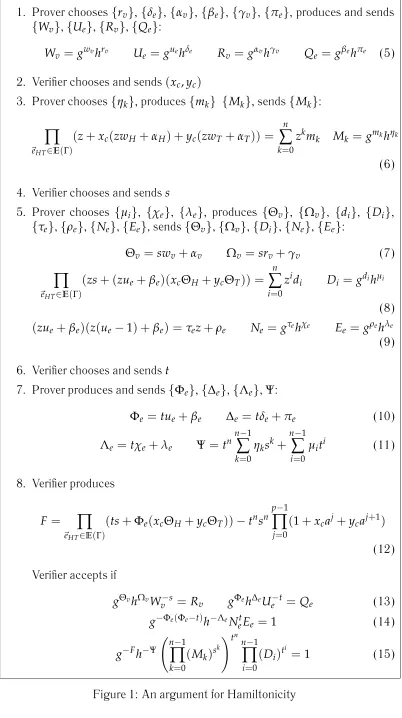
Common input is graphΓ, groupG, and group membersg,h. Auxiliary input of Prover is a sequence of graph vertices that is a cycle. Protocol is shown of Figure 1.
Lemma 2(Recognising Hamiltonicity). A Hamiltonian cycle exists in a graphΓ,|V(Γ)|= pfor some primep,p|q−1if, and only if labels wv,v ∈ Γcan be assigned with{aj}for somea ∈ Zq∗,ap = 1, a 6= 1 such that
∃(Γ′ ⊂Γ): f(x,y;Γ′)≡ p−1
∏
j=0(1+xaj+yaj+1) (4)
Proof. It is clear that labels wv = aj can be assigned to vertices along the sequence indexed withjfor any givenasuch that characteristic poly-nomial of the cycle will be of the form (4), in case a cycle exists. We show that any subgraph with characteristic polynomial (4) is a Hamiltonian cy-cle.
We observe that characteristic polynomial is a product ofplinear poly-nomials that are relatively prime to one another. It follows there are ex-actlypedges in such a graph, such that each edge connects a vertex la-belled withajand a vertex labelled withap+1. It follows that vertices and edges form a sequence.
We also observe there are exactly p different values of the form aj, j= 0 . . .p−1, such that the sequence never crosses itself.
Fromap= a0it follows that the last vertex in the sequence is the same
as the first one, such that sequence is a cycle.
Lemma 3 (Soundness). Probability for an honest Verifier to accept for any Prover and any graphΓwithout Hamiltonian cycle running protocol shown on Figure 1 is at most 4|E(Γ)|+q2|V(Γ)| over random choices of Verifier.
Proof. We show that Prover responses are estimates of polynomials that are linear in challenge, flags used are chosen from{0, 1}with probability at least1−2
q, and that fa(x,y)6≡0for
fa(x,y) =Ca(x,y)− f(x,y;Γ′)
with probability at most 2n+q2p.
Consider a Prover capable of producing responsesΘ′, Ω′ to a chal-lengessuch that
gΘ′hΩ′W−s= R, Θ′ 6=Θ, Ω′ 6=Ω
for
Θ=sw+α, Ω=sr+γ
W = gwhr, R= gαhγ
and for somew,r,α,γ ∈ Fq. It follows such a Prover is also capable of taking a logarithm using his responses as follows:
logh(g) =−Ω ′−Ω
Θ′−Θ
We consider it infeasible for a polynomial Prover to produce valid re-sponsesΘ,Ωother than estimates of polynomials that are linear both in challenge of Verifier and in value committed.
Consider a Prover capable of producing responsesΦ,∆to a challenge tsuch that
g−Φ(Φ−t)h−∆NtE=1
for
Φ=tu+β
∆=tδ+π
N =gτhχ, E=gρhλ
for some u 6∈ {0, 1} and for some δ,β,π,τ,ρ,χ,λ ∈ Fq. It follows ft(z)6≡0for anyβ,τ,ρ:
From Schwartz-Zippel lemma it follows there is at most 2q probability to choose a root of ft(z)at random: ft(t) = 0. It also follows that such a Prover is capable of taking a logarithm in case ft(t) 6= 0 using his responses as follows:
logh(g) = ∆−χt−λ
ft(t)
We consider it infeasible for a polynomial Prover to produce valid re-sponsesΦ,∆ such that ft(t) 6= 0. It follows there is at most 2q proba-bility for an honest Verifier to accept at (14) for any Prover and for any flag u6∈ {0, 1}over random choices of challenget.
Consider a Prover capable of producing responses{Φe},{Θv},Ψ to challengesxc,yc,s,tsuch that
g−Fh−Ψ n−1
∏
k=0(Mk)sk
!tn
n−1
∏
i=0(Di)ti =1
for
F=
∏
~eHT∈E(Γ)(ts+Φe(xcΘH+ycΘT))−tnsn p−1
∏
j=0(1+xcaj+ycaj+1) Φe=tue+βe
Θv=swv+αv
and for some Ψ. From Lemma 2 it follows fa(x,y) 6≡ 0 for any sub-graph ofΓ. From Schwartz-Zippel lemma it follows there is at most 2qp probability to choose a root of fa(x,y)at random: fa(xc,yc) =0. In case
fa(xc,yc)6= 0it follows fs(z)6≡0for any{sk}:
fs(z) = fa(xc,yc)sn+
n−1
∑
k=0skmk
From Schwartz-Zippel lemma it follows there is at most nq probability to choose a root of fs(z)at random: fs(s) =0. In case fs(s)6=0it follows
fst(z)6≡0for any{di}:
fst(z) = fs(s)zn+
n−1
∑
i=0zidi
is capable of taking a logarithm in case fst(t)6=0using his responses as follows:
logh(g) = (fst(t))−1(Ψ−tn n−1
∑
k=0skηk− n−1
∑
i=0tiµi)
We consider it infeasible for a polynomial Prover to produce valid re-sponses{Φe},{Θv},Ψ such that fst(t) 6= 0. It follows there is at most
2n+2p
q probability for an honest Verifier to accept at (15) for any Prover and for any graph without Hamiltonian cycle over random choices of chal-lengesxc,yc,s,t.
We consider a Prover passing verification equations such thatft(t) =0 for any edge due to unlucky choice of challenge t, or fst(t) =0 (due to choice of challenges xc,yc,s,t) to win the game. This probability esti-mate is sufficient for our purposes; a better estiesti-mate may be developed by considering options and strategies available to Prover.
We conclude there is at most2qpprobability for such a Verifier to accept while choosing(xc,yc), nq while choosings, and 2qn+ nq while choosing t, unless Prover is capable of taking logarithms in the group used. This probability is exponentially small in group order bitsize.
Lemma 4(Of knowledge). Protocol shown on Figure 1 has an extrac-tor algorithm, and is of knowledge.
Extractor is based on rewinding procedure: make Prover respond to two different challenges without choosing another set of initial random coins. All labels and flags are produced with an algorithm developed for Schnorr protocol [Sch89].
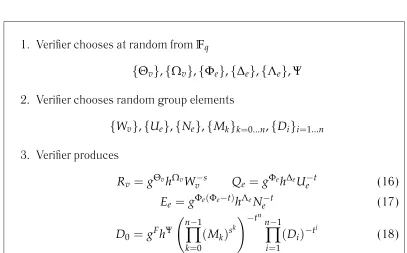
Lemma 5(Zero knowledge). Protocol shown on Figure 1 has a simu-lator algorithm, and is honest verifier zero knowledge.
Simulator algorithm is shown on Figure 2. Probability distribution for group elements{Rv},{Qe},{Ee},D0is flat due to{Ωv},{∆e},{Λe},Ψ chosen independently with flat distribution.
4
Discussion
References
[Blu86] Manuel Blum. How to prove a theorem so no one else can claim it. In International Congress of Mathematicians, pages 444–451, 1986.
[CF01] Ran Canetti and Marc Fischlin. Universally composable com-mitments. InCRYPTO, pages 19–40, 2001.
[Luc94] Stefan Lucks. How to exploit the intractability of exact tsp for cryptography. InFSE, pages 298–304, 1994.
[Luc95] Stefan Lucks. How traveling salespersons prove their identity. InIMA Conf., pages 142–149, 1995.
[MTZ01] Y. Minsky, A. Trachtenberg, and R. Zippel. Set reconciliation with nearly optimal communication complexity. In Interna-tional Symposium on Information Theory, page 232, 2001. http://citeseer.ist.psu.edu/minsky00set.html.
[Oka92] Tatsuaki Okamoto. Provably secure and practical identifi-cation schemes and corresponding signature schemes. In CRYPTO, pages 31–53, 1992.
[Sch80] J. T. Schwartz. Fast probabilistic algorithms for verification of polynomial identities. J. ACM, 27(4):701–717, 1980.
1. Prover chooses
{
rv}
,{
δe}
,{
αv}
,{
βe}
,{
γv}
,{
πe}
, produces and sends{
Wv}
,{
Ue}
,{
Rv}
,{
Qe}
:Wv
=
gwvhrv Ue=
guehδe Rv=
gαvhγv Qe=
gβehπe (5)2. Verifier chooses and sends
(
xc,yc)
3. Prover chooses
{
ηk}
, produces{
mk} {
Mk}
, sends{
Mk}
:∏
~eHT∈E(Γ)(
z+
xc(
zwH+
αH) +
yc(
zwT+
αT)) =
n∑
k=0zkmk Mk
=
gmkhηk(6)
4. Verifier chooses and sendss
5. Prover chooses
{
µi}
,{
χe}
,{
λe}
, produces{
Θv}
,{
Ωv}
,{
di}
,{
Di}
,{
τe}
,{
ρe}
,{
Ne}
,{
Ee}
, sends{
Θv}
,{
Ωv}
,{
Di}
,{
Ne}
,{
Ee}
:Θv
=
swv+
αv Ωv=
srv+
γv (7)∏
~eHT∈E(Γ)(
zs+ (
zue+
βe)(
xcΘH+
ycΘT)) =
n∑
i=0zidi Di
=
gdihµi(8)
(
zue+
βe)(
z(
ue−
1) +
βe) =
τez+
ρe Ne=
gτehχe Ee=
gρehλe (9)6. Verifier chooses and sendst
7. Prover produces and sends
{
Φe}
,{
∆e}
,{
Λe}
,Ψ:Φe
=
tue+
βe ∆e=
tδe+
πe (10)Λe
=
tχe+
λe Ψ=
tnn−1
∑
k=0ηksk
+
n−1∑
i=0µiti (11)
8. Verifier produces
F
=
∏
~eHT∈E(Γ)
(
ts+
Φe(
xcΘH+
ycΘT))
−
tnsn p−1∏
j=0(
1+
xcaj+
ycaj+1)
(12)
Verifier accepts if
gΘvhΩvW−s
v
=
Rv gΦeh∆eUe−t=
Qe (13)g−Φe(Φe−t)h−ΛeNt
eEe
=
1 (14)g−Fh−Ψ
n−1
∏
k=0(
Mk)
sk !tnn−1
∏
i=01. Verifier chooses at random fromFq
{
Θv}
,{
Ωv}
,{
Φe}
,{
∆e}
,{
Λe}
,Ψ2. Verifier chooses random group elements
{
Wv}
,{
Ue}
,{
Ne}
,{
Mk}
k=0...n,{
Di}
i=1...n3. Verifier produces
Rv
=
gΘvhΩvWv−s Qe=
gΦeh∆eUe−t (16)Ee
=
gΦe(Φe−t)hΛeNe−t (17)D0
=
gFhΨn−1
∏
k=0(
Mk)
sk !−tnn−1