TweLEX: A Tweaked Version of the LEX Stream
Cipher
Mainack Mondal?, Avik Chakraborti, Nilanjan Datta??, Debdeep Mukhopadhyay? ? ?
Abstract. LEXis a stream cipher proposed by Alex Biryukov. It was se-lected to phase 3 of the eSTREAM competition.LEXis based on the Ad-vanced Encryption Standard (AES) block cipher and uses a methodology calledLeak Extraction, proposed by Biryukov himself. However Dunkelman and Keller show that a key recovery attack exists againstLEX. Their attack requires 236.3
bytes of keystream produced by the same key and works with a time complexity of 2112
operations. In this work we exploreLEXfurther and have shown that under the assumption of a related key model we can obtain 24 secret state bytes with a time complexity of 296
and a data com-plexity of 254.3
. Subsequently, we introduce a tweaked version ofLEX, called TweLEX, which is shown to resist all known attacks againstLEX. Though the throughput ofTweLEX is half of LEX, it is still 1.25 times faster thanAES,
the underlying block cipher. This work attempts to revive the principle of
leak extractionas a simple and elegant method to design stream ciphers.
Keywords:Leak Extraction, Differential cryptanalysis, Tweak, Advanced Encryption Standard.
1
Introduction
LEXis a stream cipher designed by Alex Biryukov [1] using the round transforma-tions of the Advanced Encryption Standard (AES). The proposal was built on the concept ofleak extraction[1] and was based on the analysis of the diffusion of the transformations of AESto decide the extent of the leakand its frequency.LEXis a 128 bit key stream cipher, which is developed by extracting 32 bits from the state matrix of AESafter each round of the cipher. The property ofLEX, which makes it cryptanalytically different fromAESis that the attacker never sees the entire 128 bit ciphertext, but sees a portion of it. The design objective ofLEXwas to design a fast stream cipher, and indeed was faster thanAESin both hardware and software by 2.5 times.
LEXwas selected as a candidate for eSTREAM competition and was seriously considered till the third phase for its elegance in construction, faster operation speed and high security margin. Its simplicity in construction attracted cryptan-alytic efforts ([2] [3]) from several researchers. In response Biryukov submitted a tweaked version ofLEXto the second phase of the eSTREAM competition in 2007, which could counter these attacks. However in 2008, Dunkelman and Keller [4] proposed a key recovery attack ontweaked LEXwhich required 236.3 bytes of key-stream produced by the same key and had time complexity of 2112. This attack
removedLEXfrom the final portfolio of eSTREAM. In spite of the above attacks,
?MPI-SWS, Germany ([email protected])
it may be appreciated thatLEXis a stream cipher with high security margin while at the same time having an extremely simple design. The other selling point of LEXis that, the principle ofleak extractionmay be generalized to any block cipher, thus motivating deeper investigations of its strength.
The motivation of the present work is to modify LEX, so as to prevent all known attacks against the original cipher. In this work, we show further that under a related key model, 24 secret bytes can be recovered using an attack which has a time complexity of 296and a data complexity of 254.3. This work motivates
the tweaking of LEX into a modified cipher called TweLEX, to resist the original attacks by Dunkelman and Keller[4] and also other differential attacks. The work investigates the interesting idea of leak extractionfor constructing robust stream ciphers from block ciphers. Although TweLEX is slower than LEX, it is still 1.25 times faster than the block cipherAES.
Organization
The paper is organized as follows: In Section 2 we describe the background of this paper. In Section 3 we describe the differential trail identified in theAESkey schedule that we use to analyze LEX. Section 4 presents the related key based analysis to recover secret state bytes of LEX. The attack algorithm is analyzed for its data and time complexity in Section 5. The tweaked description of LEXis presented in Section 6, and we conclude this work in Section 7.
2
Preliminaries
2.1 Description of AES
The Advanced Encryption Standard (AES) is an 128 bit block cipher. It supports three key sizes, 128, 192 and 256. The construction ofLEXis based on the structure of AES. So we describe the structure of AESvery briefly.
AESconsiders a 128 bit plaintext as a byte matrix or state matrix of size 4×4. Here each byte represents an element ofGF(28). The state matrix undergoes 10
AESrounds of transformation for eachAESencryption. AnAESround consists of 4 operations applied to the state matrix in the following order :
– SubByte−An invertible non-linear transformation performed on each byte.
– ShiftRow (SR)−The bytes of the state matrix are permuted.
– MixColumn (MC)−Each column of the state matrix is multiplied by a con-stant 4×4 matrix.
– AddRoundKey (ARK) − The state matrix is xor-ed with a 128 bit round subkey.
For the ARK operation, 10 rounds anAESencryption requires a total of 10 subkeys. An extra subkey is also needed for‘key whitening’ step before the first round.AES derives these 11 subkeys from the original key using a key schedule algorithm [5].
2.2 Description of LEX
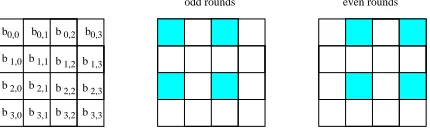
first phase or key initialization phase we choose a random stringIV and encrypt it using AES encryption. Let us call this encrypted IV S. In the key generation phaseSis encrypted using AES0 in the output feedback mode. During each round ofAES0 4 bytes from the state matrix areleaked as the output bytes of LEX. Thus for eachAES0 encryption we have 40 keystream bytes fromLEX. The bytes leaked
odd rounds even rounds
b b b b
b
b b b b
b b
b b
b
b b
0,0 0,1 0,2 0,3 1,0 1,1 1,2 1,3 2,0 2,1 2,2 2,3 3,0 3,1 3,2 3,3
Fig. 1.Output bytes in odd and even rounds ofLEX
in different rounds are shown in Figure 1by the colored squares. Therefore each encryption produces 40 bytes of key stream.
After 500 encryptions, anotherIVis chosen, and the process is repeated. After 232differentIVs the key is replaced. Hence under this restriction by a single secret
key we can get at most 500×232×40 bytes of key stream = 246.3bytes of keystream.
2.3 Notations
In the rest of this paperAESwill refer to the cipherAES0as described in Section 2.2. The bytes of any intermediate state matrixB, of anAESencryption are denoted by{Bi,j}
3
i,j=0. Let E and E0 be two AESencryptions. The secret key forE is K
and that forE0isK∗. Let an intermediate state matrix ofE(E0) beB(B0). Then the difference betweenB andB0 be denoted by∆B. The bytes of∆Bare denoted by{∆Bi,j}
3
i,j=0. Ther
thround key derived from a keyK is named asKrand its
bytes are
Kr
i,j
3
i,j=0.
In our analysis we have used two related keysKandK∗. The difference between bytes of rth round key derived from K and K∗ is
∆Kr
i,j
3
i,j=0. In this work SB(x) denotes the output difference for an input difference of xto the SubByte
operation. On the other hand SubByte(x) denotes the output byte value for an input byte value of xto the SubByte operation. Throughout this work we have used mathematical operations inGF(28). So the symbol ’+’ in this work refers to
the operation xor.
2.4 Properties of AESSubBytes operation
Throughout this work we use the following properties of AESSubBytes operation.
Property 1. Given every non-zero input and output difference pair for the Sub-Bytes operation, there are at most 4 input-output pairs which produce the given differences
Property 2. Given any non zero input(output) difference to the SubByte operation, there are a total of 127 output(input) differences possible.
As a result, given a non zero input difference β to the SubByte operation and a random non zero difference γ, probability of the event that γ can be obtained using SubByte operation on differenceβ= 127
255 ≈
1 2.
The analysis proposed in this work is based on a special differential trail in the key schedule of LEX. We describe the differential trail below.
3
Differential Trail in the Key Schedule of
LEX
Letαbe a 32-bit word. Letβ = SB(RotByte(α)). The operation RotByte and its use inAESis explained in [5]. Also αcan be expressed as [a, b, c, d]T. a, b, c, dare nonzero bytes. When we choose the key difference of the differential as
∆(Kr) = (α⊕β, β,0,0)
we can easily show that the next six 128-bit subkeys starting from Kr used in AES-128 have the following difference structure with probability 1:
(α⊕β, β,0,0)
(α⊕β, α, α, α)
(α,0, α,0) (α, α,0,0) (α,0,0,0)
(α, α, α, α)
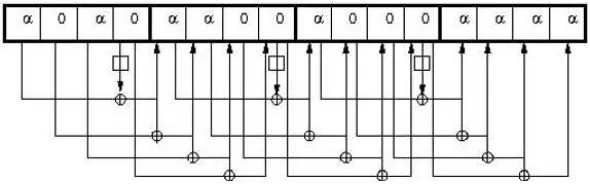
Here each row describes the differences between two subkeys for theAESrounds, starting with the original key difference. In this key schedule we observe that starting from the third subkey to sixth subkey we have no sbox computation involved. This differential trail from third subkey to sixth subkey is depicted in theFigure 2. The box denotes SubBytes operation and ⊕denotes xor.
Fig. 2.Differential trail in the key scheduling ofAES. The box denotes SubBytes operation and⊕denotes xor
In the coming sections while doing related key cryptanalysis on LEXwe shall use this key schedule extensively. Here one thing needs to be noticed. If∆(K) is
(α⊕β, β,0,0) then at third round we shall have ∆(K3
) as (α,0, α,0). Hence if we want to have∆(Kr) as (α,0, α,0) in an odd round we can just set ∆(K) as
This is indeed the trick applied to the coming sections. Hence whenever we talk aboutras an odd round, one can assume thatr= 3. In fact ifris any higher odd round the analysis of this paper have to use related-subkey cryptanalysis. This is more complex form of cryptanalysis and less practical compared to related-key based analysis.
So from this point we consider all the results provided in the later sections are based on related - keys and not on related - subkeys.
3.1 Special Differential Properties in the LEX State Matrices
In this analysis we have used two related keys K and K∗. The rth round keys generated fromKandK∗ have the difference (α,0, α,0). Hereαis a 32 bit word which can also be expressed as [a, b, c, d]T. Thus this difference pattern follows the differential trail shown in Section 3. Our cryptanalysis is successful in extracting secret state bytes when a special difference pattern appears just before the Ad-dRoundKey step of the rth round. We first describe how to find the difference pattern using the key streams.
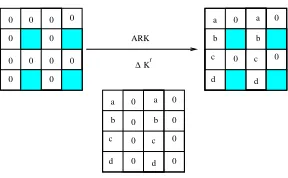
Consider twoAESencryptions generated by keysK and K∗. HereK and K∗ are related keys. Let us consider the event when the state matrices just before therthAddRoundKey operation in both encryptions will have zero differences in 12 specific byte positions. Mathematically, if the corresponding differential state matrix is denoted by ∆b, then {∆b0,0, ∆b0,1, ∆b0,2, ∆b0,3, ∆b1,0, ∆b1,2, ∆b2,0, ∆b2,1, ∆b2,2, ∆b2,3, ∆b3,0, ∆b3,2}= 0, and{∆b1,1, ∆b1,3, ∆b3,1, ∆b3,3}are non zero
values. This pattern is shown in Figure 3 along with the value of the differences after therth AddRoundkey operation.
0 0 0 0
0 0 0
0 a a b b c c
d d 0
0
0 0
0 0 0 0 0
0 0
0
0 0
0 a a b b c c
d d
0 ARK
Kr ∆
Fig. 3.The Special Difference Pattern
Next we compute the minimum number of key streams required to obtain such a difference pattern. Let the AES encryptions under the key K be sequenced as
E1, E2. . . En, and with the keyK∗be denoted asE10, E02. . . En0. The two colliding
AESencryption pairs are obtained from the two sequences and may be denoted as
Ei andEj0.
It can be shown that the optimal value ofnis 248 and hence to get a colliding
pair with high probability we need 248encryptions by the key
K. For each of them we have to consider 248 encryptions by the key
K∗. So there are a total of 296
pairs.
Now using a 32 bit condition on the key stream we shall reduce the number of pairs to be considered. LetEiandEj0 have a collision. If the state matrix afterrth round ofEi is denoted byB, then ∆B0,0, ∆B2,0, ∆B0,2, ∆B2,2 should bea, c, a, c
respectively. It is expected that out of 296 pairs only 264 pairs will satisfy this
condition.
Also if the state matrix after (r+ 1)th round of E
i is denoted by C, we can observe the differences∆C0,1, ∆C0,3, ∆C2,1, ∆C2,3for the remaining 264pairs from
the key stream. Using the propagation of difference pattern it can be shown that these values need to satisfy 4 non linear equations.
Using Property 2 of Section 2.4, the probability of satisfying all of these 4 equations is 2−4. So after checking this condition, out of 264 pairs only 260 pairs
need to be considered.
The algorithm presented in the next Section uses this difference pattern. Hence we have to repeat the analysis procedure explained in that Section for each of the 260
pairs to extract secret state bytes.
4
Algorithm to Recover Secret State Bytes
So far we have stated all the necessary properties required for our attack. In this Section using those properties we describe our algorithm which recovers certain state bytes of LEX. Our algorithm consists of two steps as presented below.
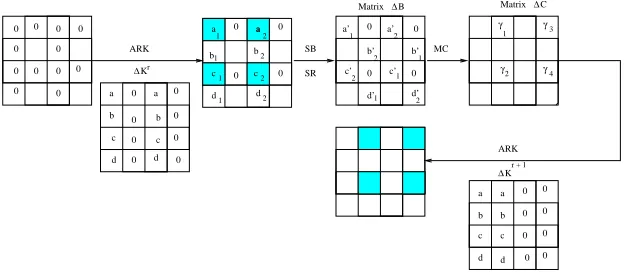
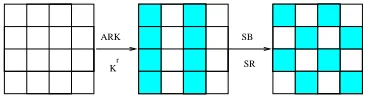
1. This step retrieves 8 bytes of the state matrix after round r. Let Ei andEj0 form a colliding encryption pair. Then the special difference shown inFigure 3 holds for this pair. Now we shall concentrate on the propagation of this special difference pattern through round (r+1). This propagation is shown inFigure 4. We shall explain the rest of this step using this Figure.
ARK
ARK Kr
r + 1
K SB SR MC 0 0 0 0 0 0 0 0 0 0 0 0 0 0 0 0 0 0 0 0 0 0 0 0 0 0 0 0 0 0 0 0 0 0 0 0 a a a a aa b b b b b a c c c c c c d d d d d d a’ a’ b’ b’ c’ c’ d’ d’ γ γ γ γ 1 1 b 1 1 1 1 1 1 1 2 2 2 2 2 2 2 2 4 3 2 ∆
Matrix ∆B Matrix ∆C
∆
We know the actual values of the colored bytes of Figure 4 from the key stream. The symbols written in the byte positions are corresponding differ-ences obtained for the pair Ei and Ej0. Let us first express the differences
a1, a2, b1, b2, c1, c2, d1, d2 in Figure 4 in terms of known differences a, b, c, d .
The difference of therthsubkeys forE
i andEj0 is known from the related key differential of Section 3 and shown inFigure 4. Observing the differences before and after xoring with round keyKrand using the linearity of ARK operation we immediately geta1 =a2 =a, b1 =b2 =b, c1 =c2 =c, d1 =d2 =d. In
Figure 4x0denotes output difference after SubByte operation applied to input differencex. Mathematically if xis a difference, x0 =SB(x) wherexcan be
a1, a2, b1, b2, c1, c2, d1 ord2.
Now we observe the differences between the key stream generated byEi and
E0
jafter (r+1)thround. From the related key differentials inLEX(Section 3) we know the subkey difference∆Kr+1as shown inFigure 4. Hence using the
lin-earity of ARK operation we can get the values of the differencesγ1, γ2, γ3, γ4in
Figure 4. Let us denote the state matrix after SR operation of (r+ 1)thround as B. C is the state matrix after applying MC operation to B. Then using the linearity of MC operation we can express each of ∆C0,1, ∆C2,1 as linear
combination ofb0
2, d01. Also ∆C0,3, ∆C2,3 can be expressed as linear
combina-tion ofb0
1, d02. Since∆C0,1, ∆C2,1, ∆C0,3, ∆C2,3 are nothing but known values γ1, γ2, γ3, γ4respectively hence we get 4 equations in 4 variablesb10, b02, d01, d02,
The attacker deducesb0
1, b02, d01, d02from these equations. By virtue of knowing
the differencesb, d we know b1, b2, d1, d2. Hence using Property 1 of Section
2.4, actual values of bytes corresponding to these four differencesb1, b2, d1, d2
can be retrieved by four table look ups. In this way we recover four bytes of the state matrix after therth round. Combined with the bytes we get from the key stream a total of eight bytes of the state matrix after therth round is known. The bytes of round (r+ 1) whose actual values are known after this step are shown inFigure 5by coloring them.
ARK
K
SB SR
r
Fig. 5.Known bytes after first step of algorithm
2. We recover some more bytes of another state matrix in this step. We continue with the colliding encryption pairEi andEj0 from step 1. Here we concentrate on the propagation of differences in therthround.Figure 6shows the differ-ences of different bytes in therth round. The bytes whose actual values are known to us from the key stream are colored. In this diagram, all ofc1, c2, c3, c4
are differences we can get directly from the key stream. We want to determine
xi,i= 1,2, . . . ,8. They are unknown differences.
Here G is the state matrix after SR operation of round r in the encryption
0 0 0 0 0 0 0 0 0 0 0 0 x x x x 5 6 7 8 0 0 0 0 x x x x 5 6 7 8 a a b b c c d d ARK
Kr −1
SB SR MC c c c c x x x x 1 1 2 2 3 3 4 4 0 0 0 0 a a b b c c d d 0 0 0 0 ARK Kr Matrix Matrix
Matrix ∆ ∆ ∆ G H A ∆ ∆
Fig. 6.Propagation of differences in roundr
with corresponding columns of∆H. In this way we can form 8 linear equations involvingxis,i= 1,2, ...,8.
We solve this system of linear equation and in particular focus on the values ofx1, x2, x3, x4 i. e the values of∆G1,1, ∆G1,3, ∆G3,1, ∆G3,3. Thus we get the
total 2nd and 4th column of∆G. Next we guess the actual values of the 2nd and 4th column of the matrixG. This takes a complexity of 232. Hence using
the MC operation we get the actual values of 2nd and 4th column of H too. Let the state matrix at the end ofrthround ofE
i is denoted byA. Using the values of x5, x6, x7, x8 combined with the known value of ∆Kr we know the
2nd and 4th column of ∆A. The bytes whose actual values are known after step 2 are shown inFigure 7by coloring them.
ARK Kr MC 0 0 0 0 0 0 0 0 0 0 0 0 0 0 0 0 a a b b c c d d x x x x x x x x 5 6 7 8 5 6 7 8 Matrix A Matrix H Matrix G c c c c x x x 1 2 3 4 1 2 3 x 4
Fig. 7.Known bytes after second step of the algorithm
5
Analysis of the algorithm
5.1 Complexity Analysis
The algorithm depends on finding the special difference pattern mentioned in Section 3.1. We also state in the same section that we need a minimum of 248
encryptions under each of the key K and K∗. Hence the total number of key stream bytes required is≈254.3. This is the data complexity of the algorithm.
Step 1 of the algorithm has a complexity of 24on average. The second step has
key suggestions. Thus the 2 steps of the attack procedure have a total complexity of 236. We have to repeat this procedure for 260 pairs as explained in Section 3.1.
Hence the time complexity of the algorithm is 296.
5.2 Efficiency of the Algorithm
In this Section we show that the algorithm retrieves the intermediate state bytes more efficiently than brute force search.
We can see fromFigure 7we have recovered 8 bytes of matrixH and 8 bytes of matrixA. These 8 bytes of matrixAalso include 4 bytes given by the key stream. Hence we have recovered total 12 secret state bytes of matrixH andA.
A careful look at the algorithm reveals that we have retrieved not only secret bytes of matrixAand matrixH for the encryptionEibut also the corresponding secret bytes ofE0
j. So we have retrieved 24 bytes of secret data with a cost of 2
96.
This is much lesser than an exhaustive search for these 24 bytes which should cost 2192.
In the following Section we present a tweaked version ofLEXwhich is resistant against all the attacks mentioned so far in this paper.
6
Proposal of the tweaked version of
LEX
:
TweLEX
In this Section we propose a modification of LEXwhich provides resistance against existing attacks on LEX. We also argue that this simple modification provides protection against any kind of differential attack onLEX.
6.1 Modification of LEX
We have seen that the most important part of the design of LEXis wherefrom a designer should output the bytes. Let after an odd round the state matrix isM
and in the next round, which is essentially an even round the state matrix isN. Then in the basic design the output bytes for those two consecutive rounds would have been M0,0, M0,2, M2,0, M2,2, N0,1, N0,3, N2,1, N2,3. In the tweaked
ver-sion ofLEXwe shall output (M0,0⊕N0,1),(M0,2⊕N0,3),(M2,0⊕N2,1),(M2,2⊕N2,3). We call the resulting stream cipher TweLEX. It is advisable to change the secret key of the cipher at least every 232 IV set ups, and to change the IV after every T = 1000 iterations to prevent algebraic attacks.
We output 4 bytes after every twoAESround. This indeed halves the through-put of LEX but it provides better security than the actual LEX. We shall now provide some argument in order to justify the design.
6.2 Security Analysis of TweLEX
Protection Against the Key Recovery attack by Dunkelman: The attack in [4] relies on finding the event that the difference between two state matrices is zero at 8 specific bytes. The probability of this event is 2−64.
They have used a 32 bit filter on the output key stream of LEX. This filter effectively reduces the complexity of their algorithm by a factor of 232. InTweLEX
the adversary does not directly know the values of state bytes. Hence he could not use the 32 bit filter and the complexity of attack will become 2112×232 = 2144.
This is worse than a brute force attack.
Protection Against the state byte recovery attack proposed in this work:
In this work we have used filters on the key stream of LEXto find out a differential pattern. Hence using a argument similar to previous paragraph we can show that our attack is ineffective agaisntTweLEX.
Protection Against other Differential Attacks: A close look on all the dif-ferential attacks on AESor LEX which relies on differential propagation through rounds reveals a similarity. All of them use the Property 1 of Section 2.4. They try to locate input-output difference pairs for theAESS-box and using a table look up retrieve corresponding actual input-output byte values.
Let us use this strategy for TweLEX. We assume that we have two or more key streams generated by TweLEX. By construction the key stream will be xor of certain state bytes. Using some differential propagation on the differences of two key streams one can retrieve some output differences forAESs-box for certain bytes of the state matrix. Then it can be shown that, using Property 1 of Section 2.4, it is not possible to retrieve the state bytes with a complexity better than brute force search. Hence this is apparent that any strategy that uses the Property 1 of Section 2.4 will fail against this modified version of LEX.
7
Conclusion
In this paper we have revisited the stream cipherLEXand have presented a related key cryptanalysis for the cipher. Consequently we proposedTweLEX, a modification of LEX which prevents the existing attacks on LEX. Although the throughput of TweLEXis half of LEXit provides a good optimization between speed and security and attempts to show thatleak extractionas an elegant method to design stream ciphers.
References
1. Alex Biryukov, “A New 128-bit Key Stream Cipher LEX,” Ecrypt Stream Cipher Project Report, 2005/013, 2005, http://ecrypt.eu.org/stream.
2. H. Wu and B. Preneel, “Attacking the IV setup of the stream cipher LEX,” Ecrypt Stream Cipher Project Report, 2005/059, 2005, http://ecrypt.eu.org/stream. 3. H˚akan Englund, Martin Hell and Thomas Johansson, “A Note on Distinguishing
attacks,” in Preproceedings of State of the Art of Stream Ciphers workshop (SASC
2007), 2007, pp. 73–78.
4. Orr Dunkelman and Nathan Keller, “A new attack on the lex stream cipher,” in
ASIACRYPT, 2008, pp. 539–556.