288
Hash Dynamic Data
Allocate
in Cloud Using
Cloud Intrusion
Detection Service
1
Gongati Mahesh ,
2Borra Subba Reddy
1
M.Tech Student ,
2Associate Professor
DEPARTMENT OF CSE
Dr.Samuel George Institute of Technology, Markapur, AP.
Abstract: : Cloud computing would be one of technologies which is going to play a vital role in the next
generation of computer engineering field. Stored information and encryption keys are usually managed by the cloud provider. It is important to put cryptographically access control on the data we share through
cloud. Identity based encryption builds a practical data sharing system. We propose a proxy re encryption technique which performs a two level encryption before storing the actual data into the cloud. We have
used AES technique to encrypt data as well as decrypt data this paper also introduce the Cloud Intrusion
Detection Service (CIDS) which detect the different attack and fire the alert to other cloud user. Identity
Based Encryption (IBE) simplifies public key management and certificate management at Public Key Infrastructure (PKI) with help of Private Key Generator. To ensure the security of data we proposed a method by implementing RSA algorithm. The trusted authority module receives encrypted file using AES
Algorithm from the data owner and computes hash value using MD-5 algorithm. It stores key in its
database which will be used during the dynamic operations and to determine the cheating party in the
system (CSP or Owner). Finally we extend the proposed IBE scheme to present a CRA-aided authentication scheme with no period-limited privileges for managing a large number of various cloud
services.
Index Terms: ID-PKS, Cryptography, CRA, Ciphertext, Encryption, Attribute-based signatures,
Attribute-based encryption, proxy server, encryption, privacy,
1. INTRODUCTION
Cloud computing is a type of Internet-based computing. Most of the time data will be shared
using cloud computing. Cloud is a big area to access any type of data and information. [1]. The
Identity Based Encryption technique provides
both the forward and backward security which was absent in the previous techniques that were
implemented [2]. . It provides the most modern
security protocols. Conventionally,
data and information transmitted over the
network [3]. There are various algorithms
available for the security services like
authentication of user/data, confidentiality of
data, data integrity [4]. The large utilization of
sensors, mobility, and geographic distribution
lead to issues of data volume, velocity, and
variation, along with requirements for accuracy,
security, Quality of Service (QoS) user
expectations, and operational costs [5]. In this
paper proposes encryption technique to
providing extra-large security in cloud
computing. Key is used to encrypt any type of
data. Key function provide random key to data
provider and number of user [6]. Data Provider
is nothing but the server and data provider is
responsible for the upload the data or files to
storage sever. Number of user access the
uploaded data of files or download the files
using the key as well as opt code [7]. To be
effective, cloud data security depends on more
than simply applying appropriate data security
procedures and countermeasures [8]. There is trusted third party called the Private Key
Generator (PKG), who generates the corresponding private keys. For encryption and
decryption operations, PKG first publishes a master public key, and then generate the
corresponding master private key. Using this master public key, any user can generate a public key corresponding to the identity by
combining the master public key with the identity value [9].
Fig. 1: Storage identity-based encryption
2. RELATED WORK
A Identity-Based Encryption (IBE) is an
interesting alternative to public key encryption, which simplify key management in a
certificate-based Public Key Infrastructure (PKI) with use of human-intelligible identities as a public keys.
Franklin propose a fully functional identity-based encryption scheme (IBE). [10]. The
defense strategy should is flexible architecture to
be applied to several cloud architecture and to
Integrate both behavior and knowledge based
techniques scheme propose the deployment of
IDS on each layer of the Cloud to gather and
correlate the alerts from different sensors [11].
Later proposed a authenticated key agreement
scheme by applying chaotic map-based
cryptography to solve these problems. This
scheme realizes the protection of hospital data
transmitted in the open channel and provides
confidential protection during the remote
diagnosing process allowing the patient to enjoy
290 TMIS [12]. The Health IoT enabled framework
collects ECG data from smart phones and other
sensors. Later send the collected to the cloud so
that Doctors can access and assess the data
seamlessly [13]. Cloud-based data analytics is
used to detect the abnormality and error of the
health data. Normally forward secrecy backward
secrecy provided for security [14]. In this mechanism the private key has two components,
the initially generated secret key is fixed and the time update key is updated frequently for
non-revoked users. Thus the non-non-revoked users can directly decrypts the data stored in cloud while
PKG stops issuing private keys for revoked users [15].
Fig.2. Data Sharing System Using RIBE
3. SYSTEM ARCHITECTURE
It is treated as a public cloud which will be run by another party to provide the capability of
computing to PKG for regulating the network by using the services. The KU-CSP is given away
from the users or the PKG, this PKG helps to reduce the storage cost and estimation of the users only by giving the flexibility and also the
temporary extension to the user infrastructure
[16]. If key will be match then user is authorized
to download the data. Else it cannot the file.
After matching of key again OTP will be send to
user for extra security. User can write the OTP
within time period Assurances should be
provided to the clients and proper practices and
privacy policies and procedures should be in
place to assure the cloud users of the data safety
[17]. It contains many informative details but
here we only visualize it as a service provider, and concentrate on the way of designing it for the purpose of securing the users data with an
unreliability KU-CSP. Further it consists of
three requirements for such model the requirements.
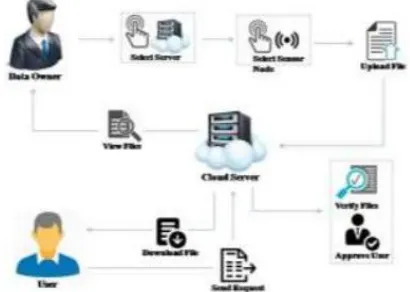
Figure-3: System Architecture
A hash is a random-looking string of characters that individually identifies the data in question, just as it identifies your fingerprint. You can
copy any data, either a file or just a string . Find the hash when you are running data using a hash
generator. Whenever you have the same data, you will get the exact same hash value as a
result [18]. Network admin maintains the Privacy table which contains unique encryption
key for all the patients. RSA is a block cipher in
which every message is mapped to an integer
[19]. RSA consists of Public-Key and
Private-Key. In our Cloud environment, Pubic-Key is
known to all, whereas Private-Key is known
only to the user who originally owns the data
[20]. We propose a secure data sharing scheme
which can be protected from collusion attack.
The revoked users can not be able to get the
original data files once they are revoked even if
they conspire with the entrusted cloud [21].
Fig. 4 Privacy preservation in Health care
system
A. Homomorphism Scheme
Cryptographic techniques provide protection for
data and information transmitted over the
network. There are various algorithms available
for the security services like authentication of
user/data, confidentiality of data, data integrity.
Modern cryptography includes the disciplines of
mathematics as well as computer sciences and
engineering [22]. A cryptosystem performs a
pair of transformations called encrypting and
decrypting. Encryption means encoding the data
so that it cannot be intercepted by anyone except
the one who is intended receiver after
transforming back to plaintext [23].
1. Key Generation (λ)
• Input: Security parameter λ
• Output: A tuple (Si , Pi) consisting of
the secret key Si and public key Pi .
2. Encryption (Pi , Pt)
• Input: A public key Pi and a plaintext
Pt
• Output: cipher text Ct
3. Decryption (Si , Ct)
• Input: a secret key Si and a cipher text
Ct
• Output: the corresponding plaintext
Pi
4. Evaluation (Pi , C, Ct)
• Input: a public key Pi a circuit C with
x inputs and a set Pt of x
ciphertext,Pt1,Pt2,Pt3,..,.Pt x
292
5. HEALTHCARE SOLUTION
STRUCTURE
We discuss a general structure of the
Cloud-based IoT-Healthcare solutions. Later a
Fog-based IoT-Healthcare solution structure in
proposed which can be interoperable with the
Cloud-based solutions Cloud-based
IoT-Healthcare usually comprised of several entities
IoT sensors wearable devices [24]. In
Healthcare solution, hand held or body
connected devices for example; pulse dosimeter
ECG monitor smart watches perceive health
context of the users. Resource manager is
responsible for coordinating the Cloud resources
while dealing with IoT enabled Healthcare data
[25]. In Cloud-based Healthcare system, two
types of Servers are used predominantly
Application Server and Database Server. In
Application Server the backend applications
web-services are hosted whereas Database
Server solely handles the data repository and
associate operations [26].
Figure 5: Cloud-based Healthcare System
Architecture
A. RSA Algorithm:
RSA is a block cipher, in which every message
is mapped to an integer. RSA consists of
Public-Key and Private-Public-Key. In our Cloud environment,
Pubic-Key is known to all, whereas Private-Key
is known only to the user who originally owns
the data [27]. Thus, encryption is done by the
Cloud service provider and decryption is done
by the Cloud user or consumer. Once the data is
encrypted with the Public-Key, it can be
decrypted with the corresponding Private-Key
only [28].
The data is encrypted, Key generation should be
done. This process is done between the Cloud
service provider and the user
1. Choose two distinct prime numbers a and b.
For security purposes, the integers a and b
should be chosen at random and should be of
similar bit length.
2. Compute n = a * b.
3. Compute Euler’s toting function, Ø(n) = (a-1)
* (b-1).
4. Chose an integer e, such that 1 < e < Ø(n)
and greatest common divisor of e , Ø(n) is 1.
Now e is released as Public-Key exponent.
5. Now determine d as follows: d = e-1(mod
Ø(n)) i.e., d is multiplication inverse of e mod
6. d is kept as Private-Key component, so that d
* e = 1 mod Ø(n).
7. The Public-Key consists of modulus n and the
public exponent e (e, n).
8. The Private-Key consists of modulus n and
the private exponent d, which must be kept
secret (d, n).
User data is encrypted first and then it is stored
in the Cloud. When required, user places a
request for the data for the Cloud provider,
Cloud provider authenticates the user and
delivers the data.
B. AES Algorithm
Algorithm finds the Proxy Re-Encryption: A
PRE scheme is represented a topple of
polynomial time algorithms (KG; RG; E; R; D).
(KG; E; D) are the standard key generation,
encryption, and decryption algorithms [29].
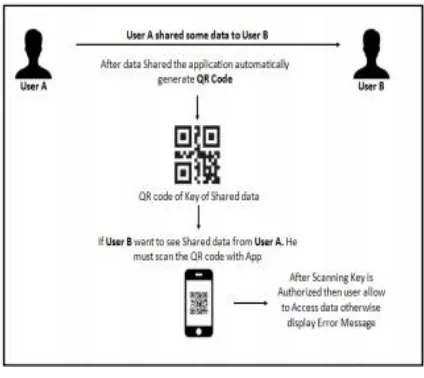
Fig. 6. Data transferring by using QR code scanning.
Step 1: Choose two distinct prime numbers p
and q.
Step 2: Find n such that n = pq. n will be used as
the modulus for both the public and private keys.
Step 3: Find the toting of n, ϕ(n)
ϕ(n)=(p-1)(q-1).
Step 4: Choose an e such that 1 < e
In other words pick d such that de - 1 can be
evenly divided by (p-1)(q-1), the totient, or ϕ(n).
This is often computed using the Extended
Euclidean Algorithm, since e and ϕ(n) are
relatively prime and d is to be the modular
multiplicative inverse of e. d is kept as the
private key exponent Another research direction
would be to give the data owner physical access
control over the data [30]. Instead of
accountability the data owner can create a set of
access control rules on his data and send the data
along with the access control policy.
6. PERFORMANCE ANALYSIS
We present the Module description, how it works, practical results and environment.
Pseudonym Generation: We generate pseudonym for each user..In Triple Data
Encryption algorithm, use 192 bits key size. The major challenge in cloud is security of data. So
294
forward and backward secrecy but this results in reducing computation costs and increasing complexity.
RSA uses 1024-bit keys but its not secure and it
works only if it is correctly implemented and
good key management is employed. Hackers
will find it difficult to decrypt such encrypted
data. Hence papillae cryptosystem is proved to
be a stronger mechanism.
Figure 7: Comparing RSA, Elgamal and Paillier
Encryption Time
7. CONCLUSIONS AND FUTURE
WORK
Focusing on issue of identity revocation, we
have introduced outsourcing computation into IBE and proposed a revocable scheme in which
the revocation operations are delegated to CSP.
Doctors are provided with highly secured and
efficient storage of hospital data hence patient
data are accessed securely. This method can
solve the issue of protecting patient private
information against unauthorized viewers and
provide high level of protection. Cloud file sharing also was known as the cloud-based file
sharing or online file sharing is a system in which user is allocated storage space on a file
server which carries read and writes options on the file server. We have used RS-IBE and AES
algorithm to revoke as well as encryption,
re-encryption and decryption. We have given time
period to users for downloading data. Certificate
Authorities and secure communication channels.
The increased need of allocating the data over the Internet is acquired by the Cloud. Cloud
computing has brought vast comfort for the society and the individuals.
8. REFERENCES
[1] L. M. Vaquero, L. Rodero-Merino, J. Caceres, and M. Lindner, “A break in the clouds: towards a cloud definition,” ACM
SIGCOMM Computer Communication Review,
vol. 39, no. 1, pp. 50–55, 2008
[2] Wei, Jianghong, Wenfen Liu, and Xuexian
Hu. "Secure Data Sharing in Cloud Computing Using Revocable-Storage IdentityBased
Encryption."
[3] Huang, Jyun-Yao, I-En Liao, and Chen-Kang
Chiang. "Efficient identity-based key management for configurable hierarchical cloud
Distributed Systems (ICPADS), 2011 IEEE 17th International Conference on. IEEE, 2011.
[4] Qiu, Shuo, et al. "Identity-Based Private
Matching over Outsourced Encrypted Datasets."
[5] Tseng, Yuh-Min, et al. "Identity-Based
Encryption with Cloud Revocation Authority and Its Applications."
[6] Wang, Cong, et al. "Secure ranked keyword search over encrypted cloud data." Distributed
Computing Systems (ICDCS), 2010 IEEE 30th International Conference on. IEEE, 2010.
[7] Wang, Cong, et al. "Privacy-assured outsourcing of image reconstruction service in
cloud." Emerging Topics in Computing, IEEE Transactions on 1.1 (2013): 166-177.
[8] Li, Jingwei, et al. "Outsourcing encryption of attribute-based encryption with mapreduce." Information and Communications Security.
Springer Berlin Heidelberg, 2012. 191-201
[9] Prof. Jagruti Dange,Sheetal
Y.Gaykwad,Gauri K.Khule,Linakshi N.Ahire,Mansi S. Bodhai,”Advanced Secure
Data Sharing In Cloud Computing using Revocable Storage Identity Based Encryption”,Vol.4,ISSUE 4,APR-2017.
[10] Shashikumar,Puneeth Hegade,Siddarth Gopinath, Zabiulla, Mrs.Sridevi K N,”Secur data
sharing in Cloud Computing Using Revocable
Data Using CP-ABE Techniques”,Issue 05,Vol.4,2017.
[11] Prof. Hitesh Patel, Prof. Parin Patel, Prof Kiran Patel,” Achieving Data Integrity in Cloud
Storage Using BLAKE Hash Function”, IJEDR |
Volume 2, Issue 2 | ISSN: 2321-9939,2014.
[12] Sheena Sathyan, Shaji R S Professor”, a
hybrid approach for the secure transmission of h.264/avc video streams”,Vol.4,2015
[13]. Girishma, V., & Satyanarayana, K. V. V.
(2016). Securing data stored in clouds using multi keys and proxy injection schemes. Journal
of Theoretical and Applied Information Technology, 88(3), 553-557. Retrieved from
www.scopus.com.
[14]. Paruchuri, V. L., Anantha, N. L., Konagala, V. L., & Bhattacharyya, D. (2016).
Ciphertext-policy attribute-based encryption for access control of data in cloud. International
Journal of Software Engineering and its Applications, 10(8), 13-22.
doi:10.14257/ijseia.2016.10.8.02.
[15]. Ramya, K. R., Malleswari, D. N., Rani, C.
R., Bhattacharyya, D., & Kim, H. -. (2016). Key aggregate based homomorphic encryption for
296
Application, 9(11), 137-148. doi:10.14257/ijdta.2016.9.11.13.
[16]. Vurukonda, N., & Thirumala Rao, B.
(2017). Secure sharing of outsourced data in cloud computing with comparison of different
attribute based encryption schemes: A review. Journal of Advanced Research in Dynamical and
Control Systems, 9(Special Issue 14), 680-698. Retrieved from
[17] R Canetti, B Riva, & GN Rothblum. (2011). Two 1-round protocols for delegation of
computation. Cryptology ePrint Archive, Report 2011/518.
[18] U Feige, & J Kilian. (1997). Making games short. Proceedings of the 29th annual ACM Symp. on Theory of Computing. New York:
ACM. pp. 506–516.
[19] S Hohenberger, & A Lysyanskaya. (2005).
How to securely outsource cryptographic computations. Proceedings of the 2nd Inter.
Conf. on Theory of Cryptography. Berlin: SpringerVerlag. pp. 264–282.
[20] R Canetti, B Riva, & G Rothblum. (2012). Two protocols for delegation of computation.
Information Theoretic Security (LNCS). Berlin: Springer. Vol. 7412, pp. 37–61.
[21] X Chen, J Li, J Ma, Q Tang, & W Lou. (2012). New and secure outsourcing algorithms
of modular exponentiations. 17th European Symp. on Research in Computer Security, 2012.
[22] MJ Atallah, & KB Frikken. (). Securely
outsourcing linear algebra computations. Proceedings of the 5th ACM Symp. on
Information, Computer and Communications Security. New York: ACM. pp. 48–59
[23] Secure Data Sharing in Cloud Computing Using Revocable -Storage Identity-Based
Encryption Jianghong Wei, Wenfen Liu, Xuexian Hu IJSDR1706010 International
Journal Of Scientific Development and Research(IJSDR)
[24] Advance Secure Data Sharing in Cloud computing using Revocable Storage Identity-Based Encryption, International Journal for
Research in Emerging Science and Technology,
VOLUME-4, ISSUE-4, APR-2017 EISSN: 2349-7610.
[25] Survey: Identity-Based Encryption in Cloud
Computing, International Journal of Science and Research(IJSR) ISSN(Online):2319-7064 Index
Copernicus Value (2013) :6.14|Impact Factor(2014): 5.611
[26] Identity Based Encryption and Data Self Destruction in Cloud Computing International
[27] Authentic Data Sharing by Using Revocable-Storage Identity Based Encryption in Cloud Computing International Journal of Cloud
computing International Journal of Advanced Research Trends in Engineering and Technology
(IJARTET) vol.4 special. issue 24 August. 2017.
[28] Data sharing in cloud computing using
(RS-IBE) Revocable Storage Identity based encryption method IJARIIE-ISSN
(O)-2395-4396 vol-2 Issue-5, 2017.
[29] Secure data sharing in cloud computing
using Revocable Storage identity-based encryption. IEEE Transactions cloud computing
(Volume:4, Issue 99 March 2016)
[30] Securing Cloud Services Using Revocable Identity Based Encryption JETIR
(ISSN-2349-5162) March 2017, Volume 4, Issue 03.
AUTHORS DETAILS
Gongati Mahesh ,
Dr.Samuel George Institute of Technology,
Markapur,AP
Mail id:[email protected]
Borra Subba Reddy,
Associate Professor in CSE , Dr.Samuel George
Institute of Technology, Markapur, AP.