© 2015, IJCSMC All Rights Reserved
6
Available Online atwww.ijcsmc.comInternational Journal of Computer Science and Mobile Computing
A Monthly Journal of Computer Science and Information Technology
ISSN 2320–088X
IJCSMC, Vol. 4, Issue. 6, June 2015, pg.6 – 11
RESEARCH ARTICLE
Improving Accuracy in Brain Computer
Interface using P300 Potential
Ruchika A. Wasu
1, Prof. Deepak Kapgate
21 Department of Computer Science & Engineering, G.H.R.A.E.T, Nagpur University, India
2 Department of Computer Science & Engineering, G.H.R.A.E.T, Nagpur University, India
1 [email protected]; 2 [email protected]
Abstract— In this paper we discuss development of the system for improving accuracy in P300 using
electroencephalogram (EEG) signals. The main idea is to capture the signals from the brain for P300 BCI and after
processing signals desired output can get with higher accuracy. The accuracy is to be increased using efficient
filtering and classification algorithms such as Linear Discriminant Algorithm (LDA) and special filters. This study
introduces a technique for classifying different frequencies separately so that accuracy is high. Information transfer
rate can be improved using accuracy. The focus of this paper is proposing the development of framework that can
capture the EEG signals classify them in the P300 signals. The x-Dawn filtering technique is used in this system. We
are using a P300 speller so that we can check our accuracy and running of the system. P300 speller is useful for
disable person who cannot type in the computer system.
Keywords— Brain Computer Interface (BCI), Electroencephalogram (EEG), P300, x-Dawn, accuracy
I. INTRODUCTION
© 2015, IJCSMC All Rights Reserved
7
According to the type of signals, BCI can be classified into two approaches first one is exogenous BCI and another one is endogenous BCI. Endogenous BCI system consist those based on sensorimotor rhythms and slow cortical potentials (SCPs) which requires a period of intensive training. Exogenous BCI system uses the brain signals are P300 evoked related potentials and Steady State Visual Evoked Potential (SSVEP) which does not require any intensive training. This system based on the electro physical activity.
P300 based BCI system-Among all the ERPs, P300 wave component evoked in the process of decision making. The P300 potential is a positive amplitude peak which appears on the EEG about 250-500 ms after an in frequent visual and auditory stimulus. Generally it is obtained when an occasional target stimulus is found by the user among several non-target stimuli, which is called as “oddball paradigm”.
P300 based BCIs gives a very low rate of information transmission because the classifier based on an average is very simple and the accuracy of P300 potential found is too low. Subsequently, so many trials are required to select only single symbol in the given matrix. Accuracy of the P300 based BCIs can be improved, while using more difficult classifier than a simple average to ensure that the several repetition remain unaffected. Performance reduces when matrix with smaller symbols are used, instead of grey and black one [23].
Accuracy provided by existing P300-based BCI system can be improved by developing effective framework for generation of P300 potentials. In this paper it shows that higher accuracy can be achieved with the P300 based BCI system.
Open vibe is software which is used for processing the real time brain signals. It includes the designer tool for making, modify and run various custom applications. The main use of the open vibe software is to interface between the EEG signal which are captured by device and a computer system. This software the processed the captured signals and proceed further by running various modules like signal monitoring, acquisition, training, classification and the final result application.
II. PROPOSED SYSTEM
In this project we describe the techniques used for improving accuracy in BCI using P300 speller. The project is developed in open vibe software. The experimental setup was the following: Participants were seated in front of the system i.e. computer screen which presenting the 6 6 matrix and concentrate over there.
Our Proposed methodology consists of four steps: - (1) Signal Monitoring, (2) Acquisition, (3) Training x-DAWN, (4) Training classifier, (5) online testing
2.1 SIGNAL MONITORING
In this scenario we check the quality of signals before performing an experiment. We should compulsorily check the quality of the signals and ensures that:
- Eye blinks are visible
- Jaw clenching are visible
© 2015, IJCSMC All Rights Reserved
8
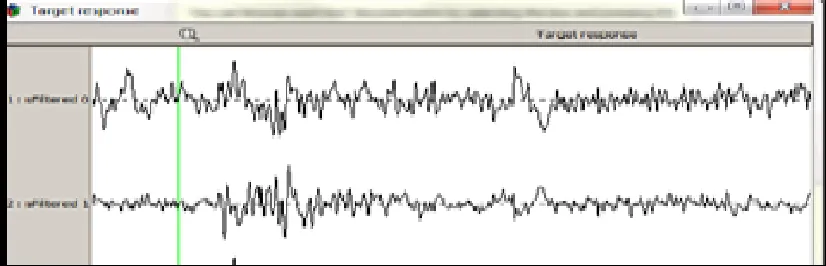
Fig 1- Target Response2.2 ACQUISITION
In this scenario, it can be used as a first step to collect some training data. Those data will later be used to train a spatial filter and a LDA classifier which will detect the P300 brain waves for online use. Then the user is instructed to concentrate on a particular letter (shown in blue box). After 12 flashes (24 flashes of each letter i.e. 12 for row and 12 for column) we move forward to another letter. This step repeated 10 times.
Fig 2- Instructing letter in blue Fig 3- Flashing row after instructing letter
2.3 TRAINING X-DAWN
© 2015, IJCSMC All Rights Reserved
9
2.4 TRAINING CLASSIFIER
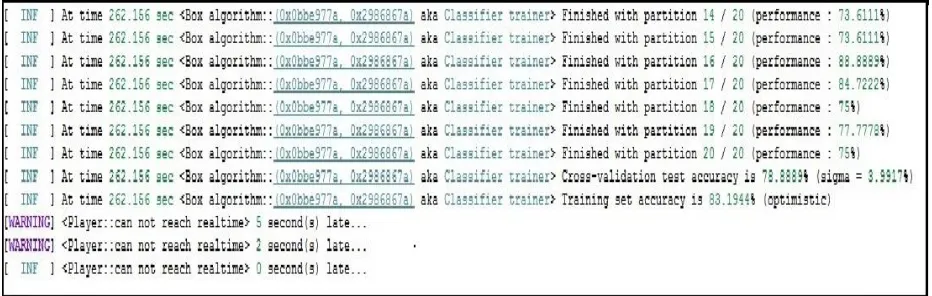
This scenario should be used to train the LDA classifier. It is simple classifiers that provide allowable accuracy without high computation requirements. LDA is common, easy and a good choice for designing online BCI system. In P300 speller it provides improved accuracy. Just configure the generic stream reader box to point to the last file you recorded with scenario acquisition and fast forward this scenario. At the end of the training, you will have an estimation of the classifier performance printed in the console.
2.5 ONLINE TESTING
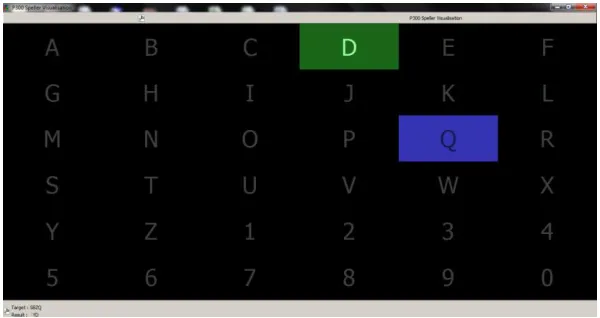
This scenario can be used online once the spatial filter and the classifiers are trained. The target letter generation box still proposes some targets in order to train eventually train the spatial filter/classifier again. You will then be presented a letter in a blue that you have to focus on followed by a 12 times flashing sequence of the whole grid. At the time of flickering, brain waves generate various frequencies which transfer from the EEG signal to the system. After filtering and classifying that signals the obtaining frequency generated the result will be presented a letter in green which is shown in result. This will be repeated 10 times.
Fig4- Target and result letter shown in blue and green respectively
2.6 REPLAY
After performing all methods, in this scenario it generates the final result which was show in the green block whatever we got in the previous modules without showing the target letters.
© 2015, IJCSMC All Rights Reserved
10
III. RESULT
After performing many trials all the procedure successfully, we get the improved accuracy in BCI by using P300 speller near about 80% to 90%.
Fig 6- Improved accuracy shown after performing all modules
IV. CONCLUSION
Among all the BCI systems like SSVEPs and many more P300 BCI is very popular and famous. There are various P300 based BCI applications which is used by locked-in patients (paralyzed patients). There are various techniques to improve accuracy and flexibility of P300 based BCI, but we use the new technique to increase the efficiency of the system. The drawback of existing P300 based BCI system provide a very low rate of information transmission and low accuracy. Due to continuous flickering of light sources it is difficult for user to concentrate and also leads to fatigue. In this project we overcome this problem by improving accuracy in the brain computer interface system with P300 potentials.
REFERENCES
[1] Abootalebi, V.; Moradi, M. H. & Khalilzadeh, M. A. (2009). A new approach for EEG features extraction in P300-based lie Detection. Computer methods and programs in biomedicine, pp. 48– 57, 2009.
[2] Bi, L.; Fan, X. A.; Luo, N.; Jie, K.; Li, Y. & Liu, Y. (2013). A Head up display based P300 Brain Computer Interface for destination Selection. IEEE Transactions on Intelligent Transportation Systems, Volume 14, No. 4.
[3] Donnerer, M. & Steed, A. Using P300 Brain Computer Interface in an Immersive Virtual Environment. [4] Fazel-Rezai, R. & Ahmad, W. P300-based Brain-Computer Interface Paradigm Design.
[5] Fazel-Rezai, R.; Allison, B. Z.; Guger, C.; Sellers, E. W.; Kleih, S. C. & Kübler, A. (2012). P300 brain computer interface: current challenges and emerging trends. Frontiers in Neuroengineering, Volume5, Article14.
[6] Guger, C.; Daban, S.; Sellers, E.; Holzner, C.; Krausz, G.; Carabalona, R.; Gramatica, F. & Edlinger, G. (2009). How many people are able to control a P300-based braincomputer interface (BCI). Neurosci. Lett. Vol. 462, No. 1, pp. 94-98.
[7] Guger, C.; Holzner, C.; Grönegress, C.; Edlinger, G. & Slater, M. (2009). Brain–computer interface for virtual reality control. Proceedings of ESANN 2009, pp. 443–448.
[8] Hoffmann, U.; Vesin, J. M.; Ebrahimi, T. & Diserens, K. (2008). An efficient P300-based braincomputer interface for disabled subjects. Journal of Neuroscience Methods, vol. 167, no. 1, pp. 115–125.
[9] Huang, A. & Zhou, W. (2007). BLDA Approach for Classifying P300 Potential.
© 2015, IJCSMC All Rights Reserved
11
[11] Kaur, M.; Ahmed, P. & Rafiq, M. Q. (2013). Analysis of Extracting Distinct Functional Components of P300 using Wavelet Transform. Mathematical Models in Engineering and Computer Science.
[12] Krusienski, D. J.; Sellers, E. W., & Cabestaing, F. (2006). A comparison of classification techniques for the P300 Speller. Journal of Neural Engineering, vol. 3, no. 4, pp. 299–305.
[13] Lakshmi, M. R.; Dr. Prasad, T. V. & Dr. Prakash, V. C. (2014). Survey on EEG Signal Processing Methods. International Journal of Advanced Research in Computer Science and Software Engineering, Volume 4, Issue 1.
[14] Mak, J. N.; McFarland, D. J. & Vaughan, T. M. (2012). EEG correlates of P300-based braincomputer interface (BCI) performance in people with amyotrophic lateral sclerosis,” Journal of Neural Engineering, vol. 9, no. 2, Article ID 026014.
[15] Mirghasemi, H.; Fazel-Rezai, R. & Shamsollahi, M. B. (2006). Analysis of P300 classifiers in brain computer interface speller. In Proceedings of the 28th Annual International Conference of the IEEE Engineering in Medicine and Biology Society (EMBS '06), pp. 6205–6208.
[16] Mugler, E.; Bensch, M.; Halder, S.; Rosenstiel, W.; Bogdan, M.; Birbaumer, N. & Kübler, A. (2008). Control of an Internet Browser Using the P300 Event-Related Potential. International Journal of Bioelectromagnetism Vol. 10, No. 1, pp. 56 - 63.
[17] Nijboer, F.; Sellers, E. W; & Mellinger, J. (2008). A P300-based brain-computer interface for people with amyotrophic lateral sclerosis. Clinical Neurophysiology, vol. 119, no. 8, pp. 1909– 1916.
[18] Panicker, R. C.; Puthusserypady, S., & Sun, Y. (2010). Adaptation in P300 brain computer interfaces: a two-classifier cotraining approach. IEEE Transactions on Biomedical Engineering, vol. 57, no. 12, pp. 2927–2935.
[19] Sellers, E. W. & Donchin, E. (2006). A P300-based brain-computer interface: initial tests by ALS patients. Clinical Neurophysiology, vol. 117, no. 3, pp. 538–548.
[20] Silvoni, S.; Volpato, C. & Cavinato, M. (2009). P300-based brain–computer interface communication: evaluation and follow-up in amyotrophic lateral sclerosis,” Frontiers in Neuroscience, vol. 3, no. 60, 2009.
[21] Thulasidas, M.; Guan, C. & Wu, J. (2006). Robust classification of EEG signals for braincomputer interface. IEEE Transactions on Neural Systems and Rehabilitation Engineering, vol. 14, no. 1, pp. 24–29.
[22] Vapnik, V. (1995). The Nature of Statistical Learning Theory, Springer, New York, NY, USA.