© 2015, IJCSMC All Rights Reserved 409
Available Online atwww.ijcsmc.com
International Journal of Computer Science and Mobile Computing
A Monthly Journal of Computer Science and Information Technology
ISSN 2320–088X
IJCSMC, Vol. 4, Issue. 6, June 2015, pg.409 – 415
RESEARCH ARTICLE
Improving RGB Data Security with Advance
Cryptography Algorithm
Mr. Rameshwar Prasad
(M.Tech, CSE), MDU, Rohtak
Abstract: Information security is the process of protecting information. It protects its availability, privacy and integrity. Access to stored information on computer databases has increased greatly. More companies store business and individual information on computer than ever before. Much of the information stored is highly confidential and not for public viewing. In this paper I have developed a new cryptography algorithm which is based on block cipher concept. In this algorithm I have used logical operation like XOR and shifting operation. Experimental results show that proposed algorithm is very efficient and secured.
To write this paper I have Study about information security using cryptography technique. After the detailed study of Network security using cryptography, I am presenting my proposed work. This paper is dividing in four sections. In section-I, I am presenting just basic introduction about Information Security using cryptography, in section-II, I am presenting detailed description of Information security using cryptography and various algorithms, in section-III, I am presenting my proposed algorithm, and in section IV I am Presenting summary and references where I have completed my research. The proposed algorithm has the batter speed compared with the comparing encryption algorithm. Nevertheless, the proposed algorithm improves encryption security by inserting the symmetric layer. The proposed algorithm will be useful to the applications which require the same procedure of encryption and decryption.
Keywords: Information security, Encryption, Decryption, Cryptography
Section – I
INTRODUCTION
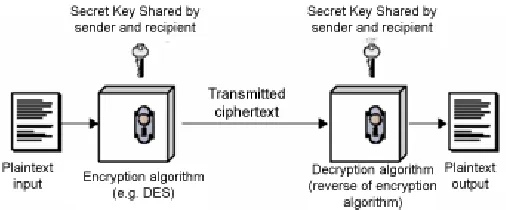
© 2015, IJCSMC All Rights Reserved 410 Figure 1: A Simplified Model of Conventional Encryption
Security Services: If we are taking about security of information then following services come in mind.
Confidentiality (privacy)
Authentication (who created or sent the data)
Integrity (has not been altered)
Non-repudiation (the order is final)
Access control (prevent misuse of resources)
Availability (permanence, non-erasure)
Section – II
Here a newly developed technique named, “A new Symmetric key Cryptography Algorithm using extended MSA method: DJSA symmetric key algorithm” [1] is discussed. In this they are suggesting a symmetric key method where they have used a random key generator for generating the initial key and that key is used for encrypting the given source file. In this method basically a substitution method where they take 4 characters from any input file and then search the corresponding characters in the random key matrix file after getting the encrypted message they store the encrypted data in another file. For searching characters from the random key matrix they have used a method which was proposed by Nath in MSA algorithm. In that they have the provision for encrypting message multiple times. The key matrix contains all possible words comprising of 2 characters each generated from all characters whose ASCII code is from 0 to 255 in a random order. The pattern of the key matrix will depend on text key entered by the user. They are proposing their own algorithm to obtain rando mization number and encryption number from the initial text key entered by the user. They are proposing their own algorithm to obtain randomization number and encryption number from the initial text key. they have given a long trial run on text key and they have found that it is very difficult to match the above two parameters from 2 different Text key which means if some one wants to break his encryption method then he/she has to know the exact pattern of the text key. To decrypt any file one has to know exactly what is the key matrix and to find the random matrix theoretically one has to apply 65536! trial run and which is intractable. They have apply method on possible files such as executable file, Microsoft word file, excel file, access database, FoxPro file, text file, image file, pdf file, video file, audio file, oracle database and they have found in all cases it giving 100% correct solution while encrypting a file and decrypting a file. This method can be used for encrypting digital signature, watermark before embedding in some cover file to make the entire system full secured. In the following section we are going in detail. Here another newly developed technique named, “Effect of Security Increment to Symmetric Data Encryption through AES Methodology” [09] is discussed. In this method they describe about symmetric cipher algorithm which is much more similar to Rijndael. The difference is that, Rijndael algorithm start with 128 bits block size, and then increase the block size by appending columns[10], whereas his algorithm start with 200 bits.
Section – III
PROPOSED WORK
© 2015, IJCSMC All Rights Reserved 411
encrypting message multiple times. The proposed key blocks contains all possible words comprising of number (n) of characters each generated from all characters whose ASCII code is from 0 to 255 in a random order. The pattern of the key blocks will depend on text key entered by the user. Our proposed system using 512 bit key size to encrypt a text message. It wills us very difficult to find out two same massages using this parameter. To decrypt any file one has to know exactly what the key blocks is and to find the random blocks theoretically one has to apply 2256trial run and which is intractable. Initially that technique is only possible for some files such as Microsoft word file, excel file, text file.
Encryption Approach
Used:-Here we are using symmetric encryption approach. We have already know that symmetric encryption approach is divide in two type one is block cipher symmetric cryptography technique and another is stream cipher symmetric cryptography but here we are choosing block cipher type because its efficiency and security.
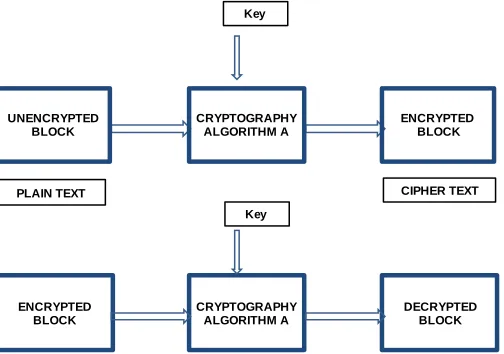
Figure 2: Basic Concept for Symmetric Cryptography
In the proposed technique we have a common key between sander and receiver, which is known as private key. Basically private key concept is the symmetric key concepts where plain text is converting into encrypted text known as cipher text using private key where cipher text decrypted by same private key into plane text. The encryption key is trivially related to the decryption key, in that they ma y be identical or there is a simple transform to go between the two keys. The keys, in practice, represent a shared secret between two or more parties that can be used to maintain private information. Basic concept of symmetric cryptography is shown in figure 2.
Reasons for Use of Symmetric Approach for Encryption and
Decryption:- The encryption process is simple.
Each trading partner can use the same encryption algorithm no need to develop and exchange secret algorithms.
Security is dependent on the length of the key.
High rates of data throughput.
Keys for symmetric-key ciphers are relatively short.
Symmetric-key ciphers can be used as primitives to construct various cryptographic mechanisms.
Symmetric-key ciphers can be composed to produce stronger ciphers
Symmetric-key encryption is perceived to have an extensive history.
Key
Key
CIPHER TEXT PLAIN TEXT
ENCRYPTED BLOCK UNENCRYPTED
BLOCK
CRYPTOGRAPHY ALGORITHM A
ENCRYPTED BLOCK
DECRYPTED BLOCK CRYPTOGRAPHY
© 2015, IJCSMC All Rights Reserved 412 Proposed Key Generation Steps:
1) Select or create any private key of Size 256 X 2 bits or 64 characters.
2) Size of selected key will be varying from 128 bits to 512 bits or 16 to 64 characters. 3) We can choose any character from 0 to 255 ASCII code.
4) Use of 64 * 8 key that means 512 bits in length.
5) Divide 64 bytes into 4 blocks of 16 bytes likes Key_Block1, Key_Block2, Key_Block3, and Key_Block4. 6) Apply XOR operation between Block1 and Block3. Results will store in new Key_Block13.
7) Apply XOR operation between Block2 and Block13. Results will store in new Key_Block213.
8) Apply XOR operation between Key_Block213 and Key_Block4. Results will store in new Key_Block4213. 9) Repeat Step 7, 8, 9 till (random number / 4).
10) Exit
Steps of proposed Algorithm:
1) Initially select plane text of 16 bytes (or we can vary from 16 to 64 depend on requirement). 2) Initially insert key of size 16 bytes ( depend on plane text value)
3) Apply XOR operation between key (Key_Block4213) and plane text block (Text_Block). Result will store in Cipher Block1. 4) Apply right circular shift with 3 values. Result will store in new Cipher_Block2.
5) Apply XOR operation between Cipher_Block2 and Key_Block2. Result will store in new Cipher_Block3. 6) Apply XOR operation between Cipher_Block3 and Key_Block4. Result will store in Cipher_Block4. 7) Cipher_Block4 is the input of the next round as a plane text block.
8) Repeat step
Section IV
RESULTS COMPARISONS
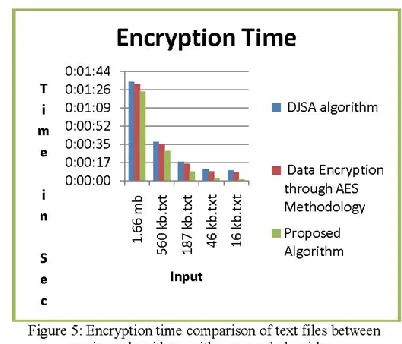
We are using two parameters for execution time one is encryption value and second is decryption time which is shown in table 1 and table 2 Here I am doing compare execution time of encrypting plaintext on different existing cryptographic algorithms with my proposed cryptography algorithm. In each cycle, same plaintexts are respectively encrypted by “A new Symmetric key Cryptography Algorithm using extended
MSA method: DJSA symmetric key algorithm”, “Effect of Security Increment to Symmetric Data Encryption through AES
Methodology” and “Proposed Algorithm (PA)” by copying them. Finally, the outputs of the evaluation system execution time, and measured
in numeric form. Actually, for an encryption algorithm, the execution time of encryption not only depends on the algorithm’s complexity, but also the key and the plaintext have certain impact. Result Comparison in Tabular Form: - In this I am going to represent our result in the form of table. After comparison the results that were obtained can be well represented in form of tables.
Here, The Proposed Algorithm (with 265bit block size in this thesis) and “A new Symmetric key Cryptography Algorithm using extended MSA method: DJSA symmetric key algorithm” algorithm (with 128-bit block size) and “Effect of Security Increment to
© 2015, IJCSMC All Rights Reserved 413
Table 1: - Encryption time comparisons of text files.
Plain Text Size DJSA algorithm Data Encryption through AES Methodology
Proposed Algorithm
1.66 mb 0:01:34 0:01:32 0:01:25 560 kb.txt 0:00:37 0:00:35 0:00:28 187 kb.txt 0:00:18 0:00:16 0:00:09 46 kb.txt 0:00:11 0:00:09 0:00:02 16 kb.txt 0:00:10 0:00:08 0:00:01
Table 2: - Decryption time comparisons of text files
Plain Text in Size
DJSA symmetric key algorithm
Data Encryption through AES Methodology
Proposed Algorithm
1.66 mb.txt 0:01:34 0:01:32 0:01:25
560 kb.txt 0:00:37 0:00:35 0:00:28
187 kb.txt 0:00:18 0:00:16 0:00:09
46 kb.txt 0:00:11 0:00:09 0:00:02
16 kb.txt 0:00:10 0:00:08 0:00:01
Graphical representation for the table 1 and table 2 is shown in figure 9 and figure 10 with blue line and orange line for encryption time and decryption time of “A new Symmetric key Cryptography Algorithm using extended MSA method: DJSA symmetric key algorithm” and
“Effect of Security Increment to Symmetric Data Encryption through AES Methodology”, respectively and green line is for “Proposed
Algorithm”. According to the graph, there is a tendency that encryption/decryption time for Proposed Algorithm, and compared algorithms increases with file size. But required time for the encryption/decryption through Proposed Algorithm is much smaller than encryption/decryption time for compared algorithms. The observations were made using personal computer with specifications of Intel Pentium Dual Core E2200 2.20 Ghz, 1 GB of RAM and Window-XP SP2as the platform
© 2015, IJCSMC All Rights Reserved 414
Figure 6: Decryption time comparison of text files between various algorithms with proposed algorithm
Characteristic of Proposed Technique:
1. Simplicity.
2. Security
3. Efficiency.
4. Robustness:
5. Availability.
6. Integration
7. Distribution
8. Time efficiency
9. Flexibility
Conclusion and Future Enhancement: From the result its is clear that our “proposed technique” is batter result producing as compared “DJSA symmetric key algorithm” and “Effect of Security Increment to Symmetric Data Encryption through AES Methodology”. If any user emphasis on security then he can use our proposed algorithm. Our method is essentially block cipher method and it will take less time if the file size is large. The important thing of our proposed method is that it is almost impossible to break the encryption algorithm without knowing the exact key value. We propose that this encryption method can be applied for data encryption and decryption in any type of public application for sending confidential data.
References
[1] Dripto Chatterjee, Joyshree Nath, Suvadeep Dasgupta, Asoke Nath “A new Symmetric key Cryptography Algorithm using extended MSA method: DJSA symmetric key algorithm” published in 2011 International Conference on Communication Systems and Network Technologies, 978-0-7695-4437-3/11 $26.00 © 2011 IEEE.
[2] Yan Wang and Ming Hu “Timing evaluation of the known cryptographic algorithms “2009 International Conference on Computational Intelligence and Security 978-0-7695-3931-7/09 $26.00 © 2009 IEEE DOI 10.1109/CIS.2009.81.
[3] Symmetric key cryptography using random key generator, A.Nath, S.Ghosh, M.A.Mallik, Proceedings of International conference on SAM-2010 held at Las Vegas(USA) 12-15 July,SAM-2010, Vol-2,P-239-244.
[4] Data Hiding and Retrieval, A.Nath, S.Das, A.Chakrabarti, Proceedings of IEEE International conference on Computer Intelligence and Computer Network held at Bhopal from 26-28 Nov, 2010.
[5] Neal Koblitz “A Course in Number Theory and Cryptography” Second Edition Published by Springer-Verlag.
[6] By Klaus Felten “An Algorithm for Symmetric Cryptography with a wide range of scalability” published by 2nd International Workshop on Embedded Systems, Internet Programming and Industial IT.
© 2015, IJCSMC All Rights Reserved 415
Journal of Computer Science and Security, Volume (1) : Issue (1).
[8] T Morkel, JHP Eloff “ ENCRYPTION TECHNIQUES: A TIMELINE APPROACH” published in Information and Computer Security Architecture (ICSA) Research Group proceeding.
[9] Text book William Stallings, Data and Computer Communications, 6eWilliam 6e 2005.
[10] Md. Nazrul Islam, Md. Monir Hossain Mia, Muhammad F. I. Chowdhury, M.A. Matin “Effect of Security Increment to Symmetric Data Encryption through AES Methodology” Ninth ACIS International Conference on Software Engineering, Artificial Intelligence, Networking, and Parallel/Distributed Computing 978-0-7695-3263-9/08 DOI 10.1109/SNPD.2008.101 IEEE 2008.