University of South Carolina
Scholar Commons
Theses and Dissertations
2015
Exploring Culturally Relevant Teaching: Lessons
from a Middle School Classroom
Kristen H. Gillaspy
University of South Carolina
Follow this and additional works at:https://scholarcommons.sc.edu/etd Part of theLanguage and Literacy Education Commons
This Open Access Dissertation is brought to you by Scholar Commons. It has been accepted for inclusion in Theses and Dissertations by an authorized administrator of Scholar Commons. For more information, please [email protected].
Recommended Citation
Exploring Culturally Relevant Teaching: Lessons from a Middle School Classroom
by
Kristen H. Gillaspy
Bachelor of Arts
University of South Carolina, 2003
Master of Teaching
University of South Carolina, 2004
Master of Education University of South Carolina, 2010
Submitted in Partial Fulfillment of the Requirements
For the Degree of Doctor of Philosophy in
Language and Literacy
College of Education
University of South Carolina
2015
Accepted by:
Diane Stephens, Major Professor
Tasha Laman, Major Professor
Susi Long, Committee Member
Michelle Bryan, Committee Member
ii
© Copyright by Kristen H. Gillaspy, 2015
iii
Dedication
for
iv
Acknowledgements
I would like to thank my husband, Will, who was beyond supportive as I
completed this degree. I have been working on this degree for most of our marriage, and
he has been a steadfast support throughout the entire process. Also, my daughter, Emma
Kate, was the best addition to our family; I was determined to finish so I could show her
what she could also accomplish one day if she chooses.
I would like to thank my family, Mom and Dad, Beth and Jason, and Vey and
Henry, for providing encouraging words throughout the degree and dissertation process. I
owe them all for the endless support they provided over the last several years. In
particular, I thank my parents for teaching me from a young age that hard work and
determination help me reach whatever goals I set.
I would like to thank the members of my committee. My chair, Dr. Diane
Stephens, helped give me vision for a final product and gave me the writing advice I
often needed. Dr. Tasha Laman encouraged me to pursue a study with students and made
me feel like my early ideas for my study were possible and worth pursuing. Dr. Susi
Long and Dr. Michelle Bryan offered their expert input on sociocultural theory and
qualitative research. I would also like to thank Dr. Jennifer Wilson for helping me begin
this journey back in 2007. Without her initial guidance and lessons, I would have never
begun this journey. I hope that my work would have made her proud.
Finally, I would like to thank the administrators at my school who supported me
v
my study in our school and provided words of encouragement as I worked through each
phase. Kai Brailey was my sounding board as I planned instruction and made curricular
decisions. Without her reflective input, I would not have accomplished so much with my
study participants. Natalie Osborne Smith helped create the single-gendered class and
provided regular support of my efforts to try something different in our school. Kyle
Meetze provided helpful input and strategies that supported my work with male students
in a single-gender classroom. Without these school leaders, I would not have been able to
vi
Abstract
In the public school setting and beyond, African American males are often
positioned as a problem. Educators have implemented and studied the use of culturally
relevant pedagogy (CRP) in an effort to shift this deficit perspective of African American
male students, as well as other students of color. CRP positions all students as
knowledgeable and capable of learning while valuing their cultural backgrounds and
experiences. CRP also provides an opportunity to explore issues around race and culture.
Though some research has been done in the area of CRP, very little focuses on the students’
experiences in culturally relevant classrooms, and there are no studies that focus
specifically on the middle school student’s experience. I conducted this action research
study to fill this gap in the literature. Specifically, I sought to understand: What happens
when the interests, lives, and cultural resources of middle school students are drawn upon
and studied through English Language Arts curriculum?
There were 11 male students in my seventh-grade, single-gender English Language
Arts (ELA) classroom. I collected data on my instructional moves and about the responses
of all the students while focusing on two African American boys who had also been in my
classroom the prior year. Data included notes from my researcher’s notebook,
video-recorded classroom observations, audio-video-recorded interviews, and students’ learning
artifacts.
As the instructor, I followed three major principles of CRP: I drew on students’
vii
background into the curriculum. I paid close attention to how students responded to my
instructional decisions and often adjusted my teaching in an effort to increase student
engagement. I identified three other characteristics of my attempt to become a culturally
relevant teacher: 1) I made an effort to develop caring relationships with students; 2) I
believed that all students were knowledgeable and able to learn; and 3) I reflected on my
racial identity. This resulted in an ever-changing lived curriculum because my reflection
on student responses often led to instructional changes. I identified four pathways to
student engagement: students engaged when they 1) had prior knowledge of the topic; 2)
could make a personal connection; 3) were involved in play as a means of learning; and 4)
had an authentic purpose. My study suggests that teachers interested in CRP need to: 1)
recognize that CRP is based on best practice teaching strategies; 2) create a space for
curricular connections to race and culture; and 3) reflect on their own racial identities.
More research is needed on middle grades students’ responses to CRP and on European
American teachers who are implementing CRP.
Keywords: culturally relevant teaching, culturally relevant pedagogy, middle
viii
Table of Contents
Acknowledgements ... iv
Abstract ... vi
List of Figures ... xi
Chapter 1: Introduction ...1
My Prior Understanding of Race and Culture ...3
Theoretical Framework ...7
Culturally Relevant Pedagogy ... 13
Conclusion ... 17
Chapter 2: Literature Review ... 18
Studies Focused on Teachers’ Practices ... 18
Students’ Experiences with Culturally Relevant Pedagogy ... 40
Conclusion ... 46
Chapter 3: Research Methodology ... 48
Purpose of the Study ... 48
Research Question ... 48
Contexts ... 50
ix
Data Gathering Methods ... 64
Organization of Data ... 69
Data Analysis ... 70
Trustworthiness, Triangulation, and Member Checking ... 73
Considerations ... 74
Conclusion ... 75
Chapter 4: Research Findings ... 76
Introduction ... 76
The Lived Curriculum ... 77
Jared and Marcus’ Responses to Lived Curriculum ... 113
Conclusion ... 133
Chapter 5: Discussion ... 135
Introduction ... 135
The Cultural Relevance of My Practice ... 135
The Relationship between Culturally Relevant Practice and Student Engagement .... 145
Becoming a Culturally Relevant Teacher ... 151
Implications for Teachers Interested in Culturally Relevant Teaching ... 161
Implications for Researchers: Questions for Further Study ... 166
Conclusion ... 169
x
Appendix A: Interview Question Guide ... 186
xi
List of Figures
Figure 3.1: Data Collection Methods ... 65
Figure 3.2: Initial Topics in the Data ... 70
Figure 3.3: Specific Instructional Focuses ... 71
Figure 3.4: Large-scale Instructional Moves ... 72
Figure 4.1: Teacher-provided Examples of Tone Words ... 82
Figure 4.2: Jared’s Underlined Words for Mood and Tone... 85
Figure 4.3: Students’ Brainstormed List ... 89
Figure 4.4: Class Norms and Expectations ... 92
Figure 4.5: Marcus’ Mentor Essay with Notes ... 94
Figure 4.6: Original and Revised Class Creed ... 99
Figure 4.7: Jared’s Poem with Notes ... 105
Figure 4.8: Students’ Notes on Mood, Tone, and Theme ... 116
Figure 4.9: Jared’s Notes and Planning for Myth Project ... 125
Figure 4.10: Marcus’ Argument Essay ... 130
1
Chapter 1: Introduction
In 1903, W.E.B. Du Bois asked, “How does it feel to be a problem?” referring to
the social, economic, and political struggle African Americans faced. This question is
still applicable today, although now it often focuses on young and adult African
American males. During the years I spent working on my dissertation, there were
numerous racial injustices enacted against African American males which received
national media attention. When I was writing my proposal in 2012, Trayvon Martin, a
young unarmed African American man in Florida was shot and killed by George
Zimmerman, a neighborhood watch volunteer. Over the 2013 summer break, Zimmerman
was acquitted of killing Martin. I clearly remember the day that the Trayvon Martin case
came up in class with my seventh grade students in the fall semester of 2013. Like many
others across the country, they strongly disagreed with the verdict. During the year
following my data collection, a 12-year-old African American boy, Tamir Rice, was shot
and killed by a police officer in Cleveland, OH. The boy was in a park near his home
with an airsoft gun and was shot within seconds after police arrived. Two weeks prior to
finishing my dissertation, an unarmed African American man, Walter Scott, was shot and
killed by a police officer in South Carolina after being pulled over for a broken tail light
on his car.
These are just three of the many stories of unarmed African American males who
have been killed. These events have sparked protests and brought conversations about
2
protesting the unjust deaths of African American boys and men, there are also many who
are not protesting. Instead, far too often, African American males continue to be
positioned as problematic.
Many educators, wanting to counter this narrative for their students and,
ultimately, in society, have argued for culturally relevant pedagogy (CRP)—for a
pedagogy which draws on students’ out-of-school literacies, experiences, and knowledge
in developing curriculum and gives them an opportunity to engage in authentic learning.
However, while numerous researchers and practitioners (Brown, 2007; Crocco, 1998;
Delpit, 2012; Gay, 2010; Harmon, 2012; Howard, 2003; Jackson, 1993; Ladson-Billings,
1995; Ladson-Billings, 2009; Ladson-Billings & Tate, 1995; Rychly & Graves, 2012;
Schmeichel, 2011; Sleeter, 2012) have written about the use of culturally relevant
teaching, many of these authors only define CRP or advocate for this type of teaching.
The studies which have been conducted (Bondy, Ross, Hambacher, & Acosta, 2012;
Dillon, 1989; Hefflin, 2002; Howard, 2001; Ladson-Billings; Lopez, 2011; Lynn,
Johnson, & Hassan, 1999; Powell, Cantrell, & Rightmyer, 2013; Tate, 1995) focus on the
teachers’ practices or experiences in implementing this teaching approach. In only a few
instances have researchers (Kirkland, 2011; Phillippo, 2012; Sampson & Garrison-Wade,
2011; Wiggan, 2008) focused on students’ responses to culturally relevant pedagogy, and
I found no studies about the responses of middle school students.
I conducted this study to fill this gap in the literature. Specifically, I sought to
understand: What happens when the interests, lives, and cultural resources of middle
3
impact of CRP on African American male students, I collected additional data on two
African American boys in my single-gender classroom of 11 male students.
My Prior Understanding of Race and Culture
As a young child, my parents taught me that I was to treat all people the same, no
matter the color of their skin. I accepted this as the right thing to do and did not question
this lesson until I was enrolled in doctoral classes where I learned about the impact of
culture on language (Delpit & Dowdy, 2008; Gonzalez, Moll, & Amanti, 2005; Heath,
1983; Ladson-Billings, 2009; Meier, 1998; Milner, 2010; Nieto, 1999; Rickford, 1998;
Tatum, 2005). I had grown up in a small town in the southeastern part of the country
where there was a very clear divide between the European American majority and the
African American minority. Not only were there parts of town that were known to
belong to one group or the other, but there were plenty of judgments that each group
made about the other. I know that like many other places during that time, and
unfortunately still today, this was/is quite common. I am also aware that in other parts of
the country and the world, the same issues exist; it is only the composition of the
disenfranchised group that varies. In the southeastern United States, the largest
disenfranchised group are African Americans.
When I was young, my grandmother worked at one of the local banks, and on
some summer days my grandfather, who was retired and often my babysitter, would walk
with me to visit her at work. One day, when I was eight years old, stands out in my
memory. As we walked down Irby Street, which was a cut through road we used to
4
brick apartments. As we passed, he shouted something at us. I do not remember exactly
what he said. My grandfather did not respond, and we just kept walking.
Once we were at the bank, my grandmother asked about how our walk over had
been, and my grandfather responded that it was fine except that a little “nigger” boy had
yelled at us. Hearing him use this word made me perk up and listen closely. Not only
had my parents taught me that I was to treat everyone the same, they also taught me to
never use that word. Even at that young age, I was keenly aware of the hateful nature of
the word. I did not say anything to my grandfather because I was also taught to respect
my grandparents which meant not questioning what they said. I remember the confusion I
felt—the mixed emotion of being so enamored by my grandfather while knowing that he
had said something that was so wrong. This was not an isolated experience. My parents
remind me that I would often whisper into their ears that one of my grandparents had said
something they had told me was wrong, and I was often confused by the language they
used.
I am grateful that my parents taught me to be colorblind and that certain language
was wrong. It provided me with a foundation that led me to the place I am today. They
provided my initial understandings about race and culture. What they taught me was
engrained in me and was the lens through which, as a child and as an adult, I viewed
others, including, when I became a teacher, the students in my classroom. For many
years, I tried to view every student equally, essentially ignoring their individual
characteristics. In some ways, this was a strength because I did not let students’ cultural
backgrounds become an obstacle, but I subsequently learned in my doctoral classes that
5
students offered that I could use in lessons and curriculum planning to further their
thinking and learning and to further grow in my teaching.
This was a huge shift for me as both a teacher and a person. Once I came to this
realization, my biggest fear was, and often still is, the fear of saying something wrong
about culture in general and race in particular. I understand that unlike some of my
students, I am part of the dominant culture because I am a European American. Because I
was and am sensitive to this difference, I feel hesitant to speak openly about race with my
students; I am afraid of being misunderstood. Like many of my African American
students, I have not experienced being part of a school or classroom setting where racial
diversity is viewed as a valuable resource or openly discussed. To the contrary, for most
of my teaching experience and for most of my students and their families, cultural
background was and is either overlooked or used as an identifying label to explain failure
on standardized tests or some other measure of school performance. I faced my fear by
conducting a study to learn more about being a culturally sensitive teacher, one who was
not colorblind.
Though I saw the good intentions in the lessons my parents taught me, I now
know that my students are not all the same and that because all of us are different, all of
us offer things that students can use to learn and I can use to teach. I wanted to learn how
to acknowledge diversity as a valuable tool and recognize and rely on the varying cultural
resources my students bring to the classroom. I wanted to become a teacher who
acknowledges the rich cultural, social, and linguistic resources of my students, and draw
6
My decision to conduct this study was tied not only to the history of
discrimination in the U.S., the recent attention to the long-standing pattern of taking the
lives of unarmed African-American males and my childhood, but by experiences working
for six years as a literacy coach in two middle schools. In both school settings, I had
numerous conversations with teachers about students’ performance, particularly about the
performance of African American students. As a literacy coach, I facilitated various
professional learning opportunities for teachers through study groups, professional book
studies, workshops, and graduate courses, many of which focused on the role of culture
and its impact in literacy education. In these various professional learning settings, we
read from texts such as The Dreamkeepers (Ladson-Billings, 2009) and Funds of
Knowledge (Gonzalez, Moll, & Amanti, 2005). Teachers’ understanding about how
cultural background impacts students fell along a continuum. Some teachers who
initially considered students’ cultural backgrounds as a deficit shifted their thinking and
began focusing on students’ strengths and on critical parts of students’ backgrounds.
However, some teachers did not make this shift. I was intrigued and initially wanted to
study their response, but I quickly remembered that, in previous research projects, I
learned very little from such inquiries. At the same time, I realized that if I worked with
teachers who were shifting their thinking and trying new teaching practices, I would hear
many of the things I already knew to be true about students, instruction, and assessment. I
concluded that in order to most authentically understand the school experience of
students in underrepresented groups and their experience in the school setting, I needed to
work with and learn from students, the very people most impacted by instructional
7
I consequently decided to move away from literacy coaching to return to the
classroom the year prior to conducting my study in an effort to understand first-hand how
I could put into practice my belief in the value of the knowledge that all students bring to
their school experiences. This study, then, became a very personal endeavor.
Theoretical Framework
My work as a literacy educator is grounded in sociocultural theory (González,
Moll, & Amanti, 2005; Heath, 1983; Rogoff, 2003; Rosenblatt, 1978; Vygotsky, 1986)
and critical theory (Dewey, 1938; Dewey, 1995; Freire, 1993; hooks, 1994). Students
bring cultural knowledge with them to school which can serve as a foundation for
developing curriculum and instruction (Delpit & Dowdy, 2008; González, Moll, &
Amanti, 2005; Heath). Viewing students’ cultural diversity as an asset is essential for
equitable teaching practice. It is important to me as an educator that all of my students
see me as a teacher who celebrates and depends on the cultural knowledge they each
bring from their homes, families, and communities. In addition to the view that cultural
knowledge is valuable and an asset to literacy curriculum, my work is also grounded in a
critical belief that the traditional school setting is structured to target the needs of white,
middle class students. In my school, African Americans only make up 10% of the
population; European-Americans make up 77%. In addition, only 22% of all the students
are enrolled in the subsidized lunch program. Instruction is targeted to the majority of
students, a group comprised of middle class European Americans, not necessarily
because the teachers are purposely choosing to ignore the other 23%, but because those
8
The role of sociocultural theory. My goal in this study was to use students’
cultural backgrounds as a guide for developing curriculum and delivering instruction. I
wanted all of my students to see themselves in the texts they encountered and the literary
touchstones they found. As I worked to understand the experiences of the students in my
classroom, my thinking was guided by my belief that my students held a great deal of
knowledge that was different from my cultural experience and that I could improve their
learning experiences by drawing on their interests, lives, and cultural resources as I
planned lessons and curriculum.
My thinking was guided by what are considered seminal texts in sociocultural
theory (González, Moll, & Amanti, 2005; Heath, 1983, Rosenblatt, 1978; Vygotsky,
1986). Based on the work of these theorists and researchers, my foundational beliefs
about language and literacy learning were that 1) students’ language is uniquely tied to
their cultural identity and that 2) students’ cultural knowledge must be an integral part of
curriculum and instruction in order to most effectively support student learning. As
Villegas and Lucas (2007) argued:
learners use their prior knowledge and beliefs to make sense of the new ideas and
experiences they encounter in school. A central role of the culturally and
linguistically responsive teacher is to support students’ learning by helping them
build bridges between what they already know about a topic and what they need
to learn about it. (p. 29)
As Villegas and Lucas pointed out, if the teacher does not find a way to access what
students already know, the students’ opportunities are stifled because their teacher will
9 experiences as a foundation for new learning.
Students’ language is tied to cultural identity.Reporting on studies of Black
Communication, Meier (1998) provided a helpful conceptualization of culture as
significantly tied to language by explaining that language is so much a part of who we are
that it is one of many taken-for-granted elements of our identity:
For most of us, culture is, at least in part, what we have grown up taking for
granted about the world, what we assume to be true, and what we do without ever
stopping to think very much about it. (p. 21)
Meier’s definition of cultural practice supports the idea that language is absorbed and
enacted in the ways people communicate within a certain community or culture. Through
language, people begin to form their identities. The language through which people
perceive the world and others significantly impacts who they are and how they view
themselves. González (2001) explained that language is symbolic of a person’s identity,
and that through language “selfhoods are constructed, identities forged, and social
processes enacted” (p. 173). Baldwin (1979), in a letter to the editor of New York Times,
agreed that language “reveals the private identity, and connects one with, or divorces one
from, the larger public, or communal identity” (para. 4). Similar observations can be
made about how African American students’ use of African American Language (AAL)
in school is a means of identification as a member of their culture. Rickford (1998), in an
interview for the San Francisco Chronicle, explained that no matter how much effort is
put toward erasing African American vernacular from students’ language, the language
will persist “because it feeds into a whole alternative set of identities and purposes that
10
idea that students’ use of home language is connected to their identity and membership in
their cultural group. These scholars share a view of language as intimately tied to the
speaker’s identity in their cultures. These studies worked to form my early understanding
that language and culture are intricately woven.
Cultural knowledge must be a part of curriculum and instruction. My work
with students involved in the study was informed by researchers and writers (Delpit &
Dowdy, 2008; Delpit, 2012; Edwards, McMillon, & Turner, 2010; Gonzalez, 2001;
Tatum, 2009; Zentella, 2005) who have shown that underrepresented groups of students
have immense cultural knowledge which contributes to their literacy learning. González
posited that, rather than overlooking what students’ daily experiences have to offer,
educators must look for “educative processes that draw on the funds of knowledge that
both households and schools possess” (p. xxi). Similarly, Delpit argued that educators
should “recognize that the linguistic form a student brings to school is intimately
connected with loved ones, community, and personal identity;” devaluing that diversity is
equivalent to implying “that something is wrong with the student and his or her family”
(p. 19). Zentella argued that teachers could benefit from becoming more aware of home
practices and learning how to use them to create instructional programs founded on the
contributions made by all the learners involved. I approached my study with the
intention of drawing on the participants’ interests, lives, and cultural resources as I
developed curriculum and instructional plans.
The role of critical theory. One purpose of my study was to question the
traditional model of school that heavily targets European American, middle class students
11
Davis, 2012; James, 2012: Jenkins, 2006; Milner, 2010; Sleeter & Bernal, 2004; Tatum,
2005; Tatum, 2009). I recognized that there were subtle markers of discrimination in the
schools where I taught, though my colleagues often seemed to be unaware of and likely
never intended these instances. I only began to notice inconsistencies in instruction as I
became more aware of them in my doctoral classes.
Taking a critical lens opened my eyes to an unfortunate reality that many
underrepresented students face daily—a reality in which they rarely see themselves in the
texts and lessons, in which their culture is overlooked completely, and in which they are
constantly compared to the European American, middle class, heterosexual majority. For
students of color, this comparison is often made in terms of standardized test
performance, discipline data, attendance, and graduation rate.
I used a critical perspective—one guided specifically by researchers focused on
the role of race and inequality in schools (Delpit, 2012; Howard, 2008; Ladson-Billings,
1997; Ladson-Billings & Tate, 1995; Ladson-Billings, 2009; Milner, 2008)—to question
how my teaching practices impacted my students’ school experiences. In order to
improve the opportunities I provided them in my classroom, I drew on critical theory as a
framework for considering the issues my students encountered in their school
experiences. I tried to work against what I came to understand as a traditional model of
schooling, and I specifically focused on two of my African American students’ interests
and out-of-school literacies as I considered how I could use their literacies to create
meaningful learning opportunities for them (Irvine, 2003; Perry, 1998; Tatum, 2009).
The critical perspective brings attention to this de-valuing of home and
12
and is not valued. A common trend in schools follows the model that Freire (1993)
referred to as the banking model of education, “in which the scope of action allowed to
the students extends only as far as receiving, filing, and storing the deposits” (p. 72).
Following the banking model, students do not make meaning on their own because they
come to expect the teacher to do the thinking for them. Lindfors (1999) similarly warned
that often the teacher is perceived as the participant who holds the knowledge. Johnston
(2004) agreed that the language teachers use in guiding students “creates realities and
invites identities” and also “works to position [students] in relation to one another” (p. 9).
Dewey (1938) offered an alternative, explaining that when students are fully engaged in
the learning process, the learning “is a co-operative enterprise,” (p. 72) in which the
teacher is serving as a sort of guide or facilitator to the learning and the students have an
equal voice in the content and processes that are explored. When students have more of a
voice in the classroom and teachers serve as the guide, student engagement is more likely
because of the focus on the students’ specific interests. This issue of questioning what is
valued and under-valued in school is essential because not only are students learning
reading and writing skills in literacy classrooms, but they are also learning about the
world and their place in it. As Freebody, Luke, and Gilbert (1991) wrote, “What students
learn in reading and literature lessons can be described as a schema for what counts as
mature adult literacy, as a model for what counts as valid, appropriate, and institutionally
sanctioned ways of reading-for-school” (p. 436). Therefore, in my study I tried to think
beyond the traditional model of schooling to incorporate my students’ interests and
13
Culturally Relevant Pedagogy
Sociocultural theory and critical theory formed the lens through which I
considered the student participants’ middle school experiences. The work I did in this
study was grounded in my belief that students in literacy classrooms should have the
opportunity to be part of a learning environment that values cultural diversity and seeks
to use the cultural knowledge students bring to the classroom to inform curriculum and
learning engagements. This belief led me to want to learn about the experiences of
underrepresented middle school students because I was hopeful that being in an ELA
class that depended on the students’ cultural knowledge could have a positive impact on
their learning. Informing this aspect of my theoretical frame, I drew from Luke and
Freebody (1997) who explained that:
The shift here, then, is from viewing that which students bring to schools and
classrooms in terms of individual differences, knowledges, skills, and
backgrounds to a view that students bring to classrooms available cultural,
community and social resources, texts and discourses. (p. 208)
Similarly, I was guided by Nieto (1999) who suggested that “learning emerges
from the social, cultural, and political spaces in which it takes place, and through the
interactions and relationships that occur among learners and teachers” (p. 2). With
Nieto’s suggestion in mind, I conducted this study based on the hope that as a teacher
who immersed myself in professional learning founded in sociocultural and critical
perspectives and who feels a sense of urgency to implement culturally relevant practices
in my classroom, I might provide a more supportive learning environment for my
14
Brown-Jeffy and Cooper, 2011; Delpit, 2012; Gay, 2010; Hale-Benson, 1990; Harmon,
2012; Howard, 2003; Ladson-Billings, 1995; Ladson-Billings, 2009; Rychly & Graves,
2012; Tatum, 2009) who define and encouraged the use of culturally relevant pedagogy, I
identified the following components as foundational in culturally relevant teaching:
The teacher is caring and invested in developing relationships with students.
The teacher believes that all students can learn and achieve academically.
The teacher selects culturally relevant texts and engagements that draw on
students’ out-of-school literacies and allow for students’ interests to drive the
curriculum.
The teacher creates a classroom environment that is safe and relies on
collaborative efforts of all students.
The teacher guides students in critically considering community issues andseeking action to improve those issues.
A literature review by Brown-Jeffy and Cooper (2011) improved my
understanding of the history and evolution of this approach to teaching. They discussed
the change in terminology including “(a) culturally appropriate (Au & Jordan, 1981); (b)
culturally congruent (Mohatt & Erickson, 1981); (c) mitigating cultural discontinuity
(Macias, 1987); (d) culturally responsive (Cazden & Legget, 1981; Erickson & Mohatt,
1982); and (e) culturally compatible (Jordan, 1985; Vogt, Jordan, & Tharp, 1987)” (p.
67). These terms were all used to refer to the now more widely understood notion that
the relationship between students’ culture and school is influential in students’ academic
achievement. The term CRP emerged from Ladson-Billings’ (1994) study of eight
15
is the work that is responsible for introducing the term in the field of education. This
term, culturally relevant pedagogy, seems to have prevailed over time, though Gay’s
(2010) culturally responsive pedagogy has also become common in the field in more
recent years. Gay made a similar point about the various names used for this approach to
teaching, which included “culturally relevant, sensitive, centered, congruent, reflective,
mediated, contextualized, synchronized, and responsive,” explaining that they all refer to
“ideas about why it is important to make classroom instruction more consistent with the
cultural orientations of ethnically diverse students” (p. 31).
Brown and Brown (2012) argued that culturally relevant teachers recognize that
“U.S. society and its schools operate in culturally normative ways that alternately deny or
marginalize alternative perspectives” (p. 19) and work to upset that norm through their
teaching practices. Gay (2010) defined this approach to teaching as “using the cultural
knowledge, prior experiences, frames of reference, and performance styles of ethnically
diverse students to make learning encounters more relevant to and effective for them” (p.
31). Specifically, this approach “teaches to and through the strengths of these students”
(Gay, p. 31). Delpit (2012) added that “if the curriculum we use to teach our children
does not connect in positive ways to the culture young people bring to school, it is
doomed to failure” (p. 20). In addition, Hale-Benson (1990) explained there would be no
educational improvements for African American children until educators “conceptualize
Black children within the context of their culture” (p. 211).
There are multiple frameworks for conceptualizing and enacting culturally relevant
teaching from various researchers. Ladson-Billings (1995) explained that CRP is
16
must develop and/or maintain cultural competence; and (c) students must develop a
critical consciousness through which they challenge the status quo of the current social
order” (p. 160). Tatum (2009) outlined three key teaching strategies for supporting
African American students’ learning—teachers should demonstrate caring, think
carefully about their responses to African American students whose behaviors might
initially seem incongruent, and view literacy development as more than the students’
reading and writing growth. Similarly, Harmon (2012) also provided an explanation of
culturally relevant teaching specific to African American students, arguing that teachers
should “(a) draw on African and African American culture and history, (b) locate ‘self’ in
a historical and cultural context, (c) enable students to create new knowledge based upon
life experiences, and (d) view knowledge as reciprocal” (p. 13). Rychly and Graves
(2012) added that teachers whose practices are culturally relevant are caring and have
empathetic responses to students and are naturally reflective about their practices, their
attitudes, and their beliefs about students.
Howard (2003) argued that there is a need for teacher reflection as a part of
culturally relevant teaching practices. Delpit (2012) provided a set of questions that
would support a teacher’s reflection:
Are we connecting in positive ways to the culture that our African
American young people bring to school?
Are we ensuring that our students know that people who look like them,
both in the past and present, have produced and are producing phenomenal
17
Are we making connections between young people’s lives and the content
that we attempt to teach?
Do they feel welcomed into the school environment, or do they feel that
they must change who they are to be accepted? (pp. 155-157)
Conclusion
In this study, I sought to understand the experiences of students in my ELA class
as I implemented culturally relevant teaching practices. I collected data on whole class
responses while also focusing on two African American students. My theoretical
perspective as I approached this study was based on sociocultural theory and critical
theory. I relied on sociocultural theory because I believe that students’ cultural
backgrounds offer rich resources to be used in planning lessons and developing
curriculum. Critical theory provided me with a lens through which I viewed the school
setting as being founded on traditional norms based on the dominant middle class,
heterosexual, European American culture. I drew on critical theory to bring into question
these often unspoken norms that are used to measure and define success for students. As
an educator, these theoretical foundations led me to learn about and implement culturally
relevant teaching practices in an effort to more successfully teach the students in my
18
Chapter 2: Literature Review
I reviewed the literature in the area of culturally relevant pedagogy. Many
well-known researchers and practitioners (Delpit 2012; Gay, 2010; Ladson-Billings, 1995;
Tatum, 2009) wrote about culturally relevant pedagogy, defining it or encouraging its
use. Their texts helped shape my understanding of what CRP is and how it could help me
better serve the students in my ELA classroom. In reviewing the research on culturally
relevant pedagogy, I focused on studies which involved African American students in
K-12 classrooms. I chose to focus on African American students because they are the
largest underrepresented group in my geographical area. I grouped those studies into two
categories: studies which focused on teachers’ implementation of CRP and those that
explored students’ responses to their teachers’ use of culturally relevant pedagogy. I then
attempted to sort the studies within each category based on the grade level of students:
elementary, middle, or high. There were studies about teachers in all three grade-level
bands, but I could not sort studies focused on students’ experiences by grade level
because the studies only focused on high school students.
Studies Focused on Teachers’ Practices
Elementary school teachers. Howard’s (2001) case study focused on
elementary school teachers’ “culturally sensitive” (p. 183) practices in their work with
African American students. Howard asked stakeholders to nominate teachers “who were
judged effective teachers of African American students” (p. 183). Originally,
19
administrators, and 3 civic leaders)” were asked to nominate teachers “whose
pedagogical practices contributed to the academic and social development of African
American students” (pp. 183-184). Howard did not provide any further criteria to define
what he considered to be effective, but instead, he let the nominators use their own
understandings of effective teachers to guide their nominations. Howard explained that
the nominators “were merely asked to provide the names of teachers they believe were
making a difference in the academic performance of African American students” (p.
184). The group identified 12 individuals who they felt were effective teachers of
African American students. Howard’s next step was to create a framework based on
various researchers’ (Boykin, 1994; Foster, 1997; Heath, 1983; Ladson-Billings, 1994;
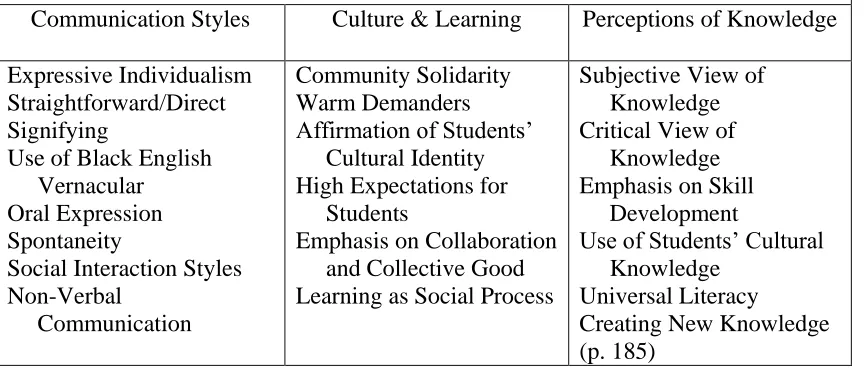
Lee, 1995) work which included 20 teaching practices broken into three categories:
“Communication Styles,” “Culture & Learning,” and “Perceptions of Knowledge” (p.
185). Within these categories (see Table 2.1), were a variety of teaching practices.
Table 2.1
Howard’s Framework of Teaching Practices
Communication Styles Culture & Learning Perceptions of Knowledge
Expressive Individualism Straightforward/Direct Signifying
Use of Black English Vernacular
Oral Expression Spontaneity
Social Interaction Styles Non-Verbal
Communication
Community Solidarity Warm Demanders
Affirmation of Students’ Cultural Identity High Expectations for Students
Emphasis on Collaboration and Collective Good Learning as Social Process
Subjective View of Knowledge
Critical View of Knowledge Emphasis on Skill Development
Use of Students’ Cultural Knowledge
Universal Literacy
20
To narrow the list of 12 teachers to a smaller group of participants, Howard
observed all 12 nominees using the framework of teaching practices as a guide. After his
observations, he narrowed the original list of 12 teachers to four who used at least 15 of
the teaching practices from his framework. These four teachers, Hazel, Dorothy,
Marilyn, and Louise, participated in the study. All four participants were African
American teachers whose experience ranged from five to twenty years in the classroom.
They taught in “African American school settings in lower-class to middle-class areas of
a city located in the northwestern region of the United States” (p. 184). To collect data,
Howard used “in-depth, structured interviews” (p. 185) which he conducted three times
with each teacher. In addition, he collected data from observations of the teachers in
their classrooms over a period of four months and from numerous informal conversations
with the teachers.
Howard analyzed his data using a grounded theory approach (Glaser & Strauss,
1999). He explained that because there was already “research and theory on the
pedagogical practices of effective teachers of African American students,” he used a
grounded theory approach “to relate the findings to the existing theories and provide
additional descriptions, different interpretations, and contextual accounts to those
theories” (p. 185).
Howard confirmed that teachers used “holistic instructional strategies, culturally
consistent communicative competencies, and skill-building strategies to promote
academic success” and was able to provide further description of those actions (p. 186).
His first finding was that the teachers’ use of holistic instructional strategies reflected
21
concerned about students’ “social, emotional, and moral growth” (p. 186). Howard’s
second finding was that the language teachers used in the classroom was often similar to
the students’ home language; he referred to this as “culturally consistent communicative
competencies” (p. 186). He explained that “the teachers structured discourse patterns,
phrases, person-to-person interactions, and vocabulary in their classrooms in ways
consistent with many of the communication modes their students used at home” (p. 190).
The teachers explained that they encouraged students to use their cultural language if it
supported them in expressing their learning or making cognitive connections in learning
new material. The third finding was that these teachers were successful in supporting
students’ academic skills. A significant part of the teachers’ efforts involved helping the
students view academic skills as something they could acquire; many of the students
initially felt they were not as smart as other students. One participant, Hazel, explained
that the use of the word skill “makes it attainable. But if you use the word smart, most
children interpret that as either having it or not” (p. 195). Howard’s study provides an
example of teachers who did not just focus on improving students’ skills. They created a
classroom environment based on students’ cultural backgrounds, which allowed for
students to take risks and push beyond their current understandings so they could make
gains in character development and academic achievement.
Hefflin’s (2002) study focused on the use of culturally relevant African American
children’s literature. She conducted her study with a classroom teacher, Pam, in a K-8
urban school that served over 300 African American students in the eastern region of the
U.S. Pam was a young teacher who taught third grade, and she was questioning how to
22
curriculum she was required to teach. Hefflin and Pam decided to work together to plan
and teach a lesson that incorporated the book Cornrows (Yarbrough, 1979), a culturally
relevant text, rather than the basal reader Pam used. Prior to planning their joint lesson,
Hefflin observed a lesson in the classroom to gain a sense of Pam’s daily approach to
teaching. Her observations became an integral part of their planning conversation.
Hefflin had observed Pam leading students through a pre-reading activity focused on
vocabulary, a whole group read aloud with various students taking turns reading, a group
discussion, and finally a journal-writing activity. As a follow-up to the overall lesson,
students completed three worksheets focused on vocabulary and comprehension.
Hefflin and Pam both felt that students were not fully engaged; they did not seem
to make connections to the lesson delivery, activities, or the text. Hefflin created a
framework which she and Pam used to both reflect on the observed lesson and plan for
their new, collaborative lesson. She explained that the framework consisted of “cultural
patterns,” (p. 233) which included four categories: texts related to the cultural
background of students, social interaction patterns based on call and response, a
connection between home and school, and a connection between the students’ individual
lives and the text. As Hefflin and Pam moved through each phase of the framework, they
quickly realized that much of what Pam typically did in her classroom was not connected
to the students’ cultural frames of reference. For example, the text used during the
observed lesson had no connection to the students’ lives or interests. Also, Pam’s
interactions with the students during both the reading portion and the group discussion
followed a somewhat rigid pattern with Pam asking a question and individual students
23
interaction which many students were familiar with from the churches they attended.
Both agreed that this more familiar pattern of communication might allow students to
engage more authentically and with more meaning. They also discussed whether or not
the questions they asked students before and after reading were scripted in a way that
drew on the students’ cultural frames of reference. For example, in planning the new
lesson, Hefflin and Pam discussed the difference in asking students about their
experiences having their hair “cornrowed” versus “fixed,” and they noted that the former
had a stronger cultural connection (p. 240). Finally, they also discussed whether or not
the lessons and activities drew on the students’ personal lives. Since most of these
engagements focused on vocabulary or comprehension, the students used very little of
their personal experiences to engage in the text. This reflective conversation between
Hefflin and Pam served as an impetus for Pam to revise her approach and create a new
lesson around the text Cornrows (Yarbrough, 1979).
One significant change occurred in the pre-reading activity. Instead of focusing
on vocabulary in the text, Pam had the students think about the title of the text and make
predictions about what might take place in the text based on their own experiences. This
discussion allowed students to discuss their personal experiences and also drew on their
cultural knowledge as they actively discussed cornrowed hair. As she read the text aloud
to her students, she relied on the call-and-response pattern as she sought reactions to the
story from her students. Hefflin and Pam also revised the follow-up activity to include an
illustration of “the person, object, or event” that the students were “most reminded of
during the reading” (p. 246). This experience allowed for a final connection to the
24
members. Both Hefflin and Pam felt that the students’ engagement in the lessons with
Cornrows was heightened because there was much more of a connection between the
text, the lesson, and the students’ cultural backgrounds.
Hyland (2009) conducted a case study focused on a European American teacher,
Andrea, who was in her fourth year of teaching and who wanted to become a culturally
relevant teacher. Andrea was a fourth and fifth grade teacher at Lincoln Elementary
School in the Midwestern region of the U.S. The school’s student population was mostly
working class African American in a community that Hyland identified as “historically
Black” (p. 98). Andrea realized that she was not connecting with her students, so she
sought help in becoming a more effective teacher of her students. Hyland collected data
over a period of two years in a series of 20 one-hour observations in Andrea’s classroom,
as well as three two-hour formal interviews, and numerous conversations.
Hyland was careful to first focus on the success of Andrea’s teaching using
culturally relevant practices. Hyland found that Andrea’s efforts in becoming more
effective showed that she valued the community and cultural knowledge students brought
to the classroom, and she wanted students to “see themselves and members of their
community as experts” (p. 102). In addition, Hyland also concluded that Andrea wanted
students to question the worlds they lived in and to ask critical questions, though within
the first year, Andrea expressed some discomfort in this area because she worried that she
was not equipped to answer the students’ questions. She eventually became comfortable
with students asking questions about race or gender and encouraged them to do so as part
25
Hyland’s case study of Andrea provided a close look at a teacher who understood
and enacted many tenets of CRP because “her students were valued; knowledge was
looked at critically; community issues were brought into the classroom. . . Andrea went
against school culture and engaged her students in project-based learning and held high
expectations for students” (2009, p. 103). However, even though Andrea enacted all of
these beliefs through her teaching practice, she still struggled to connect with community
and family members of her students. Hyland recognized that Andrea was most
comfortable enacting culturally relevant teaching practices within her own classroom
with her students. The only classroom connection to the community was guided by
university professors or doctoral students who approached her about coming into the
classroom. Though these allowed some connection to the community, she did not initiate
these connections, nor did they truly draw on the students’ home communities. Andrea
discussed her hesitance to talk with students about their home lives because she struggled
to negotiate what she believed was right or wrong. For example, she shared a belief that
parents who did not read to their children at home, as some of her students’ parents did
not, were lacking as parents. Hyland explained that Andrea was aware that her “lack of
openness affected her relationships with students, but she was confused about how to be
‘different’ without revealing that she was somehow better” (p. 106). Andrea also
expressed her discomfort in developing relationships with her African American
students’ families, saying that she was “simply more comfortable relating to White
families” (p. 107).
Ladson-Billings’ The Dreamkeepers: Successful Teachers of African American
26
that provided the foundation of culturally relevant pedagogy. The study featured the
work of eight elementary school teachers in a mostly African American school district in
Northern California. To choose her study participants, Ladson-Billings (2009) went first
to the “educational consumers” (p. 30), the parents of the students in the school, for
nominations of “outstanding teachers” (1995, p. 471). The criteria parents used to
identify the teachers included “being accorded respect by the teacher, student enthusiasm
toward school and academic tasks, and student attitudes toward themselves and others”
(1995, p. 471). Using this criteria, parents nominated “more than twenty teachers they
felt passed the test” (2009, p. 30). Secondly, Ladson-Billings asked principals and other
teachers to nominate teachers. The criteria they used included “excellent classroom
management skills, student achievement (as measured by standardized test scores), and
personal observations of teaching practice” (1995, p. 472). They, too, nominated a list of
over twenty teachers. By comparing the two lists, Ladson-Billings chose her sample of
nine teachers whose names appeared on both lists. Of the nine, all but one agreed to
participate. The eight teachers who participated in the study had all been teaching for
12-14 years; five were African American, and three were European American (2009).
Ladson-Billings collected data in a series of four phases, beginning with
interviews with the teachers, followed by unannounced observations of their classroom
teaching, then videotaped recordings of teaching, and finally conversations between the
participants while reviewing the videotapes. In analyzing her data, Ladson-Billings
concluded that many of the beliefs the teachers held were consistent with their practices.
While the teachers did not talk about their practices relative to culture, Ladson-Billings
Ladson-27
Billings described culturally relevant practices as those which “produce students who can
achieve academically, produce students who demonstrate cultural competence, and
develop students who can both understand and critique the existing social order” (1995,
p. 474).
The teachers in the study shared three characteristics. First, they believed that all
students could learn and had knowledge within them. In order to draw on students’
knowledge, the teachers felt they had to be active community members who offered
support through teaching. Secondly, the teachers tried to create strong relationships with
students for the purpose of creating a collaborative community of learners in their
classrooms (p. 480). Third, the teachers viewed students’ knowledge as something that
was constantly evolving and worked to “build bridges” for students that would “facilitate
learning” (p. 481) and allow students to demonstrate various forms of knowledge.
Moyo (2009) conducted a study within ten schools in a rural, public school
district in the southeastern region of the U.S. Moyo wanted to understand: “1. How is
culturally responsive pedagogy promoted in kindergarten classrooms and the school
culture as a whole? 2. What constraints and challenges do teachers face in implementing
culturally responsive pedagogy?” (p. 22). To collect data, Moyo conducted observations
and interviews. Kindergarten classrooms were the “target grade level” (p. 119) that she
observed, though she did conduct observations in other grade levels as well. She did not
include the length or frequency of observations, though she explained that she was
regularly present in the various schools for a period of nine months to a year. Moyo
conducted both structured and semi-structured interviews with eight kindergarten
28
Overall, the eight teachers felt the use of culturally responsive teaching was
necessary to serve the student population in the school. However, much of what the
teachers implemented as culturally responsive practices included more surface-level
strategies such as classroom decorations, the availability of books focused on diverse
cultures, and the general awareness of diversity within the student population. Moyo
recognized these teaching practices as being first steps toward implementing more
meaningful culturally responsive practices. The teachers noted a number of hindrances to
their use of these teaching practices, which included:
Few culturally diverse teachers
Inadequate college preparation on the part of some teachers for culturally
diverse learners
Standardized tests/ Teaching to the test
No Child Left Behind Act of 2001 and prescriptive curriculum and
pedagogy
Poverty issues
Inadequate Knowledge of Culturally Responsive Issues
Inadequate Family and Community Involvement
(p. 216).
Moyo concluded that even when teachers believed in culturally relevant teaching
strategies, there were often obstacles that kept teachers from fully implementing the
strategies, whether it was a lack of knowledge or confidence in different cultural
frameworks or school guidelines. Though the teachers in the study were not successful in
29
recognized the need and possible benefit of the change in their teaching approach. Moyo
concluded that teachers needed continued professional learning and support in culturally
relevant teaching, as well as the authority and flexibility to make decisions about the
curriculum and materials they use to teach their students.
Bondy, Ross, Hambacher, and Acosta (2012) conducted a study focusing on
warm demanders, a concept tied to culturally relevant teaching. Bondy et al. defined
warm demanding “as a feature of culturally relevant teaching that is characterized by
culturally relevant, critical care, and authority” (p. 441). They traced the evolution of the
term warm demander, citing Kleinfeld’s (1975) study as the first to use the terminology
when discussing the work of teachers of Eskimo and Alaskan Indian children. Later, the
term appeared again in Vazquez’s (1988) study of minority children, and was connected
specifically to African American children in Irvine and Fraser’s (1998) study. They also
relied on Ware’s (2006) framework of warm demanders, focusing on two aspects—“the
warm demander as caregiver and authority figure” (p. 422).
Their study focused specifically on European American first-year teachers as they
tried to implement culturally relevant teaching practices by being warm demanders in a
low-income, predominately African American elementary school. The researchers
videotaped the teachers three times followed by interviews in which the teachers reflected
on their teaching practices and specific efforts to be warm demanders in the classroom.
The researchers found that even though both participants graduated from the same
teacher education program and conducted internships in the same school where they were
employed, the two had very different understandings of what the role of warm demander
30
al., 2012, p. 433) view of being a warm demander, seeing it as a way she could approach
her students learning and behavior. Dianna, a fourth grade teacher, viewed warm
demanding as an approach to classroom management rather than as an approach to all of
her interactions with students. The major difference between the two teachers was that
Alyson seemed to have stronger connections with students because she was more attuned
to their perceptions of her caring and authority in the classroom. She focused a great deal
on their reactions, while Dianna was more focused on her own actions to enact care and
authority rather than paying attention to how the students perceived her.
Middle school teachers. Tate’s (1995) study focused on a middle school
teacher’s culturally relevant pedagogy. It took place in a mathematics classroom in an
urban, mainly African American, middle school in southwestern U.S. Sandra Mason, the
teacher featured in the study, taught in her school’s “laureate program designed to meet
the needs of children identified as gifted in some area of school” (p. 169). Mason’s class
was not regulated by state-driven standards or curriculum, which meant she was able to
create curriculum that best fit her students’ needs. Tate collected data in two phases—an
examination of documents that typified Mason’s teaching practices and an interview with
Mason.
Mason explained that her program focus was on solving community problems
rather than being based on mathematics content. The students then researched a
community problem and worked to create possible solutions, before eventually
attempting to implement their solutions. This approach led to the students’ exploration of
very realistic and difficult issues in their communities, including “the AIDS epidemic,
31
project, students worked to “close and/or relocate 13 liquor stores within 1000 feet of
their school” (p. 170). In order to complete this project, the students examined various
laws and codes and found that the laws gave “tax advantages and other fiscal incentives
for liquor stores” (p. 170) that were in the area near their school. The students then
brainstormed possible changes to the incentive program they would later propose to city
officials. They also used state beverage codes to look for possible violations that the
various liquor stores were making. The students met with their city’s planning
commission and their city council, with whom they shared prepared speeches explaining
why the liquor stores should have to relocate. Their story was published in the local
newspaper, and they also went to their state capital; this led to the story being reported by
the Associated Press. After all of the students’ work, local police gave over 200 citations
to the various liquor store owners due to violations. Two of the stores closed because of
major infractions. The students’ work also led to the city council’s “resolution that liquor
not be consumed within 600 feet of the school” (p. 171). Based on the data he collected,
Tate concluded that Mason’s teaching practices were based on “(a) communication
between students, teacher, and outside entities; (b) cooperative group work; (c)
investigative research throughout the learning process; (d) questioning content, people,
and institutions; (e) open-end problem solving connected to students realities; and (f)
social action” (p. 172). Tate explained that Mason’s teaching strategies “represent[ed]
efforts to ‘center’ her students in the process of acquiring knowledge for social change”
(p. 172).
Lynn, Johnson, and Hassan (1999) used the context of CRP to study the teaching
32
exploratory investigation of the beliefs and practices of one African American teacher
who exemplified” the commitment to “transform not only the minds but also the lives of
[his] African American students” (p. 42). The study was pulled from a much larger
ethnographic study that examined the practices of African American teachers in the Los
Angeles, California area. It took place at a private school, La Cienga Middle School, in
an “affluent African American community” (p. 42) in South Los Angeles called Baldwin
Hills. The study was collaborative in design, based on participatory research, in which
the researcher, Lynn, and two teachers, Johnson and Hassan, worked together to design
and conduct the study. They collected data from classroom observations, individual and
group interviews, and informal conversations over a period of nine months in 1998 and
1999. Additionally, the researchers examined documents including “newspaper articles,
statements pertaining to the school’s mission, and written material describing the school”
(p. 48). They also conducted a semi-structured group interview with school leaders,
including the founder, head of school, and campus director for the purpose of gaining an
understanding of how the school was started and their vision for students and curriculum.
The school was begun by a group, the New Visions Foundation, whose goal was
to create a private school setting that mirrored the diversity of the community it would
serve. Therefore, each school was required to “enroll a minimum of 40% students of
color” (1999, p. 45). In addition, the school itself was based on the following values:
Encouraging teachers and families to participate in the construction of
curriculum and other matters traditionally decided upon by the
33
Providing students with opportunities to nurture their artistic as well as
their academic faculties
Utilizing the community as a resource from which to build curricula and
create stronger bonds between community and school
Teaching students to respect and honor their unique cultures while
recognizing the importance and value of cultural diversity; and
Helping students become highly principled and compassionate human
beings endowed with the critical thinking skills that will serve to foster
positive social transformation
(p. 46).
Lynn et al. (1999) concluded that Hassan often made connections between
teaching and the ministry, arguing that “teachers . . . are charged to change lives and save
souls” (p. 49). He combined an “emphasis on deep-seated moralism, beneficent
opportunism, and healthy pessimism” (p. 49). The researchers considered lessons on
social justice and human rights as evidence of moralism. They detailed several lessons
and class discussions that Hassan taught focused on the impact of oppression around the
world, specifically focused on race and racism. Beneficent opportunism referred to the
message Hassan conveyed that African American leaders can reveal injustices directed
toward their community while simultaneously pointing out the way society as a whole
could improve if the injustice or ill treatment stopped. The researchers found that Hassan
used this opportunistic approach often during his teaching as he fully valued all that
students said during class discussions. No matter how naïve or misguided their