
O R I G I N A L R E S E A R C H
N-acetylcysteine reverses the decrease of DNA
methylation status caused by engineered gold,
silicon, and chitosan nanoparticles
This article was published in the following Dove Press journal: International Journal of Nanomedicine
Kanidta Sooklert1,* Siwaporn Nilyai1,* Rojrit Rojanathanes2 Depicha Jindatip3 Nutchanart Sae-liang1 Nakarin Kitkumthorn4 Apiwat Mutirangura5
Amornpun Sereemaspun1
1Nanomedicine Research Unit,
Department of Anatomy, Faculty of Medicine, Chulalongkorn University, Bangkok, Thailand;2Department of
Chemistry, Faculty of Science, Chulalongkorn University, Bangkok, Thailand;3Department of Anatomy,
Faculty of Medicine, Chulalongkorn University, Bangkok, Thailand;
4Department of Oral Biology, Faculty of
Dentistry, Mahidol University, Bangkok, Thailand;5Center of Excellence in
Molecular Genetics of Cancer and Human Diseases, Department of Anatomy, Faculty of Medicine, Chulalongkorn University, Bangkok, Thailand
*These authors contributed equally to this work
Introduction:Engineered nanoparticles (ENPs) are one of the most widely used types of
nanomaterials. Recently, ENPs have been shown to cause cellular damage by inducing ROS (reactive oxygen species) both directly and indirectly, leading to the changes in DNA methylation levels, which is an important epigenetic mechanism. In this study, we investi-gated the effect of ENP-induced ROS on DNA methylation.
Materials and methods:Human embryonic kidney and human keratinocyte (HaCaT) cells
were exposed to three different types of ENPs: gold nanoparticles, silicon nanoparticles (SiNPs), and chitosan nanoparticles (CSNPs). We then evaluated the cytotoxicity of the ENPs by measuring cell viability, morphology, cell apoptosis, cell proliferation, cell cycle distribution and ROS levels. Global DNA methylation levels was measured using 5-methyl-cytosine immunocytochemical staining and HPLC analysis. DNA methylation levels of the transposable elements, long interspersed element-1 (LINE-1) and Alu, were also measured using combined bisulfite restriction analysis technique. DNA methylation levels of the TEs LINE-1 and Alu were also measured using combined bisulfite restriction analysis technique.
Results:We found that HaCaT cells that were exposed to SiNPs exhibited increased ROS
levels, whereas HaCaT cells that were exposed to SiNPs and CSNPs experienced global and Alu hypomethylation, with no change in LINE-1 being observed in either cell line. The demethylation of Alu in HaCaT cells following exposure to SiNPs and CSNPs was prevented when the cells were pretreated with an antioxidant.
Conclusion: The global DNA methylation that is observed in cells exposed to ENPs is
associated with methylation of the Alu elements. However, the change in DNA methylation levels following ENP exposure is specific to particular ENP and cell types and independent of ROS, being induced indirectly through disruption of the oxidative defense process.
Keywords:epigenetic, DNA methylation, LINE-1, Alu, nanotoxicity
Introduction
Nanotechnology has been receiving growing interest across a number offields, with engineered nanoparticles (ENPs) being one of the most highly used nanomaterials for a range of applications, such as cosmetics, food additives, and biomedicine, because of their special physicochemical properties. However, it has previously been shown that many kinds of ENPs are toxic to organisms, causing cyto- and genotoxicity, including inflammation, oxidative stress, immunotoxicity, and DNA damage,1–3 with the level of toxicity often depending on the physicochemical Correspondence: Amornpun
Sereemaspun
Nanomedicine Research Unit, Department of Anatomy, Faculty of Medicine, Chulalongkorn University, 1873 Rama 4 Road, Pathumwan, Bangkok 10330, Thailand
Tel +6 696 569 8859 Fax +662 252 7028
Email [email protected]
International Journal of Nanomedicine
Dove
press
open access to scientific and medical research
Open Access Full Text Article
submit your manuscript| www.dovepress.com International Journal of Nanomedicine 2019:14 4573–4587 4573
International Journal of Nanomedicine downloaded from https://www.dovepress.com/ by 118.70.13.36 on 22-Aug-2020
properties of the ENP, such as the size, shape, charge, and chemical composition.4–6 In addition, exposure to ENPs has been shown to cause epigenetic changes,7 whereby gene expression is altered without any change in the DNA sequences, by inducing histone modification and changes miRNA expression and global DNA methylation, with the latter being particularly well studied due to its potential importance for maintaining genome stability.8
Recent studies have demonstrated that ENPs can induce changes in not only the global DNA methylation level but also the DNA methylation level of transposable elements (TEs), including long interspersed nuclear ele-ments (LINEs) and short interspersed nuclear eleele-ments (SINEs), respectively, both in vitro and in vivo using an inhalation exposure model.9 Furthermore, because TEs (particularly LINE-1 and Alu) account for 30% of the genome, it has been argued that their methylation levels can be used as an indicator of global DNA methylation levels.10Full-length LINE-1 contains approximately 6,000 base pairs and accounts for 17% of the human genome, with approximately 600,000 copies being dispersed throughout it. In contrast, Alu is the most abundant SINE in the human genome, with around 1 million copies mak-ing up approximately 11% of the genome. It has pre-viously been reported that changes in the DNA methylation levels of LINE-1 and Alu are correlated with diseases, particularly various types of cancers and auto-immune diseases.11 Moreover, such changes have been observed in models following exposure to various envir-onmental toxicants, such as lead, benzene, and ultrafine air pollution particles.12–14 However, the mechanisms by which ENPs induce changes in DNA methylation levels remain unclear.
Several previous studies have found that ENPs can increase the level of ROS, which has been shown to cause intracellular macromolecular damage, induce an inflammatory response, and potentially have an impact on epigenetic changes.1,15–18 Therefore, in this study, we investigated whether ROS generation after exposure to ENPs causes changes in the DNA methylation levels of LINE-1 and Alu in vitro. Because changes in DNA methy-lation levels have been shown to be both ENP-specific and cell-specific,19we investigated the effects of three types of ENPs with different chemical properties [gold nanoparti-cles (AuNPs) to represent metal ENPs, silica nanopartinanoparti-cles (SiNPs) to represent metal oxide ENPs, and chitosan nanoparticles (CSNPs) to represent polymer ENPs] on two different cell types [human embryonic kidney
(HEK293) and human keratinocyte (HaCaT) cells]. These cell types were selected because the kidney has various important functions related to the removal of toxins and keratinocytes represent the first barrier for environmental toxicants. We determined the effect of each ENP by eval-uating the amount of ROS generated and measuring both the global DNA methylation level and the DNA methyla-tion level of LINE-1 and Alu following ENP exposure. We also compared the effect of ENP exposure on cells that had and had not been exposed to the antioxidant agent N-acetyl cysteine (NAC) to clarify the role of ROS in DNA methylation.
Materials and methods
ENP preparation and characterization
AuNPs were synthesized by reacting 1 mL of 1% gold (III) chloride trihydrate (HAuCl4·3H2O) with 12 mL of0.0202 mM sodium acetate and 37 mL of Milli-Q®water. The solution was stirred in range of 75–95°C for 2 hrs, after which it became red-wine in color. LUDOX® AM SiNPs (aqueous suspensions in H2O) were purchased from
Sigma-Aldrich (Sigma, St Louis, MO, USA). CSNPs were synthesized and provided by the Chitin Research Center, Chulalongkorn University, Thailand. The total surface charge of each type of ENP was measured using a Zetasizer Nano (Malvern, UK), whereas the size and shape were observed under a transmission electron micro-scope (TEM) (Hitachi High-Technologies Corporation, Tokyo, Japan).
Protein corona formation and
nanoparticles agglomeration analysis
ENPs were incubated for 1 hr with cell culture media in an orbital shaking incubator at 37°C. The ENPs mixture were subjected to centrifugation at 16,000×g/20°C for 15 mins. After centrifugation, the ENPs-corona pellets were resus-pended in phosphate-buffered saline (PBS) and re-centrifuged three times for removed the unbound proteins. The ENPs-corona pellets were collected, and the protein concentration was quantified using a BCA Protein Assay Kit (Thermo Scientific, Waltham, MA, USA). The size distribution of ENPs in cell culture media was also mea-sured by dynamic light scattering using a Zetasizer Nano.Cell culture
HEK293 and HaCaT cell lines were purchased from American Type Culture Collection (ATCC, Manassas, VA,
International Journal of Nanomedicine downloaded from https://www.dovepress.com/ by 118.70.13.36 on 22-Aug-2020
USA). HEK293 and HaCaT cells were cultured in DMEM and supplemented with 10% (v/v) fetal bovine serum (Gibco, Waltham, MA, USA) and 1% (v/v) penicillin/streptomycin (Gibco, USA). The cells were grown in an incubator (Esco, Singapore) at 37°C with 5% carbon dioxide.
Cellular toxicity of the ENPs
The viability of HEK293 and HaCaT cells following expo-sure to the ENPs was assessed using PrestoBlue® (Invitrogen, Waltham, MA, USA), which is a resazurin-based reagent that becomes stronglyfluorescent after accept-ing electrons from molecules in livaccept-ing cells that are involved in cellular respiration. Briefly, the cells were plated in 96-well plates and challenged with each of the ENPs for 72 hrs. PrestoBlue®was then added, and the plate was incubated at 37°C for 30 mins. Thefluorescence intensity was detected at an emission wavelength of 495 nm and an excitation wave-length of 530 nm using a Varioskan Flash microplate reader (Thermo Scientific). The percentage of cell viability was then calculated with respect to a control group of untreated cells.
Cell morphology
HEK293 and HaCaT cells were seeded into a 24-well plate and treated with each of the ENPs for 72 hrs once the cells had attached to the bottom. The cell morphology was then observed under a phase-contrast inverted microscope (Eclipse TS 100; Nikon, Tokyo, Japan).
Detection of apoptosis by annexin V and
PI staining
Apoptosis was determined by fluorescein isothiocyanate (FITC)-conjugated annexin V and propidium iodide (PI) staining (BD Biosciences, Franklin Lakes, NJ, USA) accord-ing to the manufacturer’s instructions. Briefly, cells were treated with ENPs and incubated for 72 hrs. After the treat-ment, cells were harvested and washed twice with cold phosphate-buffered saline and resuspended in 1x annexin V binding buffer. FITC conjugated annexin Vand PI working solutions were added and incubated for 15 mins in the dark. Within 1 hr after staining, cells were analyzed by flow cytometry (Beckman Coulter CytoFlex, Brea, CA, USA).
Cell proliferation analysis
The cell proliferation analysis was performed by using the CellTrace™ Cell Proliferation Kits (Invitrogen). Following the manufacturer’s instructions, cells were loaded with the CellTrace™ DMSO stock solution in
PBS and incubated for 20 mins at 37°C. Afterwards, the loading solution was removed, and the cells were washed by culture medium containing 10% FBS. The stained cells were treated with ENPs for 72 hrs. After 72 hrs, cells were harvested and resuspended in PBS for
flow cytometry analysis.
DNA-based cell cycle analysis
The cell cycle phases were analyzed by measuring DNA content after PI staining. Briefly, the ENPs treated cells were collected andfixed in 70% alcohol at room tempera-ture (25°C) for 20 mins. Then, the cells were subsequently incubated with 100μg/mL RNase A at 4°C for 30 mins. Following this process, the cells were stained with 50μg/ mL PI solution (Thermo Scientific) at room temperature (25°C) for 15 mins in the dark. The data from stained cells were collected on the CytoFLEX researchflow cytometer using CytExpert Software (Beckman Coulter CytoFlex).
Measurement of intracellular ROS
The formation of intracellular ROS following exposure to each of the ENPs was determined using 2′,7′ -dichlorodihydrofluorescein diacetate (H2DCFDA; Invitrogen), which is converted into non-fluorescent 2′,7′ -dichlorodihydrofluorescein through the removal of acetate groups by intracellular esterases and then dichlorofl uores-cein (DCF) following oxidation by ROS, which produces afluorescent signal. A 10 mM H2DCFDA stock solution was prepared in dimethyl sulfoxide and diluted 1,000-fold with DMEM without serum for use as a working concen-tration. Briefly, HEK293 and HaCaT cells were seeded into a 96-well plate and washed twice with PBS. H2DCFDA was then added to each well, and the plate was incubated at 37°C in the dark for 30 mins. The cells were then washed twice with PBS and treated with the ENPs. Thefluorescence intensity was detected after 3 and 6 hrs at an emission wavelength of 485 nm and an excita-tion wavelength of 528 nm using a Varioskan Flash micro-plate reader (Thermo Scientific). The percentage of ROS generation was calculated by normalizing the level to an untreated control group. The cells treatment with H2O2
was represented as positive control.
Immunocytochemical staining with 5-mc
To examine the levels of global methylation, HEK293 and HaCaT cells were exposed to each of the ENPs and then added to low-melting-point agarose gel to form gel blocks. These gel blocks were fixed in formalin, embedded inInternational Journal of Nanomedicine downloaded from https://www.dovepress.com/ by 118.70.13.36 on 22-Aug-2020
paraffin, and sectioned at 5 µm, following which the sec-tions were dewaxed in xylene and rehydrated using etha-nol. The sections then underwent antigen retrieval by immersing them in citric acid (pH 6) and heating them in a microwave oven (full power) for 10 mins. Following this, the slides were immersed in hydrochloric acid at room temperature for 15 mins to expose the CpG dinu-cleotides. To quench any endogenous peroxidase activity, the sections were treated with 3.0% hydrogen peroxide for 4 mins. They were then incubated for 60 mins at room temperature with a commercial antibody against 5-mc to assess global DNA methylation levels, followed by a further 60 mins with secondary antibody (horseradish peroxidase polymer). Finally, the sections were incubated with 3,3′-diaminobenzidine and counterstained with hema-toxylin. The sections were scanned using an Axio Scan.Z1 (Zeiss, Jena, Germany), and counts of global methylated cells (brown) and global unmethylated cells (blue) were made in 10 random fields of view per slide using the Adobe Photoshop program (Creative Suite 6; Adobe, San Jose, CA, USA). The percentage of methylation was then calculated by dividing the number of methylated cells by the total number of cells counted. The cells treatment with 5-azacytidine were used to reflect the hypomethylation condition.
HPLC analysis
Seventy-two hours after treating with ENPs, DNA was extracted from HEK293 and HaCaT cells using a Blood & Cell Culture DNA Mini Kit (Qiagen, Hilden, Germany) and quantified using a NanoDrop™ 2000 Spectrophotometer (Thermo Fisher Scientific, Waltham, MA, USA). Following this process, the genomic DNA was digested using 8-OHdG Assay Preparation Reagent Set (FUJIFILM Wako Pure Chemical Corporation, Osaka, Japan). In brief, 20 µg DNA from all samples were heated for 2 mins at 98°C and then were chilled on ice for 10 mins. Next, 19 µl of acetic acid buffer and 10 µl of nuclease P1 solution were added and incubated for 30 mins at 37°C. Afterflash centrifuge, 20 µl of tris buffer and 1 µl of alkaline phosphatase solution were added and incubated for 30 mins at 37°C. Each sample was transferred to a filter cup of an ultracentrifuge device and centrifuged at 15,000×g at 4°C for 20 mins. Samples were then kept at−20°C until HPLC analysis. The standards 2′ -deoxycytidine (dC) and 5-methyl-2′-deoxycytidine (5mdC) were prepared in 0.1% hydrochloric acid. HPLC was per-formed on Shimadzu prominence UFLC LC-20AD (Shimadzu, Kyoto, Japan). An enable C18P 4E column
(250 mm x 4.6 mm, 5 µm) was used for separation. The separation was achieved with two mobile phases: 0.1% (v/v) trifluoroacetic acid and methanol. The flow rate was set at 1 mL/min and the injected sample volume was 20 µL. The UV detection was set at 280 nm.
Combined bisul
fi
te restriction analysis
(COBRA)
COBRA is a standard technique and simple method that is used to detect the methylation level of interspersed repeti-tive nuclear elements.20,21HEK293 and HaCaT cells were exposed to each of the ENPs for 72 hrs, following which DNA was extracted using the QIAamp® DNA Mini Kit (Qiagen) according to the manufacturer’s instructions. Bisulfite conversion of genomic DNA was performed using the EZ DNA Methylation-Gold™ Kit (Zymo Research, Orange, CA, USA) as described by the manu-facturer. Bisulfite-treated DNA was then amplified by PCR using primers that were specific to the LINE-1 (F: 5′-CCG -TAA-GGG-GTT-AGG-GAG-TTT-TT-3′ and R: 5′ -RTA-AAA-CCC-TCC-RAA-CCA-AAT-ATA-AA-3′) and Alu (F: 5′-GGCGCGGTGGTTTACGTTTGTAA-3′ and R: 5′-CAC-CAT-ATT-AAC-CAA-ACT-AAT-CCC-GA-3′) sequences.22 The PCR conditions were as follows: pre-denaturation at 95°C for 15 mins; followed by 35 cycles of denaturation at 95°C for 1 mins, annealing at 55°C for LINE-1 and 53°C for Alu for 1 mins, and extension at 72°C for 1 min, with afinal extension step at 72°C for 7 mins. The PCR products of LINE-1 (160 bp containing two CpG dinucleotides) and Alu (133 bp containing two CpG dinucleotides) were cut by adding 1 U of the restriction enzymes TaqI and TasI at 65°C overnight and were separated on 8% non-denaturing polyacryla-mide gels, stained with SYBR® Green and visualized under a STORM scanner (STORM 825; GE Healthcare, Australia). The total DNA methylation levels of LINE-1 and Alu were then calculated as described previously.20,23
Statistical analysis
All data are presented as mean ± SD. Differences between treatment groups were analyzed using ANOVA, followed by Tukey’s multiple comparison test for comparisons between multiple groups or unpaired
t-tests for comparisons between two groups. All ana-lyses were performed in GraphPad Prism 5 (GraphPad Software, Inc., La Jolla, CA, USA) with a significance level of P<0.05.
International Journal of Nanomedicine downloaded from https://www.dovepress.com/ by 118.70.13.36 on 22-Aug-2020
Results
Characterization of the ENPs
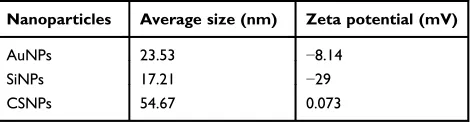
The size and dispersion of the nanoparticles that were used in this study were estimated by examining their morphol-ogy and measuring their primary diameter under a TEM and determining their zeta potential using a Zetasizer. All the three ENPs were spherical, with approximate dia-meters of 23 nm for AuNPs, 17 nm for SiNPs, and 54 nm for CSNPs (Figure 1A–C andTable 1). Both AuNPs and SiNPs exhibited a negative charge, whereas CSNPs had a positive charge. Among the three ENPs used in this study, SiNPs showed the greatest stability.
Protein corona formation and
agglomeration of ENPs
Amounts of protein adsorbed onto ENPs and hydrody-namic diameter of ENPs before and after incubation with cell culture media were investigated by using BCA Protein Assay Kit (Thermo Scientific) and Zetasizer Nano, respec-tively. After incubation with cell culture media, the amounts of protein that coated with AuNPs, SiNPs, and CSNPs was 86.33+0.16, 200.02+0.18, and 88.71+0.07 µg/ mL, respectively (Table 2). As showed in Table 2, the hydrodynamic diameters of SiNPs and CSNPs were slightly larger than before incubation with cell culture media. Whereas the hydrodynamic diameters of AuNPs became a bit smaller after incubation with cell culture media.
Cell morphology
The morphologies of HEK293 and HaCaT cells following exposure to each of the three ENPs for 72 hrs are shown in Figure 2. HEK293 cells that had been exposed to 10 µg/mL
AuNPs and up to 100 µg/mL CSNPs had the same morphol-ogy as untreated control cells, but exposure to 100 µg/mL AuNPs reduced the number of cells. In contrast, HEK293 cells that had been exposed to 10 and 100 µg/mL SiNPs exhibited morphological changes, particularly at the higher concentration, with the cells appearing to be impaired and exhibiting a deformed conformation and some also showing shrinkage. Similarly, HaCaT cells that were treated with 10 µg/mL AuNPs and up to 100 µg/mL CSNPs had the same morphology as untreated control cells, but exposure to 100 µg/mL AuNPs reduced the number of cells. Furthermore, the number of HaCaT cells decreased following exposure to SiNPs in a dose-dependent manner.
Cell viability
The viabilities of HEK293 and HaCaT cells following exposure to 10, 50, and 100 µg/mL of each of the three ENPs for 72 hrs are shown in Figure 3A–F, respectively. Exposure to AuNPs decreased the viabi-lity of HEK293 cells at 100 µg/mL and HaCaT cells at 50 and 100 µg/mL, whereas SiNPs were only toxic to HEK293 cells at 50 and 100 µg/mL, and CSNPs did not reduce the viability of either cell line at any concentration.
Figure 1 Transmission electron micrographs of the engineered nanoparticles. (A) Gold nanoparticles (AuNPs), (B) silicon nanoparticles (SiNPs), and (C) chitosan nanoparticles (CSNPs).
Table 1Size distributions and zeta potential values of the
engi-neered nanoparticles
Nanoparticles Average size (nm) Zeta potential (mV)
AuNPs 23.53 −8.14
SiNPs 17.21 −29
CSNPs 54.67 0.073
Abbreviations:AuNPs, gold nanoparticles; CSNPs, chitosan nanoparticles; SiNPs, silicon nanoparticles.
International Journal of Nanomedicine downloaded from https://www.dovepress.com/ by 118.70.13.36 on 22-Aug-2020
Cell apoptosis
After treatment with ENPs and double staining with annexin V and PI, the cells with annexin
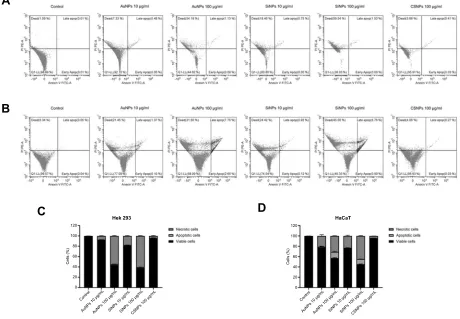
V+/PI- (indicating early apoptosis), annexin V+/PI+ (indicating late apoptosis) and annexin V-/PI+ (indicating necrosis) were observed. Results in Figure 4 showed that the treatment with AuNPs and SiNPs reduced the viability of HEK293 (Figure 4AandC) and HaCaT (Figure 4BandD) cells in a dose-dependent manner. The results displayed that the percentages of both apoptotic and necrotic cells were also increased after the concentrations of AuNPs and SiNPs are increased. Besides, we found that the percentages of apopto-tic and necroapopto-tic cells after CSNPs treatment were not signifi -cantly different compared to control group.
Cell proliferation
To confirm that ENPs may exert a cytostatic effect, cell proliferation analysis using a carboxyfluorescein succini-midyl ester (CFSE) reagent was completed. CFSE is cell permeable that readily diffuse into cells and bind cova-lently to intracellular amines. Thefluorescent intensity of CFSE is not transferred to adjacent cells but will become approximately half of the integrated CFSE in each daugh-ter cell. The discrete peaks in the histograms represent successive generations of live. Flow cytometry analysis revealed that HEK293 (Figure 5A and C) and HaCaT (Figure 5B and D) cells treated with concentration of 100μg/mL AuNPs and SiNPs had increased cell prolifera-tion. Whereas CSNPs treatment with concentrations of 100μg/mL had no significant difference in cell prolifera-tion level compared to control group (Figure 5).
Cell cycle
To explore whether ENPs mediated effect on cell cycle, a DNA-based cell cycle analysis was performed using flow cytometry. In HEK393 cells, exposure to
Table 2Protein corona and hydrodynamic diameter of ENPs before and after incubation with cell culture media for 1 hr
Nanoparticles Protein content (µg/ mL)
Hydrodynamic diameter (nm)
Before incubation to cell culture media
Pdl After incubation to cell culture media
Pdl
AuNPs 86.33±0.16 38.07 0.442 31.93 0.291
SiNPs 200.02±0.18 45.34 0.377 50.10 0.384
CSNPs 88.71±0.07 83.02 0.346 98.60 0.382
Abbreviations:AuNPs, gold nanoparticles; CSNPs, chitosan nanoparticles; SiNPs,silicon nanoparticles; ENPs, engineered nanoparticles; Pdl, polydispersity index.
Figure 2Cell morphology following treatment with the engineered nanopar-ticles. Human embryonic kidney (HEK293; left) and keratinocyte (HaCaT; right) cells were treated with gold nanoparticles (AuNPs), silicon nanoparti-cles (SiNPs), and chitosan nanopartinanoparti-cles (CSNPs) for 72 hrs and then visua-lized under a phase-contrast microscope (magnification, 200×). Cells in the control group were treated with engineered nanoparticle-free medium.
International Journal of Nanomedicine downloaded from https://www.dovepress.com/ by 118.70.13.36 on 22-Aug-2020
Hek 293
HaCaT
Cell viability (% of control) 0
***
*** ***
*** ***
0 10 50
100
50 100 150
Cell viability (% of control) 0
0 10 50
100
50 100 150
Cell viability (% of control) 0
0 10 50
100
50 100 150
AuNPs concentration (µg/mL)
Cell viability (% of control) 0 Cell viability (% of control) 0 Cell viability (% of control) 0 50 100 150 200 250
50 100 150 200
0 10 50
100
100 200 300 400
AuNPs concentration (µg/mL)
SiNPs concentration (µg/mL)
0 10 50
100
SiNPs concentration (µg/mL)
CSNPs concentration (µg/mL)
0 10 50
100
CSNPs concentration (µg/mL)
A
B
C
D
E
F
Figure 3Cellular toxicity of the engineered nanoparticles.
Notes:Human embryonic kidney (HEK293;A–C) and keratinocyte (HaCaT;D–F) cells were challenged with 0 µg/mL (control), 10, 50, and 100 µg/mL of gold nanoparticles (AuNPs), silicon nanoparticles (SiNPs), and chitosan nanoparticles (CSNPs) for 72 hrs. The percentage of cell viability was then calculated relative to the untreated control group. Values are mean ± SD. ***P<0.001 versus the control group.
Control
AuNPs 10 µg/mLAuNPs 100 µ g/mL
SiNPs 100 µ g/mL
SiNPs 10 µg/mL
CSNPs 100 µg/mL 0
20
Cells (%)
40 60 80 100 120
Control
AuNPs 10 µg/mL
AuNPs 100 µg/mL
SiNPs 100 µg/mL
SiNPs 10 µg/mL
CSNPs 100 µg/mL 0
20
Cells (%)
40 60 80 100 120
Hek 293 HaCaT
A
B
C
D
Figure 4Apoptosis and necrosis rates of human embryonic kidney (HEK293) and keratinocyte (HaCaT) cells measured usingflow cytometry with double staining of Annexin V and PI.
Notes:The scatterplot shows HEK293 (A) and HaCaT (B) cells treated with ENPs. The quantitative analysis of apoptotic and necrotic cells of treated–HEK293 (C) and HaCaT (D) cells determined byflow cytometry.
Abbreviation:ENPs, engineered nanoparticles.
International Journal of Nanomedicine downloaded from https://www.dovepress.com/ by 118.70.13.36 on 22-Aug-2020
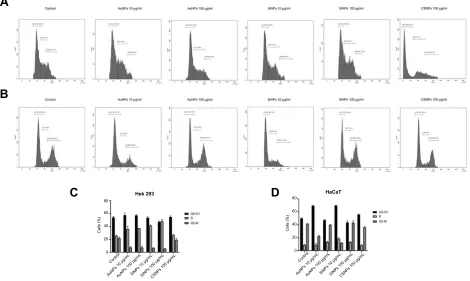
AuNPs and SiNPs resulted in a decreased cell percen-tage in the S phase, while exposure to CSNPs had no significant difference in cell cycle distribution com-pared to control group (Figure 6A and C). The flow cytometer analysis of HaCaT cells showed an increased cell percentage in the G0/G1 phase and a decreased cell percentage in the S phase in the cells treated with 10 μg/mL AuNPs and SiNPs (Figure 6B and D).
ROS generation
The intracellular ROS levels in HEK293 and HaCaT cells at 3 and 6 hrs after being challenged by the ENPs are shown in Figure 7A and B, respectively. Neither cell type exhibited a significant change in ROS levels following exposure to AuNPs or CSNPs. However, exposure to SiNPs increased the ROS level in a dose-dependent manner, with HEK293 cells treated with 100 µg/mL SiNPs and HaCaT cells treated with 50
and 100 µg/mL SiNPs having significantly higher ROS levels than that in the untreated control group at both 3 and 6 hrs.
Global DNA methylation
The global DNA methylation statuses of the HEK293 and HaCaT cells following exposure to the ENPs, as determined by 5-methylcytosine (5-mc) immunocyto-chemical staining, are shown in Figure 8, whereas the percentages of DNA methylated cells are provided in Table 3. All of the ENP-treated HEK293 cells exhib-ited high levels of methylation that were identical to that in the untreated control group. Similarly, HaCaT cells that were treated with AuNPs did not exhibit any difference in methylation from the control group. However, HaCaT cells that were exposed to 10 µg/ mL SiNPs and 100 µg/mL CSNPs had significantly lower levels of methylation than untreated control cells.
Control
AuNPs 10 µg/mL
AuNPs 100 µg/mL SiNPs 100 µ g/mL
SiNPs 10 µg/mL
CSNPs 100 µg/mL 0
10
*
*
* ****
20
Proliferated cells (%) Proliferated cells (%) 30
40
Control
AuNPs 10 µg/mL
AuNPs 100 µ g/mL
SiNPs 100 µg/mL
SiNPs 10 µ g/mL
CSNPs 100 µ g/mL 0
10 20 30 40 50
Hek 293 HaCaT
A
B
C
D
Figure 5Cell proliferation analysis.
Notes:Proliferation of carboxyfluorescein succinimidyl ester (CFSE)-labeled human embryonic kidney (HEK293) (A) and keratinocyte (HaCaT) (B) cells treated with engineered nanoparticles (ENPs) for 72 hrs. The percentages of proliferating HEK293 (C) and HaCaT (D) cells as measured by the CFSE-based assay. *P<0.01, ****P<0.0001 vs control.
International Journal of Nanomedicine downloaded from https://www.dovepress.com/ by 118.70.13.36 on 22-Aug-2020
Determination of 5-methylcytosine by
HPLC
The global DNA methylation statuses of the HEK293 and HaCaT cells following exposure to the ENPs as deter-mined by HPLC approach were presented as a ratio 5 mdC/(dC +5 mdC)×100% in Figure 9. In HaCaT cells, exposure to 100 µg/mL CSNPs showed the significantly reduced levels of methylation. The values of genomic DNA methylation in the HaCaT cells obtained from HPLC approach are consistent with the immunocytochem-ical staining method. Whereas in HEK293 cells, both 100
µg/mL CSNPs and 100 µg/mL AuNPs treatments are affected by reduction in methylation levels.
DNA methylation of LINE-1 and Alu
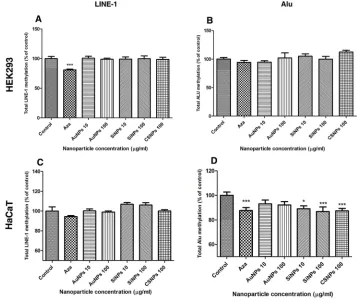
The DNA methylation levels of LINE-1 and Alu in HEK293 and HaCaT cells following exposure to the ENPs for 72 hrs are shown inFigure 10. HEK293 cells did not exhibit any change in the DNA methylation level of either TE following exposure to any of the ENPs (Figure 10AandB). In contrast, exposure of HaCaT cells to high and low doses of SiNPs and 100 µg/mL CSNPs significantly decreased the methylationControl
AuNPs 10 µg/mLAuNPs 100 µg/mL SiNPs 100 µg/mL
SiNPs 10 µg/mL
CSNPs 100 µ g/mL 0
20 40
Cells (%)
60 80
Control
AuNPs 10 µg/mL
AuNPs 100 µg/mL
SiNPs 100 µg/mL
SiNPs 10 µg/mL
CSNPs 100 µg/mL 0
20 40
Cells (%)
60 80
Hek 293 HaCaT
A
B
C
D
Figure 6Cell cycle analysis using propidium iodide (PI) staining andflow cytometry.
Notes:Flow histogram showed cell cycle distribution of PI-stained human embryonic kidney (HEK293) (A) and keratinocyte (HaCaT) (B) cells treated with different concentrations of engineered nanoparticles (ENPs). The quantitative measurement cell cycle distribution of ENPs treated HEK293 (C) and HaCaT (D) cells.
Figure 7Total ROS levels in the engineered nanoparticle-treated cells.
Notes:(A) Human embryonic kidney (HEK293) and (B) human keratinocyte (HaCaT) cells were treated with gold nanoparticles (AuNPs), silicon nanoparticles (SiNPs), and chitosan nanoparticles (CSNPs) for 72 hrs, and the percentage ROS generation relative to the untreated control group was determined after 3 and 6 hrs. Cells in the control groups were left untreated (Control) or treated with H2O2as a positive control. Values are mean ± SD. **P<0.01; ***P<0.001 versus the control group.
International Journal of Nanomedicine downloaded from https://www.dovepress.com/ by 118.70.13.36 on 22-Aug-2020
level of Alu but not LINE-1 (Figure 10C andD), whereas exposure to AuNPs had no effect on either TE.
Effect of antioxidant pretreatment on Alu
DNA methylation
To test the hypothesis that the observed changes in the DNA methylation levels of Alu in HaCaT cells resulted from ENP-induced ROS generation, HaCaT cells were incubated with the antioxidant NAC for 30 mins before being exposed to the
ENPs for 72 hrs. We found that the pretreated cells did not exhibit any decrease in the DNA methylation level of Alu following exposure to 10 and 100 µg/mL SiNPs and CSNPs (Figure 11). Exposure to AuNPs did not affect the DNA methylation level of Alu in NAC-pretreated or untreated cells.
Discussion
Nanomaterials are receiving increasing attention for use in many types of consumer products, increasing the likelihood of human exposure. Therefore, it is important that their toxicity is thoroughly understood. Several groups have recently investigated the effects of nanomaterials on epige-netic changes or“nanoepigenetics.”In this study, we gained new insights into the epigenotoxicity of ENPs, demonstrating that they alter global DNA methylation levels and DNA methylation levels of TEs via a mechanism that is indepen-dent of oxidative stress. Moreover, we proved that NAC can attenuate ENP-induced DNA hypomethylation.
The toxicity of ENPs to HEK293 and HaCaT cells was evaluated by examining both cell viability and cell morphol-ogy. However, there was inconsistency in some of the results. Both HEK293 and HaCaT cells that were treated with high doses of AuNPs exhibited a >50% decrease in viability, whereas HaCaT cells that were exposed to SiNPs, which were expected to be more toxic based on their effects on cell number and morphology, showed a higher percentage viability than the untreated control group. The PrestoBlue reagent that was used to evaluate cell viability in this study is resazurin-based and becomesfluorescent after accepting free electrons from a molecule that is involved in cellular respira-tion, such as nicotinamide adenine dinucleotide phosphate, and thus also initiates a cellular stress response.24The mor-phology results indicated that the majority of HEK293 cells were deformed following SiNP exposure, resulting in a loss of function and an inability to survive. In contrast, HaCaT cells may have a higher tolerance, with any surviving cells still generating free electrons that are taken up by the foreign agent.
It has been proposed that ENP-induced changes in DNA methylation levels in cells are caused by ROS.19,25 Here, we measured intracellular oxidative stress levels in cells at 3 and 6 hrs after being challenged by ENPs, with this time period being selected based on the findings of a previous report and the fact that ROS production typi-cally occurs fairly quickly to protect the cell from the foreign agent, after which ROS can be eliminated by intracellular antioxidant molecules.1,26 We found that
Figure 8Global DNA methylation levels in the engineered nanoparticle-exposed cells.
Notes:Human embryonic kidney (HEK293; left) and keratinocyte (HaCaT; right) cells were treated with gold nanoparticles (AuNPs), silicon nanoparticles (SiNPs), and chitosan nanoparticles (CSNPs) for 72 hrs and stained with 5-methylcytosine to measure the global DNA methylation levels. Cells in the control groups were left untreated (Control) or treated with the DNA demethylation agent 5-azacytidine to reflect the hypomethyla-tion condihypomethyla-tion. Methylated cells are brown, whereas unmethylated cells are blue.
Table 3Percentage of methylated cells from
immunocytochem-ical staining of 5-methylcytosine in HEK293 and HaCaT cell exposed to engineered nanoparticles for 72 hr
Nanoparticles 5-Methylcytosine methylated cells (%)
HEK293 HaCaT
Control 100.00 92.39
5-Azacytidine 57.00 62.50
SiNPs 10 µg/mL 100.00 75.10
AuNPs 100 µg/mL 100.00 92.67
CSNPs 100 µg/mL 100.00 81.42
Notes:Human embryonic kidney (HEK293) and keratinocyte (HaCaT) cells were treated with gold nanoparticles (AuNPs), silicon nanoparticles (SiNPs), and chitosan nanoparticles (CSNPs) for 72 hrs and then stained with 5-methylcytosine. Cells in the control groups were left untreated (Control) or treated with the DNA demethylation agent 5-azacytidine to reflect the hypomethylation condition.
International Journal of Nanomedicine downloaded from https://www.dovepress.com/ by 118.70.13.36 on 22-Aug-2020
ROS levels in HaCaT cells were increased at both 3 and 6 hrs after exposure to SiNPs, supporting the findings of a previous study. In addition, the ROS level in HEK293 cells was significantly higher following exposure to a high dose of SiNPs, which matches the findings of Fen Wang (2009) that exposure of HEK293 cells to 20- and 50-nm SiNPs induces the production of ROS in a dose-dependent
manner at 24 hrs.3In contrast, neither AuNPs nor CSNPs affected the ROS level in either cell line. CSNPs are one of the most commonly used vectors for drug or gene delivery and are considered safe to use in the skin and other organs. Based on the viability, morphology, and ROS content of CSNP-treated cells, these polymer nanoparticles did not exhibit any cytotoxicity at the selected doses and
Figure 9Quantification of effects of engineered nanoparticles on DNA methylation (5mdC).
Notes:The mean values of 5mdC percentage of total DNA in human embryonic kidney (HEK293) (A) and keratinocyte (HaCaT) (B) cells quantified by HPLC analysis. ****P<0.0001 vs control.
Figure 10Total methylation levels of LINE-1 and Alu in the engineered nanoparticle-exposed cells.
Notes:The percentage methylation of LINE-1 (AandC) and Alu (BandD) with respect to the control were measured in human embryonic kidney (HEK293) and keratinocyte (HaCaT) cells that had been treated with gold nanoparticles (AuNPs), silicon nanoparticles (SiNPs), and chitosan nanoparticles (CSNPs) for 72 hrs. Cells in the control groups were left untreated (Control) or treated with the DNA demethylation agent 5-azacytidine (Aza) to represent the hypomethylation condition. Values are mean ± SD. *P<0.05, ***P<0.001 versus the control group.
International Journal of Nanomedicine downloaded from https://www.dovepress.com/ by 118.70.13.36 on 22-Aug-2020
time periods in the present study. In contrast, there has been some controversy regarding the cytotoxicity of AuNPs, with the results depending on the exposure model used.27,28The toxicity of ENPs has also been sug-gested to depend on the physical and chemical properties of the ENPs, such as their size, charge, and stability.29,30 However, the AuNPs that were used in our study did not increase ROS levels in HEK293 or HaCaT cells following short-term exposure.
Epigenetic modifications have been reported to play critical roles in many cellular processes, and the effects of nanomaterials on epigenetic mechanisms continue to receive attention. SiNPs, in particular, have been found to induce global DNA methylation in HaCaT cells following short-term exposure and also affect the expression of the DNA methylation machinery.31Our study provided strong evidence that HaCaT cells become hypomethylated after 72 hrs of exposure to SiNPs, whereas HEK293 cells did not experience any change in global DNA methylation levels following exposure to any of the ENPs, indicating that this effect was cell-specific. Surprisingly, CSNPs also had the ability to induce genomic hypomethylation in HaCaT cells. CSNPs are generally thought to be biocompatible and bio-degradable nanoparticles that are well suited to medical applications.32However, Yu-Lan Hu reported on the toxi-city of CSNPs in zebrafish (Danio rerio) embryos, with 200-nm CSNPs increasing the rate of cell death as well as the expression of ROS and the heat shock protein 70 gene.33 Furthermore, Mi-Ryung Park confirmed that CSNPs can impair mitochondrial function in mouse preimplantation embryos and can downregulate genes that are involved in
the developmental process.34Here, we demonstrated for the
first time that CSNPs can induce global DNA hypomethyla-tion in keratinocyte cells.
The DNA methylation levels of repetitive DNA sequences are expected to represent global DNA methylation levels because they comprise a large number of CpG sequences and are abundant throughout the human genome.10LINE-1 and Alu are the two most abundant non-coding elements in the human genome and are associated with the cell stress response, genome stability, and numerous diseases.35,36Therefore, the highlight of this study was the investigation into the effect of ENP exposure on the DNA methylation levels of LINE-1 and Alu elements. We found that SiNP and CSNP exposure induces hypomethylation of Alu in HaCaT cells but not in HEK293 cells, which is in accordance with the global DNA methylation results. In contrast, the DNA methylation level of LINE-1 was not affected by exposure to any of the ENPs, indicating that the effect of the ENPs on the DNA methylation level of retro-transposable elements is DNA sequence-specific. This is likely due to LINE-1 and Alu being regulated by different mechanisms and exhibiting different transcription patterns in response to cellular stressors.37,38Similarly, previous studies on pollution exposure in humans found a relationship between exposure to persistent organic pollutants and hypo-methylation of Alu but not LINE-1, and the abundance of Alu element has been shown to be strongly correlated with cellular stress responses.39–41
In addition to inducing intracellular ROS production, ENPs have been shown to interfere with the oxidative stress balance by depleting the antioxidant capacity of 60
80
T
otal Alu
methylation
(% of control)
100 120 140
Figure 11DNA methylation level of Alu in the engineered nanoparticle-exposed cells pretreated with N-acetylcysteine (NAC).
Notes: Human keratinocyte (HaCaT) cells were pretreated with the antioxidant NAC for 30 mins before being exposed to gold nanoparticles (AuNPs), silicon nanoparticles (SiNPs), and chitosan nanoparticles (CSNPs) for 72 hrs. Cells in the control groups were left untreated (Control) or treated with the DNA demethylation agent 5-azacytidine (Aza) to represent the hypomethylation condition. Comparisons were made between the total Alu DNA methylation levels in the NAC-pretreated cells (+) and un-pretreated cells (−) using unpaired t-tests and between the NAC-pretreated cells, Aza, and control using analysis of variance. Values are mean ± SD. **P<0.01, ***P<0.001.
Abbreviation:NS, not significant.
International Journal of Nanomedicine downloaded from https://www.dovepress.com/ by 118.70.13.36 on 22-Aug-2020
cells.4Glutathione (GSH) plays a critical role in the cel-lular defense mechanism against oxidative stress and has been shown to become unbalanced in cells that have been exposed to ENPs.3 However, the protective effects of antioxidants on DNA methylation in ENP-exposed cells have not previously been investigated. Although we did not directly measure the concentration of GSH in the present study, we did find that the pretreatment of HaCaT cells with NAC, which is a precursor of GSH, before they were challenged with ENPs prevented DNA hypomethylation of the Alu elements. ENPs may induce the production of intracellular ROS and deplete GSH levels. Interestingly, it should also be noted that the pro-duction of GSH directly influences DNA methylation levels by altering pools of the methyl donor S-adenosyl methionine (SAM). Under normal conditions, homocys-teine is converted into methionine via the methionine cycle and used in the synthesis of SAM. However, when cells require a greater production of antioxidants such as GSH for defense against cellular oxidative stress, homocysteine is pushed into the GSH synthesis pathway, decreasing the level of SAM. In addition, the genome-wide methylome also affects the global DNA hypomethylation level.42 These findings suggest that ENPs induce changes in DNA methylation levels indirectly by disturbing the cel-lular oxidative defense process and that NAC represents a candidate protective drug where there is a high risk of ENP exposure.
The level of DNA methylation can change dynamically in response to the environment and specific stressors.43Lu et al showed that industry-related nanoparticles, including printer-emitted ENPs, mild steel-welding fumes, copper oxide, and titanium dioxide, affect the epigenome in lung cells.9 Furthermore, like us, they found that DNA methylation levels of LINE-1 and Alu/SINE elements (Alu in humans and SINE in mice) can change in both directions (ie, hypo- or hyper-methylation) depending on the ENP and cell type.9This indi-cates that the effects of ENPs on epigenetic mechanisms rely on many factors, including ENP properties, such as their charge, size, shape, and chemical composition, and cell type. It is believed that various properties of cells, such as receptor expression, metabolic activities, xenobiotic clearance systems, and oxidative stress defense mechanisms, influence the toxicity responses of cells.44
Conclusion
The increasing evidences that exposure to various types of ENPs causes epigenetic alterations are an important
nanoepigenetic issue. Our findings indicate that changes in the DNA methylation levels of TEs could be used as a biomarker for evaluating ENP exposure, with the methy-lation of Alu in particular being responsive to nanoparti-cle-induced cellular toxicity. However, the toxicity of ENPs on the DNA methylation mechanism and the char-acteristics of ENPs that affect the level of DNA methyla-tion alteramethyla-tion require further investigamethyla-tion for specific types of cells and ENPs.
Acknowledgments
The authors would like to thank Chitin Research Center, Chulalongkorn University, Thailand for their kind coop-eration in chitosan nanoparticles preparation and Mr. Preecha Rengvejvorachai from Department of Pathology, Faculty of Medicine, Chulalongkorn University, Thailand, for his useful critiques and valuable technical support on this study. This work was supported by the 90th Anniversary of Chulalongkorn University Fund (Ratchadaphiseksomphot Endowment Fund, Chulalongkorn University). This study also supported by National Research Council of Thailand (NRCT). SN was supported by the 90th Anniversary of Chulalongkorn University Fund (Ratchadaphiseksomphot Endowment Fund, Chulalongkorn University) and National Research Council of Thailand (NRCT).
Author contributions
All authors contributed to data analysis, drafting or revis-ing the article, gave final approval of the version to be published, and agree to be accountable for all aspects of the work.
Disclosure
KS was supported by the Ratchadapiseksomphot Endowment Fund (postdoctoral fellowship), Chulalongkorn University. AS was supported by the Ratchadaphiseksomphot Endowment Fund of Chulalongkorn University (RES560530230-AM). The authors report no other conflicts of interest in this work.
References
1. Nabeshi H, Yoshikawa T, Matsuyama K, et al. Amorphous nanosilica induce endocytosis-dependent ROS generation and DNA damage in human keratinocytes.Part Fibre Toxicol.2011;8:1. doi:10.1186/1743-8977-8-1
2. AshaRani PV, Low Kah Mun G, Hande MP, Valiyaveettil S. Cytotoxicity and genotoxicity of silver nanoparticles in human cells.
ACS Nano.2009;3(2):279–290. doi:10.1021/nn800596w
International Journal of Nanomedicine downloaded from https://www.dovepress.com/ by 118.70.13.36 on 22-Aug-2020
3. Wang F, Gao F, Lan M, Yuan H, Huang Y, Liu J. Oxidative stress contributes to silica nanoparticle-induced cytotoxicity in human embryonic kidney cells. Toxicol In Vitro. 2009;23(5):808–815. doi:10.1016/j.tiv.2009.04.009
4. Yang H, Liu C, Yang D, Zhang H, Xi Z. Comparative study of cytotoxicity, oxidative stress and genotoxicity induced by four typical nanomaterials: the role of particle size, shape and composition.
J Appl Toxicol.2009;29(1):69–78. doi:10.1002/jat.1385
5. Kim Y-J, Yu M, Park H-O, Yang S. Comparative study of cytotoxi-city, oxidative stress and genotoxicity induced by silica nanomaterials in human neuronal cell line.Mol Cell Toxicol.2010;6(4):336–343. doi:10.1007/s13273-010-0045-y
6. Sohaebuddin SK, Thevenot PT, Baker D, Eaton JW, Tang L. Nanomaterial cytotoxicity is composition, size, and cell type dependent.Part Fibre Toxicol.2010;7:22. doi:10.1186/1743-8977-7-22 7. Stoccoro A, Karlsson HL, Coppede F, Migliore L. Epigenetic effects of nano-sized materials. Toxicology. 2013;313(1):3–14. doi:10.1016/j. tox.2012.12.002
8. Hou L, Zhang X, Wang D, Baccarelli A. Environmental chemical expo-sures and human epigenetics. Int J Epidemiol. 2012;41(1):79–105. doi:10.1093/ije/dyr154
9. Lu X, Miousse IR, Pirela SV, Melnyk S, Koturbash I, Demokritou P. Short-term exposure to engineered nanomaterials affects cellular epigenome. Nanotoxicology. 2016;10(2):140–150. doi:10.3109/ 17435390.2015.1025115
10. Nelson HH, Marsit CJ, Kelsey KT. Global methylation in exposure biology and translational medical science.Environ Health Perspect.
2011;119(11):1528–1533. doi:10.1289/ehp.1103423
11. Kitkumthorn N, Mutirangura A. Long interspersed nuclear element-1 hypomethylation in cancer: biology and clinical applications.Clin Epigenet.2011;2(2):315–330. doi:10.1007/s13148-011-0032-8 12. Tarantini L, Bonzini M, Apostoli P, et al. Effects of particulate matter
on genomic DNA methylation content and iNOS promoter methylation. Environ Health Perspect. 2009;117(2):217–222. doi:10.1289/ehp.11898
13. Madrigano J, Baccarelli A, Mittleman MA, et al. Prolonged exposure to particulate pollution, genes associated with glutathione pathways, and DNA methylation in a cohort of older men. Environ Health Perspect.2011;119(7):977–982. doi:10.1289/ehp.1002773
14. Baccarelli A, Wright RO, Bollati V, et al. Rapid DNA methylation changes after exposure to traffic particles. Am J Respir Crit Care Med.2009;179(7):572–578. doi:10.1164/rccm.200807-1097OC 15. Li JJ, Hartono D, Ong CN, Bay BH, Yung LY. Autophagy and
oxidative stress associated with gold nanoparticles. Biomaterials.
2010;31(23):5996–6003. doi:10.1016/j.biomaterials.2010.04.014 16. Sarkar A, Das J, Manna P, Sil PC. Nano-copper induces oxidative
stress and apoptosis in kidney via both extrinsic and intrinsic pathways. Toxicology. 2011;290(2–3):208–217. doi:10.1016/j. tox.2011.09.086
17. Jaeger A, Weiss DG, Jonas L, Kriehuber R. Oxidative stress-induced cytotoxic and genotoxic effects of nano-sized titanium dioxide parti-cles in human HaCaT keratinocytes.Toxicology.2012;296(1–3):27– 36. doi:10.1016/j.tox.2012.02.016
18. Ziech D, Franco R, Pappa A, Panayiotidis MI. Reactive oxygen species (ROS)-induced genetic and epigenetic alterations in human carcinogenesis.Mutat Res–Fundam Mol Mech Mutagen.2011;711 (1–2):167–173. doi:10.1016/j.mrfmmm.2011.02.015
19. Ma Y, Guo Y, Wu S, Lv Z, Zhang Q, Ke Y. Titanium dioxide nanoparticles induce size-dependent cytotoxicity and genomic DNA hypomethylation in human respiratory cells. RSC Adv. 2017;7 (38):23560–23572. doi:10.1039/C6RA28272E
20. Jintaridth P, Mutirangura A. Distinctive patterns of age-dependent hypomethylation in interspersed repetitive sequences. Physiol Genomics. 2010;41(2):194–200. doi:10.1152/physiolgenomics. 00146.2009
21. Asada K, Kotake Y, Asada R, et al. LINE-1 hypomethylation in a choline-deficiency-induced liver cancer in rats: dependence on feeding period. J Biomed Biotechnol. 2006;2006(1):17142. doi:10.1155/JBB/ 2006/17142
22. Kitkumthorn N, Tuangsintanakul T, Rattanatanyong P, Tiwawech D, Mutirangura A. LINE-1 methylation in the peripheral blood mono-nuclear cells of cancer patients. Clin Chim Acta. 2012;413(9– 10):869–874. doi:10.1016/j.cca.2012.01.024
23. Patchsung M, Boonla C, Amnattrakul P, Dissayabutra T, Mutirangura A, Tosukhowong P. Long interspersed nuclear element-1 hypomethylation and oxidative stress: correlation and bladder cancer diagnostic potential.
PLoS One.2012;7(5):e37009. doi:10.1371/journal.pone.0037009 24. Erikstein BS, Hagland HR, Nikolaisen J, et al. Cellular stress induced
by resazurin leads to autophagy and cell death via production of reactive oxygen species and mitochondrial impairment. J Cell Biochem.2010;111(3):574–584. doi:10.1002/jcb.22741
25. Choudhury SR, Ordaz J, Lo CL, Damayanti NP, Zhou F, Irudayaraj J. From the cover: zinc oxide nanoparticles-induced reactive oxygen species promotes multimodal cyto- and epigenetic toxicity.Toxicol Sci.2017;156(1):261–274. doi:10.1093/toxsci/kfw252
26. Gao F, Ma N, Zhou H, et al. Zinc oxide nanoparticles-induced epige-netic change and G2/M arrest are associated with apoptosis in human epidermal keratinocytes. Int J Nanomed. 2016;11:3859–3874. doi:10.2147/IJN.S107021
27. Tabish AM, Poels K, Byun HM, et al. Changes in DNA methylation in mouse lungs after a single intra-tracheal administration of nanomaterials.
PLoS One.2017;12(1):e0169886. doi:10.1371/journal.pone.0169886 28. Li JJ, Zou L, Hartono D, Ong C-N, Bay B-H, Lanry Yung L-Y. Gold
nanoparticles induce oxidative damage in lung fibroblasts in vitro.
Adv Mater.2008;20(1):138–142. doi:10.1002/(ISSN)1521-4095 29. Lu X, Miousse IR, Pirela SV, et al. In vivo epigenetic effects induced
by engineered nanomaterials: A case study of copper oxide and laser printer-emitted engineered nanoparticles. Nanotoxicology. 2016;10 (5):629–639. doi:10.3109/17435390.2015.1108473
30. Shyamasundar S, Ng CT, Yung LY, Dheen ST, Bay BH. Epigenetic mechanisms in nanomaterial-induced toxicity.Epigenomics.2015;7 (3):395–411. doi:10.2217/epi.15.3
31. Gong C, Tao G, Yang L, Liu J, Liu Q, Zhuang Z. SiO(2) nanoparticles induce global genomic hypomethylation in HaCaT cells.Biochem Biophys Res Commun.2010;397(3):397–400. doi:10.1016/j.bbrc.2010.05.076 32. Mohammed MA, Syeda JTM, Wasan KM, Wasan EK. An overview of
chitosan nanoparticles and its application in non-parenteral drug delivery.Pharmaceutics.2017;9:4. doi:10.3390/pharmaceutics9040053 33. Hu YL, Qi W, Han F, Shao JZ, Gao JQ. Toxicity evaluation of biodegradable chitosan nanoparticles using a zebrafish embryo model.Int J Nanomed.2011;6:3351–3359. doi:10.2147/IJN.S25853 34. Park MR, Gurunathan S, Choi YJ, et al. Chitosan nanoparticles cause
pre- and postimplantation embryo complications in mice. Biol Reprod.2013;88(4):88. doi:10.1095/biolreprod.112.105882 35. Carnell AN, Goodman JI. The long (LINEs) and the short (SINEs) of
it: altered methylation as a precursor to toxicity.Toxicol Sci.2003;75 (2):229–235. doi:10.1093/toxsci/kfg138
36. Schulz WA, Steinhoff C, Florl AR. Methylation of endogenous human retroelements in health and disease. Curr Top Microbiol Immunol.2006;310:211–250.
37. Gonzalgo ML, Jones PA. Rapid quantitation of methylation differences at specific sites using methylation-sensitive single nucleotide primer exten-sion (Ms-SNuPE).Nucleic Acids Res.1997;25(12):2529–2531. 38. Li TH, Schmid CW. Differential stress induction of individual Alu
loci: implications for transcription and retrotransposition. Gene.
2001;276(1–2):135–141.
39. Kim KY, Kim DS, Lee SK, et al. Association of low-dose exposure to persistent organic pollutants with global DNA hypomethylation in healthy Koreans. Environ Health Perspect. 2010;118(3):370–374. doi:10.1289/ehp.0901131
International Journal of Nanomedicine downloaded from https://www.dovepress.com/ by 118.70.13.36 on 22-Aug-2020
40. Rusiecki JA, Baccarelli A, Bollati V, Tarantini L, Moore LE, Bonefeld-Jorgensen EC. Global DNA hypomethylation is associated with high serum-persistent organic pollutants in Greenlandic Inuit.Environ Health Perspect.2008;116(11):1547–1552. doi:10.1289/ehp.11338
41. Schmid CW. Does SINE evolution preclude Alu function?Nucleic Acids Res.1998;26(20):4541–4550.
42. Hitchler MJ, Domann FE. An epigenetic perspective on the free radical theory of development. Free Radic Biol Med. 2007;43 (7):1023–1036. doi:10.1016/j.freeradbiomed.2007.06.027
43. Sierra MI, Valdes A, Fernandez AF, Torrecillas R, Fraga MF. The effect of exposure to nanoparticles and nanomaterials on the mam-malian epigenome.Int J Nanomed.2016;11:6297–6306. doi:10.2147/ IJN.S120104
44. Magdolenova Z, Collins A, Kumar A, Dhawan A, Stone V, Dusinska M. Mechanisms of genotoxicity. A review of in vitro and in vivo studies with engineered nanoparticles. Nanotoxicology.
2014;8(3):233–278. doi:10.3109/17435390.2013.773464
International Journal of Nanomedicine
Dove
press
Publish your work in this journal
The International Journal of Nanomedicine is an international, peer-reviewed journal focusing on the application of nanotechnology in diagnostics, therapeutics, and drug delivery systems throughout the biomedical field. This journal is indexed on PubMed Central, MedLine, CAS, SciSearch®, Current Contents®/Clinical Medicine,
Journal Citation Reports/Science Edition, EMBase, Scopus and the Elsevier Bibliographic databases. The manuscript management system is completely online and includes a very quick and fair peer-review system, which is all easy to use. Visit http://www.dovepress.com/ testimonials.php to read real quotes from published authors.
Submit your manuscript here:https://www.dovepress.com/international-journal-of-nanomedicine-journal
International Journal of Nanomedicine downloaded from https://www.dovepress.com/ by 118.70.13.36 on 22-Aug-2020




![The labour market [March 1996]](data:image/gif;base64,R0lGODlhAQABAIAAAP///wAAACH5BAEAAAAALAAAAAABAAEAAAICRAEAOw==)